


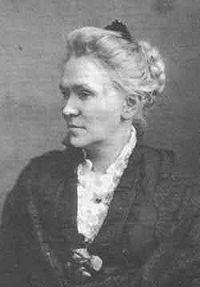
Matilda Joslyn Gage

Encyclopedia
Cicero, New York
Cicero is a town in Onondaga County, New York, USA. The population was 27,982 at the 2000 census. The name of the town was assigned by a clerk interested in the classics, honoring Cicero, a Roman statesman....
, March 24, 1826 – March 18, 1898 in Chicago
Chicago
Chicago is the largest city in the US state of Illinois. With nearly 2.7 million residents, it is the most populous city in the Midwestern United States and the third most populous in the US, after New York City and Los Angeles...
) was a suffragist
Women's suffrage
Women's suffrage or woman suffrage is the right of women to vote and to run for office. The expression is also used for the economic and political reform movement aimed at extending these rights to women and without any restrictions or qualifications such as property ownership, payment of tax, or...
, a Native American
Native Americans in the United States
Native Americans in the United States are the indigenous peoples in North America within the boundaries of the present-day continental United States, parts of Alaska, and the island state of Hawaii. They are composed of numerous, distinct tribes, states, and ethnic groups, many of which survive as...
activist, an abolitionist
Abolitionism
Abolitionism is a movement to end slavery.In western Europe and the Americas abolitionism was a movement to end the slave trade and set slaves free. At the behest of Dominican priest Bartolomé de las Casas who was shocked at the treatment of natives in the New World, Spain enacted the first...
, a freethinker
Freethought
Freethought is a philosophical viewpoint that holds that opinions should be formed on the basis of science, logic, and reason, and should not be influenced by authority, tradition, or other dogmas...
, and a prolific author, who was "born with a hatred of oppression".
Early activities
Matilda Gage spent her childhood in a house which was a station of the underground railroadUnderground Railroad
The Underground Railroad was an informal network of secret routes and safe houses used by 19th-century black slaves in the United States to escape to free states and Canada with the aid of abolitionists and allies who were sympathetic to their cause. The term is also applied to the abolitionists,...
. She faced prison for her actions under the Fugitive Slave Law of 1850
Fugitive Slave Law of 1850
The Fugitive Slave Law or Fugitive Slave Act was passed by the United States Congress on September 18, 1850, as part of the Compromise of 1850 between Southern slave holding interests and Northern Free-Soilers. This was one of the most controversial acts of the 1850 compromise and heightened...
which criminalized assistance to escaped slaves
Slavery
Slavery is a system under which people are treated as property to be bought and sold, and are forced to work. Slaves can be held against their will from the time of their capture, purchase or birth, and deprived of the right to leave, to refuse to work, or to demand compensation...
. Even though she was beset by both financial and physical (cardiac) problems throughout her life, her work for women's rights was extensive, practical, and often brilliantly executed.
Gage became involved in the women's rights movement in 1852 when she decided to speak at the National Women's Rights Convention
National Women's Rights Convention
The National Women's Rights Convention was an annual series of meetings that increased the visibility of the early women's rights movement in the United States. First held in 1850 in Worcester, Massachusetts, the National Women's Rights Convention combined both male and female leadership, and...
in Syracuse, New York
Syracuse, New York
Syracuse is a city in and the county seat of Onondaga County, New York, United States, the largest U.S. city with the name "Syracuse", and the fifth most populous city in the state. At the 2010 census, the city population was 145,170, and its metropolitan area had a population of 742,603...
. She served as president of the National Woman Suffrage Association from 1875 to 1876, and served as either Chair of the Executive Committee or Vice President for over twenty years. During the 1876 convention, she successfully argued against a group of police who claimed the association was holding an illegal assembly. They left without pressing charges.
Gage was considered to be more radical than either Susan B. Anthony
Susan B. Anthony
Susan Brownell Anthony was a prominent American civil rights leader who played a pivotal role in the 19th century women's rights movement to introduce women's suffrage into the United States. She was co-founder of the first Women's Temperance Movement with Elizabeth Cady Stanton as President...
or Elizabeth Cady Stanton
Elizabeth Cady Stanton
Elizabeth Cady Stanton was an American social activist, abolitionist, and leading figure of the early woman's movement...
(with whom she wrote History of Woman Suffrage
History of Woman Suffrage
History of Woman Suffrage was produced by Elizabeth Cady Stanton, Susan B. Anthony, Matilda Joslyn Gage and Ida Husted Harper in six volumes from 1881 to 1922...
). Along with Stanton, she was a vocal critic of the Christian Church
Christian Church
The Christian Church is the assembly or association of followers of Jesus Christ. The Greek term ἐκκλησία that in its appearances in the New Testament is usually translated as "church" basically means "assembly"...
, which put her at odds with conservative suffragists such as Frances Willard
Frances Willard (suffragist)
Frances Elizabeth Caroline Willard was an American educator, temperance reformer, and women's suffragist. Her influence was instrumental in the passage of the Eighteenth and Nineteenth Amendments to the United States Constitution...
and the Woman's Christian Temperance Union
Woman's Christian Temperance Union
The Woman's Christian Temperance Union was the first mass organization among women devoted to social reform with a program that "linked the religious and the secular through concerted and far-reaching reform strategies based on applied Christianity." Originally organized on December 23, 1873, in...
. Rather than arguing that women deserved the vote because their feminine morality would then properly influence legislation (as the WCTU did), she argued that they deserved suffrage as a 'natural right'.
Despite her opposition to the Church, Gage was in her own way deeply religious, and she joined Stanton's Revising Committee to write The Woman's Bible
The Woman's Bible
The Woman's Bible is a two-part book, written by Elizabeth Cady Stanton and a committee of 26 women, and published in 1895 and 1898 to challenge the traditional position of religious orthodoxy that woman should be subservient to man. By producing the book, Stanton wished to promote a radical...
. She became a Theosophist and encouraged her children and their spouses to do so, some of whom did.
Editor of The National Citizen
Gage was well-educated and a prolific writer—the most gifted and educated woman of her age, claimed her devoted son-in-law, L. Frank BaumL. Frank Baum
Lyman Frank Baum was an American author of children's books, best known for writing The Wonderful Wizard of Oz...
. She corresponded with numerous newspapers, reporting on developments in the woman suffrage
Women's suffrage
Women's suffrage or woman suffrage is the right of women to vote and to run for office. The expression is also used for the economic and political reform movement aimed at extending these rights to women and without any restrictions or qualifications such as property ownership, payment of tax, or...
movement. In 1878 she bought the Ballot Box, a monthly journal of a Toledo, Ohio
Toledo, Ohio
Toledo is the fourth most populous city in the U.S. state of Ohio and is the county seat of Lucas County. Toledo is in northwest Ohio, on the western end of Lake Erie, and borders the State of Michigan...
suffrage association, when its editor, Sarah R.L. Williams, decided to retire. Gage turned it into The National Citizen and Ballot Box, explaining her intentions for the paper thus:
Gage became its primary editor for the next three years (until 1881), producing and publishing essays on a wide range of issues. Each edition bore the words 'The Pen Is Mightier Than The Sword
The pen is mightier than the sword
"The pen is mightier than the sword" is a metonymic adage coined by English author Edward Bulwer-Lytton in 1839 for his play Richelieu; Or the Conspiracy. The play was about Cardinal Richelieu, though in the author's words "license with dates and details.....
', and included regular columns about prominent women in history and female inventors. Gage wrote clearly, logically, and often with a dry wit and a well-honed sense of irony. Writing about laws which allowed a man to will his children to a guardian unrelated to their mother, Gage observed:
Political activities
As a result of the campaigning of the New York State Woman Suffrage Association under Gage, the state of New York granted female suffrage for electing members of the school boards. Gage ensured that every woman in her area (Fayetteville, New YorkFayetteville, New York
Fayetteville is a village located in Onondaga County, New York, United States. As of the 2000 U.S. Census, the village had a population of 4,190. The village is named after Lafayette, a national hero of both France and the United States...
) had the opportunity to vote by writing letters making them aware of their rights, and sitting at the polls making sure nobody was turned away.
In 1871, Gage was part of a group of 10 women who attempted to vote. Reportedly, she stood by and argued with the polling officials on behalf of each individual woman. She supported Victoria Woodhull
Victoria Woodhull
Victoria Claflin Woodhull was an American leader of the woman's suffrage movement, an advocate of free love; together with her sister, the first women to operate a brokerage in Wall Street; the first women to start a weekly newspaper; an activist for women's rights and labor reforms and, in 1872,...
and (later) Ulysses S Grant in the 1872 presidential election. In 1873 she defended Susan B. Anthony when Anthony was placed on trial for having voted in that election, making compelling legal and moral arguments.
In 1884, Gage was an Elector-at-Large for Belva Lockwood and the Equal Rights Party
Equal Rights Party (United States)
The Equal Rights Party was the name for several different nineteenth century political parties in the United States.The first party was the Locofocos, during the 1830s and 1840s....
.
Founder of the Women's National Liberal Union
Gage unsuccessfully tried to prevent the conservative takeover of the women's suffrage movement. Susan B. Anthony who had helped to found the National Woman Suffrage Association (NWSA), was primarily concerned with gaining the vote, an outlook which Gage found too narrow. Conservative suffragists were drawn into the organisation, and these women tended not to support general social reform, or attacks on the church.
The American Woman Suffrage Association (AWSA)
American Woman Suffrage Association (AWSA)
The American Woman Suffrage Association was formed in November 1869 in response to a split in the American Equal Rights Association over the Fifteenth Amendment to the United States Constitution. Its founders, who supported the Fifteenth Amendment, included Lucy Stone, and Henry Blackwell...
, part of the conservative wing of the suffrage movement (and formerly at odds with the National), was open to the prospect of merging with the NWSA under Anthony, while Anthony was working toward unifying the suffrage movement under the single goal of gaining the vote. The merger of the two organizations, pushed through by Lucy Stone
Lucy Stone
Lucy Stone was a prominent American abolitionist and suffragist, and a vocal advocate and organizer promoting rights for women. In 1847, Stone was the first woman from Massachusetts to earn a college degree. She spoke out for women's rights and against slavery at a time when women were discouraged...
, Alice Stone Blackwell
Alice Stone Blackwell
Alice Stone Blackwell was an American feminist, journalist and human rights advocate.-Biography:The daughter of Henry Brown Blackwell and Lucy Stone, she was born in East Orange, New Jersey....
and Anthony, produced the National American Woman Suffrage Association
National American Woman Suffrage Association
The National American Woman Suffrage Association was an American women's rights organization formed in May 1890 as a unification of the National Woman Suffrage Association and the American Woman Suffrage Association...
(NAWSA) in 1890. While Stanton and Gage maintained their radical positions, they found that the only women's issue really unifying the NAWSA was the move for suffrage.
This prompted Gage to establish the Women's National Liberal Union (WNLU) in 1890, of which she was president until her death (by stroke) in 1898. Attracting more radical members than NAWSA, the WNLU was the perfect mouthpiece for her attacks on religion. She became the editor of the official journal of the WNLU, The Liberal Thinker.
Gage was an avid opponent of the various Christian churches, and she strongly supported the separation of church and state
Separation of church and state
The concept of the separation of church and state refers to the distance in the relationship between organized religion and the nation state....
, believing "that the greatest injury to the world has arisen from theological laws – from a union of Church and State". She wrote in October 1881:
In 1893, she published Woman, Church and State, a book which outlined the variety of ways in which Christianity had oppressed women and reinforced patriarchal
Patriarchy
Patriarchy is a social system in which the role of the male as the primary authority figure is central to social organization, and where fathers hold authority over women, children, and property. It implies the institutions of male rule and privilege, and entails female subordination...
systems. It was wide-ranging and built extensively upon arguments and ideas she had previously put forth in speeches (and in a chapter of History of Woman Suffrage which bore the same name).
Views on social issues
Like many other suffragists, Gage considered abortionAbortion
Abortion is defined as the termination of pregnancy by the removal or expulsion from the uterus of a fetus or embryo prior to viability. An abortion can occur spontaneously, in which case it is usually called a miscarriage, or it can be purposely induced...
a regrettable tragedy, although her views on the subject were more complex than simple opposition. In 1868, she wrote a letter to The Revolution (a women's rights paper edited by Elizabeth Cady Stanton and Parker Pillsbury
Parker Pillsbury
Parker Pillsbury was an American minister and advocate for abolition and women's rights.Pillsbury was born in Hamilton, Massachusetts...
), supporting the typical women's rights view of the time that abortion was an institution supported, dominated and furthered by men. Gage opposed abortion on principle, blaming it on the 'selfish desire' of husbands to maintain their wealth by reducing their offspring:
Gage was quite concerned with the rights of a woman over her own life and body. In 1881 she wrote, on the subject of divorce
Divorce
Divorce is the final termination of a marital union, canceling the legal duties and responsibilities of marriage and dissolving the bonds of matrimony between the parties...
:
Other feminists of the period referred to "voluntary motherhood," achieved through consensual nonprocreative sexual practices, periodic or permanent sexual abstinence, or (most importantly) the right of a woman (especially a wife) to refuse sex.
Works about Native Americans in the United States
Native Americans in the United States
Native Americans in the United States are the indigenous peoples in North America within the boundaries of the present-day continental United States, parts of Alaska, and the island state of Hawaii. They are composed of numerous, distinct tribes, states, and ethnic groups, many of which survive as...
by Lewis Henry Morgan and Henry Rowe Schoolcraft also influenced Gage. She decried the brutal treatment of Native Americans in her writings and public speeches. She was angered that the Federal government of the United States
Federal government of the United States
The federal government of the United States is the national government of the constitutional republic of fifty states that is the United States of America. The federal government comprises three distinct branches of government: a legislative, an executive and a judiciary. These branches and...
attempted to confer citizenship (including suffrage
Suffrage
Suffrage, political franchise, or simply the franchise, distinct from mere voting rights, is the civil right to vote gained through the democratic process...
) upon Native Americans (who, Gage argued, opposed taxation, and generally did not seek citizenship) while still withholding the vote from women. She wrote in 1878:
In her 1893 work Woman, Church and State she cited the Iroquois
Iroquois
The Iroquois , also known as the Haudenosaunee or the "People of the Longhouse", are an association of several tribes of indigenous people of North America...
society, among others, as a 'Matriarchate' in which women had true power, noting that a system of descent through the female line and female property rights led to a more equal relationship between men and women. Gage spent time among the Iroquois and received the name Karonienhawi - "she who holds the sky" - upon her initiation into the Wolf Clan. She was admitted into the Iroquois Council of Matrons.
Family
A daughter of the early abolitionist Hezekiah Joslyn, Gage was the wife of Henry Hill Gage, with whom she had five children: Charles Henry (who died in infancy), Helen Leslie, Thomas Clarkson, Julia Louise, and MaudMaud Gage Baum
Maud Gage Baum was the wife of L. Frank Baum. Her mother was the suffragist Matilda Joslyn Gage. In her early life, she attended a boys' high school and was raised to be headstrong....
. Gage maintained residence in Fayetteville, New York for the majority of her life. Though Gage was cremated, there is a memorial stone at Fayetteville Cemetery that bears her slogan "There is a word sweeter than Mother, Home or Heaven. That word is Liberty."
Maud, who was ten years younger than Julia, initially horrified her mother when she chose to marry The Wonderful Wizard of Oz
The Wonderful Wizard of Oz
The Wonderful Wizard of Oz is a children's novel written by L. Frank Baum and illustrated by W. W. Denslow. Originally published by the George M. Hill Company in Chicago on May 17, 1900, it has since been reprinted numerous times, most often under the name The Wizard of Oz, which is the name of...
author L. Frank Baum
L. Frank Baum
Lyman Frank Baum was an American author of children's books, best known for writing The Wonderful Wizard of Oz...
at a time when he was a struggling actor
Actor
An actor is a person who acts in a dramatic production and who works in film, television, theatre, or radio in that capacity...
with only a handful of plays (of which only The Maid of Arran
The Maid of Arran
The Maid of Arran, An Idyllic Irish Drama Written for the People, Irrespective of Caste or Nationality is an 1882 musical play by L. Frank Baum, writing and performing under the pseudonym, "Louis F. Baum", based on the novel A Princess of Thule by William Black...
survives) to his writing credit. However, a few minutes after the initial announcement, Gage started laughing, apparently realizing that her emphasis on all individuals making up their own minds was not lost on her headstrong daughter, who gave up a chance at a law career when the opportunity for women was rare. Gage spent six months of every year with Maud and Frank, and died in the Baum home in Chicago, Illinois in 1898.
Gage's son Thomas Clarkson Gage and his wife Sophia had a daughter named Dorothy Louise Gage, who was born in Bloomington, IL, on June 11, 1898 and died just five months later on November 11, 1898. The death so upset the child's aunt Maud, who had always longed for a daughter, that she required medical attention. Thomas Clarkson Gage's child was the namesake of her uncle Frank Baum's famed fictional character, Dorothy Gale
Dorothy Gale
Dorothy Gale is the protagonist of many of the Oz novels by American author L. Frank Baum, and the best friend of Oz's ruler Princess Ozma. Dorothy first appears in Baum's classic children's novel The Wonderful Wizard of Oz and reappears in most of its sequels...
. In 1996, Dr. Sally Roesch Wagner, a biographer of Matilda Joslyn Gage, located young Dorothy's grave in Bloomington. A memorial was erected in the child's memory at her gravesite on May 21, 1997. This child is often mistaken for her cousin of the same name, Dorothy Louise Gage (1883–1889), Helen Leslie (Gage) Gage's child. As theosophists, both the Baums and the Gages believed in reincarnation
Reincarnation
Reincarnation best describes the concept where the soul or spirit, after the death of the body, is believed to return to live in a new human body, or, in some traditions, either as a human being, animal or plant...
, and thought this child might have been Matilda Joslyn Gage, whose personal spark is apparently written into the character.
In The Dreamer of Oz: The L. Frank Baum Story
The Dreamer of Oz: The L. Frank Baum Story
The Dreamer of Oz: The L. Frank Baum Story is a 1990 film that stars John Ritter as Lyman Frank Baum, the man who wrote The Wonderful Wizard of Oz and thirteen of the other Oz books. Also starring in this TV movie was Annette O'Toole as Baum's supportive wife Maud, and Rue McClanahan who played...
, Gage was played by Rue McClanahan
Rue McClanahan
Rue McClanahan was an American actress, best known for her roles on television as Vivian Harmon on Maude, Fran Crowley on Mama's Family, and Blanche Devereaux on The Golden Girls, for which she won an Emmy Award for Outstanding Lead Actress in 1987.-Early life:McClanahan was born Eddie Rue...
, whose relationship with Frank was wrongly portrayed as antagonistic, and falsely presented Gage as the inspiration for the Wicked Witch of the West
Wicked Witch of the West
The Wicked Witch of the West is a fictional character and the most significant antagonist in L. Frank Baum's children's book The Wonderful Wizard of Oz...
. Annette O'Toole
Annette O'Toole
Annette O'Toole is an American actress, dancer, and singer-songwriter. She is most recently known for portraying Martha Kent, the mother of Clark Kent on the television series Smallville.-Early life and career:...
played Maud, and Nancy Morgan
Nancy Morgan
Nancy Karen Morgan is an American actress of film and television.Morgan is the daughter of Marjorie and Samuel A...
and Pat Skipper
Pat Skipper
William Patterson "Pat" Skipper is an American television actor, film actor and voice actor. Pat is probably best known for his television work on such shows as X-Files and Boston Legal...
played Helen and Charles, respectively.
Matilda effect
In 1993, scientific historian Margaret W. Rossiter coined the term "Matilda effectMatilda effect
The Matilda effect is the systematic repression and denial of the contribution of women scientists in research, whose work is often attributed to their male colleagues. This effect was first described in 1993 by science historian Margaret W. Rossiter....
", after Matilda Gage, to identify the social situation where woman scientists inaccurately receive less credit for their scientific work than an objective examination of their actual effort would reveal. The "Matilda effect" is a corollary to the "Matthew effect
Matthew effect
The Matthew effect may refer to:* Matthew effect , the phenomenon in sociology where "the rich get richer and the poor get poorer"* Matthew effect , the phenomenon in education that has been observed in research on how new readers acquire the skills to read...
", which was postulated by the sociologist Robert K. Merton
Robert K. Merton
Robert King Merton was a distinguished American sociologist. He spent most of his career teaching at Columbia University, where he attained the rank of University Professor...
.
Publications
Gage acted as editor of The National Citizen and Ballot Box, May 1878 - October 1881, (available on microfilm) and as editor of The Liberal Thinker, from 1890 - onwards. These publications offered her the opportunity to publish essays and opinion pieces. The following is a partial list of published works:- "Is Woman Her Own?", published in The Revolution, April 9, 1868, ed. Elizabeth Cady Stanton, Parker Pillsbury. pp 215–216.
- "Prospectus", published in The National Citizen and Ballot Box, ed. Matilda E. J. Gage. May 1878 p 1.
- "Indian Citizenship", published in The National Citizen and Ballot Box, ed. Matilda E. J. Gage. May 1878 p 2.
- "All The Rights I Want", published in The National Citizen and Ballot Box, ed. Matilda E. J. Gage. January 1879 p 2.
- "A Sermon Against Woman", published in The National Citizen and Ballot Box, ed. Matilda E. J. Gage. September 1881 p 2.
- "God in the Constitution", published in The National Citizen and Ballot Box, ed. Matilda E. J. Gage. October 1881 p 2.
- Woman As Inventor, 1870, Fayetteville, NY: F.A. Darling
- History of Woman Suffrage, 1881, Chapters by Cady Stanton, E., Anthony, S.B., Gage, M. E. J., Harper, I.H. (published again in 1985 by Salem NH: Ayer Company)
- The Aberdeen Saturday Pioneer, 14 and 21 March 1891, editor and editorials. It is possible she wrote some previous unsigned editorials, rather than L. Frank Baum, for whom she completed the paper's run.
- Woman, Church and State, 1893 (published again in 1980 by Watertowne MA: Persephone Press)
Further reading
- Brammer, Leila R. "Excluded from Suffrage History: Matilda Joslyn Gage, Nineteenth Century American Feminist", 2000, Greenwood Publishing Group Inc. ISBN 0-313-30467-X ISSN 0147-104X
- Gordon, Linda. Woman's Body, Woman's Right: Birth Control in America (New York, Penguin, 1990), pp. 95–115: "Voluntary Motherhood"
- Rivette, Barbara S. Rivette. Fayetteville’s First Woman Voter: Matilda Joslyn Gage. (Fayetteville, New York: Matilda Joslyn Gage Foundation, 2006)
- Margaret W. Rossiter: The
MatthewMatilda Effect in Science. in: Social Studies of Science. Sage Publ., London 23.1993, S. 325-341. - Wagner, Sally Roesch. Matilda Joslyn Gage: She Who Holds the Sky. (Aberdeen, South Dakota: Sky Carrier Press, 1998)
- Wagner, Sally Roesch. The Wonderful Mother of Oz (Fayetteville, New York: The Matilda Joslyn Gage Foundation, 2003)
External links
- The Matilda Joslyn Gage Foundation
- Will of Matilda Joslyn Gage
- Matilda Joslyn Gage Papers.
- Schlesinger Library, Radcliffe Institute, Harvard University