All Topics  
Mary Richardson


   Email Print
   Bookmark   Link


Mary Richardson


Mary Raleigh Richardson (1889 – November 7, 1961) was a Canadian
Canada

Canada is a country occupying most of northern North America, extending from the Atlantic Ocean in the east to the Pacific Ocean in the west and northward into the Arctic Ocean....
 suffragette active in the women's suffrage movement in the United Kingdom
Women's suffrage in the United Kingdom

Women were not formally prohibited from voting in the United Kingdom until the 1832 Reform Act and the Municipal Corporations Act 1835. Both before and after 1832 establishing women's suffrage on some level was a political topic, although it would not be until 1872 that it would become a national movement with the formation of the National S...
. Considered one of the most militant suffragettes, she was arrested nine times in two years and was force fed while on a hunger strike. She persuaded the Bishop of London to support votes for women and presented a petition to King George V by leaping on the running board of his carriage.

Militant Actions
Since the beginning of the century, the suffragette
Suffragette

File:British suffragette.jpgSuffragette is a term originally coined by the Daily Mail newspaper as a derogatory label for the more Political radicalism and militant members of the late-19th and early-20th century movement for women's suffrage Women's suffrage in the United Kingdom, in particular members of the Women's Social and Politica...
 movement had been organized in a number of large organizations that availed themselves of historically unprecedented tactics in order to make their cause more visible.


Discussion
Ask a question about 'Mary Richardson'
Start a new discussion about 'Mary Richardson'
Answer questions from other users
Full Discussion Forum


Encyclopedia


Mary Raleigh Richardson (1889 – November 7, 1961) was a Canadian
Canada

Canada is a country occupying most of northern North America, extending from the Atlantic Ocean in the east to the Pacific Ocean in the west and northward into the Arctic Ocean....
 suffragette active in the women's suffrage movement in the United Kingdom
Women's suffrage in the United Kingdom

Women were not formally prohibited from voting in the United Kingdom until the 1832 Reform Act and the Municipal Corporations Act 1835. Both before and after 1832 establishing women's suffrage on some level was a political topic, although it would not be until 1872 that it would become a national movement with the formation of the National S...
. Considered one of the most militant suffragettes, she was arrested nine times in two years and was force fed while on a hunger strike. She persuaded the Bishop of London to support votes for women and presented a petition to King George V by leaping on the running board of his carriage.

Militant Actions


Since the beginning of the century, the suffragette
Suffragette

File:British suffragette.jpgSuffragette is a term originally coined by the Daily Mail newspaper as a derogatory label for the more Political radicalism and militant members of the late-19th and early-20th century movement for women's suffrage Women's suffrage in the United Kingdom, in particular members of the Women's Social and Politica...
 movement had been organized in a number of large organizations that availed themselves of historically unprecedented tactics in order to make their cause more visible. The most important of these organizations was the Women's Social and Political Union
Women's Social and Political Union

The Women's Social and Political Union was the leading militant organisation campaigning for Women's suffrage in the United Kingdom. It was the first group whose members were known as "suffragettes"....
 (WSPU), which was founded in 1903, and was led by the charismatic Emmeline Pankhurst
Emmeline Pankhurst

Emmeline Pankhurst was a political activist and leader of the British suffragette movement. Although she was widely criticised for her militant tactics, her work is recognised as a crucial element in achieving women's suffrage in Britain....
 (1858-1928).

In despair over the absence of parliamentary reforms, the movement transformed itself in the period 1912-14 from a traditional campaign movement to a kind of guerrilla movement, which made use of warfare tactics. The movement concentrated on attacking private property, including breaking windows, burning letterboxes, setting houses on fire, and vandalism of paintings.

She was with Emily Davison
Emily Davison

Emily Wilding Davison was an activist for women's suffrage in the United Kingdom. She died when she was struck by George V of the United Kingdom's horse Anmer at the Epsom Derby....
 when Emily ran in front of the King's horse at the 1913 Epsom Derby
Epsom Derby

The Derby Stakes, known colloquially as The Derby or internationally as the Epsom Derby, is considered one of the most prestigious flat thoroughbred horse races in the world....
, sustaining injuries from which she later died. Just after the incident, Mary was beaten about the face and then chased by an angry crowd to Epsom Downs
Epsom Downs

Epsom Downs is an area of chalk downland near Epsom, Surrey; it lies along the North Downs. Part of the area is used for the Epsom Downs Racecourse, the rest is used by such people as ramblers, model aircraft flyers, golfers and cyclists....
 station, where a porter gave her refuge. Mary carried out many terrorist acts. She smashed windows at the Home Office
Home Office

The Home Office is the United Kingdom government department responsible for immigration control, security and order. As such it is responsible for the police, United Kingdom Borders Agency and MI5....
 and Holloway Prison, set fire to a country house and bombed a railway station.

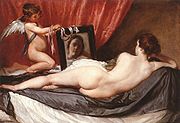
Slashing the Rokeby Venus


Her most famous act of defiance occurred in March 10, 1914 when she entered the National Gallery, London
National Gallery, London

The National Gallery in London, founded in 1824, houses a rich collection of over 2,300 paintings dating from the mid-13th century to 1900 in its home on Trafalgar Square....
 and slashed the Rokeby Venus.

Mary Richardson's attack on the painting took place around 11 a.m. on 10 March 1914. A slight woman wearing a tight gray skirt and a coat had stood for some time in front of the Rokeby Venus, apparently in deep contemplation of the painting, when she suddenly smashed the protective glass in front of the canvas, and began "hacking furiously at the picture with a chopper which, it is assumed, she had concealed under her jacket." When she was apprehended by a guard on duty in the room, she calmly surrendered and allowed herself to be led to the inspector's office with the words, "Yes, I am a suffragette. You can get another picture, but you cannot get a life, as they are killing Mrs. Pankhurst." She was referring to Emmeline Pankhurst
Emmeline Pankhurst

Emmeline Pankhurst was a political activist and leader of the British suffragette movement. Although she was widely criticised for her militant tactics, her work is recognised as a crucial element in achieving women's suffrage in Britain....
, who at the time was on hunger strike in Holloway Prison. Richardson slashed the painting seven times, particularly causing damage to the area between the figure's shoulders. However, all were successfully repaired by the National Gallery's chief restorer Helmut Ruhemann.

When she was arrested at the museum, Mary Richardson herself was only on temporary leave from prison as a part of the "Cat and Mouse Act
Cat and Mouse Act

The "Cat and Mouse Act" was an Act of Parliament passed in United Kingdom under Herbert Henry Asquith's The Liberal Party government in 1913. It made legal the hunger strikes that Suffragettes were undertaking at the time and stated that they would be released from prison as soon as they became ill....
" (prisoners were released from prison in a weakened state and brought back when they had sufficiently recovered). She wrote a brief statement explaining her actions to the WSPU which was immediately printed by the press:

"I have tried to destroy the picture of the most beautiful woman in mythological history as a protest against the Government for destroying Mrs. Pankhurst, who is the most beautiful character in modern history. Justice is an element of beauty as much as colour and outline on canvas. Mrs Pankhurst seeks to procure justice for womanhood, and for this she is being slowly murdered by a Government of Iscariot politicians. If there is an outcry against my deed, let every one remember that such an outcry is an hypocrisy so long as they allow the destruction of Mrs Pankhurst and other beautiful living women, and that until the public cease to countenance human destruction the stones cast against me for the destruction of this picture are each an evidence against them of artistic as well as moral and political humbug and hypocrisy."


Social Influence of the Slashing

In court, Mary Richardson added that she cared more for justice than for art, despite having been an art student, and thus her act was understandable, if not excusable. In an interview in 1952, nearly 40 years after the deed, Mary Richardson gave yet another reason for her action: "I didn't like the way men visitors gaped at it all day long."

The feminist art historian Lynda Nead has noted that "the incident has come to symbolize a particular perception of feminist attitudes towards the female nude; in a sense, it has come to represent a specific stereotypical image of feminism more generally." She concludes on the basis of the contemporary reactions to the act of vandalism that the value of the painting was "measured in terms of its representation of a certain kind of femininity and its position in the formation of a national cultural heritage." It is interesting to note that the market value of the Rokeby Venus rose sharply following the incident. Additionally, when characterizing the event, journalists tended to assess the attack in terms of a murder (Richardson was nicknamed "Slasher Mary"), and used words that conjured wounds inflicted on an actual female body, rather than on a pictorial representation of a female body. The Times published an article that contained factual inaccuracies as to the painting's provenance and described a "cruel wound in the neck", as well as incisions to the shoulders and back.

After the attack, the National Gallery
National gallery

A national gallery is a country's major public art gallery. Among the galleries which have this name are:*Australia:**National Gallery of Australia, Canberra...
, the Wallace Collection
Wallace Collection

The Wallace Collection is a museum in London, with a world-famous range of Fine art and decorative arts from the fifteenth to the nineteenth centuries with large holdings of French 18th-century paintings, furniture, arms & armour, porcelain and Old Master paintings arranged into 25 galleries....
, and the National Portrait Gallery (where a similar attack had taken place) were closed to women visitors. Later, women were only admitted in the company of men who could vouch for their good conduct.

Mary Richardson's attack in 1914 was not only a politically motivated act of vandalism, but was also a precisely orchestrated demonstration of how the art museum - as a kind of fourth or fifth State power - not only administered or controlled the individual works of art, but also took part in the perpetuation of the existing gender roles.

It is beyond doubt that the museums suffered from a collective phobia of women after the attack. A museum director, who wanted to express his sympathy after a similar attack at the National Portrait Gallery, wrote in a letter to one of his colleagues that "The fact that people of good intent were standing by, and unable to prevent the outrage, shows how much we really are at the mercy of women who are determined."

Sylvia Pankhurst
Sylvia Pankhurst

Estelle Sylvia Pankhurst was a notable campaigner for the suffragette movement in the United Kingdom. She was for a time a prominent Left Communism who then devoted herself to the cause of anti-fascism, and for peace....
 contextualized Mary Richardson's actions within a time of general upheaval:

"The destruction wrought in the seven months of 1914 before the War excelled that of the previous year. Three Scotch castles were destroyed by fire on a single night. The Carnegie Library in Birmingham was burnt. The Rokeby Venus, falsely, as I consider, attributed to Velázquez, and purchased for the National Gallery at a cost of £45,000, was mutilated by Mary Richardson. Romney's Master Thornhill, in the Birmingham Art Gallery, was slashed by Bertha Ryland, daughter of an early Suffagist. Carlyle's portrait of Millais [sic] in the National Portrait Gallery, and numbers of other pictures were attacked, a Bartolozzi drawing in the Doré Gallery being completely ruined. Many large empty houses in all parts of the country were set on fire, including Redlynch House, Sommerset, where the damage was estimated at £ 40,000. Railway stations, piers, sports pavilions, haystacks were set on fire. Attempts were made to blow up reservoirs. A bomb exploded in Westminster Abbey, and in the fashionable church of St George's, Hanover Square, where a famous stained-glass window from the Malines was damaged ... One hundred and forty-one acts of destruction were chronicled in the Press during the first seven months of 1914."


Later Life


Mary Richardson joined the Labour Party in 1919 and stood for parliament in 1922 in Acton; in 1926 in Bury St Edmunds; in 1931 in Aldershot; and in 1934 in London. She was never elected. In 1934 she joined Oswald Mosley's British Union of Fascists
British Union of Fascists

The British Union of Fascists was a political party in the United Kingdom formed in 1932 by a former Labour Party government minister and former Member of Parliament of the Conservative Party , Oswald Mosley....
 and became the Organising Secretary of the Women's Section. She left them in 1935 and took no further part in politics. She adopted a boy called Roger Robert, who took the name Richardson.

Although on her first visit to Hastings in 1913 pepper was thrown in her face, it is where she later retired and wrote her autobiography, Laugh a Defiance, published in 1953.

She died in her flat at 46 St James' Road, Hastings, on November 7th 1961. After a coroner's investigation she was cremated on the 10th and her ashes were taken away by Roger to his home in south London.

See also

  • List of suffragists and suffragettes
    List of suffragists and suffragettes

    File:Votes for Women lapel pin .jpgThis is a list of suffragists and suffragettes who were campaigners for women's suffrage. Suffragists and suffragettes were often members of different societies which had the same aim, but used differing tactics: for example, suffragettes in the United Kingdom usage denotes a more 'militant' type of campai...


Bibliography

Gamboni, Dario. The Destruction of Art: Iconoclasm and Vandalism since the French Revolution. Reaktion Books - Picturing History, 2007. ISBN 1861893167 Nead, Lynda. "The Female Nude: Art, Obscenity, and Sexuality. Routledge, 1992. ISBN 0415026776 Prater, Andreas. Venus at Her Mirror: Velázquez and the Art of Nude Painting. Prestel, 2002. ISBN 3791327836 Polhemus, Robert M. Erotic Faith: Being in Love from Jane Austen to D. H. Lawrence. University of Chicago Press, 1995. ISBN 0226673235