

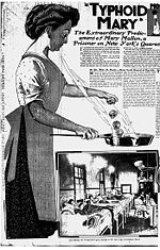
Mary Mallon

Encyclopedia
Mary Mallon also known as Typhoid Mary, was the first person in the United States identified as an asymptomatic carrier
of the pathogen associated with typhoid fever
. She was presumed to have infected some 53 people, three of whom died, over the course of her career as a cook. She was forcibly isolated twice by public health authorities and died after nearly three decades altogether in isolation.
, County Tyrone
, Ireland
, UK
(now Northern Ireland
). She emigrated to the United States
in 1884. From 1900 to 1907 she worked as a cook in the New York City
area.
In 1900, she had been working in a house in Mamaroneck, New York
, for under two weeks when the residents developed typhoid fever. She moved to Manhattan
in 1901, and members of the family for whom she worked developed fevers and diarrhea
and the laundress died. She then went to work for a lawyer until seven of the eight household members developed typhoid; Mary spent months helping to care for the people she made sick, but her care further spread the disease through the household. In 1906, she took a position in Oyster Bay, Long Island. Within two weeks, ten of eleven family members were hospitalized with typhoid. She changed employment again, and similar occurrences happened in three more households.
When typhoid researcher George Soper
approached Mallon about her possible role spreading typhoid, she adamantly rejected his request for urine and stool samples. Soper left and later published the report in June, 1907, in the Journal of the American Medical Association
. On his next contact with her, he brought a doctor with him, but was turned away again. Mallon's denials that she was a carrier were based in part on the diagnosis of a reputable chemist who had found her to not harbor the bacteria. Moreover, when Soper first told her she was a carrier, the concept of a healthy carrier of a pathogen was not commonly known. Further, class prejudice and prejudice towards the Irish
were strong in the period, as was the belief that slum
-dwelling immigrants were a major cause of epidemics. During a later encounter in the hospital, he told Mary that he would write a book about her and give her all the royalties; she angrily rejected his proposal and locked herself in the bathroom until he left.
 The New York City
Health Department sent Dr. Sara Josephine Baker to talk to Mary, but "by that time she was convinced that the law was only persecuting her when she had done nothing wrong."
A few days later, Baker arrived at Mary's workplace with several police officers who took her into custody. The New York City
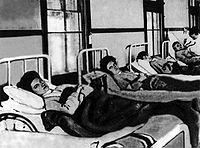
health inspector determined her to be a carrier. Under sections 1169 and 1170 of the Greater New York Charter, Mallon was held in isolation for three years at a clinic located on North Brother Island
.
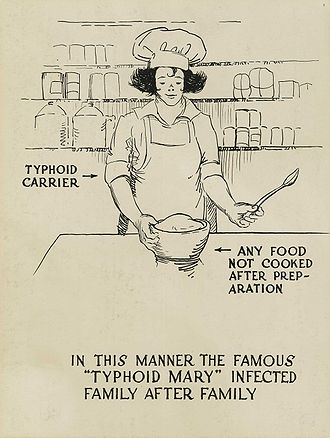
Individuals can develop typhoid fever after ingesting food or water contaminated during handling by a human carrier. The human carrier is usually a healthy person who has survived a previous episode of typhoid fever yet who continues to shed the associated bacteria, Salmonella typhi, in feces
and urine
. It takes vigorous scrubbing and thorough disinfection with soap
and hot water to remove the bacteria from the hands.
Eventually, the New York State Commissioner of Health, Eugene H. Porter, M.D., decided that disease carriers would no longer be held in isolation. Mallon could be freed if she agreed to abandon working as a cook and to take reasonable steps to prevent transmitting typhoid to others. On February 19, 1910, Mallon agreed that she "[was] prepared to change her occupation (that of a cook), and would give assurance by affidavit that she would upon her release take such hygienic precautions as would protect those with whom she came in contact, from infection". She was released from quarantine and returned to the mainland.
After being given a job as a laundress, which paid lower wages, however, Mallon adopted the pseudonym
Mary Brown, returned to her previous occupation as a cook, and in 1915 was believed to have infected 25 people, resulting in one death, while working as a cook at New York's Sloane Hospital for Women
. Public-health
authorities again found and arrested Mallon, returned to quarantine
on the island on March 27, 1915. Mallon was confined there for the remainder of her life. She became something of a minor celebrity, and was interviewed by journalists, who were forbidden to accept even a glass of water from her. Later, she was allowed to work as a technician in the island's laboratory.
. On November 11, 1938, aged 69, she died of pneumonia
. An autopsy
found evidence of live typhoid bacteria
in her gallbladder
. It is possible that she was born with the infection, as her mother had typhoid fever during her pregnancy. Her body was cremated, and the ashes were buried at Saint Raymond's Cemetery in the Bronx
.
 Mallon was the first healthy typhoid carrier to be identified by medical science, and there was no policy providing guidelines for handling the situation. Some difficulties surrounding her case stemmed from Mallon's vehement denial of her possible role, as she refused to acknowledge any connection between her working as a cook and the typhoid cases. Mallon maintained that she was perfectly healthy, had never had typhoid fever, and could not be the source. Public-health authorities determined that permanent quarantine was the only way to prevent Mallon from causing significant future typhoid outbreaks.
Other healthy typhoid carriers identified in the first quarter of the 20th century include Tony Labella, an Italian immigrant, presumed to have caused over 100 cases (with five deaths); an Adirondack guide dubbed Typhoid John, presumed to have infected 36 people (with two deaths); and Alphonse Cotils, a restaurateur and bakery owner.
Today, Typhoid Mary is a generic term for a healthy carrier of a noted pathogen, especially one who refuses to cooperate with health authorities to minimize the risk of infection. The term is also applied to computer users who spread malicious computer software by their naïveté and neglect (or outright refusal) to use security software against the malware
. See also "Typhoid adware
".
Mary Mallon is also referenced in popular culture in both the name of hip-hop group Hail Mary Mallon
, and the name of Marvel comics character "Typhoid Mary
".
Asymptomatic carrier
An asymptomatic carrier is a person or other organism that has contracted an infectious disease, but who displays no symptoms. Although unaffected by the disease themselves, carriers can transmit it to others...
of the pathogen associated with typhoid fever
Typhoid fever
Typhoid fever, also known as Typhoid, is a common worldwide bacterial disease, transmitted by the ingestion of food or water contaminated with the feces of an infected person, which contain the bacterium Salmonella enterica, serovar Typhi...
. She was presumed to have infected some 53 people, three of whom died, over the course of her career as a cook. She was forcibly isolated twice by public health authorities and died after nearly three decades altogether in isolation.
Cook
Mary Mallon was born in 1869 in CookstownCookstown
Cookstown may refer to either of the following:*Cookstown, County Tyrone, Northern Ireland*Cookstown, Ontario, Canada*Cookstown, New Jersey, United States...
, County Tyrone
County Tyrone
Historically Tyrone stretched as far north as Lough Foyle, and comprised part of modern day County Londonderry east of the River Foyle. The majority of County Londonderry was carved out of Tyrone between 1610-1620 when that land went to the Guilds of London to set up profit making schemes based on...
, Ireland
Ireland
Ireland is an island to the northwest of continental Europe. It is the third-largest island in Europe and the twentieth-largest island on Earth...
, UK
United Kingdom of Great Britain and Ireland
The United Kingdom of Great Britain and Ireland was the formal name of the United Kingdom during the period when what is now the Republic of Ireland formed a part of it....
(now Northern Ireland
Northern Ireland
Northern Ireland is one of the four countries of the United Kingdom. Situated in the north-east of the island of Ireland, it shares a border with the Republic of Ireland to the south and west...
). She emigrated to the United States
United States
The United States of America is a federal constitutional republic comprising fifty states and a federal district...
in 1884. From 1900 to 1907 she worked as a cook in the New York City
New York City
New York is the most populous city in the United States and the center of the New York Metropolitan Area, one of the most populous metropolitan areas in the world. New York exerts a significant impact upon global commerce, finance, media, art, fashion, research, technology, education, and...
area.
In 1900, she had been working in a house in Mamaroneck, New York
Mamaroneck (town), New York
Mamaroneck is a town in Westchester County, New York, United States. The population was 29,156 at the 2010 census. There are two villages contained within the town: Larchmont and the Village of Mamaroneck...
, for under two weeks when the residents developed typhoid fever. She moved to Manhattan
Manhattan
Manhattan is the oldest and the most densely populated of the five boroughs of New York City. Located primarily on the island of Manhattan at the mouth of the Hudson River, the boundaries of the borough are identical to those of New York County, an original county of the state of New York...
in 1901, and members of the family for whom she worked developed fevers and diarrhea
Diarrhea
Diarrhea , also spelled diarrhoea, is the condition of having three or more loose or liquid bowel movements per day. It is a common cause of death in developing countries and the second most common cause of infant deaths worldwide. The loss of fluids through diarrhea can cause dehydration and...
and the laundress died. She then went to work for a lawyer until seven of the eight household members developed typhoid; Mary spent months helping to care for the people she made sick, but her care further spread the disease through the household. In 1906, she took a position in Oyster Bay, Long Island. Within two weeks, ten of eleven family members were hospitalized with typhoid. She changed employment again, and similar occurrences happened in three more households.
When typhoid researcher George Soper
George Soper
George A. Soper was a sanitation engineer. He was best known for discovering Mary Mallon, or Typhoid Mary, a carrier of Typhoid who had no symptoms....
approached Mallon about her possible role spreading typhoid, she adamantly rejected his request for urine and stool samples. Soper left and later published the report in June, 1907, in the Journal of the American Medical Association
Journal of the American Medical Association
The Journal of the American Medical Association is a weekly, peer-reviewed, medical journal, published by the American Medical Association. Beginning in July 2011, the editor in chief will be Howard C. Bauchner, vice chairman of pediatrics at Boston University’s School of Medicine, replacing ...
. On his next contact with her, he brought a doctor with him, but was turned away again. Mallon's denials that she was a carrier were based in part on the diagnosis of a reputable chemist who had found her to not harbor the bacteria. Moreover, when Soper first told her she was a carrier, the concept of a healthy carrier of a pathogen was not commonly known. Further, class prejudice and prejudice towards the Irish
Irish people
The Irish people are an ethnic group who originate in Ireland, an island in northwestern Europe. Ireland has been populated for around 9,000 years , with the Irish people's earliest ancestors recorded having legends of being descended from groups such as the Nemedians, Fomorians, Fir Bolg, Tuatha...
were strong in the period, as was the belief that slum
Slum
A slum, as defined by United Nations agency UN-HABITAT, is a run-down area of a city characterized by substandard housing and squalor and lacking in tenure security. According to the United Nations, the percentage of urban dwellers living in slums decreased from 47 percent to 37 percent in the...
-dwelling immigrants were a major cause of epidemics. During a later encounter in the hospital, he told Mary that he would write a book about her and give her all the royalties; she angrily rejected his proposal and locked herself in the bathroom until he left.
Quarantine
New York City
New York is the most populous city in the United States and the center of the New York Metropolitan Area, one of the most populous metropolitan areas in the world. New York exerts a significant impact upon global commerce, finance, media, art, fashion, research, technology, education, and...
Health Department sent Dr. Sara Josephine Baker to talk to Mary, but "by that time she was convinced that the law was only persecuting her when she had done nothing wrong."
A few days later, Baker arrived at Mary's workplace with several police officers who took her into custody. The New York City
New York City
New York is the most populous city in the United States and the center of the New York Metropolitan Area, one of the most populous metropolitan areas in the world. New York exerts a significant impact upon global commerce, finance, media, art, fashion, research, technology, education, and...
health inspector determined her to be a carrier. Under sections 1169 and 1170 of the Greater New York Charter, Mallon was held in isolation for three years at a clinic located on North Brother Island
North Brother Island
North Brother Island is an island in the East River situated between the Bronx and Riker's Island. Its companion, South Brother Island, is a short distance away. Together, the two Brother Islands, North and South, have a land area of .-History:...
.
Individuals can develop typhoid fever after ingesting food or water contaminated during handling by a human carrier. The human carrier is usually a healthy person who has survived a previous episode of typhoid fever yet who continues to shed the associated bacteria, Salmonella typhi, in feces
Feces
Feces, faeces, or fæces is a waste product from an animal's digestive tract expelled through the anus or cloaca during defecation.-Etymology:...
and urine
Urine
Urine is a typically sterile liquid by-product of the body that is secreted by the kidneys through a process called urination and excreted through the urethra. Cellular metabolism generates numerous by-products, many rich in nitrogen, that require elimination from the bloodstream...
. It takes vigorous scrubbing and thorough disinfection with soap
Soap
In chemistry, soap is a salt of a fatty acid.IUPAC. "" Compendium of Chemical Terminology, 2nd ed. . Compiled by A. D. McNaught and A. Wilkinson. Blackwell Scientific Publications, Oxford . XML on-line corrected version: created by M. Nic, J. Jirat, B. Kosata; updates compiled by A. Jenkins. ISBN...
and hot water to remove the bacteria from the hands.
Eventually, the New York State Commissioner of Health, Eugene H. Porter, M.D., decided that disease carriers would no longer be held in isolation. Mallon could be freed if she agreed to abandon working as a cook and to take reasonable steps to prevent transmitting typhoid to others. On February 19, 1910, Mallon agreed that she "[was] prepared to change her occupation (that of a cook), and would give assurance by affidavit that she would upon her release take such hygienic precautions as would protect those with whom she came in contact, from infection". She was released from quarantine and returned to the mainland.
After being given a job as a laundress, which paid lower wages, however, Mallon adopted the pseudonym
Pseudonym
A pseudonym is a name that a person assumes for a particular purpose and that differs from his or her original orthonym...
Mary Brown, returned to her previous occupation as a cook, and in 1915 was believed to have infected 25 people, resulting in one death, while working as a cook at New York's Sloane Hospital for Women
Sloane Hospital for Women
The Sloane Hospital for Women is the obstetrics and gynecology service within New York-Presbyterian Hospital and the Department of Obstetrics and Gynecology of the Columbia University College of Physicians and Surgeons in New York City....
. Public-health
Public health
Public health is "the science and art of preventing disease, prolonging life and promoting health through the organized efforts and informed choices of society, organizations, public and private, communities and individuals" . It is concerned with threats to health based on population health...
authorities again found and arrested Mallon, returned to quarantine
Quarantine
Quarantine is compulsory isolation, typically to contain the spread of something considered dangerous, often but not always disease. The word comes from the Italian quarantena, meaning forty-day period....
on the island on March 27, 1915. Mallon was confined there for the remainder of her life. She became something of a minor celebrity, and was interviewed by journalists, who were forbidden to accept even a glass of water from her. Later, she was allowed to work as a technician in the island's laboratory.
Death
Mallon spent the rest of her life in quarantine. Six years before her death, she was paralyzed by a strokeStroke
A stroke, previously known medically as a cerebrovascular accident , is the rapidly developing loss of brain function due to disturbance in the blood supply to the brain. This can be due to ischemia caused by blockage , or a hemorrhage...
. On November 11, 1938, aged 69, she died of pneumonia
Pneumonia
Pneumonia is an inflammatory condition of the lung—especially affecting the microscopic air sacs —associated with fever, chest symptoms, and a lack of air space on a chest X-ray. Pneumonia is typically caused by an infection but there are a number of other causes...
. An autopsy
Autopsy
An autopsy—also known as a post-mortem examination, necropsy , autopsia cadaverum, or obduction—is a highly specialized surgical procedure that consists of a thorough examination of a corpse to determine the cause and manner of death and to evaluate any disease or injury that may be present...
found evidence of live typhoid bacteria
Bacteria
Bacteria are a large domain of prokaryotic microorganisms. Typically a few micrometres in length, bacteria have a wide range of shapes, ranging from spheres to rods and spirals...
in her gallbladder
Gallbladder
In vertebrates the gallbladder is a small organ that aids mainly in fat digestion and concentrates bile produced by the liver. In humans the loss of the gallbladder is usually easily tolerated....
. It is possible that she was born with the infection, as her mother had typhoid fever during her pregnancy. Her body was cremated, and the ashes were buried at Saint Raymond's Cemetery in the Bronx
The Bronx
The Bronx is the northernmost of the five boroughs of New York City. It is also known as Bronx County, the last of the 62 counties of New York State to be incorporated...
.
Legacy
Other healthy typhoid carriers identified in the first quarter of the 20th century include Tony Labella, an Italian immigrant, presumed to have caused over 100 cases (with five deaths); an Adirondack guide dubbed Typhoid John, presumed to have infected 36 people (with two deaths); and Alphonse Cotils, a restaurateur and bakery owner.
Today, Typhoid Mary is a generic term for a healthy carrier of a noted pathogen, especially one who refuses to cooperate with health authorities to minimize the risk of infection. The term is also applied to computer users who spread malicious computer software by their naïveté and neglect (or outright refusal) to use security software against the malware
Malware
Malware, short for malicious software, consists of programming that is designed to disrupt or deny operation, gather information that leads to loss of privacy or exploitation, or gain unauthorized access to system resources, or that otherwise exhibits abusive behavior...
. See also "Typhoid adware
Typhoid adware
Typhoid adware is a new potential type of computer security threat identified by researchers from the University of Calgary which does not require the affected computer to have adware installed in order to display advertisements on this computer...
".
Mary Mallon is also referenced in popular culture in both the name of hip-hop group Hail Mary Mallon
Hail Mary Mallon
Hail Mary Mallon, is a hip-hop group consisting of Aesop Rock, Rob Sonic, and DJ Big Wiz. The group's name is a reference to Typhoid Mary. Their first release was the song D-Up, featured on the compilation album Definitive Jux Presents 4....
, and the name of Marvel comics character "Typhoid Mary
Typhoid Mary (comics)
Typhoid Mary , also known as Typhoid, Walker, Bloody Mary and Mutant Zero, is a fictional character, a supervillain and enemy of Daredevil and Deadpool in the Marvel Comics Universe. She first appeared in Daredevil #254, and was created by Ann Nocenti and John Romita, Jr....
".
Further reading
- Bourdain, AnthonyAnthony BourdainAnthony Michael "Tony" Bourdain is an American chef, author and television personality. He is well known for his 2000 book Kitchen Confidential: Adventures in the Culinary Underbelly, and is the host of Travel Channel's culinary and cultural adventure program Anthony Bourdain: No Reservations.A...
. Typhoid Mary: An Urban Historical. New York: Bloomsbury, 2001. Hardcover, 148 pages, ISBN 1-58234-133-8 - Leavitt, Judith WalzerJudith Walzer LeavittJudith Walzer Leavitt is an American historian.She was the Rupple Bascom and Ruth Bleier Professor of History of Medicine, History of Science, and Women’s Studies at the University of Wisconsin–Madison. Her book subjects have included a study of Mary Mallon, a history of childbirth in America,...
. Typhoid Mary, Captive to the Public's Health. Boston: Beacon Press, 1996. Hardcover, 331 pages, ISBN 0-8070-2102-4 - Baker, Josephine SarahSara Josephine BakerSara Josephine Baker was an American physician notable for contributions to public health in New York City...
. Fighting for Life. New York: Macmillan Press, 1939. ISBN 0-405-05945-0 (1974 ed), ISBN 0-88275-611-7 (1980 ed) - Federspiel, JürgJürg FederspielJürg Federspiel was a Swiss writer, born in in Kemptthal, Canton Zurich.Federspiel grew up in Davos and attended secondary school in Basel. From 1951 he worked as a journalist and film critic for several Swiss newspapers, and spent time in Germany, France, Great Britain, Ireland and the USA...
. The Ballad of Typhoid Mary [translated by Joel Agee]. New York: Ballantine Press, 1985.