
All Topics  
Mary I of Scotland

 
Mary I of Scotland

   Email Print
   Bookmark   Link


Mary I of Scotland


Mary I (popularly known in the English-speaking world
English-speaking world

The English-speaking world consists of those countries or regions that use the English language to one degree or another....
 as Mary, Queen of Scots and, in France
France

France , officially the French Republic , is a country whose Metropolitan France is located in Western Europe and that also comprises various Overseas departments and territories of France....
, as Marie Stuart) (8 December 1542 – 8 February 1587) was Queen of Scots from 14 December 1542 to 24 July 1567.

She was the only surviving legitimate child of King James V
James V of Scotland

James V was King of Scots from 9 September 1513 until his premature death at the age of thirty, which followed the Scottish defeat at the Battle of Solway Moss....
. She was only six days old when her father died and left her Queen of Scots. Her mother, Mary of Guise
Mary of Guise

Mary of Guise was the Queen Consort of James V of Scotland and the mother of Mary I of Scotland. She was Regent, or Governor, of Scotland 1554–1560....
, assumed regency
Reign

A reign is the term used to describe the length of a monarch is the supreme leader over a kingdom. No time limit exists on reigns, nor is there a term of office....
 and the baby sovereign was crowned
Coronation of the British monarch

The Coronation of the British Monarch is a ceremony in which the monarch of the United Kingdom and of the other Commonwealth realms is formally Crown and invested with regalia....
 nine months later.

In 1558, she married Francis, Dauphin of France
Francis II of France

Francis II...
, who ascended the French throne as Francis II a year later.


Discussion
Ask a question about 'Mary I of Scotland'
Start a new discussion about 'Mary I of Scotland'
Answer questions from other users
Full Discussion Forum


Recent Posts


Timeline

1542   Born

1542   Princess Mary Stuart becomes Queen Mary I of Scotland.

1548   Mary I of Scotland sent to France

1556   Scottish nobles kill David Rizzio, the secretary to Mary I of Scotland in the queen's presence

1558   Mary I of Scotland marries Francis II of France

1561   Mary, Queen of Scots is denied passage through England after returning from France. She arrives at Leith, Scotland on August 19.

1567   Henry Stuart, Lord Darnley, husband of Mary I of Scotland, is murdered at the Provost's House in Edinburgh.

1568   Mary Queen of Scots escapes from Loch Leven Castle.

1568   Battle of Langside: the forces of Mary Queen of Scots are defeated by a confederacy of Scottish Protestants under James Stewart, Earl of Moray, her half-brother.

1568   Mary Queen of Scots flees to England.


Encyclopedia


Mary I (popularly known in the English-speaking world
English-speaking world

The English-speaking world consists of those countries or regions that use the English language to one degree or another....
 as Mary, Queen of Scots and, in France
France

France , officially the French Republic , is a country whose Metropolitan France is located in Western Europe and that also comprises various Overseas departments and territories of France....
, as Marie Stuart) (8 December 1542 – 8 February 1587) was Queen of Scots from 14 December 1542 to 24 July 1567.

She was the only surviving legitimate child of King James V
James V of Scotland

James V was King of Scots from 9 September 1513 until his premature death at the age of thirty, which followed the Scottish defeat at the Battle of Solway Moss....
. She was only six days old when her father died and left her Queen of Scots. Her mother, Mary of Guise
Mary of Guise

Mary of Guise was the Queen Consort of James V of Scotland and the mother of Mary I of Scotland. She was Regent, or Governor, of Scotland 1554–1560....
, assumed regency
Reign

A reign is the term used to describe the length of a monarch is the supreme leader over a kingdom. No time limit exists on reigns, nor is there a term of office....
 and the baby sovereign was crowned
Coronation of the British monarch

The Coronation of the British Monarch is a ceremony in which the monarch of the United Kingdom and of the other Commonwealth realms is formally Crown and invested with regalia....
 nine months later.

In 1558, she married Francis, Dauphin of France
Francis II of France

Francis II...
, who ascended the French throne as Francis II a year later. However, Mary did not hold the position of Queen of France for long; she was widowed by 1560. Soon after her husband's death, Mary returned to Scotland, arriving in Leith
Leith

Leith is a district and former municipal burgh in the north of the city of Edinburgh at the mouth of the Water of Leith and is the Seaport of Edinburgh, Scotland....
 on 19 August 1561. Four years later, Mary remarried, choosing her first cousin, Henry Stuart, Lord Darnley
Henry Stuart, Lord Darnley

Henry Stuart, 1st Duke of Albany , commonly known as Lord Darnley, was a King Consort of Scotland, the first cousin and second husband of Mary I of Scotland, and the father of her son James I of England, who also succeeded Elizabeth I of England as King James I of England....
, as her second husband. Their union was not happy and following the birth of their son, James
James I of England

James VI and I was List of monarchs of Scotland as James VI, and List of English monarchs and King of Ireland as James I. He ruled in Kingdom of Scotland as James VI from 24 July 1567, when he was only one year old, succeeding his mother Mary I of Scotland....
, on 19 June 1566, a plot was hatched to remove Darnley. In February 1567, an explosion occurred in the house at Kirk o'Field, and Darnley was found dead in the garden.

She soon married James Hepburn, 4th Earl of Bothwell
James Hepburn, 4th Earl of Bothwell

James Hepburn, 1st Duke of Orkney , better known by his inherited title as 4th Earl of Bothwell, was Hereditary Lord High Admiral of Scotland....
 - today, it is believed that she was forced into marriage. Mary was imprisoned in Loch Leven Castle
Loch Leven Castle

Loch Leven Castle is a ruined castle on an island in Loch Leven, in the Perth and Kinross region of Scotland. Possibly built around 1300, the castle saw military action during the Wars of Scottish Independence ....
 on 15 June and forced to abdicate
Abdication

Abdication is the act of renouncing and resigning from a formal office, especially from the supreme office of state. In Roman law the term was also applied to the disowning of a family member, as the disinheriting of a son....
 the throne in favour of her one-year-old son. After an unsuccessful attempt to regain the throne, Mary fled to England seeking protection from her father's first cousin, Queen Elizabeth I
Elizabeth I of England

Elizabeth I was List of English monarchs and Queen of Ireland from 17 November 1558 until her death. Sometimes called The Virgin Queen, Gloriana, or Good Queen Bess, Elizabeth was the fifth and last monarch of the House of Tudor....
, whose kingdom she was to inherit. Elizabeth I, however, ordered her arrest, because of threat of being deposed by Mary, who was considered the rightful ruler of England by English Catholics.

After a long period of custody in England, she was tried and executed for treason
Treason

In law, treason is the crime that covers some of the more serious acts of loyalty to one's sovereignty or nation. Historically, treason also covered the murder of specific social superiors, such as the murder of a husband by his wife ....
 following her alleged involvement in three plots to assassinate Elizabeth I of England
Elizabeth I of England

Elizabeth I was List of English monarchs and Queen of Ireland from 17 November 1558 until her death. Sometimes called The Virgin Queen, Gloriana, or Good Queen Bess, Elizabeth was the fifth and last monarch of the House of Tudor....
 and place herself on the English throne.

Heritage

During the 15th century reign of Robert III of Scotland
Robert III of Scotland

Robert III , King of Scots ...
, it had been confirmed that the Scottish Crown would only be inherited by males in the line of Robert's children—all sons—who were listed in that parliamentary
Parliament of Scotland

The Parliament of Scotland, officially the Estates of Parliament, was the legislature of the Independence Kingdom of Scotland.The unicameral parliament of Scotland is first found on record during the early thirteenth century, and the first meeting for which reliable evidence survives was at Kirkliston in 1235, during the reign of A...
 Act. Females and female lines could inherit only after extinction of male lines.

Mary ascended to the throne because, with the demise of her father, James V, Robert II had no remaining direct male descendants of unquestionably legitimate origins. John Stewart, Duke of Albany, grandson of James II of Scotland
James II of Scotland

James II of Scotland reigned as king of Scots from 1437 to 1460.He was the son of James I of Scotland and of Joan Beaufort, Queen of Scotland ....
 and at one time regent for the young James V, was the last direct male heir of Robert II (other than the king himself) when he died in 1536.

Mary was the first member of the royal House of Stuart
House of Stuart

The House of Stuart, also known as the House of Stewart is an important European royal house. Founded by Robert II of Scotland, the Stewarts first became monarchs of the Kingdom of Scotland during the late 14th century....
 to use the Gallicised
Francization

Francization or Gallicization is a process of cultural assimilation that gives a France character to a word, an ethnicity or a person....
 spelling Stuart, rather than the earlier Stewart. Mary had adopted the French spelling Stuart during her time in France, and she and her descendants continued to use it.

Mary was born at Linlithgow Palace
Linlithgow Palace

The ruins of Linlithgow Palace are situated in the town of Linlithgow, West Lothian, Scotland, 15 miles west of Edinburgh. A royal manor existed on the site in the 12th Century....
, Linlithgow
Linlithgow

Linlithgow is a town and former Royal burgh in West Lothian, Scotland. Those born in Linlithgow are sometimes nicknamed Black Bitches, and the town's coat of arms shows a black bitch dog, chained to an oak tree, which grows on an island....
, Scotland
Scotland

conventional_long_name = ScotlandAlba|common_name= Scotland|image_flag = Flag of Scotland.svg|flag_width = 130px...
, on 8 December 1542 to King James V of Scotland
James V of Scotland

James V was King of Scots from 9 September 1513 until his premature death at the age of thirty, which followed the Scottish defeat at the Battle of Solway Moss....
 and his French wife, Mary of Guise
Mary of Guise

Mary of Guise was the Queen Consort of James V of Scotland and the mother of Mary I of Scotland. She was Regent, or Governor, of Scotland 1554–1560....
. A popular legend, written by John Knox
John Knox

John Knox was a Scotland clergyman and leader of the Protestant Reformation who is considered the founder of the Presbyterianism denomination....
, states that James, upon hearing of the birth of a daughter, ruefully exclaimed, "It came with a lass, it will pass with a lass!". The House of Stewart, which originated in Brittany
Brittany

Brittany is a former independent Celtic nations monarchy and duchy, now incorporated into France. It is also, more generally, the name of the cultural area whose limits correspond to the historic province and independent duchy....
, had gained the throne of Scotland by the marriage of Marjorie Bruce
Marjorie Bruce

Marjorie Bruce or Margaret de Bruce was the eldest daughter of Robert I of Scotland, List of Scottish monarchs by his first wife, Isabella of Mar....
, daughter of Robert the Bruce, to the high steward of Scotland. James thus felt that since the crown came with a woman, a woman would be responsible for the loss of the crown from their family. This legendary statement came true, when Sophia of Hanover
Sophia of Hanover

Sophia of Hanover was the youngest daughter of Frederick V, Elector Palatine, of the House of Wittelsbach, the "Winter King" of Bohemia, and Elizabeth of Bohemia....
, daughter of Elizabeth Stuart
Elizabeth of Bohemia

Elisabeth, Electress Palatine and Queen of Bohemia was the eldest daughter of James I of England, King of England, Scotland and Ireland, and Anne of Denmark....
, became the heir to Anne of Great Britain
Anne of Great Britain

Anne became Queen of England, Queen of Scots and Kingdom of Ireland on 8 March 1702, succeeding her brother-in-law, William III of England. Her Roman Catholic father, James II of England, was Glorious Revolution in 1688/9; her brother-in-law and her sister then became joint monarchs as William III & II and Mary II of England, the only such c...
 and with her son George Louis of Hanover becoming King of Great Britain, replacing the House of Stuart in England.

Reign

The six or seven day old Mary became Queen of Scotland when her father died at the age of 30, probably from cholera
Cholera

Cholera, sometimes known as Asiatic or epidemic cholera, is an infectious gastroenteritis caused by enterotoxin-producing strains of the bacterium Vibrio cholerae....
, although his contemporaries believed his death to have been caused by grief over the Scots' loss to the English at the Battle of Solway Moss
Battle of Solway Moss

The Battle of Solway Moss took place on Solway Moss near the River Esk in the Scottish Borders in November 1542 between forces from England and Scotland ....
. James Hamilton, 2nd Earl of Arran
James Hamilton, 2nd Earl of Arran

James Hamilton, Duke of Ch?tellerault and 2nd Earl of Arran, was a Kingdom of Scotland nobleman and the eldest legitimate son of James Hamilton, 1st Earl of Arran....
 was the next in line for the throne after Mary; he acted as regent
Regent

A regent, from the Latin regens "reigning", is a person selected to act as head of state because the ruler is a minor, not present or debilitated....
 for Mary until 1554, when he was succeeded by the Queen's mother
Dowager

A dowager is a widow who holds a title or property, or dower, derived from her deceased husband. As an adjective, "Dowager" usually appears in association with monarchy and aristocracy titles....
, who continued as regent until her death in 1560.

In July 1543, when Mary was six months old, the Treaties of Greenwich promised Mary to be married to Edward
Edward VI of England

Edward VI became List of English monarchs and King of Ireland on 28 January 1547 and was crowned on 20 February at the age of nine. The son of Henry VIII of England and Jane Seymour, Edward was the third monarch of the Tudor dynasty and England's first Protestantism ruler....
, son of King Henry VIII of England
Henry VIII of England

Henry VIII was King of England from 21 April 1509 until his death. He was also Lordship of Ireland and claimant to the Early Modern France. Henry was the second monarch of the House of Tudor, succeeding his father, Henry VII of England....
 in 1552, and for their heirs to inherit the Kingdoms of Scotland and England. Mary's mother was strongly opposed to the proposition, and she hid with Mary two months later in Stirling Castle
Stirling Castle

Stirling Castle, located in Stirling, is one of the largest and most important castles, both historically and architecturally, in Scotland. The Castle sits atop the Castle Hill, a volcanic Crag and tail, which forms part of the Stirling Sill geological formation....
, where preparations were made for Mary's coronation
Coronation

A coronation is a ceremony marking the investiture of a monarch with regal power, specifically involving the placement of a coronation crown upon his or her head, and the presentation of other items of regalia....
. At the age of nine months Mary was crowned Queen of Scots in the Chapel
Chapel

A chapel is a building used as a place for fellowship and of worship for Christians. It may be attached to an institution such as a large Church , a college, a hospital, a palace, a prison or a cemetery, or may be an entirely free-standing building, sometimes with its own grounds....
 Royal at Stirling Castle on 9 September 1543. The ceremony, conducted in a hasty manner, was described as solemn with little rejoicing, and the pro-English party was conspicuously absent.

The "Rough Wooing"

The Treaties of Greenwich fell apart soon after Mary's coronation. The betrothal did not sit well with the Scots, especially since Henry VIII
Henry VIII of England

Henry VIII was King of England from 21 April 1509 until his death. He was also Lordship of Ireland and claimant to the Early Modern France. Henry was the second monarch of the House of Tudor, succeeding his father, Henry VII of England....
 suspiciously tried to change the agreement so that he could possess Mary years before the marriage was to take place. He also wanted them to break their traditional alliance with France. Fearing an uprising among the people, the Scottish Parliament broke off the treaty and the engagement at the end of the year. Henry then began his "rough wooing" designed to impose the marriage to his son on Mary. This consisted of a series of raids on Scottish territory and other military actions. It lasted until June 1551, costing over half a million pounds
Pound sterling

----The pound sterling , subdivided into 100 pence , is the currency of the United Kingdom, its Crown dependency and the British Overseas Territories of South Georgia and the South Sandwich Islands and British Antarctic Territory....
 and many lives. In May 1544, the English Earl of Hertford (later created Duke of Somerset
Duke of Somerset

The Duke of Somerset is a title in the peerage of England that has been created several times. Derived from Somerset, it is particularly associated with two families; the Beauforts who held the title from the creation of 1448 and the Seymours, from the creation of 1547 and in whose name the title is still held....
 by Edward VI
Edward VI of England

Edward VI became List of English monarchs and King of Ireland on 28 January 1547 and was crowned on 20 February at the age of nine. The son of Henry VIII of England and Jane Seymour, Edward was the third monarch of the Tudor dynasty and England's first Protestantism ruler....
) arrived in the Firth of Forth
Firth of Forth

The Firth of Forth is the estuary or firth of Scotland River Forth, where it flows into the North Sea between Fife to the north, and West Lothian, the City of Edinburgh, and East Lothian to the south....
 hoping to capture the city of Edinburgh
Edinburgh

Edinburgh ; is the Capital city of Scotland, a position it has held since 1437. It is the seventh largest city in the United Kingdom and the second largest Scottish City status in the United Kingdom after Glasgow....
 and kidnap Mary, but Mary of Guise hid her in the secret chambers of Stirling Castle. On 10 September 1547, known as "Black Saturday", the Scots suffered a bitter defeat at the Battle of Pinkie Cleugh
Battle of Pinkie Cleugh

The Battle of Pinkie Cleugh, along the banks of the River Esk, Lothian near Musselburgh, Scotland on 10 September 1547, was part of the War of the Rough Wooing....
. Mary of Guise, fearful for her daughter, sent her temporarily to Inchmahome Priory
Inchmahome Priory

Inchmahome Priory is situated on Inchmahome , the largest of three islands in the centre of Lake of Menteith, close to Aberfoyle, Scotland. The name "Inchmahome" comes from the Gaelic Innis MoCholmaig, meaning Island of St Colmaig....
, and turned to the French ambassador Monsieur D'Oysel for help.

The French, remaining true to the Auld Alliance
Auld Alliance

The Auld Alliance refers to a series of treaties, offensive and defensive in nature, between Scotland and France aimed specifically against England....
, came to the aid of the Scots. The new French King, Henry II
Henry II of France

Henry II , of the House of Valois and the son and successor of Francis I of France, was King of France from 31 March 1547, until his death....
, was now proposing to unite France and Scotland by marrying the little Queen to his three-year old son, the Dauphin Franēois. This seemed to Mary of Guise to be the only sensible solution to her troubles. In February 1548, hearing that the English were on their way back, Mary of Guise moved Mary to Dumbarton Castle
Dumbarton Castle

Dumbarton Castle has the longest recorded history of any stronghold in Great Britain. It overlooks the Scotland town of Dumbarton, and sits on a plug of volcano basalt known as Dumbarton Rock which is high....
. The English left a trail of devastation behind once more and seized the strategically located town of Haddington
Haddington, East Lothian

Haddington is a town and former Royal Burgh in East Lothian, Scotland. It is the main administrative, cultural and geographical centre for East Lothian, which was known officially as Haddingtonshire before 1921....
. By June, the much awaited French help had arrived. On 7 July with it the French Marriage Treaty was signed at a nunnery near Haddington.

Childhood in France

With her marriage agreement in place, five-year-old Mary was sent to France in 1548 to spend the next thirteen years at the French court. Henry II
Henry II of France

Henry II , of the House of Valois and the son and successor of Francis I of France, was King of France from 31 March 1547, until his death....
 had offered to guard and raise her. On 7 August 1548, the French fleet sent by Henry II
Henry II of France

Henry II , of the House of Valois and the son and successor of Francis I of France, was King of France from 31 March 1547, until his death....
 sailed back to France from Dumbarton
Dumbarton

Dumbarton is a burgh in Scotland, lying on the north bank of the River Clyde where the River Leven, Dunbartonshire flows into the Clyde estuary....
 carrying the five-year-old Queen of Scots on board. She was accompanied by her own little court consisting of two lords, two half-brothers, and the "four Marys", four little girls her own age, all named Mary, and the daughters of some of the noblest families in Scotland: Beaton
Mary Beaton

Mary Beaton was an attendant of Mary I of Scotland. Like the Queen, she was of Scottish people. She is described as pretty and plump, with fair hair and dark eyes....
, Seton
Mary Seton

Mary Seton was the daughter of George Seton, 6th Lord Seton, and Marie Pieris, Lady in waiting to Marie de Guise, consort of King James V of Scotland....
, Fleming
Mary Fleming

Mary Fleming was one of the "Four Marys," Lady-in-waiting to Mary I of Scotland. As her mother, Lady Janet Stewart, was an illegitimate daughter of King James IV of Scotland, Mary Fleming was a "half-cousin" to the Queen....
, and Livingston
Mary Livingston

Mary Livingston was the daughter of Alexander Livingston, 5th Lord Livingston, guardian of Queen Mary I of Scotland.As a child, Mary became a lady-in-waiting to Queen Mary, along with three other girls of similar age....
.

and Mary Stuart, 1558.]] Vivacious, beautiful, and clever (according to contemporary accounts), Mary had a promising childhood. While in the French court, she was a favourite. She received the best available education, and at the end of her studies, she had mastered French, Latin
Latin

Latin is an Italic language, historically spoken in Latium and Ancient Rome. Through the Military history of the Roman Empire, Latin spread throughout the Mediterranean and a large part of Europe....
, Greek, Spanish, and Italian in addition to her native Scots
Scots language

Scots or Lowland Scots refers to the Germanic Variety derived from Middle English spoken in parts of Lowland Scotland, Northern Ireland and the border areas of the Republic of Ireland....
. She also learned how to play two instruments and learned prose, poetry, horsemanship, falconry, and needlework. She formed a close friendship with her future sister-in-law, Elisabeth of Valois
Elisabeth of Valois

?lisabeth of Valois was the eldest daughter of Henry II of France and Catherine de' Medici....
, of whom Mary retained the most nostalgic memories in later life.Her grandmother Antoinette de Bourbon
Antoinette de Bourbon

Antoinette de Bourbon-La Marche was a French noblewoman of the House of Bourbon. She was the wife of Claude, Duke of Guise. Through her eldest daughter, Mary of Guise, Queen consort of King James V of Scotland, she was the maternal grandmother of Mary, Queen of Scots....
 exerted one of the strongest influences on her childhood,and acted as one of her principal advisors.

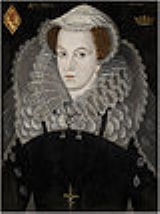
Portraits of Mary show that she had a small, well-shaped head, a long, graceful neck, bright auburn hair, hazel-brown eyes, under heavy lowered eyelids and finely arched brows, smooth lustrous skin, a high forehead, and regular, firm features. While not a beauty in the classical sense, she was an extremely pretty child who would become a strikingly attractive woman. In fact, her effect on the men with whom she later came into contact was certainly that of a beautiful woman.

Despite the fact that Mary was tall for her age (she attained an adult height of 5'11") and fluent in speech, while Henry II's son and heir Francis was abnormally short and stuttered, Henry commented that "from the very first day they met, my son and she got on as well together as if they had known each other for a long time" On 24 April 1558 Mary married the Dauphin Francis at Notre Dame de Paris
Notre Dame de Paris

Notre Dame de Paris is a Gothic architecture cathedral on the eastern half of the ?le de la Cit? in the 4th arrondissement of Paris of Paris, France, with its main entrance to the west....
, Francis assuming the title King consort of Scots. When Henry II
Henry II of France

Henry II , of the House of Valois and the son and successor of Francis I of France, was King of France from 31 March 1547, until his death....
 died on 10 July 1559, Mary, Queen of Scots, became Queen consort of France; her husband becoming Francis II of France
Francis II of France

Francis II...
.

Claim to the English throne

Under the ordinary laws of succession, Mary was next in line to the English throne after her father's cousin, Queen Elizabeth I
Elizabeth I of England

Elizabeth I was List of English monarchs and Queen of Ireland from 17 November 1558 until her death. Sometimes called The Virgin Queen, Gloriana, or Good Queen Bess, Elizabeth was the fifth and last monarch of the House of Tudor....
, who was childless. In the eyes of many Catholics, Elizabeth was illegitimate, thus making Mary the true heir as Mary II of England. However the Third Succession Act
Third Succession Act

The Third Succession Act of Henry VIII of England reign was passed by the Parliament of England in July 1543, and returned both Mary I of England and Elizabeth I of England to the line of the succession behind Edward VI of England....
 of 1543 provided that Elizabeth would succeed Mary I of England
Mary I of England

Mary I , was Queen of England and Monarchy of Ireland from 19 July 1553 until her death. The fourth crowned monarch of the Tudor dynasty, she is remembered for restoring England to Roman Catholicism after succeeding her short-lived half brother, Edward VI of England, to the English throne....
 on the throne.

The anti-Catholic Act of Settlement
Act of Settlement 1701

The Act of Settlement is an act of the Parliament of England, originally filed in 1700, and passed in 1701, to settle the Order of succession to the List of English monarchs on the Electress Sophia of Hanover a granddaughter of James I of England and her Protestantism heirs....
 was not passed until 1701, but the last will and testament of Henry VIII, (given legal force by the Third Succession Act
Third Succession Act

The Third Succession Act of Henry VIII of England reign was passed by the Parliament of England in July 1543, and returned both Mary I of England and Elizabeth I of England to the line of the succession behind Edward VI of England....
), had excluded the Stuarts from succeeding to the English throne. Mary's troubles were still further increased by the Huguenot
Huguenot

The Huguenots were members of the Protestantism Reformed Church of France of France from the sixteenth to the eighteenth centuries....
 rising in France, called le tumulte d'Amboise
Amboise conspiracy

The Amboise conspiracy, or Tumult of Amboise , was a failed attempt by Huguenots and the house of Bourbon to wrest power over France by abducting the young king, Francis II of France and arresting Francis, Duke of Guise and his brother Charles of Guise)....
 (6 March-17 March 1560), making it impossible for the French to help Mary's supporters in Scotland. The question of the succession was therefore a real one.

Franēois died on 5 December 1560, of an ear infection which led to an abcess in his brain. Mary's mother-in-law, Catherine de' Medici
Catherine de' Medici

Catherine de' Medici was born in Florence, as Caterina Maria Romula di Lorenzo de' Medici. Her parents, Lorenzo II de' Medici, Duke of Urbino, and Madeleine de la Tour d'Auvergne, both died within weeks of her birth....
, became regent for the late king's brother Charles IX
Charles IX of France

Charles IX born Charles-Maximilien, was King of France, ruling from 1560 until his death. He is best known as king at the time of the St....
, who inherited the French throne. Under the terms of the Treaty of Edinburgh
Treaty of Edinburgh

The Treaty of Edinburgh was a treaty drawn up in 1560 by the Parliament of Scotland in an attempt to formally end the Auld Alliance with France....
, signed by Mary's representatives on 6 July 1560 following the death of her mother, France undertook to withdraw troops from Scotland and recognise Elizabeth's right to rule England. The 17-year-old Mary, still in France, refused to ratify the treaty.

Religious divide

Maryscot
Mary returned to Scotland soon after her husband's death and arrived in Leith
Leith

Leith is a district and former municipal burgh in the north of the city of Edinburgh at the mouth of the Water of Leith and is the Seaport of Edinburgh, Scotland....
 on 19 August 1561. Despite her talents, Mary's upbringing had not given her the judgment to cope with the dangerous and complex political situation in the Scotland of that time.

Mary, being a devout Catholic
Roman Catholic Church

The Roman Catholic Church, officially known as the Catholic Church is the world's largest Christianity Ecclesia , representing over half of all Christians and one-sixth of the world population....
, was regarded with suspicion by many of her subjects as well as by Elizabeth, who was her father's cousin and the monarch of the neighbouring Protestant country. Scotland was torn between Catholic and Protestant factions, and Mary's illegitimate half-brother, James Stewart, 1st Earl of Moray
James Stewart, 1st Earl of Moray

File:James Stewart Earl of Moray.jpgJames Stewart, 1st Earl of Moray , a member of the House of Stewart, was Regent of Scotland from 1567 until his assassination in 1570....
, was a leader of the Protestant faction. The Protestant reformer John Knox
John Knox

John Knox was a Scotland clergyman and leader of the Protestant Reformation who is considered the founder of the Presbyterianism denomination....
 also preached against Mary, condemning her for hearing Mass
Mass (liturgy)

The Mass is the Eucharistic celebration in the Latin liturgical rites of the Roman Catholic Church. The term is used also of similar celebrations in Old Catholic Churches, in the Anglo-Catholic tradition of Anglicanism, and in some largely High Church Lutheranism Lutheranism regions, including the Scandinavian and Baltic states countries....
, dancing
Dance

Dance is an art form that generally refers to Motion of the body, usually rhythmic and to music, used as a form of Emotional expression, social social interaction or presented in a spirituality or performance setting....
, dressing too elaborately, and many other real and imagined offences.

To the disappointment of the Catholic party, however, Mary tolerated the newly-established Protestant ascendancy, and kept James Stewart as her chief advisor. In this, she was acknowledging her lack of effective military power in the face of the Protestant Lords. She joined with James in the destruction of Scotland's leading Catholic magnate, Lord Huntly
George Gordon, 4th Earl of Huntly

George Gordon, 4th Earl of Huntly , was a Scotland nobleman.The grandson of the 3rd Earl of Huntly, and a childhood companion of James V, he inherited the earldom and estates in 1524....
, in 1562 after he led a rebellion in the Highlands
Scottish Highlands

The Scottish Highlands include the rugged and mountainous regions of Scotland north and west of the Highland Boundary Fault, although the exact boundaries are not clearly defined, particularly to the east....
 against her.

Mary was also having second thoughts about the wisdom of having crossed Elizabeth, and attempted to make up the breach by inviting Elizabeth to visit Scotland. Elizabeth refused, and the bad blood remained between them. Mary then sent William Maitland of Lethington
William Maitland of Lethington

Sir William Maitland of Lethington was a Scotland politician and reformer, and the eldest son of the poet Richard Maitland.William was the renowned 'Secretary Lethington' to Mary I of Scotland....
 as an ambassador to the English court to put the case for Mary as a potential heir to the throne. Elizabeth's response is said to have included the words "As for the title of my crown, for my time I think she will not attain it." However, Mary, in her own letter to her maternal uncle Francis, Duke of Guise
Francis, Duke of Guise

Francis II, Prince of Joinville, Duke of Guise, Duke of Aumale , called Balafr? , was a France soldier and politician....
, reports other things that Maitland told her, including Elizabeth's supposed statement that, "I for my part know none better, nor that my self would prefer to her." Elizabeth was mindful of the role Parliament would have to play in the matter.

In December 1561 arrangements were made for the two queens to meet, this time in England. The meeting had been fixed for York
York

York is a walled city, sited at the confluence of the rivers River Ouse, Yorkshire and River Foss in North Yorkshire, England. The city status in the United Kingdom is noted for its rich heritage and it has played an important role throughout much of its almost 2,000 year existence....
 "or another town" in August or September 1562, but Elizabeth sent Sir Henry Sidney
Henry Sidney

Sir Henry Sidney , lord deputy of Ireland, was the eldest son of Sir William Sidney of Penshurst, a prominent politician and courtier during the reigns of Henry VIII of England and Edward VI of England, from both of whom he received extensive grants of land, including the manor of Penshurst in Kent, which became the principal residence of th...
 to cancel in July because of the Civil War in France. In 1563, Elizabeth made another attempt to neutralize Mary by suggesting she marry Robert Dudley, 1st Earl of Leicester
Robert Dudley, 1st Earl of Leicester

Robert Dudley, 1st Earl of Leicester was the long-standing favourite of Elizabeth I of England. He was appointed Master of the Horse on her accession in November 1558, and a Privy Councillor in October 1562....
 (Sidney's brother-in-law), whom Elizabeth trusted and thought she could control. Dudley, being a Protestant, would have solved a double problem for Elizabeth. She sent an ambassador to tell Mary that, if she would marry someone (as yet unnamed) of Elizabeth's choosing, Elizabeth would "proceed to the inquisition of her right and title to be our next cousin and heir". This proposal was rejected.

Marriage to Darnley

Bothwell
At Holyrood Palace
Holyrood Palace

The Palace of Holyroodhouse, or informally Holyrood Palace, founded as a monastery by David I of Scotland in 1128, has served as the principal residence of the Kings and Queens of Scotland since the fifteenth century....
 on 29 July 1565, Mary married Henry Stuart, Lord Darnley
Henry Stuart, Lord Darnley

Henry Stuart, 1st Duke of Albany , commonly known as Lord Darnley, was a King Consort of Scotland, the first cousin and second husband of Mary I of Scotland, and the father of her son James I of England, who also succeeded Elizabeth I of England as King James I of England....
, her half first cousin (The validity of this marriage has been disputed, as some say she was forced into it by Lord Darnley. However, the issue was not brought up during her lifetime). Henry was a member of the House of Stewart (or Stuart) like Mary was, but he was not an agnatic descendant of Stewart Kings, but rather of their immediate ancestors, the High Stewarts of Scotland. The union infuriated Elizabeth, who felt she should have been asked permission, as Darnley was an English subject. Elizabeth also felt threatened by the marriage, because both Mary and Darnley were claimants to the English throne, being direct descendants of Margaret Tudor
Margaret Tudor

Margaret Tudor was the elder of the two surviving daughters of Henry VII of England and Elizabeth of York, and the elder sister of Henry VIII of England....
, the elder sister of Henry VIII. Their children would inherit both parents' claims, and thus, be next in line for the English throne.

This marriage, to a leading Catholic, precipitated Mary's half-brother, the James Stewart, Earl of Moray, to join with other Protestant Lords in open rebellion. Mary set out for Stirling on 26 August 1565 to confront them, and returned to Edinburgh the following month to raise more troops. Moray and the rebellious lords were routed and fled into exile, the decisive military action becoming known as the Chaseabout Raid
Chaseabout Raid

The Chaseabout Raid was a rebellion by James Stewart, 1st Earl of Moray against his half sister, Mary I of Scotland on 26 August 1565, over her marriage to Henry Stuart, Lord Darnley....
.

Before long, Darnley became arrogant and demanded power commensurate with his courtesy title
Courtesy title

A courtesy title is a form of address in systems of nobility used by children, former wives and other close relatives of a peerage . These style are used 'by courtesy' in the sense that the users do not themselves hold substantive titles....
 of "King". On one occasion he attacked Mary in an unsuccessful attempt to cause her to miscarry their unborn child. Darnley was jealous of Mary's friendship with her private secretary, David Rizzio
David Rizzio

David Rizzio, sometimes written as David Riccio or David Rizzo was an Italy courtier, born in Turin, the son of a music teacher, who rose to become the private secretary of Mary, Queen of Scots....
, and, in March 1566 Darnley allegedly entered into a secret conspiracy with the nobles who had rebelled against Mary in the Chaseabout Raid. On 9 March a group of the lords, accompanied by Darnley, murdered Rizzio in front of Mary while the two were in conference at Holyrood Palace. Darnley changed sides again and betrayed the lords, but the murder was the catalyst for the breakdown of their marriage. Following the birth of their son, James, on 19 June 1566, a plot was hatched to remove Darnley, who was already ill (possibly suffering from syphilis
Syphilis

Syphilis is a sexually transmitted disease caused by the spirochete bacterium Treponema pallidum subspecies pallidum. The route of transmission of syphilis is almost always through sexual contact, although there are examples of congenital syphilis via transmission from mother to child in utero....
). He was recuperating in a house in Edinburgh where Mary visited him frequently, so that it appeared a reconciliation was in prospect. In February 1567, an explosion occurred in the house at Kirk o'Field, and Darnley was found dead in the garden, apparently of strangulation; historian Alison Weir, however, concludes he died of post-explosion suffocation. This event, which should have been Mary's salvation, only harmed her reputation. James Hepburn, 4th Earl of Bothwell
James Hepburn, 4th Earl of Bothwell

James Hepburn, 1st Duke of Orkney , better known by his inherited title as 4th Earl of Bothwell, was Hereditary Lord High Admiral of Scotland....
, an adventurer who would become her third husband, was generally believed to be guilty of the assassination, and was brought before a mock trial but acquitted. Mary attempted to regain support among her Lords while Bothwell got some of them to sign the Ainslie Tavern Bond, in which they agreed to support his claims to marry Mary.

Abdication and imprisonment

On 24 April 1567, Mary visited her son at Stirling
Stirling

Stirling is a City status in the United Kingdom and former ancient burgh in Scotland, and is at the heart of the wider Stirling .The city is clustered around a large Stirling Castle and medi?val old-town....
 for the last time. On her way back to Edinburgh Mary was abducted, willingly or not, by Bothwell and his men and taken to Dunbar Castle
Dunbar Castle

Dunbar Castle is the remnants of one of the most mighty fortresses in Scotland, situated over the harbour of the town of Dunbar, in East Lothian....
, where she was allegedly raped and mentally destroyed by Bothwell. She became pregnant with twins. On 6 May they returned to Edinburgh and on 15 May, at the Palace of Holyroodhouse, Mary and Bothwell were married according to Protestant rites. He had divorced his first wife, Jean Gordon
Jean Gordon, Countess of Bothwell

Lady Jean Gordon, Countess of Bothwell , was a wealthy Scottish noblewoman and the first wife of James Hepburn, Earl of Bothwell who became, after his divorce from Jean, the third husband of Mary, Queen of Scots....
 twelve days previously.

The Scottish nobility turned against Mary and Bothwell and raised an army against them. Mary and Bothwell confronted the Lords at Carberry Hill
Battle of Carberry Hill

The Battle of Carberry Hill took place on the 15th June 1567, near Musselburgh, a few miles east of Edinburgh, Scotland, UK. It was part of the ongoing civil war that surrounded Mary, Queen of Scots and the ever changing sides that opposed her and supported her....
 on 15 June, but there was no battle as Mary agreed to follow the Lords on condition that they let Bothwell go. However, the Lords broke their promise, and took Mary to Edinburgh and imprisoned her in Loch Leven Castle
Loch Leven Castle

Loch Leven Castle is a ruined castle on an island in Loch Leven, in the Perth and Kinross region of Scotland. Possibly built around 1300, the castle saw military action during the Wars of Scottish Independence ....
, situated on an island in the middle of Loch Leven
Loch Leven

Loch Leven is a fresh water loch in Perth and Kinross council area, central Scotland.Roughly triangular, the loch is about 6 km at its longest....
. Between 18 July and 24 July 1567, Mary miscarried
Miscarriage

Miscarriage or spontaneous abortion is the spontaneous end of a pregnancy at a stage where the embryo or fetus is incapable of surviving, generally defined in humans at prior to 20 weeks of gestation....
 the twins. On 24 July 1567, she was also forced to abdicate the Scottish throne in favour of her one-year-old son James.

On 2 May 1568, Mary escaped from Loch Leven and once again managed to raise a small army. After her army's defeat at the Battle of Langside
Battle of Langside

The Battle of Langside, fought on May 13 1568, was one of the more unusual contests in Scottish history, bearing a superficial resemblance to a grand family quarrel, in which a mother fought her brother who was defending the rights of her infant son....
 on 13 May, she fled to England. When Mary entered England on 19 May, she was imprisoned by Elizabeth's officers at Carlisle
Carlisle

Carlisle is in the City of Carlisle, a district of Cumbria in North West England. It is located at the confluence of the rivers River Eden, Cumbria, River Caldew and River Petteril, south of the Anglo-Scottish border....
. During her imprisonment, she famously had the phrase En ma Fin gīt mon Commencement ("In my end is my beginning") embroidered on her cloth of estate.

Mary was moved to Bolton Castle
Bolton Castle

Bolton Castle in North Yorkshire, is located in Wensleydale in the Yorkshire Dales . The nearby settlement Castle Bolton takes its name from the castle....
 on 16 July 1568 and remained there under the care of Henry the 9th Lord Scrope, until 26 January 1569, when she was moved to Tutbury Castle
Tutbury Castle

Tutbury Castle is a largely ruinous medieval castle at Tutbury, Staffordshire in the ownership of the Duchy of Lancaster. It is a Grade I listed building....
.

After some wrangling over the question of whether Mary should be tried for the murder of Darnley, Elizabeth ordered an inquiry instead of a trial, which was held in York
York

York is a walled city, sited at the confluence of the rivers River Ouse, Yorkshire and River Foss in North Yorkshire, England. The city status in the United Kingdom is noted for its rich heritage and it has played an important role throughout much of its almost 2,000 year existence....
 between October 1568 and January 1569. The inquiry was politically influenced, but Elizabeth did not wish to convict Mary of murder. , c.
Circa

Circa means "in approximately", generally referring to a year. It is widely used in genealogy and historical writing, when the dates of events are approximately known....
 1580]] Mary refused to acknowledge the power of any court to try her since she was an anointed Queen, and the man ultimately in charge of the prosecution, James Stewart, Earl of Moray, was ruling Scotland in Mary's absence. His chief motive was to keep Mary out of Scotland and her supporters under control. Mary was not permitted to see them or to speak in her own defence at the tribunal. She refused to offer a written defence unless Elizabeth would guarantee a verdict of not guilty, which Elizabeth would not do.

The inquiry hinged on the "Casket letters
Casket letters

Casket Letters is the name generally given to a group of eight letters and a sequence of irregular sonnets said to have been addressed by Mary I of Scotland, to the Earl of Bothwell, between January and April 1566 or 1567....
"— eight letters purportedly from Mary to Bothwell, reported by James Douglas, 4th Earl of Morton
James Douglas, 4th Earl of Morton

James Douglas, jure uxoris 4th Earl of Morton was the last of the four regents of Scotland during the minority of James I of England. He was in some ways the most successful of the four, since he did manage to win the civil war which had been dragging on with the supporters of the exiled Mary I of Scotland....
 to have been found in Edinburgh in a silver box engraved with an F (supposedly for Francis II), along with a number of other documents, including the Mary/Bothwell marriage certificate. The authenticity of the Casket Letters has been the source of much controversy among historians. The originals have since been lost, and the copies available in various collections do not form a complete set. Mary argued that her handwriting was not difficult to imitate, and it has frequently been suggested either that the letters are complete forgeries, that incriminating passages were inserted before the inquiry, or that the letters were written to Bothwell by some other person. Comparisons of writing style have often concluded that they were not Mary's work.

However, in 1570, Elizabeth was persuaded by representatives of Charles IX of France
Charles IX of France

Charles IX born Charles-Maximilien, was King of France, ruling from 1560 until his death. He is best known as king at the time of the St....
 to promise to help Mary regain her throne. As a pre-condition, she demanded the ratification of the Treaty of Edinburgh
Treaty of Edinburgh

The Treaty of Edinburgh was a treaty drawn up in 1560 by the Parliament of Scotland in an attempt to formally end the Auld Alliance with France....
, something Mary would still not agree to. Nevertheless, William Cecil, 1st Baron Burghley
William Cecil, 1st Baron Burghley

William Cecil, 1st Baron Burghley , Knight_of_the_Garter was an England statesman, the chief advisor and good friend of Elizabeth I of England for most of her reign , twice Secretary of State and Lord High Treasurer from 1572....
, continued negotiations with Mary on Elizabeth's behalf.

The Ridolfi Plot
Ridolfi plot

The Ridolfi plot was a Roman Catholic plot in 1570 to assassinate Elizabeth I of England and replace her with Mary I of Scotland. The plot was hatched and planned by Roberto di Ridolfi, an international banker who was able to travel between Brussels, Rome and Madrid to gather support without attracting too much suspicion....
, which attempted to unite Mary and the Duke of Norfolk
Thomas Howard, 4th Duke of Norfolk

Thomas Howard, 4th Duke of Norfolk was an England nobleman, also the 1st Earl of Southampton.Norfolk was the son of the poet Henry Howard, Earl of Surrey....
 in marriage, caused Elizabeth to reconsider. With the queen's encouragement, Parliament introduced a bill in 1572 barring Mary from the throne. Elizabeth unexpectedly refused to give it the royal assent. The furthest she ever went was in 1584, when she introduced a document (the "Bond of Association
Bond of Association

The Bond of Association was a document created in 1584 by Francis Walsingham and William Cecil, Lord Burghley after the failure of the Throckmorton Plot in 1583....
") aimed at preventing any would-be successor from profiting from her murder. It was not legally binding, but was signed by thousands, including Mary herself. Mary eventually became a liability that Elizabeth could no longer tolerate. Elizabeth did ask Mary's final custodian, Amias Paulet
Amias Paulet

Sir Amias Paulet was the son of Hugh Paulet and Philippa Pollard. His name is sometimes spelt 'Amyas'.In 1559 he was made Lieutenant Governor of the Island of Jersey, one of the Channel Islands, his father being Governor of Jersey....
, if he would contrive some accident to remove Mary. He refused on the grounds that he would not allow such "a stain on his posterity." In 1569, Elizabeth's chief minister William Cecil had unofficially appointed one Sir Francis Walsingham to organize a secret service for the protection of the realm, particularly the Queen's person. Mary was thus implicated in a succession of plots.

Elizabeth considered Mary's designs on the English throne to be a serious threat, and so eighteen years of confinement followed, much of it in Sheffield Castle
Sheffield Castle

Sheffield Castle was a castle in Sheffield, England, constructed at the confluence of the River Sheaf and the River Don, South Yorkshire, possibly on the site of a former Anglo-Saxons long house, and dominating the early town....
 and Sheffield Manor
Sheffield Manor

Sheffield Manor, also known as the Manor Lodge or Manor Castle, is a lodge built about 1510 in what then was a large deer park east of Sheffield, South Yorkshire, United Kingdom, to provide a country retreat for the fourth Earl of Shrewsbury....
 in the custody of George Talbot, 6th Earl of Shrewsbury
George Talbot, 6th Earl of Shrewsbury

George Talbot, 6th Earl of Shrewsbury and Waterford Order of the Garter, was an England statesman during the 16th century.Talbot was the only son of Francis Talbot, 5th Earl of Shrewsbury....
 and his redoubtable wife Bess of Hardwick
Bess of Hardwick

Elizabeth Talbot, Countess of Shrewsbury , known as Bess of Hardwick, was the third surviving daughter of John Hardwick, of Hardwick Hall in Derbyshire....
. Bothwell was imprisoned in Denmark, became insane, and died in 1578, still in prison. In 1580 Mary's confinement was transferred to Sir Amias Paulet
Amias Paulet

Sir Amias Paulet was the son of Hugh Paulet and Philippa Pollard. His name is sometimes spelt 'Amyas'.In 1559 he was made Lieutenant Governor of the Island of Jersey, one of the Channel Islands, his father being Governor of Jersey....
, and she was under his care for the rest of her life.

Trial and execution

Mary was put on trial for treason
Treason

In law, treason is the crime that covers some of the more serious acts of loyalty to one's sovereignty or nation. Historically, treason also covered the murder of specific social superiors, such as the murder of a husband by his wife ....
 by a court of about 40 noblemen, including Catholics, after being implicated in the Babington Plot
Babington Plot

The Babington Plot was the event which most directly led to the execution of Mary I of Scotland . This was a second major conspiracy against Elizabeth I of England after the Ridolfi plot....
 and after having allegedly sanctioned the attempted assassination of Elizabeth. Mary denied the accusation and was spirited in her defence. One of her more memorable comments from her trial was "Remember Gentlemen the Theatre of history is wider than the Realm of England." She drew attention to the fact that she was denied the opportunity to review the evidence or her papers that had been removed from her, that she had been denied access to legal counsel, and that she had never been an English subject and thus could not be convicted of treason. The extent to which the plot was created by Sir Francis Walsingham
Francis Walsingham

Sir Francis Walsingham is usually remembered as the "spymaster" of Queen regnant Elizabeth I of England. Walsingham is frequently cited as one of the earliest practitioners of modern intelligence both for espionage and for domestic security....
 and the English Secret Services will always remain open to conjecture.

In a trial presided over by England's Lord Chancellor, Sir Thomas Bromley. and Attorney General
Attorney General for England and Wales

Her Majesty's Attorney General for England and Wales, usually known simply as the Attorney General, is the chief legal adviser of the the Crown in England and Wales....
 Sir John Popham
John Popham

Sir John Popham was Speaker of the British House of Commons from 1580 to 1583, Attorney General for England and Wales from 1 June 1581 to 1592 and Lord Chief Justice of England from June 2 1592 to June 1607....
, (later Lord Chief Justice
Lord Chief Justice of England and Wales

IntroductionThe Lord Chief Justice of England and Wales was, historically, the second-highest judge of the Courts of England and Wales, after the Lord Chancellor....
), Mary was ultimately convicted of treason, and was sentenced to beheading
Decapitation

Decapitation , or beheading, is the cutting off of the head of a person or animal. Beheading typically refers to the act of intentional decapitation, e.g., as a means of murder or capital punishment; it may be accomplished, for example, with an axe, sword, knife, wire, or by means of a guillotine....
.

Although Mary had been found guilty and sentenced to death, Elizabeth hesitated to actually order her execution. She was fearful of the consequences, especially if, in revenge, Mary's son James of Scotland formed an alliance with the Catholic powers, France and Spain, and invade England. She was also concerned about how this would affect the Divine Right of Kings
Divine Right of Kings

The Divine Right of Kings is a politics and religion doctrine of royal absolutism. It asserts that a monarch is subject to no earthly authority, deriving his right to rule directly from the will of God....
. In fact she went so far as to request that Paulet simply murder Mary, thus taking the matter out of her hands, and threw a tantrum when he refused.

She did eventually sign the death warrant and entrusted it to William Davison, a privy councillor. Later, the privy council, having been summoned by Lord Burghley
William Cecil, 1st Baron Burghley

William Cecil, 1st Baron Burghley , Knight_of_the_Garter was an England statesman, the chief advisor and good friend of Elizabeth I of England for most of her reign , twice Secretary of State and Lord High Treasurer from 1572....
 without Elizabeth's knowledge, decided to carry out the sentence at once before she could change her mind.

At Fotheringhay Castle
Fotheringhay Castle

Fotheringhay Castle was in the village of Fotheringhay 3? miles to the north of the market town of Oundle, Northamptonshire .Richard III of England was born here in 1452 and it was also where Mary I of Scotland was tried and executed in 1587....
, Northamptonshire, on 7th February 1587, Mary was told that she was to be executed the next day. She spent the last hours of her life in prayer and also writing letters and her will. She expressed a request that her servants should be released. She also requested that she should be buried in France. The scaffold that was erected in the great hall was three feet tall and draped in black. It was reached by five steps and the only things on it were a disrobing stool, the block, a cushion for her to kneel on, and a bloody butcher's axe that had been previously used on animals. At her execution the executioners knelt before her and asked forgiveness. According to a contemporary account by Robert Wynkfield, she replied that she forgave them, for "you are about to end my troubles!" The executioners and her two servants helped remove a black outer gown, two petticoats, and her corset to reveal a deep red chemise—the liturgical colour of martyrdom in the Catholic Church. As she disrobed she smiled faintly to the executioner and said, "Never have I had such assistants to disrobe me, and never have I put off my clothes before such a company." She was then blindfolded and knelt down on the cushion in front of the block. She positioned her head on the block and stretched her arms out behind her.

In Lady Antonia Fraser's biography, Mary Queen of Scots, the author writes that it took two strikes to decapitate Mary: The first blow missed her neck and struck the back of her head, at which point the Queen's lips moved. (Her servants reported they thought she had whispered the words "Sweet Jesus.") The second blow severed the neck, except for a small bit of sinew that the executioner severed by using the axe as a saw. Robert Wynkfield recorded a detailed account of the moments leading up to Mary's execution, also describing that it took two strikes to behead the Queen. Afterward, the executioner held her head aloft and declared, "God save the Queen." At that moment, the auburn tresses in his hand came apart and the head fell to the ground, revealing that Mary had very short, grey hair. The chemise that Mary wore at her execution is displayed at Coughton Court
Coughton Court

Coughton Court is one of England's finest Tudor country houses on the main road between Studley and Alcester in Warwickshire, England....
 near Alcester
Alcester

Alcester is an old market town of Roman Britain origin at the junction of the River Alne and River Arrow in Warwickshire, England, and situated approximately 8 miles  west of Stratford-upon-Avon....
 in Warwickshire
Warwickshire

Warwickshire is a landlocked non-metropolitan county in the West Midlands of England. The county town is Warwick, although the largest town is Nuneaton in the far north of the county....
, which was a Catholic household at that time.

It has been suggested that it took three strikes to decapitate Mary instead of two. If so, then Mary would have been executed with the same number of axe strikes as Essex
Robert Devereux, 2nd Earl of Essex

Robert Devereux, 2nd Earl of Essex , a favourite of Queen Elizabeth I of England, is the best-known of the many holders of the title "Earl of Essex." He was a military hero and royal favourite, but following a poor campaign against Irish rebels during the Nine Years War in 1599, he defied the Queen and was executed for treason....
. It has been postulated that said number was part of a ritual devised to protract the suffering of the victim.
Mary Queen of Scots
There are several (possibly apocryphal) stories told about the execution. One already mentioned and thought to be true is that, when the executioner picked up the severed head to show it to those present, it was discovered that Mary was wearing a wig. The headsman was left holding the wig, while the late queen's head rolled on the floor. It was thought that she had tried to disguise the greying of her hair by wearing an auburn wig, the natural colour of her hair before her years of imprisonment began. She was 24 when first imprisoned by Protestants in Scotland, and she was only 44 years of age at the time of her execution. Another well-known execution story related in Robert Wynkfield's first-hand account concerns a small dog owned by the queen, which is said to have been hiding among her skirts, unseen by the spectators. Because her dress and layers of clothing were so immensely regal, it would have been easy for the tiny pet to have hidden there as she slowly made her way to the scaffold. Following the beheading, the dog refused to be parted from its owner and was covered in blood. It was finally taken away by her ladies-in-waiting and washed.

Aftermath

When the news of the execution reached Elizabeth she was extremely indignant, and her wrath was chiefly directed against Davison, who, she asserted, had disobeyed her instructions not to part with the warrant. The secretary was arrested and thrown into prison. He was later released, after paying a heavy fine, but his career was ruined.

Not long after Mary's death, the Spanish Armada
Spanish Armada

The Spanish Armada was the Habsburg Spain fleet that sailed against England under the command of the Alonso de Guzm?n El Bueno, 7th Duke of Medina Sidonia in 1588, leading to the Drake-Norris Expedition of 1589, also known as the English Armada....
 sailed to England to depose Elizabeth, but it sailed into a North Sea storm, was dispersed and then lost 5 ships in the Battle of Gravelines
Spanish Armada

The Spanish Armada was the Habsburg Spain fleet that sailed against England under the command of the Alonso de Guzm?n El Bueno, 7th Duke of Medina Sidonia in 1588, leading to the Drake-Norris Expedition of 1589, also known as the English Armada....
 and retreated sailing around England and Ireland. (The traditional view that Mary's execution was the trigger for Spain sending the Armada is now disputed.)

Mary's body was embalmed
Embalming

File:Embalming fluid.jpgEmbalming, in most modern cultures, is the art and science of temporarily preserving human remains to forestall decomposition and to make them suitable for display at a funeral....
 and left unburied at her place of execution for a year after her death. Her remains were placed in a secure lead coffin (thought to be further signs of fear of relic hunting). She was initially buried at Peterborough Cathedral
Peterborough Cathedral

Peterborough Cathedral, or the Cathedral Church of St Peter, St Paul and St Andrew – also known as Saint Peter's Cathedral – the seat of the Bishop of Peterborough, is dedicated to Saint Peter, Paul of Tarsus and Saint Andrew whose statues look down from the three high gables of the famous West Front....
 in 1588, but her body was exhumed in 1612 when her son, King James I of England
James I of England

James VI and I was List of monarchs of Scotland as James VI, and List of English monarchs and King of Ireland as James I. He ruled in Kingdom of Scotland as James VI from 24 July 1567, when he was only one year old, succeeding his mother Mary I of Scotland....
, ordered she be reinterred in Westminster Abbey
Westminster Abbey

The Collegiate Church of St Peter at Westminster, which is almost always referred to popularly and informally as Westminster Abbey, is a large, mainly Gothic architecture Church , in Westminster, London, just to the west of the Palace of Westminster....
. It remains there, along with at least 40 other descendants, in a chapel on the other side of the Abbey from the grave of her father's cousin Elizabeth I
Elizabeth I of England

Elizabeth I was List of English monarchs and Queen of Ireland from 17 November 1558 until her death. Sometimes called The Virgin Queen, Gloriana, or Good Queen Bess, Elizabeth was the fifth and last monarch of the House of Tudor....
. In the 1700s her tomb and that of Elizabeth were opened to try to ascertain where James I was buried; he was ultimately found buried with Henry VII
Henry VII of England

Henry VII was the Kingdom of England and Lordship of Ireland from his usurpation of the crown on 22 August 1485 until his death on 21 April 1509, as the first monarch of the Tudor dynasty....
.

In February 2008, a copy of the warrant for the execution of Mary Queen of Scots was purchased for £72,485 by the Archbishop of Canterbury
Archbishop of Canterbury

The Archbishop of Canterbury is the chief bishop and principal leader of the Church of England, the symbolic head of the worldwide Anglican Communion and the Diocesan Bishop of the Diocese of Canterbury, the Episcopal see that churches must be in communion with in order to be a part of the Anglican Communion....
's library at Lambeth Palace
Lambeth Palace

Lambeth Palace is the official London residence of the Archbishop of Canterbury. It is located in Lambeth, on the south bank of the River Thames a short distance upstream of the Palace of Westminster on the opposite shore....
, therefore preserving it for the nation.

Legacy

Although the Casket Letters were accepted by the inquiry as genuine after a study of the handwriting
Penmanship

Penmanship or handwriting is the art of writing with the hand and a writing instrument. Styles of handwriting are also called hands or scripts....
, and of the information contained therein, and were generally held to be certain proof of guilt if authentic, the inquiry reached the conclusion that nothing was proven. From the start, this could have been predicted as the only conclusion that would satisfy Elizabeth. James MacKay comments that one of the stranger 'trials' in legal history ended with no finding of guilt with the result that the accusers went home to Scotland and the accused remained detained in 'protective custody'."

It is impossible now to prove the case either way. Without the Casket Letters, there would have been no case against Mary, and with hindsight it is difficult to say that any of the major parties involved considered the truth to be a priority. However, it is notable that Lady Antonia Fraser, James MacKay, and John Guy who have written well-respected biographies of Mary come to the same conclusion that they were forged. Guy has actually examined the Elizabethan transcripts of the letters rather than relying upon later printed copies. He points out that the letters are disjointed. He also draws attention to the fact that the French version of one of the letters is bad in its use of language and grammar. Mary was an educated woman who could read, write, and speak French fluently; the construction of one of the letters in French has mistakes that a woman with her understanding would not make.

Another point made by these commentators is that the Casket Letters did not appear until the Conference of York. Mary had been forced to abdicate in 1567 and held captive for the best part of a year in Scotland. No reference can be found to the letters being used as evidence against Mary during this period. There was every reason for these letters to be made public to support her imprisonment and forced abdication. The originals disappeared after the Conference of York, thus adding to the sense that the letters were probably forged. Though Mary Stuart has not been canonised by the Catholic Church, many consider her a martyr, and there are relics of her. Her prayer book was long shown in France. Her apologist published, in an English journal, a sonnet which Mary was said to have composed, written with her own hand in this book. A celebrated German actress, Frau Hendel-Schutz, who excited admiration by her attitudes, and performed Friedrich Schiller
Friedrich Schiller

Johann Christoph Friedrich von Schiller [johan/jo?han kr?st?f fri?t??? f?n ??l??/??l?] was a Germany poet, philosopher, historian, and playwright....
's "Maria" with great applause in several German cities, affirmed that a cross which she wore on her neck was the very same that once belonged to the unfortunate queen.

Relics of this description have never yet been subjected to the proof of their authenticity. If there is anything which may be reasonably believed to have once been the property of the queen, it is the veil with which she covered her head on the scaffold, after the executioner had wounded the unfortunate victim in the shoulder by a false blow (whether from awkwardness or confusion is uncertain). This veil came into the possession of Sir John Coxe Hippisley
John Coxe Hippisley

Sir John Coxe Hippisley was a British diplomat and politician who pursued an ?unflagging, though wholly unsuccessful, quest for office? which led King George III of Great Britain to describe him as ?that busy man? and ?the grand intriguer?....
, who claimed to be descended from the House of Stuart
House of Stuart

The House of Stuart, also known as the House of Stewart is an important European royal house. Founded by Robert II of Scotland, the Stewarts first became monarchs of the Kingdom of Scotland during the late 14th century....
 on his mother's side. In 1818, he had an engraving made from it by Matteo Diottavi in Rome and gave copies to his friends. However, the eagerness with which the executioners burned her clothing and the executioners' block may mean that it will never be possible to be certain.
Mqs
The veil is embroidered with gold spangles by (as is said) the queen's own hand, in regular rows crossing each other, so as to form small squares, and edged with a gold border, to which another border has been subsequently joined, in which the following words are embroidered in letters of gold:
"Velum Serenissimę Marię, Scotię et Gallię Reginę Martyris, quo induebatur dum ab Heretica ad mortem iniustissimam condemnata fuit. Anno Sal. MDLXXXVI. a nobilissima matrona Anglicana diu conservatum et tandem, donationis ergo Deo, Societati Jesu consecratum."


On the plate there is an inscription, with a double certificate of its authenticity, which states, that this veil, a family treasure of the expelled house of Stuart, was finally in possession of the last branch of that family, Henry Benedict Stuart
Henry Benedict Stuart

Henry Benedict Cardinal Stuart was the fourth and final Jacobitism heir to publicly claim the thrones of England, Scotland, and Ireland. Unlike his father, James Francis Edward Stuart, and brother, Charles Edward Stuart, Henry made no effort to seize the throne....
, the Cardinal of York, who preserved it for many years in his private chapel, among the most precious relics, and at his death bequeathed it to Sir John Coxe Hippisley
John Coxe Hippisley

Sir John Coxe Hippisley was a British diplomat and politician who pursued an ?unflagging, though wholly unsuccessful, quest for office? which led King George III of Great Britain to describe him as ?that busy man? and ?the grand intriguer?....
, together with a valuable Plutarch
Plutarch

Lucius Mestrius Plutarchus , c. AD 46 ? 120 ? commonly known in English as Plutarch ? was a Ancient Rome historian , biographer, essayist, and Middle Platonism....
, a Codex with painted (illuminated) letters, and a gold coin struck in Scotland during Mary's reign.
Stuartbreviary
The plate was specially consecrated by Pope Pius VII
Pope Pius VII

Pope Pius VII, Order of Saint Benedict , born Count Barnaba Niccol? Maria Luigi Chiaramonti, was Pope from March 14, 1800 to August 20, 1823....
 in his palace on the Quirinal
Quirinal Hill

The Quirinal Hill is one of the Seven Hills of Rome, at the north-east of the city center. It is the location of the official residence of the Italian Head of State, who resides in the Quirinal Palace....
, 29 April 1818. Hippisley, during a former residence at Rome, had been very intimate with the cardinal of York, and was instrumental in obtaining for him, when he with the other cardinals emigrated to Venice
Venice

Venice is a city in northern Italy, the capital city of the Italian regions Veneto, a population of 271,251 . Together with Padua, Italy, the city is included in the Padua-Venice Metropolitan Area ....
 in 1798, a pension of £4,000 a year from King George IV of the United Kingdom
George IV of the United Kingdom

George IV was the king of Kingdom of Hanover and the United Kingdom of Great Britain and Ireland from the death of his father, George III of the United Kingdom, on 29 January 1820 until his own death ten years later....
, then Prince of Wales
Prince of Wales

Prince of Wales is a title traditionally granted to the Heir Apparent to the reigning monarch of the United Kingdom . The current Prince of Wales is Charles, Prince of Wales, the eldest son of Elizabeth II of the United Kingdom....
. But for the pension, the fugitive cardinal, whose revenues were all seized by the forces of the French Revolution
French Revolution

The French Revolution was a period of political and social upheaval and radical change in the history of France, during which the French governmental structure, previously an absolute monarchy with feudalism for the aristocracy and Roman Catholic Church clergy, underwent radical change to forms based on Age of Enlightenment principles of cit...
, would have been exposed to the greatest distress.

The cardinal desired to requite this service by the bequest of what he considered so valuable. According to a note on the plate, the veil is eighty-nine English inches long and forty-three broad, so that it seems to have been rather a kind of shawl or scarf than a veil. Melville in his Memoirs, which Schiller had read, speaks of a handkerchief belonging to the queen, which she gave away before her death, and Schiller founds upon this anecdote the well-known words of the farewell scene, addressed to Hannah Kennedy.

"Accept this handkerchief! with my own hand
For thee I've work'd it in my hours of sadness
And interwoven with my scalding tears:
With this thou'lt bind my eyes."


Remains

Mary's remains rest in Westminster Abbey on the instructions of her son, James VI. Christine Grahame, Member of the Scottish Parliament, is calling for her remains to be returned to Scotland.

Privy Council of Mary, 1561

(appointed 6 September 1561 following Mary's return to Scotland from France)

  • Lord James Stewart
    James Stewart, 1st Earl of Moray

    File:James Stewart Earl of Moray.jpgJames Stewart, 1st Earl of Moray , a member of the House of Stewart, was Regent of Scotland from 1567 until his assassination in 1570....
    , (later Earl of Moray
    Earl of Moray

    The title Earl of Moray has been created several times in the Peerage of Scotland.Prior to the formal establishment of the peerage, Earl of Moray, numerous individuals ruled the kingdom of Moray or Mormaer of Moray until 1130 when the kingdom was destroyed by David I of Scotland....
    )
  • William Maitland of Lethington
    William Maitland of Lethington

    Sir William Maitland of Lethington was a Scotland politician and reformer, and the eldest son of the poet Richard Maitland.William was the renowned 'Secretary Lethington' to Mary I of Scotland....
     - Secretary of State
    Secretary of State, Scotland

    The Secretary of Scotland was a senior post in the pre-Act of Union 1707 Government of Scotland of Scotland.The office appeared in the 14th century when it was combined with Keeper of the Privy Seal of Scotland....
  • James Hepburn, 4th Earl of Bothwell
    James Hepburn, 4th Earl of Bothwell

    James Hepburn, 1st Duke of Orkney , better known by his inherited title as 4th Earl of Bothwell, was Hereditary Lord High Admiral of Scotland....
     - Lord High Admiral of Scotland
    Lord High Admiral of Scotland

    The Lord High Admiral of Scotland was one of the Great Officer of State of Scotland before the Acts of Union 1707 in 1707.The office was one of considerable power, also known as Royal Scottish Admiralty, including command of the King of Scots's ships and sailors and inspection of all sea ports, harbours, and sea coasts....
  • George Gordon, 4th Earl of Huntly
    George Gordon, 4th Earl of Huntly

    George Gordon, 4th Earl of Huntly , was a Scotland nobleman.The grandson of the 3rd Earl of Huntly, and a childhood companion of James V, he inherited the earldom and estates in 1524....
     - Lord Chancellor
    Lord Chancellor of Scotland

    The Lord Chancellor of Scotland was a Great Officer of State in pre-Act of Union 1707 Scotland.Holders of the office are known from 1123 onwards, but its duties were occasionally performed by an official of lower status with the title of Great Seal of Scotland....
  • James Hamilton, Duc de Chātellerault, 2nd Earl of Arran
    James Hamilton, 2nd Earl of Arran

    James Hamilton, Duke of Ch?tellerault and 2nd Earl of Arran, was a Kingdom of Scotland nobleman and the eldest legitimate son of James Hamilton, 1st Earl of Arran....
     - Heir to the throne
    List of heirs of Scotland

    List of heirs of Scotland details those people who have been either heir apparent or heir presumptive to the Kingdom of Scotland, according to the rules of Primogeniture#Male-preference primogeniture, except at times when other forms of inheritance were specified, for example from 1371 to 1542 when the succession was limited to Primogeniture#...
  • Archibald Campbell, 5th Earl of Argyll
    Archibald Campbell, 5th Earl of Argyll

    Archibald Campbell, 5th Earl of Argyll was a leading figure in the politics of Scotland during the reign of Mary I of Scotland and the early part of that of James I of England....
     - Lord Justice General
    Lord President of the Court of Session

    The Lord President of the Court of Session is head of the judiciary in Scotland, and presiding judge of the College of Justice and Court of Session, as well as being Lord Justice General of Scotland and head of the High Court of Justiciary, the offices having been combined in 1836....
  • James Douglas, 4th Earl of Morton
    James Douglas, 4th Earl of Morton

    James Douglas, jure uxoris 4th Earl of Morton was the last of the four regents of Scotland during the minority of James I of England. He was in some ways the most successful of the four, since he did manage to win the civil war which had been dragging on with the supporters of the exiled Mary I of Scotland....
  • John Stewart, 4th Earl of Atholl
    John Stewart, 4th Earl of Atholl

    John Stewart, 4th Earl of Atholl, in the Stewart line , son of John Stewart, 3rd Earl of Atholl, and wife Grizel Rattray, daughter of Sir John Rattray , succeeded his father in 1542....
  • Alexander Cunningham, 4th Earl of Glencairn
  • George Hay, 7th Earl of Erroll
  • William Graham, 2nd Earl of Montrose
  • William Keith, 4th Earl Marischal
  • John Erskine, 6th Lord Erskine
    John Erskine, 17th Earl of Mar

    John Erskine, 17th Earl of Mar , regent of Kingdom of Scotland, was a son of John, 5th Lord Erskine , who was Legal guardian of King James V of Scotland, and afterwards of Mary I of Scotland....
    , (later Earl of Mar
    Earl of Mar

    The Mormaer or Earl of Mar was the provincial ruler of the province of Marr in north-eastern Scotland. First attested in the year 1014, the "family seat" eventually became Kildrummy Castle, although other sites like Doune of Invernochty were initially just as important....
    )
  • Robert Richardson
    Robert Richardson (Scottish)

    Robert Richardson , Prior of St Mary's Isle and administrator....
     - Lord High Treasurer
    Treasurer of Scotland

    The Treasurer was a senior post in the pre-Act of Union 1707 government of Scotland, the Privy Council of Scotland.The full title of the post was Lord High Treasurer, Comptroller, Collector-General and Treasurer of the New Augmentation, formed as it was from the amalgamation of four earlier offices....
  • James MacGill of Nether Rankeillour - Lord Clerk Register
    Lord Clerk Register

    The office of Lord Clerk Register is the oldest surviving Great Officer of State in Scotland, with origins in the 13th century.The Clerk-Register was from ancient times the principal Clerk in the kingdom, from whom all other clerks, whatever their government positions, and who were essentially his deputies, derived their immediate authority...
  • Sir John Bellenden of Auchinoul - Lord Justice Clerk
    Lord Justice Clerk

    The Lord Justice Clerk is the second most senior judge in Scotland, after the Lord President of the Court of Session.The holder has the title in both the Court of Session and the High Court of Justiciary and is in charge of the Second Division of Judges in the Court of Session....


Ancestry


In culture


See also

  • Act Anent the demission of the Crown in favour of our Sovereign Lord, and his Majesty's Coronation 1567
  • Rising of the North
    Rising of the North

    The Rising of the North or Revolt of the Northern Earls was an unsuccessful uprising against Elizabeth I of England in 1569 by Catholics of Northern England....


External links


  • The New Student's Reference Work/Mary Queen of Scots
  • *


|-