
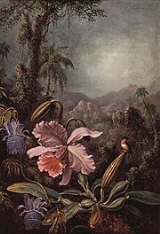
Martin Johnson Heade was a prolific
AmericanThe United States of America is a federal constitutional republic comprising fifty states and a federal district...
painterPainting is the practice of applying paint, pigment, color or other medium to a surface . The application of the medium is commonly applied to the base with a brush but other objects can be used. In art, the term painting describes both the act and the result of the action. However, painting is...
known for his
salt marshA salt marsh is an environment in the upper coastal intertidal zone between land and salt water or brackish water, it is dominated by dense stands of halophytic plants such as herbs, grasses, or low shrubs. These plants are terrestrial in origin and are essential to the stability of the salt marsh...
landscapesLandscape art is a term that covers the depiction of natural scenery such as mountains, valleys, trees, rivers, and forests, and especially art where the main subject is a wide view, with its elements arranged into a coherent composition. In other works landscape backgrounds for figures can still...
,
seascapeA seascape is a photograph, painting, or other work of art which depicts the sea, in other words an example of marine art. By a backwards development, the word has also come to mean the view of the sea itself, and be applied in planning contexts to geographical locations possessing a good view of...
s,
portraitthumb|250px|right|Portrait of [[Thomas Jefferson]] by [[Rembrandt Peale]], 1805. [[New-York Historical Society]].A portrait is a painting, photograph, sculpture, or other artistic representation of a person, in which the face and its expression is predominant. The intent is to display the likeness,...
s of tropical birds, and
still lifeA still life is a work of art depicting mostly inanimate subject matter, typically commonplace objects which may be either natural or man-made...
s. His painting style and subject matter, while derived from the
romanticismRomanticism was an artistic, literary and intellectual movement that originated in the second half of the 18th century in Europe, and gained strength in reaction to the Industrial Revolution...
of the time, is regarded by art historians as a significant departure from that of his peers.
Childhood and early career
Heade was born and raised in 1819 in
Lumberville, PennsylvaniaLumberville, Pennsylvania is a village on the Delaware River in Solebury Township, Bucks County, Pennsylvania, with a zip code of 18933. It is seven miles north of New Hope, Pennsylvania, and is located along River Road....
, a small hamlet along the
Delaware RiverThe Delaware River is a major river on the Atlantic coast of the United States.A Dutch expedition led by Henry Hudson in 1609 first mapped the river. The river was christened the South River in the New Netherland colony that followed, in contrast to the North River, as the Hudson River was then...
in
Bucks County, Pennsylvania- Industry and commerce :The boroughs of Bristol and Morrisville were prominent industrial centers along the Northeast Corridor during World War II. Suburban development accelerated in Lower Bucks in the 1950s with the opening of Levittown, Pennsylvania, the second such "Levittown" designed by...
. Until the mid 1850s, his family ran what is now called the Lumberville Store and Post Office, the village's sole general store. The family spelling of the name was Heed.
Heade received his first art training from the folk artist
Edward HicksEdward Hicks was an American folk painter, a distinguished minister of the Society of Friends, and he also became a Quaker icon because of his paintings.-Early life:...
, who lived in nearby Newton, and possibly also from Edward's cousin, Thomas Hicks. Heade was painting by 1839; his earliest known work is a portrait from that year. He traveled abroad and lived in Rome for two years. He first exhibited his work in 1841, at the
Pennsylvania Academy of the Fine ArtsThe Pennsylvania Academy of the Fine Arts is a museum and art school in Philadelphia, Pennsylvania. It was founded in 1805 and is the oldest art museum and school in the United States. The academy's museum is internationally known for its collections of 19th and 20th century American paintings,...
in Philadephia, and again in 1843 at the
National Academy of DesignThe National Academy Museum and School of Fine Arts, founded in New York City as the National Academy of Design – known simply as the "National Academy" – is an honorary association of American artists founded in 1825 by Samuel F. B. Morse, Asher B. Durand, Thomas Cole, Martin E...
in New York. Heade began exhibiting regularly in 1848, after another trip to Europe, and became an itinerant artist until he settled in New York in 1859.
Transition to landscape painting
Around 1857 Heade became interested in
landscapeLandscape art is a term that covers the depiction of natural scenery such as mountains, valleys, trees, rivers, and forests, and especially art where the main subject is a wide view, with its elements arranged into a coherent composition. In other works landscape backgrounds for figures can still...
painting, partly by meeting the established artists
John Frederick KensettJohn Frederick Kensett was an American artist and engraver. He attended school at Cheshire Academy, and studied engraving with his immigrant father, Thomas Kensett, and later with his uncle, Alfred Dagget...
and
Benjamin ChampneyBenjamin Champney was a painter whose name has become synonymous with White Mountain art of the 19th century. He began his training as a lithographer under celebrated marine artist Fitz Henry Lane at Pendleton's Lithography shop in Boston...
in the
White MountainsThe White Mountains are a mountain range covering about a quarter of the state of New Hampshire and a small portion of western Maine in the United States. Part of the Appalachian Mountains, they are considered the most rugged mountains in New England...
of
New HampshireNew Hampshire is a state in the New England region of the northeastern United States of America. The state was named after the southern English county of Hampshire. It is bordered by Massachusetts to the south, Vermont to the west, Maine and the Atlantic Ocean to the east, and the Canadian...
. Heade moved to
New York CityNew York is the most populous city in the United States and the center of the New York Metropolitan Area, one of the most populous metropolitan areas in the world. New York exerts a significant impact upon global commerce, finance, media, art, fashion, research, technology, education, and...
and took a studio in the Tenth Street Studio Building, which housed many of the famous Hudson River School artists of the time, such as
Albert BierstadtAlbert Bierstadt was a German-American painter best known for his lavish, sweeping landscapes of the American West. In obtaining the subject matter for these works, Bierstadt joined several journeys of the Westward Expansion...
, Sanford Gifford, and
Frederic Edwin ChurchFrederic Edwin Church was an American landscape painter born in Hartford, Connecticut. He was a central figure in the Hudson River School of American landscape painters...
. He became socially and professionally acquainted with them, and struck up a particularly close friendship with Church. Landscapes would ultimately form a third of Heade's total oeuvre.
Tropical subjects
Heade's interest in the tropics was piqued at least partly by the impact of
ChurchFrederic Edwin Church was an American landscape painter born in Hartford, Connecticut. He was a central figure in the Hudson River School of American landscape painters...
's monumental painting
Heart of the Andes (1859), now in the collection of the Metropolitan Museum of Art. Heade travelled to
BrazilBrazil , officially the Federative Republic of Brazil , is the largest country in South America. It is the world's fifth largest country, both by geographical area and by population with over 192 million people...
from 1863 to 1864 to paint an extensive series of small works, eventually numbering over forty, depicting
hummingbirdHummingbirds are birds that comprise the family Trochilidae. They are among the smallest of birds, most species measuring in the 7.5–13 cm range. Indeed, the smallest extant bird species is a hummingbird, the 5-cm Bee Hummingbird. They can hover in mid-air by rapidly flapping their wings...
s. He intended the series for a planned book titled "The Gems of Brazil", but the book was never published due to financial difficulty and Heade's concerns about the quality of the reproductions. Heade nevertheless returned to the tropics twice, in 1866 journeying to
NicaraguaNicaragua is the largest country in the Central American American isthmus, bordered by Honduras to the north and Costa Rica to the south. The country is situated between 11 and 14 degrees north of the Equator in the Northern Hemisphere, which places it entirely within the tropics. The Pacific Ocean...
, and in 1870 to
ColombiaColombia, officially the Republic of Colombia , is a unitary constitutional republic comprising thirty-two departments. The country is located in northwestern South America, bordered to the east by Venezuela and Brazil; to the south by Ecuador and Peru; to the north by the Caribbean Sea; to the...
,
PanamaPanama , officially the Republic of Panama , is the southernmost country of Central America. Situated on the isthmus connecting North and South America, it is bordered by Costa Rica to the northwest, Colombia to the southeast, the Caribbean Sea to the north and the Pacific Ocean to the south. The...
, and
JamaicaJamaica is an island nation of the Greater Antilles, in length, up to in width and 10,990 square kilometres in area. It is situated in the Caribbean Sea, about south of Cuba, and west of Hispaniola, the island harbouring the nation-states Haiti and the Dominican Republic...
. He continued to paint romantic works of tropical birds and lush foliage into his late career.
Salt marsh scenes
Heade's primary interest in
landscapeLandscape art is a term that covers the depiction of natural scenery such as mountains, valleys, trees, rivers, and forests, and especially art where the main subject is a wide view, with its elements arranged into a coherent composition. In other works landscape backgrounds for figures can still...
, and the works for which he is perhaps best known today, was the New England coastal
salt marshA salt marsh is an environment in the upper coastal intertidal zone between land and salt water or brackish water, it is dominated by dense stands of halophytic plants such as herbs, grasses, or low shrubs. These plants are terrestrial in origin and are essential to the stability of the salt marsh...
. Contrary to typical Hudson River School displays of scenic mountains, valleys, and waterfalls, Heade's marsh landscapes avoided depictions of grandeur. They focused instead on the horizontal expanse of subdued scenery, and employed repeating motifs that included small haystacks and diminutive figures. Heade also concentrated on the depiction of light and atmosphere in his marsh scenes. These and similar works have led some historians to characterize Heade as a
LuministLuminism is an American landscape painting style of the 1850s – 1870s, characterized by effects of light in landscapes, through using aerial perspective, and concealing visible brushstrokes...
painter. In 1883 Heade moved to Saint Augustine, Florida and took as his primary landscape subject the surrounding subtropical marshland.
Later life and still lifes
Heade married and moved to
St. Augustine, FloridaSt. Augustine is a city in the northeast section of Florida and the county seat of St. Johns County, Florida, United States. Founded in 1565 by Spanish explorer and admiral Pedro Menéndez de Avilés, it is the oldest continuously occupied European-established city and port in the continental United...
in 1883. He remained there and continued to paint until his death in 1904.
During his later years in St. Augustine, Heade painted numerous still lifes of southern flowers, especially
magnoliaMagnolia is a large genus of about 210 flowering plant species in the subfamily Magnolioideae of the family Magnoliaceae. It is named after French botanist Pierre Magnol....
blossoms laid on velvet. This was a continuation of an interest in still life that Heade had developed since the 1860s. His earlier works in this genre typically depict a display of flowers arranged in an ornate vase of small or medium size on a cloth-covered table. Heade was the only 19th century American artist to create such an extensive body of work in both still life and
landscapeLandscape art is a term that covers the depiction of natural scenery such as mountains, valleys, trees, rivers, and forests, and especially art where the main subject is a wide view, with its elements arranged into a coherent composition. In other works landscape backgrounds for figures can still...
.
Heade and the Hudson River School
Art historians have come to disagree with the common view that Heade is a
Hudson River SchoolThe Hudson River School was a mid-19th century American art movement embodied by a group of landscape painters whose aesthetic vision was influenced by romanticism...
painter, a view given wide currency by Heade's inclusion in a landmark exhibition of Hudson River School
landscapeLandscape art is a term that covers the depiction of natural scenery such as mountains, valleys, trees, rivers, and forests, and especially art where the main subject is a wide view, with its elements arranged into a coherent composition. In other works landscape backgrounds for figures can still...
s at the
Metropolitan Museum of ArtThe Metropolitan Museum of Art is a renowned art museum in New York City. Its permanent collection contains more than two million works, divided into nineteen curatorial departments. The main building, located on the eastern edge of Central Park along Manhattan's Museum Mile, is one of the...
in 1987.
The leading Heade scholar and author of Heade's
catalogue raisonnéThe typical catalogue raisonné is a monograph giving a comprehensive catalogue of artworks by an artist.The essential elements of a catalogue raisonné are that it purports to be an exhaustive list of works for a defined subject matter describing the works in a way so that they may be reliably...
,
Theodore E. Stebbins, Jr.Theodore E. Stebbins Jr. is an American art historian, museum curator, university professor, and writer.Stebbins is the Curator of American Art at Harvard University's Fogg Art Museum. For 22 years, from 1977 to 1999, he was the John Moors Cabot Curator of American Paintings at the Museum of Fine...
, wrote some years after the 1987 exhibition, "Other scholars—myself included—have increasingly come to doubt that Heade is most usefully seen as standing within that school."
According to the Heade catalogue raisonné, only around 40 percent of his paintings were landscapes. The remaining majority were still lifes, paintings of birds, and portraits, subjects unrelated to the Hudson River School. Of Heade's
landscapeLandscape art is a term that covers the depiction of natural scenery such as mountains, valleys, trees, rivers, and forests, and especially art where the main subject is a wide view, with its elements arranged into a coherent composition. In other works landscape backgrounds for figures can still...
s, perhaps only 25 percent treated traditional Hudson River School subject matter.
Heade had less interest in topographically accurate views than the Hudson River painters, and instead focused on mood and the effects of light. Stebbins wrote, "If the paintings of the shore as well as the more conventional compositions...might lead one to think of Heade as a Hudson River School painter, the [marsh scenes] make it clear that he was not."
Legacy and collections
Heade was not a famous artist during his time, and for much of the first part of the 20th century was nearly forgotten. A re-awakening of interest in American 19th century art around
World War IIWorld War II, or the Second World War , was a global conflict lasting from 1939 to 1945, involving most of the world's nations—including all of the great powers—eventually forming two opposing military alliances: the Allies and the Axis...
sparked new appreciation of his work. Heade's work in particular received critical attention with the exhibition in 1943 of his painting
Thunderstorm Over Narragansett Bay (1868), as part of the show "Romantic Painting in America" at the
Museum of Modern ArtThe Museum of Modern Art is an art museum in Midtown Manhattan in New York City, on 53rd Street, between Fifth and Sixth Avenues. It has been important in developing and collecting modernist art, and is often identified as the most influential museum of modern art in the world...
. Art historians have come to consider him as one of the most important American artists of his generation. His work has inspired contemporary artists such as
David BierkDavid Bierk , was an American-born Canadian painter. His work is exhibited at the Nancy Hoffman Gallery in New York City. According to Askart.com , Bierk was primarily active in California and Canada, and he was best known for producing landscape paintings, as well as paintings incorporating "Old...
and
Ian HornakIan Hornak was an American draughtsman, painter and printmaker associated with the Hyperrealist and Photorealist art movements.-Biography:...
.
His works are in most major American museums, including the
Museum of Fine ArtsThe Museum of Fine Arts in Boston, Massachusetts, is one of the largest museums in the United States, attracting over one million visitors a year. It contains over 450,000 works of art, making it one of the most comprehensive collections in the Americas...
in Boston, Massachusetts, which owns the nation's outstanding collection of his works, including about 30 paintings as well as numerous drawings and sketchbooks; the Metropolitan Museum of Art in New York City; and the
National Gallery of ArtThe National Gallery of Art and its Sculpture Garden is a national art museum, located on the National Mall between 3rd and 9th Streets at Constitution Avenue NW, in Washington, DC...
in Washington, D.C.
In 1955, Robert McIntyre, art historian and director of the Macbeth Gallery, donated a cache of Heade's personal papers to the
Archives of American ArtThe Archives of American Art is the largest collection of primary resources documenting the history of the visual arts in the United States. More than 16 million items of original material are housed in the Archives' research centers in Washington, D.C...
, part of the
Smithsonian InstitutionThe Smithsonian Institution is an educational and research institute and associated museum complex, administered and funded by the government of the United States and by funds from its endowment, contributions, and profits from its retail operations, concessions, licensing activities, and magazines...
. These papers included, among other things, Heade's sketchbook, notes, and letters from his friend and fellow artist,
Frederic Edwin ChurchFrederic Edwin Church was an American landscape painter born in Hartford, Connecticut. He was a central figure in the Hudson River School of American landscape painters...
. In 2007, these papers were digitized and made accessible on the Web as the
Martin Johnson Heade Papers Online.
In 1999 and 2000, Heade was the subject of a major exhibition organized by Theodore E. Stebbins, Jr. It traveled from the Museum of Fine Arts in Boston to the National Gallery of Art in DC, ending at the
Los Angeles County Museum of ArtThe Los Angeles County Museum of Art is an art museum in Los Angeles, California. It is located on Wilshire Boulevard along Museum Row in the Miracle Mile vicinity of Los Angeles, adjacent to the George C. Page Museum and La Brea Tar Pits....
.
In 2004, Heade was honored with a stamp from the U.S. Postal Service featuring his 1890 oil-on-canvas painting, "Giant Magnolias on a Blue Velvet Cloth." As Stebbins notes in his writings, Heade's work has also been copied and forged extensively. It should be noted, however, that since Heade was not popular during his lifetime, there were few contemporaries who emulated his work. 20th century copies are therefore readily apparent as fakes, since it takes oil paint decades to dry out and harden.
Discoveries of works by Heade
Theodore Stebbins, Jr., now curator of American art at the Harvard University Art Museums,
writes, "...one of the things that has always made the study of Heade's work exciting is the way his paintings continue to turn up in garage sales and other unlikely places all over the country, in a manner that the paintings of Frederic E. Church and John F. Kensett do not." Stebbins speculates the reason for this was Heade's popularity with middle-class buyers, and his willingness to distribute his works widely across the country. Among the more spectactular Heade discoveries have included:
- Thunderstorm on Narragansett Bay, now in the collection of the Amon Carter Museum
The Amon Carter Museum of American Art is located in Fort Worth, Texas. It was established by Amon G. Carter to house his collection of paintings and sculpture by Frederic Remington and Charles M. Russell. Carter’s will provided a museum in Fort Worth devoted to American art.When the museum opened...
, Fort Worth, Texas, was originally discovered in an antiques store in Larchmont, New York in 1943 by NYC art dealer Victor Spark.
- Magnolia Blossoms on Blue Velvet and Cherokee Roses, now in private collections, were purchased at an estate sale in Arizona for $60 in 1996. They sold at Christie's
Christie's is an art business and a fine arts auction house.- History :The official company literature states that founder James Christie conducted the first sale in London, England, on 5 December 1766, and the earliest auction catalogue the company retains is from December 1766...
auction house later that year for $937,500 and $134,500 respectively.
- Two Magnolias on Blue Plush was originally purchased for $29 at a rummage sale by a Wisconsin man in 1989. It sold at Christie's auction house in 1999 for $882,500. It is now in the collection of James W. McGlothlin of Bristol, Virginia.
- Magnolias on Gold Velvet Cloth was used to cover a hole in the wall of an Indiana resident for years. The owner became curious about the value of the painting after playing an art-related board game, and verified its authenticity with a New York art gallery. The Museum of Fine Arts in Houston purchased the work for $1,250,000 in 1999.
- An un-named Heade salt marsh landscape
Landscape art is a term that covers the depiction of natural scenery such as mountains, valleys, trees, rivers, and forests, and especially art where the main subject is a wide view, with its elements arranged into a coherent composition. In other works landscape backgrounds for figures can still...
now titled "River Scene" was discovered in the attic of a Boston-area resident in 2003. It sold at a local auction house to an art dealer for $1,006,250 and was featured on the PBSThe Public Broadcasting Service is an American non-profit public broadcasting television network with 354 member TV stations in the United States which hold collective ownership. Its headquarters is in Arlington, Virginia....
television show, "Find!". It was purchased by a private collector, and is now on view at the Fogg Art Museum, Cambridge, Mass.
- In 2004 a Florida woman was informed of the Heade discovery featured on "Find!" by her son, and inquired about a small 6 by 12 inch landscape that had hung in her living room. The painting, which her late husband had purchased for several dollars in St. Augustine in the 1970s, was authenticated as a late Heade marsh landscape. It sold at auction to an art dealer for $218,500.
- A painting was found in a Massachusetts attic in 2006 and consigned to a local auction in Fall River. The painting was authenticated by Dr. Theodore Stebbins, Jr. as a Heade, having been painted between 1883 and 1890 in St. Augustine, Florida. It sold for $198,000 on November 22, 2006 .
External links