
|
|
|
|
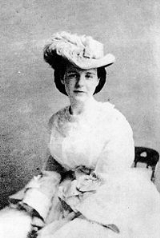
Martha Bulloch
|
| |
|
| |
Martha Bulloch Roosevelt (July 8, 1835 – February 14, 1884) was the mother of US President Theodore Roosevelt and the paternal grandmother of Eleanor Roosevelt. She married Theodore Roosevelt, Sr., and had four children. She was a descendent of Archibald Bulloch. A true southern belle, she was affectionately known as Mittie, and is thought to have been the inspiriation of Scarlett O'Hara.
ha was born in Hartford, Connecticut on July 8, 1835 to Major James Stephens Bulloch and Martha (Stewart) Elliott Bulloch, where her mother was visiting her stepson James Dunwoody Bulloch at boarding school.

Discussion
Ask a question about 'Martha Bulloch'
Start a new discussion about 'Martha Bulloch'
Answer questions from other users
|
Recent Posts

Encyclopedia
Martha Bulloch Roosevelt (July 8, 1835 – February 14, 1884) was the mother of US President Theodore Roosevelt and the paternal grandmother of Eleanor Roosevelt. She married Theodore Roosevelt, Sr., and had four children. She was a descendent of Archibald Bulloch. A true southern belle, she was affectionately known as Mittie, and is thought to have been the inspiriation of Scarlett O'Hara.
Childhood
Martha was born in Hartford, Connecticut on July 8, 1835 to Major James Stephens Bulloch and Martha (Stewart) Elliott Bulloch, where her mother was visiting her stepson James Dunwoody Bulloch at boarding school. After a few months in Hartford, baby Mittie and her mother returned to their home in Savannah where Mittie was first raised.
When Mittie was five, Major Bulloch moved the family to Cobb County, Georgia and the new village that would become Roswell, Georgia. It lies just north of the Chattahoochee River and the city of Atlanta, Georgia. Major Bulloch had gone there to be a partner in a new cotton mill with Roswell King, the founder of the town. Major Bulloch had a mansion built. Soon after it was completed in 1839, the family moved into Bulloch Hall. Because it is a significant antebellum structure, it has been listed on the National Register of Historic Places.
This was a wealthy planter family, part of the elite of Georgia. In 1850, the Bullochs held thirty-one enslaved African-Americans, most of whom worked in their cotton fields. Others were assigned to domestic production of cooking, sewing, and related work to keep the large household running. (Recent research in Bulloch records identified 33 slaves by name who were held by the family. They have been memorialized on a plaque on the mansion grounds. )
After Major Bulloch's death in 1849, the family's fortunes declined somewhat, but they nonetheless gave Mittie a grand party for her wedding. As was expected, Martha Bulloch's brothers, James and Irvine Bulloch fought in the Civil War as Confederate officers, and ended up living in England after the war.
On a separate note, it is believed that the character of Scarlett O'Hara, from Margaret Mitchell's novel, Gone With the Wind, was based on Mittie. Mittie was a true southern belle, as she was a beautiful and wonderfully happy woman at her best of times, not unlike Margaret Mitchell's fictional Scarlett O'Hara of whom Mittie was probably one real-life source; Mitchell had interviewed Mittie's best childhood friend and bridesmaid, Evelyn King, for a story in the Atlanta Journal newspaper in the early 1930s. In that interview Martha's remarkable beauty, charm and fun-loving nature was laid out in detail. At her worst, however, Mittie was a highly sensitive and emotionally fragile woman. At the least provocation, Mittie would withdraw for days into a self-imposed isolation. During these times, she would be invisible both to the family and to her social life, withdrawing to her room, taking one bath after another and suffering from a host of illnesses. Add to this the fact that his wife, Mittie was terrified for her brothers, James and Irvine Bulloch who were both involved in the Civil War on the Confederate side. James was a confederate agent in Britain and Irvine was the youngest officer on the CSS Alabama, firing the last gun before the ship sank in battle off the coast of Cherbourg, France. These emotional crises were mitigated somewhat by the incredible maturity and management abilities of her eldest daughter, Bamie, who often stepped into a leadership role, especially when her father, "Thee" was often out of town in Washington, visiting Lincoln and lobbying Congress for programs to support the northern troops in the field and their families back home. Nevertheless, had Thee, a Northerner, left his delicate home situation to literally fight against his wife's brothers and her southern kinfolk, the emotional consequences to his already fragile wife would probably have been catastrophic.
Marriage to Theodore Roosevelt, Sr.
Mittie married Theodore Roosevelt, Sr. on December 22, 1853 at the Greek Revival-style family mansion Bulloch Hall in Roswell; they were wedded in front of the fireplace mantle.
Mittie and her new husband soon moved to the bustling city of New York, settling in Manhattan. Shortly after, both her mother Martha and sister, Anna Bulloch, moved north to join them in New York. Mittie bore four children: Anna, nicknamed Bamie, (1855-1931); Theodore (1858-1919); Elliott (1860-1894), the father of Eleanor Roosevelt; and Corinne (1861-1933), grandmother of Joseph and Stewart Alsop. During her children's education, Mittie and her family traveled to Europe, predominantly spending time in France, Austria, and Germany.
Death
Martha Roosevelt died of typhoid fever on February 14 1884, aged forty-eight, on the same day and in the same house as her son Theodore's first wife, Alice Lee Roosevelt, died of Bright's disease, and two days after the birth of her own granddaughter, Alice Roosevelt Longworth. She is buried at Green-Wood Cemetery located in Brooklyn, New York.
Mittie described in Theodore Roosevelt's Autobiography
Theodore Roosevelt, in his autobiography published in 1913, described his mother with these words, "My mother, Martha Bulloch, was a sweet, gracious, beautiful Southern woman, a delightful companion and beloved by everybody. She was entirely 'unreconstructed' (sympathetic to the Southern Confederate cause) to the day of her death."
See also
Sources
Primary sources
- Roosevelt, Theodore. An Autobiography. (1913)
Secondary sources
- Beale Howard K. Theodore Roosevelt and the Rise of America to World Power (1956).
- Brands, H.W. Theodore Roosevelt (2001)
- Dalton, Kathleen. Theodore Roosevelt: A Strenuous Life. (2002)
- Harbaugh, William Henry. The Life and Times of Theodore Roosevelt. (1963)
- McCullouch, David. Mornings on Horseback, The Story of an Extraordinary Family, a Vanished Way of Life, and the Unique Child Who Became Theodore Roosevelt (2001)
- Morris, Edmund The Rise of Theodore Roosevelt (1979)
- Morris, Edmund Theodore Rex. (2001)
- Mowry, George. The era of Theodore Roosevelt and the birth of modern America, 1900-1912. (1954)
External links
|
| |
|
|