

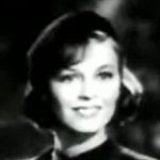
Margaret Sullavan

Encyclopedia
Margaret Brooke Sullavan (May 16, 1909January 1, 1960; studio publicity incorrectly reported her year of birth as 1911) was an American stage and film actress. Sullavan started her career on the stage in 1929. In 1933 she caught the attention of movie director John M. Stahl
and had her debut on the screen that same year in Only Yesterday
.
Sullavan preferred working on the stage and did only 16 movies, four of which were opposite James Stewart
in a popular partnership. She retired from the screen in the early forties, but returned in 1950 to make her last movie, No Sad Songs For Me (1950), in which she plays a woman who is dying of cancer. For the rest of her career she would only appear on the stage.
Sullavan was nominated for an Academy Award for Best Actress
for her performance in Three Comrades
(1938). She died of an overdose of barbiturates on January 1, New Year's Day, 1960, at the age of 50.
, the daughter of a wealthy stockbroker, Cornelius Sullavan and his wife, Garland Brooke. The first years of Margaret's childhood were spent isolated from other children. She suffered from a painful muscular weakness in the legs that prevented her from walking, so that she was unable to mingle with other children until the age of six. After recovery she emerged as an adventurous and tomboyish child who preferred playing with the children from the poorer neighborhood, much to the regrets of her class-conscious parents.
She attended boarding school at Chatham Episcopal Institute (now Chatham Hall
), where she was president of the student body and delivered the salutary oration in 1927. She moved to Boston and lived with her half-sister, Weedie, where she studied dance at the Boston Denishawn studio and (against her parents' wishes) drama at the Copley Theatre. When her parents cut her allowance to a minimum, Sullavan defiantly paid her way as a clerk in the Harvard Cooperative Bookstore (The Coop), located in Harvard Square
, Cambridge
.
, who together had established the University Players
on Cape Cod
the summer before, persuaded Sullavan to join them for their second summer season. Another member of the University Players
and one who had the comic lead in Close Up was Henry Fonda
. In the summer 1929 Sullavan appeared opposite Fonda in The Devil in the Cheese, her debut on the professional stage. Sullavan returned for most of University Players
's 1930 season. In 1931, she squeezed in one production with the University Players between the closing of the Broadway production of A Modern Virgin in July and its tour in September. She rejoined the University Players for most of its 18-week 1930-31 winter season in Baltimore.
Sullavan's parents did not approve of her choice of career. However, in 1930 she played the lead in Strictly Dishonorable
by Preston Sturges with her parents among the audience. Confronted with her evident talent their objections ceased. "To my deep relief", Sullavan later recalled. "I thought I'd have to put up with their yappings on the subject forever." A Shubert scout saw her in that play as well and eventually she met Lee Shubert
himself. At that moment Sullavan suffered from a bad case of laryngitis. Consequently, her voice was huskier than usual. Shubert loved it. In subsequent years Sullavan would joke that she cultivated that "laryngitis" into a permanent hoarseness by standing in every available draft.
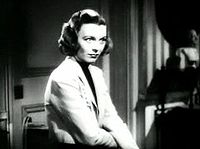 Sullavan made her debut on Broadway
in A Modern Virgin (a comedy by Elmer Harris
), on May 20, 1931. At one point in 1932 she starred in four Broadway flops in a row (If Love Were All,
Happy Landing, Chrysalis (with Humphrey Bogart) and Bad Manners), but the critics praised Sullavan for her performances in all of them.
In March 1933, Sullavan replaced another actor in Dinner at Eight in New York. Movie director John M. Stahl
happened to be watching the play and was intrigued by Sullavan and decided she would be perfect for a picture he was planning, Only Yesterday
. At that time Sullavan had already turned down offers from Paramount
and Columbia
for five-year contracts. Sullavan was offered a three-year, two-pictures-a-year contract at $1,200 a week. She accepted it and had a clause put in her contract that allowed her to return to the stage on occasion. Later on in her career Sullavan would only sign short-term contracts because she did not want to be "owned" by any studio.
.
Sullavan chose her scripts carefully. She was not satisfied with her performance in Only Yesterday. When she saw herself in the early rushes, she had been so appalled that she had tried to buy out her contract for $2,500, but Universal refused. In his November 10, 1933, review in The New York Herald Tribune, Richard Watts, Jr.
wrote that Sullavan "plays the tragic and lovelorn heroine of this shrewdly sentimental orgy with such forthright sympathy, wise reticence and honest feeling that she establishes herself with some definiteness as one of the cinema people to be watched". She followed that role with one in Little Man, What Now?
(1934), which tells the story of a couple struggling to survive in the poverty of post–World War I Germany.
Originally, Universal had been reluctant to make a movie about unemployment, starvation and homelessness, but Little Man had been an important project to Sullavan. After Only Yesterday
she wanted to try "the real thing". "It's a slice of life ... [L]ife as so many people are living it today in America and anywhere". She later said that it had been one of the few things she had done in Hollywood that gave her a great measure of satisfaction.
The Good Fairy
(1935) was a comedy that Sullavan, although not a natural comedienne, had insisted on doing to demonstrate her "wide-ranging versatility". During the production, she married its director, William Wyler
.
King Vidor's So Red the Rose (1935) dealt with the Civil War effects on the South and preceded
Gone With the Wind
by four years and Margaret Mitchell's novel by one year. Sullavan played a childish Southern-belle who matures into a responsible woman. The film also dealt with the situation of the freed black characters.
In Next Time We Love
(1936), Sullavan plays opposite the then-unknown James Stewart
. Sullavan had been campaigning for Stewart to be her leading man and the studio complied with her wish out of fear that she would otherwise stage a threatened strike. The film dealt with a married couple that has grown apart over the years. The plot was unconvincing and simple, but the gentle interplay between Sullavan and Stewart saves the movie from being a soapy and sappy experience. Next Time We Love
would be the beginning of one of Hollywood's most endearing partnerships, that of Sullavan and Stewart. They would eventually make four movies together.
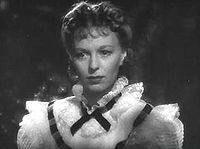 In the comedy The Moon is Our Home (1936), Sullavan plays opposite her ex-husband Henry Fonda
. The original script was rather pallid and Dorothy Parker
and Alan Campbell
were brought in to punch up the dialogue, reportedly at Sullavan's insistence. Sullavan and Fonda play a newly married couple and the movie is a cavalcade of insults and quips.
Sullavan's seventh film, Three Comrades
(1938), is a drama set in post–World War I Germany. Three returning German soldiers meet Sullavan who joins them and eventually marries one of them. She gained an Oscar nomination for her role and was named the year's best actress by the New York Film Critics Circle
.
Sullavan reunited with Stewart in The Shopworn Angel
(1938). Stewart played a sweet, naive Texan soldier on his way to Europe (World War I) who marries Sullavan on the way. Her ninth film was the rather soapy The Shining Hour
(1938), playing the suicidal sister to Joan Crawford
. In The Shop Around the Corner
(1940), Sullavan and Stewart worked together again, playing colleagues who do not get along at work, but have both responded to a lonely-hearts ad and are (without knowing it) exchanging letters with each other.
The Mortal Storm
(1940) was the last movie Sullavan and Stewart ever did together. Sullavan is a young German girl engaged to a confirmed Nazi (Robert Young
) in 1933. When she realizes the true nature of his political views, she breaks the engagement and turns her attention to anti-Nazi Stewart. Later, trying to flee the Nazi regime, Sullavan and Stewart attempt to ski across the border to safety in Austria. In the attempt Sullavan is gunned down by the Nazis (under orders from her ex-fiance). Stewart, at her request, picks her up and skis into Austria so she can die in a free country.
Back Street
(1941) was lauded as one of the best performances of Sullavan's Hollywood career. She wanted Charles Boyer
to play opposite her so much that she agreed to surrender top billing to him. Boyer plays a selfish and married banker and Sullavan his long-suffering mistress. Although he loves Sullavan, he is unwilling to leave his wife and family in favour of her. So Ends Our Night
(1941) is yet another wartime drama. Sullavan (on loan for a one-picture deal from Universal) plays a Jewish girl perpetually on the move with falsified passport and identification papers and always fearing that the officials will discover her game. On her way across Europe she meets up with a young Jewish boy (Glenn Ford
) and the hunted couple falls in love.
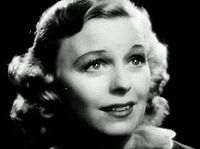 A 1940 court decision obligated Sullavan to fulfill her original 1933 Universal agreement. Two additional pictures were made legal "musts". Back Street
(1941) had been the first and as Universal long had been urging a light comedy on her, Appointment for Love (1941) would be Sullavan's last picture with that company. In the film, Sullavan appeared with Boyer again. Boyer's character marries Sullavan who tells him that his past affairs mean nothing to her. She insists that each have an apartment in the same building and that they meet only once a day, at 7 a.m.
Cry 'Havoc'
(1943) is another war drama (World War II) but one of the rare all-female pictures. Sullavan plays the strong mother figure who keeps a bunch of ill-assorted nurses in line in a dugout in Bataan, while they are awaiting the advance of Japanese soldiers who are about to take over. It was the last film that Sullavan did with MGM. After its completion she was free of all movie commitments. She had often referred to MGM and Universal
as "jails". When her husband, Leland Hayward
, tried to read her the good reviews of Cry 'Havoc, she responded with usual bluntness: "You read them, use them for toilet paper. I had enough hell with that damned picture while making it - I don't want to read about it now!"
Sullavan retired from films from 1943 to 1950 and concentrated on her family and the stage. She came back to the screen in 1950 to do one last picture, No Sad Songs for Me. She played a fifties suburban wife and mother who learns that she will die of cancer within a year and who then determines to find a "second" wife for her soon-to-be-widower husband (Wendell Corey
). Natalie Wood
, then eleven, plays their daughter. After No Sad Songs for Me and its favorable reviews, Sullavan had a number of offers for other films, but she decided to concentrate on the stage for the rest of her career.
Sullavan had a reputation of being temperamental and straightforward. On one occasion Henry Fonda
(then her ex-husband) had decided to take up a collection for the fireworks on July 4. When Sullavan refused to make a contribution, Fonda complained loudly to a fellow actor. Then Sullavan rose from her seat and doused Fonda from head to foot with a pitcher of ice water. Fonda made a stately exit, and Sullavan, composed and unconcerned, returned to her table and ate heartily.
Another of her blowups almost literally killed Sam Wood
, one of the founders of the Motion Picture Alliance. Wood was a keen anti-Communist. He dropped dead from a heart attack shortly after a raging argument with Sullavan, who had refused to fire a writer on a proposed film on account of his left-wing views. Louis B. Mayer
always seemed wary and nervous in her presence. "She was the only player who outbullied Mayer", Eddie Mannix, MGM, later said of Sullavan. "She gave him the willies".
are among the highlights of their respective early careers. In 1935, Sullavan had decided on doing Next Time We Love
. She had strong reservations about the story, but she had to "work off the damned contract". The script contained a role she thought might be ideal for Stewart.
It was years earlier, during a casual conversation with some fellow actors on Broadway that Sullavan first predicted that Stewart one day would become a major Hollywood star. By 1936, Stewart was a contract player at MGM but getting only small parts in B-movies. At that time Sullavan worked for Universal
and when she brought up Stewart's name, they were puzzled. The Universal casting-people had never heard of him. At Sullavan's suggestion Universal agreed to test him for her leading man and eventually he was borrowed from a willing MGM to star with Sullavan in Next Time We Love
.
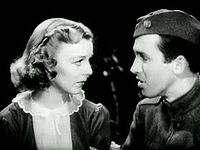 Stewart had been nervous and unsure of himself during the early stages of production. At that time he had only had two minor MGM parts which had not given him much camera experience. The director, Edward H. Griffith, began bullying Stewart. "Maggie, he's wet behind the ears", Griffith told Sullavan. "He's going to make a mess of things". Sullavan believed in Stewart and spent the evenings coaching him and helping him scale down his awkward mannerisms and hesitant speech that were soon to be famous around the world. "It was Margaret Sullavan who made James Stewart a star", director Griffith later said. "And she did, too", Bill Grady from MGM agreed. "That boy came back from Universal so changed I hardly recognized him".
The inevitable gossip in Hollywood at that time (1935–36) was that William Wyler
, Sullavan's then-husband, was suspicious about his wife's and Stewart's private rehearsing together. When Sullavan divorced Wyler in 1936 and married Leland Hayward
that same year, they moved to a colonial house just a block down from Stewart. Stewart's frequent visits to the Sullavan/Hayward home soon restoked the rumors of his romantic feelings for Sullavan.
Sullavan and Stewart's second movie together was The Shopworn Angel
(1938). "Why, they´re red-hot when they get in front of a camera", Louis B. Mayer
said about their onscreen chemistry. "I don't know what the hell it is, but it sure jumps off the screen". Walter Pidgeon
, who was part of the triangle in The Shopworn Angel later recalled: "I really felt like the odd-man-out in that one. It was really all Jimmy and Maggie ... It was so obvious he was in love with her. He came absolutely alive in his scenes with her, playing with a conviction and a sincerity I never knew him to summon away from her". Eventually the duo would do four movies together from 1936-1940 (Next Time We Love
, The Shopworn Angel
, The Shop Around the Corner
and The Mortal Storm
).
on Broadway between movies). "But as long as the flesh-and-blood theatre will have me, it is to the flesh-and-blood theatre I'll belong. I really am stage-struck. And if that be treason, Hollywood will have to make the most of it".
Another reason for her early retirement from the screen (1943) was that she wanted to spend more time with her children, Brooke, Bridget and Bill (then 6, 4 and 2 years old). She felt that she had been neglecting them and felt guilty about it. Sullavan would still do stage work on occasion. From 1943-44 she was the sexually inexperienced, but curious, Sally Middleton in The Voice of the Turtle
(by John Van Druten) on Broadway and later in London (1947). After her short return to the screen in 1950 with No Sad Songs for Me, she did not return to the stage until 1952. Her choice then was as the suicidal Hester Collyer, who meets fellow sufferer Mr. Miller (played by Herbert Berghof) in The Deep Blue Sea by Terence Rattigan
. Later, in 1953 she agreed to appear in Sabrina Fair
by Samuel Taylor. Although 44 at the time she played the chauffeur's 23-year-old daughter, Sabrina Fairchild, co-starring with Joseph Cotten
.
In 1955-56 Sullavan appeared in Janus
, a comedy by playwright Carolyn Green. Sullavan played the part of Jessica who writes under the pen name Janus and Robert Preston
played her husband. The play ran for 251 performances from November 1955 to June 1956. In the late fifties Sullavan's hearing and depression were getting worse. However, in 1959 she agreed to do
Sweet Love Remembered by playwright Ruth Goetz. It was to be Sullavan's first Broadway appearance in four years. Rehearsals began on December 1, 1959. Sullavan had mixed emotions about a return to acting and her depression soon became clear to everyone: "I loathe acting", she said on the very day she started rehearsals. "I loathe what it does to my life. It cancels you out. You cannot live while you are working. You are a person surrounded by an unbreachable wall".
That was the last interview she gave. The play was to open on February 4, 1960. Sullavan died on January 1, 1960.
Margaret Sullavan was inducted, posthumously, into the American Theatre Hall of Fame
in 1981.
on December 25, 1931 in Baltimore
, while both were performing with the University Players
in its 18-week winter season there. She was exactly four years Fonda's junior: they shared the birth date of May 16. However, Fonda's lack of experience and confidence did not go well with Sullavan and the marriage lasted only two months. Sullavan was then involved with Broadway producer Jed Harris
for some time.
In late 1934, she married William Wyler
, the director of her next movie, The Good Fairy
(1935). Her second marriage lasted just over a year and they divorced in March 1936.
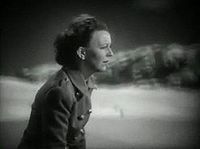 Sullavan's third husband was agent and producer Leland Hayward
. Hayward had been Sullavan's agent since 1931 and their relationship had been deepening all through 1936; they had already become lovers, and Brooke, their "love child", had been conceived that October. They both wanted the baby and married on November 15, 1936.
With the birth of her first baby, Sullavan's personality mellowed and softened somewhat. Sullavan was to have a baby every other year - Brooke in 1937, Bridget in 1939 and Bill in 1941. Their marriage lasted about 11 years and ended when Sullavan discovered that Hayward was cheating on her with Slim Keith
. At Sullavan's insistence, she and Hayward divorced in 1947, and three years later she married Kenneth Wagg, an English investment banker, to whom she was married at the time of her death.
Sullavan's sons-in-law include actor/director/artist Dennis Hopper
, the second husband of her daughter Brooke Hayward
, and Peter Duchin
, Brooke Hayward
's third husband
.
that worsened as she aged, making her more and more hard of hearing. Her voice had developed a throatiness because she could hear low tones better than high ones. From early 1957 Sullavan's hearing was worsening; she was becoming depressed and sleepless and often wandered about all night. She would often go to bed and stay there for days, her only words: "Just let me be, please". Sullavan had kept her hearing problem largely hidden. On January 8, 1960 (one week after Sullavan's death), The New York Post reporter Nancy Seely wrote: "The thunderous applause of a delighted audience—was it only a dim murmur over the years to Margaret Sullavan? Did the poised and confident mien of the beautiful actress mask a sick fear, night after night, that she'd miss an important cue?"
In addition to her hearing defect, Sullavan's children, Brooke
, and in particular Bridget and Bill, often proved rebellious and contrary. As a result of the divorce from Hayward, the family fell apart. Sullavan felt that Hayward was trying to alienate their children from her. When the children went to California to visit their father they were so spoiled with expensive gifts that, when they returned to their mother in Connecticut, they were deeply discontented with what they saw as a staid lifestyle.
By 1955, when Sullavan's two younger children told their mother that they preferred to stay with their father permanently, she suffered a nervous breakdown. Sullavan's older daughter, Brooke, in 1977 wrote about the breakdown in her autobiography Haywire
: Sullavan had humiliated herself by begging her son to stay with her. He remained adamant and his mother had started to cry. "This time she couldn't stop. Even from my room the sound was so painful I went into my bathroom and put my hands on my ears". In another scene from the book, a friend of the family (Millicent Osborne) had been alarmed by the sound of whimpering from the bedroom: "She walked in and found mother under the bed, huddled up in a fetal position. Kenneth was trying to get her out. The more authoritative his tone of voice, the farther under she crawled. Millicent Osborne took him aside and urged him to speak gently, to let her stay there until she came out of her own accord". Eventually Sullavan agreed to spend some time (two and a half months) in a private mental institution. Her two younger children also spent time in various institutions.
, but shortly after 6:00 p.m. she was pronounced dead. No note had been found to indicate suicide, and no conclusion was reached as to whether her death was the result of a deliberate or an accidental overdose. The death was later identified as apparent suicide. The county coroner, however, officially ruled the death an accident. A few days before she died, in her final interview, she said: "Theater can be a very horrible, cruel place!" Sullavan was interred at Saint Mary's Whitechapel Episcopal Churchyard, Lancaster, Virginia.
, wrote Haywire, a best-selling memoir about her family, which was made into a television movie starring Lee Remick
.
John M. Stahl
John Malcolm Stahl was an American film director and producer.Born in New York City, New York, he began working in the city's growing motion picture industry at a young age and directed his first silent film short in 1914. In the early 1920s Stahl signed on with Louis B...
and had her debut on the screen that same year in Only Yesterday
Only Yesterday (1933 film)
Only Yesterday is a 1933 drama film about a young woman who becomes pregnant by her boyfriend before he rushes off to fight in World War I. It stars Margaret Sullavan and John Boles. The film was based on the novel Briefe einer unbekannten by Stefan Zweig, though he was not credited...
.
Sullavan preferred working on the stage and did only 16 movies, four of which were opposite James Stewart
James Stewart
James Stewart was a Hollywood movie actor and USAF brigadier general.James Stewart may also refer to:-Noblemen:*James Stewart, 5th High Steward of Scotland*James Stewart, the Black Knight of Lorn James Stewart (1908–1997) was a Hollywood movie actor and USAF brigadier general.James Stewart...
in a popular partnership. She retired from the screen in the early forties, but returned in 1950 to make her last movie, No Sad Songs For Me (1950), in which she plays a woman who is dying of cancer. For the rest of her career she would only appear on the stage.
Sullavan was nominated for an Academy Award for Best Actress
Academy Award for Best Actress
Performance by an Actress in a Leading Role is one of the Academy Awards of merit presented annually by the Academy of Motion Picture Arts and Sciences to recognize an actress who has delivered an outstanding performance while working within the film industry...
for her performance in Three Comrades
Three Comrades (film)
Three Comrades 1938 is a drama film directed by Frank Borzage and produced by Joseph L. Mankiewicz for MGM. The screenplay is by F. Scott Fitzgerald and Edward E. Paramore Jr., and was adapted from the novel Three Comrades by Erich Maria Remarque...
(1938). She died of an overdose of barbiturates on January 1, New Year's Day, 1960, at the age of 50.
Background
Sullavan was born in Norfolk, VirginiaNorfolk, Virginia
Norfolk is an independent city in the Commonwealth of Virginia in the United States. With a population of 242,803 as of the 2010 Census, it is Virginia's second-largest city behind neighboring Virginia Beach....
, the daughter of a wealthy stockbroker, Cornelius Sullavan and his wife, Garland Brooke. The first years of Margaret's childhood were spent isolated from other children. She suffered from a painful muscular weakness in the legs that prevented her from walking, so that she was unable to mingle with other children until the age of six. After recovery she emerged as an adventurous and tomboyish child who preferred playing with the children from the poorer neighborhood, much to the regrets of her class-conscious parents.
She attended boarding school at Chatham Episcopal Institute (now Chatham Hall
Chatham Hall
Chatham Hall is an all-girls college-preparatory boarding school located in Chatham, Virginia, United States. Graduating classes are fewer than forty students each year. The school was founded as Chatham Episcopal Institute in 1894, Chatham Hall. The athletics teams play in the Blue Ridge Conference...
), where she was president of the student body and delivered the salutary oration in 1927. She moved to Boston and lived with her half-sister, Weedie, where she studied dance at the Boston Denishawn studio and (against her parents' wishes) drama at the Copley Theatre. When her parents cut her allowance to a minimum, Sullavan defiantly paid her way as a clerk in the Harvard Cooperative Bookstore (The Coop), located in Harvard Square
Harvard Square
Harvard Square is a large triangular area in the center of Cambridge, Massachusetts, United States, at the intersection of Massachusetts Avenue, Brattle Street, and John F. Kennedy Street. It is the historic center of Cambridge...
, Cambridge
Cambridge, Massachusetts
Cambridge is a city in Middlesex County, Massachusetts, United States, in the Greater Boston area. It was named in honor of the University of Cambridge in England, an important center of the Puritan theology embraced by the town's founders. Cambridge is home to two of the world's most prominent...
.
Early career
Sullavan succeeded in getting a chorus part in the Harvard Dramatic Society 1929 spring production Close Up, a musical written by Harvard senior and later Broadway and Hollywood composer Bernard Hanighen. The President of the Harvard Dramatic Society, Charles Leatherbee, along with the President of Princeton's Theatre Intime, Bretaigne WindustBretaigne Windust
Bretaigne Windust was a French-born theatre, film, and television director.-Early life:He was born Ernest Bretaigne Windust in Paris, France, the son of English violin virtuoso Ernest Joseph Windust and singer Elizabeth Amory Day from New York City...
, who together had established the University Players
University Players
The University Players was primarily a summer stock theater company located in West Falmouth, Cape Cod, Massachusetts, from 1928 to 1932. It was formed in 1928 by eighteen college undergraduates...
on Cape Cod
Cape Cod
Cape Cod, often referred to locally as simply the Cape, is a cape in the easternmost portion of the state of Massachusetts, in the Northeastern United States...
the summer before, persuaded Sullavan to join them for their second summer season. Another member of the University Players
University Players
The University Players was primarily a summer stock theater company located in West Falmouth, Cape Cod, Massachusetts, from 1928 to 1932. It was formed in 1928 by eighteen college undergraduates...
and one who had the comic lead in Close Up was Henry Fonda
Henry Fonda
Henry Jaynes Fonda was an American film and stage actor.Fonda made his mark early as a Broadway actor. He also appeared in 1938 in plays performed in White Plains, New York, with Joan Tompkins...
. In the summer 1929 Sullavan appeared opposite Fonda in The Devil in the Cheese, her debut on the professional stage. Sullavan returned for most of University Players
University Players
The University Players was primarily a summer stock theater company located in West Falmouth, Cape Cod, Massachusetts, from 1928 to 1932. It was formed in 1928 by eighteen college undergraduates...
's 1930 season. In 1931, she squeezed in one production with the University Players between the closing of the Broadway production of A Modern Virgin in July and its tour in September. She rejoined the University Players for most of its 18-week 1930-31 winter season in Baltimore.
Sullavan's parents did not approve of her choice of career. However, in 1930 she played the lead in Strictly Dishonorable
Strictly Dishonorable (play)
Strictly Dishonorable is a romantic comedy play written by Preston Sturges and first produced on Broadway in 1929. It has been adapted for the screen twice, first in 1931, then again in 1951...
by Preston Sturges with her parents among the audience. Confronted with her evident talent their objections ceased. "To my deep relief", Sullavan later recalled. "I thought I'd have to put up with their yappings on the subject forever." A Shubert scout saw her in that play as well and eventually she met Lee Shubert
Lee Shubert
Levi "Lee" Shubert was a Polish-born American theatre owner/operator and producer and the oldest of seven siblings of the theatrical Shubert family....
himself. At that moment Sullavan suffered from a bad case of laryngitis. Consequently, her voice was huskier than usual. Shubert loved it. In subsequent years Sullavan would joke that she cultivated that "laryngitis" into a permanent hoarseness by standing in every available draft.
Broadway theatre
Broadway theatre, commonly called simply Broadway, refers to theatrical performances presented in one of the 40 professional theatres with 500 or more seats located in the Theatre District centered along Broadway, and in Lincoln Center, in Manhattan in New York City...
in A Modern Virgin (a comedy by Elmer Harris
Elmer Blaney Harris
Elmer Blaney Harris was an American author, dramatist, and playwright.- Biography :He was born in Chicago, Illinois, the youngest of eight children. He moved with his family to Oakland, California, after his father's broom factory burned to the ground...
), on May 20, 1931. At one point in 1932 she starred in four Broadway flops in a row (If Love Were All,
Happy Landing, Chrysalis (with Humphrey Bogart) and Bad Manners), but the critics praised Sullavan for her performances in all of them.
In March 1933, Sullavan replaced another actor in Dinner at Eight in New York. Movie director John M. Stahl
John M. Stahl
John Malcolm Stahl was an American film director and producer.Born in New York City, New York, he began working in the city's growing motion picture industry at a young age and directed his first silent film short in 1914. In the early 1920s Stahl signed on with Louis B...
happened to be watching the play and was intrigued by Sullavan and decided she would be perfect for a picture he was planning, Only Yesterday
Only Yesterday (1933 film)
Only Yesterday is a 1933 drama film about a young woman who becomes pregnant by her boyfriend before he rushes off to fight in World War I. It stars Margaret Sullavan and John Boles. The film was based on the novel Briefe einer unbekannten by Stefan Zweig, though he was not credited...
. At that time Sullavan had already turned down offers from Paramount
Paramount Pictures
Paramount Pictures Corporation is an American film production and distribution company, located at 5555 Melrose Avenue in Hollywood. Founded in 1912 and currently owned by media conglomerate Viacom, it is America's oldest existing film studio; it is also the last major film studio still...
and Columbia
Columbia Pictures
Columbia Pictures Industries, Inc. is an American film production and distribution company. Columbia Pictures now forms part of the Columbia TriStar Motion Picture Group, owned by Sony Pictures Entertainment, a subsidiary of the Japanese conglomerate Sony. It is one of the leading film companies...
for five-year contracts. Sullavan was offered a three-year, two-pictures-a-year contract at $1,200 a week. She accepted it and had a clause put in her contract that allowed her to return to the stage on occasion. Later on in her career Sullavan would only sign short-term contracts because she did not want to be "owned" by any studio.
Hollywood
Sullavan arrived in Hollywood on May 16, 1933, her 24th birthday. Her film debut came that same year in Only YesterdayOnly Yesterday (1933 film)
Only Yesterday is a 1933 drama film about a young woman who becomes pregnant by her boyfriend before he rushes off to fight in World War I. It stars Margaret Sullavan and John Boles. The film was based on the novel Briefe einer unbekannten by Stefan Zweig, though he was not credited...
.
Sullavan chose her scripts carefully. She was not satisfied with her performance in Only Yesterday. When she saw herself in the early rushes, she had been so appalled that she had tried to buy out her contract for $2,500, but Universal refused. In his November 10, 1933, review in The New York Herald Tribune, Richard Watts, Jr.
Richard Watts, Jr.
Richard Watts, Jr. was an American theatre critic.Born in Parkersburg, West Virginia, Watts was educated at Columbia University. He began his writing career as the film critic for the New York Herald Tribune before assuming the post of the newspaper's drama critic in 1936.After spending World War...
wrote that Sullavan "plays the tragic and lovelorn heroine of this shrewdly sentimental orgy with such forthright sympathy, wise reticence and honest feeling that she establishes herself with some definiteness as one of the cinema people to be watched". She followed that role with one in Little Man, What Now?
Little Man, What Now? (film)
Little Man, What Now? is a 1934 drama film directed by Frank Borzage and starring Margaret Sullavan. It is based on the novel of the same name.-Cast:* Margaret Sullavan - Emma 'Lammchen' Pinneberg* Douglass Montgomery - Hans Pinneberg...
(1934), which tells the story of a couple struggling to survive in the poverty of post–World War I Germany.
Originally, Universal had been reluctant to make a movie about unemployment, starvation and homelessness, but Little Man had been an important project to Sullavan. After Only Yesterday
Only Yesterday (1933 film)
Only Yesterday is a 1933 drama film about a young woman who becomes pregnant by her boyfriend before he rushes off to fight in World War I. It stars Margaret Sullavan and John Boles. The film was based on the novel Briefe einer unbekannten by Stefan Zweig, though he was not credited...
she wanted to try "the real thing". "It's a slice of life ... [L]ife as so many people are living it today in America and anywhere". She later said that it had been one of the few things she had done in Hollywood that gave her a great measure of satisfaction.
The Good Fairy
The Good Fairy (film)
The Good Fairy is a 1935 romantic comedy film written by Preston Sturges, based on the 1930 play A jó tündér by Ferenc Molnár as translated and adapted by Jane Hinton, which was produced on Broadway in 1931...
(1935) was a comedy that Sullavan, although not a natural comedienne, had insisted on doing to demonstrate her "wide-ranging versatility". During the production, she married its director, William Wyler
William Wyler
William Wyler was a leading American motion picture director, producer, and screenwriter.Notable works included Ben-Hur , The Best Years of Our Lives , and Mrs. Miniver , all of which won Wyler Academy Awards for Best Director, and also won Best Picture...
.
King Vidor's So Red the Rose (1935) dealt with the Civil War effects on the South and preceded
Gone With the Wind
Gone with the Wind
The slaves depicted in Gone with the Wind are primarily loyal house servants, such as Mammy, Pork and Uncle Peter, and these slaves stay on with their masters even after the Emancipation Proclamation of 1863 sets them free...
by four years and Margaret Mitchell's novel by one year. Sullavan played a childish Southern-belle who matures into a responsible woman. The film also dealt with the situation of the freed black characters.
In Next Time We Love
Next Time We Love
Next Time We Love is a 1936 melodrama film directed by Edward H. Griffith and starring Margaret Sullavan, James Stewart and Ray Milland. It was written by Melville Baker with Preston Sturges and Doris Anderson, who were both uncredited, based on Ursula Parrott's 1935 novel Next Time We Live, which...
(1936), Sullavan plays opposite the then-unknown James Stewart
James Stewart (actor)
James Maitland Stewart was an American film and stage actor, known for his distinctive voice and his everyman persona. Over the course of his career, he starred in many films widely considered classics and was nominated for five Academy Awards, winning one in competition and receiving one Lifetime...
. Sullavan had been campaigning for Stewart to be her leading man and the studio complied with her wish out of fear that she would otherwise stage a threatened strike. The film dealt with a married couple that has grown apart over the years. The plot was unconvincing and simple, but the gentle interplay between Sullavan and Stewart saves the movie from being a soapy and sappy experience. Next Time We Love
Next Time We Love
Next Time We Love is a 1936 melodrama film directed by Edward H. Griffith and starring Margaret Sullavan, James Stewart and Ray Milland. It was written by Melville Baker with Preston Sturges and Doris Anderson, who were both uncredited, based on Ursula Parrott's 1935 novel Next Time We Live, which...
would be the beginning of one of Hollywood's most endearing partnerships, that of Sullavan and Stewart. They would eventually make four movies together.
Henry Fonda
Henry Jaynes Fonda was an American film and stage actor.Fonda made his mark early as a Broadway actor. He also appeared in 1938 in plays performed in White Plains, New York, with Joan Tompkins...
. The original script was rather pallid and Dorothy Parker
Dorothy Parker
Dorothy Parker was an American poet, short story writer, critic and satirist, best known for her wit, wisecracks, and eye for 20th century urban foibles....
and Alan Campbell
Alan Campbell (screenwriter)
Alan K. Campbell was an American writer, actor, and screenwriter. He and his wife, Dorothy Parker, were a popular screenwriting team in Hollywood from 1934 to 1963....
were brought in to punch up the dialogue, reportedly at Sullavan's insistence. Sullavan and Fonda play a newly married couple and the movie is a cavalcade of insults and quips.
Sullavan's seventh film, Three Comrades
Three Comrades (film)
Three Comrades 1938 is a drama film directed by Frank Borzage and produced by Joseph L. Mankiewicz for MGM. The screenplay is by F. Scott Fitzgerald and Edward E. Paramore Jr., and was adapted from the novel Three Comrades by Erich Maria Remarque...
(1938), is a drama set in post–World War I Germany. Three returning German soldiers meet Sullavan who joins them and eventually marries one of them. She gained an Oscar nomination for her role and was named the year's best actress by the New York Film Critics Circle
New York Film Critics Circle Awards
New York Film Critics' Circle Awards are given annually to honor excellence in cinema worldwide by an organization of film reviewers from New York City-based publications. It is considered one of the most important precursors to the Academy Awards....
.
Sullavan reunited with Stewart in The Shopworn Angel
The Shopworn Angel
The Shopworn Angel is a 1938 American drama film directed by H.C. Potter. The MGM release featured the second screen pairing of Margaret Sullavan and James Stewart following their successful teaming in the Universal Pictures production Next Time We Love two years earlier...
(1938). Stewart played a sweet, naive Texan soldier on his way to Europe (World War I) who marries Sullavan on the way. Her ninth film was the rather soapy The Shining Hour
The Shining Hour
The Shining Hour is a 1938 MGM film, based on a 1934 play by Keith Winter. The film starred Joan Crawford, Margaret Sullavan, Robert Young, Melvyn Douglas, and Fay Bainter.-Plot summary:...
(1938), playing the suicidal sister to Joan Crawford
Joan Crawford
Joan Crawford , born Lucille Fay LeSueur, was an American actress in film, television and theatre....
. In The Shop Around the Corner
The Shop Around the Corner
-External links:* Movie: A Journal of Film Criticism, Issue 1, 2010...
(1940), Sullavan and Stewart worked together again, playing colleagues who do not get along at work, but have both responded to a lonely-hearts ad and are (without knowing it) exchanging letters with each other.
The Mortal Storm
The Mortal Storm
The Mortal Storm is a drama film from MGM starring Margaret Sullavan and James Stewart, and directed by Frank Borzage.-Production background:...
(1940) was the last movie Sullavan and Stewart ever did together. Sullavan is a young German girl engaged to a confirmed Nazi (Robert Young
Robert Young (actor)
Robert George Young was an American television, film, and radio actor, best known for his leading roles as Jim Anderson, the father of Father Knows Best and as physician Marcus Welby in Marcus Welby, M.D. .-Early life:Born in Chicago, Illinois, Young was the son of an Irish immigrant father...
) in 1933. When she realizes the true nature of his political views, she breaks the engagement and turns her attention to anti-Nazi Stewart. Later, trying to flee the Nazi regime, Sullavan and Stewart attempt to ski across the border to safety in Austria. In the attempt Sullavan is gunned down by the Nazis (under orders from her ex-fiance). Stewart, at her request, picks her up and skis into Austria so she can die in a free country.
Back Street
Back Street (1941 film)
Back Street is a 1941 drama film made by Universal Pictures, directed by Robert Stevenson. The film stars Charles Boyer and Margaret Sullavan. It is a remake of the 1932 film of the same name, also from Universal. The film follows the 1931 Fannie Hurst novel and the 1932 film version very closely,...
(1941) was lauded as one of the best performances of Sullavan's Hollywood career. She wanted Charles Boyer
Charles Boyer
Charles Boyer was a French actor who appeared in more than 80 films between 1920 and 1976. After receiving an education in drama, Boyer started on the stage, but he found success in movies during the 1930s. His memorable performances were among the era's most highly praised romantic dramas,...
to play opposite her so much that she agreed to surrender top billing to him. Boyer plays a selfish and married banker and Sullavan his long-suffering mistress. Although he loves Sullavan, he is unwilling to leave his wife and family in favour of her. So Ends Our Night
So Ends Our Night
So Ends Our Night is a 1941 drama war film starring Fredric March and directed by John Cromwell.- Plot :The story takes place in Germany during the Third Reich, when Hitler started to invade countries and persecuting to Jews and opponents of his regime...
(1941) is yet another wartime drama. Sullavan (on loan for a one-picture deal from Universal) plays a Jewish girl perpetually on the move with falsified passport and identification papers and always fearing that the officials will discover her game. On her way across Europe she meets up with a young Jewish boy (Glenn Ford
Glenn Ford
Glenn Ford was a Canadian-born American actor from Hollywood's Golden Era with a career that spanned seven decades...
) and the hunted couple falls in love.
Back Street (1941 film)
Back Street is a 1941 drama film made by Universal Pictures, directed by Robert Stevenson. The film stars Charles Boyer and Margaret Sullavan. It is a remake of the 1932 film of the same name, also from Universal. The film follows the 1931 Fannie Hurst novel and the 1932 film version very closely,...
(1941) had been the first and as Universal long had been urging a light comedy on her, Appointment for Love (1941) would be Sullavan's last picture with that company. In the film, Sullavan appeared with Boyer again. Boyer's character marries Sullavan who tells him that his past affairs mean nothing to her. She insists that each have an apartment in the same building and that they meet only once a day, at 7 a.m.
Cry 'Havoc'
Cry 'Havoc'
This article is about the 1943 motion picture. For the board game see Cry Havoc.Cry 'Havoc' is a 1943 American drama film, produced by MGM and directed by Richard Thorpe...
(1943) is another war drama (World War II) but one of the rare all-female pictures. Sullavan plays the strong mother figure who keeps a bunch of ill-assorted nurses in line in a dugout in Bataan, while they are awaiting the advance of Japanese soldiers who are about to take over. It was the last film that Sullavan did with MGM. After its completion she was free of all movie commitments. She had often referred to MGM and Universal
Universal Studios
Universal Pictures , a subsidiary of NBCUniversal, is one of the six major movie studios....
as "jails". When her husband, Leland Hayward
Leland Hayward
Leland Hayward was a Hollywood and Broadway agent and theatrical producer. He produced the original Broadway stage productions of Rodgers and Hammerstein's South Pacific and The Sound of Music.-Early years:...
, tried to read her the good reviews of Cry 'Havoc, she responded with usual bluntness: "You read them, use them for toilet paper. I had enough hell with that damned picture while making it - I don't want to read about it now!"
Sullavan retired from films from 1943 to 1950 and concentrated on her family and the stage. She came back to the screen in 1950 to do one last picture, No Sad Songs for Me. She played a fifties suburban wife and mother who learns that she will die of cancer within a year and who then determines to find a "second" wife for her soon-to-be-widower husband (Wendell Corey
Wendell Corey
Wendell Reid Corey was an American actor and politician.He was born in Dracut, Massachusetts, the son of Milton Rothwell Corey and Julia Etta McKenney . His father was a Congregationalist clergyman...
). Natalie Wood
Natalie Wood
Natalie Wood, born Natalia Nikolaevna Zacharenko was an American film and television actress. After first working in films as a child, Wood became a successful Hollywood star as a young adult, receiving three Academy Award nominations before she was 25 years old.Wood began acting in movies at the...
, then eleven, plays their daughter. After No Sad Songs for Me and its favorable reviews, Sullavan had a number of offers for other films, but she decided to concentrate on the stage for the rest of her career.
Sullavan had a reputation of being temperamental and straightforward. On one occasion Henry Fonda
Henry Fonda
Henry Jaynes Fonda was an American film and stage actor.Fonda made his mark early as a Broadway actor. He also appeared in 1938 in plays performed in White Plains, New York, with Joan Tompkins...
(then her ex-husband) had decided to take up a collection for the fireworks on July 4. When Sullavan refused to make a contribution, Fonda complained loudly to a fellow actor. Then Sullavan rose from her seat and doused Fonda from head to foot with a pitcher of ice water. Fonda made a stately exit, and Sullavan, composed and unconcerned, returned to her table and ate heartily.
Another of her blowups almost literally killed Sam Wood
Sam Wood
Samuel Grosvenor "Sam" Wood was an American film director, and producer, who was best known for directing such Hollywood hits as A Night at the Opera, A Day at the Races, Goodbye, Mr. Chips, and The Pride of the Yankees...
, one of the founders of the Motion Picture Alliance. Wood was a keen anti-Communist. He dropped dead from a heart attack shortly after a raging argument with Sullavan, who had refused to fire a writer on a proposed film on account of his left-wing views. Louis B. Mayer
Louis B. Mayer
Louis Burt Mayer born Lazar Meir was an American film producer. He is generally cited as the creator of the "star system" within Metro-Goldwyn-Mayer in its golden years. Known always as Louis B...
always seemed wary and nervous in her presence. "She was the only player who outbullied Mayer", Eddie Mannix, MGM, later said of Sullavan. "She gave him the willies".
James Stewart
Sullavan's co-starring roles with James StewartJames Stewart
James Stewart was a Hollywood movie actor and USAF brigadier general.James Stewart may also refer to:-Noblemen:*James Stewart, 5th High Steward of Scotland*James Stewart, the Black Knight of Lorn James Stewart (1908–1997) was a Hollywood movie actor and USAF brigadier general.James Stewart...
are among the highlights of their respective early careers. In 1935, Sullavan had decided on doing Next Time We Love
Next Time We Love
Next Time We Love is a 1936 melodrama film directed by Edward H. Griffith and starring Margaret Sullavan, James Stewart and Ray Milland. It was written by Melville Baker with Preston Sturges and Doris Anderson, who were both uncredited, based on Ursula Parrott's 1935 novel Next Time We Live, which...
. She had strong reservations about the story, but she had to "work off the damned contract". The script contained a role she thought might be ideal for Stewart.
It was years earlier, during a casual conversation with some fellow actors on Broadway that Sullavan first predicted that Stewart one day would become a major Hollywood star. By 1936, Stewart was a contract player at MGM but getting only small parts in B-movies. At that time Sullavan worked for Universal
Universal Studios
Universal Pictures , a subsidiary of NBCUniversal, is one of the six major movie studios....
and when she brought up Stewart's name, they were puzzled. The Universal casting-people had never heard of him. At Sullavan's suggestion Universal agreed to test him for her leading man and eventually he was borrowed from a willing MGM to star with Sullavan in Next Time We Love
Next Time We Love
Next Time We Love is a 1936 melodrama film directed by Edward H. Griffith and starring Margaret Sullavan, James Stewart and Ray Milland. It was written by Melville Baker with Preston Sturges and Doris Anderson, who were both uncredited, based on Ursula Parrott's 1935 novel Next Time We Live, which...
.
The inevitable gossip in Hollywood at that time (1935–36) was that William Wyler
William Wyler
William Wyler was a leading American motion picture director, producer, and screenwriter.Notable works included Ben-Hur , The Best Years of Our Lives , and Mrs. Miniver , all of which won Wyler Academy Awards for Best Director, and also won Best Picture...
, Sullavan's then-husband, was suspicious about his wife's and Stewart's private rehearsing together. When Sullavan divorced Wyler in 1936 and married Leland Hayward
Leland Hayward
Leland Hayward was a Hollywood and Broadway agent and theatrical producer. He produced the original Broadway stage productions of Rodgers and Hammerstein's South Pacific and The Sound of Music.-Early years:...
that same year, they moved to a colonial house just a block down from Stewart. Stewart's frequent visits to the Sullavan/Hayward home soon restoked the rumors of his romantic feelings for Sullavan.
Sullavan and Stewart's second movie together was The Shopworn Angel
The Shopworn Angel
The Shopworn Angel is a 1938 American drama film directed by H.C. Potter. The MGM release featured the second screen pairing of Margaret Sullavan and James Stewart following their successful teaming in the Universal Pictures production Next Time We Love two years earlier...
(1938). "Why, they´re red-hot when they get in front of a camera", Louis B. Mayer
Louis B. Mayer
Louis Burt Mayer born Lazar Meir was an American film producer. He is generally cited as the creator of the "star system" within Metro-Goldwyn-Mayer in its golden years. Known always as Louis B...
said about their onscreen chemistry. "I don't know what the hell it is, but it sure jumps off the screen". Walter Pidgeon
Walter Pidgeon
Walter Davis Pidgeon was a Canadian actor, who starred in many motion pictures, including Mrs...
, who was part of the triangle in The Shopworn Angel later recalled: "I really felt like the odd-man-out in that one. It was really all Jimmy and Maggie ... It was so obvious he was in love with her. He came absolutely alive in his scenes with her, playing with a conviction and a sincerity I never knew him to summon away from her". Eventually the duo would do four movies together from 1936-1940 (Next Time We Love
Next Time We Love
Next Time We Love is a 1936 melodrama film directed by Edward H. Griffith and starring Margaret Sullavan, James Stewart and Ray Milland. It was written by Melville Baker with Preston Sturges and Doris Anderson, who were both uncredited, based on Ursula Parrott's 1935 novel Next Time We Live, which...
, The Shopworn Angel
The Shopworn Angel
The Shopworn Angel is a 1938 American drama film directed by H.C. Potter. The MGM release featured the second screen pairing of Margaret Sullavan and James Stewart following their successful teaming in the Universal Pictures production Next Time We Love two years earlier...
, The Shop Around the Corner
The Shop Around the Corner
-External links:* Movie: A Journal of Film Criticism, Issue 1, 2010...
and The Mortal Storm
The Mortal Storm
The Mortal Storm is a drama film from MGM starring Margaret Sullavan and James Stewart, and directed by Frank Borzage.-Production background:...
).
Late career
Throughout her career, Sullavan seemed to prefer the stage to the movies. She felt that only on the stage could she improve her skills as an actor. "When I really learn to act, I may take what I have learned back to Hollywood and display it on the screen", she said in an interview in October 1936 (when she was doing Stage DoorStage Door
Stage Door is a RKO film, adapted from the play by the same name, that tells the story of several would-be actresses who live together in a boarding house at 158 West 58th Street in New York City. The film stars Ginger Rogers, Katharine Hepburn, Adolphe Menjou, Gail Patrick, Constance Collier,...
on Broadway between movies). "But as long as the flesh-and-blood theatre will have me, it is to the flesh-and-blood theatre I'll belong. I really am stage-struck. And if that be treason, Hollywood will have to make the most of it".
Another reason for her early retirement from the screen (1943) was that she wanted to spend more time with her children, Brooke, Bridget and Bill (then 6, 4 and 2 years old). She felt that she had been neglecting them and felt guilty about it. Sullavan would still do stage work on occasion. From 1943-44 she was the sexually inexperienced, but curious, Sally Middleton in The Voice of the Turtle
The Voice of the Turtle (play)
The Voice of the Turtle is a comedic Broadway play by John William Van Druten dealing with the challenges of the single life in New York City during World War II...
(by John Van Druten) on Broadway and later in London (1947). After her short return to the screen in 1950 with No Sad Songs for Me, she did not return to the stage until 1952. Her choice then was as the suicidal Hester Collyer, who meets fellow sufferer Mr. Miller (played by Herbert Berghof) in The Deep Blue Sea by Terence Rattigan
Terence Rattigan
Sir Terence Mervyn Rattigan CBE was one of England's most popular 20th-century dramatists. His plays are generally set in an upper-middle-class background...
. Later, in 1953 she agreed to appear in Sabrina Fair
Sabrina Fair
Sabrina Fair is a romantic comedy written by Samuel A. Taylor. It ran on Broadway for a total of 318 performances, opening at the National Theatre on November 11, 1953. Directed by H. C...
by Samuel Taylor. Although 44 at the time she played the chauffeur's 23-year-old daughter, Sabrina Fairchild, co-starring with Joseph Cotten
Joseph Cotten
Joseph Cheshire Cotten was an American actor of stage and film. Cotten achieved prominence on Broadway, starring in the original productions of The Philadelphia Story and Sabrina Fair...
.
In 1955-56 Sullavan appeared in Janus
Janus
-General:*Janus , the two-faced Roman god of gates, doors, doorways, beginnings, and endings*Janus , a moon of Saturn*Janus Patera, a shallow volcanic crater on Io, a moon of Jupiter...
, a comedy by playwright Carolyn Green. Sullavan played the part of Jessica who writes under the pen name Janus and Robert Preston
Robert Preston (actor)
-Early life:Preston was born Robert Preston Meservey in Newton, Massachusetts, the son of Ruth L. and Frank Wesley Meservey, a garment worker and billing clerk for American Express. After attending Abraham Lincoln High School in Los Angeles, California, he studied acting at the Pasadena Community...
played her husband. The play ran for 251 performances from November 1955 to June 1956. In the late fifties Sullavan's hearing and depression were getting worse. However, in 1959 she agreed to do
Sweet Love Remembered by playwright Ruth Goetz. It was to be Sullavan's first Broadway appearance in four years. Rehearsals began on December 1, 1959. Sullavan had mixed emotions about a return to acting and her depression soon became clear to everyone: "I loathe acting", she said on the very day she started rehearsals. "I loathe what it does to my life. It cancels you out. You cannot live while you are working. You are a person surrounded by an unbreachable wall".
That was the last interview she gave. The play was to open on February 4, 1960. Sullavan died on January 1, 1960.
Margaret Sullavan was inducted, posthumously, into the American Theatre Hall of Fame
American Theatre Hall of Fame
The American Theatre Hall of Fame in New York City was founded in 1972. Earl Blackwell was the first head of the Executive Committee. In an announcement at a luncheon meeting on March 1972, he said that the new Theater Hall of Fame would be located in the Uris Theatre . James M...
in 1981.
Marriages and family
Sullavan was married four times. She married Henry FondaHenry Fonda
Henry Jaynes Fonda was an American film and stage actor.Fonda made his mark early as a Broadway actor. He also appeared in 1938 in plays performed in White Plains, New York, with Joan Tompkins...
on December 25, 1931 in Baltimore
Baltimore
Baltimore is the largest independent city in the United States and the largest city and cultural center of the US state of Maryland. The city is located in central Maryland along the tidal portion of the Patapsco River, an arm of the Chesapeake Bay. Baltimore is sometimes referred to as Baltimore...
, while both were performing with the University Players
University Players
The University Players was primarily a summer stock theater company located in West Falmouth, Cape Cod, Massachusetts, from 1928 to 1932. It was formed in 1928 by eighteen college undergraduates...
in its 18-week winter season there. She was exactly four years Fonda's junior: they shared the birth date of May 16. However, Fonda's lack of experience and confidence did not go well with Sullavan and the marriage lasted only two months. Sullavan was then involved with Broadway producer Jed Harris
Jed Harris
Jed Harris was a renowned Austrian-American theater producer and director, and writer of film.-Personal history:...
for some time.
In late 1934, she married William Wyler
William Wyler
William Wyler was a leading American motion picture director, producer, and screenwriter.Notable works included Ben-Hur , The Best Years of Our Lives , and Mrs. Miniver , all of which won Wyler Academy Awards for Best Director, and also won Best Picture...
, the director of her next movie, The Good Fairy
The Good Fairy (film)
The Good Fairy is a 1935 romantic comedy film written by Preston Sturges, based on the 1930 play A jó tündér by Ferenc Molnár as translated and adapted by Jane Hinton, which was produced on Broadway in 1931...
(1935). Her second marriage lasted just over a year and they divorced in March 1936.
Leland Hayward
Leland Hayward was a Hollywood and Broadway agent and theatrical producer. He produced the original Broadway stage productions of Rodgers and Hammerstein's South Pacific and The Sound of Music.-Early years:...
. Hayward had been Sullavan's agent since 1931 and their relationship had been deepening all through 1936; they had already become lovers, and Brooke, their "love child", had been conceived that October. They both wanted the baby and married on November 15, 1936.
With the birth of her first baby, Sullavan's personality mellowed and softened somewhat. Sullavan was to have a baby every other year - Brooke in 1937, Bridget in 1939 and Bill in 1941. Their marriage lasted about 11 years and ended when Sullavan discovered that Hayward was cheating on her with Slim Keith
Slim Keith
Nancy "Slim" Keith, Lady Keith was a New York socialite and fashion icon during the 1950s and 1960s, exemplifying the American jet set...
. At Sullavan's insistence, she and Hayward divorced in 1947, and three years later she married Kenneth Wagg, an English investment banker, to whom she was married at the time of her death.
Sullavan's sons-in-law include actor/director/artist Dennis Hopper
Dennis Hopper
Dennis Lee Hopper was an American actor, filmmaker and artist. As a young man, Hopper became interested in acting and eventually became a student of the Actors' Studio. He made his first television appearance in 1954 and appeared in two films featuring James Dean, Rebel Without a Cause and Giant...
, the second husband of her daughter Brooke Hayward
Brooke Hayward
Brooke Hayward is an American actress and writer.-Early life and career:Born in Los Angeles, Hayward is the eldest, and only surviving, child from the marriage of former agent turned film-, television-, and stage producer Leland Hayward and actress Margaret Sullavan...
, and Peter Duchin
Peter Duchin
-Life and career:Duchin was born in New York City, the son of pianist and band leader Eddy Duchin. His mother was Marjorie Oelrichs, a Newport, Rhode Island and New York City socialite who died unexpectedly when he was just five days old. He was raised by close family friends, statesman W...
, Brooke Hayward
Brooke Hayward
Brooke Hayward is an American actress and writer.-Early life and career:Born in Los Angeles, Hayward is the eldest, and only surviving, child from the marriage of former agent turned film-, television-, and stage producer Leland Hayward and actress Margaret Sullavan...
's third husband
Husband
A husband is a male participant in a marriage. The rights and obligations of the husband regarding his spouse and others, and his status in the community and in law, vary between cultures and has varied over time...
.
Illness and death
Margaret Sullavan suffered from the congenital hearing defect otosclerosisOtosclerosis
Otosclerosis is an abnormal growth of bone near the middle ear. It can result in hearing loss.-Clinical description:Otosclerosis can result in conductive and/or sensorineural hearing loss...
that worsened as she aged, making her more and more hard of hearing. Her voice had developed a throatiness because she could hear low tones better than high ones. From early 1957 Sullavan's hearing was worsening; she was becoming depressed and sleepless and often wandered about all night. She would often go to bed and stay there for days, her only words: "Just let me be, please". Sullavan had kept her hearing problem largely hidden. On January 8, 1960 (one week after Sullavan's death), The New York Post reporter Nancy Seely wrote: "The thunderous applause of a delighted audience—was it only a dim murmur over the years to Margaret Sullavan? Did the poised and confident mien of the beautiful actress mask a sick fear, night after night, that she'd miss an important cue?"
In addition to her hearing defect, Sullavan's children, Brooke
Brooke Hayward
Brooke Hayward is an American actress and writer.-Early life and career:Born in Los Angeles, Hayward is the eldest, and only surviving, child from the marriage of former agent turned film-, television-, and stage producer Leland Hayward and actress Margaret Sullavan...
, and in particular Bridget and Bill, often proved rebellious and contrary. As a result of the divorce from Hayward, the family fell apart. Sullavan felt that Hayward was trying to alienate their children from her. When the children went to California to visit their father they were so spoiled with expensive gifts that, when they returned to their mother in Connecticut, they were deeply discontented with what they saw as a staid lifestyle.
By 1955, when Sullavan's two younger children told their mother that they preferred to stay with their father permanently, she suffered a nervous breakdown. Sullavan's older daughter, Brooke, in 1977 wrote about the breakdown in her autobiography Haywire
Haywire (book)
Haywire is a memoir by actress and writer Brooke Hayward , daughter of theatrical agent and producer Leland Hayward and actress Margaret Sullavan. It is a #1 New York Times Best Seller and was on the list for 17 weeks...
: Sullavan had humiliated herself by begging her son to stay with her. He remained adamant and his mother had started to cry. "This time she couldn't stop. Even from my room the sound was so painful I went into my bathroom and put my hands on my ears". In another scene from the book, a friend of the family (Millicent Osborne) had been alarmed by the sound of whimpering from the bedroom: "She walked in and found mother under the bed, huddled up in a fetal position. Kenneth was trying to get her out. The more authoritative his tone of voice, the farther under she crawled. Millicent Osborne took him aside and urged him to speak gently, to let her stay there until she came out of her own accord". Eventually Sullavan agreed to spend some time (two and a half months) in a private mental institution. Her two younger children also spent time in various institutions.
Death
On January 1, 1960, at about 5:30 p.m., Sullavan was found in bed, barely alive and unconscious, in a hotel room in New Haven, Connecticut. Her copy of the script to Sweet Love Remembered, in which she was then starring during its tryout in New Haven, was found open beside her. Sullavan was rushed to Grace New Haven HospitalYale-New Haven Hospital
Yale-New Haven Hospital , Connecticut's largest hospital with 966 beds, is located in New Haven, Connecticut.The hospital is owned and operated by the Yale New Haven Health System, Inc...
, but shortly after 6:00 p.m. she was pronounced dead. No note had been found to indicate suicide, and no conclusion was reached as to whether her death was the result of a deliberate or an accidental overdose. The death was later identified as apparent suicide. The county coroner, however, officially ruled the death an accident. A few days before she died, in her final interview, she said: "Theater can be a very horrible, cruel place!" Sullavan was interred at Saint Mary's Whitechapel Episcopal Churchyard, Lancaster, Virginia.
Children's deaths
Sullavan's daughter Bridget was found dead in her apartment only nine months after her mother had died; she died at the age of 21 (of an overdose). Sullavan's son Bill committed suicide in 2008 at the age of 66.Haywire
Sullavan's older daughter, actress Brooke HaywardBrooke Hayward
Brooke Hayward is an American actress and writer.-Early life and career:Born in Los Angeles, Hayward is the eldest, and only surviving, child from the marriage of former agent turned film-, television-, and stage producer Leland Hayward and actress Margaret Sullavan...
, wrote Haywire, a best-selling memoir about her family, which was made into a television movie starring Lee Remick
Lee Remick
Lee Ann Remick was an American film and television actress. Among her best-known films are Anatomy of a Murder , Days of Wine and Roses , and The Omen .-Early life:...
.
Filmography
| Year | Title | Studio | Role | Director | Co-stars |
|---|---|---|---|---|---|
| 1933 | Only Yesterday Only Yesterday (1933 film) Only Yesterday is a 1933 drama film about a young woman who becomes pregnant by her boyfriend before he rushes off to fight in World War I. It stars Margaret Sullavan and John Boles. The film was based on the novel Briefe einer unbekannten by Stefan Zweig, though he was not credited... |
Universal Universal Studios Universal Pictures , a subsidiary of NBCUniversal, is one of the six major movie studios.... |
Mary Lane | John M. Stahl John M. Stahl John Malcolm Stahl was an American film director and producer.Born in New York City, New York, he began working in the city's growing motion picture industry at a young age and directed his first silent film short in 1914. In the early 1920s Stahl signed on with Louis B... |
John Boles John Boles (actor) -Early life:Boles was born in Greenville, Texas, into a middle-class family. He graduated with honors from the University of Texas in 1917 and married Marielite Dobbs in that same year. His parents wanted him to be a doctor and Boles studied and finally got his B.A. degree, but the stage called... , Edna May Oliver Edna May Oliver Edna May Oliver was an American stage and film actress. During the 1930s, she was one of the best-known character actresses in American films, often playing tart-tongued spinsters.-Early life:... , Billie Burke Billie Burke Mary William Ethelbert Appleton "Billie" Burke was an American actress. She is primarily known to modern audiences as Glinda the Good Witch of the North in the musical film The Wizard of Oz. She was nominated for an Academy Award for her performance as Emily Kilbourne in Merrily We Live... |
| 1934 | Little Man, What Now? Little Man, What Now? (film) Little Man, What Now? is a 1934 drama film directed by Frank Borzage and starring Margaret Sullavan. It is based on the novel of the same name.-Cast:* Margaret Sullavan - Emma 'Lammchen' Pinneberg* Douglass Montgomery - Hans Pinneberg... |
Universal | Emma "Lammchen" Pinneberg | Frank Borzage Frank Borzage Frank Borzage was an American film director and actor.-Biography:Frank Borzage's father, Luigi Borzaga, was born in Ronzone, in 1859. As a stonemason, he sometimes worked in Switzerland; he met his future wife, Maria Ruegg , where she worked in a silk factory... |
Douglass Montgomery Douglass Montgomery Robert Douglass Montgomery was an American film actor.-Career:Son of a jeweler, he used the stage name of Douglass Montgomery when he first acted on stage in New York. He appeared as a ruggedly handsome fair-haired man, often slightly naive. He started his career in Hollywood, often playing the... , Alan Hale, Sr. Alan Hale, Sr. Alan Hale, Sr. was an American movie actor and director, most widely remembered for his many supporting character roles, in particular as frequent sidekick of Errol Flynn. His wife of over thirty years was Gretchen Hartman , a child actress and silent film player and mother of their three children... |
| 1935 | The Good Fairy The Good Fairy (film) The Good Fairy is a 1935 romantic comedy film written by Preston Sturges, based on the 1930 play A jó tündér by Ferenc Molnár as translated and adapted by Jane Hinton, which was produced on Broadway in 1931... |
Universal | Luisa "Lu" Ginglebusher | William Wyler William Wyler William Wyler was a leading American motion picture director, producer, and screenwriter.Notable works included Ben-Hur , The Best Years of Our Lives , and Mrs. Miniver , all of which won Wyler Academy Awards for Best Director, and also won Best Picture... |
Herbert Marshall Herbert Marshall Herbert Marshall , born Herbert Brough Falcon Marshall, was an English actor.His parents were Percy F. Marshall and Ethel May Turner. He graduated from St. Mary's College in Old Harlow, Essex and worked for a time as an accounting clerk... , Frank Morgan Frank Morgan Frank Morgan was an American actor. He was best known for his portrayal of the title character in the film The Wizard of Oz.-Early life:... , Reginald Owen Reginald Owen John Reginald Owen was a British character actor. He was known for his many roles in British and American movies and later in television programs.-Personal:... |
| So Red the Rose So Red the Rose (1935 film) So Red the Rose is a 1935 motion picture drama directed by King Vidor. The Civil War-era romance is based on the 1934 novel of the same name by Stark Young.-Primary cast:*Margaret Sullavan - Valette Bedford, a plantation mistress... |
Paramount Paramount Pictures Paramount Pictures Corporation is an American film production and distribution company, located at 5555 Melrose Avenue in Hollywood. Founded in 1912 and currently owned by media conglomerate Viacom, it is America's oldest existing film studio; it is also the last major film studio still... |
Valette Bedford | King Vidor King Vidor King Wallis Vidor was an American film director, film producer, and screenwriter whose career spanned nearly seven decades... |
Walter Connolly Walter Connolly Walter Connolly was an American character actor who appeared in almost fifty films between 1914 and 1939.Connolly was a successful stage actor who appeared in twenty-two Broadway productions between 1916 and 1935, notably revivals of Pirandello's Six Characters in Search of an Author and Chekhov's... , Randolph Scott Randolph Scott Randolph Scott was an American film actor whose career spanned from 1928 to 1962. As a leading man for all but the first three years of his cinematic career, Scott appeared in a variety of genres, including social dramas, crime dramas, comedies, musicals , adventure tales, war films, and even a few... |
|
| 1936 | Next Time We Love Next Time We Love Next Time We Love is a 1936 melodrama film directed by Edward H. Griffith and starring Margaret Sullavan, James Stewart and Ray Milland. It was written by Melville Baker with Preston Sturges and Doris Anderson, who were both uncredited, based on Ursula Parrott's 1935 novel Next Time We Live, which... |
Universal | Cicely Tyler | Edward H. Griffith | James Stewart James Stewart (actor) James Maitland Stewart was an American film and stage actor, known for his distinctive voice and his everyman persona. Over the course of his career, he starred in many films widely considered classics and was nominated for five Academy Awards, winning one in competition and receiving one Lifetime... , Ray Milland Ray Milland Ray Milland was a Welsh actor and director. His screen career ran from 1929 to 1985, and he is best remembered for his Academy Award–winning portrayal of an alcoholic writer in The Lost Weekend , a sophisticated leading man opposite a corrupt John Wayne in Reap the Wild Wind , the murder-plotting... |
| The Moon's Our Home The Moon's Our Home -Plot summary:A comedy about marriage and everything relating to it. A New York novelist Henry Fonda meets up with an actress, Margaret Sullavan, and the two date and later marry, though neither knows of the other's fame... |
Paramount | Cherry Chester/Sarah Brown | William A. Seiter William A. Seiter William A. Seiter was an American film director. He was born in New York City. After attending Hudson River Military Academy, Seiter broke into films in 1915 as a bit player at Mack Sennett's Keystone Studios, doubling a cowboy... |
Henry Fonda Henry Fonda Henry Jaynes Fonda was an American film and stage actor.Fonda made his mark early as a Broadway actor. He also appeared in 1938 in plays performed in White Plains, New York, with Joan Tompkins... , Charles Butterworth Charles Butterworth (actor) Charles Butterworth was an American actor specializing in comedy roles, often in musicals. In his obituary, he was described as "the man who could not make up his mind". Butterworth's distinct voice was the inspiration for the Cap'n Crunch commercials from the Jay Ward studio... , Beulah Bondi Beulah Bondi Beulah Bondi was an American actress.Bondi began her acting career as a young child in theater, and after establishing herself as a stage actress, she reprised her role in Street Scene for the 1931 film version... , Walter Brennan Walter Brennan Walter Brennan was an American actor. Brennan won the Academy Award for Best Supporting Actor on three separate occasions, which is currently the record for most wins.-Early life:... |
|
| 1938 | Three Comrades Three Comrades (film) Three Comrades 1938 is a drama film directed by Frank Borzage and produced by Joseph L. Mankiewicz for MGM. The screenplay is by F. Scott Fitzgerald and Edward E. Paramore Jr., and was adapted from the novel Three Comrades by Erich Maria Remarque... |
MGM Metro-Goldwyn-Mayer Metro-Goldwyn-Mayer Inc. is an American media company, involved primarily in the production and distribution of films and television programs. MGM was founded in 1924 when the entertainment entrepreneur Marcus Loew gained control of Metro Pictures, Goldwyn Pictures Corporation and Louis B. Mayer... |
Patricia "Pat" Hollmann | Frank Borzage | Robert Taylor Robert Taylor (actor) Robert Taylor was an American film and television actor.-Early life:Born Spangler Arlington Brugh in Filley, Nebraska, he was the son of Ruth Adaline and Spangler Andrew Brugh, who was a farmer turned doctor... , Franchot Tone Franchot Tone Franchot Tone was an American stage, film, and television actor, star of Mutiny on the Bounty and many other films through the 1960s... , Robert Young Robert Young (actor) Robert George Young was an American television, film, and radio actor, best known for his leading roles as Jim Anderson, the father of Father Knows Best and as physician Marcus Welby in Marcus Welby, M.D. .-Early life:Born in Chicago, Illinois, Young was the son of an Irish immigrant father... |
| The Shopworn Angel The Shopworn Angel The Shopworn Angel is a 1938 American drama film directed by H.C. Potter. The MGM release featured the second screen pairing of Margaret Sullavan and James Stewart following their successful teaming in the Universal Pictures production Next Time We Love two years earlier... |
MGM | Daisy Heath | H. C. Potter H. C. Potter Henry Codman Potter was an American theatrical producer/director and a motion picture director.-Biography:... |
James Stewart, Walter Pidgeon Walter Pidgeon Walter Davis Pidgeon was a Canadian actor, who starred in many motion pictures, including Mrs... , Hattie McDaniel Hattie McDaniel Hattie McDaniel was the first African-American actress to win an Academy Award. She won the award for Best Supporting Actress for her role of Mammy in Gone with the Wind .... |
|
| The Shining Hour The Shining Hour The Shining Hour is a 1938 MGM film, based on a 1934 play by Keith Winter. The film starred Joan Crawford, Margaret Sullavan, Robert Young, Melvyn Douglas, and Fay Bainter.-Plot summary:... |
MGM | Judy Linden | Frank Borzage | Joan Crawford Joan Crawford Joan Crawford , born Lucille Fay LeSueur, was an American actress in film, television and theatre.... , Robert Young, Melvyn Douglas Melvyn Douglas Melvyn Edouard Hesselberg , better known as Melvyn Douglas, was an American actor.Coming to prominence in the 1930s as a suave leading man , Douglas later transitioned into more mature and fatherly roles as in his Academy Award-winning performances in Hud... |
|
| 1940 | The Shop Around the Corner The Shop Around the Corner -External links:* Movie: A Journal of Film Criticism, Issue 1, 2010... |
MGM | Klara Novak | Ernst Lubitsch Ernst Lubitsch Ernst Lubitsch was a German-born film director. His urbane comedies of manners gave him the reputation of being Hollywood's most elegant and sophisticated director; as his prestige grew, his films were promoted as having "the Lubitsch touch."In 1947 he received an Honorary Academy Award for his... |
James Stewart, Frank Morgan, Joseph Schildkraut Joseph Schildkraut Joseph Schildkraut was an Austrian stage and film actor.-Early life:Born in Vienna, Austria, Schildkraut was the son of stage actor Rudolph Schildkraut. The younger Schildkraut moved to the United States in the early 1900s. He appeared in many Broadway productions... |
| The Mortal Storm The Mortal Storm The Mortal Storm is a drama film from MGM starring Margaret Sullavan and James Stewart, and directed by Frank Borzage.-Production background:... |
MGM | Freya Roth | Frank Borzage | James Stewart, Frank Morgan, Robert Young, Robert Stack Robert Stack Robert Stack was an American actor. In addition to acting in more than 40 films, he was the star of the 1959-1963 ABC television series The Untouchables and later served as the host of Unsolved Mysteries.-Early life:... |
|
| 1941 | Back Street Back Street (1941 film) Back Street is a 1941 drama film made by Universal Pictures, directed by Robert Stevenson. The film stars Charles Boyer and Margaret Sullavan. It is a remake of the 1932 film of the same name, also from Universal. The film follows the 1931 Fannie Hurst novel and the 1932 film version very closely,... |
Universal | Ray Smith | Robert Stevenson Robert Stevenson (director) Robert Stevenson was an English film writer and director. He was educated at Cambridge University where he became the president of both the Liberal Club and the Cambridge Union Society.... |
Charles Boyer Charles Boyer Charles Boyer was a French actor who appeared in more than 80 films between 1920 and 1976. After receiving an education in drama, Boyer started on the stage, but he found success in movies during the 1930s. His memorable performances were among the era's most highly praised romantic dramas,... |
| So Ends Our Night So Ends Our Night So Ends Our Night is a 1941 drama war film starring Fredric March and directed by John Cromwell.- Plot :The story takes place in Germany during the Third Reich, when Hitler started to invade countries and persecuting to Jews and opponents of his regime... |
United Artists United Artists United Artists Corporation is an American film studio. The original studio of that name was founded in 1919 by D. W. Griffith, Charles Chaplin, Mary Pickford and Douglas Fairbanks.... |
Ruth Holland | John Cromwell John Cromwell (director) Elwood Dager Cromwell , known as John Cromwell, was an American film actor, director and producer.-Biography:... |
Fredric March Fredric March Fredric March was an American stage and film actor. He won the Academy Award for Best Actor in 1932 for Dr. Jekyll and Mr... , Frances Dee Frances Dee Frances Marion Dee was an American actress. She starred opposite Maurice Chevalier in the early talkie musical, The Playboy of Paris... , Glenn Ford Glenn Ford Glenn Ford was a Canadian-born American actor from Hollywood's Golden Era with a career that spanned seven decades... , Anna Sten Anna Sten Anna Sten was a Ukrainian-born Russian silent film actress and later a Hollywood film star. She began her career in stage plays and films in Russia before travelling to Germany, where she starred in several films... |
|
| Appointment for Love | Universal | Dr. Jane Alexander | William A. Seiter | Charles Boyer | |
| 1943 | Cry 'Havoc' Cry 'Havoc' This article is about the 1943 motion picture. For the board game see Cry Havoc.Cry 'Havoc' is a 1943 American drama film, produced by MGM and directed by Richard Thorpe... |
MGM | Lt. Mary Smith | Richard Thorpe Richard Thorpe Richard Thorpe was an American film director.Born Rollo Smolt Thorpe in Hutchinson, Kansas, he began his entertainment career performing in vaudeville and onstage. In 1921 he began in motion pictures as an actor and directed his first silent film in 1923. He went on to direct more than one hundred... |
Ann Sothern Ann Sothern Ann Sothern was an American film and television actress whose career spanned six decades.-Early life and career:... , Joan Blondell Joan Blondell Rose Joan Blondell was an American actress who performed in movies and on television for five decades as Joan Blondell.After winning a beauty pageant, Blondell embarked upon a film career... |
| 1950 | No Sad Songs for Me | Columbia Columbia Pictures Columbia Pictures Industries, Inc. is an American film production and distribution company. Columbia Pictures now forms part of the Columbia TriStar Motion Picture Group, owned by Sony Pictures Entertainment, a subsidiary of the Japanese conglomerate Sony. It is one of the leading film companies... |
Mary Scott | Rudolph Maté Rudolph Maté Born in Kraków , Maté started in the film business after his graduation from the University of Budapest. He went on to work as an assistant cameraman in Hungary and later throughout Europe, sometimes with noted colleague Karl Freund... |
Wendell Corey Wendell Corey Wendell Reid Corey was an American actor and politician.He was born in Dracut, Massachusetts, the son of Milton Rothwell Corey and Julia Etta McKenney . His father was a Congregationalist clergyman... , Viveca Lindfors Viveca Lindfors Elsa Viveca Torstensdotter Lindfors , better known under her professional name of Viveca Lindfors, was a Swedish stage and film actress.-Life and career:... , Natalie Wood Natalie Wood Natalie Wood, born Natalia Nikolaevna Zacharenko was an American film and television actress. After first working in films as a child, Wood became a successful Hollywood star as a young adult, receiving three Academy Award nominations before she was 25 years old.Wood began acting in movies at the... |