

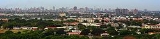
Maracaibo

Encyclopedia
Maracaibo is a city and municipality located in northwestern Venezuela off the western coast of the Lake Maracaibo
. It is the second-largest city in the country after the national capital Caracas
and the capital of Zulia
state. The population of the city is approximately 1,495,200 with the metropolitan area
estimated at 2,108,404 as of 2010.
Maracaibo is nicknamed La Tierra del Sol Amada ("The Beloved Land of the Sun").
tribe who built rows of stilt house
s all over the northern riviera of the Lake Maracaibo. The first Europeans arrived in 1499.
The city was founded three times: First in 1529 by the German Ambrosio Alfinger
, who named it Villa de Maracaibo. The lack of activity in the zone made Nicolas de Federman evacuate the village in 1535 and move its population to Cabo de la Vela nearby Coro. A second attempt by Captain Alonso Pacheco turned into failure. The third foundation of the city occurs in 1574 when Captain Pedro Maldonado, under Governor Diego de Mazariego's command, establishes the village with the name of Nueva Zamora de Maracaibo. "Nueva Zamora" comes from Mazariego's place of birth, Zamora, in Spain. Since its definite foundation, the town began to develop as a whole. It is based on the western side of Lake Maracaibo
, the dominant feature of the oil-rich Maracaibo Basin
. Favoured by prevailing winds and a protected harbour, the city is located on the shores of the lake where the narrows, which eventually lead to the Gulf of Venezuela
, first become pronounced.
sacked Maracaibo, which emptied when his fleet was first spied, and moved on to the Spanish settlement of Gibraltar on the inside of Lake Maracaibo in search of more treasure. A few weeks later, when he attempted to sail out of the lake, Morgan found an occupied fort blocking the inlet to the Caribbean, along with three Spanish ships. These were the Magdalena, the San Luis, and the Soledad. He destroyed the Magdalena and burned the San Luis by sending a dummy ship full of gunpowder to explode near them, after which the crew of the Soledad surrendered. By faking a landward attack on the fort, thereby convincing the Spanish governor to shift his cannon, he eluded their guns and escaped.
. Maracaibo then held the seat of the Captaincy General of Venezuela
. In 1821 uprisings in favour of independence began conducting to warfare and hostility. The royalists, led by Francisco Tomás Morales, fought with the patriots
, led by Rafael Urdaneta
, to take back control over the province in the Juana de Ávila Battle and Morales brought back Spanish rule in 1822 until he was defeated at the Battle of Lake Maracaibo
on 24 July 1823 culminating Venezuela's struggle for independence.
Cars, buses, and lorries, with their constant flow of manufactured goods and agricultural product, depended on the ferry system between the city and the eastern shore with their roads to connect to the country's motorway system. Maracaibo and the Lake Maracaibo region's economy was more linked to Colombia
than to eastern Venezuela due to the natural route available through Lake Maracaibo then leading to the sea.
This isolation was both a challenge and an advantage. The very nature of the city's location made for a population known for their independent thought and character. The history of this region is rife with stories about the creation of an independent and sovereign nation apart from Venezuela, a nation called La República Independiente del Zulia, which means The Independent Republic of Zulia, but this has never come to be.
in the 1950s set as a goal the construction of a bridge connecting the two lake shores. Various bridge projects for the spanning of the Lake Maracaibo narrows near the city were in the works. The general's government had decided that this "city of independent thought" should be more "connected" to the rest of the country.
Proposals for a bridge design that included rail transport and tourist facilities were seriously considered. The fall of the Pérez Jiménez government on January 23, 1958, quickly led to a less elaborate design project that was approved and funded by a democratic and more conservative government.
The building of "El Puente Sobre El Lago de Maracaibo "General Rafael Urdaneta"—(General Rafael Urdaneta Bridge
over Lake Maracaibo) named after the distinguished General hero
of the War of Independence was opened to public traffic in 1962. The project was completed on schedule in 40 months.
This bridge construction project was a remarkable feat. Built under very difficult conditions, when completed, it became the longest prestressed concrete bridge in the world. The structure is in constant use and remains today as the most important link between Maracaibo, along with much of the state of Zulia, and the rest of Venezuela.
).
In the political arena, the citizens of Maracaibo (and most other cities and municipalities in Zulia state) have in recent years voted for a competitive political system in where the governor is from a certain political party and the mayor or mayors are from the opposite political party. This system has brought many good things to the city and the state; for example, if the governor builds a bridge, one of the mayors will build two, if a mayor cleans a public park, the governor retaliates by cleaning and remodelling another one.
Maracaibo also boasts one of the best universities in the country, the state university. La Universidad del Zulia
(LUZ) is well renowned for its excellent law, medical and engineering schools as many other disciplines. Other universities and schools include Universidad Dr. Rafael Belloso Chacín (URBE) and Universidad Rafael Urdaneta, with one of the country's leading psychology schools.
Maracaibo was elevated to the status of Roman Catholic Archdiocese on 30 April 1966 with the creation of the Archdiocese of Maracaibo. Since November 2000, its Archbishop has been Ubaldo Ramón Santana Sequera.
He also notes the appreciation of literature, the arts, education, and culture among the people of Maracaibo:
During the period of de Pons' visit, however, he believed the men of Maracaibo to lack integrity with regard to honouring their commitments:
, who is in charge of representing the municipality's administration. The legislative branch is represented by the Municipal Council, composed of seven councillors, charged with the deliberation of new decrees and local laws. The comptroller tasks are managed by the municipal comptroller
's office, which oversees accountancy
. Finally, planning is represented by the Local Public Planning Council, which manages development projects for the municipality. According to United Nations
reports, Maracaibo like Caracas has significant infrastructure deficiencies under current government, including shortfalls in clean drinking water
.
.
. The rain shadow
of the Sierra Nevada de Santa Marta
gives the city a semiarid climate, only attenuated by the moderating influence of the lake; its average historical temperature is 29 °C (84 °F). In the past the climate of the city, as well in all the coast of the Lake Maracaibo, was unhealthy, due to the combination of high temperatures with high humidity. At the present time, the effects of urban development, and control of plagues, has almost eradicated that. The registered high temperature of the city is 41 °C (106 °F), and the lowest is 18 °C (64 °F).
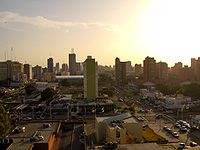
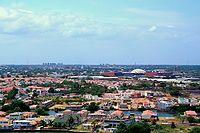
Made of concrete, it spans 8.7 kilometres (5.4 mi). The bridge is a cable-stayed bridge
that carries only vehicles. The competition to design the bridge started in 1957 and was won by Riccardo Morandi
, an Italian
. Construction was done by several companies. They included: Grün & Bilfinger, Julius Berger
, Bauboag AG, Philipp Holzmann AG, Precomprimido C.A., Wayss & Freytag and K Ingeniería.
by the Águilas del Zulia
, a Venezuelan winter league team that plays in the Liga Venezolana de Béisbol Profesional,and is based in the Estadio Luis Aparicio El Grande
. Regional teams include the Unión Atlético Maracaibo
and the Zulia FC in football
, and the Gaiteros del Zulia in basketball
, a team that participates in the Liga Profesional de Baloncesto de Venezuela, whose home is the 5.000-people Pedro Elías Belisario Aponte stadium.
Their city has one football stadium:
In the 2000 Little League World Series
, the Sierrra Maestra Little League of Maracaibo, Venezuela defeated Bellaire Little League of Bellaire, Texas in the championship game of the 54th Little League World Series. The Coquivoca Little League team from Maracaibo placed third in the 1974 Little League World Series
.
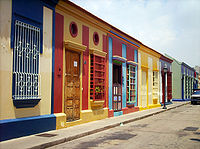 Culture in Maracaibo is very indigenous and unique, is recognized in every state and city in Venezuela, and is very influential with its gaitas
, desserts, style, living, and customs. Most major houses of advertising in Venezuela acknowledge how opposite the culture of Maracaibo is from that of Caracas. Studies of both prove, for example, that Caracas' leading soft drink brand is Coke, while in Maracaibo it is Pepsi
. This has made many brands create special localised advertising of their products (including several Pepsi commercials spoken by local celebrities).
Maracuchos are extremely proud of their city, their culture, and all of Zulia. They usually claim that Venezuela wouldn't be the country it actually is without Zulia. Rivalry with inhabitants of other regions is common, specially with Gochos (people of the Mérida and Táchira state) and Caraqueños (people of the city of Caracas
).
An interesting aspect of the city, is the humor and the musical culture of its people, the Gaita Zuliana, is a traditional christmas music
from the region. It is known that Maracaibo was culturally separated from the rest of Venezuela
, for geographical and historical reasons. The Lake Maracaibo maintained separated the city, with its neighboring states and Caracas
, capital of Venezuela. The people from Maracaibo, having been influenced by Andalusia
n colonists, apply the term "vos" instead of tú ("you"). The "vos" term, the fast speaking and the strong tone of the voice, produced a particular style, that nowadays is a “mark of origin” of the people from Maracaibo.
The city is also home to an array of immigrants from but not limited to: Spain
, Italy
, Germany
, and Latin America
n countries.
The General Rafael Urdaneta Bridge
, the freeway Machiques — Colón, and the ship transport
ation, unites the communications of the city, with the rest of Venezuela, this united with the oil boom, cultivated since 1914, is going to conform a new Maracaibo.
. The image is most venerated in Maracaibo. The story of discovery of the virgin dates from the 18th century. An old lady would make a living by washing other people's clothes, a job she did every morning at the shores of the lake. On 18 November 1709, she had taken a bulk of clothes, and as usual, headed to the lake to start washing them. This old lady was at her chores when she saw a wooden board floating towards her. She picked it up thinking that it might be of some use. When she finished her work, she went home carrying the clothes, the board and a small vase with fresh water. She then placed the board on top of the vase. Then, she noticed a small figure in the board but could not tell what it was like.
She fell asleep, and when she awoke up it was already late and dark. She decided to go to a local grocery store to buy some candles. On her way back a small gathering of people had formed outside her house, and after coming closer she noted that her home was filled with light. After entering she and some of the neighbours witnessed the small wooden board floating in the air surrounded by light with a bright crisp image of the Virgin Mary. At this, everyone was amazed and called the event a miracle.
Since that day the street where she lived was renamed "El Milagro," which means ¨Miracle¨ in Spanish, and to this day it is one of the most important streets in the neighbourhood of "El Saladillo" in the city of Maracaibo. There is a church in Maracaibo honoring her, La Chiquinquirá Church.
from Maracaibo, it is normally considered a christmas
-time music. According to Joan Corominas, it popularised in the middle 1960s in all the country, and it fused with other types of music like salsa
and merengue
in the 1970s. There are many famous Gaita groups like: Maracaibo 15
, Gran Coquivacoa
, Barrio Obrero,Alitasia, Cardenales del Éxito, Guaco
(when Guaco started was a gaita group, now is a Tropical music
band), Koquimba, Melody Gaita, Estrellas del Zulia, Saladillo, and many others.
:
Bremen
, Germany
Durban
, South Africa
Honolulu, Hawaii
, United States of America New Orleans, United States of America Ploieşti
, Romania
San Juan, Puerto Rico
Lake Maracaibo
Lake Maracaibo is a large brackish bay in Venezuela at . It is connected to the Gulf of Venezuela by Tablazo Strait at the northern end, and fed by numerous rivers, the largest being the Catatumbo. It is commonly considered a lake rather than a bay or lagoon, and at 13,210 km² it would be the...
. It is the second-largest city in the country after the national capital Caracas
Caracas
Caracas , officially Santiago de León de Caracas, is the capital and largest city of Venezuela; natives or residents are known as Caraquenians in English . It is located in the northern part of the country, following the contours of the narrow Caracas Valley on the Venezuelan coastal mountain range...
and the capital of Zulia
Zulia
Zulia State is one of the 23 states of Venezuela. The state capital is Maracaibo. In June 30, 2010, it had an estimated population of 3,821,068, giving it the largest population among Venezuela's states. It is located in the northwestern part of the country...
state. The population of the city is approximately 1,495,200 with the metropolitan area
Metropolitan area
The term metropolitan area refers to a region consisting of a densely populated urban core and its less-populated surrounding territories, sharing industry, infrastructure, and housing. A metropolitan area usually encompasses multiple jurisdictions and municipalities: neighborhoods, townships,...
estimated at 2,108,404 as of 2010.
Maracaibo is nicknamed La Tierra del Sol Amada ("The Beloved Land of the Sun").
Etymology
The name Maracaibo comes from the brave Cacique (Indian Chief) Mara, a young native who valiantly resisted the Germans and died fighting them. It is said that when Mara fell, the Indians shouted "Mara cayo!" (Mara fell!), thus originating the city name. Other historians say that the first name of this land in Indian language was "Maara-iwo" meaning "Place where serpents abound".Foundation
The first indigenous settlements were of Arawak and Carib origin. Around the main group were the AñuAnu
In Sumerian mythology, Anu was a sky-god, the god of heaven, lord of constellations, king of gods, Consort of Antu, spirits and demons, and dwelt in the highest heavenly regions. It was believed that he had the power to judge those who had committed crimes, and that he had created the stars as...
tribe who built rows of stilt house
Stilt house
Stilt houses or pile dwellings or palafitte are houses raised on piles over the surface of the soil or a body of water. Stilt houses are built primarily as a protection against flooding, but also serve to keep out vermin...
s all over the northern riviera of the Lake Maracaibo. The first Europeans arrived in 1499.
The city was founded three times: First in 1529 by the German Ambrosio Alfinger
Ambrosius Ehinger
Ambrosius Ehinger, also Dalfinger, Thalfinger, was a German conquistador and the first governor of the Welser concession, also known as “Little Venice” , in New Granada, now Venezuela and Colombia.Ehinger was a factor in Madrid for the Welser...
, who named it Villa de Maracaibo. The lack of activity in the zone made Nicolas de Federman evacuate the village in 1535 and move its population to Cabo de la Vela nearby Coro. A second attempt by Captain Alonso Pacheco turned into failure. The third foundation of the city occurs in 1574 when Captain Pedro Maldonado, under Governor Diego de Mazariego's command, establishes the village with the name of Nueva Zamora de Maracaibo. "Nueva Zamora" comes from Mazariego's place of birth, Zamora, in Spain. Since its definite foundation, the town began to develop as a whole. It is based on the western side of Lake Maracaibo
Lake Maracaibo
Lake Maracaibo is a large brackish bay in Venezuela at . It is connected to the Gulf of Venezuela by Tablazo Strait at the northern end, and fed by numerous rivers, the largest being the Catatumbo. It is commonly considered a lake rather than a bay or lagoon, and at 13,210 km² it would be the...
, the dominant feature of the oil-rich Maracaibo Basin
Maracaibo Basin
The Maracaibo Basin in Western Venezuela is a prolific, oil-producing sedimentary basin. The basin is bounded on the north by the Oca Fault which separates it from the Caribbean Sea. The remaining sides of the basin are bounded by a branching in the northern Andes Mountains termed the Sierra de...
. Favoured by prevailing winds and a protected harbour, the city is located on the shores of the lake where the narrows, which eventually lead to the Gulf of Venezuela
Gulf of Venezuela
The Gulf of Venezuela is a gulf of the Caribbean Sea bounded by the Venezuelan states of Zulia and Falcón and by Guajira Department, Colombia...
, first become pronounced.
Pirates' Attacks
In March of 1669, Henry MorganHenry Morgan
Admiral Sir Henry Morgan was an Admiral of the Royal Navy, a privateer, and a pirate who made a name for himself during activities in the Caribbean, primarily raiding Spanish settlements...
sacked Maracaibo, which emptied when his fleet was first spied, and moved on to the Spanish settlement of Gibraltar on the inside of Lake Maracaibo in search of more treasure. A few weeks later, when he attempted to sail out of the lake, Morgan found an occupied fort blocking the inlet to the Caribbean, along with three Spanish ships. These were the Magdalena, the San Luis, and the Soledad. He destroyed the Magdalena and burned the San Luis by sending a dummy ship full of gunpowder to explode near them, after which the crew of the Soledad surrendered. By faking a landward attack on the fort, thereby convincing the Spanish governor to shift his cannon, he eluded their guns and escaped.
Independence era
In 1810 the province of Maracaibo did not join the first republic of Venezuela and remained loyal to the Spanish crownSpanish Empire
The Spanish Empire comprised territories and colonies administered directly by Spain in Europe, in America, Africa, Asia and Oceania. It originated during the Age of Exploration and was therefore one of the first global empires. At the time of Habsburgs, Spain reached the peak of its world power....
. Maracaibo then held the seat of the Captaincy General of Venezuela
Captaincy General of Venezuela
The Captaincy General of Venezuela was an administrative district of colonial Spain, created in 1777 to provide more autonomy for the provinces of Venezuela, previously under the jurisdiction of the Viceroyalty of New Granada and the Audiencia of Santo Domingo...
. In 1821 uprisings in favour of independence began conducting to warfare and hostility. The royalists, led by Francisco Tomás Morales, fought with the patriots
Patriot (Spanish American Revolution)
Patriots was the name the peoples of the Spanish America, who rebelled against Spanish control during the Spanish American wars of independence, called themselves. They supported the principles of the Age of Enlightenment and sought to replace the existing governing structures with Juntas...
, led by Rafael Urdaneta
Rafael Urdaneta
Rafael José Urdaneta y Faría was a Venezuelan General and hero of the Spanish American wars of independence in several countries in northern South America.- Biographic data :...
, to take back control over the province in the Juana de Ávila Battle and Morales brought back Spanish rule in 1822 until he was defeated at the Battle of Lake Maracaibo
Battle of Lake Maracaibo
The Battle of Lake Maracaibo also known as the "Naval Battle of the Lake" was fought on 24 July 1823 in Venezuela's Lake Maracaibo between Admiral José Prudencio Padilla and royalist Captain Ángel Laborde....
on 24 July 1823 culminating Venezuela's struggle for independence.
Isolation period
For about 390 years, Maracaibo remained isolated and separated from the rest of the country. Transportation was only possible across the lake by ferry or other marine transport.Cars, buses, and lorries, with their constant flow of manufactured goods and agricultural product, depended on the ferry system between the city and the eastern shore with their roads to connect to the country's motorway system. Maracaibo and the Lake Maracaibo region's economy was more linked to Colombia
Colombia
Colombia, officially the Republic of Colombia , is a unitary constitutional republic comprising thirty-two departments. The country is located in northwestern South America, bordered to the east by Venezuela and Brazil; to the south by Ecuador and Peru; to the north by the Caribbean Sea; to the...
than to eastern Venezuela due to the natural route available through Lake Maracaibo then leading to the sea.
This isolation was both a challenge and an advantage. The very nature of the city's location made for a population known for their independent thought and character. The history of this region is rife with stories about the creation of an independent and sovereign nation apart from Venezuela, a nation called La República Independiente del Zulia, which means The Independent Republic of Zulia, but this has never come to be.
Building of the bridge
The dictatorial regime of General Marcos Pérez JiménezMarcos Pérez Jiménez
Marcos Evangelista Pérez Jiménez was a soldier and Presidents of Venezuela from 1952 to 1958.-Career:Marcos Evangelista Pérez Jiménez was born in Michelena, Táchira State. His father, Juan Pérez Bustamante, was a farmer; his mother, Adela Jiménez, a schoolteacher...
in the 1950s set as a goal the construction of a bridge connecting the two lake shores. Various bridge projects for the spanning of the Lake Maracaibo narrows near the city were in the works. The general's government had decided that this "city of independent thought" should be more "connected" to the rest of the country.
Proposals for a bridge design that included rail transport and tourist facilities were seriously considered. The fall of the Pérez Jiménez government on January 23, 1958, quickly led to a less elaborate design project that was approved and funded by a democratic and more conservative government.
The building of "El Puente Sobre El Lago de Maracaibo "General Rafael Urdaneta"—(General Rafael Urdaneta Bridge
General Rafael Urdaneta Bridge
The General Rafael Urdaneta Bridge is located at the outlet of Lake Maracaibo, in western Venezuela. The bridge connects Maracaibo with much of the rest of the country...
over Lake Maracaibo) named after the distinguished General hero
Rafael Urdaneta
Rafael José Urdaneta y Faría was a Venezuelan General and hero of the Spanish American wars of independence in several countries in northern South America.- Biographic data :...
of the War of Independence was opened to public traffic in 1962. The project was completed on schedule in 40 months.
This bridge construction project was a remarkable feat. Built under very difficult conditions, when completed, it became the longest prestressed concrete bridge in the world. The structure is in constant use and remains today as the most important link between Maracaibo, along with much of the state of Zulia, and the rest of Venezuela.
Modern times
Maracaibo has become a large metropolitan city, comprising two municipalities: to the north the municipality of Maracaibo and to the south the San Francisco municipality (established in 1995). In recent years, due to political/economic and cultural reasons, many have moved to Maracaibo from rural areas and other cities (including CaracasCaracas
Caracas , officially Santiago de León de Caracas, is the capital and largest city of Venezuela; natives or residents are known as Caraquenians in English . It is located in the northern part of the country, following the contours of the narrow Caracas Valley on the Venezuelan coastal mountain range...
).
In the political arena, the citizens of Maracaibo (and most other cities and municipalities in Zulia state) have in recent years voted for a competitive political system in where the governor is from a certain political party and the mayor or mayors are from the opposite political party. This system has brought many good things to the city and the state; for example, if the governor builds a bridge, one of the mayors will build two, if a mayor cleans a public park, the governor retaliates by cleaning and remodelling another one.
Maracaibo also boasts one of the best universities in the country, the state university. La Universidad del Zulia
University of Zulia
The University of Zulia , is a public university whose Main Campus is located in the city of Maracaibo, Venezuela...
(LUZ) is well renowned for its excellent law, medical and engineering schools as many other disciplines. Other universities and schools include Universidad Dr. Rafael Belloso Chacín (URBE) and Universidad Rafael Urdaneta, with one of the country's leading psychology schools.
Maracaibo was elevated to the status of Roman Catholic Archdiocese on 30 April 1966 with the creation of the Archdiocese of Maracaibo. Since November 2000, its Archbishop has been Ubaldo Ramón Santana Sequera.
Perspective
François de Pons, an agent to the French government in Caracas, provides some historical insight into the people of Maracaibo in his travel journal . The following excerpts describe the local population of Maracaibo:- They perform coasting, or long voyages, with equal facility; and when all trade is suspended by the operations of war, they enter privateers. Bred up in the neighbourhood of the lake, they are mostly all expert swimmers and excellent divers. Their reputation stands equally high as soldiers. Those who do not enter into the sea service, form plantations, or assist in cultivating those that belong to their fathers. Nothing proves better their aptitude for this kind of occupation, than the immense flocks of cattle with which the savannas of Maracaybo [sic] are covered.
He also notes the appreciation of literature, the arts, education, and culture among the people of Maracaibo:
- But what confers the greatest honour on the inhabitants of Maracaibo, is their application to literature; in which, notwithstanding the wretched state of public education, they make considerable progress....They likewise acquired the art of elocution, and of writing their mother tongue with the greatest purity; in a word, they possessed all the qualities that characterise men of letters.
During the period of de Pons' visit, however, he believed the men of Maracaibo to lack integrity with regard to honouring their commitments:
- After allowing that the inhabitants of this city possess activity, genius, and courage, we have nothing further to say in their praise. They are accused of violating their promises, and even of attempting to break through written engagements. Their character, in this respect, is so notorious, that every stranger whom business induces to visit Maracaybo, affirms, that it would be much better to enter into commercial speculations with the women, because they appear themselves to possess that sincerity and good sense that are every where else considered as belonging particularly to men.
Local government
Maracaibo has one municipality: Maracaibo Municipality, Venezuelan law specifies that municipal governments have four main functions: executive, legislative, comptroller, and planning. The executive function is managed by the mayorMayor
In many countries, a Mayor is the highest ranking officer in the municipal government of a town or a large urban city....
, who is in charge of representing the municipality's administration. The legislative branch is represented by the Municipal Council, composed of seven councillors, charged with the deliberation of new decrees and local laws. The comptroller tasks are managed by the municipal comptroller
Comptroller
A comptroller is a management level position responsible for supervising the quality of accounting and financial reporting of an organization.In British government, the Comptroller General or Comptroller and Auditor General is in most countries the external auditor of the budget execution of the...
's office, which oversees accountancy
Accountancy
Accountancy is the process of communicating financial information about a business entity to users such as shareholders and managers. The communication is generally in the form of financial statements that show in money terms the economic resources under the control of management; the art lies in...
. Finally, planning is represented by the Local Public Planning Council, which manages development projects for the municipality. According to United Nations
United Nations
The United Nations is an international organization whose stated aims are facilitating cooperation in international law, international security, economic development, social progress, human rights, and achievement of world peace...
reports, Maracaibo like Caracas has significant infrastructure deficiencies under current government, including shortfalls in clean drinking water
Drinking water
Drinking water or potable water is water pure enough to be consumed or used with low risk of immediate or long term harm. In most developed countries, the water supplied to households, commerce and industry is all of drinking water standard, even though only a very small proportion is actually...
.
Location
The city of Maracaibo is located at the denominated Maracaibo plain. It has low fertility, typical of a dry-tropical forest. It presents a great number of rivers, sewers and gorges. The city dominates the entrance to Lake MaracaiboLake Maracaibo
Lake Maracaibo is a large brackish bay in Venezuela at . It is connected to the Gulf of Venezuela by Tablazo Strait at the northern end, and fed by numerous rivers, the largest being the Catatumbo. It is commonly considered a lake rather than a bay or lagoon, and at 13,210 km² it would be the...
.
Climate
Maracaibo is one of the hottest cities of VenezuelaVenezuela
Venezuela , officially called the Bolivarian Republic of Venezuela , is a tropical country on the northern coast of South America. It borders Colombia to the west, Guyana to the east, and Brazil to the south...
. The rain shadow
Rain shadow
A rain shadow is a dry area on the lee side of a mountainous area. The mountains block the passage of rain-producing weather systems, casting a "shadow" of dryness behind them. As shown by the diagram to the right, the warm moist air is "pulled" by the prevailing winds over a mountain...
of the Sierra Nevada de Santa Marta
Sierra Nevada de Santa Marta
The Sierra Nevada de Santa Marta is an isolated mountain range apart from the Andes chain that runs through Colombia. Reaching an altitude of 5,700 metres above sea level just 42 km from the Caribbean coast, the Sierra Nevada is the world's highest coastal range...
gives the city a semiarid climate, only attenuated by the moderating influence of the lake; its average historical temperature is 29 °C (84 °F). In the past the climate of the city, as well in all the coast of the Lake Maracaibo, was unhealthy, due to the combination of high temperatures with high humidity. At the present time, the effects of urban development, and control of plagues, has almost eradicated that. The registered high temperature of the city is 41 °C (106 °F), and the lowest is 18 °C (64 °F).
Colleges and universities
Several universities are based in the city:- Universidad del Zulia - (LUZ)
- Universidad Nacional Experimental de la Fuerza Armada UNEFA
- Universidad Rafael Belloso Chacín - (URBE)
- Universidad Rafael Urdaneta
- Universidad Católica Cecilio Acosta
- Universidad Dr. José Gregorio Hernández
- Universidad Bolivariano de Venezuela sede Zulia
Transportation
- The Maracaibo MetroMaracaibo MetroThe Maracaibo Metro, also known as Metro del Sol Amado, is a six-station metro system in Maracaibo, Venezuela. Service between La Vanega and El Varillal opened to the public on November 25, 2006, with all stations on the line opened on June 9, 2009.The metro encompasses the suburbs of Maracaibo...
, also known as Metro del Sol Amado (due to the city nickname), is a subway system currently under construction, it encompasses the suburbs of Maracaibo with the city's downtown. Currently, six metro stations are open and running. - Buses are the main means of mass transportation, this system runs a variety of bus types, operated by several companies on normal streets and avenues:
- bus; large buses.
- buseta; medium size buses.
- microbus or colectivo; vans or minivans.
- por puesto; cars.
- La Chinita International AirportLa Chinita International Airport-Accidents and incidents:*On 1 November 1971, Vickers Viscount YV-C-AMZ of Linea Aeropostal Venezolana crashed shortly after take-off. All four people on board were killed....
, was opened on November 16, 1969, during the government of president Rafael CalderaRafael CalderaRafael Antonio Caldera Rodríguez was president of Venezuela from 1969 to 1974 and again from 1994 to 1999.Caldera taught sociology and law at various universities before entering politics. He was a founding member of COPEI, Venezuela's Christian Democratic party...
to open a gate to the western part of the country and alleviate congestion from the Simon Bolivar Airport near Caracas, which manages about 90% of the international flights in Venezuela. In fact, the only international destinations from Maracaibo are ArubaArubaAruba is a 33 km-long island of the Lesser Antilles in the southern Caribbean Sea, located 27 km north of the coast of Venezuela and 130 km east of Guajira Peninsula...
, BogotáBogotáBogotá, Distrito Capital , from 1991 to 2000 called Santa Fé de Bogotá, is the capital, and largest city, of Colombia. It is also designated by the national constitution as the capital of the department of Cundinamarca, even though the city of Bogotá now comprises an independent Capital district...
, BarranquillaBarranquillaBarranquilla is an industrial port city and municipality located in northern Colombia, near the Caribbean Sea. The capital of the Atlántico Department, it is the largest industrial city and port in the Colombian Caribbean region with a population of 1,148,506 as of 2005, which makes it Colombia's...
, CartagenaCartagena, ColombiaCartagena de Indias , is a large Caribbean beach resort city on the northern coast of Colombia in the Caribbean Coast Region and capital of Bolívar Department...
, CuraçaoCuraçaoCuraçao is an island in the southern Caribbean Sea, off the Venezuelan coast. The Country of Curaçao , which includes the main island plus the small, uninhabited island of Klein Curaçao , is a constituent country of the Kingdom of the Netherlands...
, Miami and Panama CityPanama CityPanama is the capital and largest city of the Republic of Panama. It has a population of 880,691, with a total metro population of 1,272,672, and it is located at the Pacific entrance of the Panama Canal, in the province of the same name. The city is the political and administrative center of the...
. - General Rafael Urdaneta BridgeGeneral Rafael Urdaneta BridgeThe General Rafael Urdaneta Bridge is located at the outlet of Lake Maracaibo, in western Venezuela. The bridge connects Maracaibo with much of the rest of the country...
, inaugurated in 1962, is located at the outlet Lake MaracaiboLake MaracaiboLake Maracaibo is a large brackish bay in Venezuela at . It is connected to the Gulf of Venezuela by Tablazo Strait at the northern end, and fed by numerous rivers, the largest being the Catatumbo. It is commonly considered a lake rather than a bay or lagoon, and at 13,210 km² it would be the...
, in western VenezuelaVenezuelaVenezuela , officially called the Bolivarian Republic of Venezuela , is a tropical country on the northern coast of South America. It borders Colombia to the west, Guyana to the east, and Brazil to the south...
. The bridge connects Maracaibo with much of the rest of the country. It is named after GeneralGeneralA general officer is an officer of high military rank, usually in the army, and in some nations, the air force. The term is widely used by many nations of the world, and when a country uses a different term, there is an equivalent title given....
Rafael UrdanetaRafael UrdanetaRafael José Urdaneta y Faría was a Venezuelan General and hero of the Spanish American wars of independence in several countries in northern South America.- Biographic data :...
, a Venezuelan hero in the War of Independence.
Made of concrete, it spans 8.7 kilometres (5.4 mi). The bridge is a cable-stayed bridge
Cable-stayed bridge
A cable-stayed bridge is a bridge that consists of one or more columns , with cables supporting the bridge deck....
that carries only vehicles. The competition to design the bridge started in 1957 and was won by Riccardo Morandi
Riccardo Morandi
Riccardo Morandi was an Italian civil engineer best known for his interesting use of reinforced concrete. Amongst his best known works were the General Rafael Urdaneta Bridge, an 8 km crossing of Lake Maracaibo incorporating seven cable-stayed bridge spans with unusual piers, and the...
, an Italian
Italy
Italy , officially the Italian Republic languages]] under the European Charter for Regional or Minority Languages. In each of these, Italy's official name is as follows:;;;;;;;;), is a unitary parliamentary republic in South-Central Europe. To the north it borders France, Switzerland, Austria and...
. Construction was done by several companies. They included: Grün & Bilfinger, Julius Berger
Bilfinger Berger
Bilfinger Berger is a large, internationally active construction and services company based in Mannheim, Germany.-History:Bilfinger Berger dates back to 1880 when August Bernatz founded an engineering business which became known, from 1886 as Bernatz & Grün and, from 1892, as Grün & Bilfinger.In...
, Bauboag AG, Philipp Holzmann AG, Precomprimido C.A., Wayss & Freytag and K Ingeniería.
Sports
Due to the regionalistic nature of Marabinos, they strongly support their native teams. Maracaibo, and the rest of Zulia, are represented in baseballBaseball
Baseball is a bat-and-ball sport played between two teams of nine players each. The aim is to score runs by hitting a thrown ball with a bat and touching a series of four bases arranged at the corners of a ninety-foot diamond...
by the Águilas del Zulia
Águilas del Zulia
The Águilas del Zulia is a Venezuelan winter league team that plays in the Liga Venezolana de Béisbol Profesional, and one of the most popular teams in Venezuela.-History:The team was founded in 1969...
, a Venezuelan winter league team that plays in the Liga Venezolana de Béisbol Profesional,and is based in the Estadio Luis Aparicio El Grande
Estadio Luis Aparicio El Grande
Estadio Luis Aparicio El Grande is a multi-use stadium in Maracaibo, Venezuela. It is currently used mostly for baseball games and serves as the home of Águilas del Zulia. The stadium holds 23,900 people. It is named after longtime Maracaibo shortstop Luis Aparicio, Sr., the father of Luis Aparicio...
. Regional teams include the Unión Atlético Maracaibo
Unión Atlético Maracaibo
Club Unión Atlético Maracaibo is a professional club founded on 2001 and the club has one First Division titles in the professional era. The club is based in Maracaibo.-National:...
and the Zulia FC in football
Football (soccer)
Association football, more commonly known as football or soccer, is a sport played between two teams of eleven players with a spherical ball...
, and the Gaiteros del Zulia in basketball
Basketball
Basketball is a team sport in which two teams of five players try to score points by throwing or "shooting" a ball through the top of a basketball hoop while following a set of rules...
, a team that participates in the Liga Profesional de Baloncesto de Venezuela, whose home is the 5.000-people Pedro Elías Belisario Aponte stadium.
Their city has one football stadium:
- Estadio José Pachencho RomeroEstadio José Pachencho RomeroThe José "Pachencho" Romero Stadium is a sports stadium in Maracaibo, capital of the Zulia state, in Venezuela. The stadium holds 40,800 spectators...
, constructed in 1971 for the Juegos Deportivos Bolivarianos, and redesigned in 1998, for the Juegos Deportivos Centroamericanos y del Caribe1998 Central American and Caribbean GamesThe 18th Central American and Caribbean Games were held in Maracaibo, Venezuela from August 8 to August 22, 1998 and included 31 nations and a total of 5,200 competitors.-Medals:-References:...
. It is named after an athlete from ZuliaZuliaZulia State is one of the 23 states of Venezuela. The state capital is Maracaibo. In June 30, 2010, it had an estimated population of 3,821,068, giving it the largest population among Venezuela's states. It is located in the northwestern part of the country...
. With a capacity of 26 000 spectators is being extended to 35 000 for the Copa América 2007Copa América 2007The 2007 Campeonato Sudamericano Copa América, known simply as the 2007 Copa América or 2007 Copa América Venezuela, was the 42nd edition of the Copa América, the South-American championship for international association football teams...
.
In the 2000 Little League World Series
2000 Little League World Series
-Pool play:August 20August 21August 22August 23-Elimination round:-External links:*...
, the Sierrra Maestra Little League of Maracaibo, Venezuela defeated Bellaire Little League of Bellaire, Texas in the championship game of the 54th Little League World Series. The Coquivoca Little League team from Maracaibo placed third in the 1974 Little League World Series
1974 Little League World Series
-Winners bracket:-Consolation bracket:-Notable players:*NFL quarterback Gale Gilbert played for the runner-up team from Red Bluff, California.-External links:**...
.
Teams
- Baseball: Águilas del ZuliaÁguilas del ZuliaThe Águilas del Zulia is a Venezuelan winter league team that plays in the Liga Venezolana de Béisbol Profesional, and one of the most popular teams in Venezuela.-History:The team was founded in 1969...
BBC. - Soccer: Unión Atlético MaracaiboUnión Atlético MaracaiboClub Unión Atlético Maracaibo is a professional club founded on 2001 and the club has one First Division titles in the professional era. The club is based in Maracaibo.-National:...
, Zulia FC - Basket: Gaiteros del Zulia
- Rugby: [Maracaibo Rugby Football Club "Oil Blacks"]
Culture
Gaita (music style)
Gaita is a style of Venezuelan folk music from Maracaibo in Zulia State. According to Joan Corominas, it may come from gaits, the Gothic word for "goat", which is the skin generally used for the membrane of the furro instrument. Other instruments used in gaita include maracas, cuatro, charrasca and...
, desserts, style, living, and customs. Most major houses of advertising in Venezuela acknowledge how opposite the culture of Maracaibo is from that of Caracas. Studies of both prove, for example, that Caracas' leading soft drink brand is Coke, while in Maracaibo it is Pepsi
Pepsi
Pepsi is a carbonated soft drink that is produced and manufactured by PepsiCo...
. This has made many brands create special localised advertising of their products (including several Pepsi commercials spoken by local celebrities).
Maracuchos are extremely proud of their city, their culture, and all of Zulia. They usually claim that Venezuela wouldn't be the country it actually is without Zulia. Rivalry with inhabitants of other regions is common, specially with Gochos (people of the Mérida and Táchira state) and Caraqueños (people of the city of Caracas
Caracas
Caracas , officially Santiago de León de Caracas, is the capital and largest city of Venezuela; natives or residents are known as Caraquenians in English . It is located in the northern part of the country, following the contours of the narrow Caracas Valley on the Venezuelan coastal mountain range...
).
An interesting aspect of the city, is the humor and the musical culture of its people, the Gaita Zuliana, is a traditional christmas music
Christmas music
Christmas music comprises a variety of genres of music normally performed or heard around the Christmas season, which tends to begin in the months leading up the actual holiday and end in the weeks shortly thereafter.-Early:...
from the region. It is known that Maracaibo was culturally separated from the rest of Venezuela
Venezuela
Venezuela , officially called the Bolivarian Republic of Venezuela , is a tropical country on the northern coast of South America. It borders Colombia to the west, Guyana to the east, and Brazil to the south...
, for geographical and historical reasons. The Lake Maracaibo maintained separated the city, with its neighboring states and Caracas
Caracas
Caracas , officially Santiago de León de Caracas, is the capital and largest city of Venezuela; natives or residents are known as Caraquenians in English . It is located in the northern part of the country, following the contours of the narrow Caracas Valley on the Venezuelan coastal mountain range...
, capital of Venezuela. The people from Maracaibo, having been influenced by Andalusia
Andalusia
Andalusia is the most populous and the second largest in area of the autonomous communities of Spain. The Andalusian autonomous community is officially recognised as a nationality of Spain. The territory is divided into eight provinces: Huelva, Seville, Cádiz, Córdoba, Málaga, Jaén, Granada and...
n colonists, apply the term "vos" instead of tú ("you"). The "vos" term, the fast speaking and the strong tone of the voice, produced a particular style, that nowadays is a “mark of origin” of the people from Maracaibo.
The city is also home to an array of immigrants from but not limited to: Spain
Spain
Spain , officially the Kingdom of Spain languages]] under the European Charter for Regional or Minority Languages. In each of these, Spain's official name is as follows:;;;;;;), is a country and member state of the European Union located in southwestern Europe on the Iberian Peninsula...
, Italy
Italy
Italy , officially the Italian Republic languages]] under the European Charter for Regional or Minority Languages. In each of these, Italy's official name is as follows:;;;;;;;;), is a unitary parliamentary republic in South-Central Europe. To the north it borders France, Switzerland, Austria and...
, Germany
Germany
Germany , officially the Federal Republic of Germany , is a federal parliamentary republic in Europe. The country consists of 16 states while the capital and largest city is Berlin. Germany covers an area of 357,021 km2 and has a largely temperate seasonal climate...
, and Latin America
Latin America
Latin America is a region of the Americas where Romance languages – particularly Spanish and Portuguese, and variably French – are primarily spoken. Latin America has an area of approximately 21,069,500 km² , almost 3.9% of the Earth's surface or 14.1% of its land surface area...
n countries.
The General Rafael Urdaneta Bridge
General Rafael Urdaneta Bridge
The General Rafael Urdaneta Bridge is located at the outlet of Lake Maracaibo, in western Venezuela. The bridge connects Maracaibo with much of the rest of the country...
, the freeway Machiques — Colón, and the ship transport
Ship transport
Ship transport is watercraft carrying people or goods . Sea transport has been the largest carrier of freight throughout recorded history. Although the importance of sea travel for passengers has decreased due to aviation, it is effective for short trips and pleasure cruises...
ation, unites the communications of the city, with the rest of Venezuela, this united with the oil boom, cultivated since 1914, is going to conform a new Maracaibo.
Our Lady of Rosario of Chiquinquirá
Is one of the many popular representations of the Virgin Mary in VenezuelaVenezuela
Venezuela , officially called the Bolivarian Republic of Venezuela , is a tropical country on the northern coast of South America. It borders Colombia to the west, Guyana to the east, and Brazil to the south...
. The image is most venerated in Maracaibo. The story of discovery of the virgin dates from the 18th century. An old lady would make a living by washing other people's clothes, a job she did every morning at the shores of the lake. On 18 November 1709, she had taken a bulk of clothes, and as usual, headed to the lake to start washing them. This old lady was at her chores when she saw a wooden board floating towards her. She picked it up thinking that it might be of some use. When she finished her work, she went home carrying the clothes, the board and a small vase with fresh water. She then placed the board on top of the vase. Then, she noticed a small figure in the board but could not tell what it was like.
She fell asleep, and when she awoke up it was already late and dark. She decided to go to a local grocery store to buy some candles. On her way back a small gathering of people had formed outside her house, and after coming closer she noted that her home was filled with light. After entering she and some of the neighbours witnessed the small wooden board floating in the air surrounded by light with a bright crisp image of the Virgin Mary. At this, everyone was amazed and called the event a miracle.
Since that day the street where she lived was renamed "El Milagro," which means ¨Miracle¨ in Spanish, and to this day it is one of the most important streets in the neighbourhood of "El Saladillo" in the city of Maracaibo. There is a church in Maracaibo honoring her, La Chiquinquirá Church.
Gaita Zuliana
The Gaita is the name of an Afro Venezuelan folk musicMusic
Music is an art form whose medium is sound and silence. Its common elements are pitch , rhythm , dynamics, and the sonic qualities of timbre and texture...
from Maracaibo, it is normally considered a christmas
Christmas
Christmas or Christmas Day is an annual holiday generally celebrated on December 25 by billions of people around the world. It is a Christian feast that commemorates the birth of Jesus Christ, liturgically closing the Advent season and initiating the season of Christmastide, which lasts twelve days...
-time music. According to Joan Corominas, it popularised in the middle 1960s in all the country, and it fused with other types of music like salsa
Salsa music
Salsa music is a genre of music, generally defined as a modern style of playing Cuban Son, Son Montuno, and Guaracha with touches from other genres of music...
and merengue
Merengue music
Merengue is a type of music and dance from the Dominican Republic. It is popular in the Dominican Republic and all over Latin America. Its name is Spanish, taken from the name of the meringue, a dessert made from whipped egg whites and sugar...
in the 1970s. There are many famous Gaita groups like: Maracaibo 15
Maracaibo 15
Maracaibo 15 is a Venezuelan gaita group. Founded in 1974 by singer Betulio Medina in Caracas, the name of this group reflects that it was formed by 15 people. Maracaibo 15 combines gaita with other folkloric music, such as parrandas and eastern music and international music such as cumbias, porros...
, Gran Coquivacoa
Gran Coquivacoa
Gran Coquivacoa is a Venezuelan gaita zuliana group founded in 1968, by Jesús Bocachico Petit, Nelson Suárez, Rody Tigrera, Pedro Arteaga and Manolo Salazar, at the city of Cabimas, Zulia State)....
, Barrio Obrero,Alitasia, Cardenales del Éxito, Guaco
Guaco (band)
Tropical music band from Venezuela that was formed in Maracaibo by Mario Viloria and Gustavo Aguado, Zulia in 1968. Mario retired after being the main founder because of college studies but during his participation in the group he was the main composer for several years and his home was the main...
(when Guaco started was a gaita group, now is a Tropical music
Tropical music
Musica tropical or tropical music is a broad term for vocal and instrumental music with "tropical" flavor usually associated with the Afro-Caribbean music. It is part of an even broader category of Latin music. Usually it is an upbeat dance music, but also includes ballads. It features complex,...
band), Koquimba, Melody Gaita, Estrellas del Zulia, Saladillo, and many others.
Museums, Cultural Centers and Theaters
- Museo de Arte Contemporáneo del estado Zulia (MACZUL).
- Museo General Rafael Urdaneta.
- Museo Municipal de Artes Gráficas "Balmiro León".
- Centro de Bellas Artes de Maracaibo.
- Centro de Arte de Maracaibo “Lía BermúdezLía BermúdezLía Bermúdez is a Venezuelan sculptor.She began her studies at the School of Applied Arts in Caracas and moved to Maracaibo. There in 1947, she continued her studies at the School of Visual Arts in Árraga...
”. - Teatro Baralt.
Libraries
- Biblioteca Publica del Zulia.
- Biblioteca Pública "Arturo Uslar Pietri".
- Biblioteca "Dr. Pedro Alciro Barboza de la Torre".
- Biblioteca Pública "Simón Palmar".
- Biblioteca Pública "Luís Guillermo Pineda Belloso".
- Biblioteca Pública Especializada "Pedagógica".
- Biblioteca Pública Especializada "SEDINI".
Notable natives
- Teo AcostaTeo AcostaTeolindo Antonio Acosta Lazaro was a baseball player from Venezuela.- Career :He broke into minor league baseball with Dothan of the Class D Alabama-Florida League in 1958, batting .313 with 76 RBIs and a league-leading 36 stolen bases in 124 games...
- Baseball Player - Ricardo AguirreRicardo AguirreRicardo José Aguirre González, , was a Venezuelan folk musician and Gaita Zuliana singer and composer...
- Composer and singer. - Wilson AlvarezWilson AlvarezWilson Eduardo Álvarez Fuenmayor is a former Major League Baseball left-handed pitcher...
- Former Major League Baseball left-handed pitcher. - Luis AparicioLuis AparicioLuis Ernesto Aparicio Montiel is a former shortstop in professional baseball. His career in Major League Baseball spanned three decades, from through . Aparicio played for the Chicago White Sox , Baltimore Orioles and Boston Red Sox . He batted and threw right-handed...
- Former shortstop in Major League Baseball and a member of the Baseball Hall of Fame. - José Domingo de las Nieves Rus y Ortega Azarraulia - Statesman of high caliber who abrogated for the secession of Zulia as a separate and independent state. Born in 1768, he went on to become sole representative (deputy) of his native city, Maracaibo, at the famous Cortes de Cádiz (Law Courts), in Spain, where he labored tenaciously on behalf of the city’s Charter. In the early years of the XIX c., he achieved the highest rank attainable in Spanish-colonial America: that of Juris-Consultant to the Royal Audience of Guadalajara (Mexico) - the highest Court of Appeals in the lands belonging to the Viceroyalty of New Spain (today’s Central America, Mexico, and the southern United States). After the War of Independence, he became Supreme Court Justice of the recently constituted country of Mexico; serving in that capacity until 1830, dying five years later in 1835.
- Rafael Maria BaraltRafael María BaraltRafael María Baralt y Pérez was a Venezuelan diplomat, writer and historian. He was the first Latin American to occupy a chair at the Real Academia Española...
- Illustrious Venezuelan diplomat and one of the country’s most famed writers, philologists, and historians. He was the first Latin American to occupy a chair at the ‘Real Academia Española’. Born on 3 July 1810, he suffered an untimely death due to the stresses and aggravations suffered during services rendered to his beloved country of birth. He died on 4 January 1860, and is buried in the National Pantheon of Venezuela.. - Gustavo ChacínGustavo ChacínGustavo Adolfo Chacín is a Venezuelan professional baseball pitcher for the New York Mets of Major League Baseball.-Toronto Blue Jays:In 2004, Chacín led all minor leaguers with 18 wins, and was the 24th pitcher used by the Blue Jays, tying the team record set in the 2002 season...
- MLB starting pitcher for the Toronto Blue JaysToronto Blue JaysThe Toronto Blue Jays are a professional baseball team located in Toronto, Ontario, Canada. The Blue Jays are a member of the Eastern Division of Major League Baseball 's American League ....
. - Gilberto CorreaGilberto CorreaGilberto Correa is a Venezuelan television personality known for hosting De Fiesta Con Venevision from 1969–1978 and Súper Sábado Sensacional from 1988-1996...
- TV host. - David CubillanDavid CubillanDavid Cubillan is a Venezuelan college basketball player who currently plays for the Marquette Golden Eagles. He has long been a key part of Marquette's bench play.-College career:...
- Basketball player, Marquette UniversityMarquette UniversityMarquette University is a private, coeducational, Jesuit, Roman Catholic university located in Milwaukee, Wisconsin. Founded by the Society of Jesus in 1881, the school is one of 28 member institutions of the Association of Jesuit Colleges and Universities...
. - Chiquinquirá DelgadoChiquinquirá DelgadoMaría Chiquinquirá Delgado Díaz is a TV host, model, and actress. She is currently the host of ¡Despierta América!, the morning show on the Univision network in the United States...
- actress & TV host. - Lupita FerrerLupita FerrerLupita Ferrer is a Venezuelan theater, film and television actress.Ferrer was born Yolanda Guadalupe Ferrer in Maracaibo to Spanish immigrant parents. She became famous for her beauty and her strong theatrical presence.Ferrer has a strong theatrical background...
- Actress. - Juan Bautista Fuenmayor - Historian, politician, lawyer, teacher, and founder of the first petroleum syndicates.
- Betulio GonzálezBetulio GonzálezBetulio Segundo González is a former boxer from Venezuela, who is considered a national hero in Venezuela. He is considered by many to be Venezuela's greatest world champion in boxing history...
- Former boxer. - Carlos GonzálezCarlos González (baseball)Carlos Eduardo González is a Major League Baseball outfielder for the Colorado Rockies.-Minor leagues:...
- MLB outfielderOutfielderOutfielder is a generic term applied to each of the people playing in the three defensive positions in baseball farthest from the batter. These defenders are the left fielder, the center fielder, and the right fielder...
for the Colorado RockiesColorado RockiesThe Colorado Rockies are a Major League Baseball team based in Denver, Colorado. Established in 1991, they started play in 1993 and are in the West Division of the National League. The team is named after the Rocky Mountains...
. - Geremi GonzálezGeremi GonzálezGeremis Segundo González Acosta was a Venezuelan right-handed pitcher in Major League Baseball who played for the Chicago Cubs , Tampa Bay Devil Rays , Boston Red Sox , New York Mets and Milwaukee Brewers . In his rookie season he led the Cubs with 11 wins, but he was unable to continue that...
- MLB player for the Chicago CubsChicago CubsThe Chicago Cubs are a professional baseball team located in Chicago, Illinois. They are members of the Central Division of Major League Baseball's National League. They are one of two Major League clubs based in Chicago . The Cubs are also one of the two remaining charter members of the National...
, Tampa Bay Devil Rays, Boston Red SoxBoston Red SoxThe Boston Red Sox are a professional baseball team based in Boston, Massachusetts, and a member of Major League Baseball’s American League Eastern Division. Founded in as one of the American League's eight charter franchises, the Red Sox's home ballpark has been Fenway Park since . The "Red Sox"...
, New York MetsNew York MetsThe New York Mets are a professional baseball team based in the borough of Queens in New York City, New York. They belong to Major League Baseball's National League East Division. One of baseball's first expansion teams, the Mets were founded in 1962 to replace New York's departed National League...
, and the Milwaukee BrewersMilwaukee BrewersThe Milwaukee Brewers are a professional baseball team based in Milwaukee, Wisconsin, currently playing in the Central Division of Major League Baseball's National League...
. - Juan Pablo Guanipa - Political leader.
- Jonathan HerreraJonathan HerreraJonathan Alejandro Herrera is a Major League Baseball second baseman for the Colorado Rockies. He has played full time in the minor leagues as a shortstop and second baseman for the Colorado Springs Sky Sox....
- second baseman for the Colorado Rockies. - Ninibeth LealNinibeth LealNinibeth Beatriz Leal Jiménez is a model, businessperson and fourth Miss World titleholder from Venezuela.-Miss World:...
- Miss World 1991Miss World 1991Miss World 1991, the 41st Miss World pageant, was held on December 28, 1991 in Georgia World Congress Center, Atlanta, Georgia, USA. The winner was Ninibeth Beatriz Leal Jiménez representing Venezuela.-Results:-Order of Semi-finalists:# France# Turkey...
. - Jesús Enrique Lossada - Journalist, lawyer, parliamentary, President of the Universidad del Zulia, teacher, writer.
- Carlos Meyer - Fighter pilot. The only Latin American member (though ethnic GermanEthnic GermanEthnic Germans historically also ), also collectively referred to as the German diaspora, refers to people who are of German ethnicity. Many are not born in Europe or in the modern-day state of Germany or hold German citizenship...
) of the Red Baron's flying circus, awarded the Iron CrossIron CrossThe Iron Cross is a cross symbol typically in black with a white or silver outline that originated after 1219 when the Kingdom of Jerusalem granted the Teutonic Order the right to combine the Teutonic Black Cross placed above a silver Cross of Jerusalem....
during World War IWorld War IWorld War I , which was predominantly called the World War or the Great War from its occurrence until 1939, and the First World War or World War I thereafter, was a major war centred in Europe that began on 28 July 1914 and lasted until 11 November 1918...
. - Armando MoleroArmando MoleroArmando Molero was a Venezuelan singer known as El Cantor de todos los tiempos...
- Songwriter. - Fernando Antonio Bermudez AriasFernando Antonio Bermúdez AriasFernando Antonio Bermúdez Arias is one of Venezuela’s most prolific doctor, cardiologist, scientist, writer, teacher, historian, artist and social defender...
- Doctor, cardiologist, scientist, writer, teacher, historian, artist and social defender. - Carlos Caridad-MonteroCarlos Caridad-MonteroCarlos Caridad Montero is a Venezuelan film director, scriptwriter, and journalist, from the Escuela de Cine y Televisión de San Antonio de los Baños, Cuba. He now resides in Caracas....
- film producer - Humberto Fernández MoránHumberto Fernández MoránHumberto Fernández-Morán Villalobos was a Venezuelan research scientist born in Maracaibo, Venezuela, renowned for inventing the diamond knife, significantly advancing the development of electromagnetic lenses for electron microscopy based on superconducting technology, and many other scientific...
- A research scientist. He developed the diamond scalpel and founded "IVIC", the Venezuelan scientific research institute ("Instituto Venezolano de Investigaciones Cientificas") - Luis Montiel - Wayuu tapistry artist. "...Era conocido nacional e internacionalmente como el artista del tapiz guajiro. A los 74 años y en su lar nativo de Alistasia, murio en pleno corazón del territorio Wayuu"
- Lila MorilloLila MorilloLila Morillo is a Venezuelan actress and singer.Morillo was born in Maracaibo. She moved to Caracas, to pursue her career in acting. At a young age, she met José Luis Rodríguez "El Puma", who became a singer and actor himself. In 1964, Morillo made her acting debut in Isla de sal...
- Actress & singer. - Francisco Ochoa - First President of the Universidad del Zulia.
- Udon Perez - Author of the Zulia State AnthemZulia State AnthemThe anthem of Zulia State, “Riding the Waves”, became official by Executive Order of August 15, 1909. It was the result of a public competition sponsored by the then Governor of the State, Jose Ignacio Lares Baralt, who on April 29 of that year, held a lyric and musical contest to select the words...
. - Francisco Javier Pirela - Conspirator against the Spanish Crown.
- Venancio Pulgar - Zulian caudillo, partisan for the independence of the region.
- Nick PocockNick PocockNicholas Edward Julian Pocock was an English cricketer who played for Hampshire. Pocock was a right-handed batsman who bowled left-arm medium pace....
- Former cricketer, ex-captain of Hampshire. - Joaquin Primo de Rivera - Governor, shifted industrialization in the state.
- [Oscar Romero] - Famed Tokyo expatriate.
- Daniel SarcosDaniel SarcosDaniel Sarcos is a Venezuelan actor, singer, stand-up comedian, and television personality best known as the host of Súper Sábado Sensacional from 1997–2009 and the Miss Venezuela pageant from 2004–2009. Both of these shows are seen on the Venezuelan television channel, Venevisión...
- TV host. - Monica SpearMonica SpearMónica Spear Mootz is a former beauty pageant titleholder who won Miss Venezuela 2004 and an actress.-Biography:...
- Miss Universe 2005Miss Universe 2005Miss Universe 2005, the 54th Miss Universe pageant, was held at the Impact Arena, Bangkok, Thailand on May 31, 2005.At the conclusion of the final telecast, Miss Universe Canada, Natalie Glebova was crowned Miss Universe 2005 by outgoing titleholder Jennifer Hawkins of Australia...
4th runner up. - Orlando UrdanetaOrlando UrdanetaOrlando Urdaneta is a well-known Venezuelan actor and television personality. He is one of the most outspoken critics of President Hugo Chávez and his fear of retaliation from the Bolivarian Circles made him decide to live in a self-imposed exile in Miami...
- Actor. - Rafael UrdanetaRafael UrdanetaRafael José Urdaneta y Faría was a Venezuelan General and hero of the Spanish American wars of independence in several countries in northern South America.- Biographic data :...
- Hero of the Latin American war for independence. - Vivian Urdaneta - Miss International 2000.
- Patricia VelásquezPatricia VelásquezPatricia Carola Velásquez Semprún is a Venezuelan actress and fashion model. She is often considered to be the first Latin supermodel.-Early life:...
- Actress and fashion model.
Sister cities
Maracaibo has six sister citiesTown twinning
Twin towns and sister cities are two of many terms used to describe the cooperative agreements between towns, cities, and even counties in geographically and politically distinct areas to promote cultural and commercial ties.- Terminology :...
:
Bremen
Bremen
The City Municipality of Bremen is a Hanseatic city in northwestern Germany. A commercial and industrial city with a major port on the river Weser, Bremen is part of the Bremen-Oldenburg metropolitan area . Bremen is the second most populous city in North Germany and tenth in Germany.Bremen is...
, Germany
Germany
Germany , officially the Federal Republic of Germany , is a federal parliamentary republic in Europe. The country consists of 16 states while the capital and largest city is Berlin. Germany covers an area of 357,021 km2 and has a largely temperate seasonal climate...
Durban
Durban
Durban is the largest city in the South African province of KwaZulu-Natal and the third largest city in South Africa. It forms part of the eThekwini metropolitan municipality. Durban is famous for being the busiest port in South Africa. It is also seen as one of the major centres of tourism...
, South Africa
South Africa
The Republic of South Africa is a country in southern Africa. Located at the southern tip of Africa, it is divided into nine provinces, with of coastline on the Atlantic and Indian oceans...
Honolulu, Hawaii
Honolulu, Hawaii
Honolulu is the capital and the most populous city of the U.S. state of Hawaii. Honolulu is the southernmost major U.S. city. Although the name "Honolulu" refers to the urban area on the southeastern shore of the island of Oahu, the city and county government are consolidated as the City and...
, United States of America New Orleans, United States of America Ploieşti
Ploiesti
Ploiești is the county seat of Prahova County and lies in the historical region of Wallachia in Romania. The city is located north of Bucharest....
, Romania
Romania
Romania is a country located at the crossroads of Central and Southeastern Europe, on the Lower Danube, within and outside the Carpathian arch, bordering on the Black Sea...
San Juan, Puerto Rico
San Juan, Puerto Rico
San Juan , officially Municipio de la Ciudad Capital San Juan Bautista , is the capital and most populous municipality in Puerto Rico, an unincorporated territory of the United States. As of the 2010 census, it had a population of 395,326 making it the 46th-largest city under the jurisdiction of...