


Mara Salvatrucha

Encyclopedia
Mara Salvatrucha is a transnational criminal gang
that originated in Los Angeles
and has spread to other parts of the United States
, Canada
, Mexico
, and Central America
. The majority of the gang is ethnically composed of Central Americans and active in urban and suburban areas. In the U.S., the MS-13 specially has a heavy presence in the Los Angeles
and San Francisco metropolitan areas of California
, Charlotte, North Carolina
, the Washington, D.C.
metropolitan areas of Fairfax County, Virginia
and Prince George's County, Maryland
, and Long Island, New York.
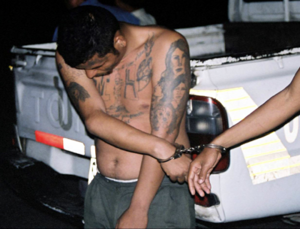
Members of MS distinguish themselves by tattoos covering the body and also often the face, as well as the use of their own sign language
. They are notorious for their use of violence and a subcultural
moral code that predominantly consists of merciless revenge and cruel retributions.
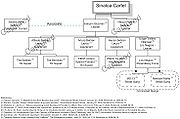
This excessive cruelty of the distinguished members of the "Maras" or "Mareros" earned them a path to be recruited by the Sinaloa Cartel
battling against Los Zetas
in an ongoing drug war south of the United States border. Their wide-ranging activities and elevated status has even caught the eye of the FBI
and Immigration and Customs Enforcement, who recently initiated wide-scale raids against known and suspected gang members netting hundreds of arrests across the country.
, set up in the 1980s by Salvadoran
immigrants in the city's Pico-Union
neighborhood who immigrated to the United States after the Central American civil wars of the 1980s.
Originally, the gang's main purpose was to protect Salvadoran immigrants from other, more established gangs of Los Angeles, who were predominantly composed of Mexicans and African-Americans.
Many Mara Salvatrucha gang members from the Los Angeles area have been deported after being arrested. As a result of these deportations, members of MS have recruited more members in their home countries. The Los Angeles Times contends that deportation policies have contributed to the size and influence of the gang both in the United States and in Central America. According to the 2009 National Gang Threat Assessment, "The gang is estimated to have 30,000 to 50,000 members and associate members worldwide, 8,000 to 10,000 of whom reside in the United States."
In recent years the gang has expanded into the Washington, D.C.
area, in particular the areas of Langley Park
and Takoma Park
near the Washington border have become centers of MS gang activity.
 In 2004, the US FBI
started the MS-13 National Gang Task Force. The FBI also began teaming with law enforcement in El Salvador
, Honduras
, Guatemala
, and Mexico
.
In 2005, the office of U.S. Immigration and Customs Enforcement
started Operation Community Shield. By 2011, this operation had made over 20,000 arrests, including more than 3,000 arrests of alleged MS-13 members.
In 2010, convictions of several MS-13 members was made in the Charlotte, NC area.
Some sources state the gang is named for La Mara, a street in San Salvador
, and the Salvatrucha guerrillas who fought in the Salvadoran Civil War. Additionally, the word mara means gang in Caliche and is taken from marabunta, the name of a fierce type of ant. "Salvatrucha" may be a combination of the words Salvadoran and trucha, a Caliche word for being alert.
. There were reports by the Minuteman Project that MS members were ordered to Arizona
to target U.S. Border Patrol
agents and Minuteman Project volunteers.
In 2005, Honduran Security Minister Oscar Alvarez
and the President of El Salvador
raised alarm by claiming that Muslim terrorist organisation Al-Qaeda
was meeting with Mara Salvatrucha and other Central American gangs to help them infiltrate the United States. FBI agents said that the U.S. intelligence community and governments of several Central American countries found there is no basis to believe that MS is connected to Al-Qaeda or other Islamic radicals, although Oscar did visit Central America to discuss the issue.
Robert Morales, a prosecutor for Guatemala, indicated to The Globe and Mail
that some Central American gang members seek refugee status in Canada
. Superintendent of the Royal Canadian Mounted Police
integrated gang task force, John Robin, said in an interview that "I think [gang members] have a feeling that police here won't treat them in the harsh manner they get down there." Robin noted that Canadian authorities "want to avoid ending up like the U.S., which is dealing with the problem of Central American gangsters on a much bigger scale".
On the southern border of Mexico
, the gang has unleashed violence against migrants.
in Virginia
. Paz was killed for informing the FBI about Mara Salvatrucha's criminal activities. Two of her former friends were later convicted of the murder.
In 2004, the FBI created the MS National Gang Task Force. In 2005, the FBI helped create a National Gang Information Center and outlined a National Gang Strategy for Congress.
On December 23, 2004, one of the most widely publicized MS crimes in Central America occurred in Chamelecón
, Honduras
when an intercity bus was intercepted and sprayed with automatic gunfire, killing 28 civilian passengers, most of whom were women and children. MS organized the massacre as a protest against the Honduran government for proposing a restoration of the death penalty in Honduras. Six gunmen raked the bus with gunfire. As passengers screamed and ducked, another gunman climbed aboard and methodically executed passengers. In February 2007, Juan Carlos Miranda Bueso and Darwin Alexis Ramírez were found guilty of several crimes including murder and attempted murder. Ebert Anibal Rivera was held over the attack and was arrested after having fled to Texas
. Juan Bautista Jimenez, accused of masterminding the massacre, was killed in prison. According to the authorities, fellow MS-13 inmates hanged
him. There was insufficient evidence to convict Óscar Fernando Mendoza and Wilson Geovany Gómez.
 On May 13, 2006, Ernesto "Smokey" Miranda, an ex-high ranking soldier and one of the founders of Mara Salvatrucha, was murdered at his home in El Salvador
a few hours after declining to attend a party for a gang member who had just been released from prison. He had begun studying law and working to keep children out of gangs.
In 2007, Julio Chavez allegedly murdered a man because he was wearing a red sweatshirt, and mistaken for a member of the Bloods
gang.
On June 4, 2008, in Toronto
, Ontario
, police executed 22 search warrants, made 17 arrests and laid 63 charges following a five-month investigation.
On June 22, 2008, in San Francisco, California
, a 21-year old MS gang member, Edwin Ramos
, shot and killed a father, Anthony Bologna, 48, and his two sons Michael, 20, and Matthew, 16, after their car briefly blocked Ramos from completing a left turn down a narrow street as they were returning home from a family barbecue.
On November 26, 2008, Jonathan Retana was convicted of the murder of Miguel Angel Deras, which the authorities linked to an MS initiation.
In 2008, the MS task force coordinated a series of arrests and crackdowns in the U.S. and Central America that involved more than 6,000 police officers in five countries. Seventy-three suspects were arrested in the U.S.; in all, more than 650 were taken into custody.
In February 2009, authorities in Colorado
and California
arrested 20 members of MS and seized 10 pounds of methamphetamine
, 2.3 kilograms (5 pounds) of cocaine
, a small amount of heroin, 12 firearms and $3,300 in cash.
In June 2009, Edwin Ortiz, Jose Gomez Amaya and Alexander Aguilar were MS gang members from Long Island
who had mistaken bystanders for rival gang members. As a result, two innocent civilians were shot. Edgar Villalobos, a laborer was killed.
On November 4, 2009, El Salvadoran leaders of the MS-13 gang allegedly put out a contract on the federal agent responsible for a crackdown on its New York factions, the Daily News has learned. The brazen plot to assassinate the unidentified Immigration and Customs Enforcement agent was revealed in an arrest warrant for reputed gang member Walter (Duke) Torres. Torres tipped authorities to the plan after he and four other MS-13 members were stopped by NYPD detectives for hassling passersby on Northern Blvd. in Queens last month. He told cops he had information to pass on, and was debriefed Oct. 22 at Rikers Island, where he was being held on a warrant issued in Virginia, according to court papers.Torres said "the order for the murder came from gang leadership in El Salvador," ICE agent Sean Sweeney wrote in an affidavit for a new warrant charging Torres with conspiracy. Torres, who belonged to an MS-13 "clique" in Virginia, said he was put in charge, and traveled to New York in August "for the specific purpose of participating in the planning and execution of the murder plot," Sweeney wrote. Gang members were trying to get their hands on a high-powered assault rifle, like an M-16
to penetrate the agent's bulletproof vest. Another MS-13 informant told authorities the agent was marked for death because the gang was "exceedingly angry" at him for arresting many members in the past three years, the affidavit states. The murder was supposed to be carried out by the Flushing clique, according to the informant. Federal prosecutors have indicted numerous MS-13 gang members on racketeering, extortion, prostitution, kidnapping, illegal immigration, money laundering, murder, people smuggling, arms trafficking, human trafficking and drug trafficking charges. The targeted special agent was the lead federal investigator on many of the federal cases.
In 2010, Rene Mejia allegedly murdered a 2 year old baby and his mother.
In August 2011, six San Francisco MS-13 members were convicted of racketeering and conspiracy, including three murders, in what at the time was the city's largest-scope gang trial in many years. Another 18 defendants reported to have ties to the gang plead guilty before trial.
. Eventually the work led to charges against 26 MS-13 members, including 7 trial convictions in January 2010, 18 guilty pleas, and 11 multi-year prison sentences.
This also included the alleged first federal death-penalty conviction for an MS-13 member, Alejandro Enrique Ramirez Umana, aka "Wizard" (age 25).
In 2005, in Los Angeles, according to a Jury in a later sentencing phase, Umana murdered Jose Herrera and Gustavo Porras (July 27) and participated and aided and abetted the killing of Andy Abarca (September 28). He later came to Charlotte, North Carolina, according to witnesses, as a veteran member of MS-13, in order to reorganize the Charlotte cell of the gang
.
According to witnesses at his later trial, on December 8, 2007, while in the Las Jarochitas, a family-run restaurant in Greensboro, North Carolina
, Umana shot Ruben Garcia Salinas fatally in the chest and Manuel Garcia Salinas in the head. Witnesses testified that the shootings took place after the Garcia Salinas brothers had “disrespected” Umana’s gang signs by calling them “fake.” Firing three more shots in the restaurant, according to trial testimony, Umana injured another individual with his gunfire. Trial testimony and evidence showed that Umana later fled back to Charlotte with MS-13 assistance. Umana was arrested five days later in possession of the murder weapon. Additional evidence and testimony from the trial revealed that while Umana was incarcerated while awaiting trial, he coordinated attempts to kill witnesses and informants.
Umana was indicted by a federal grand jury on June 23, 2008. During trial, Umana attempted to bring a knife with him to the courtroom, which was discovered by U.S. Marshals prior to Umana being transported to the courthouse. Thousands of hours were spent on the case over several years. International work was also involved.
The case was investigated by the Charlotte Safe Streets Task Force. The case was prosecuted by Chief Criminal Assistant U.S. Attorney Jill Westmoreland Rose of the U.S. Attorney’s Office
for the Western District of North Carolina, and Trial Attorney Sam Nazzaro from the Criminal Division’s Gang Unit. Assistant U.S. Attorneys Don Gast and Adam Morris of the U.S. Attorney’s Office
for the Western District of North Carolina were also members of the government’s trial team.
Charges included:
The jury convicted him on April 19, 2010 of all charges, and additionally found him responsible for the 2005 murders during the sentencing phase. On April 28, a 12-person federal jury in Charlotte voted unanimously to impose the death penalty. On July 27, 2010, Chief U.S. District Judge
Robert J. Conrad, Jr., of Charlotte, NC, formally imposed the federal death penalty sentence. Also commenting on the decision in the government press release were Assistant Attorney General Lanny A. Breuer, of the Criminal Division, U.S. Attorney
Anne M. Tompkins of the Western District of North Carolina, Owen D Harris, Special Agent
in charge of the Charlotte Division of the FBI, and Rodney Monreo, Charlotte-Mecklenburg Police Chief.
The case was automatically appealed under Federal Rules of Criminal Procedure
.
s. Common markings include "MS", "Salvatrucha", the "Devil Horns", the name of their clique, and other symbols. A December 2007 CNN internet news article stated that the gang was moving away from the tattoos in an attempt to commit crimes without being noticed.
Members of Mara Salvatrucha, like members of most modern American gangs, utilize a system of hand signs for purposes of identification and communication. One of the most commonly displayed is the "devil's head
" which forms an 'M' when displayed upside down. This hand sign is similar to the same symbol commonly seen displayed by heavy metal
musicians and their fans. Founders of Mara Salvatrucha borrowed the hand sign after attending concerts of heavy metal bands.
Criminal gang
A criminal gang may be:* Prison gang* Street gang* gangs within organized crime* Outlaw motorcycle club...
that originated in Los Angeles
Los Ángeles
Los Ángeles is the capital of the province of Biobío, in the commune of the same name, in Region VIII , in the center-south of Chile. It is located between the Laja and Biobío rivers. The population is 123,445 inhabitants...
and has spread to other parts of the United States
United States
The United States of America is a federal constitutional republic comprising fifty states and a federal district...
, Canada
Canada
Canada is a North American country consisting of ten provinces and three territories. Located in the northern part of the continent, it extends from the Atlantic Ocean in the east to the Pacific Ocean in the west, and northward into the Arctic Ocean...
, Mexico
Mexico
The United Mexican States , commonly known as Mexico , is a federal constitutional republic in North America. It is bordered on the north by the United States; on the south and west by the Pacific Ocean; on the southeast by Guatemala, Belize, and the Caribbean Sea; and on the east by the Gulf of...
, and Central America
Central America
Central America is the central geographic region of the Americas. It is the southernmost, isthmian portion of the North American continent, which connects with South America on the southeast. When considered part of the unified continental model, it is considered a subcontinent...
. The majority of the gang is ethnically composed of Central Americans and active in urban and suburban areas. In the U.S., the MS-13 specially has a heavy presence in the Los Angeles
Los Ángeles
Los Ángeles is the capital of the province of Biobío, in the commune of the same name, in Region VIII , in the center-south of Chile. It is located between the Laja and Biobío rivers. The population is 123,445 inhabitants...
and San Francisco metropolitan areas of California
California
California is a state located on the West Coast of the United States. It is by far the most populous U.S. state, and the third-largest by land area...
, Charlotte, North Carolina
Charlotte, North Carolina
Charlotte is the largest city in the U.S. state of North Carolina and the seat of Mecklenburg County. In 2010, Charlotte's population according to the US Census Bureau was 731,424, making it the 17th largest city in the United States based on population. The Charlotte metropolitan area had a 2009...
, the Washington, D.C.
Washington, D.C.
Washington, D.C., formally the District of Columbia and commonly referred to as Washington, "the District", or simply D.C., is the capital of the United States. On July 16, 1790, the United States Congress approved the creation of a permanent national capital as permitted by the U.S. Constitution....
metropolitan areas of Fairfax County, Virginia
Fairfax County, Virginia
Fairfax County is a county in Virginia, in the United States. Per the 2010 Census, the population of the county is 1,081,726, making it the most populous jurisdiction in the Commonwealth of Virginia, with 13.5% of Virginia's population...
and Prince George's County, Maryland
Prince George's County, Maryland
Prince George's County is a county located in the U.S. state of Maryland, immediately north, east, and south of Washington, DC. As of 2010, it has a population of 863,420 and is the wealthiest African-American majority county in the nation....
, and Long Island, New York.
Members of MS distinguish themselves by tattoos covering the body and also often the face, as well as the use of their own sign language
Sign language
A sign language is a language which, instead of acoustically conveyed sound patterns, uses visually transmitted sign patterns to convey meaning—simultaneously combining hand shapes, orientation and movement of the hands, arms or body, and facial expressions to fluidly express a speaker's...
. They are notorious for their use of violence and a subcultural
Subculture
In sociology, anthropology and cultural studies, a subculture is a group of people with a culture which differentiates them from the larger culture to which they belong.- Definition :...
moral code that predominantly consists of merciless revenge and cruel retributions.
This excessive cruelty of the distinguished members of the "Maras" or "Mareros" earned them a path to be recruited by the Sinaloa Cartel
Sinaloa Cartel
The Sinaloa Cartel is the most powerful drug cartel in Mexico and considered by the United States Intelligence Community as "the most powerful drug trafficking organization in the world." The Sinaloa Cartel is based in the city of Culiacán, Sinaloa, but also operates in the Mexican states of Baja...
battling against Los Zetas
Los Zetas
Los Zetas is the second most powerful drug cartel in Mexico and considered by the U.S. Drug Enforcement Administration as the most violent drug cartel and paramilitary enforcement group in Mexico...
in an ongoing drug war south of the United States border. Their wide-ranging activities and elevated status has even caught the eye of the FBI
Federal Bureau of Investigation
The Federal Bureau of Investigation is an agency of the United States Department of Justice that serves as both a federal criminal investigative body and an internal intelligence agency . The FBI has investigative jurisdiction over violations of more than 200 categories of federal crime...
and Immigration and Customs Enforcement, who recently initiated wide-scale raids against known and suspected gang members netting hundreds of arrests across the country.
History
The Mara Salvatrucha gang originated in Los AngelesLos Ángeles
Los Ángeles is the capital of the province of Biobío, in the commune of the same name, in Region VIII , in the center-south of Chile. It is located between the Laja and Biobío rivers. The population is 123,445 inhabitants...
, set up in the 1980s by Salvadoran
El Salvador
El Salvador or simply Salvador is the smallest and the most densely populated country in Central America. The country's capital city and largest city is San Salvador; Santa Ana and San Miguel are also important cultural and commercial centers in the country and in all of Central America...
immigrants in the city's Pico-Union
Pico-Union, Los Angeles, California
Pico-Union is a district in Los Angeles, California. Its name derives from the intersection of Pico Boulevard and Union Avenue. The Los Angeles Community Redevelopment Agency officially adopted the name in 1970, when it launched a neighborhood renewal program that continues to this day...
neighborhood who immigrated to the United States after the Central American civil wars of the 1980s.
Originally, the gang's main purpose was to protect Salvadoran immigrants from other, more established gangs of Los Angeles, who were predominantly composed of Mexicans and African-Americans.
Many Mara Salvatrucha gang members from the Los Angeles area have been deported after being arrested. As a result of these deportations, members of MS have recruited more members in their home countries. The Los Angeles Times contends that deportation policies have contributed to the size and influence of the gang both in the United States and in Central America. According to the 2009 National Gang Threat Assessment, "The gang is estimated to have 30,000 to 50,000 members and associate members worldwide, 8,000 to 10,000 of whom reside in the United States."
In recent years the gang has expanded into the Washington, D.C.
Washington Metropolitan Area
The Washington Metropolitan Area is the metropolitan area centered on Washington, D.C., the capital of the United States. The area includes all of the federal district and parts of the U.S...
area, in particular the areas of Langley Park
Langley Park, Maryland
Langley Park is an unincorporated area and census-designated place in the Washington, D.C. metro area. It is located inside the Capital Beltway, on the northwest edge of Prince George's County, Maryland, bordering Montgomery County, Maryland....
and Takoma Park
Takoma Park, Maryland
Takoma Park is a city in Montgomery County, Maryland, United States. It is a suburb of Washington, D.C., and part of the Washington Metropolitan Area. Founded in 1883 and incorporated in 1890, Takoma Park, informally called "Azalea City," is a Tree City USA and a nuclear-free zone...
near the Washington border have become centers of MS gang activity.
Federal Bureau of Investigation
The Federal Bureau of Investigation is an agency of the United States Department of Justice that serves as both a federal criminal investigative body and an internal intelligence agency . The FBI has investigative jurisdiction over violations of more than 200 categories of federal crime...
started the MS-13 National Gang Task Force. The FBI also began teaming with law enforcement in El Salvador
El Salvador
El Salvador or simply Salvador is the smallest and the most densely populated country in Central America. The country's capital city and largest city is San Salvador; Santa Ana and San Miguel are also important cultural and commercial centers in the country and in all of Central America...
, Honduras
Honduras
Honduras is a republic in Central America. It was previously known as Spanish Honduras to differentiate it from British Honduras, which became the modern-day state of Belize...
, Guatemala
Guatemala
Guatemala is a country in Central America bordered by Mexico to the north and west, the Pacific Ocean to the southwest, Belize to the northeast, the Caribbean to the east, and Honduras and El Salvador to the southeast...
, and Mexico
Mexico
The United Mexican States , commonly known as Mexico , is a federal constitutional republic in North America. It is bordered on the north by the United States; on the south and west by the Pacific Ocean; on the southeast by Guatemala, Belize, and the Caribbean Sea; and on the east by the Gulf of...
.
In 2005, the office of U.S. Immigration and Customs Enforcement
U.S. Immigration and Customs Enforcement
U.S. Immigration and Customs Enforcement is a federal law enforcement agency under the United States Department of Homeland Security , responsible for identifying, investigating, and dismantling vulnerabilities regarding the nation's border, economic, transportation, and infrastructure security...
started Operation Community Shield. By 2011, this operation had made over 20,000 arrests, including more than 3,000 arrests of alleged MS-13 members.
In 2010, convictions of several MS-13 members was made in the Charlotte, NC area.
Etymology
There is some dispute about the etymology of the name.Some sources state the gang is named for La Mara, a street in San Salvador
San Salvador
The city of San Salvador the capital and largest city of El Salvador, which has been designated a Gamma World City. Its complete name is La Ciudad de Gran San Salvador...
, and the Salvatrucha guerrillas who fought in the Salvadoran Civil War. Additionally, the word mara means gang in Caliche and is taken from marabunta, the name of a fierce type of ant. "Salvatrucha" may be a combination of the words Salvadoran and trucha, a Caliche word for being alert.
Illegal immigration and human smuggling
According to The Washington Times, MS "is thought to have established a major smuggling center" in MexicoMexico
The United Mexican States , commonly known as Mexico , is a federal constitutional republic in North America. It is bordered on the north by the United States; on the south and west by the Pacific Ocean; on the southeast by Guatemala, Belize, and the Caribbean Sea; and on the east by the Gulf of...
. There were reports by the Minuteman Project that MS members were ordered to Arizona
Arizona
Arizona ; is a state located in the southwestern region of the United States. It is also part of the western United States and the mountain west. The capital and largest city is Phoenix...
to target U.S. Border Patrol
United States Border Patrol
The United States Border Patrol is a federal law enforcement agency within U.S. Customs and Border Protection , a component of the Department of Homeland Security . It is an agency in the Department of Homeland Security that enforces laws and regulations for the admission of foreign-born persons to...
agents and Minuteman Project volunteers.
In 2005, Honduran Security Minister Oscar Alvarez
Oscar Álvarez
Oscar Alvarez is a Honduras Nationalist politician who is currently Minister of Public Security in the government of Porfirio Lobo, a position which he held from January 27, 2002 - November 14, 2005 in the government of Ricardo Maduro....
and the President of El Salvador
El Salvador
El Salvador or simply Salvador is the smallest and the most densely populated country in Central America. The country's capital city and largest city is San Salvador; Santa Ana and San Miguel are also important cultural and commercial centers in the country and in all of Central America...
raised alarm by claiming that Muslim terrorist organisation Al-Qaeda
Al-Qaeda
Al-Qaeda is a global broad-based militant Islamist terrorist organization founded by Osama bin Laden sometime between August 1988 and late 1989. It operates as a network comprising both a multinational, stateless army and a radical Sunni Muslim movement calling for global Jihad...
was meeting with Mara Salvatrucha and other Central American gangs to help them infiltrate the United States. FBI agents said that the U.S. intelligence community and governments of several Central American countries found there is no basis to believe that MS is connected to Al-Qaeda or other Islamic radicals, although Oscar did visit Central America to discuss the issue.
Robert Morales, a prosecutor for Guatemala, indicated to The Globe and Mail
The Globe and Mail
The Globe and Mail is a nationally distributed Canadian newspaper, based in Toronto and printed in six cities across the country. With a weekly readership of approximately 1 million, it is Canada's largest-circulation national newspaper and second-largest daily newspaper after the Toronto Star...
that some Central American gang members seek refugee status in Canada
Canada
Canada is a North American country consisting of ten provinces and three territories. Located in the northern part of the continent, it extends from the Atlantic Ocean in the east to the Pacific Ocean in the west, and northward into the Arctic Ocean...
. Superintendent of the Royal Canadian Mounted Police
Royal Canadian Mounted Police
The Royal Canadian Mounted Police , literally ‘Royal Gendarmerie of Canada’; colloquially known as The Mounties, and internally as ‘The Force’) is the national police force of Canada, and one of the most recognized of its kind in the world. It is unique in the world as a national, federal,...
integrated gang task force, John Robin, said in an interview that "I think [gang members] have a feeling that police here won't treat them in the harsh manner they get down there." Robin noted that Canadian authorities "want to avoid ending up like the U.S., which is dealing with the problem of Central American gangsters on a much bigger scale".
On the southern border of Mexico
Mexico
The United Mexican States , commonly known as Mexico , is a federal constitutional republic in North America. It is bordered on the north by the United States; on the south and west by the Pacific Ocean; on the southeast by Guatemala, Belize, and the Caribbean Sea; and on the east by the Gulf of...
, the gang has unleashed violence against migrants.
Publicized crimes
On July 13, 2003, Brenda Paz, a 17-year-old female, former MS member turned informant was found stabbed on the banks of the Shenandoah RiverShenandoah River
The Shenandoah River is a tributary of the Potomac River, long with two forks approximately long each, in the U.S. states of Virginia and West Virginia...
in Virginia
Virginia
The Commonwealth of Virginia , is a U.S. state on the Atlantic Coast of the Southern United States. Virginia is nicknamed the "Old Dominion" and sometimes the "Mother of Presidents" after the eight U.S. presidents born there...
. Paz was killed for informing the FBI about Mara Salvatrucha's criminal activities. Two of her former friends were later convicted of the murder.
In 2004, the FBI created the MS National Gang Task Force. In 2005, the FBI helped create a National Gang Information Center and outlined a National Gang Strategy for Congress.
On December 23, 2004, one of the most widely publicized MS crimes in Central America occurred in Chamelecón
Chamelecón
Chamelecón is a suburb of San Pedro Sula in Honduras.It came to world attention on 23 December 2004 when 28 people were murdered and another 28 injured while returning from the centre of San Pedro Sula by the MS-13 gang opposed to the restoration of the death penalty in Honduras. Many of the...
, Honduras
Honduras
Honduras is a republic in Central America. It was previously known as Spanish Honduras to differentiate it from British Honduras, which became the modern-day state of Belize...
when an intercity bus was intercepted and sprayed with automatic gunfire, killing 28 civilian passengers, most of whom were women and children. MS organized the massacre as a protest against the Honduran government for proposing a restoration of the death penalty in Honduras. Six gunmen raked the bus with gunfire. As passengers screamed and ducked, another gunman climbed aboard and methodically executed passengers. In February 2007, Juan Carlos Miranda Bueso and Darwin Alexis Ramírez were found guilty of several crimes including murder and attempted murder. Ebert Anibal Rivera was held over the attack and was arrested after having fled to Texas
Texas
Texas is the second largest U.S. state by both area and population, and the largest state by area in the contiguous United States.The name, based on the Caddo word "Tejas" meaning "friends" or "allies", was applied by the Spanish to the Caddo themselves and to the region of their settlement in...
. Juan Bautista Jimenez, accused of masterminding the massacre, was killed in prison. According to the authorities, fellow MS-13 inmates hanged
Hanging
Hanging is the lethal suspension of a person by a ligature. The Oxford English Dictionary states that hanging in this sense is "specifically to put to death by suspension by the neck", though it formerly also referred to crucifixion and death by impalement in which the body would remain...
him. There was insufficient evidence to convict Óscar Fernando Mendoza and Wilson Geovany Gómez.
El Salvador
El Salvador or simply Salvador is the smallest and the most densely populated country in Central America. The country's capital city and largest city is San Salvador; Santa Ana and San Miguel are also important cultural and commercial centers in the country and in all of Central America...
a few hours after declining to attend a party for a gang member who had just been released from prison. He had begun studying law and working to keep children out of gangs.
In 2007, Julio Chavez allegedly murdered a man because he was wearing a red sweatshirt, and mistaken for a member of the Bloods
Bloods
The Bloods are a street gang founded in Los Angeles, California. The gang is widely known for its rivalry with the Crips. They are identified by the red color worn by their members and by particular gang symbols, including distinctive hand signs...
gang.
On June 4, 2008, in Toronto
Toronto
Toronto is the provincial capital of Ontario and the largest city in Canada. It is located in Southern Ontario on the northwestern shore of Lake Ontario. A relatively modern city, Toronto's history dates back to the late-18th century, when its land was first purchased by the British monarchy from...
, Ontario
Ontario
Ontario is a province of Canada, located in east-central Canada. It is Canada's most populous province and second largest in total area. It is home to the nation's most populous city, Toronto, and the nation's capital, Ottawa....
, police executed 22 search warrants, made 17 arrests and laid 63 charges following a five-month investigation.
On June 22, 2008, in San Francisco, California
San Francisco, California
San Francisco , officially the City and County of San Francisco, is the financial, cultural, and transportation center of the San Francisco Bay Area, a region of 7.15 million people which includes San Jose and Oakland...
, a 21-year old MS gang member, Edwin Ramos
Edwin Ramos
Edwin U. Ramos is a Salvadoran gang member, convicted felon, and murder suspect. An illegal immigrant from El Salvador and member of the Mara Salvatrucha and Sureño street gangs, he is the suspect in the June 22, 2008 triple murder of Anthony Bologna and his sons, Michael and Matthew, in San...
, shot and killed a father, Anthony Bologna, 48, and his two sons Michael, 20, and Matthew, 16, after their car briefly blocked Ramos from completing a left turn down a narrow street as they were returning home from a family barbecue.
On November 26, 2008, Jonathan Retana was convicted of the murder of Miguel Angel Deras, which the authorities linked to an MS initiation.
In 2008, the MS task force coordinated a series of arrests and crackdowns in the U.S. and Central America that involved more than 6,000 police officers in five countries. Seventy-three suspects were arrested in the U.S.; in all, more than 650 were taken into custody.
In February 2009, authorities in Colorado
Colorado
Colorado is a U.S. state that encompasses much of the Rocky Mountains as well as the northeastern portion of the Colorado Plateau and the western edge of the Great Plains...
and California
California
California is a state located on the West Coast of the United States. It is by far the most populous U.S. state, and the third-largest by land area...
arrested 20 members of MS and seized 10 pounds of methamphetamine
Methamphetamine
Methamphetamine is a psychostimulant of the phenethylamine and amphetamine class of psychoactive drugs...
, 2.3 kilograms (5 pounds) of cocaine
Cocaine
Cocaine is a crystalline tropane alkaloid that is obtained from the leaves of the coca plant. The name comes from "coca" in addition to the alkaloid suffix -ine, forming cocaine. It is a stimulant of the central nervous system, an appetite suppressant, and a topical anesthetic...
, a small amount of heroin, 12 firearms and $3,300 in cash.
In June 2009, Edwin Ortiz, Jose Gomez Amaya and Alexander Aguilar were MS gang members from Long Island
Long Island
Long Island is an island located in the southeast part of the U.S. state of New York, just east of Manhattan. Stretching northeast into the Atlantic Ocean, Long Island contains four counties, two of which are boroughs of New York City , and two of which are mainly suburban...
who had mistaken bystanders for rival gang members. As a result, two innocent civilians were shot. Edgar Villalobos, a laborer was killed.
On November 4, 2009, El Salvadoran leaders of the MS-13 gang allegedly put out a contract on the federal agent responsible for a crackdown on its New York factions, the Daily News has learned. The brazen plot to assassinate the unidentified Immigration and Customs Enforcement agent was revealed in an arrest warrant for reputed gang member Walter (Duke) Torres. Torres tipped authorities to the plan after he and four other MS-13 members were stopped by NYPD detectives for hassling passersby on Northern Blvd. in Queens last month. He told cops he had information to pass on, and was debriefed Oct. 22 at Rikers Island, where he was being held on a warrant issued in Virginia, according to court papers.Torres said "the order for the murder came from gang leadership in El Salvador," ICE agent Sean Sweeney wrote in an affidavit for a new warrant charging Torres with conspiracy. Torres, who belonged to an MS-13 "clique" in Virginia, said he was put in charge, and traveled to New York in August "for the specific purpose of participating in the planning and execution of the murder plot," Sweeney wrote. Gang members were trying to get their hands on a high-powered assault rifle, like an M-16
M16 rifle
The M16 is the United States military designation for the AR-15 rifle adapted for both semi-automatic and full-automatic fire. Colt purchased the rights to the AR-15 from ArmaLite, and currently uses that designation only for semi-automatic versions of the rifle. The M16 fires the 5.56×45mm NATO...
to penetrate the agent's bulletproof vest. Another MS-13 informant told authorities the agent was marked for death because the gang was "exceedingly angry" at him for arresting many members in the past three years, the affidavit states. The murder was supposed to be carried out by the Flushing clique, according to the informant. Federal prosecutors have indicted numerous MS-13 gang members on racketeering, extortion, prostitution, kidnapping, illegal immigration, money laundering, murder, people smuggling, arms trafficking, human trafficking and drug trafficking charges. The targeted special agent was the lead federal investigator on many of the federal cases.
In 2010, Rene Mejia allegedly murdered a 2 year old baby and his mother.
In August 2011, six San Francisco MS-13 members were convicted of racketeering and conspiracy, including three murders, in what at the time was the city's largest-scope gang trial in many years. Another 18 defendants reported to have ties to the gang plead guilty before trial.
Charlotte, North Carolina cases
In the early 2000s, US authorities investigated MS-13 in Charlotte, North CarolinaCharlotte, North Carolina
Charlotte is the largest city in the U.S. state of North Carolina and the seat of Mecklenburg County. In 2010, Charlotte's population according to the US Census Bureau was 731,424, making it the 17th largest city in the United States based on population. The Charlotte metropolitan area had a 2009...
. Eventually the work led to charges against 26 MS-13 members, including 7 trial convictions in January 2010, 18 guilty pleas, and 11 multi-year prison sentences.
This also included the alleged first federal death-penalty conviction for an MS-13 member, Alejandro Enrique Ramirez Umana, aka "Wizard" (age 25).
In 2005, in Los Angeles, according to a Jury in a later sentencing phase, Umana murdered Jose Herrera and Gustavo Porras (July 27) and participated and aided and abetted the killing of Andy Abarca (September 28). He later came to Charlotte, North Carolina, according to witnesses, as a veteran member of MS-13, in order to reorganize the Charlotte cell of the gang
Clandestine cell system
A clandestine cell structure is a method for organizing a group of people in such a way that it can more effectively resist penetration by an opposing organization. Depending on the group's philosophy, its operational area, the communications technologies available, and the nature of the mission,...
.
According to witnesses at his later trial, on December 8, 2007, while in the Las Jarochitas, a family-run restaurant in Greensboro, North Carolina
Greensboro, North Carolina
Greensboro is a city in the U.S. state of North Carolina. It is the third-largest city by population in North Carolina and the largest city in Guilford County and the surrounding Piedmont Triad metropolitan region. According to the 2010 U.S...
, Umana shot Ruben Garcia Salinas fatally in the chest and Manuel Garcia Salinas in the head. Witnesses testified that the shootings took place after the Garcia Salinas brothers had “disrespected” Umana’s gang signs by calling them “fake.” Firing three more shots in the restaurant, according to trial testimony, Umana injured another individual with his gunfire. Trial testimony and evidence showed that Umana later fled back to Charlotte with MS-13 assistance. Umana was arrested five days later in possession of the murder weapon. Additional evidence and testimony from the trial revealed that while Umana was incarcerated while awaiting trial, he coordinated attempts to kill witnesses and informants.
Umana was indicted by a federal grand jury on June 23, 2008. During trial, Umana attempted to bring a knife with him to the courtroom, which was discovered by U.S. Marshals prior to Umana being transported to the courthouse. Thousands of hours were spent on the case over several years. International work was also involved.
The case was investigated by the Charlotte Safe Streets Task Force. The case was prosecuted by Chief Criminal Assistant U.S. Attorney Jill Westmoreland Rose of the U.S. Attorney’s Office
United States Attorney
United States Attorneys represent the United States federal government in United States district court and United States court of appeals. There are 93 U.S. Attorneys stationed throughout the United States, Puerto Rico, the U.S. Virgin Islands, Guam, and the Northern Mariana Islands...
for the Western District of North Carolina, and Trial Attorney Sam Nazzaro from the Criminal Division’s Gang Unit. Assistant U.S. Attorneys Don Gast and Adam Morris of the U.S. Attorney’s Office
United States Attorney
United States Attorneys represent the United States federal government in United States district court and United States court of appeals. There are 93 U.S. Attorneys stationed throughout the United States, Puerto Rico, the U.S. Virgin Islands, Guam, and the Northern Mariana Islands...
for the Western District of North Carolina were also members of the government’s trial team.
Charges included:
- MurderMurderMurder is the unlawful killing, with malice aforethought, of another human being, and generally this state of mind distinguishes murder from other forms of unlawful homicide...
in aid of the racketeering enterprise known as MS-13, two counts - Murder resulting from the use of a gun in a violent crime, two counts
- ConspiracyConspiracy (crime)In the criminal law, a conspiracy is an agreement between two or more persons to break the law at some time in the future, and, in some cases, with at least one overt act in furtherance of that agreement...
to participate in racketeering - Witness tamperingWitness tamperingWitness tampering is harming or otherwise threatening a witness, hoping to influence his or her testimony.-Witness tampering in the USA:In the United States, the crime of witness tampering in federal cases is defined by statute at , "Tampering with a witness, victim, or an informant"...
or intimidationIntimidationIntimidation is intentional behavior "which would cause a person of ordinary sensibilities" fear of injury or harm. It's not necessary to prove that the behavior was so violent as to cause terror or that the victim was actually frightened.Criminal threatening is the crime of intentionally or...
, two counts - Possession of a firearmWeapon possession (crime)Weapon possession refers to a class of crime regarding the unlawful possession of a weapon by a citizen within an established society.Many societies both past and present have placed restrictions on what forms of weaponry private citizens are allowed to purchase, own, and carry in public...
by an illegal alienAlien (law)In law, an alien is a person in a country who is not a citizen of that country.-Categorization:Types of "alien" persons are:*An alien who is legally permitted to remain in a country which is foreign to him or her. On specified terms, this kind of alien may be called a legal alien of that country... - ExtortionExtortionExtortion is a criminal offence which occurs when a person unlawfully obtains either money, property or services from a person, entity, or institution, through coercion. Refraining from doing harm is sometimes euphemistically called protection. Extortion is commonly practiced by organized crime...
The jury convicted him on April 19, 2010 of all charges, and additionally found him responsible for the 2005 murders during the sentencing phase. On April 28, a 12-person federal jury in Charlotte voted unanimously to impose the death penalty. On July 27, 2010, Chief U.S. District Judge
United States district court
The United States district courts are the general trial courts of the United States federal court system. Both civil and criminal cases are filed in the district court, which is a court of law, equity, and admiralty. There is a United States bankruptcy court associated with each United States...
Robert J. Conrad, Jr., of Charlotte, NC, formally imposed the federal death penalty sentence. Also commenting on the decision in the government press release were Assistant Attorney General Lanny A. Breuer, of the Criminal Division, U.S. Attorney
United States Attorney
United States Attorneys represent the United States federal government in United States district court and United States court of appeals. There are 93 U.S. Attorneys stationed throughout the United States, Puerto Rico, the U.S. Virgin Islands, Guam, and the Northern Mariana Islands...
Anne M. Tompkins of the Western District of North Carolina, Owen D Harris, Special Agent
Special agent
Special agent is usually the title for a detective or investigator for a state, county, municipal, federal or tribal government. An agent is a worker for any federal agency, and a secret agent is one who works for an intelligence agency....
in charge of the Charlotte Division of the FBI, and Rodney Monreo, Charlotte-Mecklenburg Police Chief.
The case was automatically appealed under Federal Rules of Criminal Procedure
Federal Rules of Criminal Procedure
The Federal Rules of Criminal Procedure are the procedural rules that govern how federal criminal prosecutions are conducted in United States district courts, the general trial courts of the U.S. government. As such, they are the companion to the Federal Rules of Civil Procedure...
.
Gang markings and hand signs
Many Mara Salvatrucha members cover themselves in tattooTattoo
A tattoo is made by inserting indelible ink into the dermis layer of the skin to change the pigment. Tattoos on humans are a type of body modification, and tattoos on other animals are most commonly used for identification purposes...
s. Common markings include "MS", "Salvatrucha", the "Devil Horns", the name of their clique, and other symbols. A December 2007 CNN internet news article stated that the gang was moving away from the tattoos in an attempt to commit crimes without being noticed.
Members of Mara Salvatrucha, like members of most modern American gangs, utilize a system of hand signs for purposes of identification and communication. One of the most commonly displayed is the "devil's head
Corna
The sign of the horns is a hand gesture with a variety of meanings and uses in various cultures. It is formed by extending the index and little fingers while holding the middle and ring fingers down with the thumb.-Superstition:...
" which forms an 'M' when displayed upside down. This hand sign is similar to the same symbol commonly seen displayed by heavy metal
Heavy metal music
Heavy metal is a genre of rock music that developed in the late 1960s and early 1970s, largely in the Midlands of the United Kingdom and the United States...
musicians and their fans. Founders of Mara Salvatrucha borrowed the hand sign after attending concerts of heavy metal bands.
In film
- The gang appears briefly in the film Training DayTraining DayTraining Day is a 2001 crime drama film directed by Antoine Fuqua, written by David Ayer, starring Denzel Washington and Ethan Hawke. The film follows two LAPD narcotics detectives over a 24-hour period in the gang neighborhoods of South and East Los Angeles.The film was a box office success and...
(2001).
- Principal characters of the feature movie Sin NombreSin Nombre (2009 film)Sin Nombre is an American and Mexican film written and directed by Cary Joji Fukunaga.Filmed in Spanish, the film's name means "Nameless"...
(2009) are members of MS in ChiapasChiapasChiapas officially Estado Libre y Soberano de Chiapas is one of the 31 states that, with the Federal District, comprise the 32 Federal Entities of Mexico. It is divided in 118 municipalities and its capital city is Tuxtla Gutierrez. Other important cites in Chiapas include San Cristóbal de las...
, MexicoMexicoThe United Mexican States , commonly known as Mexico , is a federal constitutional republic in North America. It is bordered on the north by the United States; on the south and west by the Pacific Ocean; on the southeast by Guatemala, Belize, and the Caribbean Sea; and on the east by the Gulf of...
and many of the traditions and practices of MS are depicted accurately (killings, tattoos, initiation, exploitation of migrants, etc.).
See also
- Criminal tattoos
- 18th Street gang18th Street gang18th Street gang is considered to be the largest transnational criminal gang in Los Angeles, California. It is estimated that there are thousands of members in Los Angeles County alone...
- Gangs
- Maras (gangs)Maras (gangs)Maras are gangs originating from Central American countries such as El Salvador, Honduras and Guatemala.- Activities :Maras activities range from Arms trafficking, assault, auto theft, burglaries, drug trafficking, extortion, human trafficking, identity fraud, identity theft, illegal gambling,...
- Organized crimeOrganized crimeOrganized crime or criminal organizations are transnational, national, or local groupings of highly centralized enterprises run by criminals for the purpose of engaging in illegal activity, most commonly for monetary profit. Some criminal organizations, such as terrorist organizations, are...
- List of California street gangs
- Gangs in the United StatesGangs in the United StatesStreet gangs in the United States date to the early 19th century. The most publicized street gangs in the U.S. are African-American; black gangs were not recognized as a social problem until after the great migration of the 1910s...
- Racketeer Influenced and Corrupt Organizations ActRacketeer Influenced and Corrupt Organizations ActThe Racketeer Influenced and Corrupt Organizations Act, commonly referred to as the RICO Act or simply RICO, is a United States federal law that provides for extended criminal penalties and a civil cause of action for acts performed as part of an ongoing criminal organization...
(RICO) - Salvadoran Civil War
Further reading
- Ana Arana, “How the Street Gangs Took Central America”, Foreign Affairs, May/June 2005.
- Federico Brevé "The Maras: A Menace to the Americas", Military Review, July–August 2007.
- Tom Diaz No Boundaries: Transnational Latino Gangs and American Law Enforcement, Ann Arbor, Mich.: University of Michigan Press, 2009.
- Samuel Logan This Is for the Mara Salvatrucha: Inside the MS-13, America's Most Violent Gang, 2009
- UNODC, May 2007; Washington Office on Latin America and the Instituto Tecnológico Autónomo de México (ITAM) Transnational Youth Gangs in Central America, Mexico and the United States, March 2007.
External links
- Samuel Logan "This Is For The Mara Salvatrucha" by Samuel Logan
- "Gangs, Terrorists, and Trade" April 12, 2007 in Foreign Policy In Focus
- MS-13 Member’s Trail Shows Gang’s Movement MS-13 Rivalry/18th Street Gang
- National Geographic post-investigation essay.
- PBS Wide Angle: 18 With a Bullet MS-13 Gang in El Salvador
- FBI.gov
- FBI.gov
- ICE.gov
- http://www.alternet.org/world/148020/federal_prosecutors_hiding_evidence_in_war_on_gangs/
- http://www.ms13gang.com/