


Mandriva Linux

Encyclopedia
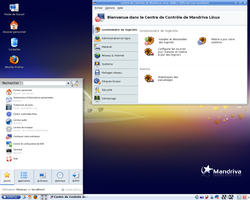
Linux distribution
A Linux distribution is a member of the family of Unix-like operating systems built on top of the Linux kernel. Such distributions are operating systems including a large collection of software applications such as word processors, spreadsheets, media players, and database applications...
distributed by Mandriva
Mandriva
Mandriva S.A. is a publicly traded Linux and open source software company with its headquarters in Paris, France and development center in Curitiba, Brazil. Mandriva, S.A...
. It uses the RPM Package Manager
RPM Package Manager
RPM Package Manager is a package management system. The name RPM variously refers to the .rpm file format, files in this format, software packaged in such files, and the package manager itself...
. The product lifetime of Mandriva Linux releases is 18 months for base updates (Linux, system software
System software
System software is computer software designed to operate the computer hardware and to provide a platform for running application software.The most basic types of system software are:...
, etc.) and 12 months for desktop updates (window managers, desktop environments, web browsers, etc.). Server
Server (computing)
In the context of client-server architecture, a server is a computer program running to serve the requests of other programs, the "clients". Thus, the "server" performs some computational task on behalf of "clients"...
products receive full updates for at least 5 years after their release.
History
The first release was based on Red Hat LinuxRed Hat Linux
Red Hat Linux, assembled by the company Red Hat, was a popular Linux based operating system until its discontinuation in 2004.Red Hat Linux 1.0 was released on November 3, 1994...
(version 5.1) and K Desktop Environment 1 in July 1998. It has since moved away from Red Hat's distribution and has become a completely separate distribution in its own right. Mandriva now includes a number of original tools, mostly to ease system configuration. Mandriva Linux was the brainchild of Gaël Duval
Gaël Duval
Gaël Duval is a graduate of the Caen University in France, where he studied networks and documentary applications. In July 1998, he created Mandrake Linux , a Linux distribution originally based on Red Hat Linux and KDE...
, who wanted to focus on ease of use for new users.
Name changes
From its inception until the release of version 8.0, Mandrake named its flagship distribution Linux-Mandrake. From version 8.1 to 9.2 the distribution name was reversed and called Mandrake Linux.In February 2004, MandrakeSoft lost a court case against Hearst Corporation
Hearst Corporation
The Hearst Corporation is an American media conglomerate based in the Hearst Tower, Manhattan in New York City, New York, United States. Founded by William Randolph Hearst as an owner of newspapers, the company's holdings now include a wide variety of media...
, owners of King Features Syndicate
King Features Syndicate
King Features Syndicate, a print syndication company owned by The Hearst Corporation, distributes about 150 comic strips, newspaper columns, editorial cartoons, puzzles and games to nearly 5000 newspapers worldwide...
. Hearst contended that MandrakeSoft infringed upon King Features' trademark
Trademark
A trademark, trade mark, or trade-mark is a distinctive sign or indicator used by an individual, business organization, or other legal entity to identify that the products or services to consumers with which the trademark appears originate from a unique source, and to distinguish its products or...
ed character Mandrake the Magician
Mandrake the Magician
Mandrake the Magician is a syndicated newspaper comic strip, created by Lee Falk , which began June 11, 1934. Phil Davis soon took over as the strip's illustrator, while Falk continued to script. The strip was distributed by King Features Syndicate.Davis worked on the strip until his death in 1964,...
. As a precaution, MandrakeSoft renamed its products by removing the space between the brand name and the product name and changing the first letter of the product name to lower case, thus creating one word. Starting from version 10.0, Mandrake Linux became known as Mandrakelinux, and its logo changed accordingly. Similarly, MandrakeMove became Mandrakemove.
In April 2005, Mandrakesoft announced the corporate acquisition of Conectiva
Conectiva
Conectiva was a company founded on August 28, 1995, in Curitiba, Paraná, Brazil, by a group of friends, among them Arnaldo Carvalho de Melo, who was a pioneer in the distribution of Linux and open source software in Brazilian Portuguese, Spanish and English for all of Latin America...
, a Brazilian based company that produced a Linux distribution for Portuguese-speaking (Brazil) and Spanish-speaking Latin America. As a result of this acquisition and the legal dispute with Hearst Corporation, Mandrakesoft announced that the company was changing its name to Mandriva, and that their linux distribution Mandrake Linux would henceforward be known as Mandriva Linux.
Installation, control and administration
Mandriva Linux contains the Mandriva Control CenterDrakConf
drakconf, or the Mandrake Control Center, is a computer program written in Perl for the configuration of Mandriva Linux, a Linux distribution...
, which eases configuration of some settings. It has many programs known as Drakes or Draks, collectively named drakxtools, to configure many different settings. Examples include MouseDrake to set up a mouse, DiskDrake to set up disk partitions and drakconnect to set up a network connection. They are written using GTK+
GTK+
GTK+ is a cross-platform widget toolkit for creating graphical user interfaces. It is licensed under the terms of the GNU LGPL, allowing both free and proprietary software to use it. It is one of the most popular toolkits for the X Window System, along with Qt.The name GTK+ originates from GTK;...
and Perl
Perl
Perl is a high-level, general-purpose, interpreted, dynamic programming language. Perl was originally developed by Larry Wall in 1987 as a general-purpose Unix scripting language to make report processing easier. Since then, it has undergone many changes and revisions and become widely popular...
, and most of them can run in both graphical and text mode using the ncurses
Ncurses
ncurses is a programming library that provides an API which allows the programmer to write text user interfaces in a terminal-independent manner. It is a toolkit for developing "GUI-like" application software that runs under a terminal emulator...
interface.
Desktops
The latest version of Mandriva Linux, 2011.0 officially supports only KDE Plasma Desktop, whereas other desktop environments are available but not supported. Older Mandriva versions used Plasma Desktop as standard but others such as GNOMEGNOME
GNOME is a desktop environment and graphical user interface that runs on top of a computer operating system. It is composed entirely of free and open source software...
were also officially supported.
Themes
A unique themeTheme (computing)
In computing, a theme is a preset package containing graphical appearance details, used to customize the look and feel of an operating system, widget set or window manager....
provides consistency between applications
Application software
Application software, also known as an application or an "app", is computer software designed to help the user to perform specific tasks. Examples include enterprise software, accounting software, office suites, graphics software and media players. Many application programs deal principally with...
and desktop environment
Desktop environment
In graphical computing, a desktop environment commonly refers to a style of graphical user interface derived from the desktop metaphor that is seen on most modern personal computers. These GUIs help the user in easily accessing, configuring, and modifying many important and frequently accessed...
s. Galaxy debuted in version 9.1 and Galaxy II appeared in 10.0. A variant of Galaxy is "Galaxy Squared", which uses square
Square (geometry)
In geometry, a square is a regular quadrilateral. This means that it has four equal sides and four equal angles...
window buttons rather than round
Circle
A circle is a simple shape of Euclidean geometry consisting of those points in a plane that are a given distance from a given point, the centre. The distance between any of the points and the centre is called the radius....
ones. A new default theme named "Ia Ora" was introduced with the release of Mandriva Linux 2007, but "Galaxy" remains available as an option for those who prefer it.
Package manager
Package management system
In software, a package management system, also called package manager, is a collection of software tools to automate the process of installing, upgrading, configuring, and removing software packages for a computer's operating system in a consistent manner...
called urpmi
Urpmi
urpmi is a Mandriva Linux package management tool for installing, removing, updating and querying software packages of local or remote media. It wraps around the package manager rpm with the aim that the user should not have to suffer the often-encountered dependency hell...
, which functions as a wrapper
Wrapper
Wrapper generally refers to a type of packaging, such as a flat sheet made out of paper, cellophane or plastic to enclose an object.Wrapper may also refer to:* Wrapper , a woman's garment which is worn over nightwear or lingerie...
to the RPM
RPM Package Manager
RPM Package Manager is a package management system. The name RPM variously refers to the .rpm file format, files in this format, software packaged in such files, and the package manager itself...
package management system. It is similar to apt-get or Yellow dog Updater, Modified
Yellow dog Updater, Modified
The Yellowdog Updater, Modified is an open-source command-line package-management utility for RPM-compatible Linux operating systems and has been released under the GNU General Public License. It was developed by Seth Vidal and a group of volunteer programmers...
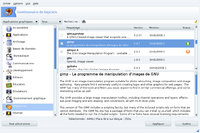
in that it allows seamless installation of a given software package by automatically installing the other packages needed. It is also media-transparent due to its ability to retrieve packages from various media, including network/Internet, CD/DVD and local disk. Urpmi also has an easy-to-use graphical front-end called rpmdrake
Rpmdrake
rpmdrake is a graphical interface to urpmi, which permits the installation of software packages. It is provided as part of Mandriva Linux for package installation.The application is written in gtk2-perl, and allows:...
, which is integrated into the Mandriva Control Center.
Remote sources for urpmi / rpmdrake can be added during the installation of recent Mandriva Linux versions. After installation, they can be added through an option in the Software Sources Manager, or by using console commands generated either manually or by one of several helper sites such as Easy URPMI. This functionality allows the user to choose some or all of the various software repositories available for their version of Mandriva Linux and can greatly expand the amount of software that the user can install through the urpmi system. Instructions on adding repositories and installing software can be found on the Mandriva Wiki.
Availability
Mandriva provides multiple editions of Linux. Some are freely-distributable, while others are sold online and via a network of authorized resellers.Versions
Since 2007, Mandriva is released on a 6-month fixed-release cycle, similar to UbuntuUbuntu (operating system)
Ubuntu is a computer operating system based on the Debian Linux distribution and distributed as free and open source software. It is named after the Southern African philosophy of Ubuntu...
and Fedora
Fedora (operating system)
Fedora is a RPM-based, general purpose collection of software, including an operating system based on the Linux kernel, developed by the community-supported Fedora Project and sponsored by Red Hat...
. In 2011, the release model was changed towards a yearly cycle.
Latest version
The latest stable version is Mandriva Linux 2011 ("Hydrogen"). It was released on 28 August 2011.Development version
The development tree of Mandriva Linux has always been known as Cooker. This tree is directly released as a new stable version.Other Systems
Many Operating Systems like Mandriva include Ubuntu, Fedora and many more, each filled with many features.Table of versions
| Year | Number | Name |
|---|---|---|
| 1998 | 5.1 | Venice |
| 1998 | 5.2 | Leeloo |
| 1999 | 5.3 | Festen |
| 1999 | 6.0 | Venus |
| 1999 | 6.1 | Helios |
| 2000 | 7.0 | Air |
| 2000 | 7.1 | Helium |
| 2000 | 7.2 | Odyssey (called Ulysses during beta) |
| 2001 | 8.0 | Traktopel |
| 2001 | 8.1 | Vitamin |
| 2002 | 8.2 | Bluebird |
| 2002 | 9.0 | Dolphin |
| 2003 | 9.1 | Bamboo |
| 2003 | 9.2 | FiveStar |
| 2004 | 10.0 | Community and Official |
| 2004 | 10.1 | Community |
| 2004 | 10.1 | Official |
| 2005 | 10.2 | Limited Edition 2005 |
| 2005 | 2006.0 | Mandriva Linux 2006 |
| 2006 | 2007 | Mandriva Linux 2007 |
| 2007 | 2007.1 | Mandriva Linux 2007 Spring |
| 2007 | 2008.0 | Mandriva Linux 2008 |
| 2008 | 2008.1 | Mandriva Linux 2008 Spring |
| 2008 | 2009.0 | Mandriva Linux 2009 |
| 2009 | 2009.1 | Mandriva Linux 2009 Spring |
| 2009 | 2010.0 | Mandriva Linux 2010 |
| 2010 | 2010.1 | Mandriva Linux 2010 Spring |
| 2010 | 2010.2 | Mandriva Linux 2010.2 |
| 2011 | 2011.0 | Hydrogen |
Editions
Each release of Mandriva Linux is split into several different editions. Each edition is derived from the same master tree, most of which is available on the public mirrors: all free / open source software, and all non-free software which is under a license that allows unrestricted distribution to the general public, is available from the public mirrors. Only commercial software under a license that does not allow unrestricted distribution to the general public (but for which Mandriva has negotiated an agreement to distribute it with paid copies) is not available from public mirrors.Mandriva Linux Free
Mandriva Linux Free is a 'traditional' distribution (i.e. one that comes with a dedicated installer, named DrakX, which is first used to install the distribution to the hard disk of the computer before it is run). It is 'free' in both sensesGratis versus Libre
Gratis versus libre is the distinction between two meanings of the English adjective "free"; namely, "for zero price" and "with little or no restriction"...
: it consists entirely of free
Free software
Free software, software libre or libre software is software that can be used, studied, and modified without restriction, and which can be copied and redistributed in modified or unmodified form either without restriction, or with restrictions that only ensure that further recipients can also do...
and open-source software
Open-source software
Open-source software is computer software that is available in source code form: the source code and certain other rights normally reserved for copyright holders are provided under a software license that permits users to study, change, improve and at times also to distribute the software.Open...
, and it is made available for public download at no charge. It is usually available in CD (three or four discs) and DVD editions for x86 32- and 64-bit CPU architectures. It is aimed at users to whom software freedom is important, and also at users who prefer a traditional installer to the installable live CD system used by One. The package selection is tailored towards regular desktop use. It consists of a subset of packages from the 'main' and 'contrib' sections of the master tree.
Mandriva Linux One
Live CD
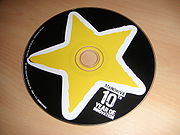
A live CD, live DVD, or live disc is a CD or DVD containing a bootable computer operating system. Live CDs are unique in that they have the ability to run a complete, modern operating system on a computer lacking mutable secondary storage, such as a hard disk drive...
and an installer (with an installation wizard that includes disk partitioning tools).
Several Mandriva Linux One versions were provided for each Mandriva Linux release preceding Mandriva 2008. Users could choose between different languages, select either the KDE or GNOME desktops and include or exclude non-free (as in speech) software. (It is not possible to fit both KDE and GNOME desktops, or more than a few languages, on a single live CD.) The 'lead' version is the KDE version with non-free software included. The One images consist of a subset of packages from the 'main', 'contrib' and 'non-free' sections of the master tree, with the documentation files stripped from the packages to save space.
Mandriva Linux One 2008 has a smaller range of versions. There are KDE and GNOME versions with the default set of languages. There are also two KDE versions with alternative sets of languages. All versions include non-free software.
Mandriva Linux Powerpack
Mandriva Linux Powerpack is a 'traditional' distribution (in other words, one that comes with a dedicated installer, DrakX, which is first used to install the distribution to the hard disk of the computer before it is run). It is the main commercial edition of Mandriva Linux, and as such, requires payment for its use. It contains several non-free packages intended to add value for the end user, including non-free drivers like the NVIDIA and ATI graphics card drivers, non-free firmware for wireless chips and modems, some browserWeb browser
A web browser is a software application for retrieving, presenting, and traversing information resources on the World Wide Web. An information resource is identified by a Uniform Resource Identifier and may be a web page, image, video, or other piece of content...
plugins such as Java and Flash, and some full applications such as Cedega, Adobe Reader and RealPlayer. It is sold directly from the Mandriva Store website and through authorized resellers. It is also made available via a subscription service, which allows unlimited downloads of Powerpack editions for the last few Mandriva releases for a set yearly fee. It consists of a subset of packages from the 'main', 'contrib', 'non-free' and 'restricted' sections of the master tree.
In Mandriva Linux 2008, the Discovery and Powerpack+ editions have been merged into Powerpack, which will become Mandriva's only commercial offering. Users will be able to choose between a novice-friendly Discovery-like setup or an installation process and desktop aimed at power users.
Mandriva Linux Discovery
Mandriva Linux Discovery was a commercial distribution aimed at first-time and novice Linux users. It was sold via the Mandriva Store website and authorized resellers, or could be downloaded by some subscribers to the Mandriva Club. Mandriva Linux 2008 does not include a Discovery edition, having added optional novice-friendly features to the Powerpack edition.In releases prior to Mandriva Linux 2007, Discovery was a 'traditional' distribution built on the DrakX installer. In Mandriva Linux 2007 and 2007 Spring, Discovery is a hybrid "Live DVD"
Live CD
A live CD, live DVD, or live disc is a CD or DVD containing a bootable computer operating system. Live CDs are unique in that they have the ability to run a complete, modern operating system on a computer lacking mutable secondary storage, such as a hard disk drive...
which can be booted without installation or installed to hard disk in the traditional manner.
Discovery was a DVD rather than a CD, allowing all languages to be provided on one disc. It consisted of a subset of packages from the 'main', 'contrib', 'non-free' and 'non-free-restricted' sections of the master tree. The package selection was tailored towards novice desktop users. A theme chosen to be appealing to novice users was used, and the 'simplified' menu layout in which applications are described rather than named and not all applications are included was the default (for all other editions, the default menu layout was the 'traditional' layout, where all graphical applications installed on the system were included and were listed by name).
Mandriva Linux Powerpack+
Mandriva Linux Powerpack+ was a version of Powerpack with additional packages, mostly commercial software. Like Powerpack, it was sold directly from the Mandriva Store website and through authorized resellers; it was also a free download for Mandriva Club members of the Gold level and above. Powerpack+ was aimed at SOHO (small office / home office) users, with the expectation that it could be used to run a small home or office server machine as well as desktop and development workstations. The package selection was tailored with this in mind, including a wide range of server packages. It consisted of a subset of packages from the 'main', 'contrib', 'non-free' and 'restricted' sections of the master tree.Mandriva 2008 no longer includes a Powerpack+ edition; instead, the Powerpack edition includes all the available packages.
Derivatives
Derivatives are distributions that are based on Mandriva Linux, some by Mandriva itself, others by independent projects. Some maintain compatibility with Mandriva Linux, so that installing a Mandriva Linux RPM also works on the offspring.Mandriva Flash
Mandriva Flash is a pre-installed Mandriva Linux distribution on a 8 GB USB key. The user can choose how much space is used for system files and how much is reserved for user files. An earlier version of Mandriva Flash was 4 GB and before that 2 GB in size with fixed ratios. It can be booted directly from the key on systems that support booting from USB devices, or from a 'kickstart' CD (the image for the CD is provided with the Flash) on systems that do not. Flash runs faster than live CDs due to the relative speed of flash memory, and the read/write nature of the medium allows users to save files, configuration options and even to install new packages.Mandriva Corporate Server
Mandriva Corporate Server is a distribution specifically tailored for enterprise-level general purpose server usage. Development is started from the basis of a previous Mandriva Linux release, with the package selection altered, important packages updated, certain extra configuration tools and applications added, and some extra support for enterprise-level hardware. The maintenance lifetime of each release is five years. The current release of Corporate Server is 4.0.Mandriva Corporate Desktop
Mandriva Corporate Desktop is the desktop counterpart to Corporate Server. Again it is based on a Mandriva Linux release with enterprise-specific modifications and a five-year maintenance lifetime. The current release of Corporate Desktop is 4.0.Multi Network Firewall
Linux Mandrake 7.2 had a version tailored specifically for use as a firewall, known as Single Network Firewall (SNF). Its successor, based on Mandrake 8.2, was titled Multi Network Firewall (MNF). The third iteration is named MNF 2 and is based upon Mandrakelinux 10.0.These firewall distributions are designed to provide security for computer networks, and can be administered remotely via a browser-based interface or Secure Shell
Secure Shell
Secure Shell is a network protocol for secure data communication, remote shell services or command execution and other secure network services between two networked computers that it connects via a secure channel over an insecure network: a server and a client...
. MNF 2 is now counted as part of the Corporate product line and can only be bought, with support, from Mandriva.
GlobeTrotter
GlobeTrotter is a LaCieLaCie
LaCie is a computer hardware company specializing in external hard drives, RAID arrays, optical drives, Flash Drives, and computer monitors. The company markets several lines of hard drives with a capacity of up to many terabytes of data, with a choice of interfaces...
mobile USB drive loaded with a specific version of Mandriva Linux. Like Move, it can boot most PCs into Linux without installing first. The 40 GB hard drive makes it a convenient way to carry a Linux workstation around. GlobeTrotter was launched in August 2003 and could be ordered through Mandriva's online store.
Gaming Edition
Mandrake Linux 8.1 had a Gaming Edition, which was a game oriented Linux distribution. It had a port of The SimsThe Sims
The Sims is a strategic life-simulation computer game developed by Maxis and published by Electronic Arts. Its development was led by game designer Will Wright, also known for developing SimCity...
using the Transgaming
TransGaming Technologies
TransGaming Inc. is a company specialized in video game portability technology. The company has its head office in Toronto and a research hub in Ottawa. It was founded by Gavriel State, who ran the Linux product division at the Corel Corporation...
WineX technology.
CLIC
CLIC (aka Cluster LInux pour le Calcul) is a dedicated version of Mandrakelinux created by MandrakeSoft specifically for clustering environments. It was sponsored by the RNTL, other partners were ID-IMAG, Groupe BullGroupe Bull
-External links:* * — Friends, co-workers and former employees of Bull and Honeywell* *...
and Mandrakesoft. This project's aim was to produce a HPC
High-performance computing
High-performance computing uses supercomputers and computer clusters to solve advanced computation problems. Today, computer systems approaching the teraflops-region are counted as HPC-computers.-Overview:...
Linux Distribution for 32- and 64-bit processors.
The objective of project CLIC was to allow the realization of large scientific computers while being based on free software
Free software
Free software, software libre or libre software is software that can be used, studied, and modified without restriction, and which can be copied and redistributed in modified or unmodified form either without restriction, or with restrictions that only ensure that further recipients can also do...
. The objective consists of the realization a Linux distribution for clusters of machines, meeting the needs for deployment, administration and programming of clusters within the framework of exploitation for intensive calculation.
It features an automated installation of a full cluster using the Ka tools, urpmi and the clusterscripts.
This project was finished on 1 December 2003 and Mandrakesoft decided to continue that project with a product called Mandrake Linux Clustering. This product included Drakcluster (GUI) for improved usability. It was dedicated to the HPC
High-performance computing
High-performance computing uses supercomputers and computer clusters to solve advanced computation problems. Today, computer systems approaching the teraflops-region are counted as HPC-computers.-Overview:...
market but it could also be used (with some modifications) to all kinds of clusters (such as High Availability, applicative or grid). It features parallel commands (bash, copying tools), deployment (disks), software upgrade/downgrade (urpmi parallel), monitoring (ganglia), etc. Clustering was available on x86 and x86-64 architectures.
Mandrake Move
A LiveMove is the set formed by a Live CDLive CD
A live CD, live DVD, or live disc is a CD or DVD containing a bootable computer operating system. Live CDs are unique in that they have the ability to run a complete, modern operating system on a computer lacking mutable secondary storage, such as a hard disk drive...
and a bootfloppy or USB flash drive
USB flash drive
A flash drive is a data storage device that consists of flash memory with an integrated Universal Serial Bus interface. flash drives are typically removable and rewritable, and physically much smaller than a floppy disk. Most weigh less than 30 g...
.
Mandrake Move was a Mandriva
Mandriva
Mandriva S.A. is a publicly traded Linux and open source software company with its headquarters in Paris, France and development center in Curitiba, Brazil. Mandriva, S.A...
product that benefits from a Mandrake Linux Live CD which doesn't need to be installed to run on a computer, and a USB key that automatically records bootloader, hardware configuration and personal data.
The first version of Mandrake Move was released in December 2003 (but only distributed to customers in January 2004, due to production delays). It brought two main innovations compared to competitors:
- ability to eject the cdrom if the machine has 256 MB of RAM or more (KnoppixKnoppixKnoppix, or KNOPPIX , is an operating system based on Debian designed to be run directly from a CD / DVD or a USB key , one of the first of its kind for any operating system. Knoppix was developed by Linux consultant Klaus Knopper. When starting a program, it is loaded from the removable medium...
also can, but needs to copy the whole cdrom into RAM, therefore needs a machine with 1 GB of RAM or more), and continue to operate in a "downgraded" mode allowing only to play multimedia files
- transparent save of any user modification of his/her own files and system configuration files, if operated with a USB key
The second version, now simply called Move, was released in October 2004. Hardware support and stability have seen much improvement. Move is now superseded by Mandriva One and Mandriva Flash.