

Mandaic alphabet

Encyclopedia
The Mandaic alphabet is based on the Aramaic alphabet
, and is used for writing the Mandaic language
.
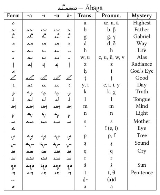
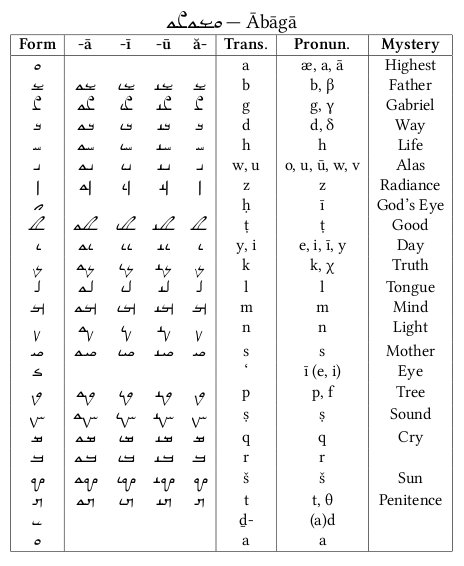 The Mandaic name for the script is Abagada or Abaga, after the first letters of the alphabet
. Rather than the ancient Semitic names for the letters (alaph, beth, gimal), the letters are known as â, bâ, gâ and so on.
The alphabet consists of 24 letters: the 22 letters of the Aramaic alphabet with two additional letters at the end. As the number 24 is auspicious for Mandaean
s (it is the number of hours from sunset to sunset), the additional letters are somewhat artificial. The 23rd letter is adu, the relative particle (cf. Arabic tāʾ marbūṭa, Coptic
letter "ti", and English ampersand). And the 24th is the first letter, a, repeated. Thus, Mandaeans say that the abagada has perfected the alpha and omega.
Unlike most other Semitic alphabets, the vowels are usually written out in full. The first and last letter, a (corresponding to alaph), is used to represent a range of open vowels. The sixth letter, wa, is used for close back vowels (u and o), and the tenth letter, ya is used for close front vowels (i and e). These last two can also serve as the consonants w/v and y. The eighth letter corresponds to the Semitic heth, and is called eh; it always is pronounced as a long i-vowel, but is rarely used as it is thought to be a sacred representation of the eye of God. A similar situation exists for the sixteenth letter, e (Aramaic ayn), which usually represents e at the beginning of a word, or, when followed by wa or ya, for initial u or i respectively.
All the letters in the Mandaic alphabet are considered by Mandaeans to have magic properties, and impart mysteries (raze). A hint at a few of these meanings is given alongside the respective letters.
Post-classical and modern Mandaic uses a lot of Persian
words. Four additional letters are used in writing non-classical words. They are, in fact, simple modifications of the canonical letters, and are not considered to bring the sum of letters to 28. The letters gha, dha, fa and ja are produced by placing two horizontally-aligned dots under ga, da, pa and sha, respectively.
Standard in October, 2010 with the release of version 6.0.
The Unicode block for Mandaic is U+0840–U+085F:
Aramaic alphabet
The Aramaic alphabet is adapted from the Phoenician alphabet and became distinctive from it by the 8th century BC. The letters all represent consonants, some of which are matres lectionis, which also indicate long vowels....
, and is used for writing the Mandaic language
Mandaic language
The Mandaic language is the language of the Mandaean religion. Classical Mandaic is used by a section of the Mandaean community in liturgical rites....
.
Alphabet
An alphabet is a standard set of letters—basic written symbols or graphemes—each of which represents a phoneme in a spoken language, either as it exists now or as it was in the past. There are other systems, such as logographies, in which each character represents a word, morpheme, or semantic...
. Rather than the ancient Semitic names for the letters (alaph, beth, gimal), the letters are known as â, bâ, gâ and so on.
The alphabet consists of 24 letters: the 22 letters of the Aramaic alphabet with two additional letters at the end. As the number 24 is auspicious for Mandaean
Mandaeism
Mandaeism or Mandaeanism is a Gnostic religion with a strongly dualistic worldview. Its adherents, the Mandaeans, revere Adam, Abel, Seth, Enosh, Noah, Shem, Aram and especially John the Baptist...
s (it is the number of hours from sunset to sunset), the additional letters are somewhat artificial. The 23rd letter is adu, the relative particle (cf. Arabic tāʾ marbūṭa, Coptic
Coptic language
Coptic or Coptic Egyptian is the current stage of the Egyptian language, a northern Afro-Asiatic language spoken in Egypt until at least the 17th century. Egyptian began to be written using the Greek alphabet in the 1st century...
letter "ti", and English ampersand). And the 24th is the first letter, a, repeated. Thus, Mandaeans say that the abagada has perfected the alpha and omega.
Unlike most other Semitic alphabets, the vowels are usually written out in full. The first and last letter, a (corresponding to alaph), is used to represent a range of open vowels. The sixth letter, wa, is used for close back vowels (u and o), and the tenth letter, ya is used for close front vowels (i and e). These last two can also serve as the consonants w/v and y. The eighth letter corresponds to the Semitic heth, and is called eh; it always is pronounced as a long i-vowel, but is rarely used as it is thought to be a sacred representation of the eye of God. A similar situation exists for the sixteenth letter, e (Aramaic ayn), which usually represents e at the beginning of a word, or, when followed by wa or ya, for initial u or i respectively.
All the letters in the Mandaic alphabet are considered by Mandaeans to have magic properties, and impart mysteries (raze). A hint at a few of these meanings is given alongside the respective letters.
Post-classical and modern Mandaic uses a lot of Persian
Persian language
Persian is an Iranian language within the Indo-Iranian branch of the Indo-European languages. It is primarily spoken in Iran, Afghanistan, Tajikistan and countries which historically came under Persian influence...
words. Four additional letters are used in writing non-classical words. They are, in fact, simple modifications of the canonical letters, and are not considered to bring the sum of letters to 28. The letters gha, dha, fa and ja are produced by placing two horizontally-aligned dots under ga, da, pa and sha, respectively.
Unicode
The Mandaic alphabet was added to the UnicodeUnicode
Unicode is a computing industry standard for the consistent encoding, representation and handling of text expressed in most of the world's writing systems...
Standard in October, 2010 with the release of version 6.0.
The Unicode block for Mandaic is U+0840–U+085F:
External links
- Everson, MichaelMichael EversonMichael Everson is a linguist, script encoder, typesetter, and font designer. His central area of expertise is with writing systems of the world, specifically in the representation of these systems in formats for computer and digital media...
(2008). Proposal for encoding the Mandaic script in the BMP of the UCS, ISO/IEC JTC1/SC2/WG2 N3485R.