

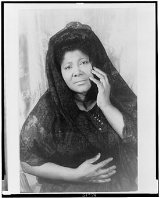
Mahalia Jackson

Encyclopedia
Mahalia Jackson was an African-American gospel
singer. Possessing a powerful contralto
voice, she was referred to as "The Queen of Gospel". Jackson became one of the most influential gospel singers in the world, and was heralded internationally as a singer and civil rights
activist; entertainer Harry Belafonte
called her "the single most powerful black woman in the United States". She recorded about 30 albums (mostly for Columbia Records
) during her career, and her 45 rpm
records included a dozen "golds"—million-sellers.
section of the Carrollton neighborhood
of Uptown New Orleans, Louisiana. The three-room dwelling on Pitt Street housed thirteen people and a dog. This included Little Mahala (named after her aunt, Mahala Clark-Paul whom the family called Aunt Duke), her brother Roosevelt Hunter, whom they called Peter, and her mother Charity Clark, who worked as both a maid and a laundress. Several aunts and cousins lived in the house as well. Aunt Mahala was given the nickname "Duke" after proving herself the undisputed "boss" of the family. The extended family (the Clarks) consisted of her mother's siblings – Isabell, Mahala, Boston, Porterfield, Hannah, Alice, Rhoda, Bessie, their children, grandchildren and patriarch Rev. Paul Clark, a former slave. Mahalia's father, John A. Jackson, Sr. was a stevedore
(dockworker) and a barber who later became a Baptist minister. He fathered four other children besides Mahalia – Wilmon (older) and then Yvonne, Pearl and Johnny, Jr. (by his marriage shortly after Halie's birth). Her father's sister, Jeanette Jackson-Burnett, and husband, Josie, were vaudeville entertainers.
When she was born Halie suffered from genu varum, or "bowed legs". The doctors wanted to perform surgery by breaking Halie's legs, but one of the resident aunts opposed it. Halie's mother would rub her legs down with greasy dishwater. The condition never stopped young Halie from performing her dance steps for the white woman her mother and Aunt Bell cleaned house for.
Mahalia was five when her mother, Charity, died, leaving her family to decide who would raise Halie and her brother. Aunt Duke assumed this responsibility, and the children were forced to work from sunup to sundown. Aunt Duke would always inspect the house using the "white glove" method. If the house was not cleaned properly, Halie was beaten. If one of the other relatives was unable to do their chores, or clean at their job, Halie or one of her cousins was expected to perform that particular task. School was hardly an option. Halie loved to sing and church is where she loved to sing the most. Halie’s Aunt Bell told her that one day she would sing in front of royalty, a prediction that would eventually come true. Mahalia Jackson began her singing career at the local Mount Mariah Baptist Church. She was baptized in Mississippi by Mt. Mariah's pastor, the Rev. E. D. Lawrence, then went back to the church to "receive the right hand of fellowship."

to Chicago, Illinois, in the midst of the Great Migration
. After her first Sunday church service, where she had given an impromptu performance of her favorite song, "Hand Me Down My Silver Trumpet, Gabriel", she was invited to join the Greater Salem Baptist Church Choir. She began touring the city's churches and surrounding areas with the Johnson Gospel Singers, one of the earliest professional gospel groups. In 1929, Jackson met the composer Thomas A. Dorsey
, known as the Father of Gospel Music. He gave her musical advice, and in the mid-1930s they began a fourteen-year association of touring, with Jackson singing Dorsey's songs in church programs and at conventions. His "Take My Hand, Precious Lord
" became her signature song.
In 1936, Jackson married Isaac Lanes Grey Hockenhull ("Ike"), a graduate of Fisk University
and Tuskegee Institute, who was 10 years her senior. Mahalia refused to sing secular music, a pledge she would keep throughout her professional life. She was frequently offered money to do so and she divorced Isaac in 1941 because of his unrelenting pressure on her to sing secular music and his addiction to gambling on racehorses.
In 1931, Jackson recorded "You Better Run, Run, Run". Not much is known about this recording and it is impossible to find. Biographer Laurraine Goreau cites that it was also around this time she added 'i' to her name, changing it from Mahala to Mahalia, pronounced m. At age 26, Mahalia's second set of records was recorded on May 21, 1937 under the Decca Coral label
, accompanied by Estelle Allen (piano), in order; "God's Gonna Separate The Wheat From The Tares," "My Lord," "Keep Me Everyday," and "God Shall Wipe All Tears Away." Financially, these were not successful, and Decca let her go.
In 1947, she signed up with the Apollo
label, and in 1948 recorded the William Herbert Brewster
song "Move On Up a Little Higher", a recording so popular that stores could not stock enough copies of it to meet demand, selling an astonishing eight million copies. (The song was later honored with the Grammy Hall of Fame Award in 1998). The success of this record rocketed Jackson to fame in the U.S. and soon after in Europe. During this time she toured as a concert artist, appearing more frequently in concert halls and less often in churches. As a consequence of this change in her venues, her arrangements expanded from piano and organ to orchestral accompaniments.
Other recordings received wide praise, including: "Let the Power of the Holy Ghost Fall on Me" (1949), which won the French Academy's Grand Prix du Disque; and "Silent Night, Holy Night", which became one of the best-selling singles in the history of Norway
. When Jackson sang "Silent Night" on Denmark
's national radio, more than twenty thousand requests for copies poured in. Other recordings on the Apollo label included "He Knows My Heart" (1946), "Amazing Grace
" (1947), "Tired" (1947), "I Can Put My Trust in Jesus" (1949), "Walk with Me" (1949), "Let the Power of the Holy Ghost Fall on Me" (1949), "Go Tell It on the Mountain
" (1950), "The Lord's Prayer
" (1950), "How I Got Over
" (1951), "His Eye Is on the Sparrow
" (1951), "I Believe
" (1953), "Didn't It Rain" (1953), "Hands of God" (1953), and "Nobody Knows" (1954).
when Joe Bostic produced the "Negro Gospel and Religious Music Festival". She started touring Europe in 1952 and was hailed by critics as the "world's greatest gospel singer". In Paris she was called the Angel of Peace, and throughout the continent she sang to capacity audiences. The tour, however, had to be cut short due to exhaustion. Jackson began a radio series on CBS
and signed to Columbia Records
in 1954. A writer for Down Beat
music magazine stated on November 17, 1954: "It is generally agreed that the greatest spiritual singer now alive is Mahalia Jackson." Her debut album for Columbia was The World's Greatest Gospel Singer
, recorded in 1954, followed by a Christmas album called Sweet Little Jesus Boy, and Bless This House in 1956.
With her mainstream success, Jackson was criticized by some gospel purists who felt she had watered down her sound for popular accessibility. Jackson had many notable accomplishments during this period, including her performance of many songs in the 1958 film, St. Louis Blues
, and singing "Trouble of the World" in 1959's Imitation of Life
; recording with Percy Faith
. When Mahalia Jackson recorded The Power and the Glory with Faith, the orchestra arched their bows to honor her in solemn recognition of her great voice. She was the main attraction in the first gospel music showcase at the Newport Jazz Festival
in 1957, which was organized by Joe Bostic and recorded by the Voice of America
, and performed again in 1958 (Newport 1958). She was also present at the opening night of Chicago's Old Town School of Folk Music
in December 1957. In 1961, she sang at U.S. President John F. Kennedy
's inaugural ball. She recorded her second Christmas album Silent Night (Songs for Christmas) in 1962. By this time, she had also become a familiar face to British television viewers as a result of short films of her performing that were occasionally shown. Historian Noel Serrano stated; "God touched the vocal chords of this Great Woman and placed a special elixir to sing for His honor and Glory!"
At the March on Washington
in 1963, she sang in front of 250,000 people "How I Got Over
" and "I've Been 'Buked, and I've Been Scorned". Martin Luther King, Jr.
made his famous "I Have a Dream
" speech there. She also sang "Take My Hand, Precious Lord
" at his funeral after he was assassinated in 1968. Jackson sang to crowds at the 1964 New York World's Fair
and was accompanied by "wonderboy preacher" Al Sharpton
. She toured Europe again in 1961 (Recorded Live in Europe 1961), 1963–1964, 1967, 1968 and 1969. In 1970, she performed for Liberian President William Tubman
.
Her last album was What The World Needs Now (1969). She ended her career in 1971 with a concert in Germany, and when she returned, made one of her final television appearances on The Flip Wilson Show
. Jackson devoted much of her time and energy to helping others. She established the Mahalia Jackson Scholarship Foundation for young people who wanted to attend college. For her efforts in helping international understanding, she received the Silver Dove Award. Chicago remained her home until the end. She opened a beauty parlor and a florist shop with her earnings, while also investing in real estate ($100,000 a year at her peak).
, and Mrs. Coretta Scott King
eulogized Mahalia during the Chicago funeral as "a friend – proud, black and beautiful". Sammy Davis, Jr.
and Ella Fitzgerald
paid their respects. Dr. Joseph H. Jackson
, president of the National Baptist Convention, U.S.A., Inc., delivered the eulogy at the Chicago funeral. Aretha Franklin
closed the Chicago rites with a moving rendition of "Precious Lord, Take My Hand
".
Three days later, a thousand miles away, the scene repeated itself: again the long lines, again the silent tribute, again the thousands filling the great hall of the Rivergate Convention Center in downtown New Orleans this time. Mayor Moon Landrieu
and Louisiana Governor John J. McKeithen joined gospel singer Bessie Griffin
; Dick Gregory
praised 'Mahalia's "moral force" as main reason for her success", and Lou Rawls
sang "Just a Closer Walk With Thee". The funeral cortège of 24 limousines drove slowly past her childhood place of worship, Mt. Moriah Baptist Church, where her recordings played through loudspeakers. It made its way to Providence Memorial Park in Metairie, Louisiana
where Jackson was entombed. Despite the inscription of Jackson's birth year on her headstone
as 1912, she was actually born in 1911. Among Mahalia's surviving relatives is her great-nephew, Indiana Pacers
forward Danny Granger
.
Jackson's estate was reported at "more than a million dollars". Some reporters estimated that record royalties, television and movie residuals, and various investments made it worth more. The bulk of the estate was left to a number of relatives – many of whom cared for Mahalia during her early years. Among principal heirs were relatives including her half-brother John Jackson and aunt Hannah Robinson. Neither of her ex-husbands, Isaac Hockenhull (1936–1941) or Sigmund Galloway (1964–1967), were mentioned in her will.
. Her good friend Martin Luther King Jr said, "A voice like hers comes along once in a millennium." She was a close friend of Doris Akers
, one of the most prolific gospel composers of the 20th century. In 1958, they co-wrote the hit, "Lord, Don't Move the Mountain". Mahalia also sang many of Akers' own compositions such as, "God Is So Good to Me", "God Spoke to Me One Day", "Trouble", "Lead On, Lord Jesus", and "He's a Light Unto My Pathway", helping Akers to secure her position as the leading female Gospel composer of that time. In addition to sharing her singing talent with the world, she mentored the extraordinarily gifted Aretha Franklin
. Mahalia was also good friends with Dorothy Norwood
and fellow Chicago-based gospel singer Albertina Walker
. She also discovered a young Della Reese
. On the twentieth anniversary of her passing, Smithsonian Folkways
Recording commemorated Jackson with the album I Sing Because I'm Happy, which includes interviews about her childhood conducted by Jules Scherwin.
American Idol
winner and Grammy Award
-winning R&B singer Fantasia Barrino
has been cast to play Mahalia Jackson in a biographical film about her life. The movie will be based on the 1993 book Got to Tell It: Mahalia Jackson, Queen of Gospel. The film is said to be directed by Euzhan Palcy
, according to The Hollywood Reporter
.
The National Academy of Recording Arts & Sciences created the Gospel Music or Other Religious Recording
category for Jackson making her the first Gospel Music Artist to win the prestigious Grammy Award.
In December 2008, she was inducted into The Louisiana Music Hall of Fame
.
A prominent namesake in her native New Orleans is the Mahalia Jackson Theater of the Performing Arts
, which was remodeled and reopened on January 17, 2009, with a gala ceremony featuring Placido Domingo
, Patricia Clarkson
, and the New Orleans Opera
directed by Robert Lyall.
, a special Grammy award established in 1973 to honor artists whose recordings are at least twenty-five years old and have "qualitative or historical significance."
Gospel music
Gospel music is music that is written to express either personal, spiritual or a communal belief regarding Christian life, as well as to give a Christian alternative to mainstream secular music....
singer. Possessing a powerful contralto
Contralto
Contralto is the deepest female classical singing voice, with the lowest tessitura, falling between tenor and mezzo-soprano. It typically ranges between the F below middle C to the second G above middle C , although at the extremes some voices can reach the E below middle C or the second B above...
voice, she was referred to as "The Queen of Gospel". Jackson became one of the most influential gospel singers in the world, and was heralded internationally as a singer and civil rights
Civil rights
Civil and political rights are a class of rights that protect individuals' freedom from unwarranted infringement by governments and private organizations, and ensure one's ability to participate in the civil and political life of the state without discrimination or repression.Civil rights include...
activist; entertainer Harry Belafonte
Harry Belafonte
Harold George "Harry" Belafonte, Jr. is an American singer, songwriter, actor and social activist. He was dubbed the "King of Calypso" for popularizing the Caribbean musical style with an international audience in the 1950s...
called her "the single most powerful black woman in the United States". She recorded about 30 albums (mostly for Columbia Records
Columbia Records
Columbia Records is an American record label, owned by Japan's Sony Music Entertainment, operating under the Columbia Music Group with Aware Records. It was founded in 1888, evolving from an earlier enterprise, the American Graphophone Company — successor to the Volta Graphophone Company...
) during her career, and her 45 rpm
Gramophone record
A gramophone record, commonly known as a phonograph record , vinyl record , or colloquially, a record, is an analog sound storage medium consisting of a flat disc with an inscribed, modulated spiral groove...
records included a dozen "golds"—million-sellers.
Early life
Born as Mahala Jackson and nicknamed "Halie", Jackson grew up in the Black PearlBlack Pearl, New Orleans
Black Pearl is a neighborhood of the city of New Orleans. A subdistrict of the Uptown/Carrollton Area, its boundaries as defined by the City Planning Commission are: South Carrollton Avenue and St...
section of the Carrollton neighborhood
Carrollton, Louisiana
Carrollton is a neighborhood of uptown New Orleans, Louisiana, USA, which includes the Carrollton Historic District. It is the part of Uptown New Orleans farthest up river from the French Quarter...
of Uptown New Orleans, Louisiana. The three-room dwelling on Pitt Street housed thirteen people and a dog. This included Little Mahala (named after her aunt, Mahala Clark-Paul whom the family called Aunt Duke), her brother Roosevelt Hunter, whom they called Peter, and her mother Charity Clark, who worked as both a maid and a laundress. Several aunts and cousins lived in the house as well. Aunt Mahala was given the nickname "Duke" after proving herself the undisputed "boss" of the family. The extended family (the Clarks) consisted of her mother's siblings – Isabell, Mahala, Boston, Porterfield, Hannah, Alice, Rhoda, Bessie, their children, grandchildren and patriarch Rev. Paul Clark, a former slave. Mahalia's father, John A. Jackson, Sr. was a stevedore
Stevedore
Stevedore, dockworker, docker, dock labourer, wharfie and longshoreman can have various waterfront-related meanings concerning loading and unloading ships, according to place and country....
(dockworker) and a barber who later became a Baptist minister. He fathered four other children besides Mahalia – Wilmon (older) and then Yvonne, Pearl and Johnny, Jr. (by his marriage shortly after Halie's birth). Her father's sister, Jeanette Jackson-Burnett, and husband, Josie, were vaudeville entertainers.
When she was born Halie suffered from genu varum, or "bowed legs". The doctors wanted to perform surgery by breaking Halie's legs, but one of the resident aunts opposed it. Halie's mother would rub her legs down with greasy dishwater. The condition never stopped young Halie from performing her dance steps for the white woman her mother and Aunt Bell cleaned house for.
Mahalia was five when her mother, Charity, died, leaving her family to decide who would raise Halie and her brother. Aunt Duke assumed this responsibility, and the children were forced to work from sunup to sundown. Aunt Duke would always inspect the house using the "white glove" method. If the house was not cleaned properly, Halie was beaten. If one of the other relatives was unable to do their chores, or clean at their job, Halie or one of her cousins was expected to perform that particular task. School was hardly an option. Halie loved to sing and church is where she loved to sing the most. Halie’s Aunt Bell told her that one day she would sing in front of royalty, a prediction that would eventually come true. Mahalia Jackson began her singing career at the local Mount Mariah Baptist Church. She was baptized in Mississippi by Mt. Mariah's pastor, the Rev. E. D. Lawrence, then went back to the church to "receive the right hand of fellowship."
Career
1920s–1940s
In 1927, at the age of sixteen, Jackson moved from the southSouthern United States
The Southern United States—commonly referred to as the American South, Dixie, or simply the South—constitutes a large distinctive area in the southeastern and south-central United States...
to Chicago, Illinois, in the midst of the Great Migration
Great Migration (African American)
The Great Migration was the movement of 6 million blacks out of the Southern United States to the Northeast, Midwest, and West from 1910 to 1970. Some historians differentiate between a Great Migration , numbering about 1.6 million migrants, and a Second Great Migration , in which 5 million or more...
. After her first Sunday church service, where she had given an impromptu performance of her favorite song, "Hand Me Down My Silver Trumpet, Gabriel", she was invited to join the Greater Salem Baptist Church Choir. She began touring the city's churches and surrounding areas with the Johnson Gospel Singers, one of the earliest professional gospel groups. In 1929, Jackson met the composer Thomas A. Dorsey
Thomas A. Dorsey
Thomas Andrew Dorsey was known as "the father of black gospel music" and was at one time so closely associated with the field that songs written in the new style were sometimes known as "dorseys." Earlier in his life he was a leading blues pianist known as Georgia Tom.As formulated by Dorsey,...
, known as the Father of Gospel Music. He gave her musical advice, and in the mid-1930s they began a fourteen-year association of touring, with Jackson singing Dorsey's songs in church programs and at conventions. His "Take My Hand, Precious Lord
Take My Hand, Precious Lord
"Take My Hand, Precious Lord" is a gospel song, lyrics by Rev. Thomas A. Dorsey , melody by George Nelson Allen .-History:...
" became her signature song.
In 1936, Jackson married Isaac Lanes Grey Hockenhull ("Ike"), a graduate of Fisk University
Fisk University
Fisk University is an historically black university founded in 1866 in Nashville, Tennessee, U.S. The world-famous Fisk Jubilee Singers started as a group of students who performed to earn enough money to save the school at a critical time of financial shortages. They toured to raise funds to...
and Tuskegee Institute, who was 10 years her senior. Mahalia refused to sing secular music, a pledge she would keep throughout her professional life. She was frequently offered money to do so and she divorced Isaac in 1941 because of his unrelenting pressure on her to sing secular music and his addiction to gambling on racehorses.
In 1931, Jackson recorded "You Better Run, Run, Run". Not much is known about this recording and it is impossible to find. Biographer Laurraine Goreau cites that it was also around this time she added 'i' to her name, changing it from Mahala to Mahalia, pronounced m. At age 26, Mahalia's second set of records was recorded on May 21, 1937 under the Decca Coral label
Decca Records
Decca Records began as a British record label established in 1929 by Edward Lewis. Its U.S. label was established in late 1934; however, owing to World War II, the link with the British company was broken for several decades....
, accompanied by Estelle Allen (piano), in order; "God's Gonna Separate The Wheat From The Tares," "My Lord," "Keep Me Everyday," and "God Shall Wipe All Tears Away." Financially, these were not successful, and Decca let her go.
In 1947, she signed up with the Apollo
Apollo Records (1944)
The third and best known Apollo Records to exist was an independent record label in business from 1944 until 1962 in the United States. It was formed in New York City in 1944 by Bess Berman and her husband Isaac "Ike" Berman together with Hy Siegel and Sam Schneider...
label, and in 1948 recorded the William Herbert Brewster
W. Herbert Brewster
William Herbert Brewster was an influential African American Baptist minister, composer, dramatist, singer, poet and community leader....
song "Move On Up a Little Higher", a recording so popular that stores could not stock enough copies of it to meet demand, selling an astonishing eight million copies. (The song was later honored with the Grammy Hall of Fame Award in 1998). The success of this record rocketed Jackson to fame in the U.S. and soon after in Europe. During this time she toured as a concert artist, appearing more frequently in concert halls and less often in churches. As a consequence of this change in her venues, her arrangements expanded from piano and organ to orchestral accompaniments.
Other recordings received wide praise, including: "Let the Power of the Holy Ghost Fall on Me" (1949), which won the French Academy's Grand Prix du Disque; and "Silent Night, Holy Night", which became one of the best-selling singles in the history of Norway
Norway
Norway , officially the Kingdom of Norway, is a Nordic unitary constitutional monarchy whose territory comprises the western portion of the Scandinavian Peninsula, Jan Mayen, and the Arctic archipelago of Svalbard and Bouvet Island. Norway has a total area of and a population of about 4.9 million...
. When Jackson sang "Silent Night" on Denmark
Denmark
Denmark is a Scandinavian country in Northern Europe. The countries of Denmark and Greenland, as well as the Faroe Islands, constitute the Kingdom of Denmark . It is the southernmost of the Nordic countries, southwest of Sweden and south of Norway, and bordered to the south by Germany. Denmark...
's national radio, more than twenty thousand requests for copies poured in. Other recordings on the Apollo label included "He Knows My Heart" (1946), "Amazing Grace
Amazing Grace
"Amazing Grace" is a Christian hymn with words written by the English poet and clergyman John Newton , published in 1779. With a message that forgiveness and redemption are possible regardless of the sins people commit and that the soul can be delivered from despair through the mercy of God,...
" (1947), "Tired" (1947), "I Can Put My Trust in Jesus" (1949), "Walk with Me" (1949), "Let the Power of the Holy Ghost Fall on Me" (1949), "Go Tell It on the Mountain
Go Tell It on the Mountain (song)
"Go Tell It on the Mountain" is an African-American spiritual song, compiled by John Wesley Work, Jr., dating back to at least 1865, that has been sung and recorded by many gospel and secular performers...
" (1950), "The Lord's Prayer
The Lord's Prayer (song)
"The Lord's Prayer" is a musical setting of the Lord's Prayer written by Albert Hay Malotte in 1935 and recorded by numerous singers including John Charles Thomas, Perry Como, Doris Day, Gracie Fields, Mahalia Jackson, Mario Lanza, Elvis Presley, and Ronnie Milsap...
" (1950), "How I Got Over
How I Got Over
How I Got Over is a Gospel hymn composed and published in 1951 by Clara Ward . Notable recordings of this work have been made by Mahalia Jackson , Aretha Franklin , and the Blind Boys of Alabama How I Got Over is a Gospel hymn composed and published in 1951 by Clara Ward (1924-1973). Notable...
" (1951), "His Eye Is on the Sparrow
His Eye is on the Sparrow
"His Eye Is on the Sparrow" is a Gospel hymn. Although today it is a staple of African-American worship services, the song was originally written in 1905 by two white songwriters, lyricist Civilla D. Martin and composer Charles H. Gabriel...
" (1951), "I Believe
I Believe (1953 song)
"I Believe" is the name of a popular song written by Ervin Drake, Irvin Graham, Jimmy Shirl and Al Stillman in 1953.I Believe was commissioned and introduced by Jane Froman on her television show, and became the first hit song ever introduced on TV...
" (1953), "Didn't It Rain" (1953), "Hands of God" (1953), and "Nobody Knows" (1954).
1950s–1970s
In 1950, Jackson became the first gospel singer to perform at New York's Carnegie HallCarnegie Hall
Carnegie Hall is a concert venue in Midtown Manhattan in New York City, United States, located at 881 Seventh Avenue, occupying the east stretch of Seventh Avenue between West 56th Street and West 57th Street, two blocks south of Central Park....
when Joe Bostic produced the "Negro Gospel and Religious Music Festival". She started touring Europe in 1952 and was hailed by critics as the "world's greatest gospel singer". In Paris she was called the Angel of Peace, and throughout the continent she sang to capacity audiences. The tour, however, had to be cut short due to exhaustion. Jackson began a radio series on CBS
CBS
CBS Broadcasting Inc. is a major US commercial broadcasting television network, which started as a radio network. The name is derived from the initials of the network's former name, Columbia Broadcasting System. The network is sometimes referred to as the "Eye Network" in reference to the shape of...
and signed to Columbia Records
Columbia Records
Columbia Records is an American record label, owned by Japan's Sony Music Entertainment, operating under the Columbia Music Group with Aware Records. It was founded in 1888, evolving from an earlier enterprise, the American Graphophone Company — successor to the Volta Graphophone Company...
in 1954. A writer for Down Beat
Down Beat
Down Beat is an American magazine devoted to "jazz, blues and beyond" to indicate its expansion beyond the jazz realm which it covered exclusively in previous years. The publication was established in 1934 in Chicago, Illinois...
music magazine stated on November 17, 1954: "It is generally agreed that the greatest spiritual singer now alive is Mahalia Jackson." Her debut album for Columbia was The World's Greatest Gospel Singer
The World's Greatest Gospel Singer (album)
The World's Greatest Gospel Singer was Mahalia Jackson's debut album on the Columbia label, recorded in 1954.-Overview:Original record sleeve, written by George Avakian: "The recordings in this collection were made in the course of two consecutive evenings at Columbia's 30th Street Studio in New York...
, recorded in 1954, followed by a Christmas album called Sweet Little Jesus Boy, and Bless This House in 1956.
With her mainstream success, Jackson was criticized by some gospel purists who felt she had watered down her sound for popular accessibility. Jackson had many notable accomplishments during this period, including her performance of many songs in the 1958 film, St. Louis Blues
St. Louis Blues (1958 film)
St. Louis Blues is a 1958 film broadly based on the life of W. C. Handy. It starred jazz and blues greats Nat "King" Cole, Pearl Bailey, Cab Calloway, Ella Fitzgerald, Eartha Kitt, and Barney Bigard, as well as gospel singer Mahalia Jackson and actress Ruby Dee...
, and singing "Trouble of the World" in 1959's Imitation of Life
Imitation of Life (1959 film)
Imitation of Life is a 1959 American film directed by Douglas Sirk, produced by Ross Hunter and released by Universal Pictures, starring Lana Turner and John Gavin and features Sandra Dee, Dan O'Herlihy, Susan Kohner, Robert Alda and Juanita Moore as Annie Johnson. Gospel music star Mahalia Jackson...
; recording with Percy Faith
Percy Faith
Percy Faith was a Canadian-born American bandleader, orchestrator, composer and conductor, known for his lush arrangements of pop and Christmas standards. He is often credited with creating the "easy listening" or "mood music" format which became staples of American popular music in the 1950s and...
. When Mahalia Jackson recorded The Power and the Glory with Faith, the orchestra arched their bows to honor her in solemn recognition of her great voice. She was the main attraction in the first gospel music showcase at the Newport Jazz Festival
Newport Jazz Festival
The Newport Jazz Festival is a music festival held every summer in Newport, Rhode Island, USA. It was established in 1954 by socialite Elaine Lorillard, who, together with husband Louis Lorillard, financed the festival for many years. The couple hired jazz impresario George Wein to organize the...
in 1957, which was organized by Joe Bostic and recorded by the Voice of America
Voice of America
Voice of America is the official external broadcast institution of the United States federal government. It is one of five civilian U.S. international broadcasters working under the umbrella of the Broadcasting Board of Governors . VOA provides a wide range of programming for broadcast on radio...
, and performed again in 1958 (Newport 1958). She was also present at the opening night of Chicago's Old Town School of Folk Music
Old Town School of Folk Music
The Old Town School of Folk Music is a Chicago teaching and performing institution that launched the careers of many notable folk music artists...
in December 1957. In 1961, she sang at U.S. President John F. Kennedy
John F. Kennedy
John Fitzgerald "Jack" Kennedy , often referred to by his initials JFK, was the 35th President of the United States, serving from 1961 until his assassination in 1963....
's inaugural ball. She recorded her second Christmas album Silent Night (Songs for Christmas) in 1962. By this time, she had also become a familiar face to British television viewers as a result of short films of her performing that were occasionally shown. Historian Noel Serrano stated; "God touched the vocal chords of this Great Woman and placed a special elixir to sing for His honor and Glory!"
At the March on Washington
March on Washington for Jobs and Freedom
The March on Washington for Jobs and Freedom was the largest political rally for human rights in United States history and called for civil and economic rights for African Americans. It took place in Washington, D.C. on Wednesday, August 28, 1963. Martin Luther King, Jr...
in 1963, she sang in front of 250,000 people "How I Got Over
How I Got Over
How I Got Over is a Gospel hymn composed and published in 1951 by Clara Ward . Notable recordings of this work have been made by Mahalia Jackson , Aretha Franklin , and the Blind Boys of Alabama How I Got Over is a Gospel hymn composed and published in 1951 by Clara Ward (1924-1973). Notable...
" and "I've Been 'Buked, and I've Been Scorned". Martin Luther King, Jr.
Martin Luther King, Jr.
Martin Luther King, Jr. was an American clergyman, activist, and prominent leader in the African-American Civil Rights Movement. He is best known for being an iconic figure in the advancement of civil rights in the United States and around the world, using nonviolent methods following the...
made his famous "I Have a Dream
I Have a Dream
"I Have a Dream" is a 17-minute public speech by Martin Luther King, Jr. delivered on August 28, 1963, in which he called for racial equality and an end to discrimination...
" speech there. She also sang "Take My Hand, Precious Lord
Take My Hand, Precious Lord
"Take My Hand, Precious Lord" is a gospel song, lyrics by Rev. Thomas A. Dorsey , melody by George Nelson Allen .-History:...
" at his funeral after he was assassinated in 1968. Jackson sang to crowds at the 1964 New York World's Fair
1964 New York World's Fair
The 1964/1965 New York World's Fair was the third major world's fair to be held in New York City. Hailing itself as a "universal and international" exposition, the fair's theme was "Peace Through Understanding," dedicated to "Man's Achievement on a Shrinking Globe in an Expanding Universe";...
and was accompanied by "wonderboy preacher" Al Sharpton
Al Sharpton
Alfred Charles "Al" Sharpton, Jr. is an American Baptist minister, civil rights activist, and television/radio talk show host. In 2004, he was a candidate for the Democratic nomination for the U.S. presidential election...
. She toured Europe again in 1961 (Recorded Live in Europe 1961), 1963–1964, 1967, 1968 and 1969. In 1970, she performed for Liberian President William Tubman
William Tubman
William Vacanarat Shadrach Tubman was a Liberian politician. He was the 19th President of Liberia from 1944 until his death in 1971....
.
Her last album was What The World Needs Now (1969). She ended her career in 1971 with a concert in Germany, and when she returned, made one of her final television appearances on The Flip Wilson Show
The Flip Wilson Show
The Flip Wilson Show is a variety show that aired in the U.S. on NBC from September 17, 1970 to June 27, 1974. The show starred American comedian Flip Wilson; the program was one of the first American television programs starring a black person in the title role to become highly successful with a...
. Jackson devoted much of her time and energy to helping others. She established the Mahalia Jackson Scholarship Foundation for young people who wanted to attend college. For her efforts in helping international understanding, she received the Silver Dove Award. Chicago remained her home until the end. She opened a beauty parlor and a florist shop with her earnings, while also investing in real estate ($100,000 a year at her peak).
Death
Mahalia Jackson died in Chicago on January 27, 1972 of heart failure and diabetes complications. Two cities paid tribute, Chicago and New Orleans. Beginning in Chicago, outside the Greater Salem Baptist Church, 50,000 people filed silently past her mahogany, glass-topped coffin in final tribute to the queen of gospel song. The next day, as many as could – 6,000 or more – filled every seat and stood along the walls of the city's public concert hall, the Arie Crown Theater of McCormick Place, for a two-hour funeral service. Mahalia's pastor, the Rev. Leon Jenkins, Mayor Richard J. DaleyRichard J. Daley
Richard Joseph Daley served for 21 years as the mayor and undisputed Democratic boss of Chicago and is considered by historians to be the "last of the big city bosses." He played a major role in the history of the Democratic Party, especially with his support of John F...
, and Mrs. Coretta Scott King
Coretta Scott King
Coretta Scott King was an American author, activist, and civil rights leader. The widow of Martin Luther King, Jr., Coretta Scott King helped lead the African-American Civil Rights Movement in the 1960s.Mrs...
eulogized Mahalia during the Chicago funeral as "a friend – proud, black and beautiful". Sammy Davis, Jr.
Sammy Davis, Jr.
Samuel George "Sammy" Davis Jr. was an American entertainer and was also known for his impersonations of actors and other celebrities....
and Ella Fitzgerald
Ella Fitzgerald
Ella Jane Fitzgerald , also known as the "First Lady of Song" and "Lady Ella," was an American jazz and song vocalist...
paid their respects. Dr. Joseph H. Jackson
Joseph H. Jackson
Joseph Harrison Jackson was an American Pastor and the longest serving President of the National Baptist Convention, USA, Inc.During the height of the American Civil Rights Movement, Jackson's vocal stance for "civil rights through law and order" went in direct opposition to the methods of civil...
, president of the National Baptist Convention, U.S.A., Inc., delivered the eulogy at the Chicago funeral. Aretha Franklin
Aretha Franklin
Aretha Louise Franklin is an American singer, songwriter, and pianist. Although known for her soul recordings and referred to as The Queen of Soul, Franklin is also adept at jazz, blues, R&B, gospel music, and rock. Rolling Stone magazine ranked her atop its list of The Greatest Singers of All...
closed the Chicago rites with a moving rendition of "Precious Lord, Take My Hand
Take My Hand, Precious Lord
"Take My Hand, Precious Lord" is a gospel song, lyrics by Rev. Thomas A. Dorsey , melody by George Nelson Allen .-History:...
".
Three days later, a thousand miles away, the scene repeated itself: again the long lines, again the silent tribute, again the thousands filling the great hall of the Rivergate Convention Center in downtown New Orleans this time. Mayor Moon Landrieu
Moon Landrieu
Maurice Edwin "Moon" Landrieu is a Democratic politician from Louisiana who served as Mayor of New Orleans from 1970–1978. He also is a former judge...
and Louisiana Governor John J. McKeithen joined gospel singer Bessie Griffin
Bessie Griffin
Bessie Griffin was an African American gospel singer.Born Arlette B. Broil in New Orleans, Louisiana, she was steeped in church music as a child...
; Dick Gregory
Dick Gregory
Richard Claxton "Dick" Gregory is an American comedian, social activist, social critic, writer, and entrepreneur....
praised 'Mahalia's "moral force" as main reason for her success", and Lou Rawls
Lou Rawls
Louis Allen "Lou" Rawls was an American soul, jazz, and blues singer. He was known for his smooth vocal style: Frank Sinatra once said that Rawls had "the classiest singing and silkiest chops in the singing game"...
sang "Just a Closer Walk With Thee". The funeral cortège of 24 limousines drove slowly past her childhood place of worship, Mt. Moriah Baptist Church, where her recordings played through loudspeakers. It made its way to Providence Memorial Park in Metairie, Louisiana
Metairie, Louisiana
Metairie is a census-designated place in Jefferson Parish, Louisiana, United States and is a major part of the New Orleans Metropolitan Area. Metairie is the largest community in Jefferson Parish. It is an unincorporated area that would be larger than most of the state's cities if it were...
where Jackson was entombed. Despite the inscription of Jackson's birth year on her headstone
Headstone
A headstone, tombstone, or gravestone is a marker, usually stone, that is placed over a grave. In most cases they have the deceased's name, date of birth, and date of death inscribed on them, along with a personal message, or prayer.- Use :...
as 1912, she was actually born in 1911. Among Mahalia's surviving relatives is her great-nephew, Indiana Pacers
Indiana Pacers
The Indiana Pacers are a professional basketball team based in Indianapolis, Indiana. They are members of the Central Division of the Eastern Conference of the National Basketball Association...
forward Danny Granger
Danny Granger
Danny Granger, Jr. is an American professional basketball player for the Indiana Pacers of the NBA. He is mainly a small forward, though he does log time at the power forward position. He is also able to initiate the team's offense and so is regarded as one who can play the point forward position...
.
Jackson's estate was reported at "more than a million dollars". Some reporters estimated that record royalties, television and movie residuals, and various investments made it worth more. The bulk of the estate was left to a number of relatives – many of whom cared for Mahalia during her early years. Among principal heirs were relatives including her half-brother John Jackson and aunt Hannah Robinson. Neither of her ex-husbands, Isaac Hockenhull (1936–1941) or Sigmund Galloway (1964–1967), were mentioned in her will.
Legacy and honors
Mahalia Jackson's music was never played widely on any but traditional gospel and traditional Christian radio stations. Her music was heard for decades on Family RadioFamily Radio
Family Radio, also known by its licensee name Family Stations Inc., is a Christian radio network based in Oakland, California, USA, founded by Lloyd Lindquist, Richard H. Palmquist and Harold Camping...
. Her good friend Martin Luther King Jr said, "A voice like hers comes along once in a millennium." She was a close friend of Doris Akers
Doris Akers
Doris Mae Akers was an American Gospel music composer, arranger and singer. Known for her work with the Sky Pilot Choir, she was inducted into the Gospel Music Hall of Fame in 2001.-Early life:...
, one of the most prolific gospel composers of the 20th century. In 1958, they co-wrote the hit, "Lord, Don't Move the Mountain". Mahalia also sang many of Akers' own compositions such as, "God Is So Good to Me", "God Spoke to Me One Day", "Trouble", "Lead On, Lord Jesus", and "He's a Light Unto My Pathway", helping Akers to secure her position as the leading female Gospel composer of that time. In addition to sharing her singing talent with the world, she mentored the extraordinarily gifted Aretha Franklin
Aretha Franklin
Aretha Louise Franklin is an American singer, songwriter, and pianist. Although known for her soul recordings and referred to as The Queen of Soul, Franklin is also adept at jazz, blues, R&B, gospel music, and rock. Rolling Stone magazine ranked her atop its list of The Greatest Singers of All...
. Mahalia was also good friends with Dorothy Norwood
Dorothy Norwood
Dorothy Norwood is an American gospel singer. She began touring with her family at the age of eight, and in 1956, began singing with Mahalia Jackson. In the early 1960s she was a member of ]The Caravans, and in 1964, she embarked on a solo career, recording her first album, Johnny and Jesus...
and fellow Chicago-based gospel singer Albertina Walker
Albertina Walker
-Early years:Walker was born in Chicago, Illinois, to Ruben and Camille Coleman Walker. Her mother was born in Houston County, Georgia, and her father in Bibb County, Georgia. They moved to Chicago between 1917-1920 where they lived out their lives. Albertina had four siblings born in Bibb County...
. She also discovered a young Della Reese
Della Reese
Delloreese Patricia Early, known professionally as Della Reese , is an American actress, singer, game show panelist of the 1970s, one-time talk-show hostess and ordained minister. She started her career in the 1950s as a gospel, pop and jazz singer, scoring a hit with her 1959 single "Don't You...
. On the twentieth anniversary of her passing, Smithsonian Folkways
Smithsonian Folkways
Smithsonian Folkways is the nonprofit record label of the Smithsonian Institution. It is a part of the Smithsonian's Center for Folklife and Cultural Heritage, located at Capital Gallery in downtown Washington, D.C. The label was founded in 1987 after the family of Moses Asch, founder of Folkways...
Recording commemorated Jackson with the album I Sing Because I'm Happy, which includes interviews about her childhood conducted by Jules Scherwin.
American Idol
American Idol
American Idol, titled American Idol: The Search for a Superstar for the first season, is a reality television singing competition created by Simon Fuller and produced by FremantleMedia North America and 19 Entertainment...
winner and Grammy Award
Grammy Award
A Grammy Award — or Grammy — is an accolade by the National Academy of Recording Arts and Sciences of the United States to recognize outstanding achievement in the music industry...
-winning R&B singer Fantasia Barrino
Fantasia Barrino
Fantasia Monique Barrino commonly known as Fantasia, is an American R&B singer, Broadway and television actress who rose to fame as the winner of the third season of the reality television series American Idol in 2004. Following her victory, she released her debut single, "I Believe", which...
has been cast to play Mahalia Jackson in a biographical film about her life. The movie will be based on the 1993 book Got to Tell It: Mahalia Jackson, Queen of Gospel. The film is said to be directed by Euzhan Palcy
Euzhan Palcy
Euzhan Palcy is a film director writer and producer from Martinique, French West Indies. She is notable for being the first black female director produced by a major Hollywood studio , for A Dry White Season; as well as being the only female filmmaker who directed Marlon Brando .- Early life and...
, according to The Hollywood Reporter
The Hollywood Reporter
Formerly a daily trade magazine, The Hollywood Reporter re-launched in late 2010 as a unique hybrid publication serving the entertainment industry and a consumer audience...
.
The National Academy of Recording Arts & Sciences created the Gospel Music or Other Religious Recording
Grammy Award for Best Inspirational Performance
The Grammy Award for Best Inspirational Performance was awarded from 1962 to 1986. During this time the award had several minor name changes:*From 1962 to 1963 the award was known as Best Gospel or Other Religious Recording...
category for Jackson making her the first Gospel Music Artist to win the prestigious Grammy Award.
In December 2008, she was inducted into The Louisiana Music Hall of Fame
Louisiana Music Hall of Fame
The Louisiana Music Hall of Fame is an IRS certified 501 non-profit organization based in the state capitol of Baton Rouge, La., that seeks to preserve Louisiana's rich music culture and heritage and to further educate its citizens and people worldwide about the state’s unique role contributing...
.
A prominent namesake in her native New Orleans is the Mahalia Jackson Theater of the Performing Arts
Mahalia Jackson Theater of the Performing Arts
The Mahalia Jackson Theater for the Performing Arts is a theater located in Louis Armstrong Park in New Orleans, Louisiana. It was named after gospel singer Mahalia Jackson, who was born in New Orleans. The theater reopened in January 2009 after being closed following the landfall of Hurricane...
, which was remodeled and reopened on January 17, 2009, with a gala ceremony featuring Placido Domingo
Plácido Domingo
Plácido Domingo KBE , born José Plácido Domingo Embil, is a Spanish tenor and conductor known for his versatile and strong voice, possessing a ringing and dramatic tone throughout its range...
, Patricia Clarkson
Patricia Clarkson
Patricia Davies Clarkson is an American actress. After studying drama on the East Coast, Clarkson launched her acting career in 1985, and has worked steadily in both film and television. She twice won the Emmy for Outstanding Guest Actress in Six Feet Under...
, and the New Orleans Opera
New Orleans Opera
Opera has long been part of the musical culture of New Orleans, Louisiana. Operas have regularly been performed in the city since the 1790s, and for the majority of the city's history since the early 19th century, New Orleans has had a resident company regularly performing opera in addition to...
directed by Robert Lyall.
Grammy Award history
| Mahalia Jackson Grammy Award Grammy Award A Grammy Award — or Grammy — is an accolade by the National Academy of Recording Arts and Sciences of the United States to recognize outstanding achievement in the music industry... History |
|||||
| Year | Category | Title | Genre | Label | Result |
|---|---|---|---|---|---|
| 1976 | Best Soul Gospel Performance | "How I Got Over How I Got Over How I Got Over is a Gospel hymn composed and published in 1951 by Clara Ward . Notable recordings of this work have been made by Mahalia Jackson , Aretha Franklin , and the Blind Boys of Alabama How I Got Over is a Gospel hymn composed and published in 1951 by Clara Ward (1924-1973). Notable... " |
Gospel | Columbia | Winner |
| 1972 | Grammy Lifetime Achievement Award Grammy Lifetime Achievement Award The Grammy Lifetime Achievement Award is awarded by the Recording Academy to "performers who, during their lifetimes, have made creative contributions of outstanding artistic significance to the field of recording."... |
Winner | |||
| 1969 | Best Soul Gospel Performance | "Guide Me, O Thou Great Jehovah" | Gospel | Columbia | Nominee |
| 1963 | Best Gospel Or Other Religious Recording, Musical | "Make a Joyful Noise Unto The Lord" | Gospel | Columbia | Nominee |
| 1962 | Best Gospel Or Other Religious Recording | "Great Songs of Love and Faith" | Gospel | Columbia | Winner |
| 1961 | Best Gospel or Other Religious Recording | "Everytime I Feel the Spirit Everytime I Feel the Spirit Everytime I Feel the Spirit is a 1959 studio album by Nat King Cole, of Negro spirituals, arranged by Gordon Jenkins. Cole is accompanied by the First Church of Deliverance Choir of Chicago, Illinois... " |
Gospel | Columbia | Winner |
Grammy Hall of Fame
Mahalia Jackson was posthumously inducted into the Grammy Hall of FameGrammy Hall of Fame Award
The Grammy Hall of Fame Award is a special Grammy award established in 1973 to honor recordings that are at least twenty-five years old and that have "qualitative or historical significance"...
, a special Grammy award established in 1973 to honor artists whose recordings are at least twenty-five years old and have "qualitative or historical significance."
| Grammy Hall of Fame Award Grammy Hall of Fame Award The Grammy Hall of Fame Award is a special Grammy award established in 1973 to honor recordings that are at least twenty-five years old and that have "qualitative or historical significance"... |
||||
| Year Recorded | Song | Genre | Label | Year Inducted |
|---|---|---|---|---|
| 1947 | "Move On Up a Little Higher" | Gospel (Single) | Apollo | 1998 |
Honors
| Mahalia Jackson Honors | ||||
| Year | Category | Honor | Result | Notes |
|---|---|---|---|---|
| 1998 | U.S. Postal Service | 32¢ Postage Stamp | Honored | Issued July 15, 1998 |
| 1997 | Rock and Roll Hall of Fame | Inducted | "Early Influence" | |
| 1988 | Hollywood Walk of Fame | Star | at 6840 Hollywood Blvd. | |
| 1978 | Gospel Music Hall of Fame Gospel Music Hall of Fame The Gospel Music Hall of Fame, created in 1971 by the Gospel Music Association, is a Hall of Fame dedicated exclusively to recognizing meaningful contributions by individuals and groups in all forms of gospel music.-Inductees:... |
Inducted | ||
| 2008 | Louisiana Music Hall of Fame Louisiana Music Hall of Fame The Louisiana Music Hall of Fame is an IRS certified 501 non-profit organization based in the state capitol of Baton Rouge, La., that seeks to preserve Louisiana's rich music culture and heritage and to further educate its citizens and people worldwide about the state’s unique role contributing... |
Inducted | ||
Well-known songs
- "What Child Is This"
- "How I Got OverHow I Got OverHow I Got Over is a Gospel hymn composed and published in 1951 by Clara Ward . Notable recordings of this work have been made by Mahalia Jackson , Aretha Franklin , and the Blind Boys of Alabama How I Got Over is a Gospel hymn composed and published in 1951 by Clara Ward (1924-1973). Notable...
" - "Trouble of the World"
- "Silent Night"
- "Go Tell It on the MountainGo Tell It on the Mountain (song)"Go Tell It on the Mountain" is an African-American spiritual song, compiled by John Wesley Work, Jr., dating back to at least 1865, that has been sung and recorded by many gospel and secular performers...
" - "Amazing GraceAmazing Grace"Amazing Grace" is a Christian hymn with words written by the English poet and clergyman John Newton , published in 1779. With a message that forgiveness and redemption are possible regardless of the sins people commit and that the soul can be delivered from despair through the mercy of God,...
", (Apollo 194, 1947) - "Move On Up A Little HigherMove On Up A Little Higher (song)"Move On Up A Little Higher" is a gospel song written by W. Herbert Brewster, first recorded on September 12, 1947, by gospel singer Mahalia Jackson, that sold eight million copies. The song was honored with the Grammy Hall of Fame Award in . In 2005, the Library of Congress honored the song by...
", (Apollo 164, 1947) - "Take My Hand, Precious LordTake My Hand, Precious Lord"Take My Hand, Precious Lord" is a gospel song, lyrics by Rev. Thomas A. Dorsey , melody by George Nelson Allen .-History:...
" (performed this song at Dr. Martin Luther King Jr.Martin Luther King, Jr.Martin Luther King, Jr. was an American clergyman, activist, and prominent leader in the African-American Civil Rights Movement. He is best known for being an iconic figure in the advancement of civil rights in the United States and around the world, using nonviolent methods following the...
's funeral) - "Remember MeRemember Me- Songs :* "Remember Me" * "Remember Me" , 2001* "Remember Me" , 1998* "Remember Me" , 2002* "Remember Me" , 1970* "Remember Me" - Songs :* "Remember Me" (Blue Boy song)* "Remember Me" (British Sea Power song), 2001* "Remember Me" (Journey song), 1998* "Remember Me" (Hoobastank song), 2002*...
" - "Joshua Fit the Battle of JerichoJoshua Fit the Battle of Jericho"Joshua Fit the Battle of Jericho" is a well-known negro spiritual.The song is believed to have been composed by slaves in the first half of the nineteenth century. Some references suggest that it was copyrighted by Jay Roberts in 1865...
" - "Holding My Saviour's Hands"
- "Roll Jordan, Roll"
- "The Upper Room"
- "We Shall OvercomeWe Shall Overcome"We Shall Overcome" is a protest song that became a key anthem of the African-American Civil Rights Movement . The title and structure of the song are derived from an early gospel song by African-American composer Charles Albert Tindley...
" - "I'm on My Way to Canaan"
- "You'll Never Walk AloneYou'll Never Walk Alone (song)"You'll Never Walk Alone" is a show tune from the 1945 Rodgers and Hammerstein musical Carousel.In the musical, in the second act, Nettie Fowler, the cousin of the female protagonist Julie Jordan, sings "You'll Never Walk Alone" to comfort and encourage Julie when her husband, Billy Bigelow, the...
" - "His Eye is on the SparrowHis Eye is on the Sparrow"His Eye Is on the Sparrow" is a Gospel hymn. Although today it is a staple of African-American worship services, the song was originally written in 1905 by two white songwriters, lyricist Civilla D. Martin and composer Charles H. Gabriel...
" - "What a Friend We Have in JesusWhat a Friend We Have in Jesus"What a Friend We Have in Jesus" is a Christian hymn originally written by Joseph M. Scriven as a poem in 1855 to comfort his mother who was living in Ireland while he was in Canada. Scriven originally published the poem anonymously, and only received full credit for it in the 1880s. The tune to...
" - "Didn't it Rain"
- "Wait Till My Change Comes", (Apollo 110, 1946)
- "He Knows My Heart", (Apollo 145, 1946)
In popular culture
- She appears in the 1960 film, Jazz on a Summer's DayJazz on a Summer's DayJazz on a Summer's Day is a documentary film set at the 1958 Newport Jazz Festival in Rhode Island, and filmed and directed by noted commercial and fashion photographer Bert Stern and the film director Aram Avakian , who also edited the movie...
– an artistic documentary filmed at the 1958 Newport Jazz Festival. She sings three gospel numbers at the end of the film, including "The Lord's Prayer." - In the 1958 movie St. Louis BluesSt. Louis Blues (1958 film)St. Louis Blues is a 1958 film broadly based on the life of W. C. Handy. It starred jazz and blues greats Nat "King" Cole, Pearl Bailey, Cab Calloway, Ella Fitzgerald, Eartha Kitt, and Barney Bigard, as well as gospel singer Mahalia Jackson and actress Ruby Dee...
, she played the character Bessie May and sang on the church choir. - In the movie An American CrimeAn American CrimeAn American Crime is a 2007 American crime-drama film starring Ellen Page and Catherine Keener. The film is based on the true story of the torture and murder of Sylvia Likens by Indianapolis housewife Gertrude Baniszewski...
, the song "Tell The World About This" is played on the first day of court. - In the movie Jungle FeverJungle FeverJungle Fever is a 1991 American drama film directed by Spike Lee, starring Wesley Snipes and Annabella Sciorra. It was Lee's fifth feature-length film. The film mainly explores interracial relationships...
, the character played by Ossie DavisOssie DavisOssie Davis was an American film actor, director, poet, playwright, writer, and social activist.-Early years:...
tries to distract himself from his son Gator's (Samuel L. Jackson) crack cocaineCrack cocaineCrack cocaine is the freebase form of cocaine that can be smoked. It may also be termed rock, hard, iron, cavvy, base, or just crack; it is the most addictive form of cocaine. Crack rocks offer a short but intense high to smokers...
addiction by listening to Mahalia Jackson albums by the hour. - In the 1959 film Imitation of LifeImitation of Life (1959 film)Imitation of Life is a 1959 American film directed by Douglas Sirk, produced by Ross Hunter and released by Universal Pictures, starring Lana Turner and John Gavin and features Sandra Dee, Dan O'Herlihy, Susan Kohner, Robert Alda and Juanita Moore as Annie Johnson. Gospel music star Mahalia Jackson...
, Mahalia Jackson portrays the choir soloist, singing "Trouble of the World" at Annie's funeral. She has no speaking lines, but her singing performance highlights the climactic scene. - In the 1964 Film The Best ManThe Best Man (1964 film)The Best Man is a 1964 film directed by Franklin J. Schaffner with a screenplay by Gore Vidal based on his play of the same title. Starring Henry Fonda, Cliff Robertson, and Lee Tracy, the film details the seamy political maneuverings behind the nomination of a presidential candidate...
, Mahalia plays herself, singing at a Democratic Covention in a two-minute clip. - In the The BoondocksThe Boondocks (TV series)The Boondocks is an American animated series created by Aaron McGruder on Cartoon Network's late night programing block, Adult Swim, based on McGruder's comic strip of the same name...
episode "Return of the KingReturn of The King (Boondocks episode)"Return of the King" is the ninth episode of the animated television series The Boondocks, airing on Cartoon Network as part of its Adult Swim programming. It was originally broadcast on January 15, 2006, which would have been Martin Luther King, Jr.'s 77th birthday. The episode's name was taken...
", a still-living Martin Luther King, Jr.Martin Luther King, Jr.Martin Luther King, Jr. was an American clergyman, activist, and prominent leader in the African-American Civil Rights Movement. He is best known for being an iconic figure in the advancement of civil rights in the United States and around the world, using nonviolent methods following the...
laments over losing his iTunesITunesiTunes is a media player computer program, used for playing, downloading, and organizing digital music and video files on desktop computers. It can also manage contents on iPod, iPhone, iPod Touch and iPad....
password when he tried to download Mahalia Jackson's catalog. - In the 1970 musical documentary Elvis: That's the Way It IsElvis: That's the Way it IsElvis: That's the Way It Is is a documentary movie directed by Denis Sanders about Elvis Presley that was released on November 11, 1970. The film documents Elvis' Summer Festival in Las Vegas during August 1970...
, Elvis PresleyElvis PresleyElvis Aaron Presley was one of the most popular American singers of the 20th century. A cultural icon, he is widely known by the single name Elvis. He is often referred to as the "King of Rock and Roll" or simply "the King"....
jokes about replacing his female backing group the Sweet InspirationsSweet InspirationsThe Sweet Inspirations were founded by Cissy Houston , mother of Whitney Houston, and sister of Lee Warrick...
with The SupremesThe SupremesThe Supremes, an American female singing group, were the premier act of Motown Records during the 1960s.Originally founded as The Primettes in Detroit, Michigan, in 1959, The Supremes' repertoire included doo-wop, pop, soul, Broadway show tunes, psychedelic soul, and disco...
, "and Mahalia Jackson singing lead with them". - She is referenced in the Denis LearyDenis LearyDenis Colin Leary is an Irish-American actor, comedian, writer and director. Leary is known for his biting, fast paced comedic style and chain smoking...
song "Elvis & I" when Leary sings "He says what the hell is Lisa MarieLisa Marie PresleyLisa Marie Presley is an American singer and songwriter, also known as the "Princess of Rock and Roll". She is the only child of Elvis Presley, and daughter of Priscilla Presley.-Early life:...
thinking with Michael JacksonMichael JacksonMichael Joseph Jackson was an American recording artist, entertainer, and businessman. Referred to as the King of Pop, or by his initials MJ, Jackson is recognized as the most successful entertainer of all time by Guinness World Records...
crap, she should have married JaneJanet JacksonJanet Damita Jo Jackson is an American recording artist and actress. Known for a series of sonically innovative, socially conscious and sexually provocative records, as well as elaborate stage shows, television and film roles, she has been a prominent figure in popular culture for over 25 years...
or LaToya or TitoTito JacksonToriano Adaryll "Tito" Jackson is an American singer and lead guitarist and original member of The Jackson 5. He is the older brother of American pop stars Michael Jackson and Janet Jackson.-Early life and rise to stardom:...
or even Mahalia Jackson". - In the 1994 "Wake Up Show Anthem" for the Los Angeles radio station 92.3FM The BeatKHHTKHHT is a radio station licensed to Los Angeles, California, USA with a Rhythmic Oldies musical format. It is owned by Clear Channel Communications.-KFAC:...
, the rapper Ras KassRas KassJohn Austin IV, better known by his stage name Ras Kass, is an American rapper. He is also a part of hip hop supergroup The HRSMN along with Canibus, Killah Priest, and Kurupt...
mentioned Jackson in his freestyleFreestyle rapFreestyle rap commonly refers to rap lyrics which are improvised through a acapella or with instrumental beats, i.e. performed with no previously composed lyrics, or "off the top of the head"...
verse: "Come equip, your losing your paraphernalia/I'm a hip hop Apostle singing the Gospel like Mahalia Jackson". - She was an early influence on Northern Irish singer Van MorrisonVan MorrisonVan Morrison, OBE is a Northern Irish singer-songwriter and musician. His live performances at their best are regarded as transcendental and inspired; while some of his recordings, such as the studio albums Astral Weeks and Moondance, and the live album It's Too Late to Stop Now, are widely...
, whose song "Summertime in EnglandSummertime in England"Summertime in England" is the longest song on Northern Irish singer-songwriter Van Morrison's 1980 album, Common One and is approximately fifteen minutes long. Although the album this appeared on was not successful critically or commercially, this song would be performed by Morrison in concert...
" (from 1980s Common OneCommon OneCommon One is the twelfth album by Northern Irish singer/songwriter Van Morrison, released in 1980.It has been said to be one of his most ambitious and daring albums since Astral Weeks...
) refers to her by name: "The voice of Mahalia Jackson came through the ether." - In the Donna SummerDonna SummerLaDonna Adrian Gaines , known by her stage name, Donna Summer, is an American singer/songwriter who gained prominence during the disco era of the 1970s. She has a mezzo-soprano vocal range. Summer is a five-time Grammy winner and was the first artist to have three consecutive double albums reach...
song, "Dinner with Gershwin", she wants to 'sing hymns with Mahalia'. - Duke EllingtonDuke EllingtonEdward Kennedy "Duke" Ellington was an American composer, pianist, and big band leader. Ellington wrote over 1,000 compositions...
, with whom she occasionally recorded, paid tribute to her on his New Orleans Suite album with the song, "Portrait of Mahalia Jackson". - When an interviewer asked Lester YoungLester YoungLester Willis Young , nicknamed "Prez", was an American jazz tenor saxophonist and clarinetist. He also played trumpet, violin, and drums....
whether Mahalia is comparable to legendary blues vocalist Bessie SmithBessie SmithBessie Smith was an American blues singer.Sometimes referred to as The Empress of the Blues, Smith was the most popular female blues singer of the 1920s and 1930s...
, he found it difficult to answer on account of the believed tension between the gospel and blues form of music. - In Harry Connick, Jr.Harry Connick, Jr.Joseph Harry Fowler Connick, Jr. is an American singer, big-band leader/conductor, pianist, actor, and composer. He has sold over 25 million albums worldwide. Connick is ranked among the top 60 best-selling male artists in the United States by the Recording Industry Association of America, with...
's song "Oh, My NOLA", he pays homage and makes reference to Louis ArmstrongLouis ArmstrongLouis Armstrong , nicknamed Satchmo or Pops, was an American jazz trumpeter and singer from New Orleans, Louisiana....
and her in the line "How proud would Satchmo and Mahalia be/To know that their memory was safe with me."
Further reading
- Jabir, Johari, “On Conjuring Mahalia: Mahalia Jackson, New Orleans, and the Sanctified Swing,” American Quarterly, 61 (Sept. 2009), 649–70.
- Tony Heilbut, The Gospel Sound: Good News and Bad Times, Limelight Editions, 1997, ISBN 0-87910-034-6.
- Horace Clarence BoyerHorace Clarence BoyerDr. Horace Clarence Boyer was one of the foremost scholars in African-American gospel music. He and his brother James had a career as singers under the name the Famous Boyer Brothers...
, How Sweet the Sound: The Golden Age of Gospel, Elliott and Clark, 1995, ISBN 0-252-06877-7. - Laurraine Goreau, Just Mahalia, Baby, Waco, TX: World Books, 1975.
- Jesse JacksonJesse JacksonJesse Louis Jackson, Sr. is an African-American civil rights activist and Baptist minister. He was a candidate for the Democratic presidential nomination in 1984 and 1988 and served as shadow senator for the District of Columbia from 1991 to 1997. He was the founder of both entities that merged to...
, Make a Joyful Noise Unto the Lord! : The Life of Mahalia Jackson, Queen of Gospel Singers, T.Y. Crowell, 1974. - Mahalia Jackson, Movin On Up Hawthorn Books, 1966.
- Hettie JonesHettie JonesHettie Jones is best known as the former wife of Amiri Baraka, known as LeRoi Jones at the time of their marriage, but is also a writer herself. They have two children, Kellie and Lisa Jones....
, Big Star Fallin' Mama : Five Women in Black Music, Viking Press, 1974. - Jules Schwerin, Got to Tell It : Mahalia Jackson, Queen of Gospel, Oxford Univ. Press, 1992, ISBN 0-19-507144-1.
- Bob Darden, People Get Ready : A New History of Black Gospel Music, New York: Continuum, 2004. ISBN 0-8264-1436-2
- Jean Gay Cornell, Mahalia Jackson: Queen of Gospel Song, Champaign, IL., Garrard Pub. Co., 1974. ISBN 0-8116-4581-9
External links
- Mahalia Jackson at Find A GraveFind A GraveFind a Grave is a commercial website providing free access and input to an online database of cemetery records. It was founded in 1998 as a DBA and incorporated in 2000.-History:...
- I Sing Because I'm Happy Album Details at Smithsonian FolkwaysSmithsonian FolkwaysSmithsonian Folkways is the nonprofit record label of the Smithsonian Institution. It is a part of the Smithsonian's Center for Folklife and Cultural Heritage, located at Capital Gallery in downtown Washington, D.C. The label was founded in 1987 after the family of Moses Asch, founder of Folkways...
- Mahalia Jackson at the Internet Movie DatabaseInternet Movie DatabaseInternet Movie Database is an online database of information related to movies, television shows, actors, production crew personnel, video games and fictional characters featured in visual entertainment media. It is one of the most popular online entertainment destinations, with over 100 million...
- Mahalia Jackson at the Notable Names Database
- bio in the Rock and Roll Hall of FameRock and Roll Hall of FameThe Rock and Roll Hall of Fame and Museum is a museum located on the shore of Lake Erie in downtown Cleveland, Ohio, United States. It is dedicated to archiving the history of some of the best-known and most influential artists, producers, engineers and others who have, in some major way,...
- Mahalia Jackson discography
- Mahalia Jackson: Voice Of The Civil Rights Movement by NPR