
All Topics  
Magick

 
Magick

   Email Print
   Bookmark   Link


Magick


Magick, in the broadest sense, is any act designed to cause intentional change. The spelling with the terminal "k" was repopularized in the first half of the 20th century by Aleister Crowley
Aleister Crowley

Aleister Crowley, born Edward Alexander Crowley , , was a United Kingdom occultist, writer, mountaineering, poet, and yogi. He was an influential member of several occult organizations, including the Hermetic Order of the Golden Dawn, the A?A?, and Ordo Templi Orientis , and is best known today for his Works of Aleister Crowley, especi...
 when he introduced it as a core component of Thelema
Thelema

Thelema is a philosophy of life based on the rule or law, "Do what thou wilt." The ideal of "Do what thou wilt" and its association with the word Thelema goes back to Fran?ois Rabelais, but was more fully developed and proselytized by Aleister Crowley, who founded a religion named Thelema based on this ideal....
.

"The Anglo-Saxon k in Magick, like most of Crowley's conceits, is a means of indicating the kind of magic which he performed. K is the eleventh letter of several alphabets, and eleven is the principal number of magick, because it is the number attributed to the Qliphoth - the underworld of demonic and chaotic forces that have to be conquered before magick can be performed.


Discussion
Ask a question about 'Magick'
Start a new discussion about 'Magick'
Answer questions from other users
Full Discussion Forum


Recent Posts


Encyclopedia


Magick, in the broadest sense, is any act designed to cause intentional change. The spelling with the terminal "k" was repopularized in the first half of the 20th century by Aleister Crowley
Aleister Crowley

Aleister Crowley, born Edward Alexander Crowley , , was a United Kingdom occultist, writer, mountaineering, poet, and yogi. He was an influential member of several occult organizations, including the Hermetic Order of the Golden Dawn, the A?A?, and Ordo Templi Orientis , and is best known today for his Works of Aleister Crowley, especi...
 when he introduced it as a core component of Thelema
Thelema

Thelema is a philosophy of life based on the rule or law, "Do what thou wilt." The ideal of "Do what thou wilt" and its association with the word Thelema goes back to Fran?ois Rabelais, but was more fully developed and proselytized by Aleister Crowley, who founded a religion named Thelema based on this ideal....
.

"The Anglo-Saxon k in Magick, like most of Crowley's conceits, is a means of indicating the kind of magic which he performed. K is the eleventh letter of several alphabets, and eleven is the principal number of magick, because it is the number attributed to the Qliphoth - the underworld of demonic and chaotic forces that have to be conquered before magick can be performed. K has other magical implications: it corresponds to the power or shakti aspect of creative energy, for k is the ancient Egyptian khu, the magical power. Specifically, it stands for kteis (vagina), the complement to the wand (or phallus) which is used by the Magician in certain aspects of the Great Work."


For Crowley, the alternate spelling was used to differentiate it from other practices, such as stage magic
Magic (illusion)

Magic is a performing art that entertains an audience by creating illusions of seemingly impossible or supernatural feats, using purely natural means....
. Magick is not capable of producing "miracles" or violating the physical laws of the universe (e.g., it cannot cause a solar eclipse), although "it is theoretically possible to cause in any object any change of which that object is capable by nature".

Crowley preferred the spelling magick, defining it as "the science and art of causing change to occur in conformity with the will." By this, he included "mundane" acts of will as well as ritual magic. In Magick in Theory and Practice, Chapter XIV, Crowley says:

What is a Magical Operation? It may be defined as any event in nature which is brought to pass by Will. We must not exclude potato-growing or banking from our definition. Let us take a very simple example of a Magical Act: that of a man blowing his nose.


Crowley saw magick as the essential method for a person to reach true understanding of the self and to act according to one's True Will
True Will

True Will is a term found within the mystical system of Thelema, adapted from the philosophy of Fran?ois Rabelais in 1904 with Aleister Crowley's writing of The Book of the Law....
, which he saw as the reconciliation "between freewill and destiny." Crowley describes this process:

One must find out for oneself, and make sure beyond doubt, who one is, what one is, why one is...Being thus conscious of the proper course to pursue, the next thing is to understand the conditions necessary to following it out. After that, one must eliminate from oneself every element alien or hostile to success, and develop those parts of oneself which are specially needed to control the aforesaid conditions.


Since the time of Crowley's writing about magick, many different spiritual and occult traditions have adopted the spelling with the terminal -k, but have redefined what it means to some degree. For many modern occultists, it refers strictly to paranormal magic
Magic (paranormal)

Magic, sometimes known as sorcery, is a conceptual system that asserts human ability to control or predict the nature through Mysticism, paranormal or supernatural means....
, which involves influencing events and physical phenomena by supernatural, mystical, or paranormal means.

Definitions and general purpose of magick


Crowley defined magick as "the Science and Art of causing Change to occur in conformity with Will." He goes on to elaborate on this, in one postulate, and twenty eight theorems. His first clarification on the matter is that of a postulate, in which he states "ANY required change may be effected by the application of the proper kind and degree of Force in the proper manner, through the proper medium to the proper object."

Crowley provided some further statements about the nature of magick as he defined it (from the Introduction to Magick, Book 4):

  • "Every intentional (Willed) act is a Magical act."
  • "Magick is the Science of understanding oneself and one's conditions. It is the Art of applying that understanding in action."


For Crowley, the practice of magick—although it equally applies to mundane things, like balancing the checkbook—is essentially to be used for attaining the Knowledge and Conversation of one's Holy Guardian Angel
Holy Guardian Angel

The term Holy Guardian Angel was possibly coined either by Abramelin the Mage, a French Cabalist who wrote a book on ceremonial magick during the 15th century or Samuel Liddell MacGregor Mathers, the founder of the Hermetic Order of the Golden Dawn, who later translated this manuscript and elaborated on this earlier work, giving it extensive...
 (which he believed was the first step necessary for spiritual attainment). Since achieving this state with one's "Silent Self" can be extremely arduous, magick can be used not only to reach that particular goal, but to clear the way for it as well. For example, if one needed a particular dwelling to perform the operation, one could use magick to obtain a suitable home. Crowley stated that magick that did not have one of these goals as its aim was black magic
Black magic

Black magic or dark magic is a form of Magic that draws on assumed malevolent powers. It may be used for dark purposes or malevolent acts that deliberately cause harm in some way....
 and should be avoided.

High vs. low magick


Although he referred to magick as a "high" art, Crowley himself did not use the term "low magick." Rather, he compared magick—which he saw as the essential method for achieving enlightenment and doing one's sacred Will—with practices he referred to as witchcraft
Witchcraft

Witchcraft, in various historical, anthropological, religious and mythological contexts, is the use of certain kinds of supernatural or Magic powers....
 or sorcery. The essential difference, from Crowley's point of view, is one of intent, where the purpose of a magical event is either in service to the True Will
True Will

True Will is a term found within the mystical system of Thelema, adapted from the philosophy of Fran?ois Rabelais in 1904 with Aleister Crowley's writing of The Book of the Law....
 (which he referred to as the Great Work) or to the individual ego. Within this framework, ego- or vanity-driven practices like love charms, fascinations, or fortune telling tend to fall into the latter category.

W.E.Butler defines magick as "bringing about changes in consciousness [of the operator] at will".

Paranormal effects


Crowley made many claims for the paranormal
Paranormal

Paranormal is a general term that describes unusual experiences that lack a scientific explanation, or phenomena alleged to be outside of science's current ability to explain or measure....
 effects of magick; however, as magicians and mystics
Mysticism

Mysticism is the pursuit of communion with, Unio Mystica with, or conscious awareness of an ultimate reality, divinity, Spirituality, or God through direct experience, intuition, or insight....
 had done before him and continue to do after him, Crowley dismissed such effects as useless:

So we find that from November, 1901, he did no practices of any kind until the Spring Equinox of 1904, with the exception of a casual week in the summer of 1903, and an exhibition game of magick in the King's Chamber of the Great Pyramid in November, 1903, when by his invocations he filled that chamber with a brightness as of full moonlight. (This was no subjective illusion. The light was sufficient for him to read the ritual by.) Only to conclude, "There, you see it? What's the good of it?" -- (Crowley, The Equinox of the Gods)


Even so, Crowley realized that paranormal effects and magical powers have some level of value for the individual:

My own experience was very convincing on this point; for one power after another came popping up when it was least wanted, and I saw at once that they represented so many leaks in my boat. They argued imperfect insulation. And really they are quite a bit of a nuisance. Their possession is so flattering, and their seduction so subtle. One understands at once why all the first-class Teachers insist so sternly that the Siddhi (or Iddhi) must be rejected firmly by the Aspirant, if he is not to be sidetracked and ultimately lost. Nevertheless, "even the evil germs of Matter may alike become useful and good" as Zoroaster reminds us. For one thing, their possession is indubitably a sheet-anchor, at the mercy of the hurricane of Doubt— doubt as to whether the whole business is not Tommy-rot! Such moments are frequent, even when one has advanced to a stage when Doubt would seem impossible; until you get there, you can have no idea how bad it is! Then, again, when these powers have sprung naturally and spontaneously from the exercise of one's proper faculties in the Great Work, they ought to be a little more than leaks. You ought to be able to organize and control them in such wise that they are of actual assistance to you in taking the Next Step. After all, what moral or magical difference is there between the power of digesting one's food, and that of transforming oneself into a hawk? -- (Crowley, Magick Without Tears)


Techniques of magick


There are several ways to view what magick is. Again, at its most broad, it can be defined as any willed action leading to intended change. It can also be seen as the general set of methods used to accomplish the Great Work of mystical attainment. At the practical level, magick most often takes several practices and forms of ritual, including banishing, invocation and evocation, eucharistic ritual, consecration and purification, astral travel, yoga, sex magick, and divination.

Banishing


Banishing
Banishing

Banishing refers to one or more rituals in Ceremonial magic intended to remove non-physical influences ranging from spirits to negative influences....
 rituals can be performed in order to eliminate forces that might interfere with a magical operation, and are often performed at the beginning of an important event or ceremony (although they can be performed for their own sake as well). The area of effect can be a magick circle, a room, or the magician themself. The general theory of magick proposes that there are various forces which are represented by the classic elements (air, earth, fire, and water), the planets, the signs of the Zodiac
Zodiac

Zodiac denotes an annual cycle of twelve stations along the ecliptic, the apparent path of the Sun across the heavens through the constellations that divide the ecliptic into twelve equal zones of celestial longitude....
, and adjacent spaces in the astral world. Magick also proposes that various spirits and non-corporeal intelligences can be present. Banishings are performed in order to "clean out" these forces and presences. It is not uncommon to believe that banishings are more psychological than anything else, used to calm and balance the mind, but that the effect is ultimately the same—a sense of cleanliness within the self and the environment. There are many banishing rituals, but most are some variation on two of the most common—"The Star Ruby" and the Lesser Banishing Ritual of the Pentagram.

Crowley describes banishing in his Magick, Book 4 (ch.13):

[...] in the banishing ritual of the pentagram we not only command the demons to depart, but invoke the Archangels and their hosts to act as guardians of the Circle during our pre-occupation with the ceremony proper. In more elaborate ceremonies it is usual to banish everything by name. Each element, each planet, and each sign, perhaps even the Sephiroth themselves; all are removed, including the very one which we wished to invoke, for that forces as existing in Nature is always impure. But this process, being long and wearisome, is not altogether advisable in actual working. It is usually sufficient to perform a general banishing, and to rely upon the aid of the guardians invoked. [...] "The Banishing Ritual of the Pentagram" is the best to use.


However, he further states:

“Those who regard this ritual as a mere devise to invoke or banish spirits, are unworthy to possess it. Properly understood, it is the Medicine of Metals and the Stone of the Wise."


Purification


Purification is similar in theme to banishing, but is a more rigorous process of preparing the self and her temple for serious spiritual work. Crowley mentions that ancient magicians would purify themselves through arduous programs, such as through special diets, fasting, sexual abstinence, keeping the body meticulously tidy, and undergoing a complicated series of prayers. He goes on to say that purification no longer requires such activity, since the magician can purify the self via willed intention. Specifically, the magician labors to purify the mind and body of all influences which may interfere with the Great Work:

The point is to seize every occasion of bringing every available force to bear upon the objective of the assault. It does not matter what the force is (by any standard of judgment) so long as it plays its proper part in securing the success of the general purpose [...] We must constantly examine ourselves, and assure ourselves that every action is really subservient to the One Purpose.


Crowley recommended symbolically ritual practices, such as bathing and robing before a main ceremony: "The bath signifies the removal of all things extraneous to antagonistic to the one thought. The putting on of the robe is the positive side of the same operation. It is the assumption of the frame of mind suitable to that one thought."

Consecration


Consecration is an equally important magical operation. It is essentially the dedication, usually of a ritual instrument or space, to a specific purpose. In Magick, Book 4 (ch.13), Crowley writes:

The ritual here in question should summarize the situation, and devote the particular arrangement to its purpose by invoking the appropriate forces. Let it be well remembered that each object is bound by the Oaths of its original consecration as such. Thus, if a pantacle has been made sacred to Venus, it cannot be used in an operation of Mars.


A common element in ritual consecration is anointing with Oil of Abramelin
Abramelin oil

Abramelin oil, also called Oil of Abramelin, is a ceremonial magic oil blended from aromatic plant materials. Its name came about due to its having been described in a medieval grimoire called The Book of Abramelin written by Abraham the Jew....
.

Invocation


Invocation is the bringing in or identifying with a particular deity or spirit. Crowley wrote of two keys to success in this arena: to "inflame thyself in praying" and to "invoke often". It is important to note that for Crowley, the single most important invocation, or any act of magick for that matter, was the invocation of one's Holy Guardian Angel
Holy Guardian Angel

The term Holy Guardian Angel was possibly coined either by Abramelin the Mage, a French Cabalist who wrote a book on ceremonial magick during the 15th century or Samuel Liddell MacGregor Mathers, the founder of the Hermetic Order of the Golden Dawn, who later translated this manuscript and elaborated on this earlier work, giving it extensive...
, or "secret self", which allows the adept to know his or her True Will
True Will

True Will is a term found within the mystical system of Thelema, adapted from the philosophy of Fran?ois Rabelais in 1904 with Aleister Crowley's writing of The Book of the Law....
.

Crowley describes the experience of invocation:

The mind must be exalted until it loses consciousness of self. The Magician must be carried forward blindly by a force which, though in him and of him, is by no means that which he in his normal state of consciousness calls I. Just as the poet, the lover, the artist, is carried out of himself in a creative frenzy, so must it be for the Magician.


Crowley (Magick, Book 4) discusses three main categories of invocation, although "in the great essentials these three methods are one. In each case the magician identifies himself with the Deity invoked."
  • Devotion —where "identity with the God is attained by love and by surrender, by giving up or suppressing all irrelevant (and illusionary) parts of yourself."
  • Calling forth—where "identity is attained by paying special attention to the desired part of yourself."
  • Drama—where "identity is attained by sympathy. It is very difficult for the ordinary man to lose himself completely in the subject of a play or of a novel; but for those who can do so, this method is unquestionably the best."


Another invocatory technique that the magician can employ is called the assumption of godforms—where with "concentrated imagination of oneself in the symbolic shape of any God, one should be able to identify oneself with the idea which [the god] represents." A general method involves positioning the body in a position that is typical for a given god, imagining that the image of the god is coinciding with or enveloping the body, accompanied by the practice of "vibration" of the appropriate god-name(s) (see below).
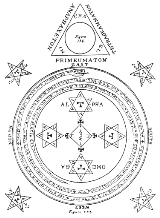
Circletriangle

Evocation


There is a distinct difference between invocation and evocation, as Crowley explains:

To "invoke" is to "call in", just as to "evoke" is to "call forth". This is the essential difference between the two branches of Magick. In invocation, the macrocosm floods the consciousness. In evocation, the magician, having become the macrocosm, creates a microcosm. You invoke a God into the Circle. You evoke a Spirit into the Triangle.


Generally, evocation is used for two main purposes: to gather information and to obtain the services or obedience of a spirit or demon. Crowley believed that the most effective form of evocation was found in the grimoire on Goetia
Goetia

refers to a practice which includes the invocation of angels or the evocation of demons, and usage of the term in English largely derives from the 17th century grimoire The Lesser Key of Solomon, which features an Ars Goetia as its first section....
 (see below), which instructs the magician in how to safely summon forth and command 72 infernal spirits. However, it is equally possible to evoke angelic beings, gods, and other intelligences related to planets, elements, and the Zodiac.

Unlike with invocation, which involves a calling in, evocation involves a calling forth, most commonly into what is called the "triangle of art."

Astral travel


  • Astral body
    Astral body

    The astral body is a subtle body posited by many religious philosophers, intermediate between the intelligent soul and the physical body, composed of a subtle material....
  • Body of Light
  • Rising on the Planes
  • Trance
    Trance

    Trance denotes a variety of processes, techniques, modalities and states of mind, awareness and consciousness. Trance states may occur involuntarily and unbidden....
    s and visions
    Vision (religion)

    In spirituality including religion, visions comprise inspirational renderings, generally of a future state and/or of a mythologyical being, and are believed to come from a deity, sometimes directly or indirectly via prophets, and serve to inspire or prod believers as part of a revelation or an Epiphany ....


Eucharist

The word eucharist originally comes from the Greek word for thanksgiving. However, within magick, it takes on a special meaning—the transmutation of ordinary things (usually food and drink) into divine sacraments, which are then consumed. The object is to infuse the food and drink with certain properties, usually embodied by various deities, so that the adept takes in those properties upon consumption. Crowley describes the process of the regular practice of eucharistic ritual:

The magician becomes filled with God, fed upon God, intoxicated with God. Little by little his body will become purified by the internal lustration of God; day by day his mortal frame, shedding its earthly elements, will become in very truth the Temple of the Holy Ghost. Day by day matter is replaced by Spirit, the human by the divine; ultimately the change will be complete; God manifest in flesh will be his name.


There are several eucharistic rituals within the magical canon. Two of the most well known are The Mass of the Phoenix and The Gnostic Mass. The first is a ritual designed for the individual, which involves sacrificing a "Cake of Light" (a type of bread that serves as the host) to Ra
Ra

Ra is an ancient Egyptian Solar deity . By the Fifth dynasty of Egypt he became a major deity in ancient Egyptian religion, identified primarily with the noon, with other deities representing other positions of the sun....
 (i.e. the Sun) and infusing a second Cake with the adept's own blood (either real or symbolic, in a gesture reflecting the myth of the Pelican
Pelican

A pelican is a large water bird with a distinctive pouch under the beak, belonging to the bird Family Pelecanidae.Along with the darters, cormorants, gannets, boobys, frigatebirds, and tropicbirds, pelicans make up the order Pelecaniformes....
 cutting its own breast to feed its young) and then consuming it with the words, "There is no grace: there is no guilt: This is the Law: Do what thou wilt!" The other ritual, The Gnostic Mass, is a very popular public ritual (although it can be practiced privately) that involves a team of participants, including a Priest and Priestess. This ritual is an enactment of the mystical journey that culminates with the Mystic Marriage and the consumption of a Cake of Light and a goblet of wine (a process termed "communication"). Afterwards, each Communcant declares, "There is no part of me that is not of the gods!"

Yoga


Generally speaking, Yoga
Yoga

Yoga refers to traditional physical and mental disciplines originating in India. The word is associated with meditative practices in both Buddhism and Hinduism....
 is not considered to be magick per se. Rather, it is the necessary training of the body and the mind to allow for certain types of magick to take place. Simply put, the goal is the control of the mind—to increase concentration and to be able to enter different states of consciousness. When developing his basic yogic program, Crowley borrowed heavily from many other yogis, such as Patanjali
Patańjali

Pata?jali is the compiler of the Yoga Sutras, an important collection of aphorisms on Yoga practice, and also the author of the Mahabha?ya, a major commentary on Panini Ashtadhyayi....
 and Yajnavalkya
Yajnavalkya

Sage Yajnavalkya of Mithila was a legendary rishi of Vedic India, credited with the authorship of the Shatapatha Brahmana , besides Yogayajnavalkya Samhita and the Yaj?avalkya Sm?ti....
.

Yoga, as Crowley interprets it, involves several key components. The first is Asana
Asana

Asana is a body position, typically associated with the practice of Yoga, intended primarily to restore and maintain a practitioner's well-being, improve the body's flexibility and vitality, and promote the ability to remain in seated meditation for extended periods....
, which is the assumption (after eventual success) of any easy, steady and comfortable posture. Next is Pranayama
Pranayama

Pranayama is a Sanskrit word meaning "lengthening of the prana or breath". The word is composed of two Sanskrit words, Prana, life force, or vital energy, particularly, the breath, and "ayama", to lengthen or extend....
, which is the control of breath, and Mantra
Mantra

A mantra can be defined as a sound, syllable, word, or group of words that are considered capable of creating transformation. Their use and type varies according to the school and philosophy associated with the mantra....
m, the use of mantra
Mantra

A mantra can be defined as a sound, syllable, word, or group of words that are considered capable of creating transformation. Their use and type varies according to the school and philosophy associated with the mantra....
s. Yama
Yama

Yama , also known as Yamaraja in India, Yanluowang or simply Yan in China, and Enma in Japan, is the lord of death, first recorded in the Vedas....
 and Niyama
Niyama

Niyama is a set of behaviors codified as "the observances" in numerous scriptures including the Shandilya and Varuha Upanishads, Hatha Yoga Pradipika by Gorakshanatha, the Tirumantiram of Tirumular and the Yoga Sutras of Patanjali....
 are the adopted moral or behavioral codes (of the adept's choosing) that will be least likely to excite the mind. Pratyahara
Pratyahara

Pratyahara or the 'withdrawal of the senses' is the fifth element among the Eight stages of Patanjali's Ashtanga Yoga , as mentioned in his classical work, Yoga Sutras of Patanjali written in 2 BCE ....
 is the stilling of the thoughts so that the mind becomes quiet. Dharana
Dharana

Dhara?a is translated as 'collection or? concentration of the mind ', or 'the act of holding, bearing, wearing, supporting, maintaining, retaining, keeping back , a good memory', or 'firmness, steadfastness, ......
 is the beginning of concentration, usually on a single shape, like a triangle, which eventually leads to Dhyana
Dhyana

Dhyana or jhana in Pali refers to a stage of meditation, which is a subset of samadhi. It is a key concept in Hinduism, Buddhism, and Sikhism....
, the loss of distinction between object and subject, which can be described as the annihilation of the ego (or sense of a separate self). The final stage is Samadhi
Samadhi

Samadhi is a Hinduism and Buddhism technical term that usually denotes higher levels of concentrated meditation, or dhyana, in Yogic schools. Nirvana of Buddhism is a step towards Samadhi ....
—Union with the All.

Divination


The art of divination
Divination

Divination is the attempt to gain insight into a question or situation by way of a standardized process or ritual. Diviners ascertain their interpretations of how a querent should proceed by reading signs, events, or omens, or through alleged contact with a supernatural agency....
 is generally employed for the purpose of obtaining information that can guide the adept in his Great Work. The underlying theory states that there exists intelligences (either outside of or inside the mind of the diviner) that can offer accurate information within certain limits using a language of symbols. Normally, divination within magick is not the same as fortune telling, which is more interested in predicting future events. Rather, divination tends to be more about discovering information about the nature and condition of things that can help the magician gain insight and to make better decisions.

There are literally hundreds of different divinatory techniques in the world. However, Western occult practice mostly includes the use of astrology
Astrology

Astrology is a group of systems, traditions, and beliefs which hold that the relative positions of astronomical object and related details can provide useful information about personality, human affairs, and other terrestrial matters....
 (calculating the influence of heavenly bodies), bibliomancy
Bibliomancy

Bibliomancy is the use of books in divination. The method of employing sacred books for 'magical medicine', for removing negative entities, or for divination is widespread in many religions of the world....
 (reading random passages from a book, such as Liber Legis or the I Ching
I Ching

The I Ching , or ?Y? Jing? ; also called Classic of Changes or Book of Changes is one of the oldest of the Chinese classic texts....
), tarot (a deck of 78 cards, each with symblic meaning, usually laid out in a meaningful pattern), and geomancy
Geomancy

File:Geomantic_instrument_Egypt_or_Syria_1241_1242_CE_Muhammad_ibn_Khutlukh_al_Mawsuli.jpgFile:Geomantic instrument Egypt or Syria 1241 1242 CE detail 1.jpg...
 (a method of making random marks on paper or in earth that results in a combination of sixteen patterns).

It is an accepted truism within magick that divination is imperfect. As Crowley writes, "In estimating the ultimate value of a divinatory judgment, one must allow for more than the numerous sources of error inherent in the process itself. The judgment can do no more than the facts presented to it warrant. It is naturally impossible in most cases to make sure that some important factor has not been omitted [...] One must not assume that the oracle is omniscient."

Other magical practices


Qabalah and the Tree of Life

The Tree of Life
Tree of life

The concept of a many-branched tree illustrating the idea that all life on earth is related has been used in tree of life , religion, philosophy, mythology and other areas....
 is a tool used to categorize and organize various mystical concepts. At its most simple level, it is composed of ten spheres, or emanations, called sephiroth
Sephirot (Kabbalah)

Sephirot , in the Kabbalah of Judaism, are the ten attributes that names of God in Judaism created through which he can manifest not only in the physical but the metaphysical universe....
 (sing. "sephira") which are connected by twenty two paths. The sephiroth are represented by the planets and the paths by the characters of the Hebrew alphabet
Hebrew alphabet

The Hebrew alphabet consists of 22 letters used for writing the Hebrew language. Five of these letters have a different form when appearing as the last letter in a word....
, which are subdivided by the four elements, the seven classical planets, and the twelve signs of the Zodiac
Zodiac

Zodiac denotes an annual cycle of twelve stations along the ecliptic, the apparent path of the Sun across the heavens through the constellations that divide the ecliptic into twelve equal zones of celestial longitude....
. Within the western magical tradition, the Tree is used as a kind of conceptual filing cabinet. Each sephira and path is assigned various ideas, such as gods, cards of the Tarot, astrological planets and signs, elements, etc.

Crowley considered a deep understanding of the Tree of Life to be essential to the magician:
The Tree of Life has got to be learnt by heart; you must know it backwards, forwards, sideways, and upside down; it must become the automatic background of all your thinking. You must keep on hanging everything that comes your way upon its proper bough.


Similar to Yoga, learning the Tree of Life is not so much magick as it is a way to map out one's spiritual universe. As such, the adept may use the Tree to determine a destination for astral travel, to choose which gods to invoke for what purposes, et cetera. It also plays an important role in modeling the spiritual journey, where the adept begins in Malkuth, which is the every-day material world of phenomena, with the ultimate goal being at Kether, the sphere of Unity with the All.

Magical record

A magical record is a journal or other source of documentation containing magical events, experiences, ideas, and any other information that the magician may see fit to add. There can be many purposes for such a record, such as recording evidence to verify the effectiveness of specific procedures (per the scientific method that Aleister Crowley claimed should be applied to the practice of magick) or to ensure that data may propagate beyond the lifetime of the magician. Benefits of this process vary, but usually include future analysis and further education by the individual and/or associates with whom the magician feels comfortable in revealing such intrinsically private information.

Crowley was highly insistent upon the importance of this practice. As he writes in Liber E, "It is absolutely necessary that all experiments should be recorded in detail during, or immediately after, their performance (...) The more scientific the record is, the better. Yet the emotions should be noted, as being some of the conditions. Let then the record be written with sincerity and care; thus with practice it will be found more and more to approximate to the ideal." Other items he suggests for inclusion include the physical and mental condition of the experimenter, the time and place, and environmental conditions, including the weather.

Components of ritual magick


Magical weapons

As with magick itself, a magical weapon is any instrument used to bring about intentional change. As Crowley writes, "Illustration: It is my Will to inform the World of certain facts within my knowledge. I therefore take "magical weapons", pen, ink, and paper; [...] The composition and distribution of this book is thus an act of Magick by which I cause Changes to take place in conformity with my Will." With that said, in practice, magical weapons are usually specific, consecrated items used within ceremonial ritual. There is no hard and fast rule for what is or isn't a magical weapon—if a magician considers it such a weapon, then it is. However, there does exist a set of magical weapons that have particular uses and symbolic meanings. Common weapons include the dagger
Dagger

A dagger is a typically double-edged blade used for stabbing or thrusting. They often fulfill the role of a companion weapon in close combat....
 (or athame
Athame

An athame or atham? is a ceremonial double-edged dagger, one of several Magical tools in Wicca used in Traditional Witchcraft and other pagan beliefs and religions such as Wicca for various ritual knives....
 in neopagan parlance), sword
Sword

A sword is a long, edged piece of metal, used as a cutting, thrusting, and clubbing weapon in many civilizations throughout the world. The word sword comes from the Old English language wikt:sweord, cognate to Old High German swert, Middle Dutch swaert, Old Norse sver? Old Frisian and Old Saxon swerd and Dutch langua...
, wand
Wand

A wand is a thin, straight, hand-held stick of wood, ivory, or metal. Generally, in modern language, wands are ceremonial and/or have associations with Magic but there have been other uses, all stemming from the original meaning as a synonym of rod and virge, both of which had a similar development....
, holy oil
Abramelin oil

Abramelin oil, also called Oil of Abramelin, is a ceremonial magic oil blended from aromatic plant materials. Its name came about due to its having been described in a medieval grimoire called The Book of Abramelin written by Abraham the Jew....
, cup (or graal
Graal

Graal can be:* Holy Grail or "Graal" in older forms* A style of glassblowing* Graal-M?ritz, a seaside health resort* GRenoble Anneau Accelerateur Laser...
), disk (or pentacle
Pentacle

A pentacle is an amulet used in Magic evocation, generally made of parchment, paper or metal , on which the symbol of a spirit or energy being evoked is drawn....
), oil lamp
Oil lamp

An oil lamp is a simple vessel used to produce light continuously for a period of time from a fuel source. The use of oil lamps extends from prehistory to the present day....
, bell
Bell (instrument)

A bell is a simple sound-making device. The bell is a percussion instrument and an idiophone. Its form is usually an open-ended hollow drum which resonates upon being struck....
, and thurible
Thurible

A thurible is a metal censer suspended from chains, in which incense is burned during worship services. It is used in the Catholic Church, Eastern Orthodox, Anglicanism/Episcopal_Church_, Old Catholic, and some Lutheran churches, as well as in Christian and non-Christian Gnostic Churches and in the practice of magick....
 (or censer).

Magical formulae

A magical formula is generally a name, word, or series of letters whose meaning illustrates principles and degrees of understanding that are often difficult to relay using other forms of speech or writing. It is a concise means to communicate very abstract information through the medium of a word or phrase, usually regarding a process of spiritual or mystical change. Common formulae include YHVH, INRI, IAO, ShT, AUMGN, NOX, and LVX.

These words often have no intrinsic meaning in and of themselves. However, when deconstructed, each individual letter may refer to some universal concept found in the system that the formula appears. Additionally, in grouping certain letters together one is able to display meaningful sequences that are considered to be of value to the spiritual system that utilizes them (e.g., spiritual hierarchies, historiographic data, psychological stages, etc.)

Vibration of god-names


In magical rituals involving the invocation of deities, a vocal technique called vibration is commonly used. This was a basic aspect of magical training for Crowley, who described it in "Liber O." According to that text, vibration involves a physical set of steps, starting in a standing position, breathing in through the nose while imagining the name of the god entering with the breath, imagining that breath travelling through the entire body, stepping forward with the left foot while throwing the body forward with arms outstretched, visualizing the name rushing out when spoken, ending in an upright stance, with the right forefinger placed upon the lips. According to Crowley in "Liber O", success in this technique is signaled by physical exhaustion and "though only by the student himself is it perceived, when he hears the name of the God vehemently roared forth, as if by the concourse of ten thousand thunders; and it should appear to him as if that Great Voice proceeded from the Universe, and not from himself."

In general ritual practice, vibration can also refer to a technique of saying a god-name or a magical formula in a long, drawn-out fashion (i.e. with a full, deep breath) that employs the nasal passages, such that the sound feels and sounds "vibrated."

See also


General

  • Folk magic
  • Magic (paranormal)
    Magic (paranormal)

    Magic, sometimes known as sorcery, is a conceptual system that asserts human ability to control or predict the nature through Mysticism, paranormal or supernatural means....
  • Magic and religion
    Magic and religion

    A belief in Magic as a means of influencing the world seems to have been common in all cultures. Some of these beliefs crossed over into nascent religions, influencing rites and religious celebrations....
  • Mysticism
    Mysticism

    Mysticism is the pursuit of communion with, Unio Mystica with, or conscious awareness of an ultimate reality, divinity, Spirituality, or God through direct experience, intuition, or insight....
  • Occult
    Occult

    The word occult comes from the Latin word occultus , referring to "knowledge of the hidden". In the medical sense it is used to refer to a structure or process that is hidden, e.g....
  • List of magical terms and traditions
    List of magical terms and traditions

    This is a list of magical terms and traditions dealing with various occult practices, traditions, and components of magic. This list is not intended for topics like stage magic, illusion, or other entertainment-based definition....


Types of magick

  • Chaos magic
    Chaos magic

    Chaos magic is a form of magic which was first formulated in West Yorkshire, England, in the 1970s. Through a variety of techniques often reminiscent of Western ceremonial magic or neoshamanism, many practitioners believe they can change both their subjective experience and objective reality, though some chaos magicians dispute that magic...
  • Enochian magic
    Enochian magic

    Enochian magic is a system of ceremonial magic based on the evocation and commanding of various spirits. It is based on the 16th-century writings of Dr....
  • Goetia
    Goetia

    refers to a practice which includes the invocation of angels or the evocation of demons, and usage of the term in English largely derives from the 17th century grimoire The Lesser Key of Solomon, which features an Ars Goetia as its first section....
  • theurgy
    Theurgy

    Theurgy describes the practice of rituals, sometimes seen as magic in nature, performed with the intention of invoking the action of one or more gods, especially with the goal of uniting with the divine, achieving henosis, and perfecting oneself....
  • Witchcraft
    Witchcraft

    Witchcraft, in various historical, anthropological, religious and mythological contexts, is the use of certain kinds of supernatural or Magic powers....


Components of ritual magick

  • Element
    Classical element

    Many ancient philosophy used a set of archetype classical elements to explain patterns in nature. In this context, the word element refers to a chemical substance that is either a chemical compound or a mixture of chemical compounds , rather than a chemical element of modern physical science....
    s and cardinal direction
    Cardinal direction

    The four cardinal directions or cardinal points are north, south, east, and west, commonly denoted by their initials - N, S, E, W. They are mostly used for geography orientation on Earth but may be calculated anywhere on a rotating astronomical object....
    s


Other magical practices

  • Amulet
    Amulet

    An amulet , a close cousin of the talisman consists of any object intended to bring good luck and/or protection to its owner.Potential amulets include: Gemstone or simple Gemstone, statues, coins, drawings, pendants, jewelry ring, plants, animals, etc.; even words said in certain occasions?for example: vade retro satana?, to repe...
    s
  • Curse
    Curse

    A curse is any manner of adversity thought to be inflicted by any supernatural power, such as a spell , a prayer, an imprecation, an execration, magic , witchcraft, a god, a natural force, or a spiritual being....
    s
  • Initiation
    Initiation

    Initiation is a rite of passage ceremony marking entrance or acceptance into a group or society. It could also be a formal admission to adulthood in a community or one of its formal components....
  • Oath
    Oath

    An oath is either a promise or a statement of fact calling upon something or someone that the oath maker considers sacred, usually God, as a witness to the binding nature of the promise or the truth of the statement of fact....
    s
  • Sigil
    Sigil (magic)

    A sigil is a symbol created for a specific magical purpose. A sigil is usually made up of a complex combination of several specific symbols or geometric figures each with a specific meaning or intent....
    s


External links

  • - the first non-partisan, academic journal investigating the occult tradition of Thelema, founded by Aleister Crowley