

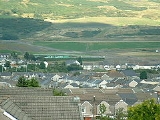
Maesteg

Encyclopedia
Maesteg is a town and community
in Bridgend County Borough, Wales
. Maesteg lies at the northernmost end of the Llynfi Valley, close to the border with Neath Port Talbot
. In 2001, Maesteg had a population of 17,859, but it is now at an estimate of 20,000.
Historically a part of Glamorgan
, the growth of the town started with the opening of ironworks
in the 1820s and 1830s. Once a coal mining
area, the last pit closed in 1985. With the decline of the coal industry and, more recently, the closure of one large factory producing cosmetics and another manufacturing vehicle components, the valley has become a residential/dormitory area for the Port Talbot, Bridgend and Cardiff journey-to-work areas.
 Before the development of industry in the 1820s, the Llynfi Valley was a sparsely populated area of scattered farms. The nearest settlement was the village of Llangynwyd
located on the hillside about two miles south of the present-day town centre of Maesteg. Close to Llangynwyd is an extensive earthwork known as Y Bwlwarcau, an Iron Age
enclosure that is probably a remnant of the earliest settlement in the Llynfi district.
During the Middle Ages
the valley was part of Tir Iarll (the Earl’s Land), an area ‘famous for its game coverts, its woods and sparkling streams’ that was set aside as a hunting reserve by Robert Fitzhamon, Earl of Gloucester, the Norman
conqueror of Glamorgan. Up to the 18th century many of the farms of the Llynfi Valley became centres for local culture. For example Llwydarth, the home of the influential Powell family, was a centre for writers and poets in Glamorgan in the 17th century.
and Garnlwyd in the Llynfi Valley. This was the Dyffryn Llynfi and Porthcawl Railway (DLPR); it was extended to the Coegnant district near the head of the valley in 1830. The railway opened-up the district and prompted the formation of an iron company which began building a works on Maesteg Uchaf Farm, near the site of the present-day town centre, in 1826. The company took its name from the farm and, by 1831, two furnaces were in blast and the first rows of workers’ housing had been completed near the Maesteg Ironworks. At about the same time one of the first zinc smelters in Wales was set up on Coegnant Farm near the northern terminus of the DLPR.
In 1839 work on a second, larger, ironworks commenced at Nantycrynwydd Farm on a site now largely occupied by the Tesco store and adjoining car park. The works, which became known as the Llynfi Ironworks (or ‘The New Works’) was started by the unsuccessful Cambrian Iron and Spelter Company and was bought by the ambitious Llynvi Iron Company in 1845. The Cornstores section of the Maesteg Sports Centre and the adjoining base of a blast furnace remain as links to the Llynfi Works and the valley’s significant 19th century iron industry. The two ironworks, with associated collieries and new housing, transformed what was an area of scattered farms with a population of about 400 in 1821 into a growing township with a population of 4,000 by 1841.
The Cambrian/Llynfi Works attracted the investment capital of a number of prominent figures from the early Victorian period including the poet William Wordsworth, who was a Cambrian shareholder in the early 1840s, Sir Felix Booth
, the gin distiller, and the writer and radical politician, Dr John Bowring
. Bowring invested heavily in the Llynfi Works in the mid 1840s and, for a number of years, that part of the valley around his works was known as Bowrington. During his association with the Maesteg district he campaigned in Parliament for a decimal system of coinage and was largely responsible for the introduction of Britain’s first decimal coin, the florin
or ‘two shilling piece,’ (now the ten pence piece - 10p). John Bowring lost his capital in the trade depression of the late 1840s although the iron company continued trading. After his Llynfi venture, John Bowring became British Consul in Canton
, China
, and was Governor of Hong Kong
1854-59.
The iron industry in Maesteg continued, with varying degrees of success, until wrought iron making was replaced by the manufacture of cheaper, mass produced steel during the 1870s. In its heyday, after the opening of the broad-gauge, steam-hauled Llynfi Valley Railway in 1861, the Llynfi Works had a reputation for producing high-quality iron. In the mid-Victorian period there was a flourishing export trade to Southern Italy and Turkey
for example, rails were exported to the USA and Llynvi ‘Navy Quality’ No.3 Cable Iron was highly regarded by the makers of Admiralty
-tested anchor chains. However, as the Llynfi site could not be adapted for the production of steel, iron making ceased in the Maesteg area in 1885.
During the mid 1880s with the closure of the Llynfi Works and its associated collieries, the Maesteg district, with a population of about 10,000, faced an uncertain future. Fortunately, the local coal industry began to expand with the formation of North’s Navigation Collieries Ltd in 1889. The colliery company was led by the remarkable Colonel North, the ‘Nitrate King’ and, some years later, in 1900, another company led by Sir Alfred Jones
of the Elder Dempster shipping line also developed collieries in the valley. Due to the expansion programme set in motion by the two mining companies, two of the local, former iron company collieries were modernised (Coegnant and Garth) and two new large collieries were sunk at Caerau and St John’s (Cwmdu). Because of the development of the coal industry, the local population increased from about 10,000 in 1891 to almost 30,000 in 1921.
During the years 1890 to 1925 the valley gained a worldwide reputation as a producer of Admiralty-grade steam coal, high quality coking coal and what was regarded as the best house coal in South Wales
. By the early 1920s there were over 7,000 miners at work in the valley. However, as the area depended to such a large extent on the coal export trade, it was seriously affected by the trade depression of the years 1928-38. During that period of acute poverty and large-scale unemployment, the population of the Llynfi Valley decreased by almost a third as many left the district to seek employment in the new light industries growing up in areas such as West London
and the Midlands
.
For many years after the Second World War the local coal industry employed well over 2,000 workers and new jobs were created in local Government-built factories and in new industries in the Port Talbot
and Bridgend
journey-to-work areas. Due to the buoyant coal industry and the success of the new factories during the years 1950-75, the population of Maesteg and district stabilised at about 20,000, roughly the figure today. With the creation of more jobs in the Bridgend and Port Talbot districts, the Llynfi Valley gradually became a residential area, a process which speeded up with the terminal decline of the coal industry during the period 1977 to 1985.
Today, the valley faces another employment crisis, just as it did in the 1880s and the 1930s, with the closure of two local factories in 2007-08 which were the largest employers in the district.
Llynfi Valley Metal-Working Centres
Llynfi Valley Collieries
. Services are operated by Arriva Trains Wales
and run directly to Cardiff Central
via Bridgend. The services usually continue to Cheltenham Spa via Newport
and Gloucester
. The terminus station is Maesteg
, the other two stations are the most recently built , and Garth station which serves the Garth and Cwmfelin villages situated just outside Maesteg. A bus service
replaces a withdrawn rail service from Maesteg to Caerau.
In the past, there were other railway stations in Maesteg. Llangynwyd Station used to lie on the Maesteg line a few miles east of where Garth Station is today, and Maesteg (Neath Road) which was on the old Port Talbot Railway Line but these are now closed.
The original Maesteg railway station was situated a few yards west of the terminus that is there today. Remains of the original station are still there behind the Asda
Store, including the platforms and the bridge joining the two platforms. The old track was removed in 2007 during the land reclamation project.
operate the majority of the services from this station. Services run to Bridgend
, Swansea
via Port Talbot
, Caerau Park, Llangynwyd
and Cymmer. There are no bus services to Cardiff
from Maesteg but passengers can change at Bridgend
to access a service to Cardiff
.
state primary schools: Cwmfelin Primary, Plasnewydd Primary, Blaencaerau Primary, Nantyfyllon Primary, Llangynwyd Primary and Garth Primary. There is also a Catholic
primary school, St. Mary's and St. Patrick's, and a Welsh-medium
school, Ysgol Cynwyd Sant. One of the two comprehensive school
s located in Maesteg is Maesteg Comprehensive School
, which recently moved to a new site. The new school cost £17,000,000. The second comprehensive school
is a Welsh-medium school, Ysgol Gyfun Gymraeg Llangynwyd
. The Welsh language
school is located on the same premises as Maesteg Comprehensive School
was previously. The pupils of Ysgol Cynwyd Sant continue their education at Ysgol Gyfun Gymraeg Llangynwyd, and the pupils of St. Mary's and St. Patrick's pursue their secondary education in Archbishop McGrath Catholic Comprehensive School, located in Tondu
, a few miles to the south.
Plasnewydd School is a primary school near the Maesteg town centre. It is one of the biggest primary schools in the Llynfi Valley
, with just over 400 pupils. Plasnewydd is now an eco-school
.
and theatre
. There are many local groups providing music styles from the traditional male voice choir music and Curtain Up Youth Theatre to the more modern rock band, Funeral for a Friend
, who originally hail from Maesteg.
Maesteg has a rich tradition of Singing, especially in choirs. At present, there are three male voice choirs: Cor Meibion Maesteg A'r Cylch (Maesteg and District Male Voice Choir), Cor Meibion Glerwyr Maesteg Gleemen Male voice Choir, and Cor yr Hen Blwyf (the Old Parish Choir, The Largest being Cor Meibion Maesteg, with membership exeding 50. There are also two ladies choirs: Cor merched Cwm Llynfi (Llynfi Valley Ladies Choir) and Harmony Ladies Choir. There is one mixed choir, Noteworthy mixed choir
Maesteg Children's Choir hosts many concerts throughout the year, and Curtain Up Youth Theatre has been performing musicals since the turn of the millennium, giving children of the valley a chance to showcase their talents. Maesteg Amateur Operatic Society recently celebrated its 60th anniversary with a production of 'The King and I
.' The society continues to flourish with talents from all ages eager to perform, ranging from 16 to founder members, who are still active, at 80 and above.
Artist Christopher Williams
was born in Maesteg in 1873. Six of his paintings are on display in Maesteg Town Hall.
The Welsh national anthem Hen Wlad Fy Nhadau
was first performed in Maesteg, in the vestry of the original Capel Tabor which is now Maesteg Workingmen's Club.
a football (soccer)
team founded in 1945 and affiliated to the Football Association of Wales
. There are four Welsh Rugby Union
teams in Maesteg. The older is Maesteg RFC
founded in 1877, while Maesteg Harlequins RFC
were formed in the 1920s. Other rugby union teams from the area include Nantyffyllon RFC
, and Maesteg Celtic RFC
.
. Bridge FM is the most-listened-to radio station in the County Borough. The breakfast-time presenter, Lee Jukes, has close ties with the Maesteg Gleemen Male Voice Choir, and is also a patron of Maesteg Amateur Operatic Society.
The town is also served by three local newspapers: The Glamorgan Gazette, published weekly, has its main office in Bridgend
, but prints news related to Maesteg; The Gem, formerly The Recorder, a free weekly, printed in Cowbridge
, and The Llynfi News, a free monthly paper, based in Maesteg.
Community (Wales)
A community is a division of land in Wales that forms the lowest-tier of local government in Wales. Welsh communities are analogous to civil parishes in England....
in Bridgend County Borough, Wales
Wales
Wales is a country that is part of the United Kingdom and the island of Great Britain, bordered by England to its east and the Atlantic Ocean and Irish Sea to its west. It has a population of three million, and a total area of 20,779 km²...
. Maesteg lies at the northernmost end of the Llynfi Valley, close to the border with Neath Port Talbot
Neath Port Talbot
Neath Port Talbot is a county borough and one of the unitary authority areas of Wales. Neath Port Talbot is the 8th most populous county in Wales and the third most populous county borough....
. In 2001, Maesteg had a population of 17,859, but it is now at an estimate of 20,000.
Historically a part of Glamorgan
Glamorgan
Glamorgan or Glamorganshire is one of the thirteen historic counties and a former administrative county of Wales. It was originally an early medieval kingdom of varying boundaries known as Glywysing until taken over by the Normans as a lordship. Glamorgan is latterly represented by the three...
, the growth of the town started with the opening of ironworks
Ironworks
An ironworks or iron works is a building or site where iron is smelted and where heavy iron and/or steel products are made. The term is both singular and plural, i.e...
in the 1820s and 1830s. Once a coal mining
Coal mining
The goal of coal mining is to obtain coal from the ground. Coal is valued for its energy content, and since the 1880s has been widely used to generate electricity. Steel and cement industries use coal as a fuel for extraction of iron from iron ore and for cement production. In the United States,...
area, the last pit closed in 1985. With the decline of the coal industry and, more recently, the closure of one large factory producing cosmetics and another manufacturing vehicle components, the valley has become a residential/dormitory area for the Port Talbot, Bridgend and Cardiff journey-to-work areas.
History
Llangynwyd
Llangynwyd is a village 2 miles to the south of Maesteg, in the county borough of Bridgend, Wales. It was part of the medieval cwmwd of Tir Iarll.- History and amenities :The 2001 census gave the population as 2,843...
located on the hillside about two miles south of the present-day town centre of Maesteg. Close to Llangynwyd is an extensive earthwork known as Y Bwlwarcau, an Iron Age
Iron Age
The Iron Age is the archaeological period generally occurring after the Bronze Age, marked by the prevalent use of iron. The early period of the age is characterized by the widespread use of iron or steel. The adoption of such material coincided with other changes in society, including differing...
enclosure that is probably a remnant of the earliest settlement in the Llynfi district.
During the Middle Ages
Middle Ages
The Middle Ages is a periodization of European history from the 5th century to the 15th century. The Middle Ages follows the fall of the Western Roman Empire in 476 and precedes the Early Modern Era. It is the middle period of a three-period division of Western history: Classic, Medieval and Modern...
the valley was part of Tir Iarll (the Earl’s Land), an area ‘famous for its game coverts, its woods and sparkling streams’ that was set aside as a hunting reserve by Robert Fitzhamon, Earl of Gloucester, the Norman
Normans
The Normans were the people who gave their name to Normandy, a region in northern France. They were descended from Norse Viking conquerors of the territory and the native population of Frankish and Gallo-Roman stock...
conqueror of Glamorgan. Up to the 18th century many of the farms of the Llynfi Valley became centres for local culture. For example Llwydarth, the home of the influential Powell family, was a centre for writers and poets in Glamorgan in the 17th century.
Industrial history
The origins of the present-day community in the Llynfi Valley date from the late 1820s when the area’s considerable coal and iron-ore resources were developed on an industrial scale for the first time. In 1828 a 15-mile horse-drawn railway was completed between a new harbour at PorthcawlPorthcawl
Porthcawl is a town on the south coast of Wales in the county borough of Bridgend, 25 miles west of the capital city, Cardiff and 19 miles southeast of Swansea...
and Garnlwyd in the Llynfi Valley. This was the Dyffryn Llynfi and Porthcawl Railway (DLPR); it was extended to the Coegnant district near the head of the valley in 1830. The railway opened-up the district and prompted the formation of an iron company which began building a works on Maesteg Uchaf Farm, near the site of the present-day town centre, in 1826. The company took its name from the farm and, by 1831, two furnaces were in blast and the first rows of workers’ housing had been completed near the Maesteg Ironworks. At about the same time one of the first zinc smelters in Wales was set up on Coegnant Farm near the northern terminus of the DLPR.
In 1839 work on a second, larger, ironworks commenced at Nantycrynwydd Farm on a site now largely occupied by the Tesco store and adjoining car park. The works, which became known as the Llynfi Ironworks (or ‘The New Works’) was started by the unsuccessful Cambrian Iron and Spelter Company and was bought by the ambitious Llynvi Iron Company in 1845. The Cornstores section of the Maesteg Sports Centre and the adjoining base of a blast furnace remain as links to the Llynfi Works and the valley’s significant 19th century iron industry. The two ironworks, with associated collieries and new housing, transformed what was an area of scattered farms with a population of about 400 in 1821 into a growing township with a population of 4,000 by 1841.
The Cambrian/Llynfi Works attracted the investment capital of a number of prominent figures from the early Victorian period including the poet William Wordsworth, who was a Cambrian shareholder in the early 1840s, Sir Felix Booth
Felix Booth
Sir Felix Booth, 1st Baronet was a wealthy UK gin distiller. His earlier family had founded Booth's Gin in London in 1740. In 1832 Booth bought the site of the old Ophthalmic Hospital in Albany Street, Regent's Park as a site for his distillery...
, the gin distiller, and the writer and radical politician, Dr John Bowring
John Bowring
Sir John Bowring, KCB was an English political economist, traveller, miscellaneous writer, polyglot, and the 4th Governor of Hong Kong.- Early life :...
. Bowring invested heavily in the Llynfi Works in the mid 1840s and, for a number of years, that part of the valley around his works was known as Bowrington. During his association with the Maesteg district he campaigned in Parliament for a decimal system of coinage and was largely responsible for the introduction of Britain’s first decimal coin, the florin
Florin
Florin derives from the city of Florence in Italy and frequently refers to the gold coin struck in 1252.This money format was plagiarized in other countries and the word florin is used, for example, in relation to the Dutch guilder and the coin first issued in 1344 by Edward III of England, then...
or ‘two shilling piece,’ (now the ten pence piece - 10p). John Bowring lost his capital in the trade depression of the late 1840s although the iron company continued trading. After his Llynfi venture, John Bowring became British Consul in Canton
Canton
- Administrative divisions :* Canton , territorial/administrative subdivision in some countries, notably Switzerland* Township , known as canton in Canadian French- China :...
, China
China
Chinese civilization may refer to:* China for more general discussion of the country.* Chinese culture* Greater China, the transnational community of ethnic Chinese.* History of China* Sinosphere, the area historically affected by Chinese culture...
, and was Governor of Hong Kong
Governor of Hong Kong
The Governor of Hong Kong was the head of the government of Hong Kong during British rule from 1843 to 1997. The governor's roles were defined in the Hong Kong Letters Patent and Royal Instructions...
1854-59.
The iron industry in Maesteg continued, with varying degrees of success, until wrought iron making was replaced by the manufacture of cheaper, mass produced steel during the 1870s. In its heyday, after the opening of the broad-gauge, steam-hauled Llynfi Valley Railway in 1861, the Llynfi Works had a reputation for producing high-quality iron. In the mid-Victorian period there was a flourishing export trade to Southern Italy and Turkey
Turkey
Turkey , known officially as the Republic of Turkey , is a Eurasian country located in Western Asia and in East Thrace in Southeastern Europe...
for example, rails were exported to the USA and Llynvi ‘Navy Quality’ No.3 Cable Iron was highly regarded by the makers of Admiralty
Admiralty
The Admiralty was formerly the authority in the Kingdom of England, and later in the United Kingdom, responsible for the command of the Royal Navy...
-tested anchor chains. However, as the Llynfi site could not be adapted for the production of steel, iron making ceased in the Maesteg area in 1885.
During the mid 1880s with the closure of the Llynfi Works and its associated collieries, the Maesteg district, with a population of about 10,000, faced an uncertain future. Fortunately, the local coal industry began to expand with the formation of North’s Navigation Collieries Ltd in 1889. The colliery company was led by the remarkable Colonel North, the ‘Nitrate King’ and, some years later, in 1900, another company led by Sir Alfred Jones
Alfred Lewis Jones
Sir Alfred Lewis Jones , British ship-owner, was born in Carmarthenshire, Wales.At the age of twelve he was apprenticed to the managers of the African Steamship Company at Liverpool, making several voyages to the west coast of Africa. By the time he was twenty-six he had risen to be manager of the...
of the Elder Dempster shipping line also developed collieries in the valley. Due to the expansion programme set in motion by the two mining companies, two of the local, former iron company collieries were modernised (Coegnant and Garth) and two new large collieries were sunk at Caerau and St John’s (Cwmdu). Because of the development of the coal industry, the local population increased from about 10,000 in 1891 to almost 30,000 in 1921.
During the years 1890 to 1925 the valley gained a worldwide reputation as a producer of Admiralty-grade steam coal, high quality coking coal and what was regarded as the best house coal in South Wales
South Wales
South Wales is an area of Wales bordered by England and the Bristol Channel to the east and south, and Mid Wales and West Wales to the north and west. The most densely populated region in the south-west of the United Kingdom, it is home to around 2.1 million people and includes the capital city of...
. By the early 1920s there were over 7,000 miners at work in the valley. However, as the area depended to such a large extent on the coal export trade, it was seriously affected by the trade depression of the years 1928-38. During that period of acute poverty and large-scale unemployment, the population of the Llynfi Valley decreased by almost a third as many left the district to seek employment in the new light industries growing up in areas such as West London
West (London sub region)
The West is a sub-region of the London Plan corresponding to the London Boroughs of Brent, Ealing, Hammersmith and Fulham, Harrow, Hillingdon and Hounslow. The sub region was established in 2004 and was adjusted in 2008 to include Kensington and Chelsea. The west has a population of 1.6 million and...
and the Midlands
English Midlands
The Midlands, or the English Midlands, is the traditional name for the area comprising central England that broadly corresponds to the early medieval Kingdom of Mercia. It borders Southern England, Northern England, East Anglia and Wales. Its largest city is Birmingham, and it was an important...
.
For many years after the Second World War the local coal industry employed well over 2,000 workers and new jobs were created in local Government-built factories and in new industries in the Port Talbot
Port Talbot
Port Talbot is a town in Neath Port Talbot, Wales. It had a population of 35,633 in 2001.-History:Port Talbot grew out of the original small port and market town of Aberafan , which belonged to the medieval Lords of Afan. The area of the parish of Margam lying on the west bank of the lower Afan...
and Bridgend
Bridgend
Bridgend is a town in the Bridgend County Borough in Wales, west of the capital, Cardiff. The river crossed by the original bridge, which gave the town its name, is the River Ogmore but the River Ewenny also passes to the south of the town...
journey-to-work areas. Due to the buoyant coal industry and the success of the new factories during the years 1950-75, the population of Maesteg and district stabilised at about 20,000, roughly the figure today. With the creation of more jobs in the Bridgend and Port Talbot districts, the Llynfi Valley gradually became a residential area, a process which speeded up with the terminal decline of the coal industry during the period 1977 to 1985.
Today, the valley faces another employment crisis, just as it did in the 1880s and the 1930s, with the closure of two local factories in 2007-08 which were the largest employers in the district.
Llynfi Valley Metal-Working Centres
| Name | In Production | Maximum Workforce |
|---|---|---|
| Coegnant Spelter (zinc) Works | 1830-1847 | 95 in 1839 |
| Maesteg Iron Works | 1828–1860 | 561 in 1841 |
| Llynfi Iron Works | 1839–1885 | 2,000 in 1870 |
| Llwydarth Tinplate Works | 1868–1900 | 470 in 1886 |
Llynfi Valley Collieries
| Name | Sinking Commenced | Year of Closure | Maximum Workforce |
|---|---|---|---|
| Garth | 1864 | 1930 | 1,007 in 1907 |
| Oakwood (Davis's Pit) | 1868 | 1928 | 495 in 1899 |
| Coegnant | 1881 | 1981 | 2,182 in 1914 |
| Caerau | 1890 | 1977 | 2,432 in 1922 |
| Maesteg Deep | 1868 | 1930 | 671 in 1910 |
| St John's (Cwmdu) | 1908 | 1985 | 1,479 in 1920 |
Railway
Maesteg has three railway stations, all on the Maesteg LineMaesteg Line
The Maesteg Line is commuter rail line in South Wales from Cardiff to Bridgend and Maesteg. The line follows the South Wales Main Line as far as Bridgend, where it then diverges to continue to Maesteg.-History:...
. Services are operated by Arriva Trains Wales
Arriva Trains Wales
Arriva Trains Wales is a train operating company, owned by Arriva, that operates urban and inter urban passenger services in Wales and the Welsh Marches...
and run directly to Cardiff Central
Cardiff Central railway station
Cardiff Central railway station is a major railway station on the South Wales Main Line in Cardiff, Wales.It is the largest and busiest station in Wales and one of the major stations of the British rail network, the tenth busiest station in the United Kingdom outside of London , based on 2007/08...
via Bridgend. The services usually continue to Cheltenham Spa via Newport
Newport
Newport is a city and unitary authority area in Wales. Standing on the banks of the River Usk, it is located about east of Cardiff and is the largest urban area within the historic county boundaries of Monmouthshire and the preserved county of Gwent...
and Gloucester
Gloucester
Gloucester is a city, district and county town of Gloucestershire in the South West region of England. Gloucester lies close to the Welsh border, and on the River Severn, approximately north-east of Bristol, and south-southwest of Birmingham....
. The terminus station is Maesteg
Maesteg railway station
Maesteg railway station is one of two railway stations that serve the town of Maesteg in South Wales. The 1992 built station is located in the centre of the town, adjacent to the Somerfield Supermarket store and on former sidings.-History:...
, the other two stations are the most recently built , and Garth station which serves the Garth and Cwmfelin villages situated just outside Maesteg. A bus service
Rail linc
rail linc is a brand name applied to various dedicated rail-feeder buses in the Sewta region of South Wales.Unlike other local bus services, they are for the use of rail passengers only and the vehicles are usually fitted with National Rail ticket machines....
replaces a withdrawn rail service from Maesteg to Caerau.
In the past, there were other railway stations in Maesteg. Llangynwyd Station used to lie on the Maesteg line a few miles east of where Garth Station is today, and Maesteg (Neath Road) which was on the old Port Talbot Railway Line but these are now closed.
The original Maesteg railway station was situated a few yards west of the terminus that is there today. Remains of the original station are still there behind the Asda
Asda
Asda Stores Ltd is a British supermarket chain which retails food, clothing, general merchandise, toys and financial services. It also has a mobile telephone network, , Asda Mobile...
Store, including the platforms and the bridge joining the two platforms. The old track was removed in 2007 during the land reclamation project.
Buses
Maesteg Bus Station is situated to the rear of the town hall. First CymruFirst Cymru
First Cymru Buses Ltd. is a provider of public transport bus services in South Wales. First Cymru was formed from a number of privatised former bus companies, including South Wales Transport. Its headquarters are in Penlan, Swansea...
operate the majority of the services from this station. Services run to Bridgend
Bridgend
Bridgend is a town in the Bridgend County Borough in Wales, west of the capital, Cardiff. The river crossed by the original bridge, which gave the town its name, is the River Ogmore but the River Ewenny also passes to the south of the town...
, Swansea
Swansea
Swansea is a coastal city and county in Wales. Swansea is in the historic county boundaries of Glamorgan. Situated on the sandy South West Wales coast, the county area includes the Gower Peninsula and the Lliw uplands...
via Port Talbot
Port Talbot
Port Talbot is a town in Neath Port Talbot, Wales. It had a population of 35,633 in 2001.-History:Port Talbot grew out of the original small port and market town of Aberafan , which belonged to the medieval Lords of Afan. The area of the parish of Margam lying on the west bank of the lower Afan...
, Caerau Park, Llangynwyd
Llangynwyd
Llangynwyd is a village 2 miles to the south of Maesteg, in the county borough of Bridgend, Wales. It was part of the medieval cwmwd of Tir Iarll.- History and amenities :The 2001 census gave the population as 2,843...
and Cymmer. There are no bus services to Cardiff
Cardiff
Cardiff is the capital, largest city and most populous county of Wales and the 10th largest city in the United Kingdom. The city is Wales' chief commercial centre, the base for most national cultural and sporting institutions, the Welsh national media, and the seat of the National Assembly for...
from Maesteg but passengers can change at Bridgend
Bridgend
Bridgend is a town in the Bridgend County Borough in Wales, west of the capital, Cardiff. The river crossed by the original bridge, which gave the town its name, is the River Ogmore but the River Ewenny also passes to the south of the town...
to access a service to Cardiff
Cardiff
Cardiff is the capital, largest city and most populous county of Wales and the 10th largest city in the United Kingdom. The city is Wales' chief commercial centre, the base for most national cultural and sporting institutions, the Welsh national media, and the seat of the National Assembly for...
.
Education
Maesteg has six English languageEnglish language
English is a West Germanic language that arose in the Anglo-Saxon kingdoms of England and spread into what was to become south-east Scotland under the influence of the Anglian medieval kingdom of Northumbria...
state primary schools: Cwmfelin Primary, Plasnewydd Primary, Blaencaerau Primary, Nantyfyllon Primary, Llangynwyd Primary and Garth Primary. There is also a Catholic
Catholic
The word catholic comes from the Greek phrase , meaning "on the whole," "according to the whole" or "in general", and is a combination of the Greek words meaning "about" and meaning "whole"...
primary school, St. Mary's and St. Patrick's, and a Welsh-medium
Welsh language
Welsh is a member of the Brythonic branch of the Celtic languages spoken natively in Wales, by some along the Welsh border in England, and in Y Wladfa...
school, Ysgol Cynwyd Sant. One of the two comprehensive school
Comprehensive school
A comprehensive school is a state school that does not select its intake on the basis of academic achievement or aptitude. This is in contrast to the selective school system, where admission is restricted on the basis of a selection criteria. The term is commonly used in relation to the United...
s located in Maesteg is Maesteg Comprehensive School
Maesteg Comprehensive School
Ysgol Maesteg School is a comprehensive school situated in the town of Maesteg in the South Wales Valleys of south-eastern Wales. It is also known as just Maesteg School.. As from February 2008 the school's official name was changed from Maesteg Comprehensive School to Ysgol Maesteg School...
, which recently moved to a new site. The new school cost £17,000,000. The second comprehensive school
Comprehensive school
A comprehensive school is a state school that does not select its intake on the basis of academic achievement or aptitude. This is in contrast to the selective school system, where admission is restricted on the basis of a selection criteria. The term is commonly used in relation to the United...
is a Welsh-medium school, Ysgol Gyfun Gymraeg Llangynwyd
Ysgol Gyfun Gymraeg Llangynwyd
Ysgol Gyfun Gymraeg Llangynwyd is the borough of Bridgend's first and only Welsh medium secondary school. The school opened its doors on the 3 September 2008 on the site of the former Maesteg Comprehensive Upper School in Llangynwyd....
. The Welsh language
Welsh language
Welsh is a member of the Brythonic branch of the Celtic languages spoken natively in Wales, by some along the Welsh border in England, and in Y Wladfa...
school is located on the same premises as Maesteg Comprehensive School
Maesteg Comprehensive School
Ysgol Maesteg School is a comprehensive school situated in the town of Maesteg in the South Wales Valleys of south-eastern Wales. It is also known as just Maesteg School.. As from February 2008 the school's official name was changed from Maesteg Comprehensive School to Ysgol Maesteg School...
was previously. The pupils of Ysgol Cynwyd Sant continue their education at Ysgol Gyfun Gymraeg Llangynwyd, and the pupils of St. Mary's and St. Patrick's pursue their secondary education in Archbishop McGrath Catholic Comprehensive School, located in Tondu
Tondu
Tondu is a village in Bridgend County Borough, Wales, located about north of the town of Bridgend.Tondu lies on the A4063 from Bridgend to Maesteg, and was established in the late 18th century as a coal mining village servicing the Parc Slip Colliery...
, a few miles to the south.
Plasnewydd School is a primary school near the Maesteg town centre. It is one of the biggest primary schools in the Llynfi Valley
River Llynfi
The River Llynfi, otherwise referred to as the Llynfi River or Afon Llynfi in Welsh , is one of three main tributaries of the River Ogmore or Afon Ogwr....
, with just over 400 pupils. Plasnewydd is now an eco-school
Eco-Schools
Eco-Schools is an international program of environmental and sustainable developmental education for schools. Foundation for Environmental Education is the founder of the programme and Eco-Schools is just one out of their five programmes....
.
Maesteg Town Council
Maesteg Town Council consists of seventeen councillors representing the Llynfi Valley, made up of the wards of Maesteg West, Maesteg East, Nantyffyllon and Caerau. In total, 13 of the 17 Councillors are Labour, 3 are Indepdendent and 1 Liberal Democrat.Religion
The largest religion in the valley is Christianity, the majority of denominations being Nonconformist.Music and art
Maesteg has a tradition of musicMusic
Music is an art form whose medium is sound and silence. Its common elements are pitch , rhythm , dynamics, and the sonic qualities of timbre and texture...
and theatre
Theatre
Theatre is a collaborative form of fine art that uses live performers to present the experience of a real or imagined event before a live audience in a specific place. The performers may communicate this experience to the audience through combinations of gesture, speech, song, music or dance...
. There are many local groups providing music styles from the traditional male voice choir music and Curtain Up Youth Theatre to the more modern rock band, Funeral for a Friend
Funeral for a Friend
Funeral for a Friend are a Welsh post-hardcore band, from Bridgend. Formed 2001, they have released five studio albums, seven EPs, sixteen singles, one DVD, and one compilation album.-Formation and Early Years:...
, who originally hail from Maesteg.
Maesteg has a rich tradition of Singing, especially in choirs. At present, there are three male voice choirs: Cor Meibion Maesteg A'r Cylch (Maesteg and District Male Voice Choir), Cor Meibion Glerwyr Maesteg Gleemen Male voice Choir, and Cor yr Hen Blwyf (the Old Parish Choir, The Largest being Cor Meibion Maesteg, with membership exeding 50. There are also two ladies choirs: Cor merched Cwm Llynfi (Llynfi Valley Ladies Choir) and Harmony Ladies Choir. There is one mixed choir, Noteworthy mixed choir
Maesteg Children's Choir hosts many concerts throughout the year, and Curtain Up Youth Theatre has been performing musicals since the turn of the millennium, giving children of the valley a chance to showcase their talents. Maesteg Amateur Operatic Society recently celebrated its 60th anniversary with a production of 'The King and I
The King and I
The King and I is a stage musical, the fifth by the team of Richard Rodgers and Oscar Hammerstein II. The work is based on the 1944 novel Anna and the King of Siam by Margaret Landon and derives from the memoirs of Anna Leonowens, who became governess to the children of King Mongkut of Siam in...
.' The society continues to flourish with talents from all ages eager to perform, ranging from 16 to founder members, who are still active, at 80 and above.
Artist Christopher Williams
Christopher Williams (Welsh artist)
Christopher David Williams was a Welsh artist.He was born in Maesteg, Wales. His father Evan Williams intended him to be a doctor, but he disliked the idea. A visit to the Walker Art Gallery, Liverpool, in 1892, where he spent some hours in front of Frederick Leighton's "Perseus and Andromeda,"...
was born in Maesteg in 1873. Six of his paintings are on display in Maesteg Town Hall.
The Welsh national anthem Hen Wlad Fy Nhadau
Hen Wlad Fy Nhadau
Hen Wlad Fy Nhadau is the national anthem of Wales. The title – taken from the first words of the song – means "Old Land of My Fathers", usually rendered in English as simply "Land of My Fathers". The words were written by Evan James and the tune composed by his son, James James, both residents...
was first performed in Maesteg, in the vestry of the original Capel Tabor which is now Maesteg Workingmen's Club.
Sport
Maesteg is home to Maesteg Park A.F.C.Maesteg Park A.F.C.
Maesteg Park A.F.C. was a Welsh football club based in Maesteg, Wales.-History:Formed in 1945, as Maesteg Park Athletic, they spent nearly twenty years in local league football prior to joining Division Two West of the Welsh Football League in 1962/63. Within six years the club gained promotion and...
a football (soccer)
Football (soccer)
Association football, more commonly known as football or soccer, is a sport played between two teams of eleven players with a spherical ball...
team founded in 1945 and affiliated to the Football Association of Wales
Football Association of Wales
The Football Association of Wales is the governing body of association football in Wales. It is a member of FIFA, UEFA and the IFAB.Established in 1876 , it is the third-oldest national association in the world, and is one of the four associations The Football Association of Wales (FAW) is the...
. There are four Welsh Rugby Union
Welsh Rugby Union
The Welsh Rugby Union is the governing body of rugby union in Wales, recognised by the International Rugby Board.The union's patron is Queen Elizabeth II, and her grandson Prince William of Wales became the Vice Royal Patron of the Welsh Rugby Union as of February 2007.-History:The roots of the...
teams in Maesteg. The older is Maesteg RFC
Maesteg RFC
Maesteg Rugby Football Club is a rugby union team from the town of Maesteg, South Wales. The club presently play in the Welsh Rugby Union Division One West and is a feeder club for the Ospreys.-Club history:...
founded in 1877, while Maesteg Harlequins RFC
Maesteg Harlequins RFC
Maesteg Harlequins RFC is a rugby union team from the town of Maesteg, Wales. The Maesteg Harlequins were founded in 1898, their first captain being Tom Hopkins. They have reformed under different guises but for the majority of their 113 years they have been known as Maesteg Harlequins...
were formed in the 1920s. Other rugby union teams from the area include Nantyffyllon RFC
Nantyffyllon RFC
Nantyffyllon Rugby Football Club is a rugby union team from the village of Nantyffyllon, Maesteg in Wales. The club is a member of the Welsh Rugby Union and is a feeder club for the Ospreys. The club fields a senior team which plays in the WRU leagues, and also fields a second XV, youth and junior...
, and Maesteg Celtic RFC
Maesteg Celtic RFC
Maesteg Celtic Rugby Football Club is a rugby union team from the town of Maesteg, South Wales. Maesteg Celtic RFC presently play in the Welsh Rugby Union Division Three South West League having gained promotion during the 2007/08 season. The club is a member of the Welsh Rugby Union and is a...
.
Notable people
- See :Category:People from Maesteg
- Philip Boswood Ballard (1865–1950), pioneering educational psychologist.
- Allan BatemanAllan BatemanAllan Glen Bateman is a Welsh former rugby union and rugby league player, a dual-code rugby international centre who represented the British Lions at rugby union and Great Britain at rugby league....
, Wales and British Lions, rugby union and rugby league player. - Dave BowenDave BowenDavid Lloyd "Dave" Bowen was a Welsh football player and manager, who captained his country to their only ever World Cup finals, in 1958.-Playing career:...
(1928–1995), Arsenal and Wales, footballer and football manager. - Henry BracyHenry BracyHenry Bracy was a Welsh tenor who is notable as the creator of the role of Prince Hilarion in the Gilbert and Sullivan comic opera Princess Ida. Bracy was often a lead tenor within the operettas in which he appeared. He was married to actress Clara T. Bracy, the sister of Lydia Thompson...
(1846–1917), tenor. - Jason CookJason Cook (boxer)Jason Cook is a professional boxer, who fights under the nickname "The Power". As an amateur, he won a silver medal for Wales at the 1994 Commonwealth Games. As a professional, he has fought as a lightweight, and has won both the European and IBO championships at the weight...
, European boxing champion. - Matthew Lee Davies, Funeral for a FriendFuneral for a FriendFuneral for a Friend are a Welsh post-hardcore band, from Bridgend. Formed 2001, they have released five studio albums, seven EPs, sixteen singles, one DVD, and one compilation album.-Formation and Early Years:...
(lead vocalist) - Ray 'Chico' HopkinsRay HopkinsRay "Chico" Hopkins is a Welsh international rugby player who was also a member of the British Lions.Outside rugby he was a National Coal Board fitter at their workshop in Maesteg.-Club career:...
, Wales and British LionsBritish and Irish LionsThe British and Irish Lions is a rugby union team made up of players from England, Scotland, Ireland and Wales...
, rugby union and rugby league player. - George JeffriesGeorge Jeffreys (pastor)George Jeffreys was a Welsh minister who founded the Elim Pentecostal Church, one of the first Pentecostal organisations.As a fifteen-year-old from Nantyffylon, Maesteg, Wales, George became a Christian during the 1904-1905 Welsh Revival, along with his older brother Stephen...
(1889–1972), founder of the worldwide Elim Pentecostal Church. - Siân Lloyd, ITV weather presenter.
- Sir Rhys Hopkin MorrisRhys Hopkin MorrisSir Rhys Hopkin Morris was a Welsh Liberal politician who was a Member of Parliament from 1923–1932 and from 1945–1956....
, (1888–1956), politician, stipendiary magistrate, first director of the Welsh Region BBC. - Sir William Beddoe ReesBeddoe ReesSir William Beddoe Rees, usually known simply as Beddoe Rees was a Welsh industrialist and Liberal politician.-Family and education:...
MP (1877–1931), Welsh chapel architect, town-planner and politician. - David Emlyn Thomas (1892–1954), politician and trade unionist.
- Islyn Thomas (1912–2002), U.S.-based author, engineer and industrialist.
- Rees ThomasRees Thomas (rugby league)Rees Thomas was a Welsh former professional rugby league footballer of the 1940s and '50s who at representative level played for Wales, and at club level for Swinton and Wigan, playing at , i.e. number 7...
Rugby league scrum half with SwintonSwinton LionsSwinton Lions is an English professional rugby league club from Swinton, Greater Manchester. The club has won the Championship six times and three Challenge Cups. They currently play in the Championship.-Early years:...
and WiganWigan WarriorsWigan Warriors is an English rugby league club based in Wigan, Greater Manchester. The club's first team squad competes in the engage Super League and the team are the current Challenge Cup holders as of the 27th August 2011....
(winner Lance Todd trophyLance Todd TrophyThe Lance Todd Trophy is awarded to the Man-of-the-Match in rugby league football's Challenge Cup Final.The trophy was introduced in 1946, in memory of Lance Todd, the New Zealand-born player and administrator, who was killed in a road accident during the Second World War...
1958). - Thomas Llyfnwy ThomasThomas L. ThomasThomas Llyfnwy Thomas was a Welsh American baritone concert singer who achieved fame for his performances both in concert halls and on television and radio, most notably on The Voice of Firestone, where he was the most frequently featured singer...
(1912–1983), U.S.-based vocalist and T.V. personality. - Christopher WilliamsChristopher Williams (Welsh artist)Christopher David Williams was a Welsh artist.He was born in Maesteg, Wales. His father Evan Williams intended him to be a doctor, but he disliked the idea. A visit to the Walker Art Gallery, Liverpool, in 1892, where he spent some hours in front of Frederick Leighton's "Perseus and Andromeda,"...
(1873–1934), leading artist, portrait painter. - John J. WilliamsJ.J. WilliamsJohn James Williams , known universally as J.J. Williams, is a former Welsh rugby union player who gained thirty caps for Wales as a winger....
, Wales and British Lions, rugby union player and international athlete.
Media
As part of Bridgend County Borough, the local radio station is 106.3 Bridge FM106.3 Bridge FM
Bridge FM is the local commercial radio station broadcasting in south Wales' Bridgend County Borough and the surrounding areas on a frequency of 106.3 MHz....
. Bridge FM is the most-listened-to radio station in the County Borough. The breakfast-time presenter, Lee Jukes, has close ties with the Maesteg Gleemen Male Voice Choir, and is also a patron of Maesteg Amateur Operatic Society.
The town is also served by three local newspapers: The Glamorgan Gazette, published weekly, has its main office in Bridgend
Bridgend
Bridgend is a town in the Bridgend County Borough in Wales, west of the capital, Cardiff. The river crossed by the original bridge, which gave the town its name, is the River Ogmore but the River Ewenny also passes to the south of the town...
, but prints news related to Maesteg; The Gem, formerly The Recorder, a free weekly, printed in Cowbridge
Cowbridge
Cowbridge is a market town in the Vale of Glamorgan in Wales, approximately west of Cardiff. Cowbridge is twinned with Clisson in the Loire-Atlantique department in northwestern France.-Roman times:...
, and The Llynfi News, a free monthly paper, based in Maesteg.
External links
- http://www.mongabay.com/igapo/2005_world_city_populations/Wales.html
- http://www.bridgend.gov.uk/Web1/groups/tourism/documents/marketing/001792.hcsp
- http://www.grossi.co.uk/wales/towns.htm
- http://www.diggingupthepast.org.uk/maps/maesteg1884.html
- http://www.roman-britain.org/celtic/celtic_map.htm
- http://scarab.newport.ac.uk/pavi/paviland.html
- http://www.bridgend.gov.uk/Web1/groups/tourism/documents/marketing/001754.hcsp
- http://www.visitmaesteg.piczo.com/
- Welsh Coal Mines website - research the histories of the local pits and al the others in Wales
- Maesteg Harlequins website
- Maesteg Rugby Club website
- BBC's Maesteg website