


Maeshowe

Encyclopedia


Old Norse
Old Norse is a North Germanic language that was spoken by inhabitants of Scandinavia and inhabitants of their overseas settlements during the Viking Age, until about 1300....
: Orkhaugr) is a Neolithic
Neolithic
The Neolithic Age, Era, or Period, or New Stone Age, was a period in the development of human technology, beginning about 9500 BC in some parts of the Middle East, and later in other parts of the world. It is traditionally considered as the last part of the Stone Age...
chambered cairn
Chambered cairn
A chambered cairn is a burial monument, usually constructed during the Neolithic, consisting of a cairn of stones inside which a sizeable chamber was constructed. Some chambered cairns are also passage-graves....
and passage grave
Passage grave
thumb|250px|right|A simple passage tomb in [[Carrowmore]] near [[Sligo]] in IrelandA passage grave or passage tomb consists of a narrow passage made of large stones and one or multiple burial chambers covered in earth or stone. Megaliths are usually used in the construction of passage tombs, which...
situated on Mainland, Orkney, Scotland
Scotland
Scotland is a country that is part of the United Kingdom. Occupying the northern third of the island of Great Britain, it shares a border with England to the south and is bounded by the North Sea to the east, the Atlantic Ocean to the north and west, and the North Channel and Irish Sea to the...
. The monuments around Maeshowe, including Skara Brae
Skara Brae
Skara Brae is a large stone-built Neolithic settlement, located on the Bay of Skaill on the west coast of Mainland, Orkney, Scotland. It consists of ten clustered houses, and was occupied from roughly 3180 BCE–2500 BCE...
, were designated a UNESCO
UNESCO
The United Nations Educational, Scientific and Cultural Organization is a specialized agency of the United Nations...
World Heritage Site
World Heritage Site
A UNESCO World Heritage Site is a place that is listed by the UNESCO as of special cultural or physical significance...
in 1999. It gives its name to the Maeshowe type of chambered cairn, which is limited to Orkney. Maeshowe is very similar to the famous Newgrange
Newgrange
Newgrange is a prehistoric monument located in County Meath, on the eastern side of Ireland, about one kilometre north of the River Boyne. It was built around 3200 BC , during the Neolithic period...
tomb in Ireland
Ireland
Ireland is an island to the northwest of continental Europe. It is the third-largest island in Europe and the twentieth-largest island on Earth...
, suggesting a linkage between the two cultures. Maeshowe is a magnificent example of Neolithic craftsmanship and is, in the words of the distinguished archaeologist Stuart Piggott
Stuart Piggott
Stuart Ernest Piggott CBE was a British archaeologist best known for his work on prehistoric Wessex.Born in Petersfield, Hampshire, Piggott was educated at Churcher's College and on leaving school in 1927 took up a post as assistant at Reading Museum where he developed an expertise in Neolithic...
, "a superlative monument that by its originality of execution is lifted out of its class into a unique position."
Maeshowe appears as a grassy mound rising from a flat plain near the south-east end of the Loch
Loch
Loch is the Irish and Scottish Gaelic word for a lake or a sea inlet. It has been anglicised as lough, although this is pronounced the same way as loch. Some lochs could also be called a firth, fjord, estuary, strait or bay...
of Harray
Harray
Harray is a former parish on Mainland, Orkney, now merged with Birsay. It has the unique distinction of being the only landlocked parish on the islands, however it is next to the freshwater Loch of Harray....
. Maeshowe is one of the largest tombs in Orkney; the mound encasing the tomb is 115 feet (35.1 m) in diameter and rises to a height of 24 feet (7.3 m). Surrounding the mound, at a distance of 50 feet (15.2 m) to 70 feet (21.3 m) is a ditch up to 45 feet (13.7 m) wide. The grass mound hides a complex of passages and chambers built of carefully crafted slabs of flagstone
Flagstone
Flagstone, is a generic flat stone, usually used for paving slabs or walkways, patios, fences and roofing. It may be used for memorials, headstones, facades and other constructions. The name derives from Middle English flagge meaning turf, perhaps from Old Norse flaga meaning slab.Flagstone is a...
weighing up to 30 tons. It is aligned so that the rear wall of its central chamber held up by a bracketed wall, is illuminated on the winter solstice
Winter solstice
Winter solstice may refer to:* Winter solstice, astronomical event* Winter Solstice , former band* Winter Solstice: North , seasonal songs* Winter Solstice , 2005 American film...
. A similar display occurs in Newgrange
Newgrange
Newgrange is a prehistoric monument located in County Meath, on the eastern side of Ireland, about one kilometre north of the River Boyne. It was built around 3200 BC , during the Neolithic period...
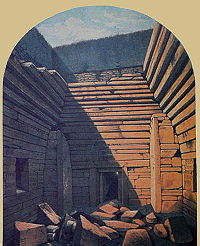
. This entrance passage is 36 feet (11 m) long and leads to the central almost square chamber measuring about 15 feet (4.6 m) on each side. The current height of the chamber is 12.5 feet (3.8 m), this reflects the height to which the original stonework is preserved and capped by a modern corbelled roof. The original roof may have risen to a height of 15 feet (4.6 m) or more.
The entrance passage is only about 3 foot (0.9144 m) high, requiring visitors to stoop or crawl into the central chamber. That chamber is constructed largely of flat slabs of stone, many of which traverse nearly the entire length of the walls. In each corner lie huge angled buttresses that rise to the vaulting. At a height of about 3 foot (0.9144 m), the walls construction changes from the use of flat to overlapping slabs creating a beehive-shaped vault.
The "modern" opening of the tomb was by James Farrer, an antiquarian and the Member of Parliament
Member of Parliament
A Member of Parliament is a representative of the voters to a :parliament. In many countries with bicameral parliaments, the term applies specifically to members of the lower house, as upper houses often have a different title, such as senate, and thus also have different titles for its members,...
for Durham
Durham
Durham is a city in north east England. It is within the County Durham local government district, and is the county town of the larger ceremonial county...
, in July 1861. Farrer, like many antiquarians of the day, was not noted for his careful excavation of sites. John Hedges describes him as possessing "a rapacious appetite for excavation matched only by his crude techniques, lack of inspiration, and general inability to publish." Farrer and his workmen broke through the roof of the entrance passage and found it filled with debris. He then turned his attention to the top of the mound, broke through and, over a period of a few days, emptied the main chamber of material that had filled it completely. He and his workmen discovered the famous runic inscriptions carved on the walls, proof that Norsemen had broken into the tomb at least six centuries earlier. As described in the Orkneyinga Saga
Orkneyinga saga
The Orkneyinga saga is a historical narrative of the history of the Orkney Islands, from their capture by the Norwegian king in the ninth century onwards until about 1200...
, Maeshowe was looted by the famous Vikings Earl Harald Maddadarson
Harald Maddadsson
Harald Maddadsson was Earl of Orkney and Mormaer of Caithness from 1139 until 1206. He was the son of Matad, Mormaer of Atholl, and Margaret, daughter of Earl Haakon Paulsson of Orkney...
and Ragnvald, Earl of Møre in about the 12th century. The more than thirty runic
Runic alphabet
The runic alphabets are a set of related alphabets using letters known as runes to write various Germanic languages before the adoption of the Latin alphabet and for specialized purposes thereafter...
inscriptions on the walls of the chamber represent the largest single collection of such carvings in the world.
Grooved ware
Grooved ware is the name given to a pottery style of the British Neolithic. Its manufacturers are sometimes known as the Grooved ware people. Unlike the later Beaker ware, Grooved culture was not an import from the continent but seems to have developed in Orkney, early in the 3rd millennium BC, but...
, a distinctive type of pottery that spread throughout the British Isles from about 3000 BC. The land around Maeshowe at its construction probably looked much as it does today- treeless with grasses representative of Pollen Assemblage Zone MNH-I reflecting "mixed agricultural practices, probably with a pastoral bias- there is a substantial amount of ribwort pollen, but also that of cereals.".
A Neolithic "low road" connects Maeshowe with the magnificently preserved village of Skara Brae
Skara Brae
Skara Brae is a large stone-built Neolithic settlement, located on the Bay of Skaill on the west coast of Mainland, Orkney, Scotland. It consists of ten clustered houses, and was occupied from roughly 3180 BCE–2500 BCE...
, passing near the Standing Stones of Stenness and the Ring of Brodgar
Ring of Brodgar
The Ring of Brodgar is a Neolithic henge and stone circle on the Mainland, the largest island in Orkney, Scotland...
. Low roads connect Neolithic ceremonial sites throughout Britain. Some archeologists believe that Maeshowe was originally surrounded by a large stone circle. The complex including Maeshowe, the Ring of Brodgar, the Standing Stones of Stenness, Skara Brae, as well as other tombs and standing stones represents a concentration of Neolithic sites that is rivalled in Britain only by the complexes associated with Stonehenge
Stonehenge
Stonehenge is a prehistoric monument located in the English county of Wiltshire, about west of Amesbury and north of Salisbury. One of the most famous sites in the world, Stonehenge is composed of a circular setting of large standing stones set within earthworks...
and Avebury
Avebury
Avebury is a Neolithic henge monument containing three stone circles which is located around the village of Avebury in Wiltshire, south west England. Unique amongst megalithic monuments, Avebury contains the largest stone circle in Europe, and is one of the best known prehistoric sites in Britain...
.
Chambered tombs of the Maeshowe "type" are characterized by a long, low entrance passageway leading to a square or rectangular chamber from which there is access to a number of side cells. Although there are disagreements as to the attribution of tombs to tomb types, there are only seven definitely known Maeshowe type tombs. On Mainland, there are, in addition to Maeshowe; the tombs of Cuween, Wideford Hill, and Quanterness. The tomb of Quoyness is found on Sanday, while Vinquoy Hill is located on Eday
Eday
Eday is one of the Orkney Islands, which are located to the north of the Scottish mainland in the United Kingdom. Eday is located in the North Isles of Orkney, and is about north of the main island of Orkney Mainland...
. Finally, there is an unnamed tomb on the Holm of Papa Westray
Holm of Papa
The Holm of Papa is a very small uninhabited island in the Orkney islands. It is around 15 ha in size...
. Anna Ritchie reports that there are three more Maeshowe type tombs in Orkney but she doesn't name or locate them.
Toponymy
The origin of the name Maeshowe is uncertain. While the second element is certainly from the Old Norse haugr usually meaning a mound, there have been several different theories postulated for the first element, maes.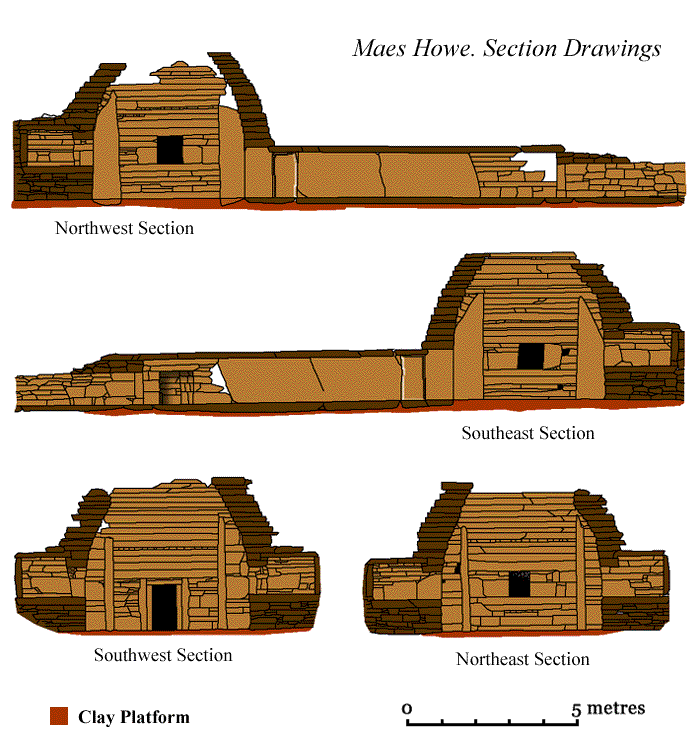
- Celtic origins. The Welsh word 'Maes' meaning 'field' or 'area of activity'; it is typical for 'maes' to be followed by an adjective, such as 'fair field', 'Maes teg'. 'Maeshowe' might then mean 'the burial mound field', or 'the area around the cairn'. Due to the rarity of surviving pre-Norse elements in Orcadian placenames, this theory does not enjoy much support.
- A personal name. 'Maeshowe' could simply be a corruption of 'Tormis' Howe', meaning it was the burial mound of someone called Tormis. Some other cairns in the area do seem to be named after individuals, and 'Tormiston' is immediately adjacent to the tomb.
- Old Norse for 'The Maiden's Tomb'? This would be meyjarhaugr or maerhaugr.
- Old Norse for 'The Great Tomb'? This would be mestrhaugr. Interestingly, Maeshowe is called Orkahaugr in the Orkneyinga SagaOrkneyinga sagaThe Orkneyinga saga is a historical narrative of the history of the Orkney Islands, from their capture by the Norwegian king in the ninth century onwards until about 1200...
. The first element of that name, orka, signifies power or greatness.
World Heritage status
‘The Heart of Neolithic OrkneyHeart of Neolithic Orkney
Heart of Neolithic Orkney refers to a group of Neolithic monuments found on the Mainland, one of the islands of Orkney, Scotland. The name was adopted by UNESCO when it proclaimed these sites as a World Heritage Site in 1999....
’ was inscribed as a World Heritage site in December 1999. In addition to Maeshowe, the site includes Skara Brae
Skara Brae
Skara Brae is a large stone-built Neolithic settlement, located on the Bay of Skaill on the west coast of Mainland, Orkney, Scotland. It consists of ten clustered houses, and was occupied from roughly 3180 BCE–2500 BCE...
, the Standing Stones of Stenness, the Ring of Brodgar
Ring of Brodgar
The Ring of Brodgar is a Neolithic henge and stone circle on the Mainland, the largest island in Orkney, Scotland...
and other nearby sites. It is managed by Historic Scotland
Historic Scotland
Historic Scotland is an executive agency of the Scottish Government, responsible for historic monuments in Scotland.-Role:As its website states:...
, whose 'Statement of Significance' for the site begins:
The monuments at the heart of Neolithic Orkney and Skara Brae proclaim the triumphs of the human spirit in early ages and isolated places. They were approximately contemporary with the mastabas of the archaic period of Egypt (first and second dynasties), the brick temples of Sumeria, and the first cities of the Harappa culture in India, and a century or two earlier than the Golden Age of China. Unusually fine for their early date, and with a remarkably rich survival of evidence, these sites stand as a visible symbol of the achievements of early peoples away from the traditional centres of civilisation...Maes Howe is a masterpiece of Neolithic peoples. It is an exceptionally early architectural accomplishment. With its almost classical strength and simplicity it is a unique survival from 5000 years ago. It is an expression of genius within a group of people whose other tombs were claustrophobic chambers in smaller mounds.
See also
- NewgrangeNewgrangeNewgrange is a prehistoric monument located in County Meath, on the eastern side of Ireland, about one kilometre north of the River Boyne. It was built around 3200 BC , during the Neolithic period...
, another winter-solstice-aligned passage tomb - Ring of BrodgarRing of BrodgarThe Ring of Brodgar is a Neolithic henge and stone circle on the Mainland, the largest island in Orkney, Scotland...
- Skara BraeSkara BraeSkara Brae is a large stone-built Neolithic settlement, located on the Bay of Skaill on the west coast of Mainland, Orkney, Scotland. It consists of ten clustered houses, and was occupied from roughly 3180 BCE–2500 BCE...
- Standing Stones of Stenness
- The Stone Lud
- Heart of Neolithic OrkneyHeart of Neolithic OrkneyHeart of Neolithic Orkney refers to a group of Neolithic monuments found on the Mainland, one of the islands of Orkney, Scotland. The name was adopted by UNESCO when it proclaimed these sites as a World Heritage Site in 1999....
- Prehistoric OrkneyPrehistoric OrkneyPrehistoric Orkney refers to a period in the human occupation of the Orkney archipelago of Scotland that was the latter part of these islands' prehistory. The period of prehistory prior to occupation by the genus Homo is part of the geology of Scotland...
- List of megalithic sites
- List of archaeoastronomical sites by country
External links
- Maeshowe Chambered Cairn - official site at Historic ScotlandHistoric ScotlandHistoric Scotland is an executive agency of the Scottish Government, responsible for historic monuments in Scotland.-Role:As its website states:...
- Orkneyjar
- Winter Solstice Webcam
- Research around the reappearance of the sun
- Article about Maeshowe at Undiscovered Scotland