

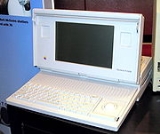
Macintosh Portable

Encyclopedia
The Macintosh Portable was Apple Inc.'s first attempt at making a battery
-powered portable
Macintosh personal computer
that held the power of a desktop Macintosh. It was also the first commercial off-the-shelf
portable computer used in space and the first to send an email from space, in 1991 aboard Space Shuttle
mission STS-43
.
Released on September 20, 1989, it was received with excitement from most critics but with very poor sales to consumers. It featured a black and white active-matrix LCD screen in a hinged cover that covered the keyboard when the machine was not in use. The mouse function was handled by a built-in trackball that could be removed and located on either side of the keyboard. It used expensive SRAM
in an effort to maximize battery life and to provide an "instant on" low power sleep mode.
, despite using the 68HC000
, a low-power version of the Motorola 68000
, running at 16 megahertz (MHz) on a 16 MHz bus. The Portable came with 1 megabyte
(MB) of RAM soldered on the motherboard and was expandable to 5 MB using the single RAM expansion slot, or 9 MB using the single PDS
expansion slot which, due to strict FCC regulations, was not developed for use with any other expansion cards such as the popular Ethernet card for the SE. It also had a single ROM
expansion slot which would accommodate up to 4 MB, though the Portable itself used a 256 K ROM based on the SE's. Weighing in at 15.8 lb (7.2 kg), due in large part to the sealed lead-acid batteries used, the machine was widely considered more of a "luggable" than a portable. Compared to the PowerBook
series introduced a few years later, the Portable lacked the ergonomic layout that set the trend for all future laptops.
Using the same Snow White design language
as Apple's prior attempt at a portable computer, the Apple IIc
, the Mac Portable had a standard 1.44 MB floppy disk
drive, an optional internal hard disk (a low-power 3.5-inch drive from Conner
was used) or second internal floppy drive, and also offered the first optional internal modem in a Macintosh. It additionally offered a full complement of standard-sized desktop peripheral ports, though the use of the internal modem disabled the external modem port. The modular, 'snap together' physical design of the Portable made it easy to upgrade, customize and repair in the field. Memory, modem and special-purpose circuit boards could be inserted in seconds without special tools, simply by opening the large panel that covered the back of the computer. Users could even move the trackball to the left of the keyboard to accommodate left-handed use, or replace it with an optional numeric keypad
.
Additionally, the Portable included many forward-thinking features which were rarely implemented, if ever taken advantage of. The Portable was capable of SCSI Disk Mode (first officially supported by Apple with the PowerBook 100
) through a third-party kit, thus allowing it to be used as an external drive for a desktop Mac. It was also the first Mac with a self-contained display to include a built-in monitor output, requiring an external Video Adapter (which Apple canceled shortly after it was announced), something even the PowerBook line would not incorporate until its second-generation models. However, third-party developers did create products utilizing this output, including an overhead projector panel. It was also the first Mac to allow its display settings to be completely controlled by software, a feature that would later turn up in the Macintosh Classic
desktop.
Perhaps the most prominent feature of the Portable (and the single item that contributed most significantly to its cost) was the much praised active matrix LCD, which provided a bright, sharp display comparable to a desktop Mac. Apple's use of the more expensive technology made it a standout from the PC portables which used inferior and cheaper passive-matrix displays.
s from Apple and other manufacturers, the battery is charged in series with the supply of power to the computer. If the battery can no longer hold a charge, then the computer cannot run on AC power and hence it will not boot. The main reason for this is that the original power supply had a very low output. This is also why in many instances the hard drive would not spin up. Several popular unauthorized workarounds were devised, including to use the power supply from the PowerBook 100 Series which provides a higher output. Sealed lead acid cells tend to fail if they are fully discharged, another common complaint about the Portable. The batteries are no longer manufactured and it is very rare to find an original battery that will hold charge and allow the computer to start. It is possible to repack the battery with new cells, or use alternative 6 V batteries http://www.lowendmac.com/pb/portabattery.shtml. The sealed lead acid cells used in the Portable's battery pack were made by Gates and were also used in Quantum 1 battery packs for photographic flash use.
One of the drawbacks of the Portable was poor readability in low light situations. So in February 1991, Apple introduced a backlit Macintosh Portable (model M5126). Along with the new screen, Apple changed the SRAM memory to pseudo-SRAM (which reduced the total RAM expansion to 8 MB) and lowered the price. The backlight feature was a welcomed improvement, but it came with a sacrifice: battery life was cut in half. An upgrade kit was also offered for the earlier model as well, which plugged into the ROM expansion slot. The Portable was discontinued in October of the same year.
In addition, at 16 pounds and 4 inches thick, the Portable was a heavy and bulky portable computer. Lead-acid batteries contributed to its weight and bulk.
.
In May 2006, PC World
rated the Macintosh Portable as the seventeenth worst tech product of all time.
Battery (electricity)
An electrical battery is one or more electrochemical cells that convert stored chemical energy into electrical energy. Since the invention of the first battery in 1800 by Alessandro Volta and especially since the technically improved Daniell cell in 1836, batteries have become a common power...
-powered portable
Portable computer
A portable computer is a computer that is designed to be moved from one place to another and includes a display and keyboard. Portable computers, by their nature, are generally microcomputers. Portable computers, because of their size, are also commonly known as 'Lunchbox' or 'Luggable' computers...
Macintosh personal computer
Personal computer
A personal computer is any general-purpose computer whose size, capabilities, and original sales price make it useful for individuals, and which is intended to be operated directly by an end-user with no intervening computer operator...
that held the power of a desktop Macintosh. It was also the first commercial off-the-shelf
Commercial off-the-shelf
In the United States, Commercially available Off-The-Shelf is a Federal Acquisition Regulation term defining a nondevelopmental item of supply that is both commercial and sold in substantial quantities in the commercial marketplace, and that can be procured or utilized under government contract...
portable computer used in space and the first to send an email from space, in 1991 aboard Space Shuttle
Space Shuttle
The Space Shuttle was a manned orbital rocket and spacecraft system operated by NASA on 135 missions from 1981 to 2011. The system combined rocket launch, orbital spacecraft, and re-entry spaceplane with modular add-ons...
mission STS-43
STS-43
-Mission parameters:*Mass:**Orbiter landing with payload: **Payload: *Perigee: *Apogee: *Inclination: 28.5°*Period: 90.6 min-Preparations and Launch:The launch took place on 2 August 1991, 11:01:59 am EDT...
.
Released on September 20, 1989, it was received with excitement from most critics but with very poor sales to consumers. It featured a black and white active-matrix LCD screen in a hinged cover that covered the keyboard when the machine was not in use. The mouse function was handled by a built-in trackball that could be removed and located on either side of the keyboard. It used expensive SRAM
Static random access memory
Static random-access memory is a type of semiconductor memory where the word static indicates that, unlike dynamic RAM , it does not need to be periodically refreshed, as SRAM uses bistable latching circuitry to store each bit...
in an effort to maximize battery life and to provide an "instant on" low power sleep mode.
Hardware
The machine was architecturally similar to the Macintosh SEMacintosh SE
The Macintosh SE was a personal computer manufactured by Apple between March 1987 and October 1990. This computer marked a significant improvement on the Macintosh Plus design and was introduced by Apple at the same time as the Macintosh II....
, despite using the 68HC000
Motorola 68000
The Motorola 68000 is a 16/32-bit CISC microprocessor core designed and marketed by Freescale Semiconductor...
, a low-power version of the Motorola 68000
Motorola 68000
The Motorola 68000 is a 16/32-bit CISC microprocessor core designed and marketed by Freescale Semiconductor...
, running at 16 megahertz (MHz) on a 16 MHz bus. The Portable came with 1 megabyte
Megabyte
The megabyte is a multiple of the unit byte for digital information storage or transmission with two different values depending on context: bytes generally for computer memory; and one million bytes generally for computer storage. The IEEE Standards Board has decided that "Mega will mean 1 000...
(MB) of RAM soldered on the motherboard and was expandable to 5 MB using the single RAM expansion slot, or 9 MB using the single PDS
Processor Direct Slot
Processor Direct Slot or PDS introduced by Apple Computer, in several of their Macintosh models, provided a limited measure of hardware expandibility, without going to the expense of providing full-fledged bus expansion slots.Typically, a machine would feature multiple bus expansions slots, if any...
expansion slot which, due to strict FCC regulations, was not developed for use with any other expansion cards such as the popular Ethernet card for the SE. It also had a single ROM
Read-only memory
Read-only memory is a class of storage medium used in computers and other electronic devices. Data stored in ROM cannot be modified, or can be modified only slowly or with difficulty, so it is mainly used to distribute firmware .In its strictest sense, ROM refers only...
expansion slot which would accommodate up to 4 MB, though the Portable itself used a 256 K ROM based on the SE's. Weighing in at 15.8 lb (7.2 kg), due in large part to the sealed lead-acid batteries used, the machine was widely considered more of a "luggable" than a portable. Compared to the PowerBook
PowerBook
The PowerBook was a line of Macintosh laptop computers that was designed, manufactured and sold by Apple Computer, Inc. from 1991 to 2006. During its lifetime, the PowerBook went through several major revisions and redesigns, often being the first to incorporate features that would later become...
series introduced a few years later, the Portable lacked the ergonomic layout that set the trend for all future laptops.
Using the same Snow White design language
Snow White design language
The Snow White design language was an industrial design language developed by Hartmut Esslinger's Frog Design. Used by Apple Computer from 1984 to 1990, the scheme has vertical and horizontal stripes for decoration, ventilation, and the illusion that the computer enclosure is smaller than it...
as Apple's prior attempt at a portable computer, the Apple IIc
Apple IIc
The Apple IIc, the fourth model in the Apple II series of personal computers, was Apple Computer’s first endeavor to produce a portable computer. The end result was a notebook-sized version of the Apple II that could be transported from place to place...
, the Mac Portable had a standard 1.44 MB floppy disk
Floppy disk
A floppy disk is a disk storage medium composed of a disk of thin and flexible magnetic storage medium, sealed in a rectangular plastic carrier lined with fabric that removes dust particles...
drive, an optional internal hard disk (a low-power 3.5-inch drive from Conner
Conner Peripherals
Conner Peripherals was a company that manufactured hard drives for personal computers. Conner Peripherals was founded in 1985 by Seagate Technology co-founder Finis Conner but it in itself never produced a product. In 1986 Conner Peripherals merged with CoData, started by MiniScribe founders Terry...
was used) or second internal floppy drive, and also offered the first optional internal modem in a Macintosh. It additionally offered a full complement of standard-sized desktop peripheral ports, though the use of the internal modem disabled the external modem port. The modular, 'snap together' physical design of the Portable made it easy to upgrade, customize and repair in the field. Memory, modem and special-purpose circuit boards could be inserted in seconds without special tools, simply by opening the large panel that covered the back of the computer. Users could even move the trackball to the left of the keyboard to accommodate left-handed use, or replace it with an optional numeric keypad
Numeric keypad
A numeric keypad, numpad or tenkey for short, is the small, palm-sized, seventeen key section of a computer keyboard, usually on the very far right. The numeric keypad features digits 0 to 9, addition , subtraction , multiplication and division symbols, a decimal point and Num Lock and Enter keys...
.
Additionally, the Portable included many forward-thinking features which were rarely implemented, if ever taken advantage of. The Portable was capable of SCSI Disk Mode (first officially supported by Apple with the PowerBook 100
PowerBook 100
The PowerBook 100 was a portable subnotebook personal computer manufactured by Apple Computer and introduced on October 21, 1991 at the COMDEX computer expo in Las Vegas, Nevada. Priced at US$2,300, the PowerBook 100 was the low-end model of the first three simultaneously-released...
) through a third-party kit, thus allowing it to be used as an external drive for a desktop Mac. It was also the first Mac with a self-contained display to include a built-in monitor output, requiring an external Video Adapter (which Apple canceled shortly after it was announced), something even the PowerBook line would not incorporate until its second-generation models. However, third-party developers did create products utilizing this output, including an overhead projector panel. It was also the first Mac to allow its display settings to be completely controlled by software, a feature that would later turn up in the Macintosh Classic
Macintosh Classic
The Macintosh Classic was a personal computer manufactured by Apple Computer. Introduced on October 15, 1990, it was the first Apple Macintosh to sell for less than US$1,000. Production of the Classic was prompted by the success of the Macintosh Plus and the SE...
desktop.
Perhaps the most prominent feature of the Portable (and the single item that contributed most significantly to its cost) was the much praised active matrix LCD, which provided a bright, sharp display comparable to a desktop Mac. Apple's use of the more expensive technology made it a standout from the PC portables which used inferior and cheaper passive-matrix displays.
Criticism
Unlike later portable computerPortable computer
A portable computer is a computer that is designed to be moved from one place to another and includes a display and keyboard. Portable computers, by their nature, are generally microcomputers. Portable computers, because of their size, are also commonly known as 'Lunchbox' or 'Luggable' computers...
s from Apple and other manufacturers, the battery is charged in series with the supply of power to the computer. If the battery can no longer hold a charge, then the computer cannot run on AC power and hence it will not boot. The main reason for this is that the original power supply had a very low output. This is also why in many instances the hard drive would not spin up. Several popular unauthorized workarounds were devised, including to use the power supply from the PowerBook 100 Series which provides a higher output. Sealed lead acid cells tend to fail if they are fully discharged, another common complaint about the Portable. The batteries are no longer manufactured and it is very rare to find an original battery that will hold charge and allow the computer to start. It is possible to repack the battery with new cells, or use alternative 6 V batteries http://www.lowendmac.com/pb/portabattery.shtml. The sealed lead acid cells used in the Portable's battery pack were made by Gates and were also used in Quantum 1 battery packs for photographic flash use.
One of the drawbacks of the Portable was poor readability in low light situations. So in February 1991, Apple introduced a backlit Macintosh Portable (model M5126). Along with the new screen, Apple changed the SRAM memory to pseudo-SRAM (which reduced the total RAM expansion to 8 MB) and lowered the price. The backlight feature was a welcomed improvement, but it came with a sacrifice: battery life was cut in half. An upgrade kit was also offered for the earlier model as well, which plugged into the ROM expansion slot. The Portable was discontinued in October of the same year.
In addition, at 16 pounds and 4 inches thick, the Portable was a heavy and bulky portable computer. Lead-acid batteries contributed to its weight and bulk.
Legacy
The Macintosh Portable and PowerBook 100 can run Macintosh System 6.0.4 through System 7.5.5System 7 (Macintosh)
System 7 is a single-user graphical user interface-based operating system for Macintosh computers. It was introduced on May 13, 1991 by Apple Computer. It succeeded System 6, and was the main Macintosh operating system until it was succeeded by Mac OS 8 in 1997...
.
In May 2006, PC World
PC World (magazine)
PC World is a global computer magazine published monthly by IDG. It offers advice on various aspects of PCs and related items, the Internet, and other personal-technology products and services...
rated the Macintosh Portable as the seventeenth worst tech product of all time.
See also
- Outbound LaptopOutbound LaptopThe Outbound Laptop was an Apple Macintosh-compatible laptop computer. It was powered by a 15-MHz Motorola 68000 processor. Later versions increased the clock speed to 20 MHz....
, a Mac-compatible laptop available at the same time as the Portable, but significantly smaller
External links
- Mac Portable profile on Low End Mac
- More pictures on this Mac Portable