
All Topics  
Machu Picchu

 
Machu Picchu

   Email Print
   Bookmark   Link


Machu Picchu


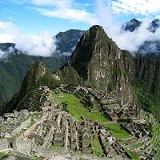
Machu Picchu ("Old Peak"; ) is a pre-Columbian
Pre-Columbian

The pre-Columbian era incorporates all archaeology of the Americas in the history of the Americas before the appearance of significant European influences on the Americas continents....
 Inca
Inca Empire

The Inca Empire was the largest empire in pre-Columbian America. The administrative, political and military center of the empire was located in Cuzco in modern-day Peru....
 site located above sea level. It is situated on a mountain ridge above the Urubamba Valley in Peru
Peru

Peru , officially the Republic of Peru , is a country in western South America. It is bordered on the north by Ecuador and Colombia, on the east by Brazil, on the southeast by Bolivia, on the south by Chile, and on the west by the Pacific Ocean....
, which is northwest of Cuzco and through which the Urubamba River
Urubamba River

The Urubamba River is a river in Peru. A partially navigable headwater of the Amazon River, it rises in the Andes to the south-east of Cusco near the Puno Region border, where it is called the Vilcanota River ....
 flows. The river is a partially navigable headwater of the Amazon River
Amazon River

The Amazon River of South America is the list of rivers by length in the world by volume, with a total river flow greater than the next top eight largest rivers combined....
. Often referred to as "The Lost City of the Incas", Machu Picchu is one of the most familiar symbols of the Inca Empire
Inca Empire

The Inca Empire was the largest empire in pre-Columbian America. The administrative, political and military center of the empire was located in Cuzco in modern-day Peru....
.

It was built around 1460 AD but was abandoned as an official site for the Inca rulers a hundred years later, at the time of the Spanish conquest of the Inca Empire
Spanish conquest of the Inca Empire

Sorry, no overview for this topic
.


Discussion
Ask a question about 'Machu Picchu'
Start a new discussion about 'Machu Picchu'
Answer questions from other users
Full Discussion Forum


Encyclopedia


Machu Picchu ("Old Peak"; ) is a pre-Columbian
Pre-Columbian

The pre-Columbian era incorporates all archaeology of the Americas in the history of the Americas before the appearance of significant European influences on the Americas continents....
 Inca
Inca Empire

The Inca Empire was the largest empire in pre-Columbian America. The administrative, political and military center of the empire was located in Cuzco in modern-day Peru....
 site located above sea level. It is situated on a mountain ridge above the Urubamba Valley in Peru
Peru

Peru , officially the Republic of Peru , is a country in western South America. It is bordered on the north by Ecuador and Colombia, on the east by Brazil, on the southeast by Bolivia, on the south by Chile, and on the west by the Pacific Ocean....
, which is northwest of Cuzco and through which the Urubamba River
Urubamba River

The Urubamba River is a river in Peru. A partially navigable headwater of the Amazon River, it rises in the Andes to the south-east of Cusco near the Puno Region border, where it is called the Vilcanota River ....
 flows. The river is a partially navigable headwater of the Amazon River
Amazon River

The Amazon River of South America is the list of rivers by length in the world by volume, with a total river flow greater than the next top eight largest rivers combined....
. Often referred to as "The Lost City of the Incas", Machu Picchu is one of the most familiar symbols of the Inca Empire
Inca Empire

The Inca Empire was the largest empire in pre-Columbian America. The administrative, political and military center of the empire was located in Cuzco in modern-day Peru....
.

It was built around 1460 AD but was abandoned as an official site for the Inca rulers a hundred years later, at the time of the Spanish conquest of the Inca Empire
Spanish conquest of the Inca Empire

Sorry, no overview for this topic
. Although known locally, it was said to have been forgotten for centuries when the site was brought to worldwide attention in 1911 by Hiram Bingham
Hiram Bingham III

Hiram Bingham, formally Hiram Bingham III, was an United States academic, explorer and politician. He rediscovered the Inca settlement of Machu Picchu in 1911....
, an American historian. Since then, Machu Picchu has become an important tourist attraction. It has recently come to light that the site may have been discovered and plundered several years previously, in 1867 by a German businessman, Augusto Berns. In fact, there is substantial evidence that a British missionary, Thomas Payne, and a German engineer, J. M. von Hassel, arrived earlier than Hiram, and maps found by historians show references to Machu Picchu as early as 1874.

Machu Picchu was declared a Peruvian Historical Sanctuary in 1981 and a UNESCO World Heritage Site
World Heritage Site

A UNESCO World Heritage Site is a site that is on the list maintained by the international World Heritage Programme administered by the UNESCO World Heritage Committee, composed of 21 Sovereign state which are elected by their General Assembly for a four-year term....
 in 1983. Since it was not plundered by the Spanish when they conquered the Incas, it is especially important as a cultural site and is considered a sacred place.

Machu Picchu was built in the classical Inca style, with polished dry-stone walls. Its primary buildings are the Intihuatana, the Temple of the Sun, and the Room of the Three Windows. These are located in what is known by archaeologists as the Sacred District of Machu Picchu. In September 2007, Peru and Yale University
Yale University

Yale University is a private university in New Haven, Connecticut. Founded in 1701 as the Collegiate School, Yale is the Colonial Colleges institution of higher education in the United States and is a member of the Ivy League....
 reached an agreement regarding the return of artifacts which Hiram Bingham had removed from Machu Picchu in the early twentieth century. Currently, there are concerns about the effect of tourism on the site as it reached 400,000 visitors in 2003.

History


Machu Picchu was constructed around 1462, at the height of the Inca Empire. It was abandoned less than 100 years later. It is likely that most of its inhabitants were wiped out by smallpox
Smallpox

Smallpox is an infectious disease unique to humans, caused by either of two virus variants, Variola major and Variola minor. The disease is also known by the Latin names Variola or Variola vera, which is a derivative of the Latin varius, meaning spotted, or varus, meaning "pimple"....
 before the Spanish
Spain

Spain or the Kingdom of Spain , is a country located in Southern Europe on the Iberian Peninsula.The Spanish constitution does not establish any official denomination of the country, even though Espa?a , Estado espa?ol and Naci?n espa?ola are used interchangeably....
 conquistadores arrived in the area, and there is no record of their having known of the remote city. Hiram Bingham
Hiram Bingham

Hiram Bingham may refer to:*Hiram Bingham I, missionary to the Kingdom of Hawai'i*Hiram Bingham II, his son, also a missionary to the Kingdom of Hawai'i...
, the credited discoverer of the site, along with several others, originally hypothesized that the citadel was the traditional birthplace of the Inca of the "Virgins of the Suns".

Another theory maintains that Machu Picchu was an Inca "llacta", a settlement built to control the economy of these conquered regions. Yet another asserts that it may have been built as a prison for a select few who had committed heinous crimes against Inca society. Research conducted by scholars, such as John Rowe and Richard Burger, has convinced most archaeologists that rather than a defensive retreat, Machu Picchu was an estate of the Inca emperor, Pachacuti
Pachacuti

Pachacuti Inca Yupanqui was the ninth Sapa Inca of the Kingdom of Cusco, which he transformed into the empire Tawantinsuyu. In Quechua, Pachakutiq means "He who remakes the world"....
. In addition, Johan Reinhard presented evidence that the site was selected because of its position relative to sacred landscape features—such as its mountains, which are purported to be in alignment with key astronomical events that would have been important to the Incas. Although the citadel
Citadel

A citadel is a Fortification for protecting a town, sometimes incorporating a castle. The term derives from the same Latin language root as the word "city", civis, meaning citizen....
 is located only about 80 kilometers (50 miles) from Cusco
Cusco

||}Cusco is a city in southeastern Peru, near the Urubamba Valley of the Andes mountain range. It is the capital of the Cusco Region as well as the Cusco Province....
, the Inca capital, it was never found by the Spanish and consequently not plundered and destroyed, as was the case with many other Inca sites. Over the centuries, the surrounding jungle grew over much of the site, and few knew of its existence. On July 24, 1911, Machu Picchu was brought to the attention of scholars by Hiram Bingham, an American historian employed as a lecturer at Yale University
Yale University

Yale University is a private university in New Haven, Connecticut. Founded in 1701 as the Collegiate School, Yale is the Colonial Colleges institution of higher education in the United States and is a member of the Ivy League....
. Bingham was led up to Machu Picchu by a local 11 year old Quechan
Quechan

The Quechan are a Native Americans in the United States tribe who live on the Fort Yuma Reservation on the lower Colorado River in Arizona just north of the border with Mexico....
 boy named Pablito Alvarez. Bingham undertook archaeological studies and completed a survey of the area. Bingham coined the name "The Lost City of the Incas", which was the title of his first book.

Bingham had been searching for the city of Vilcapampa
Vitcos

File:Vitcos Archaeological site.jpgVitcos is an archaeological site in the Cusco Region in Peru, believed to have been built by ruler in exile Manco Inca during the Spain conquest of Peru....
, the last Inca refuge and spot of resistance during the Spanish conquest of Peru. In 1911, after years of previous trips and explorations around the zone, he was led to the citadel by Quechuans. These people were living in Machu Picchu, in the original Inca infrastructure. Although most of the original inhabitants had died within a century of the city's construction, a small number of families survived so by the time the site was 'discovered' in 1911, people still were living on the site, and many mummies—mostly of women
Mummy

A mummy is a corpse whose skin and organs have been preserved by either intentional or incidental exposure to chemicals, extreme coldness, very high humidity, or lack of air when bodies are submerged in bogs....
—were discovered as well. Bingham made several more trips and conducted excavations on the site through 1915, carrying off artifacts. He wrote a number of books and articles about the discovery of Machu Picchu in his lifetime.

Simone Waisbard
Simone Waisbard

Simone Waisbard was a French people explorer who spent years in South America and Central America, studying remnants of the many ancient civilizations and tribes that have lived there....
, a long-time researcher of Cusco, claims that Enrique Palma, Gabino Sánchez, and Agustín Lizárraga left their names engraved on one of the rocks at Machu Picchu on July 14, 1901. This would mean that they 'discovered' it long before Bingham did in 1911. Likewise, in 1904, an engineer named Franklin supposedly spotted the ruins from a distant mountain. He told Thomas Payne, an English Christian missionary living in the region, about the site, Payne's family members claim. They also report that in 1906, Payne and another fellow missionary named Stuart E McNairn (1867–1956) climbed up to the ruins.

The site received significant publicity after the National Geographic Society
National Geographic Society

The National Geographic Society , headquartered in Washington, D.C. in the United States, is one of the largest non-profit scientific and educational institutions in the world....
 devoted their entire April 1913 issue to Machu Picchu.

An area of 325.92 square kilometers surrounding Machu Picchu was declared a "Historical Sanctuary" of Peru in 1981. In addition to the ruins, this sanctuary area includes a large portion of adjoining region, rich with flora
Flora

In botany, flora has two meanings. The first meaning, flora of an area or of time period, refers to all plant life occurring in an area or time period, especially the naturally occurring or indigenous plant life....
 and fauna
Fauna

File:Fauna.pngFauna is all of the animal life of any particular region or time. The corresponding term for plants is flora.Zoology and paleontology use fauna to refer to a typical collection of animals found in a specific time or place, e.g....
.

Machu Picchu was designated as a World Heritage Site
World Heritage Site

A UNESCO World Heritage Site is a site that is on the list maintained by the international World Heritage Programme administered by the UNESCO World Heritage Committee, composed of 21 Sovereign state which are elected by their General Assembly for a four-year term....
 in 1983 when it was described as "an absolute masterpiece of architecture and a unique testimony to the Inca civilization".

On July 7, 2007, Machu Picchu was voted as one of New Open World Corporation's New Seven Wonders of the World
New Seven Wonders of the World

New Seven Wonders of the World is a project that attempts to revive the Seven Wonders of the Ancient World concept with a list of modern wonders....
. The World Monuments Fund
World Monuments Fund

The World Monuments Fund is a New York City-based private, non-profit organization dedicated to the historic preservation of historic architecture and cultural heritage sites worldwide through fieldwork, advocacy, grantmaking, education, and training....
 placed Machu Picchu on its 2008 Watch List of the 100 Most Endangered Sites in the world because of environmental degradation resulting from the impact of tourism, uncontrolled development in the nearby town of Aguas Calientes that included a poorly sited tram to ease visitor access, and the construction of a bridge across the Vilcanota River that is likely to bring even more tourists to the site in defiance of a court order and government protests against it.

Location

Machu Picchu Locn
Machu Picchu is 80 kilometers northwest of Cusco
Cusco

||}Cusco is a city in southeastern Peru, near the Urubamba Valley of the Andes mountain range. It is the capital of the Cusco Region as well as the Cusco Province....
, on the crest of the mountain Machu Picchu, located about 2,350 meters (7,710 feet) above sea level. It is one of the most important archaeological sites in South America and the most visited tourist attraction in Peru.

It is above Urubamba Valley. From atop the cliff of Machu Picchu, there is a vertical rock face of 600 meters rising from the Urubamba River
Urubamba River

The Urubamba River is a river in Peru. A partially navigable headwater of the Amazon River, it rises in the Andes to the south-east of Cusco near the Puno Region border, where it is called the Vilcanota River ....
 at the foot of the cliff. The location of the city was a military secret, and its deep precipices and mountains provide excellent natural defenses. The Inca Bridge, an Inca rope bridge
Inca rope bridge

Inca rope bridges were simple suspension bridges over canyons and gorges to provide access for the Inca Empire. Bridges of this type were suitable for use since the Inca people did not use wheeled transport - traffic was limited to pedestrians and livestock....
, across the Urubamba River in the Pongo de Mainique
Pongo de Mainique

The Pongo de Mainique is a pongo in Peru, being wide and long, with to high cliffs. It is considered the most dangerous whitewater pass on the Urubamba River, which it divides between Upper and Lower Urubamba....
, provided a secret entrance for the Inca army
Inca army

The Incan army was the best organized of its time in South America, in the 15th and 16th centuries. It consisted of several battalions organized in often large scale numbers....
. Another Inca bridge to the west of Machu Picchu, the tree-trunk bridge, at a location where a gap occurs in the cliff that measures , could be bridged by two tree trunks. If the trees were removed, it would leave a fall to the base of the cliffs, also discouraging invaders.

The city sits in a saddle between two mountains, with a commanding view down two valleys and a nearly impassable mountain at its back. It has a water supply from springs that cannot be blocked easily, and enough land to grow food for about four times as many people as ever lived there. The hillsides leading to it have been terraced, not only to provide more farmland to grow crops, but to steepen the slopes which invaders would have to ascend. There are two high-altitude routes from Machu Picchu across the mountains back to Cusco, one through the sun gate, and the other across the Inca bridge. Both easily could be blocked if invaders should approach along them. Regardless of its original purpose, it is strategically located and readily defended.


Architecture

Perfectwall
The central buildings of Machu Picchu use the classical Inca architectural style of polished dry-stone walls of regular shape. The Incas were masters of this technique, called ashlar
Ashlar

Ashlar is dressed stone work of any type of stone. Ashlar blocks are large rectangular blocks of masonry sculpted to have square edges and even faces....
, in which blocks of stone are cut to fit together tightly without mortar
Mortar (masonry)

Mortar is a workable paste formed by mixture of cement, water and fine aggregate masonry to bind construction blocks together and fill the gaps between them....
. The Incas were among the best stone masons the world has seen, and many junctions in the central city are so perfect that it is said not even a knife blade fits between the stones. Some Inca buildings were constructed using mortar
Mortar (masonry)

Mortar is a workable paste formed by mixture of cement, water and fine aggregate masonry to bind construction blocks together and fill the gaps between them....
, but by Inca standards this was quick, shoddy construction, and was not used in the building of important structures. Peru is a highly seismic land, and mortar-free construction was more earthquake-resistant than using mortar. The stones of the dry-stone walls built by the Incas can move slightly and resettle without the walls collapsing.

Inca walls show numerous design details that also help protect them from collapsing in an earthquake. Doors and windows are trapezoidal and tilt inward from bottom to top; corners usually are rounded; inside corners often incline slightly into the rooms; and "L"-shaped blocks often were used to tie outside corners of the structure together. These walls do not rise straight from bottom to top but are offset slightly from row to row.

The Incas never used the wheel
Wheel

A wheel is a circular device that is capable of rotating on its axis, facilitating movement or transportation whilst supporting a load , or performing labour in machines....
 in any practical manner. Its use in toys demonstrates that the principle was well-known to them, although it was not applied in their engineering. The lack of strong draft animals
Working animal

A working animal is an animal that is kept by humans and trained to perform tasks. They may be close members of the family, such as guide dogs, or domestications such as logging elephants....
 as well as terrain and dense vegetation issues may have rendered it impractical. How they moved and placed enormous blocks of stones remains a mystery, although the general belief is that they used hundreds of men to push the stones up inclined planes. A few of the stones still have knobs on them that could have been used to lever them into position; it is believed that after the stones were placed, the Incas would have sanded the knobs away, but a few were overlooked.

The space is composed of 140 structures or features, including temples, sanctuaries
Sanctuary

Sanctuary has multiple meanings. A sanctuary is the consecrated area of a church or temple around its church tabernacle or altar. An animal sanctuary is a place where animals live and are protected....
, park
Park

A park is a Environmental protection, in its natural or semi-natural state or planted, and set aside for human recreation and enjoyment....
s, and residences that include houses with thatched roofs. There are more than one hundred flights of stone steps–often completely carved from a single block of granite–and a great number of water fountains that are interconnected by channels and water-drains perforated in the rock that were designed for the original irrigation system. Evidence has been found to suggest that the irrigation system was used to carry water from a holy spring to each of the houses in turn.
According to archaeologists, the urban sector of Machu Picchu was divided into three great districts: the Sacred District, the Popular District to the south, and the District of the Priests and the Nobility.
Machupicchu Intihuatana
Located in the first zone are the primary archaeological treasures: the Intihuatana, the Temple of the Sun and the Room of the Three Windows. These were dedicated to Inti
Inti

According to the Inca mythology, Inti is the sun god, as well a patron deity of Tahuantinsuyu. His exact origin is not known. The most common story says he is the son of Viracocha, the god of civilization....
, their sun god and greatest deity. The Popular District, or Residential District, is the place where the lower class people lived. It includes storage buildings and simple houses. In the royalty area, a sector that existed for the nobility
Nobility

Nobility is a government-privileged title which may be either hereditary or for a lifetime. Titles of nobility exist today in many countries although it is usually associated with present or former monarchies....
, includes a group of houses located in rows over a slope, the residence of the Amautas (wise persons) was characterized by its reddish walls, and the zone of the Ñustas (princesses) had trapezoid-shaped rooms. The Monumental Mausoleum is a carved statue with a vaulted interior and carved drawings. It was used for rites or sacrifices.

As part of their road system
Inca road system

Among the many roads and trails constructed in pre-Columbian South America, the Inca road system, or Qhapaq ?an was the most extensive and highly advanced for its time....
, the Inca built a road to the Machu Picchu region. Today, tens of thousands of tourists walk the Inca Trail
Inca road system

Among the many roads and trails constructed in pre-Columbian South America, the Inca road system, or Qhapaq ?an was the most extensive and highly advanced for its time....
 to visit Machu Picchu each year, acclimatising at Cusco before starting on a two- to four-day journey on foot from the Urubamba valley up through the Andes mountain range to the isolated city.


Intihuatana stone

Intihuatana Solar Clock
The Intihuatana stone is one of many ritual
Ritual

A ritual is a set of repeated actions, often thought to have symbolic value, the performance of which is usually prescribed by a religion or by the traditions of a community by religious or political laws because of the perceived efficacy of those actions....
 stones in South America. The Spanish did not find Machu Picchu so the Intihuatana Stone was not destroyed as many other ritual stones in Peru were. These stones are arranged to point directly at the sun during the winter solstice
Solstice

A solstice is an astronomical event that occurs twice each year, when the tilt of the Earth's Rotation is most inclined toward or away from the Sun, causing the Sun's apparent position in the sky to reach its north or south extreme....
. Intihuatana also is called "The Hitching Point of the Sun" because it was believed to hold the sun in its place along its annual path in the sky. At midday on March 21 and September 21, the equinoxes, the sun stands almost above the pillar—casting no shadow at all. Researchers believe that it was built as an astronomic clock or calendar.

The Intihuatana stone was damaged in September 2000 when a 450 kg (1,000-pound) crane fell onto it, breaking off a piece of stone the size of a ballpoint pen. The crane was being used by a crew hired by J. Walter Thompson advertising agency
JWT

JWT is the current name of the United States largest and world's second largestadvertising agency. It is one of the key companies of Sir Martin Sorrell's WPP Group and is headquartered in New York....
 to film an advertisement for a beer brand. "Machu Picchu is the heart of our archaeological heritage and the Intihuatana is the heart of Machu Picchu. They've struck at our most sacred inheritance," said Federico Kaufmann Doig, a Peruvian archaeologist.

Concerns over tourism

Machu Picchu Seen From Huayna Picchu
Machu Picchu is a UNESCO World Heritage site. As Peru's most visited tourist attraction and major revenue generator, it is continually threatened by economic and commercial forces. In the late 1990s, the Peruvian government granted concessions to allow the construction of a cable car and development of a luxury hotel, including a tourist complex with boutiques and restaurants. These plans were met with protests from scientists, academics, and the Peruvian public—all worried that the greater numbers of visitors would pose tremendous physical burdens on the ruins.

A growing number of people visit Machu Picchu (400,000 in 2003). For this reason, there were protests against a plan to build a bridge to the site as well. A no-fly zone
No-fly zone

A no-fly zone is a territory over which aircraft are not permitted to fly. Such zones are usually set up in a military context, somewhat like a demilitarized zone in the sky....
 exists above the area. UNESCO
UNESCO

United Nations Educational, Scientific and Cultural Organization is a specialized agency of the United Nations established on 16 November 1945....
 is considering putting Machu Picchu on its list of endangered World Heritage Sites
List of World Heritage Sites in danger

These are thirty sites which the United Nations Educational, Scientific and Cultural Organization World Heritage Committee has decided to include on a list of World Heritage Sites in danger; this list also shows the year in which the World Heritage committee added the site to this list....
.

During the 1980s a large rock from Machu Picchu's central plaza was moved out of its alignment to a different location in order to create a helicopter landing zone. Helicopter landings were forbidden in the 1990s. In 2006 a Cusco-based company, Helicusco, sought to have tourist flights over Machu Picchu, but the decision was quickly overturned.

Controversy with Yale University

In 1912 and 1914-15, Bingham excavated the treasures from Machu Picchu—ceramic vessels, silver statues, jewelry and human bones—and took them from Peru to Yale University
Yale University

Yale University is a private university in New Haven, Connecticut. Founded in 1701 as the Collegiate School, Yale is the Colonial Colleges institution of higher education in the United States and is a member of the Ivy League....
 in the United States
United States

The United States of America is a Federal government constitutional republic comprising U.S. state and a federal district. The country is situated mostly in central North America, where its Contiguous United States and Washington, D.C., the Capital districts and territories, lie between the Pacific Ocean and Atlantic Oceans, Borders of the U...
 for further study. Yale has retained the artifacts until now. The National Geographic Society
National Geographic Society

The National Geographic Society , headquartered in Washington, D.C. in the United States, is one of the largest non-profit scientific and educational institutions in the world....
, which co-sponsored Bingham’s explorations, has acknowledged that the artifacts were taken on loan and is committed to seeing them returned to Peru.

Eliane Karp
Eliane Karp

Eliane Karp , a Belgian-born anthropology and economics, is the wife of the president of Peru, Alejandro Toledo, with whom she has a daughter, Chantal....
, an anthropologist who is the wife of the former Peruvian President Alejandro Toledo
Alejandro Toledo

Alejandro Celestino Toledo Manrique is a Peruvian politician and economist. He was List of Presidents of Peru of Peru from 2001 to 2006. He was elected in 2001 defeating former President Alan Garc?a....
, accused Yale of profiting from Peru's cultural heritage by claiming title to more than 250 pieces removed from Machu Picchu by Bingham in 1912, which had been on display at Yale's Peabody Museum ever since. Some of the artifacts Bingham removed were returned to Peru, but Yale kept the rest saying its position was supported by federal case law involving Peruvian antiquities.

On September 19, 2007, the Courant reported that Peru and Yale had reached an agreement regarding the requested return of the artifacts. The agreement includes sponsorship of a joint traveling exhibition and construction of a new museum and research center in Cusco about which Yale will advise Peruvian officials. Yale acknowledges Peru's title to all the excavated objects from Machu Picchu, but Yale will share rights with Peru in the research collection, part of which will remain at Yale as an object of continuing study.

On June 19, 2008, National Geographic Society’s vice-president Terry Garcia was quoted by daily La República
La República

La Rep?blica is a center-left newspaper published in Lima, Peru. It is one of the two main national dailies sold all over the country since it was founded on May 3, 1981....
. “We were part of this agreement. National Geographic was there, we know what was said, the objects were loaned and should be returned.” In November 2008, the Peruvian government decided to sue Yale after all the negotiations to have the pieces returned failed.

See also

  • Choquequirao
    Choquequirao

    Choquequirao is a partly excavated ruined city of the Inca in the south of Peru. It bears a striking similarity in structure and architecture to Machu Picchu and is referred to as its 'sister'....
  • Kuelap
    Kuelap

    The fortress of Kuelap , associated with the Chachapoyas culture, consists of massive exterior stone walls containing more than four hundred buildings....
  • Pachacutec
  • Putucusi
    Putucusi

    Putucusi, Quechua language for ?Happy Mountain?, is a round-shaped mountain located on the opposite side of the Urubamba River to Machu Picchu in the Cusco Region department of Peru....
    , neighboring mountain
  • List of megalithic sites
    List of megalithic sites

    This is a list of ancient sites that moved megalithic stones, organized according to the size of the largest megalith on the site. A megalith is a large stone which has been used to construct a structure or monument, either alone or together with other stones....
  • List of archaeoastronomical sites sorted by country
    List of archaeoastronomical sites sorted by country

    This is a list of sites where claims for the use of archaeoastronomy have been made, sorted by country....


Twin towns

  • Haworth
    Haworth

    Haworth is a village and tourist attraction in the England Ceremonial county of West Yorkshire best known for its association with the Bront?....
    , United Kingdom
    United Kingdom

    The United Kingdom of Great Britain and Northern Ireland, commonly known as the United Kingdom , the UK or Britain,is a sovereign state located off the northwestern coast of continental Europe....


External links

  • *


Coordinates
Geographic coordinate system

A geographic coordinate system enables every location on the Earth to be specified in three coordinates, using mainly a Spherical coordinates#Spherical coordinates....
: