


Macedonia (Greece)

Encyclopedia
Macedonia (ˌmæsɨˈdoʊniə; , Makedonía, maceðoˈnia) is a geographical and historical region
of Greece
in Southern Europe
. Macedonia is the largest and second most populous Greek region. The region and that of Thrace
(and sometimes Epirus
and Thessaly
) are often together referred to informally as Northern Greece
.
It incorporates most of the territories of ancient Macedon, a kingdom ruled by the Argeads
whose most celebrated members were Alexander the Great and his father Philip II
. The name Macedonia was later applied to identify various administrative areas in the Roman and Byzantine Empires with widely differing borders. Under the Ottomans, the name disappeared altogether.
Even before the establishment of the modern Greek state in 1830, it was identified as a Greek province, albeit without clearly defined geographical borders By the mid 19th century, the name was becoming consolidated informally, defining more of a distinct geographical
, rather than political, region in the southern Balkans
. At the end of the Ottoman Empire most of the region known as Rumelia
(from Ottoman , "Land of the Romans") was divided by the Treaty of Bucharest of 1913, following the Ottoman defeat in the Balkan Wars
of 1912-1913. Greece, Serbia
, Bulgaria
each took control of portions of the Macedonia (region)
, with Greece obtaining the largest portion; a small section went to Albania
. The region was an administrative subdivision of Greece until the administrative reform of 1987, when the region was divided into the regions of West Macedonia
and Central Macedonia
and part of the region of East Macedonia and Thrace
, the latter containing also the whole of the region of Thrace.
, the history of Macedonia began with the Makednoi
tribe (makednos means "tall" in Greek), among the first to use the name, migrating to the region from Histiaeotis in the south. There they lived near Thracian tribes such as the Bryges
who would later leave Macedonia for Asia Minor
and become known as Phrygia
ns. Macedonia was named after the Makednoi. Accounts of other toponyms such as Emathia
are attested to have been in use before that.
A branch of the Macedonians may have invaded Southern Greece towards the end of the second millennium B.C. Upon reaching the Peloponnese the invaders were renamed Dorians, triggering the accounts of the Dorian invasion. For centuries the Macedonian tribes were organized in independent kingdoms, in what is now Central Macedonia, and their role in internal Hellenic politics was minimal, even before the rise of Athens. The Macedonians may have belonged to the Dorian branch of Greeks, while there were many Ionians
in the coastal regions. The rest of the region was inhabited by various Thracian and Illyrian tribes as well as mostly coastal colonies of other Greek states such as Amphipolis, Olynthos, Potidea, Stageira and many others, and to the north another tribe dwelt, called the Paeonians. During the late 6th and early 5th century BC, the region came under Persian rule until the destruction of Xerxes at Plataea
. During the Peloponnesian War
, Macedonia became the theatre of many military actions by the Peloponnesian League
and the Athenians, and saw incursions of Thracians and Illyrians, as attested by Thucidydes. Many Macedonian cities were allied to the Spartans (both the Spartans and the Macedonians were Dorian, while the Athenians were Ionian), but Athens maintained the colony of Amphipolis
under her control for many years. The kingdom of Macedon
, was reorganised by Philip II
and achieved the union of Greek states by forming the League of Corinth
. After his assassination, his son Alexander succeeded to the throne of Macedon and, retaining the office of "General of Greece", he became one of the best known persons to which this land ever gave birth.
 Macedonia remained an important and powerful kingdom until the Battle of Pydna
(June 22, 168 BC), in which the Roman general Aemilius Paulus defeated King Perseus of Macedon
, ending the reign of the Antigonid dynasty
over Macedonia. For a brief period a Macedonian republic called the “Koinon of the Macedonians” was established. It was divided into four administrative districts. That period ended in 148 BC, when Macedonia was fully annexed by the Romans. The northern boundary at that time ended at the Ochrid lake and Bylazora, a Paeonian city (modern Titov Veles). Strabo
, writing in the first century AD places the border of Macedonia on that part at Lychnidos, Byzantine Achris and presently Ochrid. Therefore ancient Macedonia did not significantly extend beyond its current borders (in Greece). This is stressed by 370 academics in their letter to US president Barack Obama
. To the east, Macedonia ended according to Strabo
at the river Strymon, although he mentions that other writers placed Macedonia’s border with Thrace
at the river Nestos, which is also the present geographical boundary between the two administrative districts of Greece
.
Subsequently the provinces of Epirus
and Thessaly
as well as other regions to the north were incorporated into a new Provincia Macedonia, but in 297 AD under a Diocletian
reform many of these regions were removed and two new provinces were created: Macedonia Prima and Macedonia Salutaris (from 479-482 AD Macedonia Secunda). Macedonia Prima coincided approximately with Strabo’s definition of Macedonia and with the modern administrative district of Greece and had Thessalonica as its capital, while Macedonia Secunda had the Dardani
an city of Stobi
(near Gradsko
) as its capital. This subdivision is mentioned in Hierocles
’ Synecdemon (527-528) and remained through the reign of emperor Justinian.
The Slavic, Avar
, Bulgarian
and Magyar
invasions in the 6-7th centuries devastated both provinces with only parts of Macedonia Prima in the coastal areas and nearer Thrace
remaining in Byzantine
hands, while most of the hinterland was disputed between the Byzantium
and Bulgaria
. The Macedonian regions under Byzantine control passed under the tourma of Macedonia to the province of Thrace
.
A new system of administration came into place in 789-802 AD, following the Byzantine empire
’s recovery from these invasions. The new system was based on administrative divisions called Themata
. The region of Macedonia Prima (the territory of modern Greek administrative district of Macedonia) was divided between the Thema of Thessalonica and the Thema of Strymon, so that only the region of the area from Nestos eastwards continued to carry the name Macedonia, referred to as the Thema of Macedonia or the Thema of “Macedonia in Thrace”. The Thema of Macedonia in Thrace had its capital in Adrianople.
 Familiarity with the Slavic element in the area led two brothers from Thessaloniki
, Saints Cyril and Methodius
, to be chosen to convert the Slavs to Christianity
. Following the campaigns of Basil II
, all of Macedonia returned to the Byzantine state. Following the Fourth Crusade
1203–1204, a short-lived Crusader
realm, the Kingdom of Thessalonica
, was established in the region, but it was subdued by the Greek Despotate of Epirus
in 1224. Returning to the restored Byzantine Empire
shortly thereafter, the area remained in Byzantine hands until the 1340s, when all of Macedonia (except Thessaloniki, and possibly Veria
) was conquered by the Serbian ruler Stefan Dusan. Divided between Serbia and Bulgaria
after Dusan's death, the region fell quickly to the advancing Ottomans
, with Thessaloniki alone holding out until 1387. After a brief Byzantine interval in 1403–1430 (during the last seven years of which the city was handed over to the Venetians), Thessalonica and its immediate surrounding area returned to the Ottomans.
 The capture of Thessalonica threw the Greek world into consternation, being regarded as the prelude to the fall of Constantinople
itself. The memory of the event has survived through folk traditions containing fact and myths. Apostolos Vacalopoulos records the following Turkish tradition connected with the capture of Thessalonica:
became a centre of Ottoman
administration in the Balkans. While most of Macedonia was ruled by the Ottomans, in Mount Athos
the monastic community continued to exist in a state of autonomy. The remainder of the Chalkidiki peninsula also enjoyed an autonomous status: the “Koinon of Mademochoria” was governed by a locally appointed council due to privileges obtained on account of its wealth, coming from the gold and silver mines in the area.
There were several uprisings in Macedonia during Ottoman rule
, including an uprising after the Battle of Lepanto
that ended in massacres of the Greek population, the uprising in Naousa
of the armatolos Zisis Karademos
in 1705, a rebellion in the area of Grevena
by a Klepht
called Ziakas (1730–1810) and the Greek Declaration of Independence in Macedonia by Emmanuel Pappas
in 1821, during the Greek War of Independence
. In 1854 Theodoros Ziakas
, the son of the klepth Ziakas, together with Tsamis Karatasos, who had been among the captains at the siege of Naousa
in 1821, led another uprising in Western Macedonia that has been profusely commemorated in Greek folk song.
, after the Second Balkan War
with the Treaty of Bucharest (1913).
(Greek: δήμοι) or "communities" (Greek: κοινότητες – roughly equivalent to British
or Australian shires). They are overseen by the Ministry for the Interior, while the Ministry of Macedonia and Thrace
is responsible for the coordination and application of the government's policies in the region. Prior to the Kallikratis Reform in 2010, Greece's regional units were called "prefectures", and Thasos
was part of the prefecture of Kavala.
Macedonia borders the neighboring regions of Thessaly
to the south, Thrace (part of the East Macedonia and Thrace
region) to the east and Epirus
to the west. It also borders Albania
to the north-west, the Republic of Macedonia
to the north and Bulgaria
to the north-east. The three Macedonian regions and their subdivisions are:
The geographical region of Macedonia also includes the male-only autonomous monastic state of Mount Athos
, but this is not part of the Macedonia precincts. Mount Athos is under the spiritual jurisdiction of the Ecumenical Patriarchate of Constantinople
, and enjoys a special status: it is inaccessible to women; its territory is a self-governed part of Greece, and the powers of the state are exercised through a governor. The European Union
takes this special status into consideration, particularly on matters of taxation exemption and rights of installation. The governor of Mount Athos is appointed by the Greek Foreign Ministry.
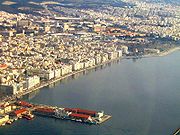 Macedonia possesses some of the richest farmland in Greece in the plains of Veria, Thessaloniki, Serres and Drama. A wide variety of agricultural products and cash crops are grown, including rice
, wheat
, beans, olives, cotton
, tobacco
, fruit
, grapes, wine
and other alcoholic beverages. Food processing and textile weaving constitute the principal manufacturing industries. Tourism
is a major industry along the coast, particularly in the Chalcidice
peninsula, the island of Thasos
and the northern approaches to Mount Olympus
. Many tourists originate from Germany and Eastern Europe.
Thessaloniki
is a major port
city and industrial center; Kavala
is the second harbor of Macedonia. Apart from the principal airport
at Thessaloniki
(Makedonia Airport), airports also exist in Kavala
(M.Alexandros Airport), Kozani
(Filippos Airport), and Kastoria
(Aristotelis Airport). The "Via Egnatia
" motorway crosses the full distance of Macedonia, linking most of its main cities. It also has a train system; it is usually criticized for being underfunded, and there has been much anger directed against OSE
, the national railway company.
A continuation from ancient days is dishes such as lamb cooked with quince or various vegetables and fruits, goat boiled or fried in olive oil: modern recipes from Kavala to Kastoria and Kozani offer lamb with quince, pork with celery or leeks.
Some current specialties are trahana with crackling, phyllo-based pies (cheese, leek, spinach) and wild boar. Favourites are tyrokafteri (Macedonian spicy cheese spread), soupies krasates (cuttlefish in wine), mydia yiachni (mussel stew). Unlike Athens, the traditional pita bread for the popular souvlaki (kebab) is not grilled but fried. The variety of sweets has been particularly enriched with the arrival of the refugees. (Information included from 'Greek Gastronomy', GNTO, 2004)
of the geographic region of Macedonia
in Greece
, which is a part of the music
of whole region of Macedonia
. Folk dances in Macedonia include Makedonia (dance)
, chasapiko
, leventikos
, zeibekiko
, zonaradiko
, endeka Kozanis
, Samarinas, stankena, Akritikos, baidouska, Macedonikos antikristos, mikri Eleni, partalos
, kleftikos Makedonikos, mpougatsas
, Kastorianos
, o Nikolos
and sirtos Macedonias. In Macedonia, there are also patriotic songs sung by the Greek army and local citizens like: famous Macedonia
.
and most are Greek Orthodox
Christians. From the Middle Ages to the early 20th century, the ethnic composition of the region of Macedonia
is characterized by uncertainty both about numbers and identification. The 1904 Ottoman
census of Hilmi Pasha recorded 373,227 Greeks and 204,317 Bulgarians
in the vilayet of Selânik (Thessaloniki
) alone. According to the same census, Greeks were also dominant in the vilayet of Monastir (Bitola
), counting 261,283 Greeks and 178,412 Bulgarians. Hugh Poulton, in his Who Are the Macedonians, notes that "assessing population figures is problematic" for the territory of Greek Macedonia before its incorporation into the Greek state in 1913. The area's remaining population was principally composed of Ottoman Turks
and also some Jews
, and at much smaller numbers of Roma, Albanians
and Vlachs
.
During the first half of the twentieth century, major demographic shifts took place, which resulted in the region's population becoming overwhelmingly ethnic Greek. In 1919, after Greek victory in World War I, Bulgaria and Greece signed the Treaty of Neuilly
, which called for an exchange of populations between the two countries. According to the treaty, Bulgaria was considered to be the parent state of all ethnic Slavs living in Greece. Most ethnic Greeks from Bulgaria were resettled in Greek Macedonia; most Slavs were resettled in Bulgaria but a number remained, most of them by changing or adapting their surnames and declaring themselves to be Greek so as to be exempt from the exchange. In 1923 Greece and Turkey
signed the Treaty of Lausanne
in the aftermath of the Greco-Turkish War, and 600,000 Greek refugees from Anatolia
were resettled in the region replacing Macedonian Turks and other Muslims (of Albanian, Roma, Slavic and Vlach ethnicity) under similar terms.
Macedonian cities during Ottoman rule were often known by multiple names (Greek, Slavic or Ottoman Turkish by the respective populations). After the partition of Ottoman Europe, most cities in Greece either became officially known by their Greek names or adopted Greek names; likewise most cities in Bulgaria and the Kingdom of Yugoslavia
became officially known or adopted names in the languages of their respective states. After the population exchanges, many locations were renamed to the languages of their new occupants.
!Year
!Greeks
!Bulgarians
!Muslims
!Others
!Total
|-
|1926 League of nations data
| align="center" |88.8%
(1,341,000)
| align="center" |5.1%
(77,000)
| align="center" |0.1%
(2,000)
| align="center" |6.0%
(91,000)
|1,511,000
|-
|}>
The population was badly affected by the Second World War through starvation, executions, massacres and deportations. Central Macedonia, including Thessaloniki, was occupied by the Germans, and in the east Nazi-aligned Bulgarian occupation forces persecuted the local Greek population and settled Bulgarian colonists in their occupation zone in eastern Macedonia and western Thrace, deporting all Jews from the region. Total civilian deaths in Macedonia are estimated at over 400,000, including up to 55,000 Greek Jews. Further heavy fighting affected the region during the Greek Civil War
which drove many inhabitants of rural Macedonia to emigrate to the towns and cities, or abroad, during the late 1940s and 1950s.
Greek
is by far the most widely spoken and the only official language of public life and education in Macedonia. The local Macedonian dialect is spoken alongside dialects from other parts of Greece and Pontic Greek still spoken by some Greeks of Pontic descent. Macedonian Slavic dialects are the most widely spoken minority language while Aromanian
, Arvanitic, Megleno-Romanian
, Turkish
and Romani
are also spoken. Ladino is still spoken by some Jews in Thessaloniki.
After the fall of communism throughout Eastern Europe in the late 1980s and early 1990s, a large number of Eastern Europe
ans came to Macedonia to find work. Since the early 2000s, they have been joined by Africans and South Asians.

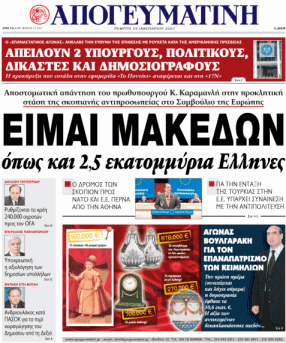 Macedonians is the term by which ethnic Greeks
originating from the region are known. Macedonians came to be of particular importance during the Balkan Wars
when they were a minority population inside the Ottoman province of Macedonia
. The Macedonians now have a strong regional identity, manifested both in Greece and by emigrant groups in the Greek diaspora
. This sense of identity has been highlighted in the context of the Macedonian naming dispute
after the break-up of Yugoslavia, in which Greece objects to its northern neighbour calling itself the "Republic of Macedonia
", since explicit self-identification as Macedonian is a matter of national pride for many Greeks. A characteristic expression of this attitude could be seen when Greek newspapers headlined a declaration by Prime Minister Kostas Karamanlis at a meeting of the Council of Europe
in Strasbourg
in January 2007, saying that "I myself am a Macedonian, and another two and a half million Greeks are Macedonians."
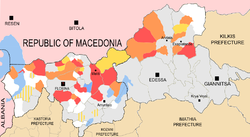 Slavic-speakers are concentrated in the Florina
, Kastoria
, Edessa
, Giannitsa
, Ptolemaida
and Naousa
regions. Their dialects are linguistically classified variously either as Macedonian
or Bulgarian
, depending on the region and on political orientation. The exact number of the minority is difficult to know, and its members' choice of ethnic identification is difficult to ascertain (since some people are cautious in the replies that they give when surveys are conducted). Most maximum estimates range around 100,000–120,000. The Greek branch of the former International Helsinki Federation for Human Rights
has estimated that those of an ethnic Macedonian national conscienceness number between 10,000–30,000.
Aromanians form a minority population throughout much of Macedonia. They largely identify as Greeks and most belong to the Greek Orthodox Church. In the 1951 census they numbered 39,855 in all Greece (the number in Macedonia proper is unknown). Many Aromanians villages can be found along the slopes of the Vermion Mountains
and Mount Olympus
. Smaller numbers can be found in the Prespes
region and near the Gramos
mountains.
is traditionally spoken in the 11 Vlach villages, Archangelos
, Notia
, Karpi, Koupa, Langadia, Perikleia, Skra and Kastaneri (the other three are found in the Republic of Macedonia). They are generally adherents to the Orthodox Church while the former majority in Notia was Muslim.
prefecture while many can be found in the capital, Thessaloniki. There are three Arvanites villages in the Florina prefecture (Drosopigi
, Lechovo
and Flambouro) with others located in Kilkis and Thessaloniki regions.
(Sephardim
and Romaniotes
), Armenians
and Roma. Roma communities are concentrated mainly around the city of Thessaloniki. An uncertain number of them live in Macedonia from the total of about 200,000-300,000 that live scattered on all the regions of Greece.
Regions of Greece
The traditional geographic divisions of Greece were also the official administrative subdivisions of Greece until the 1987 administrative reform )...
of Greece
Greece
Greece , officially the Hellenic Republic , and historically Hellas or the Republic of Greece in English, is a country in southeastern Europe....
in Southern Europe
Southern Europe
The term Southern Europe, at its most general definition, is used to mean "all countries in the south of Europe". However, the concept, at different times, has had different meanings, providing additional political, linguistic and cultural context to the definition in addition to the typical...
. Macedonia is the largest and second most populous Greek region. The region and that of Thrace
Western Thrace
Western Thrace or simply Thrace is a geographic and historical region of Greece, located between the Nestos and Evros rivers in the northeast of the country. Together with the regions of Macedonia and Epirus, it is often referred to informally as northern Greece...
(and sometimes Epirus
Epirus (region)
Epirus is a geographical and historical region in southeastern Europe, shared between Greece and Albania. It lies between the Pindus Mountains and the Ionian Sea, stretching from the Bay of Vlorë in the north to the Ambracian Gulf in the south...
and Thessaly
Thessaly
Thessaly is a traditional geographical region and an administrative region of Greece, comprising most of the ancient region of the same name. Before the Greek Dark Ages, Thessaly was known as Aeolia, and appears thus in Homer's Odyssey....
) are often together referred to informally as Northern Greece
Voreia Ellada
Voreia Ellada , meaning Northern Greece, is a first level NUTS administrative division of Greece created for statistical purposes by the European Union....
.
It incorporates most of the territories of ancient Macedon, a kingdom ruled by the Argeads
Argead dynasty
The Argead dynasty was an ancient Greek royal house. They were the ruling dynasty of Macedonia from about 700 to 310 BC. Their tradition, as described in ancient Greek historiography, traced their origins to Argos, in southern Greece...
whose most celebrated members were Alexander the Great and his father Philip II
Philip II of Macedon
Philip II of Macedon "friend" + ἵππος "horse" — transliterated ; 382 – 336 BC), was a king of Macedon from 359 BC until his assassination in 336 BC. He was the father of Alexander the Great and Philip III.-Biography:...
. The name Macedonia was later applied to identify various administrative areas in the Roman and Byzantine Empires with widely differing borders. Under the Ottomans, the name disappeared altogether.
Even before the establishment of the modern Greek state in 1830, it was identified as a Greek province, albeit without clearly defined geographical borders By the mid 19th century, the name was becoming consolidated informally, defining more of a distinct geographical
Macedonia (region)
Macedonia is a geographical and historical region of the Balkan peninsula in southeastern Europe. Its boundaries have changed considerably over time, but nowadays the region is considered to include parts of five Balkan countries: Greece, the Republic of Macedonia, Bulgaria, Albania, Serbia, as...
, rather than political, region in the southern Balkans
Balkans
The Balkans is a geopolitical and cultural region of southeastern Europe...
. At the end of the Ottoman Empire most of the region known as Rumelia
Rumelia
Rumelia was an historical region comprising the territories of the Ottoman Empire in Europe...
(from Ottoman , "Land of the Romans") was divided by the Treaty of Bucharest of 1913, following the Ottoman defeat in the Balkan Wars
Balkan Wars
The Balkan Wars were two conflicts that took place in the Balkans in south-eastern Europe in 1912 and 1913.By the early 20th century, Montenegro, Bulgaria, Greece and Serbia, the countries of the Balkan League, had achieved their independence from the Ottoman Empire, but large parts of their ethnic...
of 1912-1913. Greece, Serbia
Kingdom of Serbia
The Kingdom of Serbia was created when Prince Milan Obrenović, ruler of the Principality of Serbia, was crowned King in 1882. The Principality of Serbia was ruled by the Karađorđevic dynasty from 1817 onwards . The Principality, suzerain to the Porte, had expelled all Ottoman troops by 1867, de...
, Bulgaria
Kingdom of Bulgaria
The Kingdom of Bulgaria was established as an independent state when the Principality of Bulgaria, an Ottoman vassal, officially proclaimed itself independent on October 5, 1908 . This move also formalised the annexation of the Ottoman province of Eastern Rumelia, which had been under the control...
each took control of portions of the Macedonia (region)
Macedonia (region)
Macedonia is a geographical and historical region of the Balkan peninsula in southeastern Europe. Its boundaries have changed considerably over time, but nowadays the region is considered to include parts of five Balkan countries: Greece, the Republic of Macedonia, Bulgaria, Albania, Serbia, as...
, with Greece obtaining the largest portion; a small section went to Albania
Albania
Albania , officially known as the Republic of Albania , is a country in Southeastern Europe, in the Balkans region. It is bordered by Montenegro to the northwest, Kosovo to the northeast, the Republic of Macedonia to the east and Greece to the south and southeast. It has a coast on the Adriatic Sea...
. The region was an administrative subdivision of Greece until the administrative reform of 1987, when the region was divided into the regions of West Macedonia
West Macedonia
West Macedonia is one of the thirteen regions of Greece, consisting of the western part of Greek Macedonia. It is divided into the regional units of Florina, Grevena, Kastoria, and Kozani.-Geography:...
and Central Macedonia
Central Macedonia
Central Macedonia is one of the thirteen regions of Greece, consisting of the central part of the region of Macedonia. With a population of over 1.8 million, it is the second most populous in Greece after Attica.- Administration :...
and part of the region of East Macedonia and Thrace
East Macedonia and Thrace
East Macedonia and Thrace is one of the thirteen regions of Greece. It consists of the northeastern parts of the country, comprising the eastern part of the region of Macedonia along with the region of Thrace, and the islands of Thasos and Samothrace....
, the latter containing also the whole of the region of Thrace.
Prehistory
Macedonia lies at the crossroads of human development between the Aegean and the Balkans. The earliest signs of human habitation date back to the palaeolithic period. In the Late Neolithic period (c. 4500 to 3500 BC), trade took place from quite distant regions, indicate rapid socio-economic changes. One of the most important changes was the start of copper working.Ancient History
According to HerodotusHerodotus
Herodotus was an ancient Greek historian who was born in Halicarnassus, Caria and lived in the 5th century BC . He has been called the "Father of History", and was the first historian known to collect his materials systematically, test their accuracy to a certain extent and arrange them in a...
, the history of Macedonia began with the Makednoi
Makednos
Makedon, also Macedon or Makednos , was the eponymous mythological ancestor of the ancient Macedonians according to various ancient Greek fragmentary narratives...
tribe (makednos means "tall" in Greek), among the first to use the name, migrating to the region from Histiaeotis in the south. There they lived near Thracian tribes such as the Bryges
Bryges
Bryges or Briges is the historical name given to a people of the ancient Balkans. They are generally considered to have been related to the Phrygians, who during classical antiquity lived in western Anatolia. Both names, Bryges and Phrygians, are assumed to be variants of the same root. Based on...
who would later leave Macedonia for Asia Minor
Anatolia
Anatolia is a geographic and historical term denoting the westernmost protrusion of Asia, comprising the majority of the Republic of Turkey...
and become known as Phrygia
Phrygia
In antiquity, Phrygia was a kingdom in the west central part of Anatolia, in what is now modern-day Turkey. The Phrygians initially lived in the southern Balkans; according to Herodotus, under the name of Bryges , changing it to Phruges after their final migration to Anatolia, via the...
ns. Macedonia was named after the Makednoi. Accounts of other toponyms such as Emathia
Imathia Prefecture
Imathia is one of the regional units of Greece. It is part of the region of Central Macedonia. The capital of Imathia is the city of Veroia.-Administration:The regional unit Imathia is subdivided into 3 municipalities...
are attested to have been in use before that.
A branch of the Macedonians may have invaded Southern Greece towards the end of the second millennium B.C. Upon reaching the Peloponnese the invaders were renamed Dorians, triggering the accounts of the Dorian invasion. For centuries the Macedonian tribes were organized in independent kingdoms, in what is now Central Macedonia, and their role in internal Hellenic politics was minimal, even before the rise of Athens. The Macedonians may have belonged to the Dorian branch of Greeks, while there were many Ionians
Ionians
The Ionians were one of the four major tribes into which the Classical Greeks considered the population of Hellenes to have been divided...
in the coastal regions. The rest of the region was inhabited by various Thracian and Illyrian tribes as well as mostly coastal colonies of other Greek states such as Amphipolis, Olynthos, Potidea, Stageira and many others, and to the north another tribe dwelt, called the Paeonians. During the late 6th and early 5th century BC, the region came under Persian rule until the destruction of Xerxes at Plataea
Plataea
Plataea or Plataeae was an ancient city, located in Greece in southeastern Boeotia, south of Thebes. It was the location of the Battle of Plataea in 479 BC, in which an alliance of Greek city-states defeated the Persians....
. During the Peloponnesian War
Peloponnesian War
The Peloponnesian War, 431 to 404 BC, was an ancient Greek war fought by Athens and its empire against the Peloponnesian League led by Sparta. Historians have traditionally divided the war into three phases...
, Macedonia became the theatre of many military actions by the Peloponnesian League
Peloponnesian League
The Peloponnesian League was an alliance in the Peloponnesus from the 6th to the 4th centuries BC.- Early history:By the end of the 6th century, Sparta had become the most powerful state in the Peloponnese, and was the political and military hegemon over Argos, the next most powerful state...
and the Athenians, and saw incursions of Thracians and Illyrians, as attested by Thucidydes. Many Macedonian cities were allied to the Spartans (both the Spartans and the Macedonians were Dorian, while the Athenians were Ionian), but Athens maintained the colony of Amphipolis
Amphipolis
Amphipolis was an ancient Greek city in the region once inhabited by the Edoni people in the present-day region of Central Macedonia. It was built on a raised plateau overlooking the east bank of the river Strymon where it emerged from Lake Cercinitis, about 3 m. from the Aegean Sea. Founded in...
under her control for many years. The kingdom of Macedon
Macedon
Macedonia or Macedon was an ancient kingdom, centered in the northeastern part of the Greek peninsula, bordered by Epirus to the west, Paeonia to the north, the region of Thrace to the east and Thessaly to the south....
, was reorganised by Philip II
Philip II of Macedon
Philip II of Macedon "friend" + ἵππος "horse" — transliterated ; 382 – 336 BC), was a king of Macedon from 359 BC until his assassination in 336 BC. He was the father of Alexander the Great and Philip III.-Biography:...
and achieved the union of Greek states by forming the League of Corinth
League of Corinth
The League of Corinth, also sometimes referred to as Hellenic League was a federation of Greek states created by Philip II of Macedon during the winter of 338 BC/337 BC after the Battle of Chaeronea, to facilitate his use of military forces in his war against Persia...
. After his assassination, his son Alexander succeeded to the throne of Macedon and, retaining the office of "General of Greece", he became one of the best known persons to which this land ever gave birth.
Roman period
Battle of Pydna
The Battle of Pydna in 168 BC between Rome and the Macedonian Antigonid dynasty saw the further ascendancy of Rome in the Hellenic/Hellenistic world and the end of the Antigonid line of kings, whose power traced back to Alexander the Great.Paul K...
(June 22, 168 BC), in which the Roman general Aemilius Paulus defeated King Perseus of Macedon
Perseus of Macedon
Perseus was the last king of the Antigonid dynasty, who ruled the successor state in Macedon created upon the death of Alexander the Great...
, ending the reign of the Antigonid dynasty
Antigonid dynasty
The Antigonid dynasty was a dynasty of Hellenistic kings descended from Alexander the Great's general Antigonus I Monophthalmus .-History:...
over Macedonia. For a brief period a Macedonian republic called the “Koinon of the Macedonians” was established. It was divided into four administrative districts. That period ended in 148 BC, when Macedonia was fully annexed by the Romans. The northern boundary at that time ended at the Ochrid lake and Bylazora, a Paeonian city (modern Titov Veles). Strabo
Strabo
Strabo, also written Strabon was a Greek historian, geographer and philosopher.-Life:Strabo was born to an affluent family from Amaseia in Pontus , a city which he said was situated the approximate equivalent of 75 km from the Black Sea...
, writing in the first century AD places the border of Macedonia on that part at Lychnidos, Byzantine Achris and presently Ochrid. Therefore ancient Macedonia did not significantly extend beyond its current borders (in Greece). This is stressed by 370 academics in their letter to US president Barack Obama
Barack Obama
Barack Hussein Obama II is the 44th and current President of the United States. He is the first African American to hold the office. Obama previously served as a United States Senator from Illinois, from January 2005 until he resigned following his victory in the 2008 presidential election.Born in...
. To the east, Macedonia ended according to Strabo
Strabo
Strabo, also written Strabon was a Greek historian, geographer and philosopher.-Life:Strabo was born to an affluent family from Amaseia in Pontus , a city which he said was situated the approximate equivalent of 75 km from the Black Sea...
at the river Strymon, although he mentions that other writers placed Macedonia’s border with Thrace
Thrace
Thrace is a historical and geographic area in southeast Europe. As a geographical concept, Thrace designates a region bounded by the Balkan Mountains on the north, Rhodope Mountains and the Aegean Sea on the south, and by the Black Sea and the Sea of Marmara on the east...
at the river Nestos, which is also the present geographical boundary between the two administrative districts of Greece
Greece
Greece , officially the Hellenic Republic , and historically Hellas or the Republic of Greece in English, is a country in southeastern Europe....
.
Subsequently the provinces of Epirus
Epirus (ancient state)
Epirus was an ancient Greek state, located in the geographical region of Epirus, in the western Balkans. The homeland of the ancient Epirotes was bordered by the Aetolian League to the south, Thessalia and Macedonia to the east and Illyrian tribes to the north...
and Thessaly
Thessaly
Thessaly is a traditional geographical region and an administrative region of Greece, comprising most of the ancient region of the same name. Before the Greek Dark Ages, Thessaly was known as Aeolia, and appears thus in Homer's Odyssey....
as well as other regions to the north were incorporated into a new Provincia Macedonia, but in 297 AD under a Diocletian
Diocletian
Diocletian |latinized]] upon his accession to Diocletian . c. 22 December 244 – 3 December 311), was a Roman Emperor from 284 to 305....
reform many of these regions were removed and two new provinces were created: Macedonia Prima and Macedonia Salutaris (from 479-482 AD Macedonia Secunda). Macedonia Prima coincided approximately with Strabo’s definition of Macedonia and with the modern administrative district of Greece and had Thessalonica as its capital, while Macedonia Secunda had the Dardani
Dardani
Dardania was the region of the Dardani .Located at the Thraco-Illyrian contact zone, their identification as either an Illyrian or Thracian tribe is uncertain. Their territory itself was not considered part of Illyria by Strabo. The term used for their territory was , while for other tribes had...
an city of Stobi
Stobi
Stobi was an ancient town of Paeonia, later conquered by Macedon, and later turned into the capital of the Roman province of Macedonia Salutaris . It is located on the main road that leads from the Danube to the Aegean Sea and is considered by many to be the most famous archaeological site in the...
(near Gradsko
Gradsko
Gradsko may refer to:*Gradsko, Bulgaria, a small village in south-eastern Bulgaria.*Gradsko, Republic of Macedonia, a village in the Republic of Macedonia.*Gradsko Municipality, a municipality in the Republic of Macedonia....
) as its capital. This subdivision is mentioned in Hierocles
Hierocles of Alexandria
Hierocles of Alexandria was a Greek Neoplatonist writer who was active around AD 430.He studied under Plutarch at Athens in the early 5th century, and taught for some years in his native city. He seems to have been banished from Alexandria and to have taken up his abode in Constantinople, where he...
’ Synecdemon (527-528) and remained through the reign of emperor Justinian.
The Slavic, Avar
Avar
Avar or Avars may refer to:* Eurasian Avars, a nomadic people that conquered the Hungarian Steppe in the early Middle Ages* Uar * Caucasian Avars, a modern people of the Caucasus** Avar language, the language of the Caucasian Avars...
, Bulgarian
First Bulgarian Empire
The First Bulgarian Empire was a medieval Bulgarian state founded in the north-eastern Balkans in c. 680 by the Bulgars, uniting with seven South Slavic tribes...
and Magyar
Magyar
Magyar may refer to:* A nation and an ethnic group native to and primarily associated with Hungarian people* The Hungarian language,...
invasions in the 6-7th centuries devastated both provinces with only parts of Macedonia Prima in the coastal areas and nearer Thrace
Western Thrace
Western Thrace or simply Thrace is a geographic and historical region of Greece, located between the Nestos and Evros rivers in the northeast of the country. Together with the regions of Macedonia and Epirus, it is often referred to informally as northern Greece...
remaining in Byzantine
Byzantine Empire
The Byzantine Empire was the Eastern Roman Empire during the periods of Late Antiquity and the Middle Ages, centred on the capital of Constantinople. Known simply as the Roman Empire or Romania to its inhabitants and neighbours, the Empire was the direct continuation of the Ancient Roman State...
hands, while most of the hinterland was disputed between the Byzantium
Byzantine Empire
The Byzantine Empire was the Eastern Roman Empire during the periods of Late Antiquity and the Middle Ages, centred on the capital of Constantinople. Known simply as the Roman Empire or Romania to its inhabitants and neighbours, the Empire was the direct continuation of the Ancient Roman State...
and Bulgaria
First Bulgarian Empire
The First Bulgarian Empire was a medieval Bulgarian state founded in the north-eastern Balkans in c. 680 by the Bulgars, uniting with seven South Slavic tribes...
. The Macedonian regions under Byzantine control passed under the tourma of Macedonia to the province of Thrace
Thrace
Thrace is a historical and geographic area in southeast Europe. As a geographical concept, Thrace designates a region bounded by the Balkan Mountains on the north, Rhodope Mountains and the Aegean Sea on the south, and by the Black Sea and the Sea of Marmara on the east...
.
A new system of administration came into place in 789-802 AD, following the Byzantine empire
Byzantine Empire
The Byzantine Empire was the Eastern Roman Empire during the periods of Late Antiquity and the Middle Ages, centred on the capital of Constantinople. Known simply as the Roman Empire or Romania to its inhabitants and neighbours, the Empire was the direct continuation of the Ancient Roman State...
’s recovery from these invasions. The new system was based on administrative divisions called Themata
Themata
Themata is the debut full-length album by the Australian progressive rock band Karnivool. The album was released independently on 7 February 2005, and was distributed via MGM Distribution. The album was released in the United States on 10 April 2007 via Bieler Bros...
. The region of Macedonia Prima (the territory of modern Greek administrative district of Macedonia) was divided between the Thema of Thessalonica and the Thema of Strymon, so that only the region of the area from Nestos eastwards continued to carry the name Macedonia, referred to as the Thema of Macedonia or the Thema of “Macedonia in Thrace”. The Thema of Macedonia in Thrace had its capital in Adrianople.
Medieval history
Thessaloniki
Thessaloniki , historically also known as Thessalonica, Salonika or Salonica, is the second-largest city in Greece and the capital of the region of Central Macedonia as well as the capital of the Decentralized Administration of Macedonia and Thrace...
, Saints Cyril and Methodius
Saints Cyril and Methodius
Saints Cyril and Methodius were two Byzantine Greek brothers born in Thessaloniki in the 9th century. They became missionaries of Christianity among the Slavic peoples of Bulgaria, Great Moravia and Pannonia. Through their work they influenced the cultural development of all Slavs, for which they...
, to be chosen to convert the Slavs to Christianity
Christianity
Christianity is a monotheistic religion based on the life and teachings of Jesus as presented in canonical gospels and other New Testament writings...
. Following the campaigns of Basil II
Basil II
Basil II , known in his time as Basil the Porphyrogenitus and Basil the Young to distinguish him from his ancestor Basil I the Macedonian, was a Byzantine emperor from the Macedonian dynasty who reigned from 10 January 976 to 15 December 1025.The first part of his long reign was dominated...
, all of Macedonia returned to the Byzantine state. Following the Fourth Crusade
Fourth Crusade
The Fourth Crusade was originally intended to conquer Muslim-controlled Jerusalem by means of an invasion through Egypt. Instead, in April 1204, the Crusaders of Western Europe invaded and conquered the Christian city of Constantinople, capital of the Eastern Roman Empire...
1203–1204, a short-lived Crusader
Crusader states
The Crusader states were a number of mostly 12th- and 13th-century feudal states created by Western European crusaders in Asia Minor, Greece and the Holy Land , and during the Northern Crusades in the eastern Baltic area...
realm, the Kingdom of Thessalonica
Kingdom of Thessalonica
The Kingdom of Thessalonica was a short-lived Crusader State founded after the Fourth Crusade over the conquered Byzantine lands.- Background :...
, was established in the region, but it was subdued by the Greek Despotate of Epirus
Despotate of Epirus
The Despotate or Principality of Epirus was one of the Byzantine Greek successor states of the Byzantine Empire that emerged in the aftermath of the Fourth Crusade in 1204. It claimed to be the legitimate successor of the Byzantine Empire, along with the Empire of Nicaea, and the Empire of Trebizond...
in 1224. Returning to the restored Byzantine Empire
Byzantine Empire
The Byzantine Empire was the Eastern Roman Empire during the periods of Late Antiquity and the Middle Ages, centred on the capital of Constantinople. Known simply as the Roman Empire or Romania to its inhabitants and neighbours, the Empire was the direct continuation of the Ancient Roman State...
shortly thereafter, the area remained in Byzantine hands until the 1340s, when all of Macedonia (except Thessaloniki, and possibly Veria
Veria
Veria is a city built at the foot of Vermion Mountains in Greece. It is a commercial center of Macedonia, the capital of the prefecture of Imathia, the province of Imathia and the seat of a bishop of the Greek Orthodox Church...
) was conquered by the Serbian ruler Stefan Dusan. Divided between Serbia and Bulgaria
Second Bulgarian Empire
The Second Bulgarian Empire was a medieval Bulgarian state which existed between 1185 and 1396 . A successor of the First Bulgarian Empire, it reached the peak of its power under Kaloyan and Ivan Asen II before gradually being conquered by the Ottomans in the late 14th-early 15th century...
after Dusan's death, the region fell quickly to the advancing Ottomans
Ottoman Empire
The Ottoman EmpireIt was usually referred to as the "Ottoman Empire", the "Turkish Empire", the "Ottoman Caliphate" or more commonly "Turkey" by its contemporaries...
, with Thessaloniki alone holding out until 1387. After a brief Byzantine interval in 1403–1430 (during the last seven years of which the city was handed over to the Venetians), Thessalonica and its immediate surrounding area returned to the Ottomans.
Constantinople
Constantinople was the capital of the Roman, Eastern Roman, Byzantine, Latin, and Ottoman Empires. Throughout most of the Middle Ages, Constantinople was Europe's largest and wealthiest city.-Names:...
itself. The memory of the event has survived through folk traditions containing fact and myths. Apostolos Vacalopoulos records the following Turkish tradition connected with the capture of Thessalonica:
Ottoman Rule
ThessalonikiThessaloniki
Thessaloniki , historically also known as Thessalonica, Salonika or Salonica, is the second-largest city in Greece and the capital of the region of Central Macedonia as well as the capital of the Decentralized Administration of Macedonia and Thrace...
became a centre of Ottoman
Ottoman Empire
The Ottoman EmpireIt was usually referred to as the "Ottoman Empire", the "Turkish Empire", the "Ottoman Caliphate" or more commonly "Turkey" by its contemporaries...
administration in the Balkans. While most of Macedonia was ruled by the Ottomans, in Mount Athos
Mount Athos
Mount Athos is a mountain and peninsula in Macedonia, Greece. A World Heritage Site, it is home to 20 Eastern Orthodox monasteries and forms a self-governed monastic state within the sovereignty of the Hellenic Republic. Spiritually, Mount Athos comes under the direct jurisdiction of the...
the monastic community continued to exist in a state of autonomy. The remainder of the Chalkidiki peninsula also enjoyed an autonomous status: the “Koinon of Mademochoria” was governed by a locally appointed council due to privileges obtained on account of its wealth, coming from the gold and silver mines in the area.
There were several uprisings in Macedonia during Ottoman rule
Ottoman Empire
The Ottoman EmpireIt was usually referred to as the "Ottoman Empire", the "Turkish Empire", the "Ottoman Caliphate" or more commonly "Turkey" by its contemporaries...
, including an uprising after the Battle of Lepanto
Battle of Lepanto
The Battle of Lepanto normally refers to the 1571 Holy League victory over the Ottoman fleet. There were also three earlier battles fought in the vicinity of Lepanto:*Battle of Naupactus in 429 BC, an Athenian victory during the Peleoponnesian War...
that ended in massacres of the Greek population, the uprising in Naousa
Naousa, Imathia
Naousa or Naoussa is a city in the Imathia peripheral unit of Macedonia, Greece. Population 34,441.It is famous for its parks and for its ski resorts...
of the armatolos Zisis Karademos
Zisis Karademos
Zisis Karademos was a Greek armatolos that led an uprising in Naousa in western Macedonia in 1705.In 1705, a commissar of the Ottoman Sultan named Ahmet Çelebi came to Naousa to select fifty male children for the devşirme conscription, to be raised as Janissaries. His arrival sparked a revolt in...
in 1705, a rebellion in the area of Grevena
Grevena
Grevena is a town and municipality in Greece, capital of the Grevena peripheral unit. The town's current population is 10,447 citizens; it lies about 400 km from Athens and about 180 km from Thessaloniki. The municipality's population is 30,564...
by a Klepht
Klepht
Klephts were self-appointed armatoloi, anti-Ottoman insurgents, and warlike mountain-folk who lived in the countryside when Greece was a part of the Ottoman Empire...
called Ziakas (1730–1810) and the Greek Declaration of Independence in Macedonia by Emmanuel Pappas
Emmanouel Pappas
Emmanouel Pappas , prominent member of Filiki Etaireia and leader of the Greek War of Independence in Macedonia was one of the most heroic figures of the Struggle....
in 1821, during the Greek War of Independence
Greek War of Independence
The Greek War of Independence, also known as the Greek Revolution was a successful war of independence waged by the Greek revolutionaries between...
. In 1854 Theodoros Ziakas
Theodoros Ziakas
Theodoros Ziakas was a chieftain in northern Greece that was active in the Grevena region uprising against the Turks in 1854.Theodoros Ziakas took the western Pindus, using it as a base from which to raid the Grevena area...
, the son of the klepth Ziakas, together with Tsamis Karatasos, who had been among the captains at the siege of Naousa
Naousa, Imathia
Naousa or Naoussa is a city in the Imathia peripheral unit of Macedonia, Greece. Population 34,441.It is famous for its parks and for its ski resorts...
in 1821, led another uprising in Western Macedonia that has been profusely commemorated in Greek folk song.
Modern history
Greece gained the region from the Ottoman EmpireOttoman Empire
The Ottoman EmpireIt was usually referred to as the "Ottoman Empire", the "Turkish Empire", the "Ottoman Caliphate" or more commonly "Turkey" by its contemporaries...
, after the Second Balkan War
Second Balkan War
The Second Balkan War was a conflict which broke out when Bulgaria, dissatisfied with its share of the spoils of the First Balkan War, attacked its former allies, Serbia and Greece, on 29 June 1913. Bulgaria had a prewar agreement about the division of region of Macedonia...
with the Treaty of Bucharest (1913).
Etymology
There are a number of theories for the etymology of the name Macedonia:- According to HerodotusHerodotusHerodotus was an ancient Greek historian who was born in Halicarnassus, Caria and lived in the 5th century BC . He has been called the "Father of History", and was the first historian known to collect his materials systematically, test their accuracy to a certain extent and arrange them in a...
, both the Dorians and MacedoniansAncient MacedoniansThe Macedonians originated from inhabitants of the northeastern part of the Greek peninsula, in the alluvial plain around the rivers Haliacmon and lower Axios...
descended from the tribe of the Makednoi. The name of the latter probably derives from the DoricDoric GreekDoric or Dorian was a dialect of ancient Greek. Its variants were spoken in the southern and eastern Peloponnese, Crete, Rhodes, some islands in the southern Aegean Sea, some cities on the coasts of Asia Minor, Southern Italy, Sicily, Epirus and Macedon. Together with Northwest Greek, it forms the...
noun , mākos (AtticAttic GreekAttic Greek is the prestige dialect of Ancient Greek that was spoken in Attica, which includes Athens. Of the ancient dialects, it is the most similar to later Greek, and is the standard form of the language studied in courses of "Ancient Greek". It is sometimes included in Ionic.- Origin and range...
and modernModern GreekModern Greek refers to the varieties of the Greek language spoken in the modern era. The beginning of the "modern" period of the language is often symbolically assigned to the fall of the Byzantine Empire in 1453, even though that date marks no clear linguistic boundary and many characteristic...
GreekGreek languageGreek is an independent branch of the Indo-European family of languages. Native to the southern Balkans, it has the longest documented history of any Indo-European language, spanning 34 centuries of written records. Its writing system has been the Greek alphabet for the majority of its history;...
, mákros and , mēkos), meaning "length", and the adjective , makednós, meaning "tall, tapering", possibly indicating that the Macedonians (Makedónes) and their Makednoi tribal ancestors were regarded as tall people. The adjective is used by HomerHomerIn the Western classical tradition Homer , is the author of the Iliad and the Odyssey, and is revered as the greatest ancient Greek epic poet. These epics lie at the beginning of the Western canon of literature, and have had an enormous influence on the history of literature.When he lived is...
in OdysseyOdysseyThe Odyssey is one of two major ancient Greek epic poems attributed to Homer. It is, in part, a sequel to the Iliad, the other work ascribed to Homer. The poem is fundamental to the modern Western canon, and is the second—the Iliad being the first—extant work of Western literature...
(7.105f), to describe a tall poplarPoplarPopulus is a genus of 25–35 species of deciduous flowering plants in the family Salicaceae, native to most of the Northern Hemisphere. English names variously applied to different species include poplar , aspen, and cottonwood....
tree, and by AristophanesAristophanesAristophanes , son of Philippus, of the deme Cydathenaus, was a comic playwright of ancient Athens. Eleven of his forty plays survive virtually complete...
in his comedy the BirdsThe Birds (play)The Birds is a comedy by the Ancient Greek playwright Aristophanes. It was performed in 414 BCE at the City Dionysia where it won second prize. It has been acclaimed by modern critics as a perfectly realized fantasy remarkable for its mimicry of birds and for the gaiety of its songs...
, to describe a wall built around their imaginary city. - The district of Macedonia took its name from the Macedonian people, who in turn owe their name to Macedon, who according to HesiodHesiodHesiod was a Greek oral poet generally thought by scholars to have been active between 750 and 650 BC, around the same time as Homer. His is the first European poetry in which the poet regards himself as a topic, an individual with a distinctive role to play. Ancient authors credited him and...
was the son of ZeusZeusIn the ancient Greek religion, Zeus was the "Father of Gods and men" who ruled the Olympians of Mount Olympus as a father ruled the family. He was the god of sky and thunder in Greek mythology. His Roman counterpart is Jupiter and his Etruscan counterpart is Tinia.Zeus was the child of Cronus...
and ThyiaThyiaAccording to a quotation from Hesiod's lost work Eoiae or Catalogue of Women, preserved in the De Thematibus of Constantine Porphyrogenitus, Thyia was the daughter of Deucalion and Pyrrha and mother of Magnes and Makednos by Zeus.In the Delphic tradition, Thyia was also the naiad of a spring on...
, DeucalionDeucalionIn Greek mythology Deucalion was a son of Prometheus and Pronoia. The anger of Zeus was ignited by the hubris of the Pelasgians, and he decided to put an end to the Bronze Age. Lycaon, the king of Arcadia, had sacrificed a boy to Zeus, who was appalled by this savage offering...
's daughter. Hesiod makes Magnes and Macedon brothers, cousins of GraecusGraecusGraecus or Græcus was, according to Hesiod's "Eoiae" or Catalogue of Women on the origin of the Greeks, the son of Pandora II and Zeus...
, sons of Zeus and grandchildren of Deucalion, the mythological progenitor of all Greeks.
Local government
Macedonia is divided into three regions comprising fourteen regional units . The regional units are further divided into municipalitiesCommunities and Municipalities of Greece
For the new municipalities of Greece see the Kallikratis ProgrammeThe municipalities and communities of Greece are one of several levels of government within the organizational structure of that country. Thirteen regions called peripheries form the largest unit of government beneath the State. ...
(Greek: δήμοι) or "communities" (Greek: κοινότητες – roughly equivalent to British
United Kingdom
The United Kingdom of Great Britain and Northern IrelandIn the United Kingdom and Dependencies, other languages have been officially recognised as legitimate autochthonous languages under the European Charter for Regional or Minority Languages...
or Australian shires). They are overseen by the Ministry for the Interior, while the Ministry of Macedonia and Thrace
Minister for Macedonia–Thrace (Greece)
The Minister for Macedonia–Thrace was the government minister in charge of Greece's defunct Ministry of Macedonia–Thrace. The last minister was Stavros Kalafatis...
is responsible for the coordination and application of the government's policies in the region. Prior to the Kallikratis Reform in 2010, Greece's regional units were called "prefectures", and Thasos
Thasos
Thasos or Thassos is a Greek island in the northern Aegean Sea, close to the coast of Thrace and the plain of the river Nestos but geographically part of Macedonia. It is the northernmost Greek island, and 12th largest by area...
was part of the prefecture of Kavala.
Macedonia borders the neighboring regions of Thessaly
Thessaly
Thessaly is a traditional geographical region and an administrative region of Greece, comprising most of the ancient region of the same name. Before the Greek Dark Ages, Thessaly was known as Aeolia, and appears thus in Homer's Odyssey....
to the south, Thrace (part of the East Macedonia and Thrace
East Macedonia and Thrace
East Macedonia and Thrace is one of the thirteen regions of Greece. It consists of the northeastern parts of the country, comprising the eastern part of the region of Macedonia along with the region of Thrace, and the islands of Thasos and Samothrace....
region) to the east and Epirus
Epirus (region)
Epirus is a geographical and historical region in southeastern Europe, shared between Greece and Albania. It lies between the Pindus Mountains and the Ionian Sea, stretching from the Bay of Vlorë in the north to the Ambracian Gulf in the south...
to the west. It also borders Albania
Albania
Albania , officially known as the Republic of Albania , is a country in Southeastern Europe, in the Balkans region. It is bordered by Montenegro to the northwest, Kosovo to the northeast, the Republic of Macedonia to the east and Greece to the south and southeast. It has a coast on the Adriatic Sea...
to the north-west, the Republic of Macedonia
Republic of Macedonia
Macedonia , officially the Republic of Macedonia , is a country located in the central Balkan peninsula in Southeast Europe. It is one of the successor states of the former Yugoslavia, from which it declared independence in 1991...
to the north and Bulgaria
Bulgaria
Bulgaria , officially the Republic of Bulgaria , is a parliamentary democracy within a unitary constitutional republic in Southeast Europe. The country borders Romania to the north, Serbia and Macedonia to the west, Greece and Turkey to the south, as well as the Black Sea to the east...
to the north-east. The three Macedonian regions and their subdivisions are:
| Map of Macedonia | # | regions, regional units and autonomous communities as of 2011 | Capital | Area Area Area is a quantity that expresses the extent of a two-dimensional surface or shape in the plane. Area can be understood as the amount of material with a given thickness that would be necessary to fashion a model of the shape, or the amount of paint necessary to cover the surface with a single coat... | Population Population A population is all the organisms that both belong to the same group or species and live in the same geographical area. The area that is used to define a sexual population is such that inter-breeding is possible between any pair within the area and more probable than cross-breeding with individuals... |
|---|---|---|---|---|---|
| Total | West Macedonia West Macedonia West Macedonia is one of the thirteen regions of Greece, consisting of the western part of Greek Macedonia. It is divided into the regional units of Florina, Grevena, Kastoria, and Kozani.-Geography:... |
Kozani Kozani Kozani is a city in northern Greece, capital of Kozani regional unit and of West Macedonia region. It is located in the western part of Macedonia, in the northern part of the Aliakmonas river valley... |
9,451 km² | 301,522 | |
| 1 | Regional Unit of Kastoria | Kastoria Kastoria Kastoria is a city in northern Greece in the periphery of West Macedonia. It is the capital of Kastoria peripheral unit. It is situated on a promontory on the western shore of Lake Orestiada, in a valley surrounded by limestone mountains... |
1,720 km² | 53,483 | |
| 2 | Regional Unit of Florina | Florina Florina Florina is a town and municipality in mountainous northwestern Macedonia, Greece. Its motto is, 'Where Greece begins'. It is also the Metropolitan seat for the region. It lies in the central part of Florina peripheral unit, of which it is the capital. Florina belongs to the periphery of West... |
1,924 km² | 54,768 | |
| 3 | Regional Unit of Kozani | Kozani Kozani Kozani is a city in northern Greece, capital of Kozani regional unit and of West Macedonia region. It is located in the western part of Macedonia, in the northern part of the Aliakmonas river valley... |
3,516 km² | 155,324 | |
| 4 | Regional Unit of Grevena | Grevena Grevena Grevena is a town and municipality in Greece, capital of the Grevena peripheral unit. The town's current population is 10,447 citizens; it lies about 400 km from Athens and about 180 km from Thessaloniki. The municipality's population is 30,564... |
2,291 km² | 37,947 | |
| Total | Central Macedonia Central Macedonia Central Macedonia is one of the thirteen regions of Greece, consisting of the central part of the region of Macedonia. With a population of over 1.8 million, it is the second most populous in Greece after Attica.- Administration :... |
Thessaloniki Thessaloniki Thessaloniki , historically also known as Thessalonica, Salonika or Salonica, is the second-largest city in Greece and the capital of the region of Central Macedonia as well as the capital of the Decentralized Administration of Macedonia and Thrace... |
18,811 km² | 1,871,952 | |
| 5 | Regional Unit of Pella | Edessa Edessa, Greece Edessa , is a city in northern Greece and the capital of the Pella regional unit, in the Central Macedonia region of Greece. It was also the capital of the defunct province of the same name.-Name:... |
2,506 km² | 145,797 | |
| 6 | Regional Unit of Imathia | Veria Veria Veria is a city built at the foot of Vermion Mountains in Greece. It is a commercial center of Macedonia, the capital of the prefecture of Imathia, the province of Imathia and the seat of a bishop of the Greek Orthodox Church... |
1,701 km² | 143,618 | |
| 7 | Regional Unit of Pieria | Katerini Katerini Katerini is a town in Central Macedonia, Greece, the capital of Pieria regional unit. It lies on the Pierian plain, between Mt. Olympus and the Thermaikos Gulf, at an altitude of 14 m. The town, which is one of the newest in Greece, has a population of 83,764... |
1,516 km² | 129,846 | |
| 8 | Regional Unit of Kilkis | Kilkis Kilkis Kilkis is an industrial city in Central Macedonia, Greece. As of 2001 there were 17,430 people living in the city proper, 24,812 people living in the municipal unit, and 56,336 in the municipality of Kilkis. It is also the capital city of the regional unit of Kilkis.-Name:Kilkis is located in a... |
2,519 km² | 89,056 | |
| 9 | Regional Unit of Thessaloniki | Thessaloniki Thessaloniki Thessaloniki , historically also known as Thessalonica, Salonika or Salonica, is the second-largest city in Greece and the capital of the region of Central Macedonia as well as the capital of the Decentralized Administration of Macedonia and Thrace... |
3,683 km² | 1,057,825 | |
| 10 | Regional Unit of Chalkidiki | Polygyros Polygyros Polygyros is a town and municipality in Central Macedonia, Greece. It is the capital of Chalkidiki.-Geography:Polygyros town is built in the shape of an amphitheatre on a plateau on the south west side of the mountain Cholomontas. It is south of Greek National Road 16... |
2,918 km² | 104,894 | |
| 11 | Regional Unit of Serres | Serres Serres Serres is a city in Greece, seat of the Serres prefecture.Serres may also refer to:Places:* Serres, Germany, a part of Wiernsheim in Baden-WürttembergIn France:* Serres, Aude in the Aude département... |
3.968 km² | 200,916 | |
| Total | East Macedonia East Macedonia and Thrace East Macedonia and Thrace is one of the thirteen regions of Greece. It consists of the northeastern parts of the country, comprising the eastern part of the region of Macedonia along with the region of Thrace, and the islands of Thasos and Samothrace.... |
Kavala Kavala Kavala , is the second largest city in northern Greece, the principal seaport of eastern Macedonia and the capital of Kavala peripheral unit. It is situated on the Bay of Kavala, across from the island of Thasos... |
5,579 km² | 249,029 | |
| 12 | Regional Unit of Drama | Drama Drama, Greece Drama , the ancient Drabescus , is a town and municipality in northeastern Greece. Drama is the capital of the peripheral unit of Drama which is part of the East Macedonia and Thrace periphery. The town is the economic center of the municipality , which in turn comprises 53.5 percent of the... |
3,468 km² | 103,975 | |
| 13 | Regional Unit of Kavala | Kavala Kavala Kavala , is the second largest city in northern Greece, the principal seaport of eastern Macedonia and the capital of Kavala peripheral unit. It is situated on the Bay of Kavala, across from the island of Thasos... |
1,728 km² | 131,289 | |
| 14 | Regional Unit of Thasos Thasos Thasos or Thassos is a Greek island in the northern Aegean Sea, close to the coast of Thrace and the plain of the river Nestos but geographically part of Macedonia. It is the northernmost Greek island, and 12th largest by area... |
Thasos Thasos town Thasos is a municipality on the island of Thasos in northern Greece. It is the capital and main town of the island. The town is also called Limenas Thasou or for short just Limenas to distinguish the town from the island on which it is situated... |
379 km² | 13,765 | |
| 15 | Mount Athos Mount Athos Mount Athos is a mountain and peninsula in Macedonia, Greece. A World Heritage Site, it is home to 20 Eastern Orthodox monasteries and forms a self-governed monastic state within the sovereignty of the Hellenic Republic. Spiritually, Mount Athos comes under the direct jurisdiction of the... (autonomous community) |
Karyes Karyes (Athos) Karyes is a settlement in Mount Athos. It is the seat of the clerical and secular administration of the Athonite monastic state. The 2001 Greek census reported a population of 233 inhabitants... |
336 km² | 2,262 | |
| Total | Macedonia Makedonia Makedonia, Makedonija or Makedoniya are names used for Macedonia by peoples within the region.It may also refer to:* Makedonia , a Greek newspaper... |
Thessaloniki Thessaloniki Thessaloniki , historically also known as Thessalonica, Salonika or Salonica, is the second-largest city in Greece and the capital of the region of Central Macedonia as well as the capital of the Decentralized Administration of Macedonia and Thrace... |
34,177 km² |
The geographical region of Macedonia also includes the male-only autonomous monastic state of Mount Athos
Mount Athos
Mount Athos is a mountain and peninsula in Macedonia, Greece. A World Heritage Site, it is home to 20 Eastern Orthodox monasteries and forms a self-governed monastic state within the sovereignty of the Hellenic Republic. Spiritually, Mount Athos comes under the direct jurisdiction of the...
, but this is not part of the Macedonia precincts. Mount Athos is under the spiritual jurisdiction of the Ecumenical Patriarchate of Constantinople
Ecumenical Patriarchate of Constantinople
The Ecumenical Patriarchate of Constantinople , part of the wider Orthodox Church, is one of the fourteen autocephalous churches within the communion of Orthodox Christianity...
, and enjoys a special status: it is inaccessible to women; its territory is a self-governed part of Greece, and the powers of the state are exercised through a governor. The European Union
European Union
The European Union is an economic and political union of 27 independent member states which are located primarily in Europe. The EU traces its origins from the European Coal and Steel Community and the European Economic Community , formed by six countries in 1958...
takes this special status into consideration, particularly on matters of taxation exemption and rights of installation. The governor of Mount Athos is appointed by the Greek Foreign Ministry.
Economy and transport
Rice
Rice is the seed of the monocot plants Oryza sativa or Oryza glaberrima . As a cereal grain, it is the most important staple food for a large part of the world's human population, especially in East Asia, Southeast Asia, South Asia, the Middle East, and the West Indies...
, wheat
Wheat
Wheat is a cereal grain, originally from the Levant region of the Near East, but now cultivated worldwide. In 2007 world production of wheat was 607 million tons, making it the third most-produced cereal after maize and rice...
, beans, olives, cotton
Cotton
Cotton is a soft, fluffy staple fiber that grows in a boll, or protective capsule, around the seeds of cotton plants of the genus Gossypium. The fiber is almost pure cellulose. The botanical purpose of cotton fiber is to aid in seed dispersal....
, tobacco
Tobacco
Tobacco is an agricultural product processed from the leaves of plants in the genus Nicotiana. It can be consumed, used as a pesticide and, in the form of nicotine tartrate, used in some medicines...
, fruit
Fruit
In broad terms, a fruit is a structure of a plant that contains its seeds.The term has different meanings dependent on context. In non-technical usage, such as food preparation, fruit normally means the fleshy seed-associated structures of certain plants that are sweet and edible in the raw state,...
, grapes, wine
Wine
Wine is an alcoholic beverage, made of fermented fruit juice, usually from grapes. The natural chemical balance of grapes lets them ferment without the addition of sugars, acids, enzymes, or other nutrients. Grape wine is produced by fermenting crushed grapes using various types of yeast. Yeast...
and other alcoholic beverages. Food processing and textile weaving constitute the principal manufacturing industries. Tourism
Tourism
Tourism is travel for recreational, leisure or business purposes. The World Tourism Organization defines tourists as people "traveling to and staying in places outside their usual environment for not more than one consecutive year for leisure, business and other purposes".Tourism has become a...
is a major industry along the coast, particularly in the Chalcidice
Chalcidice
Chalkidiki, also Halkidiki, Chalcidice or Chalkidike , is a peninsula in northern Greece, and one of the regional units of Greece. It is part of the region of Central Macedonia. The autonomous Mount Athos region is part of the peninsula, but not of the regional unit...
peninsula, the island of Thasos
Thasos
Thasos or Thassos is a Greek island in the northern Aegean Sea, close to the coast of Thrace and the plain of the river Nestos but geographically part of Macedonia. It is the northernmost Greek island, and 12th largest by area...
and the northern approaches to Mount Olympus
Mount Olympus
Mount Olympus is the highest mountain in Greece, located on the border between Thessaly and Macedonia, about 100 kilometres away from Thessaloniki, Greece's second largest city. Mount Olympus has 52 peaks. The highest peak Mytikas, meaning "nose", rises to 2,917 metres...
. Many tourists originate from Germany and Eastern Europe.
Thessaloniki
Thessaloniki
Thessaloniki , historically also known as Thessalonica, Salonika or Salonica, is the second-largest city in Greece and the capital of the region of Central Macedonia as well as the capital of the Decentralized Administration of Macedonia and Thrace...
is a major port
Port
A port is a location on a coast or shore containing one or more harbors where ships can dock and transfer people or cargo to or from land....
city and industrial center; Kavala
Kavala
Kavala , is the second largest city in northern Greece, the principal seaport of eastern Macedonia and the capital of Kavala peripheral unit. It is situated on the Bay of Kavala, across from the island of Thasos...
is the second harbor of Macedonia. Apart from the principal airport
Airport
An airport is a location where aircraft such as fixed-wing aircraft, helicopters, and blimps take off and land. Aircraft may be stored or maintained at an airport...
at Thessaloniki
Thessaloniki
Thessaloniki , historically also known as Thessalonica, Salonika or Salonica, is the second-largest city in Greece and the capital of the region of Central Macedonia as well as the capital of the Decentralized Administration of Macedonia and Thrace...
(Makedonia Airport), airports also exist in Kavala
Kavala
Kavala , is the second largest city in northern Greece, the principal seaport of eastern Macedonia and the capital of Kavala peripheral unit. It is situated on the Bay of Kavala, across from the island of Thasos...
(M.Alexandros Airport), Kozani
Kozani
Kozani is a city in northern Greece, capital of Kozani regional unit and of West Macedonia region. It is located in the western part of Macedonia, in the northern part of the Aliakmonas river valley...
(Filippos Airport), and Kastoria
Kastoria
Kastoria is a city in northern Greece in the periphery of West Macedonia. It is the capital of Kastoria peripheral unit. It is situated on a promontory on the western shore of Lake Orestiada, in a valley surrounded by limestone mountains...
(Aristotelis Airport). The "Via Egnatia
Egnatia Odos (modern road)
Egnatia Odos is the Greek part of the European route. It is a motorway in Greece that extends from the western port of Igoumenitsa to the eastern Greek–Turkish border at Kipoi. It runs a total of...
" motorway crosses the full distance of Macedonia, linking most of its main cities. It also has a train system; it is usually criticized for being underfunded, and there has been much anger directed against OSE
OSE
Ose may refer to:*Ose *Ose, , King of the Ashanti Empire*Ose, Poland*Ose, Skye, a settlement in Scotland*Ōse, Ehime, a former village in Japan*Ose, Nigeria, a Local Government Area of Ondo State...
, the national railway company.
Macedonian cuisine
The arrival of Greek refugees from Asia Minor and Constantinople in the 20th century popularised Ottoman and Constantinopolitan recipes.A continuation from ancient days is dishes such as lamb cooked with quince or various vegetables and fruits, goat boiled or fried in olive oil: modern recipes from Kavala to Kastoria and Kozani offer lamb with quince, pork with celery or leeks.
Some current specialties are trahana with crackling, phyllo-based pies (cheese, leek, spinach) and wild boar. Favourites are tyrokafteri (Macedonian spicy cheese spread), soupies krasates (cuttlefish in wine), mydia yiachni (mussel stew). Unlike Athens, the traditional pita bread for the popular souvlaki (kebab) is not grilled but fried. The variety of sweets has been particularly enriched with the arrival of the refugees. (Information included from 'Greek Gastronomy', GNTO, 2004)
Macedonian music
Music of Macedonia is the musicMusic
Music is an art form whose medium is sound and silence. Its common elements are pitch , rhythm , dynamics, and the sonic qualities of timbre and texture...
of the geographic region of Macedonia
Macedonia (Greece)
Macedonia is a geographical and historical region of Greece in Southern Europe. Macedonia is the largest and second most populous Greek region...
in Greece
Greece
Greece , officially the Hellenic Republic , and historically Hellas or the Republic of Greece in English, is a country in southeastern Europe....
, which is a part of the music
Music of Macedonia
Music of Macedonia may refer to:*Music of the Republic of Macedonia*Music of Macedonia...
of whole region of Macedonia
Macedonia (region)
Macedonia is a geographical and historical region of the Balkan peninsula in southeastern Europe. Its boundaries have changed considerably over time, but nowadays the region is considered to include parts of five Balkan countries: Greece, the Republic of Macedonia, Bulgaria, Albania, Serbia, as...
. Folk dances in Macedonia include Makedonia (dance)
Makedonia (dance)
Makedonia is a form of the Greek folk dance Hasapiko ) that has evolved over the years to the patriotic song "Makedonia Xakousti" , unofficial anthem of the Greek region of Macedonia...
, chasapiko
Hasapiko
The Hasapiko , is a Greek folk dance from Constantinople. The dance originated in the Middle Ages as a battle mime with swords performed by the Greek butchers guild, which adopted it from the military of Byzantine era. In Constantinople during the Byzantine times, it was called in Greek...
, leventikos
Leventikos
Leventikos , also known as Litós , Kucano, Nešo, and Bufskoto Oro, is a dance of western Macedonia, mainly performed by ethnic Macedonians and Greeks in the town of Florina, Greece and in the Resen and Bitola regions in the neighbouring Republic of Macedonia.The meter varies: one is 12 = 3+2+2+3+2...
, zeibekiko
Zeibekiko
Zeibekiko is a Greek folk dance with a rhythmic pattern of 9/4 or else 9/8 . The name of the dance derives from the Zeibek warriors of Anatolia. It is danced by one person only and is of free choreographic structure, which is often refers to ancient Greek tragedy...
, zonaradiko
Zonaradiko
Zonaradiko is a traditional folk dance from Thrace that is named after the dance's handhold. Dancers hold the adjacent dancer's zonaria during the dance. Zonaradiko is a dance done in one form or another...
, endeka Kozanis
Endeka Kozanis
Endeka Kozanis is a traditional Greek dance, mostly danced at the region of Kozani. According to one point of view, it is a dance that was being danced at the weddings...
, Samarinas, stankena, Akritikos, baidouska, Macedonikos antikristos, mikri Eleni, partalos
Partalos
Partalos ,is a Greek dance from Macedonia, Greece. It is a danced exclusively by men and it is very widespread in the area of Pylaia, Thessaloniki.-References:*...
, kleftikos Makedonikos, mpougatsas
Mpougatsas
Mpougatsas ,is a kind of a Greek folk dance from Macedonia, Greece.-References:**...
, Kastorianos
Kastorianos
Kastorianos ,is a kind of a Greek folk dance from Macedonia, Greece. It is very widespread in the cities of Kastoria and Kozani.-References:*...
, o Nikolos
O Nikolos
O Nikolos ,is a kind of a Greek folk dance from the area of Siatista, Greece.-References:*...
and sirtos Macedonias. In Macedonia, there are also patriotic songs sung by the Greek army and local citizens like: famous Macedonia
Famous Macedonia
Famous Macedonia is a military march, often regarded as the unofficial anthem of the Greek region of Macedonia, and used by the Hellenic Army since the Balkan Wars....
.
Demographics
The inhabitants are overwhelmingly ethnic GreeksGreeks
The Greeks, also known as the Hellenes , are a nation and ethnic group native to Greece, Cyprus and neighboring regions. They also form a significant diaspora, with Greek communities established around the world....
and most are Greek Orthodox
Greek Orthodox Church
The Greek Orthodox Church is the body of several churches within the larger communion of Eastern Orthodox Christianity sharing a common cultural tradition whose liturgy is also traditionally conducted in Koine Greek, the original language of the New Testament...
Christians. From the Middle Ages to the early 20th century, the ethnic composition of the region of Macedonia
Demographic history of Macedonia
- Early history :The region of Macedonia is known to have been inhabited since Paleolithic times. Early historical inhabitants of the region were the Ancient Macedonians, Phrygians, Thracians and Illyrians. Thracians in early times occupied mainly the eastern parts of Macedonia but were also...
is characterized by uncertainty both about numbers and identification. The 1904 Ottoman
Ottoman Empire
The Ottoman EmpireIt was usually referred to as the "Ottoman Empire", the "Turkish Empire", the "Ottoman Caliphate" or more commonly "Turkey" by its contemporaries...
census of Hilmi Pasha recorded 373,227 Greeks and 204,317 Bulgarians
Bulgarians
The Bulgarians are a South Slavic nation and ethnic group native to Bulgaria and neighbouring regions. Emigration has resulted in immigrant communities in a number of other countries.-History and ethnogenesis:...
in the vilayet of Selânik (Thessaloniki
Thessaloniki
Thessaloniki , historically also known as Thessalonica, Salonika or Salonica, is the second-largest city in Greece and the capital of the region of Central Macedonia as well as the capital of the Decentralized Administration of Macedonia and Thrace...
) alone. According to the same census, Greeks were also dominant in the vilayet of Monastir (Bitola
Bitola
Bitola is a city in the southwestern part of the Republic of Macedonia. The city is an administrative, cultural, industrial, commercial, and educational centre. It is located in the southern part of the Pelagonia valley, surrounded by the Baba and Nidže mountains, 14 km north of the...
), counting 261,283 Greeks and 178,412 Bulgarians. Hugh Poulton, in his Who Are the Macedonians, notes that "assessing population figures is problematic" for the territory of Greek Macedonia before its incorporation into the Greek state in 1913. The area's remaining population was principally composed of Ottoman Turks
Ottoman Turks
The Ottoman Turks were the Turkish-speaking population of the Ottoman Empire who formed the base of the state's military and ruling classes. Reliable information about the early history of Ottoman Turks is scarce, but they take their Turkish name, Osmanlı , from the house of Osman I The Ottoman...
and also some Jews
Jews
The Jews , also known as the Jewish people, are a nation and ethnoreligious group originating in the Israelites or Hebrews of the Ancient Near East. The Jewish ethnicity, nationality, and religion are strongly interrelated, as Judaism is the traditional faith of the Jewish nation...
, and at much smaller numbers of Roma, Albanians
Albanians
Albanians are a nation and ethnic group native to Albania and neighbouring countries. They speak the Albanian language. More than half of all Albanians live in Albania and Kosovo...
and Vlachs
Vlachs
Vlach is a blanket term covering several modern Latin peoples descending from the Latinised population in Central, Eastern and Southeastern Europe. English variations on the name include: Walla, Wlachs, Wallachs, Vlahs, Olahs or Ulahs...
.
During the first half of the twentieth century, major demographic shifts took place, which resulted in the region's population becoming overwhelmingly ethnic Greek. In 1919, after Greek victory in World War I, Bulgaria and Greece signed the Treaty of Neuilly
Treaty of Neuilly
The Treaty of Neuilly-sur-Seine, dealing with Bulgaria for its role as one of the Central Powers in World War I, was signed on 27 November 1919 at Neuilly-sur-Seine, France....
, which called for an exchange of populations between the two countries. According to the treaty, Bulgaria was considered to be the parent state of all ethnic Slavs living in Greece. Most ethnic Greeks from Bulgaria were resettled in Greek Macedonia; most Slavs were resettled in Bulgaria but a number remained, most of them by changing or adapting their surnames and declaring themselves to be Greek so as to be exempt from the exchange. In 1923 Greece and Turkey
Turkey
Turkey , known officially as the Republic of Turkey , is a Eurasian country located in Western Asia and in East Thrace in Southeastern Europe...
signed the Treaty of Lausanne
Treaty of Lausanne
The Treaty of Lausanne was a peace treaty signed in Lausanne, Switzerland on 24 July 1923, that settled the Anatolian and East Thracian parts of the partitioning of the Ottoman Empire. The treaty of Lausanne was ratified by the Greek government on 11 February 1924, by the Turkish government on 31...
in the aftermath of the Greco-Turkish War, and 600,000 Greek refugees from Anatolia
Anatolia
Anatolia is a geographic and historical term denoting the westernmost protrusion of Asia, comprising the majority of the Republic of Turkey...
were resettled in the region replacing Macedonian Turks and other Muslims (of Albanian, Roma, Slavic and Vlach ethnicity) under similar terms.
Macedonian cities during Ottoman rule were often known by multiple names (Greek, Slavic or Ottoman Turkish by the respective populations). After the partition of Ottoman Europe, most cities in Greece either became officially known by their Greek names or adopted Greek names; likewise most cities in Bulgaria and the Kingdom of Yugoslavia
Kingdom of Yugoslavia
The Kingdom of Yugoslavia was a state stretching from the Western Balkans to Central Europe which existed during the often-tumultuous interwar era of 1918–1941...
became officially known or adopted names in the languages of their respective states. After the population exchanges, many locations were renamed to the languages of their new occupants.
!Greeks
!Bulgarians
!Muslims
!Others
!Total
|-
|1926 League of nations data
| align="center" |88.8%
(1,341,000)
| align="center" |5.1%
(77,000)
| align="center" |0.1%
(2,000)
| align="center" |6.0%
(91,000)
|1,511,000
|-
|}>
The population was badly affected by the Second World War through starvation, executions, massacres and deportations. Central Macedonia, including Thessaloniki, was occupied by the Germans, and in the east Nazi-aligned Bulgarian occupation forces persecuted the local Greek population and settled Bulgarian colonists in their occupation zone in eastern Macedonia and western Thrace, deporting all Jews from the region. Total civilian deaths in Macedonia are estimated at over 400,000, including up to 55,000 Greek Jews. Further heavy fighting affected the region during the Greek Civil War
Greek Civil War
The Greek Civil War was fought from 1946 to 1949 between the Greek governmental army, backed by the United Kingdom and United States, and the Democratic Army of Greece , the military branch of the Greek Communist Party , backed by Bulgaria, Yugoslavia and Albania...
which drove many inhabitants of rural Macedonia to emigrate to the towns and cities, or abroad, during the late 1940s and 1950s.
Greek
Greek language
Greek is an independent branch of the Indo-European family of languages. Native to the southern Balkans, it has the longest documented history of any Indo-European language, spanning 34 centuries of written records. Its writing system has been the Greek alphabet for the majority of its history;...
is by far the most widely spoken and the only official language of public life and education in Macedonia. The local Macedonian dialect is spoken alongside dialects from other parts of Greece and Pontic Greek still spoken by some Greeks of Pontic descent. Macedonian Slavic dialects are the most widely spoken minority language while Aromanian
Aromanian language
Aromanian , also known as Macedo-Romanian, Arumanian or Vlach is an Eastern Romance language spoken in Southeastern Europe...
, Arvanitic, Megleno-Romanian
Megleno-Romanian language
Megleno-Romanian is a Romance language, similar to Aromanian and Romanian, or a dialect of the Romanian language...
, Turkish
Turkish language
Turkish is a language spoken as a native language by over 83 million people worldwide, making it the most commonly spoken of the Turkic languages. Its speakers are located predominantly in Turkey and Northern Cyprus with smaller groups in Iraq, Greece, Bulgaria, the Republic of Macedonia, Kosovo,...
and Romani
Romani language
Romani or Romany, Gypsy or Gipsy is any of several languages of the Romani people. They are Indic, sometimes classified in the "Central" or "Northwestern" zone, and sometimes treated as a branch of their own....
are also spoken. Ladino is still spoken by some Jews in Thessaloniki.
After the fall of communism throughout Eastern Europe in the late 1980s and early 1990s, a large number of Eastern Europe
Eastern Europe
Eastern Europe is the eastern part of Europe. The term has widely disparate geopolitical, geographical, cultural and socioeconomic readings, which makes it highly context-dependent and even volatile, and there are "almost as many definitions of Eastern Europe as there are scholars of the region"...
ans came to Macedonia to find work. Since the early 2000s, they have been joined by Africans and South Asians.
Population of largest towns
| Town or city | Greek name | Population |
|---|---|---|
| 01. Thessaloniki (municipality) Thessaloniki Thessaloniki , historically also known as Thessalonica, Salonika or Salonica, is the second-largest city in Greece and the capital of the region of Central Macedonia as well as the capital of the Decentralized Administration of Macedonia and Thrace... |
Δήμος Θεσσαλονίκης | 363,987 |
| 02. Kavala Kavala Kavala , is the second largest city in northern Greece, the principal seaport of eastern Macedonia and the capital of Kavala peripheral unit. It is situated on the Bay of Kavala, across from the island of Thasos... |
Καβάλα | 63,293 |
| 03. Katerini Katerini Katerini is a town in Central Macedonia, Greece, the capital of Pieria regional unit. It lies on the Pierian plain, between Mt. Olympus and the Thermaikos Gulf, at an altitude of 14 m. The town, which is one of the newest in Greece, has a population of 83,764... |
Κατερίνη | 56,434 |
| 04. Serres Serres Serres is a city in Greece, seat of the Serres prefecture.Serres may also refer to:Places:* Serres, Germany, a part of Wiernsheim in Baden-WürttembergIn France:* Serres, Aude in the Aude département... |
Σέρρες | 56,145 |
| 05. Drama Drama, Greece Drama , the ancient Drabescus , is a town and municipality in northeastern Greece. Drama is the capital of the peripheral unit of Drama which is part of the East Macedonia and Thrace periphery. The town is the economic center of the municipality , which in turn comprises 53.5 percent of the... |
Δράμα | 55,632 |
| 06. Kozani Kozani Kozani is a city in northern Greece, capital of Kozani regional unit and of West Macedonia region. It is located in the western part of Macedonia, in the northern part of the Aliakmonas river valley... |
Κοζάνη | 47,451 |
| 07. Veria Veria Veria is a city built at the foot of Vermion Mountains in Greece. It is a commercial center of Macedonia, the capital of the prefecture of Imathia, the province of Imathia and the seat of a bishop of the Greek Orthodox Church... |
Βέροια | 47,411 |
| 08. Ptolemaida Ptolemaida Ptolemaida is a town and a former municipality in Kozani peripheral unit, West Macedonia, Greece. Since the 2011 local government reform it is part of the municipality Eordaia, of which it is the seat and a municipal unit... |
Πτολεμαΐδα | 35,539 |
| 09. Giannitsa Giannitsa Giannitsa is the largest town and a former municipality in Pella regional unit, Greece. Since the 2011 local government reform it is part of the municipality Pella, of which it is a municipal unit... |
Γιαννιτσά | 26,296 |
| 10. Kilkis Kilkis Kilkis is an industrial city in Central Macedonia, Greece. As of 2001 there were 17,430 people living in the city proper, 24,812 people living in the municipal unit, and 56,336 in the municipality of Kilkis. It is also the capital city of the regional unit of Kilkis.-Name:Kilkis is located in a... |
Κιλκίς | 24,812 |
| 11. Naoussa Naousa, Imathia Naousa or Naoussa is a city in the Imathia peripheral unit of Macedonia, Greece. Population 34,441.It is famous for its parks and for its ski resorts... |
Νάουσα | 22,288 |
| 12. Aridaia Aridaia Aridaía is a town and a former municipality in the Pella regional unit, Greece. Since the 2011 local government reform it is part of the municipality Almopia, of which it is a municipal unit. It was the capital of the former Almopia eparchy... |
Αριδαία | 20,213 |
| 13. Alexandria | Αλεξάνδρεια | 19,283 |
| 14. Edessa Edessa, Greece Edessa , is a city in northern Greece and the capital of the Pella regional unit, in the Central Macedonia region of Greece. It was also the capital of the defunct province of the same name.-Name:... |
Έδεσσα | 18,253 |
| 15. Nea Moudania Nea Moudania Nea Moudania is the seat of the municipality of Nea Propontida, Chalkidiki, Greece and its main town. The town is located 60 km south of Thessaloniki and is considered to be the financial and commercial center of the peripheral unit of Chalkidiki... |
Νέα Μουδανιά | 17,032 |
| 16. Florina Florina Florina is a town and municipality in mountainous northwestern Macedonia, Greece. Its motto is, 'Where Greece begins'. It is also the Metropolitan seat for the region. It lies in the central part of Florina peripheral unit, of which it is the capital. Florina belongs to the periphery of West... |
Φλώρινα | 16,771 |
| 17. Kastoria Kastoria Kastoria is a city in northern Greece in the periphery of West Macedonia. It is the capital of Kastoria peripheral unit. It is situated on a promontory on the western shore of Lake Orestiada, in a valley surrounded by limestone mountains... |
Καστοριά | 16,218 |
| 18. Grevena Grevena Grevena is a town and municipality in Greece, capital of the Grevena peripheral unit. The town's current population is 10,447 citizens; it lies about 400 km from Athens and about 180 km from Thessaloniki. The municipality's population is 30,564... |
Γρεβενά | 15,481 |
| 19. Polygyros Polygyros Polygyros is a town and municipality in Central Macedonia, Greece. It is the capital of Chalkidiki.-Geography:Polygyros town is built in the shape of an amphitheatre on a plateau on the south west side of the mountain Cholomontas. It is south of Greek National Road 16... |
Πολύγυρος | 10,721 |
| 20. Skydra Skydra Skydra is a town and a municipality in the Pella regional unit of Macedonia in Greece.-Municipality:The municipality Skydra was formed at the 2011 local government reform by the merger of the following 2 former municipalities, that became municipal units:... |
Σκύδρα | 5,081 |
Regional identity
Greeks
The Greeks, also known as the Hellenes , are a nation and ethnic group native to Greece, Cyprus and neighboring regions. They also form a significant diaspora, with Greek communities established around the world....
originating from the region are known. Macedonians came to be of particular importance during the Balkan Wars
Balkan Wars
The Balkan Wars were two conflicts that took place in the Balkans in south-eastern Europe in 1912 and 1913.By the early 20th century, Montenegro, Bulgaria, Greece and Serbia, the countries of the Balkan League, had achieved their independence from the Ottoman Empire, but large parts of their ethnic...
when they were a minority population inside the Ottoman province of Macedonia
Ottoman Greece
Most of Greece gradually became part of the Ottoman Empire from the 15th century until its declaration of independence in 1821, a historical period also known as Tourkokratia ....
. The Macedonians now have a strong regional identity, manifested both in Greece and by emigrant groups in the Greek diaspora
Greek diaspora
The Greek diaspora, also known as Hellenic Diaspora or Diaspora of Hellenism, is a term used to refer to the communities of Greek people living outside the traditional Greek homelands, but more commonly in southeast Europe and Asia Minor...
. This sense of identity has been highlighted in the context of the Macedonian naming dispute
Macedonia naming dispute
A diplomatic dispute over the use of the name Macedonia has been an ongoing issue in the bilateral relations between Greece and the Republic of Macedonia since the latter became independent from former Yugoslavia in 1991...
after the break-up of Yugoslavia, in which Greece objects to its northern neighbour calling itself the "Republic of Macedonia
Republic of Macedonia
Macedonia , officially the Republic of Macedonia , is a country located in the central Balkan peninsula in Southeast Europe. It is one of the successor states of the former Yugoslavia, from which it declared independence in 1991...
", since explicit self-identification as Macedonian is a matter of national pride for many Greeks. A characteristic expression of this attitude could be seen when Greek newspapers headlined a declaration by Prime Minister Kostas Karamanlis at a meeting of the Council of Europe
Council of Europe
The Council of Europe is an international organisation promoting co-operation between all countries of Europe in the areas of legal standards, human rights, democratic development, the rule of law and cultural co-operation...
in Strasbourg
Strasbourg
Strasbourg is the capital and principal city of the Alsace region in eastern France and is the official seat of the European Parliament. Located close to the border with Germany, it is the capital of the Bas-Rhin département. The city and the region of Alsace are historically German-speaking,...
in January 2007, saying that "I myself am a Macedonian, and another two and a half million Greeks are Macedonians."
Minority populations
The exact size of the linguistic and ethnic minority groups of Macedonia is officially unknown, as Greece has not conducted a census on the question of mother tongue since 1951. The main minority groups in Macedonia are:Slavic-speakers
Florina
Florina is a town and municipality in mountainous northwestern Macedonia, Greece. Its motto is, 'Where Greece begins'. It is also the Metropolitan seat for the region. It lies in the central part of Florina peripheral unit, of which it is the capital. Florina belongs to the periphery of West...
, Kastoria
Kastoria
Kastoria is a city in northern Greece in the periphery of West Macedonia. It is the capital of Kastoria peripheral unit. It is situated on a promontory on the western shore of Lake Orestiada, in a valley surrounded by limestone mountains...
, Edessa
Edessa, Greece
Edessa , is a city in northern Greece and the capital of the Pella regional unit, in the Central Macedonia region of Greece. It was also the capital of the defunct province of the same name.-Name:...
, Giannitsa
Giannitsa
Giannitsa is the largest town and a former municipality in Pella regional unit, Greece. Since the 2011 local government reform it is part of the municipality Pella, of which it is a municipal unit...
, Ptolemaida
Ptolemaida
Ptolemaida is a town and a former municipality in Kozani peripheral unit, West Macedonia, Greece. Since the 2011 local government reform it is part of the municipality Eordaia, of which it is the seat and a municipal unit...
and Naousa
Naousa, Imathia
Naousa or Naoussa is a city in the Imathia peripheral unit of Macedonia, Greece. Population 34,441.It is famous for its parks and for its ski resorts...
regions. Their dialects are linguistically classified variously either as Macedonian
Macedonian language
Macedonian is a South Slavic language spoken as a first language by approximately 2–3 million people principally in the region of Macedonia but also in the Macedonian diaspora...
or Bulgarian
Bulgarian language
Bulgarian is an Indo-European language, a member of the Slavic linguistic group.Bulgarian, along with the closely related Macedonian language, demonstrates several linguistic characteristics that set it apart from all other Slavic languages such as the elimination of case declension, the...
, depending on the region and on political orientation. The exact number of the minority is difficult to know, and its members' choice of ethnic identification is difficult to ascertain (since some people are cautious in the replies that they give when surveys are conducted). Most maximum estimates range around 100,000–120,000. The Greek branch of the former International Helsinki Federation for Human Rights
International Helsinki Federation for Human Rights
The International Helsinki Federation for Human Rights was a self-governing group of non-governmental, not-for-profit organizations that act to protect human rights throughout Europe, North America and Central Asia...
has estimated that those of an ethnic Macedonian national conscienceness number between 10,000–30,000.
Aromanians
- See also: Aromanians in Greece and Aromanian speakers of Greece
Aromanians form a minority population throughout much of Macedonia. They largely identify as Greeks and most belong to the Greek Orthodox Church. In the 1951 census they numbered 39,855 in all Greece (the number in Macedonia proper is unknown). Many Aromanians villages can be found along the slopes of the Vermion Mountains
Vermion Mountains
The Vermio Mountains is a mountain range between Imathia and Kozani Prefecture in west-central Macedonia. The range is west of the plain of Kambania. The town of Veria, which is the capital of Imathia prefecture, is built οn the foot of these mountains...
and Mount Olympus
Mount Olympus
Mount Olympus is the highest mountain in Greece, located on the border between Thessaly and Macedonia, about 100 kilometres away from Thessaloniki, Greece's second largest city. Mount Olympus has 52 peaks. The highest peak Mytikas, meaning "nose", rises to 2,917 metres...
. Smaller numbers can be found in the Prespes
Prespes
Prespes is a municipality in the Florina peripheral unit, Greece. Population 1,851 . The seat of the municipality is in Laimos.-Municipality:...
region and near the Gramos
Gramos
Gramos is a village and a former community in Kastoria peripheral unit, West Macedonia, Greece. Since the 2011 local government reform it is part of the municipality Nestorio, of which it is a municipal unit. Population 28 . The village is an old Aromanian settlement, named after the nearby...
mountains.
Megleno-Romanians
Megleno-Romanians can be found in the Moglena region of Macedonia. The Megleno-Romanian languageMegleno-Romanian language
Megleno-Romanian is a Romance language, similar to Aromanian and Romanian, or a dialect of the Romanian language...
is traditionally spoken in the 11 Vlach villages, Archangelos
Archangelos
Archangelos is a town and a former municipality on the island of Rhodes, in the Dodecanese, Greece. Since the 2011 local government reform it is part of the municipality Rhodes, of which it is a municipal unit.-Location and population:...
, Notia
Notia
Nótia is a village in the Exaplatanos municipality of the Pella Prefecture, Central Macedonia, Greece. Lying at an altitude of 595 metres in the Upper Karadjova Plain, it was for centuries the largest Meglen Vlach village, and the only one with a regular market.Much of Notia's Meglen Vlach...
, Karpi, Koupa, Langadia, Perikleia, Skra and Kastaneri (the other three are found in the Republic of Macedonia). They are generally adherents to the Orthodox Church while the former majority in Notia was Muslim.
Arvanites
Arvanites communities can be found in Greek Macedonia. Five Arvanite communities exist in SerresSerres
Serres is a city in Greece, seat of the Serres prefecture.Serres may also refer to:Places:* Serres, Germany, a part of Wiernsheim in Baden-WürttembergIn France:* Serres, Aude in the Aude département...
prefecture while many can be found in the capital, Thessaloniki. There are three Arvanites villages in the Florina prefecture (Drosopigi
Drosopigi, Florina
Drosopigi is a village in Macedonia, Greece. It lies in the central part of Florina Prefecture, as part of the Perasma municipality. The village's year round population is estimated at 225 people, but in the summer it grows to nearly 400. In the surrounding area many other villages can be found,...
, Lechovo
Lechovo
Lechovo is a village and a former community in Florina peripheral unit, West Macedonia, Greece. Since the 2011 local government reform it is part of the municipality Amyntaio, of which it is a municipal unit. Population 1,227 . The picturesque village is set amongst the mountains of Northern...
and Flambouro) with others located in Kilkis and Thessaloniki regions.
Others
Other minority groups include JewsJews
The Jews , also known as the Jewish people, are a nation and ethnoreligious group originating in the Israelites or Hebrews of the Ancient Near East. The Jewish ethnicity, nationality, and religion are strongly interrelated, as Judaism is the traditional faith of the Jewish nation...
(Sephardim
Sephardi Jews
Sephardi Jews is a general term referring to the descendants of the Jews who lived in the Iberian Peninsula before their expulsion in the Spanish Inquisition. It can also refer to those who use a Sephardic style of liturgy or would otherwise define themselves in terms of the Jewish customs and...
and Romaniotes
Romaniotes
The Romaniotes or Romaniots are a Jewish population who have lived in the territory of today's Greece and neighboring areas with large Greek populations for more than 2,000 years. Their languages were Yevanic, a Greek dialect, and Greek. They derived their name from the old name for the people...
), Armenians
Armenians
Armenian people or Armenians are a nation and ethnic group native to the Armenian Highland.The largest concentration is in Armenia having a nearly-homogeneous population with 97.9% or 3,145,354 being ethnic Armenian....
and Roma. Roma communities are concentrated mainly around the city of Thessaloniki. An uncertain number of them live in Macedonia from the total of about 200,000-300,000 that live scattered on all the regions of Greece.
See also
- Macedonians (Greeks)Macedonians (Greeks)Macedonians are a regional population group of ethnic Greeks, inhabiting or originating from the region of Macedonia, in northern Greece. Today, most live in or around the regional capital city of Thessaloniki. Many have spread across the whole of Greece and in the diaspora.-Preface:Greek...
- Macedonia (region)Macedonia (region)Macedonia is a geographical and historical region of the Balkan peninsula in southeastern Europe. Its boundaries have changed considerably over time, but nowadays the region is considered to include parts of five Balkan countries: Greece, the Republic of Macedonia, Bulgaria, Albania, Serbia, as...
- Macedonia (terminology)Macedonia (terminology)The name Macedonia is used in a number of competing or overlapping meanings to describe geographical, political and historical areas, languages and peoples in a part of south-eastern Europe. It has been a major source of political controversy since the early 20th century...
- List of Macedonians (Greek)
- Modern regions of Greece
External links
- Macedonian Press Agency
- Museums of Macedonia
- Nikolaos Martis - Macedonia's Hellenism: Empirical documents and sources
- An online review of Macedonian affairs, history and culture
- EMS.name
- University of Macedonia
- University of Western Macedonia
- Macedonia, The Historical Profile of Northern Greece
- Map of Makedonia
- Technological Educational Institution of Serres
- Department of Physical Education Science & Athletics of Serres
- Roman province of Macedonia
- Macedonia, Greece - History And Politics - eBook Greek Language (ISBN 960-6-0337-5)
- Alistrati Cave in Serres
- Lake Kerkini in Serres - Kerkini Wetland (Ramsar & Natura 2000 Protected)
