

MIMD

Encyclopedia
In computing
Computing
Computing is usually defined as the activity of using and improving computer hardware and software. It is the computer-specific part of information technology...
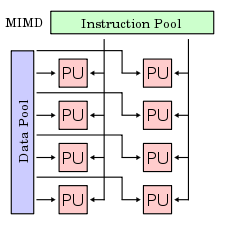
, MIMD (multiple instruction, multiple data) is a technique employed to achieve parallelism. Machines using MIMD have a number of processors that function asynchronously
Asynchrony
Asynchrony, in the general meaning, is the state of not being synchronized.* Asynchronous learning* Collaborative editing systemsIn specific terms of digital logic and physical layer of communication, an asynchronous process does not require a clock signal, in contrast with synchronous and...
and independently. At any time, different processors may be executing different instructions on different pieces of data. MIMD architectures may be used in a number of application areas such as computer-aided design
Computer-aided design
Computer-aided design , also known as computer-aided design and drafting , is the use of computer technology for the process of design and design-documentation. Computer Aided Drafting describes the process of drafting with a computer...
/computer-aided manufacturing
Computer-aided manufacturing
Computer-aided manufacturing is the use of computer software to control machine tools and related machinery in the manufacturing of workpieces. This is not the only definition for CAM, but it is the most common; CAM may also refer to the use of a computer to assist in all operations of a...
, simulation
Computer simulation
A computer simulation, a computer model, or a computational model is a computer program, or network of computers, that attempts to simulate an abstract model of a particular system...
, modeling
Scientific modelling
Scientific modelling is the process of generating abstract, conceptual, graphical and/or mathematical models. Science offers a growing collection of methods, techniques and theory about all kinds of specialized scientific modelling...
, and as communication switches. MIMD machines can be of either shared memory
Shared memory
In computing, shared memory is memory that may be simultaneously accessed by multiple programs with an intent to provide communication among them or avoid redundant copies. Depending on context, programs may run on a single processor or on multiple separate processors...
or distributed memory
Distributed memory
In computer science, distributed memory refers to a multiple-processor computer system in which each processor has its own private memory. Computational tasks can only operate on local data, and if remote data is required, the computational task must communicate with one or more remote processors...
categories. These classifications are based on how MIMD processors access memory. Shared memory machines may be of the bus-based
Bus network
A bus network topology is a network architecture in which a set of clients are connected via a shared communications line, called a bus. There are several common instances of the bus architecture, including one in the motherboard of most computers, and those in some versions of Ethernet...
, extended, or hierarchical type. Distributed memory machines may have hypercube
Grid network
A grid network is a kind of computer network consisting of a number of systems connected in a grid topology.In a regular grid topology, each node in the network is connected with two neighbors along one or more dimensions. If the network is one-dimensional, and the chain of nodes is connected to...
or mesh
Mesh networking
Mesh networking is a type of networking where each node must not only capture and disseminate its own data, but also serve as a relay for other nodes, that is, it must collaborate to propagate the data in the network....
interconnection schemes.
Shared Memory Model
The processors are all connected to a "globally available" memory, via either a software or hardwareHardware
Hardware is a general term for equipment such as keys, locks, hinges, latches, handles, wire, chains, plumbing supplies, tools, utensils, cutlery and machine parts. Household hardware is typically sold in hardware stores....
means. The operating system
Operating system
An operating system is a set of programs that manage computer hardware resources and provide common services for application software. The operating system is the most important type of system software in a computer system...
usually maintains its memory coherence.
From a programmer's point-of-view, this memory model is better understood than the distributed memory model. Another advantage is that memory coherence is managed by the operating system and not the written program. Two known disadvantages are: scalability beyond thirty-two processors is difficult, and the shared memory model is less flexible than the distributed memory model.
There are many examples of shared memory (multiprocessors): UMA (Uniform Memory Access
Uniform Memory Access
Uniform Memory Access is a shared memory architecture used in parallel computers.All the processors in the UMA model share the physical memory uniformly...
), COMA (Cache Only Memory Access) and NUMA (Non-Uniform Memory Access
Non-Uniform Memory Access
Non-Uniform Memory Access is a computer memory design used in Multiprocessing, where the memory access time depends on the memory location relative to a processor...
).
Bus-based
MIMD machines with shared memory have processors which share a common, central memory. In the simplest form, all processors are attached to a bus which connects them to memory.Hierarchical
MIMD machines with hierarchical shared memory use a hierarchy of buses to give processors access to each other's memory. Processors on different boards may communicate through inter-nodal buses. Buses support communication between boards. With this type of architecture, the machine may support over nine thousand processors.Distributed memory
In distributed memory MIMD machines, each processor has its own individual memory location. Each processor has no direct knowledge about other processor's memory. For data to be shared, it must be passed from one processor to another as a message. Since there is no shared memory, contention is not as great a problem with these machines. It is not economically feasible to connect a large number of processors directly to each other. A way to avoid this multitude of direct connections is to connect each processor to just a few others. This type of design can be inefficient because of the added time required to pass a message from one processor to another along the message path. The amount of time required for processors to perform simple message routing can be substantial. Systems were designed to reduce this time loss and hypercube and mesh are among two of the popular interconnection schemes.As examples of distributed memory(multicomputers): MPP (massively parallel processors) and COW (Clusters of Workstations).
The first one is complex and expensive: lots of super-computers coupled by broad-band networks. Examples: hypercube and mesh interconections.
COW is the "home-made" version for a fraction of the price.
Hypercube interconnection network
In an MIMD distributed memory machine with a hypercubeHypercube
In geometry, a hypercube is an n-dimensional analogue of a square and a cube . It is a closed, compact, convex figure whose 1-skeleton consists of groups of opposite parallel line segments aligned in each of the space's dimensions, perpendicular to each other and of the same length.An...
system interconnection network containing four processors, a processor and a memory module are placed at each vertex of a square. The diameter of the system is the minimum number of steps it takes for one processor to send a message to the processor that is the farthest away. So, for example, the diameter of a 2-cube is 1. In a hypercube system with eight processors and each processor and memory module being placed in the vertex of a cube, the diameter is 3. In general, a system that contains 2^N processors with each processor directly connected to N other processors, the diameter of the system is N. One disadvantage of a hypercube system is that it must be configured in powers of two, so a machine must be built that could potentially have many more processors than is really needed for the application.
Mesh interconnection network
In an MIMD distributed memory machine with a mesh interconnection network, processors are placed in a two-dimensional grid. Each processor is connected to its four immediate neighbors. Wraparound connections may be provided at the edges of the mesh. One advantage of the mesh interconnection network over the hypercube is that the mesh system need not be configured in powers of two. A disadvantage is that the diameter of the mesh network is greater than the hypercube for systems with more than four processors.See also
- SMPSymmetric multiprocessingIn computing, symmetric multiprocessing involves a multiprocessor computer hardware architecture where two or more identical processors are connected to a single shared main memory and are controlled by a single OS instance. Most common multiprocessor systems today use an SMP architecture...
- NUMANon-Uniform Memory AccessNon-Uniform Memory Access is a computer memory design used in Multiprocessing, where the memory access time depends on the memory location relative to a processor...
- Flynn's taxonomyFlynn's TaxonomyFlynn's taxonomy is a classification of computer architectures, proposed by Michael J. Flynn in 1966.-Classifications:The four classifications defined by Flynn are based upon the number of concurrent instruction and data streams available in the architecture:Single Instruction, Single Data stream...
- SPMDSPMDIn computing, SPMD is a technique employed to achieve parallelism; it is a subcategory of MIMD. Tasks are split up and run simultaneously on multiple processors with different input in order to obtain results faster. SPMD is the most common style of parallel programming...
- Multi-core (computing)Multi-core (computing)A multi-core processor is a single computing component with two or more independent actual processors , which are the units that read and execute program instructions...
- SuperscalarSuperscalarA superscalar CPU architecture implements a form of parallelism called instruction level parallelism within a single processor. It therefore allows faster CPU throughput than would otherwise be possible at a given clock rate...
- Very long instruction wordVery long instruction wordVery long instruction word or VLIW refers to a CPU architecture designed to take advantage of instruction level parallelism . A processor that executes every instruction one after the other may use processor resources inefficiently, potentially leading to poor performance...