
Home      Discussion      Topics      Dictionary      Almanac
Signup       Login
MG Midget

MG Midget

Overview
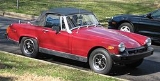
The MG Midget is a small two-seater sports car
Sports car
A sports car is a small, usually two seat, two door automobile designed for high speed driving and maneuverability....

 produced by the MG division of the British Motor Corporation
British Motor Corporation
The British Motor Corporation, or commonly known as BMC was a vehicle manufacturer from United Kingdom, formed by the merger of the Austin Motor Company and the Nuffield Organisation in 1952...

 from 1961 to 1979. It revived a famous name used on earlier models such as the MG M-type
MG M-type
The MG M-type was produced by the MG Car company from April 1929 to 1932. It was sometimes referred to as the 8/33. Launched at the 1928 London Motor Show when the sales of the larger MG saloons was faultering because of the economic climate, the small car brought MG ownership to a new sector of...

, MG D-type, MG J-type and MG T-type.
Discussion
Ask a question about 'MG Midget'
Start a new discussion about 'MG Midget'
Answer questions from other users
Full Discussion Forum
 
Unanswered Questions
Encyclopedia
The MG Midget is a small two-seater sports car
Sports car
A sports car is a small, usually two seat, two door automobile designed for high speed driving and maneuverability....

 produced by the MG division of the British Motor Corporation
British Motor Corporation
The British Motor Corporation, or commonly known as BMC was a vehicle manufacturer from United Kingdom, formed by the merger of the Austin Motor Company and the Nuffield Organisation in 1952...

 from 1961 to 1979. It revived a famous name used on earlier models such as the MG M-type
MG M-type
The MG M-type was produced by the MG Car company from April 1929 to 1932. It was sometimes referred to as the 8/33. Launched at the 1928 London Motor Show when the sales of the larger MG saloons was faultering because of the economic climate, the small car brought MG ownership to a new sector of...

, MG D-type, MG J-type and MG T-type.

MG Midget MkI (1961–1964)


The first version was essentially a slightly more expensive badge-engineered
Badge engineering
Badge engineering is an ironic term that describes the rebadging of one product as another...

 version of the Austin-Healey Sprite
Austin-Healey Sprite
The Austin-Healey Sprite is a small open sports car which was announced to the press in Monte Carlo by the British Motor Corporation on 20 May 1958, just before that year's Monaco Grand Prix. It was intended to be a low-cost model that "a chap could keep in his bike shed", yet be the successor to...

 MKII and retained the quarter-elliptic sprung rear axle from the original Sprite. The engine was a 948 cc A-Series
BMC A-Series engine
Austin Motor Company's small straight-4 automobile engine, the A-Series, is one of the most common in the world. Launched in 1951 with the Austin A30, production lasted until 2000 in the Mini. It used a cast-iron block and cylinder head, and a steel crankshaft with 3 main bearings...

with twin SU carburettors producing 46 hp (34 kW) at 5500 rpm and 53 lbf·ft (72 Nm) at 3000 rpm. Brakes were 7 in (178 mm) drums all round. A hard top, heater, radio and luggage rack were available as factory fitted extras.

In October 1962 the engine was increased to 1098 cc, raising the output to 56 hp (42 kW) at 5500 rpm and 62 lbf·ft (84 Nm) at 3250 rpm and disc brakes replaced the drums at the front. Wire-spoked wheels became available.

The doors had no external handles or locks and the windows were sliding Perspex side-screens. A heater was an optional extra.

Production was 16,080 of the small-engined version and 9601 of the 1098.

A car with the 948 cc engine was tested by the British magazine The Motor
The Motor (magazine)
The Motor was a British weekly car magazine founded on 28 January 1903....

 in 1962 and had a top speed of 87.9 mph (141.5 km/h) and could accelerate from 0-60 mph (96.6 km/h) in 18.3 seconds. A fuel consumption of 40.2 mpgimp was recorded. The test car cost £689 including taxes on the UK market.

MG Midget MkII (1964–1966)


Externally the main changes were to the doors, which gained wind-up windows, swivelling quarter lights, external handles and separate locks. The windscreen also gained a (slight) curvature and was retained in a more substantial frame. The hood (US – top), though modified, continued to have a removable frame that had to be erected before the cover was put on. The rear springs were replaced by more conventional semi-elliptic types which gave a better ride. The engine block was strengthened and larger main bearings were fitted, increasing the power to 59 hp (44 kW) at 5750 rpm and torque to 65 lbf·ft (88 Nm) at 3500 rpm.

A total of 26,601 were made.

MG Midget MkIII (1966–1974)


The engine now grew to 1275 cc using the development seen on the Mini
Mini
The Mini is a small car that was made by the British Motor Corporation and its successors from 1959 until 2000. The original is considered a British icon of the 1960s, and its space-saving front-wheel-drive layout influenced a generation of car-makers...

-Cooper 'S'. Enthusiasts were disappointed that this was a de-tuned
Engine tuning
Engine tuning is the adjustment, modification or design of internal combustion engines to yield optimal performance, to increase an engine's power output, economy, or durability....

 version of the 75bhp @ 5800 rpm Cooper 'S' engine, giving only 65 hp (48 kW) at 6000 rpm and 72 lbf·ft (98 Nm) at 3000 rpm. A reduced compression ratio of 8.8:1 was used instead of the 9.75:1 employed on the Cooper S engine. The Midget used the 12G940 cylinder head casting that was common to other BMC 1300 cars, whereas the Cooper 'S' had a special head with extra-large valves: however, these valves caused many 'S' heads to fail through cracking between the valve seats. The detuned engine was used for reasons of model range placement - with the Cooper 'S' spec engine the Midget would have been faster than the more expensive MGB.
The hydraulic system gained a separate master cylinder for the clutch.
The hood was now permanently attached to the car, with an improved mechanism making it much easier to use.
There were minor facelift changes to the body in 1969, with the sills painted black and a revised recessed black grille. Rubery Owen "Rostyle" wheels were standardised but wire-spoked ones remained an option. US-spec cars received several safety additions: a padded fascia (dashboard) with smaller main gauges; collapsible steering column, scissor-type hood hinges, a third windshield wiper, additional side marker lights, and anti-burst door latches. The rear axle gear ratio was increased in 1968 to 3.9:1, giving 16.5 mph for every 1000 RPM. The increased gear ratio gave the 1275 model slightly better fuel economy than the 1098 model.

In August 1971 the compression ratio on North American engines was reduced to 8.0:1. Engine power output fell to 54.5 bhp @ 5500 RPM and 67 lb-ft of torque @ 3250 RPM.

The square-shaped rear wheel arches became rounded in January 1972. Also in this year, a Triumph steering rack was fitted, giving a gearing that was somewhat lower than earlier Midgets. A second exhaust silencer was also added in 1972. Alternators were fitted instead of dynamos from 1973 onwards. For 1974 model year, rubber bumper extensions were added to the chrome bumpers to meet the first US bumper impact regulations.

Many consider the round-arch Midgets with chrome bumpers produced for model years 1972 and 1973 to be the most desirable.
These round-arch cars started leaving the Abingdon factory in late 1971.

Between 1966 and the 1969 face lift 22,415 were made, and a further 77,831 up to 1974.

MG Midget 1500 (1974–1980)


To meet US federal regulations, large black plastic bumpers (usually called rubber bumpers, despite not actually being rubber) were added to the front and rear and the ride height was increased. The increased ride height impacted handling, and an anti-roll bar was added to help with higher center of gravity. The A-Series engine was replaced by the 1493 cc unit from the Triumph Spitfire
Triumph Spitfire
The Triumph Spitfire is a small English two-seat sports car, introduced at the London Motor Show in 1962. The vehicle was based on a design produced for Standard-Triumph in 1957 by Italian designer Giovanni Michelotti...

 and a modified Morris Marina
Morris Marina
The Morris Marina is a car which was manufactured by the Morris division of British Leyland in the UK throughout the 1970s, which was a period of great turbulence and difficulty for the British car industry. It was known in some markets as the Austin Marina, Leyland Marina, and Morris 1.7...

 gearbox with synchromesh on all four gears. The increased displacement of the new engine was better able to cope with the increasing emission regulations. Although the horsepower ratings were similar (65bhp - home market) the 1493 CC engine produced more torque. The increased output combined with taller gear ratios resulted in faster acceleration, (12 seconds 0-60 compared to 13 for the 1275cc version) and top speed of just over 100mph. In the US market British Leyland struggled to keep engine power at acceptable levels, as the engines were loaded with air pumps, EGR valves and catalytic converters to keep up with new US and California exhaust emission control regulations. The home market's dual SU HS4 carbs were swapped for a single Zenith-Stromberg 150 CD4 unit, and the power fell to 50 bhp at 5000 RPM and 67 lb-ft of torque at 2500 RPM. The round rear-wheel arches were now square again, to increase the body strength. The last car was made on December 7, 1979, after 73,899 of the last version had been made. The last 500 cars were painted black. There was no Austin-Healey Sprite equivalent. A limited number of MG Midgets were titled in 1980, and appear as 1980 models.

ADO34


ADO34 was the name of a project active between 1960 and 1964 that aimed to develop a Mini
Mini
The Mini is a small car that was made by the British Motor Corporation and its successors from 1959 until 2000. The original is considered a British icon of the 1960s, and its space-saving front-wheel-drive layout influenced a generation of car-makers...

-based roadster to replace the MG Midget and Austin-Healey Sprite
Austin-Healey Sprite
The Austin-Healey Sprite is a small open sports car which was announced to the press in Monte Carlo by the British Motor Corporation on 20 May 1958, just before that year's Monaco Grand Prix. It was intended to be a low-cost model that "a chap could keep in his bike shed", yet be the successor to...

. It was not proceeded with.

Today


Originally designed by Donald Healey
Donald Healey
Donald Mitchell Healey CBE was a noted English rally driver, automobile engineer, and speed record holder.- Early life :...

 and his team, the car may have started life as an Austin-Healey Sprite, but was always manufactured by the MG Car Company at its factory in Abingdon, Berkshire. MG developed and improved the Sprite to the point where they felt it was fit to be known as the first post-war MG Midget.

Over the years, the two models came to be given the joint soubriquet 'Spridget', and from their inception, Spridgets became popular cars to use in 'grass roots' motor sport events all over the world, because of their predictable and entertaining handling characteristics and the ready availability of tuning parts, both from the manufacturer BMC and from independent tuning concerns – particularly Alexanander Engineering and Speedwell Performance Conversions.

The UK still has a race series dedicated to the MG Midget which is run by the MG Car Club
MG Car Club
The MG Car Club is an international club founded in 1930 for owners and enthusiasts of MG cars. The club headquarters are based in Abingdon, Oxfordshire and are located adjacent to the now defunct MG factory site where cars were produced between 1930 - 1980...

. The MG Midget Challenge is a national race series for MG Midgets and Austin Healey Sprites (built 1956–1979). The championship is run at all major UK circuits, with the occasional visit to Spa-Francorchamps in Belgium, and has been running since 1977.

Spridgets are also still highly popular in the US and elsewhere for vintage racing. All Sprites and earlier model Midgets are powered by the very common A-Series engine which is very tunable for higher output.

Today, MG Midgets are increasingly being restored to a high standard, helped by the excellent availability of re-manufactured parts. This made easier because many of the components used are common to other Austin and Morris models, and many body fittings on the later cars are common to the MGB. British Motor Heritage, which owns many of the original press tools, makes body panels and complete body shells, and is backed up by a small army of suppliers of parts, both new and used.