

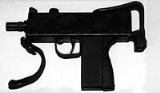
MAC-11

Encyclopedia
The Ingram MAC-11 is a machine pistol
developed by American gun designer Gordon Ingram at the Military Armament Corporation (MAC) during the 1970s. The weapon is a sub-compact version of the Model 10 (MAC-10
), and is chambered to fire the smaller .380 ACP
round.
This weapon is sometimes confused with the Sylvia & Wayne Daniels M-11/9
or the Vulcan M-11-9
, both of which are later variants of the MAC chambered for 9 mm Luger Parabellum
cartridge.
was developed for the MAC-11, which used wipes as baffles, instead of the reflex baffles that Mitchell Werbell III
created for the MAC-10. Though wipes are less durable than reflex baffles, they had the advantage of proving quieter for the MAC-11.
design. The M-11A1 also has two safety features which are also found on the Model 10A1. The charging handle rotates to the 90 degrees to lock the bolt in the forward position thus preventing the weapon from being cocked. The second safety is a slider which is pushed forward to lock the trigger, which in turn pins the bolt to the rear (cocked) position. This prevents the weapon from discharging even when dropped, which is a typical problem with the open-bolt design.
.
. At the MAC-11's high cyclic rate, extreme trigger discipline is required to discharge short bursts, which are required for combat expediency. Without proper training, the natural tendency of the inexperienced shooter is to hold down the trigger, discharging the entire magazine in little more than a second, often with poor accuracy due to recoil.
Machine pistol
A machine pistol is a handgun-style, often magazine-fed and self-loading firearm, capable of fully automatic or burst fire, and normally chambered for pistol cartridges. The term is a literal translation of Maschinenpistole, the German term for a hand-held automatic weapon...
developed by American gun designer Gordon Ingram at the Military Armament Corporation (MAC) during the 1970s. The weapon is a sub-compact version of the Model 10 (MAC-10
MAC-10
The MAC-10 is a highly compact, blowback operated machine pistol developed by Gordon B. Ingram in 1964.-Design:The M-10 was built predominantly from steel stampings...
), and is chambered to fire the smaller .380 ACP
.380 ACP
The .380 ACP pistol cartridge is a rimless, straight-walled pistol cartridge developed by firearms designer John Browning. The cartridge headspaces on the mouth of the case. It was introduced in 1908 by Colt, and has been a popular self-defense cartridge ever since...
round.
This weapon is sometimes confused with the Sylvia & Wayne Daniels M-11/9
Cobray Company
The Cobray Company was a manufacturer of sub-machine guns and semi-automatic carbines, handguns and shotguns as well as non-lethal 37 mm launchers. These were manufactured by SWD...
or the Vulcan M-11-9
Vulcan M-11-9
The Vulcan M-11-9 is a semi-automatic, closed bolt pistol manufactured by Vulcan Armament.The M-11-9 is a knockoff of the Ingram MAC-10 series which is an open bolt, fully automatic machine pistol....
, both of which are later variants of the MAC chambered for 9 mm Luger Parabellum
9 mm Luger Parabellum
The 9×19mm Parabellum cartridge was designed by Georg Luger and introduced in 1902 by the German weapons manufacturer Deutsche Waffen- und Munitionsfabriken for their Luger semi-automatic pistol...
cartridge.
Sound suppressor
A specific suppressorSuppressor
A suppressor, sound suppressor, sound moderator, or silencer, is a device attached to or part of the barrel of a firearm which reduces the amount of noise and flash generated by firing the weapon....
was developed for the MAC-11, which used wipes as baffles, instead of the reflex baffles that Mitchell Werbell III
Mitchell Werbell III
Mitchell Livingston WerBell III, , was an OSS operative, Soldier of Fortune, Paramilitary trainer, firearms engineer, and arms dealer.- Early life and OSS service :...
created for the MAC-10. Though wipes are less durable than reflex baffles, they had the advantage of proving quieter for the MAC-11.
Operation
Like the larger M-10, the M-11 has open sights with the rear pinhole sight welded to the receiver. These sights are for use with the folding stock, as using them without the stock is nearly useless because of the initial jump of the weapon due to its heavy, open-boltOpen bolt
A semi or full automatic firearm is said to fire from an open bolt if, when ready to fire, the bolt and working parts are held to the rear. When the trigger is pulled the bolt goes forward, feeding a round from the magazine into the chamber and firing it...
design. The M-11A1 also has two safety features which are also found on the Model 10A1. The charging handle rotates to the 90 degrees to lock the bolt in the forward position thus preventing the weapon from being cocked. The second safety is a slider which is pushed forward to lock the trigger, which in turn pins the bolt to the rear (cocked) position. This prevents the weapon from discharging even when dropped, which is a typical problem with the open-bolt design.
Performance
The rate of fire of the M-11A1 is listed as approximately 1200 rpm (rounds per minute), though in reality, it is closer to 1600 rpmRate of fire
Rate of fire is the frequency at which a specific weapon can fire or launch its projectiles. It is usually measured in rounds per minute , or per second .-Overview:...
.
Acceptance
The M-11 is the least-common version in the MAC family of firearms. This is mostly due to the .380 ACP round, which has a muzzle velocity of approximately 950 ft/s (289.6 m/s) and 200 ft.lbf of energy, and is widely considered to have insufficient stopping powerStopping power
Stopping power is a colloquial term used to describe the ability of a firearm or other weapon to cause a penetrating ballistic injury to a target, human or animal, sufficient to incapacitate the target where it stands....
. At the MAC-11's high cyclic rate, extreme trigger discipline is required to discharge short bursts, which are required for combat expediency. Without proper training, the natural tendency of the inexperienced shooter is to hold down the trigger, discharging the entire magazine in little more than a second, often with poor accuracy due to recoil.