
|
|
|
|
MAC-10
|
| |
|
| |
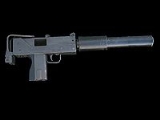
The MAC-10 (Military Armament Corporation Model 10) is a highly compact, blowback operated machine pistol developed by Gordon B. Ingram in 1964.
It is a simple, low-cost design with few moving parts, making it easy to manufacture and maintain. The M-10 is one of a series of machine pistols, the others being: the MAC-11 (M-11A1), which is a scaled down version of the M-10 chambered in .380 ACP; and the M-11/9, which is a smaller 9mm version that has a longer receiver with a shorter profile later made by SWD (Sylvia and Wayne Daniel) and Leinad.
The term "MAC-10" is commonly used, but unofficial parlance.

Discussion
Ask a question about 'MAC-10'
Start a new discussion about 'MAC-10'
Answer questions from other users
|
Recent Posts

Encyclopedia
The MAC-10 (Military Armament Corporation Model 10) is a highly compact, blowback operated machine pistol developed by Gordon B. Ingram in 1964.
It is a simple, low-cost design with few moving parts, making it easy to manufacture and maintain. The M-10 is one of a series of machine pistols, the others being: the MAC-11 (M-11A1), which is a scaled down version of the M-10 chambered in .380 ACP; and the M-11/9, which is a smaller 9mm version that has a longer receiver with a shorter profile later made by SWD (Sylvia and Wayne Daniel) and Leinad.
The term "MAC-10" is commonly used, but unofficial parlance. Ironically, the MAC company never used the nomenclature MAC-10 on any of its catalogs or sales literature--only "M10", but because "MAC-10" became so frequently used by Class 3 dealers, gun writers, and collectors, it is now used more frequently than "M10" to identify the guns.
The compactness and high rates of fire for these weapons (no less than 1000 rounds per minute for the M-10 and 1600 rpm for the M-11A1) worked against them. Their small size made them difficult to fire accurately in full auto, and this, when combined with their high rate of fire, made control challenging; this was a key factor in their never finding much success with the military. However, they did see limited service in Vietnam with Special Forces.
Besides Military Armament Corporation and SWD, MAC-10s and MAC-10 parts have been produced by RPB Industries, Cobray Company, Jersey Arms Works, and Section Five Firearms.
Design
The MAC-10 was built predominantly from steel stampings. A notched cocking handle protrudes from the top of the receiver, and by turning the handle 90° would lock the bolt, and act as an indicator that the weapon is unable to fire. The MAC-10 has a telescoping bolt, which wraps around the barrel. This allows a more compact weapon, and balances the weight of the weapon over the pistol grip where the magazine is located. The MAC-10 fires from an open bolt, and in addition, the light weight of the bolt results in a rapid rate of fire. The barrel is threaded to accept a suppressor, which worked by reducing the discharge's sound, without attempting to reduce the velocity of the bullet. At the suggestion of the United States Army, Ingram added a small bracket with a small strap beneath the muzzle to aid in controlling recoil during fully-automatic fire.
Suppressor
Probably the biggest reason for the original MAC-10 finding recognition was its revolutionary sound suppressor designed by Mitchell Werbell III of Sionics. This suppressor had a two-stage design, with the first stage being larger than the second. This uniquely shaped suppressor gave the MAC-10 a very distinctive look. It was also very quiet, to the point that the bolt could be heard cycling, along with the suppressed report of the weapons discharge. Later-production variants had a "wipeless" suppressor front cap design that was advanced for the time in that its internal metal parts needed only to be cleaned, not replaced, in contrast to the older-technology "wipe" type suppressors. The suppressor also created a place to hold the weapon; this, combined with the weight it added, made the weapon easier to control. During the 1970s the United States of America placed restrictions on the exportation of suppressors, and a number of countries canceled their orders of MAC-10s as the effectiveness of the MAC-10's suppressor was one of its main selling points. This was one factor that led to the bankruptcy of Military Armament Company, the main producer, in 1976. The weapon's barrel threads were originally intended for this suppressor, but many other muzzle attachments can be used: muzzle brakes, barrel extensions, fake suppressors, fore-grips, and so on. Also, a single-stage "wipe" type suppressor was marketed by SWD and Cobray in the last years (1983–1986) of the MAC-10's manufacture. The suppressor is 11.44 inches in length, 2.13 inches in overall diameter, and weighs 1.20 pounds.
Calibers
Most MAC-10s, including the original design, are chambered for .45 ACP rounds. In the United States, fully automatic MAC-10 machine pistols are NFA articles, and probably the least expensive (relative; Approximate cost as of Q1 2008 is $3,000 US +/-) automatic weapons on the American market. A large number of semi-completed sheet metal frame flats were given serial numbers before the Firearm Owners Protection Act of 1986, and this made it possible to complete the manufacture of registered MAC-10s for the civilian market after the 1986 production freeze took effect. There were also a few thousand semi-automatic pistols and carbines that were based on the original MAC-10 design. These were made in open-bolt and later in closed-bolt designs, in response to ATF rule changes that banned semi-auto open bolt designs, beginning in the early 1980s.
Users
  - - Also an optional issue to security guards
- - Used by the SAS prior to their use of the MP5. An unknown number of 9mm M-10 sub-machineguns were made by Section Five Firearms Ltd., a manufacturer previously located in Tunbridge Wells, Kent. Section Five's MACs have a distinctive UZI-style grip and magazine release.
See also
External links
- on EnemyForces.com
- on Modern Firearms
-
- at the
-
|
| |
|
|