
All Topics  
M1 Helmet

 
M1 Helmet

   Email Print
   Bookmark   Link


M1 Helmet


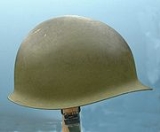
The M1 helmet is a combat helmet that was used by the American
United States

The United States of America is a Federal government constitutional republic comprising U.S. state and a federal district. The country is situated mostly in central North America, where its Contiguous United States and Washington, D.C., the Capital districts and territories, lie between the Pacific Ocean and Atlantic Oceans, Borders of the U...
 military
Military

A military is an organization authorized by its nation to use force, usually including use of weapons, in defending its country by combating actual or Threat of force ....
 from World War II
World War II

World War II, or the Second World War , was a global military conflict which involved a Participants in World War II, including all of the great powers, organised into two opposing military alliances: the Allies of World War II and the Axis powers....
 until it was succeeded by the PASGT helmet
Personnel Armor System for Ground Troops

Personnel Armor System for Ground Troops, sometimes abbreviated to PASGT, is a combat helmet and ballistic vest used by the American military from the late 1980s until 2003, when the system was succeeded by the Lightweight Helmet, MICH TC-2000 Combat Helmet and Interceptor body armor....
 beginning in 1985. For over forty years, the M1 was standard issue for the U.S. military and naval forces, and has become an icon of the American military, with its design inspiring other militaries around the world.

The M1 helmet is extremely popular with militaria
Militaria

Militaria are Artifact s or replicas of military, police, etc., collecting for their historical significance. Such antiques include firearms, swords, knife, and other weapons; military uniforms, helmets, other military headgear, and armour; military medal; challenge coins and awards; badges and insignia; military art, sculpture, and printmak...
 collectors, and helmets from the World War II period are generally more valuable than later models.


Discussion
Ask a question about 'M1 Helmet'
Start a new discussion about 'M1 Helmet'
Answer questions from other users
Full Discussion Forum


Encyclopedia


The M1 helmet is a combat helmet that was used by the American
United States

The United States of America is a Federal government constitutional republic comprising U.S. state and a federal district. The country is situated mostly in central North America, where its Contiguous United States and Washington, D.C., the Capital districts and territories, lie between the Pacific Ocean and Atlantic Oceans, Borders of the U...
 military
Military

A military is an organization authorized by its nation to use force, usually including use of weapons, in defending its country by combating actual or Threat of force ....
 from World War II
World War II

World War II, or the Second World War , was a global military conflict which involved a Participants in World War II, including all of the great powers, organised into two opposing military alliances: the Allies of World War II and the Axis powers....
 until it was succeeded by the PASGT helmet
Personnel Armor System for Ground Troops

Personnel Armor System for Ground Troops, sometimes abbreviated to PASGT, is a combat helmet and ballistic vest used by the American military from the late 1980s until 2003, when the system was succeeded by the Lightweight Helmet, MICH TC-2000 Combat Helmet and Interceptor body armor....
 beginning in 1985. For over forty years, the M1 was standard issue for the U.S. military and naval forces, and has become an icon of the American military, with its design inspiring other militaries around the world.

The M1 helmet is extremely popular with militaria
Militaria

Militaria are Artifact s or replicas of military, police, etc., collecting for their historical significance. Such antiques include firearms, swords, knife, and other weapons; military uniforms, helmets, other military headgear, and armour; military medal; challenge coins and awards; badges and insignia; military art, sculpture, and printmak...
 collectors, and helmets from the World War II period are generally more valuable than later models. Both World War II and Vietnam era helmets are becoming harder to find. Those with (original) rare or unusual markings or some kind of documented history tend to be more expensive. This is particularly true of paratroopers'
Paratrooper

Paratroopers are soldiers trained in parachuting and generally operate as part of an Airborne forces.Paratroopers are used for tactical advantage as they can be inserted into the battlefield from the air, thereby allowing them to be positioned in areas not accessible by land....
 helmets, which are variants known as the M1C Helmet
M1C Helmet

The M1C helmet was a variant of the U.S. Army's popular and iconic M1 helmet. Developed in World War II to replace the M2 helmet, it was issued to paratroopers....
 and M2 Helmet.

History

M1helmetshell
The M1 Helmet was introduced during the World War II in 1942 to replace the M1917A1 Steel helmet
Brodie helmet

The Brodie helmet, called Helmet, steel, Mark I helmet in Britain and the M1917 Helmet in the U.S. was a steel combat helmet designed and patented in 1915 by the Briton John L....
. During the service life of the M1 helmet, 20 million US M-1 steel helmets were manufactured during World War II. A second US production run of approximately one million helmets was made in 1966-1967, for the Vietnam War
Vietnam War

The Vietnam War, also known as the Second Indochina Wars, the Vietnam Conflict, or often in Vietnam the American War occurred in Vietnam, Laos and Cambodia from 1959 to April 30, 1975....
. The Vietnam War helmet was different from the World War II/Korean War
Korean War

The Korean War refers to a period of military conflict between North Korea and South Korea regimes, with major hostilities lasting from June 25, 1950 until the armistice signed on July 27, 1953....
 version by having a lowered, or less pronounced dome shape at the top forward section, and was painted in a light olive green. The M1 was phased out during the 1980s in favor of the PASGT helmet which offered increased ergonomics
Ergonomics

Ergonomics is the scientific discipline concerned with designing according to human needs, and the profession that applies theory, principles, data and methods to design in order to optimize human well-being and overall system performance....
 and ballistic protection. It should be noted that no distinction in nomenclature existed between wartime front seams and post war shells in the United States Army
United States Army

The United States Army is the branch of the United States Armed Forces responsible for Army operations. It is the largest and oldest established branch of the U.S....
 supply system, hence World War II shells remained in use until the M1 was retired from service.

While obsolete in United States service, the M1 Helmet and international variants are still in use by other nations around the world. The M1 helmet liner still occupies a symbolic niche in the United States military. For example, liners are currently worn in training by United States Navy SEALs
United States Navy SEALs

The United States Navy Sea, Air and Land Forces, commonly known as the Navy SEALs, are the United States Special Operations Forces of the United States Navy, employed in Direct action and special reconnaissance operations....
 BUD/S candidates, wherein it is painted with the trainees' class number, name, and rank insignia, and painted and chromed versions models are still used in ceremonial units. In Israeli
Israel Defense Forces

The Israel Defense Forces , commonly known in Israel by the Hebrew Acronym and initialism Tzahal , are Israel's military forces, comprising the GOC Army Headquarters, Israeli Air Force and Israeli navy....
 service, reserve soldiers have used the M1 helmet in combat as late as 2006.

Design


The M1 is two "one-size-fits-all" helmets: An outer shell, sometimes referred to as the "steel pot", made of metal and a hard hat
Hard hat

A hard hat is a type of helmet predominantly used in workplace environments, such as construction sites, to protect the head from injury by falling objects, debris, bad weather, and electric shock....
-type liner that is nestled inside the shell and contains the suspension system that would be adjusted to fit the wearer's head. Helmet covers and netting would be applied by covering the steel shell with the extra material tucked inside the shell and secured by inserting the liner.

The outer shell cannot be worn by itself. The liner can be worn by itself providing protection similar to a hard hat
Hard hat

A hard hat is a type of helmet predominantly used in workplace environments, such as construction sites, to protect the head from injury by falling objects, debris, bad weather, and electric shock....
, and was often worn in such fashion by military policemen, Assistant Drill Instructors (known as AI's), and rifle/machine gun/pistol range staff, although they were supposed to wear steel at the range. The liner is sometimes worn in U.S. military ceremonies and parades, painted white or chromed.

Shell

The shell of the M2 was changed mainly in silhouette, as seen from the side, from its World War II beginnings. The second, and last, U.S. production run of about 1 million M1s during the mid 1960s, lowered (streamlined) the top forehead portion of the steel shell. The bulk of the helmet shell is constructed from a single piece of pressed non-magnetic steel
Steel

Steel is an alloy consisting mostly of iron, with a carbon content between 0.2% and 2.14% by weight , depending on grade. Carbon is the most cost-effective alloying material for iron, but various other alloying elements are used such as manganese, chromium, vanadium, and tungsten....
. The rim edge of the shell has a crimped metal band running around it, which provides a clean edge. This is usually known as the "rim". The metal band of the rim material has a seam where the ends of the strip meet. On the earliest shells the seam meets at the front. This was moved to the back of the rim in 1944, when the rim went from being made of stainless steel to manganese steel.

On each side of the helmet shell there are stainless steel loops for attachment of the chinstrap. The shape of these fixtures, known as bails, is one of the most recognizable distinguishing factors between shells produced at different times. Early World War II production helmets have fixed, rectangular bails, and late-war and 1960s helmets feature movable rectangular bails which swivel inward and outward. This swivel feature was adopted to address the problem that when earlier helmets were dropped, the bails were more susceptible to breaking off. Early paratrooper shells feature fixed, D-shaped bails. World War II production helmets feature khaki (olive drab
Variations of green

This article is about notable tints and shades of the color green. These various colors are shown below....
 late in the war) web chinstraps that are sewn on. 1960s and 70s chinstraps are made of olive drab webbing attached to the shell with blackened metal clips. Nylon, clip-on, chinstraps were introduced in the U.S. military in the 1980s and issued to be fitted by the individual serviceman to his own helmet. These straps featured a two-piece web chin cup and were fastened by a metal snap rather than buckle.

During World War II and later, many soldiers wore the webbing
Webbing

Webbing is a strong cloth weaving as a flat strip or tube of varying width and fibers often used in place of rope. The name webbing comes from the meshed material frequently used in its construction, which resembles a web....
 chinstraps unfastened or looped around the back of the helmet and clipped together. This practice arose for two reasons: First, because hand-to-hand combat was anticipated, and an enemy could be expected to attack from behind, reach over the helmet, grab its visor, and pull. If the chinstrap were worn, the head would be snapped back, causing the victim to lose balance, and leave the throat and stomach exposed to a knife thrust. Secondly, many men incorrectly believed that a nearby exploding bomb or artillery shell could cause the chinstrap to snap their neck when the helmet was caught in its concussive force, although a replacement buckle, the T-1 pressure-release buckle, was manufactured that allowed the chinstrap to release automatically should this occur. In place of the chinstrap, the nape strap inside the liner was counted on to provide sufficient contact to keep the helmet from easily falling off the wearer's head.

Alternative use of steel shell
The design of exterior metal led to some novel uses: When separated from the liner, the shell could be used as an entrenching tool
Entrenching tool

An Entrenching tool or E-tool, is a collapsible spade used by military forces for a variety of military purposes. Survivalists, campers, hikers and other outdoors groups have found it to be indispensable in field use....
, washbasin, bucket, seat, and, in desperate times, latrine
Latrine

A latrine is a structure for defecation and urination. Latrines allow for safer and more hygienic disposal of human waste than open defecation....
. The shell was also used as a cooking pot but the practice was discouraged, as it would make the metal alloy brittle and useless as protective headwear.

Liner

M1helmetdiagram
The liner is made from many parts. The outer part is shaped to fit snugly into the steel shell. The various elements of the suspension system are rivet
Rivet

A rivet is a permanent mechanical fastener. Before it is installed it consists of a smooth cylinder shaft with a head on one end. The end opposite the head is called the buck-tail....
ed, later clipped, inside it. The suspension is made from strips of webbing material stretching around and across the inside of the liner. A sweatband is mounted onto these, which is adjusted to fit around the head of the wearer. World War II and Korean War era liners also have their own chinstrap made from brown leather
Leather

Leather is a material created through the tanning of rawhides and skins of animals, primarily cattlehide. The tanning process converts the putrescible skin into a durable, long-lasting and versatile natural material for various uses....
. The liner chinstrap is snapped or riveted directly to the inside of the liner and does not have bails like the shell chinstrap, but it still swivels inside the helmet. The liner chinstrap is usually seen looped over the brim of the shell and helps to keep the shell in place when its own chinstraps aren't in use.

The first liners were made from compressed paper fibers impregnated with phenolic resin
Phenolic resin

Phenolic resin can include any of various synthetic thermosetting resins such as Bakelite, obtained by the reaction of phenols with simple aldehydes and used to make molded products, including billiards balls, laboratory countertops, and as coatings and adhesives....
, but were quickly eliminated, because they degraded quickly in high humidity environments and were replaced by constantly evolving plastic
Plastic

Plastic is the general common term for a wide range of synthetic or semisynthetic organic chemistry solid materials suitable for the manufacture of industrial products....
 liners. During the same period, the original silver Rayon
Rayon

Rayon is a manufactured regenerated cellulose fiber. Because it is produced from naturally occurring polymers, it is neither a truly synthetic fiber nor a natural fiber; it is a semi-synthetic fiber ....
 suspension material was phased out in favor of khaki
Khaki

This article is about the textile. For the colour, see Khaki . Kaki, another name for the persimmon, is often misspelled "Khaki".Khaki is a type of textile or the Khaki ....
 cotton. After World War II the cotton was changed from khaki or Olive Drab #3 to a color known as Olive Drab #7. Much later, liners switched to using stronger synthetic webbing
Nylon

Nylon is a generic designation for a family of synthetic polymers known generically as polyamides and first produced on February 28, 1935 by Wallace Carothers at DuPont....
 and had improved neck support. There were many companies making liners during the war — Westinghouse Electric & Manufacturing Company
Westinghouse Electric (1886)

Founded in 1886 as Westinghouse Electric Company and later renamed Westinghouse Electric Corporation by George Westinghouse. The company purchased CBS in 1995 and was renamed CBS Corporation in 1997....
 made most of them, while other companies tested, such as Firestone Tire and Rubber Company
Firestone Tire and Rubber Company

The Firestone Tire and Rubber Company was founded by Harvey Firestone in 1900 to supply pneumatic tires for wagons, buggies, and other forms of wheeled transportation common in the era....
.

In the 1960s the M1 helmet liner was redesigned, eliminating the leather chin strap, nape strap and a change in the suspension webbing to a pattern resembling an asterisk in a coarse cotton web material in lieu of the earlier herringbone twill. In the early 1970s materials changed to a thicker, more flexible nylon with a rougher unbeveled rim. Later changes included a move to a yellow and green material for liner construction.

Accessories


Cover

Around late 1942 or early 1943, the United States Marine Corps
United States Marine Corps

The United States Marine Corps is a branch of the United States Armed Forces responsible for providing Military power projection from the sea, using the mobility of the United States Navy to rapidly deliver Marine Air-Ground Task Force....
 used a cloth camouflage-patterned cover for its helmets. The cover was made from herringbone twill
Twill

Twill is a type of textile weaving with a pattern of diagonal parallel ribs.It is made by passing the weft thread over one or more Warp threads and then under two or more warp threads and so on, with a "step" or offset between rows to create the characteristic diagonal pattern....
 fabric. It had a "forest green" pattern on one side and a "brown coral island" pattern on the other.

The United States Army often utilized nets to reduce the helmets shine when wet and to allow burlap scrim or vegetation to be added for camouflage purposes. Most nets were acquired from British
British Army

The British Army is the Army branch of the British Armed Forces. It came into being with the unification of the Kingdoms of Kingdom of England and Kingdom of Scotland into the Kingdom of Great Britain in 1707....
 or Canadian Army
Canadian Forces Land Force Command

Land Force Command , often also called the Canada Army, is responsible for army operations within the Canadian Forces.The current size of Land Force Command is 19,500 regular soldiers and 16,000 reserve soldiers, for a total of around 35,500 soldiers....
 stocks or cut from larger camouflage nets, The Army did not adopt an official issue net until the M-1944 mesh net that included a neoprene foliage band, which would been retained on latter Mitchell and woodland camouflage covers.

After World War II, various styles of camouflage cover were used at different times. In the 1960s through 1970s, the type commonly seen in the United States Army and Marine Corps
Marine corps

Marines are military forces optimised for operations at sea. Historically marine forces are part of a navy. However, in some countries the marine force is under independent command....
 was a reversible fabric cover called the Mitchell pattern. This type was nearly omnipresent in Vietnam
Vietnam War

The Vietnam War, also known as the Second Indochina Wars, the Vietnam Conflict, or often in Vietnam the American War occurred in Vietnam, Laos and Cambodia from 1959 to April 30, 1975....
, and where, for the first time, the Army wore the cloth camouflage as general issue; whereas in World War II and the Korean War, the Army traditionally wore their helmets only with nets, or just plain, without anything on it. By contrast, United States Marines have consistently worn a cloth camouflage cover over their M-1 helmets in all three major wars — World War II, Korea
Korean War

The Korean War refers to a period of military conflict between North Korea and South Korea regimes, with major hostilities lasting from June 25, 1950 until the armistice signed on July 27, 1953....
, and Vietnam. The Korean War (1950-1953) was largely fought using World War II weapons and equipment, and the Marine Corps
Marine corps

Marines are military forces optimised for operations at sea. Historically marine forces are part of a navy. However, in some countries the marine force is under independent command....
 helmets and camouflage covers were basically the same as those used during World War II. In Vietnam, the green portion of the reversible fabric camouflage was normally worn outermost. Helmet covers in the (European) woodland camouflage, were designed for fighting in the European Theater of Operations (NATO
NATO

The North Atlantic Treaty Organization , also called the Atlantic Alliance, is a military alliance established by the signing of the North Atlantic Treaty on 4 April 1949....
), and became the post-Vietnam (jungle pattern) camouflage cover used by the U.S. military from the late 1970s onward. The (European) Woodland pattern was not reversible; they were only printed on one side. These covers were all constructed from two semi-circular pieces of cloth stitched together to form a dome-like shape conforming to the helmet's shape. They were secured to the helmet by folding their open ends into the steel pot, and then placing the liner inside, trapping the cloth between the pot and the liner. An olive green elastic band, intended to hold additional camouflage materials, was often worn around the helmet to further hold the cover in place.

Other armies used these or similar covers printed with different camouflage patterns, or employed entirely different methods. In the Dutch Army
Royal Netherlands Army

The Royal Netherlands Army is the land forces element of the military of the Netherlands. The core fighting element of the army is divided into three separate brigades: two mechanised brigades and one airborne brigade....
, for example, it was common practice to use a square piece of burlap
Burlap

Burlap redirects here, for other uses see Burlap Hessian or burlap is a coarse woven Textile usually made from jute fibers and allied vegetable fibers....
 as a helmet cover on M1 helmets, usually secured by a net (see above) and a wide rubber band
Rubber band

A rubber band is a short length of rubber and latex formed in the shape of a loop.Such bands are typically used to hold multiple objects together....
.

During The Battle of the Bulge and Korean War, soldiers made white helmet covers that were good camouflage in the snowy areas. They were not issued to soldiers, so many soldiers simply made them from a white cloth from a shirt or, more commonly, used those that belonged to the Germans
Germany

Germany , officially the Federal Republic of Germany , is a country in Central Europe. It is bordered to the north by the North Sea, Denmark, and the Baltic Sea; to the east by Poland and the Czech Republic; to the south by Austria and Switzerland; and to the west by France, Luxembourg, Belgium, and the Netherlands....
, since this is where the idea originated.

Air force use


With the use of the USAAF for massed daylight bombing raids over occupied Europe during WWII, flak protection against german anti-aircraft fire was developed. The first derivation of the M1 was to provide cut-outs so that it would fit over the earphones of the flying helmet. When extra metal plates were added to cover the earphones, the result was the M3. Larger ear plates and no flared lip to the helmet gave the M5.

International adoption

Several nations adopted the M1 helmet after World War II. The Dutch and Austrians, in particular, were very prolific in creating these clone helmets. Many speculate that adoption of the M1 style of helmet was due to the negative aura that surrounded the Stahlhelm, in addition to other more practical reasons. For reenactors with a budget and movie sets, these clone helmets are a very viable alternative to original front-seam helmets. Because of this, they are a resource that has yet to be tapped into by World War II enthusiasts. However, it should be noted that the shape of these helmets are slightly different than the World War II and Korean War vintage M1, and a trained eye can tell the difference. For example, the slight "S" shaped curve on the rim is more pronounced on the World War II and Korean War helmets. The visor in the front is also larger and the rim flares out more.

During the First Indochina War
First Indochina War

The First Indochina War was fought in French Indochina from December 19, 1946, until August 1, 1954, between the French Union?s French Far East Expeditionary Corps, led by France and supported by B?o ??i?s Vietnamese National Army against the Vi?t Minh, led by H? Ch? Minh and V? Nguy?n Gi?p....
, the U.S. Army supplied the French Union
French Union

The French Union was a political entity created by the French Fourth Republic to replace the old French colonial system, the "French colonial empire" and to abolish its "indigenous" status....
 and State of Vietnam
State of Vietnam

The State of Vietnam was a state in southern Vietnam which replaced the Provisional Central Government of Vietnam . The provisional government was a brief transitional administration between colonial Cochinchina and an independent state....
 troops with M1 helmets, which became more common than the French clone "Type 51" (modèle 51).

The M1 was used by the Canadian Army from 1960 to 1997.

See also

  • Helmet
    Helmet

    A helmet is a form of protective gear worn on the head to protect it from injuries, a variation of the hat. The oldest use of helmets was by Ancient Greek soldiers, who wore thick leather or bronze helmets to protect the head from sword blows and arrows....
  • Korean War
    Korean War

    The Korean War refers to a period of military conflict between North Korea and South Korea regimes, with major hostilities lasting from June 25, 1950 until the armistice signed on July 27, 1953....
  • List of hats and headgear
    List of hats and headgear

    This is an incomplete list of hats and headgear , both modern and historical....
  • List of uniforms and clothing of WWII
    List of uniforms and clothing of WWII

    This is a list of Military uniform and clothing associated with World War II....
  • Militaria
    Militaria

    Militaria are Artifact s or replicas of military, police, etc., collecting for their historical significance. Such antiques include firearms, swords, knife, and other weapons; military uniforms, helmets, other military headgear, and armour; military medal; challenge coins and awards; badges and insignia; military art, sculpture, and printmak...
  • Military equipment
  • World War II
    World War II

    World War II, or the Second World War , was a global military conflict which involved a Participants in World War II, including all of the great powers, organised into two opposing military alliances: the Allies of World War II and the Axis powers....
  • First Indochina War
    First Indochina War

    The First Indochina War was fought in French Indochina from December 19, 1946, until August 1, 1954, between the French Union?s French Far East Expeditionary Corps, led by France and supported by B?o ??i?s Vietnamese National Army against the Vi?t Minh, led by H? Ch? Minh and V? Nguy?n Gi?p....
  • Vietnam War
    Vietnam War

    The Vietnam War, also known as the Second Indochina Wars, the Vietnam Conflict, or often in Vietnam the American War occurred in Vietnam, Laos and Cambodia from 1959 to April 30, 1975....
  • PASGT Helmet
  • Iraqi M80 Helmet
    Iraqi M80 Helmet

    The Iraqi M80 Helmet is a military helmet made of compressed canvas used by The Iraqi Armed Forces from the early 1980s onwards. They were used in the Iran-Iraq War, The Gulf War/Operation Desert Storm and the 2003 Invasion of Iraq/Operation Iraqi Freedom....


External links

  • M1 Helmet Restoration