

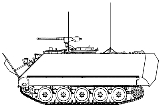
M113 Armored Personnel Carrier

Encyclopedia
The M113 is a fully tracked armored personnel carrier that has formed the backbone of the United States Army
's mechanized infantry
units from the time of its first fielding in Vietnam in April 1962. The M113 was the most widely used armored vehicle of the U.S. Army in the Vietnam War
, earning the nickname 'Green Dragon' by some people, but largely known as an APC and ACAV (armored cavalry assault vehicle) by the allied forces, as it was used to break through heavy thickets in the midst of the jungle to attack and overrun enemy positions.
The M113 introduced new aluminum armor that made the vehicle much lighter than earlier vehicles; it was thick enough to protect the crew and passengers against small arms fire but light enough that the vehicle was air transportable and moderately amphibious. In the U.S. Army, the M113 series have long been replaced as front-line combat vehicles by the M2 and M3 Bradley, but large numbers are still used in support roles such as armored ambulance, mortar carrier, engineer vehicle, command vehicle, etc. The Army's Heavy Brigade Combat Teams are currently equipped with around 6,000 M113s and 4,000 Bradleys.
The M113's versatility spawned a wide variety of adaptations that live on worldwide, and in U.S. service. These variants together represent about half of U.S. Army armored vehicles today. To date, it is estimated that over 80,000 M113s of all types have been produced and used by over 50 countries worldwide, making it one of the most widely used armored fighting vehicles of all time. The Military Channel's "Top Ten" series named the M113 the most significant infantry vehicle in history. The U.S. Army plans to retire the M113 family of vehicles by 2018 and is seeking replacement with the GCV Infantry Fighting Vehicle
program.
(FMC), which had produced the earlier M59 and M75
Armored personnel carriers. The M113 bore a very strong resemblance to both of these earlier vehicles. The M75 was too heavy and expensive to be useful; its weight prevented amphibious capability, and being transported by air. The lightened M59 addressed both of these problems, but ended up with too little armor, and was unreliable as a result of efforts to reduce its cost.
The Army was looking for a vehicle that combined the best features of both designs, the "Airborne Armored Multi-Purpose Vehicle Family" (AAM-PVF). of all-purpose, all-terrain armored fighting vehicles FMC had been working with Kaiser Aluminum and Chemical Co.
in the late 1950s to develop a suitable aluminum armor. Use of this armor could produce a vehicle that provided the protection of the M75, and the light weight and mobility of the M59.
FMC responded with two proposals; two versions of the aluminum T113 - a thicker and a thinner armored one - along with the similar but mostly steel T117. The thicker-armored version of the T113, effectively the prototype of the M113, was chosen because it weighed less than the steel competitor, while offering the same level of protection. An improved T113 design, the T113E1, was adopted by the U.S. Army in 1960 as the M113. A diesel prototype T113E2 was put into production in 1964 as the M113A1, and quickly supplanted the gasoline-engined M113.
In 1994, FMC transferred the M113's production over to its newly formed defense subsidiary, United Defense
. Then in 2005, United Defense was acquired by BAE
.
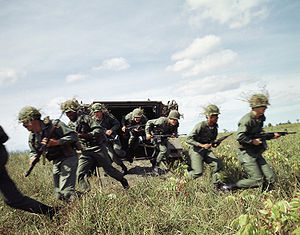 The M113 was developed to provide a survivable and reliable light tracked vehicle able to be air-lifted and air-dropped, by C-130 and C-141 transport planes. The original concept was that the vehicle would be used solely for transportation, bringing the troops forward under armor and then having them dismount for combat; the M113 would then retreat to the rear. Entering service with the U.S. Army in 1960, the M113 required only two crewmen, a driver and a commander, and carried 11 passengers inside the vehicle. Its main armament was a single .50-caliber (12.7 mm) M2 Browning machine gun operated by the commander.
On 30 March 1962, the first batch of 32 M113s arrived in Vietnam, and were sent to two Army of the Republic of Vietnam
(ARVN) mechanized rifle companies, each equipped with 15 of the APCs (M113s). On 11 June 1962, the two mechanized units were fielded for the first time. During the Battle of Ap Bac
in January 1963, at least fourteen of the exposed .50 caliber gunners aboard the M113s were killed in action, necessitating modifications to improve crew survivability. Soon, makeshift shields formed from metal salvaged from the hull(s) of sunken ships were fitted to the carriers, which afforded better protection. But, finding that this material could be penetrated by small arms fire, subsequent shields were constructed from scrapped armored vehicles.
The ARVN 80th Ordnance Unit in South Vietnam developed the shield idea further and commenced engineering general issue gun shields for the M113. These shields became the predecessor to the standardized Armored Cavalry Assault Vehicle (or ACAV) variant and were issued to all ARVN mechanized units during the early 1960s. The ARVNs had modified the M113s to function as "amphibious
light tanks" and not as battle taxis as US designers had intended. Instead of an armored personnel carrier, the ARVN used the carried infantry as extra "dismountable soldiers" in "an over-sized tank crew." These "ACAV" sets were eventually adapted to U.S. Army M113s with the arrival of the Army's conventional forces in 1965. The vehicles continued to operate in the role of a light tank and reconnaissance vehicle, and did not operate as designed in theatre. Still, the M113 could carry 11 infantrymen inside, with two crewmen operating the M113.
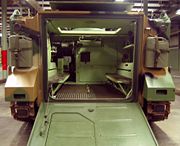 The U.S. Army, after berating the Vietnamese for flouting battle doctrine, came out with their own ACAV version. This more or less standardized ACAV kit included shields and a circular turret for the .50-caliber M2 machine gun in the Track Commander (TC) position, two M60 machine guns with shields for the left and right rear positions, and "belly armor" - steel armor bolted from the front bottom extending 1/2 to 2/3 of the way towards the bottom rear of the M113. The two rear machine gunners could fire their weapons while standing inside the rectangular open cargo hatch. This transformed the M113 into a fighting vehicle, but the vehicle still suffered from its lightly armored configuration, having never been designed for such a role.
In order to improve the fighting ability of the mounted troops, a number of experiments were carried out in the 1960s under MICV-65
project, which aimed to develop a true "infantry fighting vehicle" rather than an "armored personnel carrier". Pacific Car and Foundry entered the steel-armored XM701, but this proved to be too slow and too heavy to be airmobile, even in the C-141. FMC entered the XM734, which was largely the ACAV M113, but whereas the M113 seated the troops facing inward on benches along the walls, the XM734 sat them facing outwards on a central bench. Four gun ports and vision blocks were added on each side to allow the seated troops to fire even while under cover. Although neither the XM701 or XM734 were deemed worthwhile to produce, FMC continued development of their version as the XM765 Advanced Infantry Fighting Vehicle
(AIFV). The AIFV was sold to a number of third party-users in the 1970s, including the Netherlands
, the Philippines
and Belgium
.
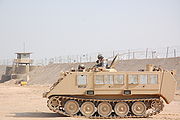 Modified versions of the Vietnam War
ACAV sets have been deployed to Iraq (formerly referred to as Southwest Asia
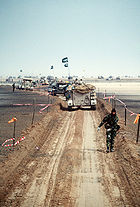
within the US military) to equip the standard M113s still in service. The circular .50 caliber gun shields have been modified, however the rear port and starboard gun stations have been deleted for service in that region. Some of these modified vehicles have been utilized for convoy escort duties.
The M113 has relatively light armor, but it can be augmented with add-on steel plates for improved ballistic protection. Also, reactive armor
and slat armor can be added for protection against RPGs. Windowed gunshields
developed by an armorer in Iraq
are reminiscent of ACAV vehicle modifications so effective in Southeast Asia
(Vietnam War
). Band tracks are in use by Canadian and other forces to enable stealthy operation, less damage to paved roads, and less vibration and rolling resistance.
Most of the 13,000 M113s which are still in U.S. Army service have been upgraded to the A3 variant.
The M113 has also been adopted to replace the aging fleet of visually modified (vismod
) M551s being used to simulate Russian-made combat vehicles at the U.S. Army's National Training Center in Fort Irwin, California
. These M113s, like the M551s they replaced, have also been modified to resemble enemy tanks and APCs, such as the T-80
and BMP-2
. One of the advantages of the M113 being used to simulate the latter is that the infantry squad can now ride inside the simulated BMP instead of in a truck accompanying a tank masquerading as one, as was often the case with the M551s.
, now using the M113 Armored Personnel Carrier. In addition, Armored Cavalry squadrons in Vietnam consisted largely of M113s, after replacing the intended M114 in a variety of roles, and Armor battalions contained M113s within their headquarters companies, such as the maintenance section, medical section, vehicle recovery section, mortar section, and the scout (reconnaissance) section. U.S. Army mechanized infantry
units in Vietnam were fully equipped with the M113 APC/ACAV, which consisted of one headquarters company and three line companies, normally with an authorized strength of approximately 900 men. Ten U.S. mechanized
infantry
battalions and one mechanized brigade were deployed to Vietnam from 1965 until their departure in 1972.2/2nd Mechanized Infantry
, 1/5th Mechanized Infantry
, 2/8th Mechanized Infantry, 1/16th Mechanized Infantry
, 2/22nd Mechanized Infantry, 4/23rd Mechanized Infantry
, 2/47th Mechanized Infantry, 1/50th Mechanized Infantry
, 5/60th Mechanized Infantry, 1/61st Mechanized Infantry
, and the 1st Brigade, 5th Infantry Division (Mechanized).
The U.S. Army 1st Brigade, 5th (Mech) Infantry Division in Vietnam was not composed of strictly mechanized infantry
battalions. The 5th (M) ID (1st Bde), consisted of: the 5/4th Field Artillery
, 1/11th Light Infantry
(straight leg-no armored vehicles), 1/77th Armor
(M48 Patton
tanks), 1/61st Mechanized Infantry
, "A" Troop" 4/12th Armored Cavalry (only one Troop of Cavalry), and the 3/5th Armored Cavalry OPCON (Operationally Controlled) /Attached from the 9th Infantry Division.
The one troop
of the 12th Armored Cavalry and the full squadron
of the 5th Armored Cavalry were M551 Sheridan
and M113 ACAV equipped.
M113s were instrumental in conducting RIFs (Reconnaissance In Force), Search and Destroy
missions, and large invasions (incursions) such as during the U.S. invasion of Cambodia on 1 May 1970 and later Laos (Operation Lam Son 719
) in 1971; all of which utilized the M113 as the primary work horse for moving the ground armies. While operating with Cavalry and Armor
units, the M113s often worked in conjunction with U.S. M48 Patton
and M551 Sheridan
tanks. During the Vietnam War, U.S. Army gun trucks (modified 2½-ton and 5-ton cargo trucks), along with V-100 armored cars, conducted convoy escorts for military traffic.
The USAF used M113 and M113A1 ACAV vehicles in USAF Security Police Squadrons, which provided air base ground defense support in Vietnam. M113s were also supplied to the South Vietnamese Army of the Republic of Vietnam
(ARVN). One notable ARVN unit equipped with the M113 APC, the 3d Armored Cavalry Squadron
, earned the Presidential Unit Citation. M113s were also supplied to the Cambodian Khmer National Armed Forces
, equipped with a turret for the machine gun and a recoilless rifle mounted on the roof.
The Australian Army
also used the M113 in Vietnam. After initial experience showed the crew commander was too vulnerable to fire, the Australians tried a number of different guns shields and turrets, eventually standardizing with the Cadillac-Cage T-50 turret fitted with two .30 cal Browning machine guns, or a single .30/single .50 combination. Other turrets were tried as were various gun shields, the main design of which was similar to the gun shield used on the U.S. M113 ACAV version.
In addition, the Australians operated an M113 variant fitted with a Saladin
armored car turret, with a 76 mm gun as a fire support vehicle, or FSV, for infantry fire support. This has now also been removed from service.
Subsequent to Vietnam all Australian M113 troop carriers were fitted with the T50 turret. The FSV was eventually phased out and replaced with a modernized version known as the MRV (medium reconnaissance vehicle). The MRV featured a Scorpion
turret with 76 mm gun, improved fire control, and passive night vision equipment.
compound.
The Osceola County Sheriff also uses one for their S.W.A.T Team.
 Today’s M113 fleet includes a mix of M113A2 and A3 variants and other derivatives equipped with the most recent RISE (Reliability Improvements for Selected Equipment) package. The standard RISE package includes an upgraded propulsion system (turbocharged engine and new transmission), greatly improved driver controls (new power brakes and conventional steering controls), external fuel tanks, and 200-amp alternator with four batteries. Additional A3 improvements include incorporation of spall liners and provisions for mounting external armor.
The future M113A3 fleet will include a number of vehicles that will have high speed digital networks and data transfer systems. The M113A3 digitization program includes applying appliqué hardware, software, and installation kits and hosting them in the M113 FOV.
employs the M113 in many different variants, all designed in Israel, and has given each of them official names, from the baseline "Bardelas" over the "Nagmash", "Nagman", and "Kasman" variants for urban combat up to the "Zelda" and "Zelda 2", which were fitted with ERA armor-suites. The Australian Army refers to its M113A1s as "Buckets", and the modified M113A1 fitted with 76 mm turrets as "Beasts". The German Army has various nicknames, depending on location and branch of service, including "Elephantshoe", "Tank Wedge" and "Bathtub".
While some claim the M113 has been nicknamed "Gavin" (after General James M. Gavin
), this is not an official designation. One observer said "I have never, never heard anybody use the name “Gavin” for the M-113. Not in the US nor in any of the many countries that use the vehicle. Not in the military forces, not in the companies that build and equip it, not in the groups that retrofit and repair it."
replace the M113 by 2018 with the GCV Infantry Fighting Vehicle
meanwhile displacing the other vehicles into task specific roles of the M113. Vehicles displaced into specific roles of the M113 are then to be replaced entirely by future variants of the GCV. If budget cuts don't postpone the program.
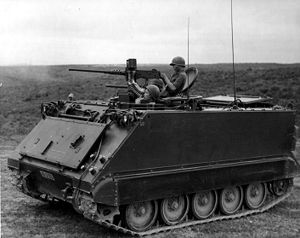
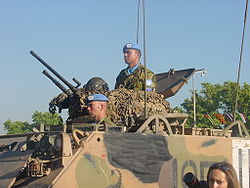 The basic M113 armored personnel carrier can itself be fitted with a number of weapon systems. The most common weapon fit is a single .50 caliber M2 machine gun. However, the mount can also be fitted with a 40 mm Mk 19
automatic grenade launcher. A number of anti-tank weapons could be fitted to the standard variant: the U.S. Army developed kits that allowed the M47 Dragon
and BGM-71 TOW
anti-tank missile systems to be mounted. In the case of the M47, the system mated to the existing machine gun mount, without having to remove the machine gun. This allowed the commander to use the weapon, as well as the machine gun. A large array of turrets and fixed mounts are available to mount high explosive cannon from 20mm to 105mm to the M113 series making them function also as assault guns and fire support means; while in many cases still having room inside to carry dismounted infantry or cavalry scouts.
, with an Allison tx100-1 3 speed automatic transmission, and allows the vehicle to carry a large payload cross-country and to be transported by fixed- and rotary-wing aircraft. The M113 can swim without deploying flotation curtains, and is propelled in the water by its tracks.
Original version, powered by 209 hp (156 kW) Chrysler 75M V8 petrol engine.
M113A1
Starting in 1964, the gasoline
engine was replaced with a 215 hp (160 kW) diesel engine, to take advantage of the better fuel economy and reduced fire hazard of the diesel engine. The suffix A1 was used on all variants to denote a diesel engine, i.e. an M106A1 was an M106 mortar carrier equipped with a diesel engine.
M113A2
In 1979 further upgrades were introduced, including cooling and suspension improvements and smoke grenade launchers on the glacis plate. The suffix A2 is used on all variants to denote upgrade to A2 standard.
M113A3
In 1987, further improvements for "enhanced (battlefield) survival" were introduced. This included a yoke for steering instead of laterals, a more powerful engine, external fuel tanks and internal spall liners for improved protection. The suffix A3 is used on all variants to denote upgrade to A3 standard.
M113 Armored Cavalry Assault Vehicle (ACAV) variant
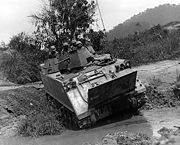 The "Armored Cavalry Assault Vehicle" or "ACAV", was a concept and field modification pioneered by the South Vietnamese Army (ARVN) in 1963 during the Vietnam war. ARVN troops utilized the M113 armored personnel carrier as an infantry fighting vehicle
, and more often than not, as a light tank
by fighting mounted rather than as a "battle taxi" as dictated by U.S. Army doctrine
.
After it was found that the commander and cargo hatch positions were extremely exposed and the commander and troops hence vulnerable to enemy fire, the South Vietnamese engineers thought out a simple and cheap remedy to this problem: Initially field expedient shields and mounts were made from sunken ships, but this was soft metal and could be penetrated by small arms
fire. Finally armor plate, from scrapped armored vehicles was used; this worked well, and by the end of 1964 all ARVN ACAVs were equipped with gun shields. For the US Army, ACAV sets were produced industrially in Okinawa for the .50 cal. machine gun, and rear aft and starboard M60 machine gun positions. Finally, the ARVN's ACAV modifications were adopted by the US Army in Vietnam, and by 1965 the full ACAV set was mass-produced in the U.S. The kit included shields and circular turret armor for the commander's M2 .50 caliber machine gun, and two additional 7.62 mm M60 machine guns, again with shields, fitted on either side of the top cargo hatch. This kit could be retrofitted to any M113. ACAV sets were sometimes fitted to the M106 mortar carrier
, but the different rear hatch found on this vehicle required the left M60 machine gun to be fitted to the extreme rear instead of the side. Many kits were added in the field, but at least in the case of the 11th Armored Cavalry Regiment, the vehicles had their ACAV sets installed in the U.S. prior to their deployment to Vietnam in 1966 from Ft. Meade, Maryland
. Additional armor in the form of a mine protective kit under the hull was also frequently fitted.
system
A smoke screen generator vehicle.
M106
A mortar carrier armed with an M30 mortar
mounted on a turntable in the rear troop compartment. On this variant, the single hatch over the rear troop compartment was exchanged for a three-part circular hatch. The mortar could be fired from the vehicle, but could also be fired dismounted. Today, the US Army mortar carrier is the M1064A3, an M106 upgraded to A3 standard armed with an M121 120 mm mortar, a variant of the M120 mortar.
M125
Another mortar carrier, basically an M106 armed with an M29
81 mm mortar.
M132
Flamethrower variant equipped with a turret armed with a flamethrower
and a .50 caliber machine gun. These vehicles are no longer used by the US Army. Vehicles upgraded to A1 standard were known as M132A1.
M163
Anti-aircraft variant equipped with a turret armed with a variant of the 20 mm M61 Vulcan
cannon.
M48 Chaparral
Anti-aircraft variant equipped with a launcher armed with four MIM-72A/M48 Chaparral missiles.
M548
Unarmored cargo carrier equipped with a rear cargo bed.
M577
Command variant, the roof over the rear troop compartment is higher. The vehicle also carries additional radios and a generator. A variant of this is the M1068 Standard Integrated Command Post System Carrier, equipped with the newest US Army automated command and control system.
M579
A fitter and repair vehicle equipped with a crane. This vehicle was not taken into US Army service.
M806
Repair and recovery vehicle equipped with an internal winch and two earth anchors mounted on the rear hull.
M901 ITV
(Improved TOW Vehicle)
Equipped with a launcher armed with two TOW missiles
.
M113 "MBT" (NTC)
A variant of the M113 fitted with a modified Bradley turret as part of a VISmod package specifically for training. This version also features MILES gear, a MGSS/TWGSS system, and fake ERA around the turret.
Others
A huge number of M113 variants have been created, ranging from infantry carriers to nuclear missile carriers. The M113 has become one of the most prolific armored vehicles of the second half of the 20th century, and continues to serve with armies around the world into the 21st century. Not without its faults, the otherwise versatile chassis of the M113 has been used to create almost every type of vehicle imaginable. Few vehicles ever created can claim the application to such a wide range of roles.
In 1994, a stretched version of the M113 was presented by its manufacturer, also known as "Mobile Tactical Vehicle Light" (MTVL). Its hull is lengthened by 34 inches and equipped with an additional road wheel (six on each side) to sustain the added dry weight and payload. The vehicle was developed as a "production-tooled demonstrator" with private-industry funding from United Defense. Although the US Army did not buy it, it was acquired by other nations, and is copied today by Pakistan, Turkey and Egypt in their local M113-producing plants. Some nations, like Canada or Australia, also stretched existing M113-hulls.
M113 Clones
Pakistan produces an armored personnel carrier known as Talha which has a number of mechanical and automotive parts in common with the M113. Turkey produces the ACV-300 based on the AIFV.
United States Army
The United States Army is the main branch of the United States Armed Forces responsible for land-based military operations. It is the largest and oldest established branch of the U.S. military, and is one of seven U.S. uniformed services...
's mechanized infantry
Mechanized infantry
Mechanized infantry are infantry equipped with armored personnel carriers , or infantry fighting vehicles for transport and combat ....
units from the time of its first fielding in Vietnam in April 1962. The M113 was the most widely used armored vehicle of the U.S. Army in the Vietnam War
Vietnam War
The Vietnam War was a Cold War-era military conflict that occurred in Vietnam, Laos, and Cambodia from 1 November 1955 to the fall of Saigon on 30 April 1975. This war followed the First Indochina War and was fought between North Vietnam, supported by its communist allies, and the government of...
, earning the nickname 'Green Dragon' by some people, but largely known as an APC and ACAV (armored cavalry assault vehicle) by the allied forces, as it was used to break through heavy thickets in the midst of the jungle to attack and overrun enemy positions.
The M113 introduced new aluminum armor that made the vehicle much lighter than earlier vehicles; it was thick enough to protect the crew and passengers against small arms fire but light enough that the vehicle was air transportable and moderately amphibious. In the U.S. Army, the M113 series have long been replaced as front-line combat vehicles by the M2 and M3 Bradley, but large numbers are still used in support roles such as armored ambulance, mortar carrier, engineer vehicle, command vehicle, etc. The Army's Heavy Brigade Combat Teams are currently equipped with around 6,000 M113s and 4,000 Bradleys.
The M113's versatility spawned a wide variety of adaptations that live on worldwide, and in U.S. service. These variants together represent about half of U.S. Army armored vehicles today. To date, it is estimated that over 80,000 M113s of all types have been produced and used by over 50 countries worldwide, making it one of the most widely used armored fighting vehicles of all time. The Military Channel's "Top Ten" series named the M113 the most significant infantry vehicle in history. The U.S. Army plans to retire the M113 family of vehicles by 2018 and is seeking replacement with the GCV Infantry Fighting Vehicle
GCV Infantry Fighting Vehicle
The Ground Combat Vehicle Infantry Fighting Vehicle is an infantry fighting vehicle being developed for the U.S. Army. The program originated as the lead vehicle of the U.S. Army's Ground Combat Vehicle program coordinated by TACOM and spawned a parallel program coordinated by DARPA...
program.
Origins
The M113 was developed by Food Machinery Corp.FMC Corp.
FMC Corporation is a chemical manufacturing company headquartered in Philadelphia, Pennsylvania. FMC employs over 4,800 people world wide, and had gross revenues of US$3.115 billion in 2008.-The Bean Spray Pump Company:...
(FMC), which had produced the earlier M59 and M75
M75 (APC)
The M75 is a American armored personnel carrier that was produced between December 1952 and February 1954, and saw service in the Korean War. It was replaced in U.S. service by the smaller, cheaper, amphibious M59. The M75s were given as military aid to Belgium where they were used until the early...
Armored personnel carriers. The M113 bore a very strong resemblance to both of these earlier vehicles. The M75 was too heavy and expensive to be useful; its weight prevented amphibious capability, and being transported by air. The lightened M59 addressed both of these problems, but ended up with too little armor, and was unreliable as a result of efforts to reduce its cost.
The Army was looking for a vehicle that combined the best features of both designs, the "Airborne Armored Multi-Purpose Vehicle Family" (AAM-PVF). of all-purpose, all-terrain armored fighting vehicles FMC had been working with Kaiser Aluminum and Chemical Co.
Kaiser Aluminum
Kaiser Aluminum is an American aluminum producer. The company was founded in 1946 by American industrialist Henry J. Kaiser. Kaiser entered the aluminum business by leasing, then purchasing three government-owned aluminum facilities in Washington state. These were the primary reduction plants at...
in the late 1950s to develop a suitable aluminum armor. Use of this armor could produce a vehicle that provided the protection of the M75, and the light weight and mobility of the M59.
FMC responded with two proposals; two versions of the aluminum T113 - a thicker and a thinner armored one - along with the similar but mostly steel T117. The thicker-armored version of the T113, effectively the prototype of the M113, was chosen because it weighed less than the steel competitor, while offering the same level of protection. An improved T113 design, the T113E1, was adopted by the U.S. Army in 1960 as the M113. A diesel prototype T113E2 was put into production in 1964 as the M113A1, and quickly supplanted the gasoline-engined M113.
In 1994, FMC transferred the M113's production over to its newly formed defense subsidiary, United Defense
United Defense
United Defense Industries was a United States defense contractor which is now part of BAE Systems Land and Armaments. This company produces combat vehicles, artillery, naval guns, missile launchers and precision munitions.-History:...
. Then in 2005, United Defense was acquired by BAE
BAE
BAE Systems, a British defence, security and aerospace companyBAE may also refer to:*British Aerospace , a UK aircraft, munitions and defence-systems manufacturer...
.
On 30 March 1962, the first batch of 32 M113s arrived in Vietnam, and were sent to two Army of the Republic of Vietnam
Army of the Republic of Vietnam
The Army of the Republic of Viet Nam , sometimes parsimoniously referred to as the South Vietnamese Army , was the land-based military forces of the Republic of Vietnam , which existed from October 26, 1955 until the fall of Saigon on April 30, 1975...
(ARVN) mechanized rifle companies, each equipped with 15 of the APCs (M113s). On 11 June 1962, the two mechanized units were fielded for the first time. During the Battle of Ap Bac
Battle of Ap Bac
The Battle of Ap Bac was a major battle fought on January 3, 1963, during the Vietnam War. It was fought in Dinh Tuong Province , South Vietnam. On December 28, 1962, U.S...
in January 1963, at least fourteen of the exposed .50 caliber gunners aboard the M113s were killed in action, necessitating modifications to improve crew survivability. Soon, makeshift shields formed from metal salvaged from the hull(s) of sunken ships were fitted to the carriers, which afforded better protection. But, finding that this material could be penetrated by small arms fire, subsequent shields were constructed from scrapped armored vehicles.
The ARVN 80th Ordnance Unit in South Vietnam developed the shield idea further and commenced engineering general issue gun shields for the M113. These shields became the predecessor to the standardized Armored Cavalry Assault Vehicle (or ACAV) variant and were issued to all ARVN mechanized units during the early 1960s. The ARVNs had modified the M113s to function as "amphibious
Amphibious vehicle
An amphibious vehicle , is a vehicle or craft, that is a means of transport, viable on land as well as on water – just like an amphibian....
light tanks" and not as battle taxis as US designers had intended. Instead of an armored personnel carrier, the ARVN used the carried infantry as extra "dismountable soldiers" in "an over-sized tank crew." These "ACAV" sets were eventually adapted to U.S. Army M113s with the arrival of the Army's conventional forces in 1965. The vehicles continued to operate in the role of a light tank and reconnaissance vehicle, and did not operate as designed in theatre. Still, the M113 could carry 11 infantrymen inside, with two crewmen operating the M113.
In order to improve the fighting ability of the mounted troops, a number of experiments were carried out in the 1960s under MICV-65
MICV-65
MICV-65, short for Mechanized Infantry Combat Vehicle, 1965, was a US Army project that studied a number of armored fighting vehicles that would replace the M113 and M114 as well as take on a variety of new roles. A number of designs were studied as part of the MICV project, but none of the entered...
project, which aimed to develop a true "infantry fighting vehicle" rather than an "armored personnel carrier". Pacific Car and Foundry entered the steel-armored XM701, but this proved to be too slow and too heavy to be airmobile, even in the C-141. FMC entered the XM734, which was largely the ACAV M113, but whereas the M113 seated the troops facing inward on benches along the walls, the XM734 sat them facing outwards on a central bench. Four gun ports and vision blocks were added on each side to allow the seated troops to fire even while under cover. Although neither the XM701 or XM734 were deemed worthwhile to produce, FMC continued development of their version as the XM765 Advanced Infantry Fighting Vehicle
AIFV
The AIFV is a tracked light armored vehicle which serves as an infantry fighting vehicle in the armies of several countries. It is a development of the M113A1 armored personnel carrier.-History:...
(AIFV). The AIFV was sold to a number of third party-users in the 1970s, including the Netherlands
Netherlands
The Netherlands is a constituent country of the Kingdom of the Netherlands, located mainly in North-West Europe and with several islands in the Caribbean. Mainland Netherlands borders the North Sea to the north and west, Belgium to the south, and Germany to the east, and shares maritime borders...
, the Philippines
Philippines
The Philippines , officially known as the Republic of the Philippines , is a country in Southeast Asia in the western Pacific Ocean. To its north across the Luzon Strait lies Taiwan. West across the South China Sea sits Vietnam...
and Belgium
Belgium
Belgium , officially the Kingdom of Belgium, is a federal state in Western Europe. It is a founding member of the European Union and hosts the EU's headquarters, and those of several other major international organisations such as NATO.Belgium is also a member of, or affiliated to, many...
.
Modifications
Vietnam War
The Vietnam War was a Cold War-era military conflict that occurred in Vietnam, Laos, and Cambodia from 1 November 1955 to the fall of Saigon on 30 April 1975. This war followed the First Indochina War and was fought between North Vietnam, supported by its communist allies, and the government of...
ACAV sets have been deployed to Iraq (formerly referred to as Southwest Asia
Southwest Asia
Western Asia, West Asia, Southwest Asia or Southwestern Asia are terms that describe the westernmost portion of Asia. The terms are partly coterminous with the Middle East, which describes a geographical position in relation to Western Europe rather than its location within Asia...
within the US military) to equip the standard M113s still in service. The circular .50 caliber gun shields have been modified, however the rear port and starboard gun stations have been deleted for service in that region. Some of these modified vehicles have been utilized for convoy escort duties.
The M113 has relatively light armor, but it can be augmented with add-on steel plates for improved ballistic protection. Also, reactive armor
Reactive armour
Reactive armour is a type of vehicle armour that reacts in some way to the impact of a weapon to reduce the damage done to the vehicle being protected. It is most effective in protecting against shaped charges and specially hardened long rod penetrators...
and slat armor can be added for protection against RPGs. Windowed gunshields
Transparent Armor Gun Shield
Built by BAE Systems, the Transparent Armor Gun shield, or TAGS, is a visually transparent protective gun shield for operators of vehicle-mounted machine guns. It borrows on the experience of the Israeli Defense Force in using such armor on a variety of vehicles. The shield is intended to provide...
developed by an armorer in Iraq
Iraq
Iraq ; officially the Republic of Iraq is a country in Western Asia spanning most of the northwestern end of the Zagros mountain range, the eastern part of the Syrian Desert and the northern part of the Arabian Desert....
are reminiscent of ACAV vehicle modifications so effective in Southeast Asia
Southeast Asia
Southeast Asia, South-East Asia, South East Asia or Southeastern Asia is a subregion of Asia, consisting of the countries that are geographically south of China, east of India, west of New Guinea and north of Australia. The region lies on the intersection of geological plates, with heavy seismic...
(Vietnam War
Vietnam War
The Vietnam War was a Cold War-era military conflict that occurred in Vietnam, Laos, and Cambodia from 1 November 1955 to the fall of Saigon on 30 April 1975. This war followed the First Indochina War and was fought between North Vietnam, supported by its communist allies, and the government of...
). Band tracks are in use by Canadian and other forces to enable stealthy operation, less damage to paved roads, and less vibration and rolling resistance.
Most of the 13,000 M113s which are still in U.S. Army service have been upgraded to the A3 variant.
The M113 has also been adopted to replace the aging fleet of visually modified (vismod
Vismod
The term vismod is an abbreviation of the term visually modified, and is used by the elements of the United States Department of Defense to refer to any vehicle, aircraft, or other object that has been altered to simulate equipment used by an enemy for training purposes, often by specialized units...
) M551s being used to simulate Russian-made combat vehicles at the U.S. Army's National Training Center in Fort Irwin, California
California
California is a state located on the West Coast of the United States. It is by far the most populous U.S. state, and the third-largest by land area...
. These M113s, like the M551s they replaced, have also been modified to resemble enemy tanks and APCs, such as the T-80
T-80
The T-80 is a main battle tank designed and manufactured in the former Soviet Union. A development of the T-64, it entered service in 1976 and was the first production tank to be equipped with a gas turbine engine for main propulsion.the Swedish Stridsvagn 103 of 1971 used a gas turbine alongside...
and BMP-2
BMP-2
The BMP-2 is a second-generation, amphibious infantry fighting vehicle introduced in the 1980s in the Soviet Union, following the BMP-1 of the 1960s....
. One of the advantages of the M113 being used to simulate the latter is that the infantry squad can now ride inside the simulated BMP instead of in a truck accompanying a tank masquerading as one, as was often the case with the M551s.
Vietnam
The Vietnam War was the first combat opportunity for "mechanized" infantry, a technically new type of infantry with its roots in the armored infantry of World War IIWorld War II
World War II, or the Second World War , was a global conflict lasting from 1939 to 1945, involving most of the world's nations—including all of the great powers—eventually forming two opposing military alliances: the Allies and the Axis...
, now using the M113 Armored Personnel Carrier. In addition, Armored Cavalry squadrons in Vietnam consisted largely of M113s, after replacing the intended M114 in a variety of roles, and Armor battalions contained M113s within their headquarters companies, such as the maintenance section, medical section, vehicle recovery section, mortar section, and the scout (reconnaissance) section. U.S. Army mechanized infantry
Mechanized infantry
Mechanized infantry are infantry equipped with armored personnel carriers , or infantry fighting vehicles for transport and combat ....
units in Vietnam were fully equipped with the M113 APC/ACAV, which consisted of one headquarters company and three line companies, normally with an authorized strength of approximately 900 men. Ten U.S. mechanized
Mechanized
Mechanized refers to the use of machines. Related articles:*Mechanised agriculture*Mechanization* For "Mechanized artillery", see Self-propelled artillery* For "Mechanized force" and "Mechanized warfare", see Armoured warfare*Mechanized infantry...
infantry
Infantry
Infantrymen are soldiers who are specifically trained for the role of fighting on foot to engage the enemy face to face and have historically borne the brunt of the casualties of combat in wars. As the oldest branch of combat arms, they are the backbone of armies...
battalions and one mechanized brigade were deployed to Vietnam from 1965 until their departure in 1972.2/2nd Mechanized Infantry
2nd Infantry Regiment (United States)
The 2nd Infantry Regiment is an infantry regiment in the United States Army. It has served the United States for more than two hundred years. It is the third oldest regiment in the US Army with a Lineage date of 1808 and a history extending back to 1791...
, 1/5th Mechanized Infantry
5th Infantry Regiment (United States)
The 5th Infantry Regiment is the third-oldest infantry regiment of the United States Army, tracing its origins to 1808...
, 2/8th Mechanized Infantry, 1/16th Mechanized Infantry
16th Infantry Regiment (United States)
The 16th Infantry Regiment is a regiment in the United States Army.-Formation:The 34th Infantry Regiment and 11th Infantry Regiment consolidated into the 16th Infantry Regiment on 3 March 1869. The 11th Infantry's history prior to the consolidation is normally included with the 16th's.-U.S...
, 2/22nd Mechanized Infantry, 4/23rd Mechanized Infantry
23rd Infantry Regiment (United States)
The 23rd Infantry Regiment is an infantry regiment in the United States Army originally formed on June 26th 1812. The 23rd saw action in 14 battles during the War of 1812...
, 2/47th Mechanized Infantry, 1/50th Mechanized Infantry
50th Infantry Regiment (United States)
The 50th Infantry Regiment is a United States Army infantry regiment.-Lineage:*Constituted 15 May 1917 in the Regular Army as the 50th Infantry.*Organized 1 June 1917 at Syracuse, New York.*Assigned 31 July 1918 to the 20th Division....
, 5/60th Mechanized Infantry, 1/61st Mechanized Infantry
61st Infantry Regiment (United States)
The 61st Infantry Regiment is an infantry regiment of the United States Army traditionally associated with the 5th Infantry Division.-History:The regiment's camaign honors include Vietnam War...
, and the 1st Brigade, 5th Infantry Division (Mechanized).
The U.S. Army 1st Brigade, 5th (Mech) Infantry Division in Vietnam was not composed of strictly mechanized infantry
Mechanized infantry
Mechanized infantry are infantry equipped with armored personnel carriers , or infantry fighting vehicles for transport and combat ....
battalions. The 5th (M) ID (1st Bde), consisted of: the 5/4th Field Artillery
4th Field Artillery Regiment (United States)
The 4th Field Artillery Regiment is an Field Artillery regiment of the United States Army first formed in 1907.-History:The 4th Field Artillery Regiment was first activated in 1907 from numbered companies of artillery...
, 1/11th Light Infantry
11th Infantry Regiment (United States)
The 11th Infantry Regiment is a regiment in the United States Army.-The First 11th Infantry:Under the authority granted the President by the Act of July 16, 1798, to raise twelve additional regiments of infantry, the first 11th Infantry came into existence in the Army of the United States in...
(straight leg-no armored vehicles), 1/77th Armor
77th Armor Regiment (United States)
The 77th Armor is an armored regiment of the United States Army. The 77th Armor Regiment is part of the U.S. Army Regimental System with only a single battalion, the 1st Battalion, 77th Armor Regiment, and is therefore classified as both a single battalion, and the remainder of the Regiment itself...
(M48 Patton
M48 Patton
The M48 Patton is a medium tank that was designed in the United States. It was the third and final tank to be officially named after General George S. Patton, commander of the U.S. Third Army during World War II and one of the earliest American advocates for the use of tanks in battle It was a...
tanks), 1/61st Mechanized Infantry
61st Infantry Regiment (United States)
The 61st Infantry Regiment is an infantry regiment of the United States Army traditionally associated with the 5th Infantry Division.-History:The regiment's camaign honors include Vietnam War...
, "A" Troop" 4/12th Armored Cavalry (only one Troop of Cavalry), and the 3/5th Armored Cavalry OPCON (Operationally Controlled) /Attached from the 9th Infantry Division.
The one troop
Troop
A troop is a military unit, originally a small force of cavalry, subordinate to a squadron and headed by the troop leader. In many armies a troop is the equivalent unit to the infantry section or platoon...
of the 12th Armored Cavalry and the full squadron
Squadron (cavalry)
A squadron was historically a cavalry sub unit. It is still used to refer to modern cavalry units but can also be used as a designation for other arms and services.-United States:...
of the 5th Armored Cavalry were M551 Sheridan
M551 Sheridan
The M551 Sheridan was a light tank developed by the United States and named after Civil War General Philip Sheridan. It was designed to be landed by parachute and to swim across rivers. It was armed with the technically advanced but troublesome M81/M81E1 152mm gun/launcher which fired conventional...
and M113 ACAV equipped.
M113s were instrumental in conducting RIFs (Reconnaissance In Force), Search and Destroy
Search and destroy
Search and Destroy, Seek and Destroy, or even simply S&D, refers to a military strategy that became a notorious component of the Vietnam War. The idea was to insert ground forces into hostile territory, search out the enemy, destroy them, and withdraw immediately afterward...
missions, and large invasions (incursions) such as during the U.S. invasion of Cambodia on 1 May 1970 and later Laos (Operation Lam Son 719
Operation Lam Son 719
Operation Lam Son 719 was a limited-objective offensive campaign conducted in southeastern portion of the Kingdom of Laos by the armed forces of the Republic of Vietnam between 8 February and 25 March 1971, during the Vietnam War...
) in 1971; all of which utilized the M113 as the primary work horse for moving the ground armies. While operating with Cavalry and Armor
Armoured warfare
Armoured warfare or tank warfare is the use of armoured fighting vehicles in modern warfare. It is a major component of modern methods of war....
units, the M113s often worked in conjunction with U.S. M48 Patton
M48 Patton
The M48 Patton is a medium tank that was designed in the United States. It was the third and final tank to be officially named after General George S. Patton, commander of the U.S. Third Army during World War II and one of the earliest American advocates for the use of tanks in battle It was a...
and M551 Sheridan
M551 Sheridan
The M551 Sheridan was a light tank developed by the United States and named after Civil War General Philip Sheridan. It was designed to be landed by parachute and to swim across rivers. It was armed with the technically advanced but troublesome M81/M81E1 152mm gun/launcher which fired conventional...
tanks. During the Vietnam War, U.S. Army gun trucks (modified 2½-ton and 5-ton cargo trucks), along with V-100 armored cars, conducted convoy escorts for military traffic.
The USAF used M113 and M113A1 ACAV vehicles in USAF Security Police Squadrons, which provided air base ground defense support in Vietnam. M113s were also supplied to the South Vietnamese Army of the Republic of Vietnam
Army of the Republic of Vietnam
The Army of the Republic of Viet Nam , sometimes parsimoniously referred to as the South Vietnamese Army , was the land-based military forces of the Republic of Vietnam , which existed from October 26, 1955 until the fall of Saigon on April 30, 1975...
(ARVN). One notable ARVN unit equipped with the M113 APC, the 3d Armored Cavalry Squadron
3d Armored Cavalry Squadron (South Vietnam)
The 3d Armored Cavalry Squadron of the Army of the Republic of Vietnam — the army of the nation state of South Vietnam that existed from 1955 to 1975 — was part of II Corps that oversaw the twelve provinces of the central highlands; corps headquarters being in the mountain town of Pleiku...
, earned the Presidential Unit Citation. M113s were also supplied to the Cambodian Khmer National Armed Forces
Khmer National Armed Forces
The Khmer National Armed Forces , often abbreviated to FANK, were the official armed defense forces of the Khmer Republic, a short-lived state that existed from 1970 to 1975, known today as Cambodia...
, equipped with a turret for the machine gun and a recoilless rifle mounted on the roof.
The Australian Army
Australian Army
The Australian Army is Australia's military land force. It is part of the Australian Defence Force along with the Royal Australian Navy and the Royal Australian Air Force. While the Chief of Defence commands the Australian Defence Force , the Army is commanded by the Chief of Army...
also used the M113 in Vietnam. After initial experience showed the crew commander was too vulnerable to fire, the Australians tried a number of different guns shields and turrets, eventually standardizing with the Cadillac-Cage T-50 turret fitted with two .30 cal Browning machine guns, or a single .30/single .50 combination. Other turrets were tried as were various gun shields, the main design of which was similar to the gun shield used on the U.S. M113 ACAV version.
In addition, the Australians operated an M113 variant fitted with a Saladin
Alvis Saladin
The Saladin is a six-wheeled armoured car built by Alvis, and fitted with a 76mm gun.Used extensively by the British Army, it replaced the AEC Armoured Car that had been in service since World War II.-History:...
armored car turret, with a 76 mm gun as a fire support vehicle, or FSV, for infantry fire support. This has now also been removed from service.
Subsequent to Vietnam all Australian M113 troop carriers were fitted with the T50 turret. The FSV was eventually phased out and replaced with a modernized version known as the MRV (medium reconnaissance vehicle). The MRV featured a Scorpion
FV101 Scorpion
The FV101 Scorpion is a British armoured reconnaissance vehicle. It was the lead vehicle and the fire support type in the Combat Vehicle Reconnaissance , CVR, family of seven armoured vehicles...
turret with 76 mm gun, improved fire control, and passive night vision equipment.
Law enforcement
M113s have been adopted by some law enforcement agencies. Photos show an M113 marked "Midland County Sheriff" was used in the 2008 raid of the Fundamentalist Church of Jesus Christ of Latter Day SaintsFundamentalist Church of Jesus Christ of Latter Day Saints
The Fundamentalist Church of Jesus Christ of Latter-Day Saints is one of the largest Mormon fundamentalist denominations and one of the largest organizations in the United States whose members practice polygamy. The FLDS Church emerged in the early twentieth century when its founding members left...
compound.
The Osceola County Sheriff also uses one for their S.W.A.T Team.
Recent history
The future M113A3 fleet will include a number of vehicles that will have high speed digital networks and data transfer systems. The M113A3 digitization program includes applying appliqué hardware, software, and installation kits and hosting them in the M113 FOV.
Nicknames
The M113 has received a variety of nicknames over the years. The South Vietnamese Army (ARVN) called it the "Green Dragon". U.S. troops tended to refer to the M113 simply as a "track" or an ACAV. The IDFIsrael Defense Forces
The Israel Defense Forces , commonly known in Israel by the Hebrew acronym Tzahal , are the military forces of the State of Israel. They consist of the ground forces, air force and navy. It is the sole military wing of the Israeli security forces, and has no civilian jurisdiction within Israel...
employs the M113 in many different variants, all designed in Israel, and has given each of them official names, from the baseline "Bardelas" over the "Nagmash", "Nagman", and "Kasman" variants for urban combat up to the "Zelda" and "Zelda 2", which were fitted with ERA armor-suites. The Australian Army refers to its M113A1s as "Buckets", and the modified M113A1 fitted with 76 mm turrets as "Beasts". The German Army has various nicknames, depending on location and branch of service, including "Elephantshoe", "Tank Wedge" and "Bathtub".
While some claim the M113 has been nicknamed "Gavin" (after General James M. Gavin
James M. Gavin
James Maurice "Jumpin' Jim" Gavin was a prominent Lieutenant General in the United States Army during World War II...
), this is not an official designation. One observer said "I have never, never heard anybody use the name “Gavin” for the M-113. Not in the US nor in any of the many countries that use the vehicle. Not in the military forces, not in the companies that build and equip it, not in the groups that retrofit and repair it."
Replacement
It is the U.S Army's intention that the BCT Ground Combat Vehicle ProgramBCT Ground Combat Vehicle Program
The Ground Combat Vehicle is the U.S. Army's replacement program for armored fighting vehicles in Heavy and Stryker brigade combat teams. The GCV is organized under the Follow On Incremental Capabilities Package of the BCT Modernization program. The first variant of the vehicle is to be prototyped...
replace the M113 by 2018 with the GCV Infantry Fighting Vehicle
GCV Infantry Fighting Vehicle
The Ground Combat Vehicle Infantry Fighting Vehicle is an infantry fighting vehicle being developed for the U.S. Army. The program originated as the lead vehicle of the U.S. Army's Ground Combat Vehicle program coordinated by TACOM and spawned a parallel program coordinated by DARPA...
meanwhile displacing the other vehicles into task specific roles of the M113. Vehicles displaced into specific roles of the M113 are then to be replaced entirely by future variants of the GCV. If budget cuts don't postpone the program.
Armament
Mk 19 grenade launcher
The Mk 19 Grenade Launcher is a 40 mm belt-fed automatic grenade launcher or grenade machine gun that entered U.S. military service during the Cold War, first seeing action during the Vietnam War and remaining in service today.-Overview:...
automatic grenade launcher. A number of anti-tank weapons could be fitted to the standard variant: the U.S. Army developed kits that allowed the M47 Dragon
M47 Dragon
The M47 Dragon is an American shoulder-fired, man-portable anti-tank missile system. It has since been phased out in US service, in favor of the newer FGM-148 Javelin system.-Description:...
and BGM-71 TOW
BGM-71 TOW
The BGM-71 TOW is an anti-tank missile. "BGM" is a weapon classification that stands for "Multiple Environment , Surface-Attack , Missile ". "TOW" is an acronym that stands for "Tube-launched, Optically-tracked, Wire command data link, guided missile"...
anti-tank missile systems to be mounted. In the case of the M47, the system mated to the existing machine gun mount, without having to remove the machine gun. This allowed the commander to use the weapon, as well as the machine gun. A large array of turrets and fixed mounts are available to mount high explosive cannon from 20mm to 105mm to the M113 series making them function also as assault guns and fire support means; while in many cases still having room inside to carry dismounted infantry or cavalry scouts.
Armor
The 10.5-ton M113 is built of 5083 aircraft-quality aluminum alloy which gives it some of the same strength as steel at a slightly reduced weight, as the greater thickness allows structural stiffness.Mobility
Its weight allows the use of a relatively small engine to power the vehicle, a 6V53 Detroit 2-stroke six cylinder dieselDiesel engine
A diesel engine is an internal combustion engine that uses the heat of compression to initiate ignition to burn the fuel, which is injected into the combustion chamber...
, with an Allison tx100-1 3 speed automatic transmission, and allows the vehicle to carry a large payload cross-country and to be transported by fixed- and rotary-wing aircraft. The M113 can swim without deploying flotation curtains, and is propelled in the water by its tracks.
Basic variants
M113Original version, powered by 209 hp (156 kW) Chrysler 75M V8 petrol engine.
M113A1
Starting in 1964, the gasoline
Gasoline
Gasoline , or petrol , is a toxic, translucent, petroleum-derived liquid that is primarily used as a fuel in internal combustion engines. It consists mostly of organic compounds obtained by the fractional distillation of petroleum, enhanced with a variety of additives. Some gasolines also contain...
engine was replaced with a 215 hp (160 kW) diesel engine, to take advantage of the better fuel economy and reduced fire hazard of the diesel engine. The suffix A1 was used on all variants to denote a diesel engine, i.e. an M106A1 was an M106 mortar carrier equipped with a diesel engine.
M113A2
In 1979 further upgrades were introduced, including cooling and suspension improvements and smoke grenade launchers on the glacis plate. The suffix A2 is used on all variants to denote upgrade to A2 standard.
M113A3
In 1987, further improvements for "enhanced (battlefield) survival" were introduced. This included a yoke for steering instead of laterals, a more powerful engine, external fuel tanks and internal spall liners for improved protection. The suffix A3 is used on all variants to denote upgrade to A3 standard.
M113 Armored Cavalry Assault Vehicle (ACAV) variant
Infantry fighting vehicle
An infantry fighting vehicle , also known as a mechanized infantry combat vehicle , is a type of armoured fighting vehicle used to carry infantry into battle and provide fire support for them...
, and more often than not, as a light tank
Light tank
A light tank is a tank variant initially designed for rapid movement, and now primarily employed in low-intensity conflict. Early light tanks were generally armed and armored similar to an armored car, but used tracks in order to provide better cross-country mobility.The light tank was a major...
by fighting mounted rather than as a "battle taxi" as dictated by U.S. Army doctrine
Military doctrine
Military doctrine is the concise expression of how military forces contribute to campaigns, major operations, battles, and engagements.It is a guide to action, not hard and fast rules. Doctrine provides a common frame of reference across the military...
.
After it was found that the commander and cargo hatch positions were extremely exposed and the commander and troops hence vulnerable to enemy fire, the South Vietnamese engineers thought out a simple and cheap remedy to this problem: Initially field expedient shields and mounts were made from sunken ships, but this was soft metal and could be penetrated by small arms
Small arms
Small arms is a term of art used by armed forces to denote infantry weapons an individual soldier may carry. The description is usually limited to revolvers, pistols, submachine guns, carbines, assault rifles, battle rifles, multiple barrel firearms, sniper rifles, squad automatic weapons, light...
fire. Finally armor plate, from scrapped armored vehicles was used; this worked well, and by the end of 1964 all ARVN ACAVs were equipped with gun shields. For the US Army, ACAV sets were produced industrially in Okinawa for the .50 cal. machine gun, and rear aft and starboard M60 machine gun positions. Finally, the ARVN's ACAV modifications were adopted by the US Army in Vietnam, and by 1965 the full ACAV set was mass-produced in the U.S. The kit included shields and circular turret armor for the commander's M2 .50 caliber machine gun, and two additional 7.62 mm M60 machine guns, again with shields, fitted on either side of the top cargo hatch. This kit could be retrofitted to any M113. ACAV sets were sometimes fitted to the M106 mortar carrier
M106 mortar carrier
The M106 mortar carrier was a tracked, self-propelled artillery vehicle in service with the United States Army. It was replaced with the M1064 mortar carrier.-History:...
, but the different rear hatch found on this vehicle required the left M60 machine gun to be fitted to the extreme rear instead of the side. Many kits were added in the field, but at least in the case of the 11th Armored Cavalry Regiment, the vehicles had their ACAV sets installed in the U.S. prior to their deployment to Vietnam in 1966 from Ft. Meade, Maryland
Maryland
Maryland is a U.S. state located in the Mid Atlantic region of the United States, bordering Virginia, West Virginia, and the District of Columbia to its south and west; Pennsylvania to its north; and Delaware to its east...
. Additional armor in the form of a mine protective kit under the hull was also frequently fitted.
Derivatives
M58 WolfM58 Wolf
The M58 Wolf is an agile, armored mobile vehicle of the United States Army, capable of producing smoke screens to block both visual and infrared detection. Large area multispectral obscurant smoke screening is used to cover the tracks of troops and artillery.-Construction:The M58 system is made up...
system
A smoke screen generator vehicle.
M106
A mortar carrier armed with an M30 mortar
M30 107 mm Mortar
The M30 107 mm heavy mortar is an American rifled, muzzle-loading, high-angle-of-fire weapon used for long-range indirect fire support to infantry units.-Design:...
mounted on a turntable in the rear troop compartment. On this variant, the single hatch over the rear troop compartment was exchanged for a three-part circular hatch. The mortar could be fired from the vehicle, but could also be fired dismounted. Today, the US Army mortar carrier is the M1064A3, an M106 upgraded to A3 standard armed with an M121 120 mm mortar, a variant of the M120 mortar.
M125
Another mortar carrier, basically an M106 armed with an M29
M29 Mortar
The M29 is a United States produced 81 millimeter calibre mortar. It began replacing the M1 Mortar in U.S. service in 1952 being lighter and with greater range. It was replaced by the M252 Mortar in 1984...
81 mm mortar.
M132
Flamethrower variant equipped with a turret armed with a flamethrower
Flamethrower
A flamethrower is a mechanical device designed to project a long controllable stream of fire.Some flamethrowers project a stream of ignited flammable liquid; some project a long gas flame. Most military flamethrowers use liquids, but commercial flamethrowers tend to use high-pressure propane and...
and a .50 caliber machine gun. These vehicles are no longer used by the US Army. Vehicles upgraded to A1 standard were known as M132A1.
M163
M163 VADS
The M163 Vulcan Air Defense System is a self-propelled anti-aircraft gun that was used by the United States Army. The M168 gun is a variant of the General Dynamics 20 mm M61 Vulcan rotary cannon, the standard cannon in most US combat aircraft since the 1960s, mounted on either an armored...
Anti-aircraft variant equipped with a turret armed with a variant of the 20 mm M61 Vulcan
M61 Vulcan
The M61 Vulcan is a hydraulically or pneumatically driven, six-barreled, air-cooled, electrically fired Gatling-style rotary cannon which fires 20 mm rounds at an extremely high rate. The M61 and its derivatives have been the principal cannon armament of United States military fixed-wing aircraft...
cannon.
M48 Chaparral
Anti-aircraft variant equipped with a launcher armed with four MIM-72A/M48 Chaparral missiles.
M548
Unarmored cargo carrier equipped with a rear cargo bed.
M577
Command variant, the roof over the rear troop compartment is higher. The vehicle also carries additional radios and a generator. A variant of this is the M1068 Standard Integrated Command Post System Carrier, equipped with the newest US Army automated command and control system.
M579
A fitter and repair vehicle equipped with a crane. This vehicle was not taken into US Army service.
M806
Repair and recovery vehicle equipped with an internal winch and two earth anchors mounted on the rear hull.
M901 ITV
M901 ITV
The M901 ITV is a United States Army armored vehicle designed to carry a dual M220 TOW launcher. It is based on the ubiquitous M113 Armored Personnel Carrier chassis.- Equipment :...
(Improved TOW Vehicle)
Equipped with a launcher armed with two TOW missiles
BGM-71 TOW
The BGM-71 TOW is an anti-tank missile. "BGM" is a weapon classification that stands for "Multiple Environment , Surface-Attack , Missile ". "TOW" is an acronym that stands for "Tube-launched, Optically-tracked, Wire command data link, guided missile"...
.
M113 "MBT" (NTC)
A variant of the M113 fitted with a modified Bradley turret as part of a VISmod package specifically for training. This version also features MILES gear, a MGSS/TWGSS system, and fake ERA around the turret.
Others
A huge number of M113 variants have been created, ranging from infantry carriers to nuclear missile carriers. The M113 has become one of the most prolific armored vehicles of the second half of the 20th century, and continues to serve with armies around the world into the 21st century. Not without its faults, the otherwise versatile chassis of the M113 has been used to create almost every type of vehicle imaginable. Few vehicles ever created can claim the application to such a wide range of roles.
In 1994, a stretched version of the M113 was presented by its manufacturer, also known as "Mobile Tactical Vehicle Light" (MTVL). Its hull is lengthened by 34 inches and equipped with an additional road wheel (six on each side) to sustain the added dry weight and payload. The vehicle was developed as a "production-tooled demonstrator" with private-industry funding from United Defense. Although the US Army did not buy it, it was acquired by other nations, and is copied today by Pakistan, Turkey and Egypt in their local M113-producing plants. Some nations, like Canada or Australia, also stretched existing M113-hulls.
M113 Clones
Pakistan produces an armored personnel carrier known as Talha which has a number of mechanical and automotive parts in common with the M113. Turkey produces the ACV-300 based on the AIFV.
Operators
- 63: 130: 580 (Australian ArmyAustralian ArmyThe Australian Army is Australia's military land force. It is part of the Australian Defence Force along with the Royal Australian Navy and the Royal Australian Air Force. While the Chief of Defence commands the Australian Defence Force , the Army is commanded by the Chief of Army...
): 700 : 110 (Bangladesh ArmyBangladesh ArmyThe Bangladesh Army is the land forces branch and the largest of the three uniformed service of the Bangladesh Armed Forces. The primary mission of the Army is to provide necessary forces and capabilities in support of Bangladesh's security and defense strategies including defense of the nation's...
): 10 on active service (Belgian ArmyBelgian ArmyThe Land Component is organised using the concept of capacities, whereby units are gathered together according to their function and material. Within this framework, there are five capacities: the command capacity, the combat capacity, the support capacity, the services capacity and the training...
): 500: 16 (former Belgian): (Bolivian ArmyBolivian ArmyThe Bolivian Army or Ejército Boliviano is the land forces component of the Military of Bolivia, the Bolivian Army has around 31,500 men.- Combat units directly under the Army general command :...
): 50: 80 : Brazilian ArmyBrazilian ArmyThe Brazilian Army is the land arm of the Brazilian Military. The Brazilian Army has fought in several international conflicts, mostly in South America and during the 19th century, such as the Brazilian War of Independence , Argentina-Brazil War , War of the Farrapos , Platine War , Uruguayan War ...
: 584; Brazilian Marine CorpsBrazilian Marine CorpsThe Brazilian Marine Corps is the land combat branch of the Brazilian Navy.- Mission :...
: 29: 289 (Canadian Army) - 1,143 Purchased from the mid-1960s through the 1990s. Mostly declared surplus. 289 to be upgraded to various configurations and retained until 2020. (Chilean ArmyChilean ArmyThe Chilean Army is the land arm of the Military of Chile. This 45,000-person army is organized into seven divisions, a special operations brigade and an air brigade....
): 427: 120: 8 (One captured example marked "239943") - 12: 632 (Designated PMV, Pansret Mandskabsvogn, literally translated to APC. Slowly being replaced in the mechanized infantry by the CV90.): 2,950: 20: 110: 4,000: Over 2.500 (1900 M113A1/A2 APC,250+ Mortar carriers,300 M901A1/A2 ITV,70 M577A2,50 M113A1 Medic (New Iraqi Army): 283, plus a recent order for 440 refurbished M113A2s. It has been suggested that Iraq intends to buy a fleet of 1026. (Iranian Army): 200 (Israeli Defence Forces): 6,131 (Italian ArmyItalian ArmyThe Italian Army is the ground defence force of the Italian Armed Forces. It is all-volunteer force of active-duty personnel, numbering 108,355 in 2010. Its best-known combat vehicles are the Dardo infantry fighting vehicle, the Centauro tank destroyer and the Ariete tank, and among its aircraft...
): 3,000+ (Slowly being replaced by the Dardo IFVDardo IFVThe Dardo is a infantry fighting vehicle designed for the Italian Army as a replacement for the M113 APC. It is designed and built by the Iveco Fiat Oto Melara Syndicated Company based in Rome...
and Lince VTML): 1300 (South Korean ArmyRepublic of Korea ArmyThe Republic of Korea Army is the largest of the military branches of the South Korean armed forces with 520,000 members as of 2010...
): 400: 80 (Lebanese ArmyLebanese Armed ForcesThe Lebanese Armed Forces or Forces Armées Libanaises in French, also known as the Lebanese Army according to its official Website The Lebanese Armed Forces (LAF) (Arabic: القوات المسلحة اللبنانية | Al-Quwwāt al-Musallaḥa al-Lubnāniyya) or Forces Armées Libanaises in French, also known as the...
) 1100+
- One M577 converted to IFVInfantry fighting vehicleAn infantry fighting vehicle , also known as a mechanized infantry combat vehicle , is a type of armoured fighting vehicle used to carry infantry into battle and provide fire support for them...
with added 2A28 Grom turret taken from BMP-1. (Lithuanian Land Force): 210 (as of 2008)- Overall 361 items were transferred from GermanyGermanyGermany , officially the Federal Republic of Germany , is a federal parliamentary republic in Europe. The country consists of 16 states while the capital and largest city is Berlin. Germany covers an area of 357,021 km2 and has a largely temperate seasonal climate...
between 2000 and 2006.: 383: 30 (Royal Netherlands ArmyRoyal Netherlands ArmyThe Royal Netherlands Army is the land forces element of the military of the Netherlands.-Short history:The Royal Netherlands Army was raised on 9 January 1814, but its origins date back to 1572, when the so-called Staatse Leger was raised...
), (Royal Marechaussee): replaced with YPR-765 (New Zealand ArmyNew Zealand ArmyThe New Zealand Army , is the land component of the New Zealand Defence Force and comprises around 4,500 Regular Force personnel, 2,000 Territorial Force personnel and 500 civilians. Formerly the New Zealand Military Forces, the current name was adopted around 1946...
): 120 (Replaced with NZLAV lll) (Norwegian ArmyNorwegian ArmyNorway achieved full independence in 1905, and in the first century of its short life has contributed to two major conflicts, the Cold War and the War on Terror. The Norwegian Army currently operates in the north of Norway and in Afghanistan as well as in Eastern Europe. The Army is the oldest of...
): 900: 1,600+: 130:Philippine ArmyPhilippine ArmyThe Philippine Army is the ground arm of the Armed Forces of the Philippines . Its official name in Tagalog is Hukbong Katihan ng Pilipinas. On July 23, 2010, President Benigno Aquino III appointed Maj. Gen...
100+ (Polish Land ForcesPolish Land ForcesThe Polish Land Forces are a branch of Poland's Armed Forces. They currently contain some 65,000 active personnel and form many components of EU and NATO deployments around the world.-History:...
): 35 (command and medical evacuation variants) (Portuguese ArmyPortuguese ArmyThe Portuguese Army is the ground branch of the Portuguese Armed Forces which, in co-operation with other branches of the Portuguese military, is charged with the defence of Portugal...
) (Saudi Arabian ArmySaudi Arabian ArmyThe Saudi Arabian Army , also called Royal Saudi Land Force . Is a branch of the Saudi Armed Forces. The total number of active troops is estimated to be 233,500The current Chief of the Saudi General Staff is Field Marshal Saleh Al-Muhaya....
), (Saudi National Guard): 3,000 (Singapore Armed ForcesSingapore Armed ForcesThe Singapore Armed Forces is the military arm of the Total Defence of the Republic of Singapore; as well as the military component of the Ministry of Defence. The SAF comprises three branches: the Singapore Army, the Republic of Singapore Air Force and the Republic of Singapore Navy...
): 1,200 (being replaced by Bionix AFVBionix AFVThe Bionix is a family of tracked Singaporean armoured fighting vehicles developed by Singapore Technologies Kinetics . Intended to augment the Singapore Army's aging M113 armoured personnel carriers, it is the first indigenous armoured vehicle to be developed in Southeast Asia...
s): 860 (being replaced by the Pizarro IFVASCOD AFVThe ASCOD armoured fighting vehicle family is the product of a cooperation agreement between Austrian Steyr-Daimler-Puch AG and Spanish Santa Bárbara Sistemas The ASCOD (Austrian Spanish Cooperation Development) armoured fighting vehicle family is the product of a cooperation agreement between...
): 1 (for evaluation): 400 (Republic of China ArmyRepublic of China ArmyThe ROC Army's current operational strength includes 3 armies, 5 corps. As of 2005, the Army's 35 brigades include 25 infantry brigades, 5 armoured brigades and 3 mechanized infantry brigades...
): 675 : 385: 120: 3,000+ (Slowly Replacing with ACV-300): 6 (used in the Congo 1963–1964): 6000 - The M113 is also used by NASANASAThe National Aeronautics and Space Administration is the agency of the United States government that is responsible for the nation's civilian space program and for aeronautics and aerospace research...
for emergency evacuation of astronautAstronautAn astronaut or cosmonaut is a person trained by a human spaceflight program to command, pilot, or serve as a crew member of a spacecraft....
s during a launch pad emergency, as well as some police SWATSWATA SWAT team is an elite tactical unit in various national law enforcement departments. They are trained to perform high-risk operations that fall outside of the abilities of regular officers...
units, like the Phoenix, ArizonaPhoenix, ArizonaPhoenix is the capital, and largest city, of the U.S. state of Arizona, as well as the sixth most populated city in the United States. Phoenix is home to 1,445,632 people according to the official 2010 U.S. Census Bureau data...
police department.: 24: 750: 670
- Overall 361 items were transferred from Germany
Former operators
 Army of Free LebanonArmy of Free LebanonThe Army of Free Lebanon – AFL or ‘Colonel Barakat’s Army’ , also designated Armée du Liban Libre or ‘Armée du Colonel Barakat’ in French, was a predominantely Christian splinter faction of the Lebanese Army that came to play a major role in the 1975-77 phase of the Lebanese Civil War.-Emblem:Upon...
 Amal MovementAmal MovementAmal Movement is short for the Lebanese Resistance Detachments the acronym for which, in Arabic, is "amal", meaning "hope."Amal was founded in 1975 as the militia wing of the Movement of the Disinherited, a Shi'a political movement founded by Musa...
(Forces Armées Nationales Khmères - FANK), (Khmer RougeKhmer RougeThe Khmer Rouge literally translated as Red Cambodians was the name given to the followers of the Communist Party of Kampuchea, who were the ruling party in Cambodia from 1975 to 1979, led by Pol Pot, Nuon Chea, Ieng Sary, Son Sen and Khieu Samphan...
), (Royal Cambodian Army): 210, only 20 are known to be fully operational. East Germany Vehicles captured by North VietnamNorth VietnamThe Democratic Republic of Vietnam , was a communist state that ruled the northern half of Vietnam from 1954 until 1976 following the Geneva Conference and laid claim to all of Vietnam from 1945 to 1954 during the First Indochina War, during which they controlled pockets of territory throughout...
from ARVN, passed on to the GDR.- Hezbollah
- Kataeb Regulatory ForcesKataeb Regulatory ForcesThe Kataeb Regulatory Forces – KRF or RF , Forces Regulatoires du Kataeb in French were the military wing of the right-wing Lebanese Christian Kataeb Party, otherwise known as the Phalange, from 1961 to 1977...
- Lebanese ForcesLebanese ForcesThe Lebanese Forces is a Lebanese political party. Founded as a militia by Bachir Gemayel during the Lebanese Civil War, the movement fought as the main militia within the Christian-dominated Lebanese Front...
- Progressive Socialist PartyProgressive Socialist PartyThe Progressive Socialist Party or PSP , also known as Parti Socialiste Progressiste in French, is a political party in Lebanon. Its current leader is Walid Jumblatt...
(DruzeDruzeThe Druze are an esoteric, monotheistic religious community, found primarily in Syria, Lebanon, Israel, and Jordan, which emerged during the 11th century from Ismailism. The Druze have an eclectic set of beliefs that incorporate several elements from Abrahamic religions, Gnosticism, Neoplatonism...
) - Marada BrigadeMarada BrigadeThe Marada Movement is a Lebanese political party and a former militia active during the Lebanese civil war, named after the legendary Syriac Marada or Mardaites warriors of the early Middle Ages...
- South Lebanon ArmySouth Lebanon ArmyThe South Lebanon Army , also "South Lebanese Army," was a Lebanese militia during the Lebanese Civil War. After 1979, the militia operated in southern Lebanon under the authority of Saad Haddad's Government of Free Lebanon...
(Army of the Republic of VietnamArmy of the Republic of VietnamThe Army of the Republic of Viet Nam , sometimes parsimoniously referred to as the South Vietnamese Army , was the land-based military forces of the Republic of Vietnam , which existed from October 26, 1955 until the fall of Saigon on April 30, 1975...
- ARVN), (People's Army of Vietnam - PAVN) - Tigers MilitiaTigers Militia (Lebanon)The Tigers Militia , also known as NLP Tigers or Tigers of the Liberals and PNL "Lionceaux" in French, was the military wing of the National Liberal Party during the Lebanese Civil War.- Origins :The NLP militia was first raised in October 1968 by Camille Chamoun at his own home town...
See also
- MICV-65MICV-65MICV-65, short for Mechanized Infantry Combat Vehicle, 1965, was a US Army project that studied a number of armored fighting vehicles that would replace the M113 and M114 as well as take on a variety of new roles. A number of designs were studied as part of the MICV project, but none of the entered...
- a failed project to introduce an improved APC - AIFVAIFVThe AIFV is a tracked light armored vehicle which serves as an infantry fighting vehicle in the armies of several countries. It is a development of the M113A1 armored personnel carrier.-History:...
- FMC's "Product Improved M113A1" from MICV-65, which saw sales to NATO countries and production under license by FNSS for the Turkish Army - FV432FV432The FV432 is the armoured personnel carrier variant of the British Army's FV430 series of armoured fighting vehicles. Since its introduction in the 1960s it has been the most common variant, being used for transporting infantry on the battlefield...
- a contemporary British vehicle - Pbv 302 - Swedish APC
- Boxer MRAVBoxer MRAVThe Boxer is a German-Dutch multirole armoured fighting vehicle designed to accomplish a number of operations through the use of installable mission modules. It is produced by the ARTEC GmbH industrial group, and the programme is being managed by OCCAR...
- Germany's replacement for the M113 - G-numbers (SNL G294)
- List of U.S. military vehicles by model number
External links
- Army Fact File for M113
- United Defence
- FAS.org
- Gary's Combat Vehicle Reference Guide
- NASA Kennedy Space Center site
- M113 at Israeli Weapons
- Canadian Forces Official Website
- M113 ACAV Operations with 11th ACR in Vietnam
- Dutch Cavalry Museum has an M113 C&V (M113 ACAV) in its exposition.
- Australian DoD M113 Upgrade Project
- M113 in the danish army
- M113 G3 DK in the Danish army
- M113 G3 Waran in the Danish army
- "M113 APC: four decades of service and still showing potential", Infantry Magazine, July–August, 2004, by Stanley C. Crist.