


Lymph vessel

Encyclopedia
In anatomy
, lymph vessels (or lymphatic vessels) are thin walled, valve
d structures that carry lymph
. As part of the lymphatic system
, lymph vessels are complementary to the cardiovascular system. Lymph vessels are lined by endothelial cells
, and deep to that have a thin layer of smooth muscle
s, and adventitia
that bind the lymph vessel to the surroundings. Lymph vessels are devoted to propulsion of the lymph from the lymph capillaries, which are mainly concerned with absorption of interstitial fluid
from the tissues. Lymph capillaries are slightly larger than their counterpart capillaries of the vascular system. Lymph vessel that carries lymph to a lymph node
are called the afferent lymph vessel
, and one that carries it from a lymph node is called the efferent lymph vessel
, from where the lymph may travel to another lymph node or may be returned to a vein, or may travel to a larger lymph duct
. Lymph ducts drain the lymph into one of the subclavian vein
s and thus return it to general circulation.
Generally, lymph flows away from the tissues
to lymph node
s and eventually to either the right lymphatic duct
or the largest lymph vessel in the body, the thoracic duct
. These vessels drain into the right and left subclavian veins respectively.
typically results.
that is called endothelium
, and the cells are called endothelial cells. This layer functions to mechanically transport fluid and since the basement membrane
on which it rests is discontinuous; it leaks easily. The next layer is that of smooth muscle
s that are arranged in a circular fashion around the endothelium, which by shortening (contracting) or relaxing alter the diameter (caliber) of the lumen
. The outermost layer is the adventitia
that consists of fibrous tissue. The general structure described here is seen only in larger lymphatics; smaller lymphatics have fewer layers. The smallest vessels (lymphatic or lymph capillaries) lack both the muscular layer and the outer adventitia. As they proceed forward and in their course are joined by other capillaries, they grow larger and first take on an adventitia, and then smooth muscles.
The whole lymphatic conducting system broadly consists of two types of channels—the initial lymphatics, the prelymphatics or lymph capillaries that specialize in collection of the lymph from the ISF, and the larger lymph vessels that propel the lymph forward.
Unlike the cardiovascular system, the lymphatic system is not closed and has no central pump. Lymph movement occurs despite low pressure due to peristalsis
(propulsion of the lymph due to alternate contraction and relaxation of smooth muscle
), valves, and compression during contraction of adjacent skeletal muscle and arterial pulsation
.
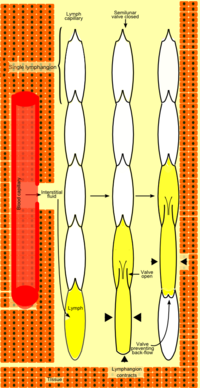 The lymphatic circulation begins with blind ending (closed at one end) highly permeable superficial lymph capillaries, formed by endothelial cells with button-like junctions between them that allow fluid to pass through them when the interstitial pressure is sufficiently high. These button-like junctions consist of protein filaments
like platelet endothelial cell adhesion molecule-1
or (PECAM-1). A valve system in place here prevents the absorbed lymph from leaking back into the ISF. There is another system of semilunar (semi=half; lunar=related to the Moon) valves that prevents back-flow of lymph along the lumen of the vessel. Lymph capillaries have many interconnections (anastomoses) between them and form a very fine network.
Rhythmic contraction of the vessel walls through movements may also help draw fluid into the smallest lymphatic vessels, capillaries
. If tissue fluid builds up the tissue will swell; this is called edema
. As the circular path through the body's system continues, the fluid is then transported to progressively larger lymphatic vessels culminating in the right lymphatic duct
(for lymph from the right upper body) and the thoracic duct
(for the rest of the body); both ducts drain into the circulatory system at the right and left subclavian vein
s. The system collaborates with white blood cells in lymph nodes to protect the body from being infected by cancer cells, fungi, viruses or bacteria. This is known as a secondary circulatory system.
as it enters a lymph node. Here the lymph percolates through the lymph node tissue and is removed by the efferent lymph vessel
. An efferent lymph vessel may directly drain into one of the (right or thoracic
) lymph ducts, or may empty into another lymph node as its afferent lymph vessel. Both the lymph ducts return the lymph to the blood stream by emptying into the subclavian vein
s
The functional unit of a lymph vessel is known as a lymphangion
, which is the segment between two valves. Since it is contractile, depending upon the ratio of its length to its radius, it can act either like a contractile chamber propelling the fluid ahead, or as a resistance vessel tending to stop the lymph in its place.
is a disease involving multiple cysts or lesions formed from lymphatic vessels.
Anatomy
Anatomy is a branch of biology and medicine that is the consideration of the structure of living things. It is a general term that includes human anatomy, animal anatomy , and plant anatomy...
, lymph vessels (or lymphatic vessels) are thin walled, valve
Valve
A valve is a device that regulates, directs or controls the flow of a fluid by opening, closing, or partially obstructing various passageways. Valves are technically pipe fittings, but are usually discussed as a separate category...
d structures that carry lymph
Lymph
Lymph is considered a part of the interstitial fluid, the fluid which lies in the interstices of all body tissues. Interstitial fluid becomes lymph when it enters a lymph capillary...
. As part of the lymphatic system
Lymphatic system
The lymphoid system is the part of the immune system comprising a network of conduits called lymphatic vessels that carry a clear fluid called lymph unidirectionally toward the heart. Lymphoid tissue is found in many organs, particularly the lymph nodes, and in the lymphoid follicles associated...
, lymph vessels are complementary to the cardiovascular system. Lymph vessels are lined by endothelial cells
Endothelium
The endothelium is the thin layer of cells that lines the interior surface of blood vessels, forming an interface between circulating blood in the lumen and the rest of the vessel wall. These cells are called endothelial cells. Endothelial cells line the entire circulatory system, from the heart...
, and deep to that have a thin layer of smooth muscle
Smooth muscle
Smooth muscle is an involuntary non-striated muscle. It is divided into two sub-groups; the single-unit and multiunit smooth muscle. Within single-unit smooth muscle tissues, the autonomic nervous system innervates a single cell within a sheet or bundle and the action potential is propagated by...
s, and adventitia
Adventitia
Adventitia is the outermost connective tissue covering of any organ, vessel, or other structure. It is also called the tunica adventitia or the tunica externa....
that bind the lymph vessel to the surroundings. Lymph vessels are devoted to propulsion of the lymph from the lymph capillaries, which are mainly concerned with absorption of interstitial fluid
Interstitial fluid
Interstitial fluid is a solution that bathes and surrounds the cells of multicellular animals. It is the main component of the extracellular fluid, which also includes plasma and transcellular fluid...
from the tissues. Lymph capillaries are slightly larger than their counterpart capillaries of the vascular system. Lymph vessel that carries lymph to a lymph node
Lymph node
A lymph node is a small ball or an oval-shaped organ of the immune system, distributed widely throughout the body including the armpit and stomach/gut and linked by lymphatic vessels. Lymph nodes are garrisons of B, T, and other immune cells. Lymph nodes are found all through the body, and act as...
are called the afferent lymph vessel
Afferent lymph vessel
The afferent lymph vessels enter at all parts of the periphery of the lymph node, and after branching and forming a dense plexus in the substance of the capsule, open into the lymph sinuses of the cortical part...
, and one that carries it from a lymph node is called the efferent lymph vessel
Efferent lymph vessel
The efferent lymphatic vessel commences from the lymph sinuses of the medullary portion of the lymph nodes and leave the lymph nodes either to veins or greater nodes....
, from where the lymph may travel to another lymph node or may be returned to a vein, or may travel to a larger lymph duct
Lymph duct
A lymph duct is a great lymphatic vessel that empties lymph into one of the subclavian veins. There are two lymph ducts in the body—the right lymph duct and the thoracic duct. The former drains lymph from the right upper limb, right side of thorax and right halves of head and neck. Remember...
. Lymph ducts drain the lymph into one of the subclavian vein
Subclavian vein
The subclavian veins are two large veins, one on either side of the body. Their diameter is approximately that of the smallest finger.-Path:Each subclavian vein is a continuation of the axillary vein and runs from the outer border of the first rib to the medial border of anterior scalene muscle...
s and thus return it to general circulation.
Generally, lymph flows away from the tissues
Biological tissue
Tissue is a cellular organizational level intermediate between cells and a complete organism. A tissue is an ensemble of cells, not necessarily identical, but from the same origin, that together carry out a specific function. These are called tissues because of their identical functioning...
to lymph node
Lymph node
A lymph node is a small ball or an oval-shaped organ of the immune system, distributed widely throughout the body including the armpit and stomach/gut and linked by lymphatic vessels. Lymph nodes are garrisons of B, T, and other immune cells. Lymph nodes are found all through the body, and act as...
s and eventually to either the right lymphatic duct
Right lymphatic duct
The right lymphatic duct, about 1.25 cm. in length, courses along the medial border of the Scalenus anterior at the root of the neck. In most cases it ends in the right subclavian vein, at its angle of junction with the right internal jugular vein, although the termination can be variable, however...
or the largest lymph vessel in the body, the thoracic duct
Thoracic duct
In human anatomy, the thoracic duct of the lymphatic system is the largest lymphatic vessel in the body. It is also known as the left lymphatic duct, alimentary duct, chyliferous duct, and Van Hoorne's canal....
. These vessels drain into the right and left subclavian veins respectively.
Function
Lymph vessels act as a reservoir from plasma and other substances including cells that leaked from the vascular system and transport lymph fluid back from the tissues to the circulatory system. Without functioning lymph vessels, lymph cannot be effectively drained and edemaEdema
Edema or oedema ; both words from the Greek , oídēma "swelling"), formerly known as dropsy or hydropsy, is an abnormal accumulation of fluid beneath the skin or in one or more cavities of the body that produces swelling...
typically results.
General structure of Lymphatics
The general structure of lymphatics is based on that of blood vessels. There is an inner lining of single flattened epithelial cells (simple squamous epithelium) composed of a type of epitheliumEpithelium
Epithelium is one of the four basic types of animal tissue, along with connective tissue, muscle tissue and nervous tissue. Epithelial tissues line the cavities and surfaces of structures throughout the body, and also form many glands. Functions of epithelial cells include secretion, selective...
that is called endothelium
Endothelium
The endothelium is the thin layer of cells that lines the interior surface of blood vessels, forming an interface between circulating blood in the lumen and the rest of the vessel wall. These cells are called endothelial cells. Endothelial cells line the entire circulatory system, from the heart...
, and the cells are called endothelial cells. This layer functions to mechanically transport fluid and since the basement membrane
Basement membrane
The basement membrane is a thin sheet of fibers that underlies the epithelium, which lines the cavities and surfaces of organs including skin, or the endothelium, which lines the interior surface of blood vessels.- Composition :...
on which it rests is discontinuous; it leaks easily. The next layer is that of smooth muscle
Smooth muscle
Smooth muscle is an involuntary non-striated muscle. It is divided into two sub-groups; the single-unit and multiunit smooth muscle. Within single-unit smooth muscle tissues, the autonomic nervous system innervates a single cell within a sheet or bundle and the action potential is propagated by...
s that are arranged in a circular fashion around the endothelium, which by shortening (contracting) or relaxing alter the diameter (caliber) of the lumen
Lumen (anatomy)
A lumen in biology is the inside space of a tubular structure, such as an artery or intestine...
. The outermost layer is the adventitia
Adventitia
Adventitia is the outermost connective tissue covering of any organ, vessel, or other structure. It is also called the tunica adventitia or the tunica externa....
that consists of fibrous tissue. The general structure described here is seen only in larger lymphatics; smaller lymphatics have fewer layers. The smallest vessels (lymphatic or lymph capillaries) lack both the muscular layer and the outer adventitia. As they proceed forward and in their course are joined by other capillaries, they grow larger and first take on an adventitia, and then smooth muscles.
The whole lymphatic conducting system broadly consists of two types of channels—the initial lymphatics, the prelymphatics or lymph capillaries that specialize in collection of the lymph from the ISF, and the larger lymph vessels that propel the lymph forward.
Unlike the cardiovascular system, the lymphatic system is not closed and has no central pump. Lymph movement occurs despite low pressure due to peristalsis
Peristalsis
Peristalsis is a radially symmetrical contraction and relaxation of muscles which propagates in a wave down the muscular tube, in an anterograde fashion. In humans, peristalsis is found in the contraction of smooth muscles to propel contents through the digestive tract. Earthworms use a similar...
(propulsion of the lymph due to alternate contraction and relaxation of smooth muscle
Smooth muscle
Smooth muscle is an involuntary non-striated muscle. It is divided into two sub-groups; the single-unit and multiunit smooth muscle. Within single-unit smooth muscle tissues, the autonomic nervous system innervates a single cell within a sheet or bundle and the action potential is propagated by...
), valves, and compression during contraction of adjacent skeletal muscle and arterial pulsation
Pulse
In medicine, one's pulse represents the tactile arterial palpation of the heartbeat by trained fingertips. The pulse may be palpated in any place that allows an artery to be compressed against a bone, such as at the neck , at the wrist , behind the knee , on the inside of the elbow , and near the...
.
Lymph capillaries
Fibrous protein
Scleroproteins, or fibrous proteins, constitute one of the three main classes of proteins, alongside globular proteins and conjugated proteins.Keratin, collagen, elastin, and fibroin are all scleroproteins...
like platelet endothelial cell adhesion molecule-1
CD31
Platelet endothelial cell adhesion molecule also known as cluster of differentiation 31 is a protein that in human is encoded by the PECAM1 gene found on chromosome 17...
or (PECAM-1). A valve system in place here prevents the absorbed lymph from leaking back into the ISF. There is another system of semilunar (semi=half; lunar=related to the Moon) valves that prevents back-flow of lymph along the lumen of the vessel. Lymph capillaries have many interconnections (anastomoses) between them and form a very fine network.
Rhythmic contraction of the vessel walls through movements may also help draw fluid into the smallest lymphatic vessels, capillaries
Capillary
Capillaries are the smallest of a body's blood vessels and are parts of the microcirculation. They are only 1 cell thick. These microvessels, measuring 5-10 μm in diameter, connect arterioles and venules, and enable the exchange of water, oxygen, carbon dioxide, and many other nutrient and waste...
. If tissue fluid builds up the tissue will swell; this is called edema
Edema
Edema or oedema ; both words from the Greek , oídēma "swelling"), formerly known as dropsy or hydropsy, is an abnormal accumulation of fluid beneath the skin or in one or more cavities of the body that produces swelling...
. As the circular path through the body's system continues, the fluid is then transported to progressively larger lymphatic vessels culminating in the right lymphatic duct
Right lymphatic duct
The right lymphatic duct, about 1.25 cm. in length, courses along the medial border of the Scalenus anterior at the root of the neck. In most cases it ends in the right subclavian vein, at its angle of junction with the right internal jugular vein, although the termination can be variable, however...
(for lymph from the right upper body) and the thoracic duct
Thoracic duct
In human anatomy, the thoracic duct of the lymphatic system is the largest lymphatic vessel in the body. It is also known as the left lymphatic duct, alimentary duct, chyliferous duct, and Van Hoorne's canal....
(for the rest of the body); both ducts drain into the circulatory system at the right and left subclavian vein
Subclavian vein
The subclavian veins are two large veins, one on either side of the body. Their diameter is approximately that of the smallest finger.-Path:Each subclavian vein is a continuation of the axillary vein and runs from the outer border of the first rib to the medial border of anterior scalene muscle...
s. The system collaborates with white blood cells in lymph nodes to protect the body from being infected by cancer cells, fungi, viruses or bacteria. This is known as a secondary circulatory system.
Lymph vessels
The lymph capillaries drain the lymph to larger contractile lymphatics, which have valves as well as smooth muscle walls. These are called the collecting lymphatics. As the collecting lymph vessel accumulates lymph from more and more lymph capillaries in its course, it becomes larger and is called the afferent lymph vesselAfferent lymph vessel
The afferent lymph vessels enter at all parts of the periphery of the lymph node, and after branching and forming a dense plexus in the substance of the capsule, open into the lymph sinuses of the cortical part...
as it enters a lymph node. Here the lymph percolates through the lymph node tissue and is removed by the efferent lymph vessel
Efferent lymph vessel
The efferent lymphatic vessel commences from the lymph sinuses of the medullary portion of the lymph nodes and leave the lymph nodes either to veins or greater nodes....
. An efferent lymph vessel may directly drain into one of the (right or thoracic
Thoracic duct
In human anatomy, the thoracic duct of the lymphatic system is the largest lymphatic vessel in the body. It is also known as the left lymphatic duct, alimentary duct, chyliferous duct, and Van Hoorne's canal....
) lymph ducts, or may empty into another lymph node as its afferent lymph vessel. Both the lymph ducts return the lymph to the blood stream by emptying into the subclavian vein
Subclavian vein
The subclavian veins are two large veins, one on either side of the body. Their diameter is approximately that of the smallest finger.-Path:Each subclavian vein is a continuation of the axillary vein and runs from the outer border of the first rib to the medial border of anterior scalene muscle...
s
The functional unit of a lymph vessel is known as a lymphangion
Lymphangion
A lymphangion is the functional unit of a lymph vessel that lies between two semilunar valves.Lymph vessels are channels larger than the lymph capillaries that have thicker walls, valves in their lumen and smooth muscles in their walls, thus lymph vessel lymphangion would be muscular, and capable...
, which is the segment between two valves. Since it is contractile, depending upon the ratio of its length to its radius, it can act either like a contractile chamber propelling the fluid ahead, or as a resistance vessel tending to stop the lymph in its place.
Diseases of the lymphatic system
LymphangiomatosisLymphangiomatosis
Lymphangiomatosis is a condition where a lymphangioma is not present in a single localised mass, but in a widespread or multifocal manner. It is a rare neoplasm which results from an abnormal development of the lymphatic system...
is a disease involving multiple cysts or lesions formed from lymphatic vessels.