
Home      Discussion      Topics      Dictionary      Almanac
Signup       Login
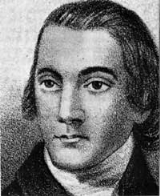
Lyman Hall

Lyman Hall

Overview
Lyman Hall (April 12, 1724 October 19, 1790), physician, clergyman, and statesman, was a signer of the United States
United States
The United States of America is a federal constitutional republic comprising fifty states and a federal district...

 Declaration of Independence
United States Declaration of Independence
The United States Declaration of Independence is a statement adopted by the Continental Congress on July 4, 1776, which announced that the thirteen American colonies then at war with Great Britain were now independent states, and thus no longer a part of the British Empire...

 as a representative of Georgia
Georgia (U.S. state)
Georgia is a state in the United States. One of the original Thirteen Colonies that revolted against British rule in the American Revolution, it had been the last of the Thirteen Colonies to be established, in 1733. Georgia was the fourth state to ratify the United States Constitution, on January...

. Hall County
Hall County, Georgia
Hall County is a county located in the U.S. state of Georgia. As of 2000, the population was 139,277. It is included in the Gainesville, Georgia Metropolitan Statistical Area. Explosive growth is evident, with the Census estimates for 2007 showing a population of 180,175...

 is named after him.

Born in Wallingford, Connecticut
Wallingford, Connecticut
Wallingford is a city in New Haven County, Connecticut, United States. The population was 43,026 at the 2000 census.- History :Wallingford was established on October 10, 1667, when the Connecticut General Assembly authorized the "making of a village on the east river" to 38 planters and freemen...

, on April 12, 1724, Lyman Hall was the son of John Hall and Mary Street. His paternal grandfather, Hon. John Hall (1670 to 1730), was a member of the Governor's Council and a Justice of the colony's supreme court.
Discussion
Ask a question about 'Lyman Hall'
Start a new discussion about 'Lyman Hall'
Answer questions from other users
Full Discussion Forum
 
Encyclopedia
Lyman Hall (April 12, 1724 October 19, 1790), physician, clergyman, and statesman, was a signer of the United States
United States
The United States of America is a federal constitutional republic comprising fifty states and a federal district...

 Declaration of Independence
United States Declaration of Independence
The United States Declaration of Independence is a statement adopted by the Continental Congress on July 4, 1776, which announced that the thirteen American colonies then at war with Great Britain were now independent states, and thus no longer a part of the British Empire...

 as a representative of Georgia
Georgia (U.S. state)
Georgia is a state in the United States. One of the original Thirteen Colonies that revolted against British rule in the American Revolution, it had been the last of the Thirteen Colonies to be established, in 1733. Georgia was the fourth state to ratify the United States Constitution, on January...

. Hall County
Hall County, Georgia
Hall County is a county located in the U.S. state of Georgia. As of 2000, the population was 139,277. It is included in the Gainesville, Georgia Metropolitan Statistical Area. Explosive growth is evident, with the Census estimates for 2007 showing a population of 180,175...

 is named after him.

Early life and family


Born in Wallingford, Connecticut
Wallingford, Connecticut
Wallingford is a city in New Haven County, Connecticut, United States. The population was 43,026 at the 2000 census.- History :Wallingford was established on October 10, 1667, when the Connecticut General Assembly authorized the "making of a village on the east river" to 38 planters and freemen...

, on April 12, 1724, Lyman Hall was the son of John Hall and Mary Street. His paternal grandfather, Hon. John Hall (1670 to 1730), was a member of the Governor's Council and a Justice of the colony's supreme court. His maternal grandfather was Rev. Samuel Street (Harvard 1664), Wallingford's first pastor.

Hall graduated from Yale College
Yale College
Yale College was the official name of Yale University from 1718 to 1887. The name now refers to the undergraduate part of the university. Each undergraduate student is assigned to one of 12 residential colleges.-Residential colleges:...

 in 1747 and studied theology with his uncle, Rev Samuel Hall (1695-1776; Yale 1716) in Cheshire, CT. In 1749, he was called to the pulpit of Stratfield Parish (now Bridgeport, CT). His pastorate was a stormy one: an outspoken group of parishioners opposed his ordination; in 1751, he was dismissed after charges against his moral character which, according to one biography, "were supported by proof and also by his own confession." He continued to preach for two more years, filling vacant pulpits, while he studied medicine and taught school.

In 1752, he married Abigail Burr of Fairfield, Connecticut
Fairfield, Connecticut
Fairfield is a town located in Fairfield County, Connecticut, United States. It is situated along the Gold Coast of Connecticut. Fairfield is a town of many neighborhoods, two of which—Southport and Greenfield Hill—are notably affluent. As of the 2000 census, the town had a total population of...

, however, she died the following year. In 1757, he married again to Mary Osborne. He migrated to South Carolina
South Carolina
South Carolina is a U.S. state that borders Georgia to the south and North Carolina to the north. Originally part of the Province of Carolina, the Province of South Carolina was one of the 13 colonies that declared independence from the British Crown during the American Revolution. The colony was...

 and established himself as a physician at Dorchester, South Carolina
Dorchester, South Carolina
Dorchester was a town in South Carolina. Situated on the Ashley River around from Charleston, it was founded in February 1696 by the followers of Reverend Joseph Lord from Dorchester, Massachusetts, who gave it the same name of the town from whence they had emigrated, which was in turn named...

, near Charleston
Charleston, South Carolina
Charleston is a city in Charleston County, South Carolina in the U.S. state of South Carolina. It is the largest city and county seat of Charleston County. The city was founded as Charlestown or Charles Towne, Carolina in 1670, and moved to its present location from a location on the west bank of...

, a community settled by Congregationalist migrants from Dorchester, Massachusetts
Dorchester, Massachusetts
Dorchester is a neighborhood of Boston, Massachusetts, United States. It is named after the town of Dorchester in the English county of Dorset, from which Puritans emigrated. Dorchester, including a large portion of today's Boston, was separately incorporated in 1630. It was still a primarily rural...

 decades earlier. When these settlers moved to the Midway District
Midway, Georgia
Midway is a city in Liberty County, Georgia, United States. It is a part of the Hinesville-Fort Stewart metropolitan statistical area. The population was 1,100 at the 2000 census....

now Liberty County
Liberty County, Georgia
Liberty County is a county located in the U.S. state of Georgia. As of 2000, the population was 61,610. The 2007 Census Estimate shows a population of 60,503...

in Georgia, Hall accompanied them. He soon became one of the leading citizens of the newly founded town of Sunbury.

Revolutionary war


On the eve of the American Revolution
American Revolution
The American Revolution is the political upheaval during the last half of the 18th century in which thirteen of Britain's colonies in North America at first rejected the governance of the Parliament of Great Britain, and later the British monarchy itself, to become the sovereign United States of...

, St. John's Parish, in which Sunbury was located, was a hotbed of radical sentiment in a predominantly loyalist
Loyalist (American Revolution)
Loyalists were American colonists who remained loyal to the Kingdom of Great Britain during and after the American Revolutionary War. They were often referred to as Tories, Royalists, or King's Men by the Patriots, those that supported the revolution...

 colony. Though Georgia was not initially represented in the First Continental Congress
First Continental Congress
The First Continental Congress was a convention of delegates from twelve of the thirteen British North American colonies that met on September 5, 1774, at Carpenters' Hall in Philadelphia, Pennsylvania, early in the American Revolution...

, through Hall's influence, the parish was persuaded to send a delegate Hall himself to Philadelphia
Philadelphia, Pennsylvania
Philadelphia is the largest city in Pennsylvania and the sixth-most-populous city in the United States.In 2008, the population of the city proper was estimated to be over 1.4 million, while the metropolitan area's population of 5.8 million made it the country's fifth-largest...

, Pennsylvania
Pennsylvania
The Commonwealth of Pennsylvania , often colloquially referred to as PA by natives and Northeasterners, is a state located in the Northeastern and Middle Atlantic regions of the United States...

, to the Second Continental Congress
Second Continental Congress
The Second Continental Congress was a convention of delegates from the Thirteen Colonies that met beginning on May 10, 1775, in Philadelphia, Pennsylvania, soon after warfare in the American Revolutionary War had begun. It succeeded the First Continental Congress, which met briefly during 1774,...

. He was admitted to a seat in Congress in 1775, a seat that he held until 1780. He was one of the three Georgians to sign the Declaration of Independence.

In January 1779, Sunbury was burned by the British. Hall's family fled to the North, where they remained until the British evacuation in 1782. Hall then returned to Georgia, settling in Savannah
Savannah, Georgia
Savannah is the largest city in, and the county seat of, Chatham County, Georgia, USA. Savannah was established in 1733 and was the first colonial and state capital of Georgia...

. In January 1783, he was elected an early governor of the state a position that he held for one year. While governor, Hall advocated the chartering of a state university, believing that education, particularly religious education, would result in a more virtuous citizenry. His efforts led to the chartering of the University of Georgia
University of Georgia
The University of Georgia is a public research university located in Athens, Georgia, the oldest and largest of the state's institutions of higher learning. Founded in 1785, UGA claims to be the oldest public university in the United States....

 in 1785. At the expiration of his term as governor, he resumed his medical practice.

Death and legacy


In 1790, Hall removed to a plantation in Burke County, Georgia
Burke County, Georgia
Burke County is a county located in the U.S. state of Georgia. As of 2000, the population was 22,243. The 2007 Census Estimate showed a population of 22,754 . The county seat is Waynesboro.Burke County is part of the Augusta, Georgia metropolitan area....

, on the Carolina border, where he died on October 19 at the age of 66. Hall's widow, Mary Osborne, survived him, dying in November 1793. His one son, John, died shortly after and left no children of his own.

Lyman Hall is memorialized in Georgia and in Connecticut, his native state, where the town of Wallingford honored him by naming a high school after its distinguished native son. Elementary schools in Liberty County, Georgia
Liberty County, Georgia
Liberty County is a county located in the U.S. state of Georgia. As of 2000, the population was 61,610. The 2007 Census Estimate shows a population of 60,503...

 and in Hall County, Georgia
Hall County, Georgia
Hall County is a county located in the U.S. state of Georgia. As of 2000, the population was 139,277. It is included in the Gainesville, Georgia Metropolitan Statistical Area. Explosive growth is evident, with the Census estimates for 2007 showing a population of 180,175...

 are also named for him.

Signers Monument
Signers Monument
Signers Monument is a granite obelisk located in Augusta, Georgia, on Greene Street. Signers Monument recognizes Georgia's three signatories of the United States Declaration of Independence: George Walton, Lyman Hall, and Button Gwinnett.-Description:...

, a granite obelisk in front of the courthouse in Augusta, Georgia
Augusta, Georgia
Augusta is a consolidated city in the U.S. state of Georgia. The City of Augusta and Richmond County governments merged operations in 1996; as of September 2008, the Augusta-Richmond county population was 192,851, not counting the unconsolidated cities of Hephzibah and Blythe.Augusta is the...

, memorializes Hall and the other two Georgians who signed the Declaration of Independence. His remains were re-interred there from his original grave on his plantation in Burke County.

In popular culture


Lyman Hall is portrayed in the 1969 Broadway musical 1776
1776 (musical)
1776 is a musical with music and lyrics by Sherman Edwards and a book by Peter Stone. It is based on the events leading to the writing and signing of the United States Declaration of Independence in Philadelphia, Pennsylvania, in 1776....

 and in the 1972 film of the same name
1776 (film)
1776 is a 1972 American musical film directed by Peter H. Hunt. The screenplay by Peter Stone was adapted from his libretto for the 1969 stage musical of the same name. Portions of the dialogue and some of the song lyrics were taken directly from the letters and memoirs of the actual participants...

 by Jonathan Moore. As presented in the play and in the film, at a critical point in the struggle of John Adams
John Adams
John Adams was an American politician and the second President of the United States , after being the first Vice President for two terms. He is regarded as one of the most influential Founding Fathers of the United States.Adams came to prominence in the early stages of the American Revolution...

 to convince his fellow delegates to the Second Continental Congress
Second Continental Congress
The Second Continental Congress was a convention of delegates from the Thirteen Colonies that met beginning on May 10, 1775, in Philadelphia, Pennsylvania, soon after warfare in the American Revolutionary War had begun. It succeeded the First Continental Congress, which met briefly during 1774,...

 to choose independence, Hall re-enters the chamber to change Georgia's vote. He says he has been thinking: "In trying to resolve my dilemma I remembered something I'd once read, 'that a representative owes the People not only his industry, but his judgment, and he betrays them if he sacrifices it to their opinion.' It was written by Edmund Burke
Edmund Burke
Edmund Burke PC was an Anglo-Irish statesman, author, orator, political theorist, and philosopher who, after relocating to England, served for many years in the House of Commons of the United Kingdom as a member of the Whig party. He is mainly remembered for his opposition to the French Revolution...

, a member of the British Parliament." Hall then walks over to the tally board and changes Georgia's vote from "Nay" to "Yea".