
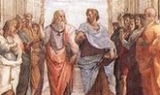
The
lyceum is a category of educational institution defined within the education system of many countries, mainly in Europe. The definition varies between countries; usually it is a type of
secondary schoolSecondary school is a term used to describe an educational institution where the final stage of schooling, known as secondary education and usually compulsory up to a specified age, takes place...
.
History
"Lyceum" is a
LatinLatin is an Italic language originally spoken in Latium and Ancient Rome. It, along with most European languages, is a descendant of the ancient Proto-Indo-European language. Although it is considered a dead language, a number of scholars and members of the Christian clergy speak it fluently, and...
rendering of the
Ancient GreekAncient Greek is the stage of the Greek language in the periods spanning the times c. 9th–6th centuries BC, , c. 5th–4th centuries BC , and the c. 3rd century BC – 6th century AD of ancient Greece and the ancient world; being predated in the 2nd millennium BC by Mycenaean Greek...
Λύκειον ("Lykeion"), the name of a
gymnasiumThe gymnasium in ancient Greece functioned as a training facility for competitors in public games. It was also a place for socializing and engaging in intellectual pursuits. The name comes from the Ancient Greek term gymnós meaning "naked". Athletes competed in the nude, a practice said to...
in
Classical AthensThe city of Athens during the classical period of Ancient Greece was a notable polis of Attica, Greece, leading the Delian League in the Peloponnesian War against Sparta and the Peloponnesian League. Athenian democracy was established in 508 BC under Cleisthenes following the tyranny of Hippias...
dedicated to
Apollo LyceusApollo is one of the most important and complex of the Olympian deities in Greek and Roman mythology...
.
This original LyceumThe Lyceum was a gymnasium and public meeting place in Classical Athens named after the god of the grove that housed the Lyceum, Apollo Lyceus...
is remembered as the location of the peripatetic school of
AristotleAristotle was a Greek philosopher and polymath, a student of Plato and teacher of Alexander the Great. His writings cover many subjects, including physics, metaphysics, poetry, theater, music, logic, rhetoric, linguistics, politics, government, ethics, biology, and zoology...
. Some countries derive the name for their modern schools from the Latin but use the Greek name for the ancient school: for example, Dutch has "Lykeion" (ancient) and "Lyceum" (modern), both rendered "lyceum" in English.
This name, Lycée, was retrieved and utilized by Napoleon in 1802 to name the main secondary education establishments. From France the name spread in many countries influenced by French culture.
Lyceums of the Russian Empire
In Imperial Russia, a Lyceum was one of the following higher educational facilities: Demidov Lyceum of Law in
YaroslavlYaroslavl is a city and the administrative center of Yaroslavl Oblast, Russia, located northeast of Moscow. The historical part of the city, a World Heritage Site, is located at the confluence of the Volga and the Kotorosl Rivers. It is one of the Golden Ring cities, a group of historic cities...
(1803), Alexander Lyceum in
Tsarskoye SeloTsarskoye Selo is the town containing a former Russian residence of the imperial family and visiting nobility, located south from the center of St. Petersburg. It is now part of the town of Pushkin and of the World Heritage Site Saint Petersburg and Related Groups of Monuments.-History:In...
(1810), Richelieu lyceum in
OdessaOdessa or Odesa is the administrative center of the Odessa Oblast located in southern Ukraine. The city is a major seaport located on the northwest shore of the Black Sea and the fourth largest city in Ukraine with a population of 1,029,000 .The predecessor of Odessa, a small Tatar settlement,...
(1817), and Imperial
KatkovMikhail Nikiforovich Katkov was a conservative Russian journalist influential during the reign of Alexander III.Katkov was born of a Russian government official and a Georgian noblewoman...
Lyceum in Moscow (1867).
the
Tsarskoye Selo LyceumThe Imperial Lyceum in Tsarskoye Selo near Saint Petersburg also known historically as the Imperial Alexander Lyceum after its founder the Emperor Alexander I with the object of educating youths of the best families, who should afterwards occupy important posts in the Imperial service.Its...
was opened on October 19, 1811 in the
neoclassicalNeoclassicism is the name given to Western movements in the decorative and visual arts, literature, theatre, music, and architecture that draw inspiration from the "classical" art and culture of Ancient Greece or Ancient Rome...
building designed by
Vasily StasovVasily Petrovich Stasov was a Russian architect.-Biography:Stasov was born in Moscow....
and situated next to the
Catherine PalaceThe Catherine Palace was the Rococo summer residence of the Russian tsars, located in the town of Tsarskoye Selo , 25 km south-east of St. Petersburg, Russia.- History :...
. The first graduates were all brilliant and included
Aleksandr PushkinAlexander Sergeyevich Pushkin was a Russian author of the Romantic era who is considered by many to be the greatest Russian poet and the founder of modern Russian literature....
and Alexander Gorchakov. The opening date was celebrated each year with carousals and revels, and Pushkin composed new verses for each of those occasions. In January 1844 the Lyceum was moved to
Saint PetersburgSaint Petersburg is a city and a federal subject of Russia located on the Neva River at the head of the Gulf of Finland on the Baltic Sea...
.
During 33 years of the Tsarskoye Selo Lyceum's existence, there were 286 graduates. The most famous of these were
Anton DelwigBaron Anton Antonovich Delvig was a Russian poet and journalist who studied in the Tsarskoye Selo Lyceum together with Alexander Pushkin, with whom he became a close friend. Pushkin dedicated a poem to him...
, Wilhelm Küchelbecher,
Nicholas de GiersNicholas de Giers was a Russian Foreign Minister during the reign of Alexander III. He was one of the architects of the Franco-Russian Alliance, which was later transformed into the Triple Entente.- Biography :...
,
Dmitry TolstoyCount Dmitry Andreyevich Tolstoy was a Russian statesman, a member of the State Council of Imperial Russia . He belonged to the comital branch of the Tolstoy family....
,
Yakov Karlovich GrotYakov Karlovich Grot , was a nineteenth-century Russian philologist of Swedish extraction who worked at the University of Helsinki.Grot was a graduate of the Tsarskoye Selo Lyceum...
,
Nikolay Yakovlevich DanilevskyNikolay Yakovlevich Danilevsky was a Russian naturalist, economist, ethnologist, philosopher, historian, and ideologue of the pan-Slavism and Slavophile movement who expounded a view of world history as circular...
,
Alexei Lobanov-RostovskyPrince Alexey Borisovich Lobanov-Rostovsky was a Russian statesman, probably best remembered for having concluded the Li-Lobanov Treaty with China and for his publication of the Russian Genealogical Book ....
and
Mikhail Saltykov-ShchedrinMikhail Yevgrafovich Saltykov-Shchedrin , better known by his pseudonym Shchedrin , was a major Russian satirist of the 19th century. At one time, after the death of the poet Nikolai Nekrasov, he acted as editor of the well-known Russian magazine, the Otechestvenniye Zapiski, until it was banned by...
.
Albania
The
Albanian National LyceumThe Albanian National Lyceum was a high school in the city of Korçë, Albania, fully financed by the Albanian government, but that emphasized the French culture and the European values. The school fully functioned in the years 1917-1939...
was a high school in the city of
KorçëKorçë is a city in southeastern Albania and the capital of the Korçë District. It has a population of around 105,000 people , making it the sixth largest city in Albania...
,
AlbaniaAlbania , officially known as the Republic of Albania , is a country in Southeastern Europe, in the Balkans region. It is bordered by Montenegro to the northwest, Kosovo to the northeast, the Republic of Macedonia to the east and Greece to the south and southeast. It has a coast on the Adriatic Sea...
, that emphasized the French culture and the European values. The school fully functioned with a French culture emphasis during 1917-1939. The school was continued post World War II as the Raqi Qirinxhi High School.
Belarus
The
Belarusian Humanities LyceumBelarusian Humanities Lyceum is a private secondary school, formerly located at 21 Kirau Street in Minsk, Belarus.-History:It was founded on January 15, 1991 as the Yakub Kolas National State Humanities Lyceum, by leading Belarusian intellectuals such as the present Belarusian Language Society...
is a private secondary school founded shortly after Belarus' independence from the USSR by intellectuals, such as
Vincuk ViacorkaVincuk Viačorka is a Belarusian linguist, politician and the former leader of the Belarusian National Front , a Belarusian opposition party.Vincuk Viačorka was born on July 7, 1961 in Brest in the family of a Soviet bureaucrat....
and Uladzimir Kolas, with the stated aims of preserving and promoting native Belarusian culture, and raising a new Belarusian elite. It was shut down in 2003 by president
Alexander LukashenkoAlexander Grigoryevich Lukashenko has been serving as the President of Belarus since 20 July 1994. Before his career as a politician, Lukashenko worked as director of a state-owned agricultural farm. Under Lukashenko's rule, Belarus has come to be viewed as a state whose conduct is out of line...
, but continues to operate in secret. It is currently the only educational institution using the
Belarusian languageThe Belarusian language , sometimes referred to as White Russian or White Ruthenian, is the language of the Belarusian people...
as its medium of instruction.
Czech Republic
The term
lyceum refers to the type of secondary education consisting of 4 years ended by graduation. It is a type between grammar school and a technical high school.
France
The
FrenchFrench is a Romance language spoken as a first language in France, the Romandy region in Switzerland, Wallonia and Brussels in Belgium, Monaco, the regions of Quebec and Acadia in Canada, and by various communities elsewhere. Second-language speakers of French are distributed throughout many parts...
word for an upper secondary school,
lycée, derives from Lyceum. (see
Secondary education in FranceIn France, secondary education is in two stages:* collèges cater for the first four years of secondary education from the ages of 11 to 14...
.)
Finland
The concept and name
lyceum (in Swedish,
lyseo in Finnish) entered Finland through Sweden. Traditionally, lycea were schools to prepare students to enter universities, as opposed to the typical, more general education. Some old schools continue to use the name
lyceum, though their operations today vary. For example, Helsinki Normal Lyceum educates students in grades 7-12, while Oulu Lyceum enrolls students only in grades 10-12. The more commonly used term for upper secondary school in Finland is
lukio in Finnish,
gymnasium in Swedish.
Greece
Secondary Education - Ages: 16 ~ 18
Γενικό Λύκειο (3 years),
Geniko Lykeio "General Lyceum", (~ 1996, 2006~present)
Ενιαίο Λύκειο (3 years),
Eniaio Lykeio "Unified Lyceum" (1997~2006)
Comparable to the last two or three years of American High School (upper secondary) classes in Greece.
The institution of Εσπερινό Λύκειο (4 years),
Esperino Lykeio "Evening Lyceum" was introduced in 1974 to accommodate the secondary education needs of working and adult students.
India
The Goa Lyceum (
PortuguesePortuguese is a Romance language that arose in the medieval Kingdom of Galicia, nowadays Galicia and Northern Portugal. The southern part of the Kingdom of Galicia became independent as the County of Portugal in 1095...
:
Liceu de Goa) in
Panaji,
GoaGoa , a former Portuguese colony, is India's smallest state by area and the fourth smallest by population. Located in South West India in the region known as the Konkan, it is bounded by the state of Maharashtra to the north, and by Karnataka to the east and south, while the Arabian Sea forms its...
- established in 1854, following the Portuguese model - was the first public secondary school in the state, then a Portuguese territory. Later, the Goa Lyceum received the official title of
Liceu Nacional Afonso de Albuquerque (
Afonso de AlbuquerqueAfonso de Albuquerque[p][n] was a Portuguese fidalgo, or nobleman, an admiral whose military and administrative activities as second governor of Portuguese India conquered and established the Portuguese colonial empire in the Indian Ocean...
National Lyceum).
Italy
The
ItalianItalian is a Romance language spoken mainly in Europe: Italy, Switzerland, San Marino, Vatican City, by minorities in Malta, Monaco, Croatia, Slovenia, France, Libya, Eritrea, and Somalia, and by immigrant communities in the Americas and Australia...
word for an upper secondary school,
liceo, derives from Lyceum (see
Education in ItalyEducation in Italy is compulsory from 6 to 15/16 years of age, and is divided into five stages: kindergarten , primary school , lower secondary school , upper secondary school and university...
). Among the Italian kinds of
licei are:
liceo classicoLiceo classico is a secondary school type in Italy. The educational curriculum lasts five years, and students are generally about 14 to 19 years of age....
(specializing in classical studies, including Latin, Ancient Greek and philosophy),
liceo scientificoLiceo Scientifico is a secondary school type in Italy. Along with Liceo Classico, it is considered the peak of the Italian upper secondary education. The access to this school is possible after the successful completion of the three year middle school and the corresponding final examination...
(specializing in scientific studies, and with Latin, English and philosophy for 5 years), liceo artistico (specializing in art subjects, with English for 5 years), liceo linguistico (specializing in foreign languages: three foreign languages for 5 years). They last 5 years between 14 and 19 years of age.
Netherlands
In the Netherlands, a lyceum is a secondary school for children aged 12–18, where "
voorbereidend wetenschappelijk onderwijsVoorbereidend wetenschappelijk onderwijs or pre-university secondary education is the highest variant in the secondary educational system of the Netherlands. After leaving elementary school students are enrolled in different types of secondary schools, according to their academic ability...
" (vwo) and "
hoger algemeen voortgezet onderwijsThe havo or hoger algemeen voortgezet onderwijs is a stream in the secondary educational system of the Netherlands. It has five grades and is generally attended from age twelve to seventeen...
" (havo) education choices are possible. Successful completion allows the candidate admission to university. The term lyceum is also sometimes used for other
vocational schoolA vocational school , providing vocational education, is a school in which students are taught the skills needed to perform a particular job...
s such as the Grafisch Lyceum, or
Muzieklyceum Amsterdam, which grew into the
Conservatorium van AmsterdamThe Conservatorium van Amsterdam is a Dutch academy of music located in Amsterdam. This school is the music division of the Amsterdamse Hogeschool voor de Kunsten, the city's vocational university of arts...
.
Philippines
There is a major university in the City of Manila named
Lyceum (complete name:
Lyceum of the Philippines UniversityThe Lyceum of the Philippines University is an institute of higher education located in Intramuros in the City of Manila. It was founded in 1952 by Dr. José P. Laurel, who became the third and one of the most acclaimed presidents of the Philippines...
). It is also referred to with the acronym LPU. Its branches also bear the name "Lyceum". There are other schools that are not affiliated with LPU but have the word "Lyceum" in their names; however, LPU is the original bearer of the name and is more closely associated with it.LPU is one of the most stable University in the Philippines with branch campuses in Batangas, Laguna, and Cavite.
Poland
The
liceum is the
PolishPolish is a language of the Lechitic subgroup of West Slavic languages, used throughout Poland and by Polish minorities in other countries...
secondary-education school. Polish liceums are attended by children aged 16 to 19–21 (see list below). Before graduating, pupils are subject to a final examination, the
maturaMatura or a similar term is the common name for the high-school leaving exam or "maturity exam" in various countries, including Albania, Austria, Bosnia and Herzegovina, Bulgaria, Croatia, the Czech Republic, Hungary, Italy, Kosovo, Liechtenstein, Macedonia, Montenegro, Poland, Serbia,...
.
Polish liceums are of several types:
- general lyceum (16-19)
- specialised lyceum (16-19)
- complementary lyceum (18-21)
Portugal
From 1836 until 1978, in the
PortuguesePortugal , officially the Portuguese Republic is a country situated in southwestern Europe on the Iberian Peninsula. Portugal is the westernmost country of Europe, and is bordered by the Atlantic Ocean to the West and South and by Spain to the North and East. The Atlantic archipelagos of the...
educational systemEducation in Portugal is regulated by the State through two ministries - the Ministry of Education, and the Ministry of Science, Technology and Higher Education. There are a system of public education and also many private schools at all levels of education...
, the lyceum , or national lyceum , was a
high schoolHigh school is a term used in parts of the English speaking world to describe institutions which provide all or part of secondary education. The term is often incorporated into the name of such institutions....
that prepared students to enter
universitiesHigher education in Portugal is divided into two main subsystems: university and polytechnic education. It is provided in autonomous public universities, private universities, public or private university institutes, polytechnic institutions and higher education institutions of other types...
or more general education. On the other hand, the technical school was a technical-oriented school.
After several
education reformEducation reform is the process of improving public education. Small improvements in education theoretically have large social returns, in health, wealth and well-being. Historically, reforms have taken different forms because the motivations of reformers have differed.A continuing motivation has...
s, all these schools merged into a single system of
secondary schoolsSecondary education is the stage of education following primary education. Secondary education includes the final stage of compulsory education and in many countries it is entirely compulsory. The next stage of education is usually college or university...
, offering grades 7 to 12.
Romania
The Romanian term is
liceu and it represents a post-secondary, pre-university educational institution. It is more specialized than secondary school. Certain specialized lyceum diplomas are enough to find a job.
Serbia
The
Lyceum of the Serbian Princedom was the first
higher educationHigher, post-secondary, tertiary, or third level education refers to the stage of learning that occurs at universities, academies, colleges, seminaries, and institutes of technology...
school in
SerbiaSerbia , officially the Republic of Serbia , is a landlocked country located at the crossroads of Central and Southeast Europe, covering the southern part of the Carpathian basin and the central part of the Balkans...
in which education was taught in
SerbianSerbian is a form of Serbo-Croatian, a South Slavic language, spoken by Serbs in Serbia, Bosnia and Herzegovina, Montenegro, Croatia and neighbouring countries....
. It was founded in 1838 on the initiative of Prince Miloš Obrenović II in 1838 in
KragujevacKragujevac is the fourth largest city in Serbia, the main city of the Šumadija region and the administrative centre of Šumadija District. It is situated on the banks of the Lepenica River...
. When
BelgradeBelgrade is the capital and largest city of Serbia. It is located at the confluence of the Sava and Danube rivers, where the Pannonian Plain meets the Balkans. According to official results of Census 2011, the city has a population of 1,639,121. It is one of the 15 largest cities in Europe...
became the Serbian capital city in 1841, the Serbian Lyceum was moved to it. In 1863 it was transformed into the Higher School.
Turkey
The
TurkishTurkish is a language spoken as a native language by over 83 million people worldwide, making it the most commonly spoken of the Turkic languages. Its speakers are located predominantly in Turkey and Northern Cyprus with smaller groups in Iraq, Greece, Bulgaria, the Republic of Macedonia, Kosovo,...
word for the latest part of pre-university education is
lise which is derived from the French word "lycée" and corresponds to "high school" in English. It lasts 3 to 5 years with respect to the type of the high school. At the end of their "lise" education, students take the
ÖSSStudent Selection and Placement System or Higher Education Examination-Undergraduate Placement Examination , [formerly Student Selection Examination, ], is a standardized test for the admission to higher education in Turkey administered by ÖSYM. Within the Turkish education system, the only way to...
test (Öğrenci Seçme Sınavı), i.e. university entrance examination, to get the right to enroll in a university.
Uzbekistan
Lyceums also emerged in the former Soviet Union countries after they became independent. One typical example is Uzbekistan, where all high schools were replaced with lyceums ("litsey" is the Russian term, derived from French "lycée"), offering three-year educational program with a certain major in certain direction. Unlike Turkey, Uzbek lyceums do not hold University entrance examination, which gives students the right to enter a University, but they hold a kind of "mock examination" which is designed to test their eligibility for a certain University.
External links