


Luke 1

Encyclopedia
Luke 1 is the first chapter of the Gospel of Luke
in the New Testament
of the Christian
Bible
. It describes the events leading up to the birth of Jesus
. It is written to Theophilus
, who could be a real person or could simply mean a fellow Christian as theo philus is Greek
for God
love
r. It could be both, addressed to a specific person, whether their name was that or not, and also meant for others as well. (Brown 227) Acts of the Apostles
begins addressed the same way in 1:1.
Luke
says:
It thus claims to be an accurate history
, although skeptics would dispute this. It is meant to confirm the things that Theophilus has already been taught about Jesus, being written by a believer for the purpose of confirming belief. (Brown 227)
Luke clearly states there are other accounts about Jesus circulating and he is aware of them. He also states he is not an eyewitness but belongs to another generation that received its information from "eyewitnesses" to these events in a previous generation. Some argue Luke thus states that he is getting his information from the disciples and Apostles, which the tradition about Luke being a follower of Paul
accords with. Luke however does not say explicitly that he knew or interviewed Jesus' disciples, at least in the Gospel, and so some think "handed down to us" means the traditions and other documents about Jesus that came from witnesses of the previous generation, which Luke carefully researched, not necessarily from someone Luke actually knew. (Brown 227) Sections of Acts however have the author relating events with the author and Paul together, such as 20:5-7, :13-15
According to Robert J. Karris "Luke alone of the evangelists introduces his work with a finely crafted, periodic Greek
sentence." (Brown et al. 678) The first sentence gives the "since" clause
, the main clause is given in the first part of the second sentence, and the purpose clause is given by "so that you may know...". Luke uses the word epeidēper to start the book, a literary word that only occurs here in the Greek Bible. He uses diēgēsis
for "an account", which taken alone seems to mean a personal storytelling, but when compared to other usages at the time, such as with the works of Josephus
, is to be taken as meaning a well planned account, although he might use it in the original meaning in Luke 8:39. He uses the word kathexēs for orderly account, which would mean a logic
al, spatial
, or chronological
account. Karris argues that the use of the word as well in Acts indicated that Luke is composing in a logical sequence, with Luke building a logical argument for his view of God fulfilling his promises through Jesus. (Brown et al. 678) Many scholars have seen parallels between this style and the openings to the Greek histories of Herodotus
and Thucydides
as well as scientific manuals and treatises of the Hellenistic
world. (Brown 227)
's parents, who he claims were Zechariah
, an Abijah
Priest, and Elizabeth
, a descendant of Aaron
. They are both getting old and have no children. Luke says this all occurs during the reign of "Herod king of Judea
" (5), who almost certainly is Herod the Great
.
Zechariah is on duty one day and goes into the Temple
to light incense
. During this time, priests served in the temple once a week twice a year, there being twenty four divisions of priests. Luke says "...it so happened...", kai egeneto, that he was on duty at the time. Some scholars see this as Luke imitating the style of the Septuagint in order to make his book sound like the Jewish scriptures. The majority of modern English
translations choose not to include this phrase. (Miller 118)
The Angel
Gabriel
appears to him and tells him he will soon have a son, to name him John, and to not allow him any alcoholic drinks
, and that "he will be great in the sight of the Lord." (15) Numbers
6:3 has obstaining from alcohol as a requirement to be a nazarite. Zechariah doubts Gabriel and Gabriel takes away his power of speech until this happens. Zechariah leaves the temple, unable to speak, and goes home. Elizabeth is soon pregnant. She says "...he has shown his favor and taken away my disgrace among the people. (25)" as infertility
was often believed to be proof of disfavor with God. (Miller 119)
Luke thus starts with the Temple and then ends the book at the Temple in Luke 24:53 Zechariah not being able to speak and so complete his liturgy is contrasted with the "good news" brought by Jesus. (Brown et al. 680)
There is much debate on the historicity of this information, as skeptics would reject appearances by angels and God's intervention in history in this manner. Whether one believes in such things or not, it is entirely possible that John's parents were childless throughout most of their life until John's birth. Some see Luke as taking a historical event or tradition he received and interpreting it in terms of events in the Old Testament
. Luke seems to follow an Old Testament pattern in the sequence of his information here, specifically an announcement of impending birth, the child being given a name, and then discussion of their destiny. (Brown et al. 679) This pattern can be seen in Genesis with Ishmael
in 16:11-12 and Isaac
in 17:19. Abraham
and Sarah
were also childless well into their old age. Josiah
is announced this way in 1 Kings
13:2, King Solomon in 1 Chronicles
22:9-10, and the Immanuel
prediction, used in Matthew
1:23, from Isaiah
7:14-17. Others see a five step pattern, with two extra steps of objections and confirmatory sign
s. (Brown et al. 680) Gabriel appeared to Daniel
in the Book of Daniel
9:21.
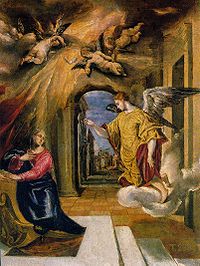
Luke then tells the story of Gabriel's visit to Mary, informing her that she will soon have a virgin conception by God. This is not found in Matthew 1:20
, which has an unnamed angel appear to Joseph
after having discovered Mary is pregnant. Gabriel goes to Nazareth
and finds Mary, who Luke tells us is a virgin engaged to Joseph. The name Mary means excellence, while Joseph means "May Yahweh
add." (Brown et al. 680)
Gabriel greets her with the word kecharitōmenē, meaning favored or graced, presumably by God. She does not seem to understand why she is favored, but Gabriel then tells her:
This seems to follow the same pattern as the announcement of John's birth and is also about fulfillment of God's promises. Jesus means "God Saves" (Brown et al. 680) She tells Gabriel she is a virgin but Gabriel says God will give her the child, and thus he will be the Son of God. He then points out how her relative Elizabeth, though old, is now carrying a child, and how "...nothing is impossible with God." 37, then he leaves. Luke states Mary is a virgin, and that she is somehow descended from Aaron, but here says Jesus will inherit his "father"'s throne, or David's. In his Genealogy of Jesus
in chapter 3 Aaron is not listed as an ancestor is his Davidic line, and so his descent from David seems to be, according to Luke, legal not biological.
In Daniel 9:24-27 Gabriel gives a prophecy
about seventy weeks and the "Anointed One". If one adds the 180 days that Elizabeth was pregnant before Mary's conception plus the 270 days of Mary's pregnancy plus the forty days of "purification" in Luke 2:22, one gets 490 days, or seventy weeks. (Brown et al. 681) Many Christians have seen this as a fulfillment of prophecy, but skeptics tend to counter that Luke could be constructing his story to fit what he sees as fulfillments of prophecy, whether real or not. God's promise of a messiah
from the house of David is in 2 Samuel
7
It is significant that Luke states that Mary lives in Nazareth, a small backwater town. He thus has God's grace bestowed on a young, unmarried woman living in an insignificant town. Luke frequently has favor shown on women, sinners, and various "unimportant" people. (Brown et al. 681)
Paul never mentions a virgin birth for Jesus, but in Romans
1:3-4 speaks of him as the Son of God by virtue of his resurrection
, and states he had a more than human nature. Luke here has Jesus' divine nature declared from the first moment of his conception. (Brown et al. 680)
, gives praise to God. She first thanks God for favoring one so "humble" as her, then praises God for his "mercy" and "help" to all people. Many see the Magnificat patterned on Hannah's prayer
in 1 Samuel 2:1-10. (Brown 232)
In verses 51-53 Luke uses the past tense
six times, implying Jesus' conception has fulfilled or is fulfilling these actions of God. These verses speak of the downfall of the proud and rich and the favor of the downtrodden. This might be a general statement, or an allusion to Israel and its Gentile rulers. Some have speculated these represent Ebionite
views. Mary then mentions Abraham, again linking this with God's original covenant
. (Brown et al. 681) Mary stays for three months and leaves shortly before John's birth. Some find the idea of a young pregnant woman making the trip from Jerusalem to Nazareth improbable, but it is certainly not impossible.
saw this as echos of the births of Samson
in Judges
13:24-25 and Samuel in 1 Samuel 2:21. (Brown 233) Karris sees relating the circumcision, as Luke also does for Jesus in Luke 2, as Luke's way of linking John and Jesus, and therefore Christianity, to a fulfillment of Israel. (Brown et al. 682)
The first part of Zechariah's song praises the still unborn Jesus in verses 68-75. He says "He has raised up a horn
of salvation
for us in the house of his servant David...", with a horn representing strength, such as in Psalm 89:17 and 92:10. (Miller 120) There is then a praising and foretelling of John in verses 76-77, then the song switches back to Jesus in 78-79. Raymond E. Brown thought these sections might have been Jewish Christian
hymn
s linked together by Luke. (Brown et al. 682) It is a common thesis
that the Magnificat, the Canticle, and the two songs in chapter 2, the Gloria in Excelsis Deo
and the Nunc dimittis
, were added by Luke to his original composition from a collection of hymns written in Greek. A minority of scholars think the Magnificat and Canticle might be Jewish hymns taken by the Christians, but Jewish hymns of the period reflect a future hope of God's help whereas these refer to it already having been fulfilled. Another group of scholars, also a minority, argue these were originally composed in Aramaic or Hebrew
and so might come from original testimony and so usually argue for these songs' historicity. Scholars often see these as primitive as so probably composed before other songs in the New Testament, such as Philippians
2:6-11. (Brown 232)
David is mentioned in the first section, once again linking Jesus to fulfillment of Israel's past. The song ends with a note of peace
, a common Lukan theme. Peace is the first thing he says to all the gathered Apostles in Luke 24.
Luke's source for this information is unknown and frequently debated. Even if the Q hypothesis is correct, these stories of John's and Jesus's birth were not in it, nor are they in Mark
. Luke does not list anything about an Angel visiting Joseph, which suggests that either Matthew and Luke received their information on this subject from different sources, or Luke has access to both stories, knows Matthew is already circulating, and is filling in the story told in Matthew. If Luke is right, Jesus and John were cousins of some sort.
Gospel of Luke
The Gospel According to Luke , commonly shortened to the Gospel of Luke or simply Luke, is the third and longest of the four canonical Gospels. This synoptic gospel is an account of the life and ministry of Jesus of Nazareth. It details his story from the events of his birth to his Ascension.The...
in the New Testament
New Testament
The New Testament is the second major division of the Christian biblical canon, the first such division being the much longer Old Testament....
of the Christian
Christian
A Christian is a person who adheres to Christianity, an Abrahamic, monotheistic religion based on the life and teachings of Jesus of Nazareth as recorded in the Canonical gospels and the letters of the New Testament...
Bible
Bible
The Bible refers to any one of the collections of the primary religious texts of Judaism and Christianity. There is no common version of the Bible, as the individual books , their contents and their order vary among denominations...
. It describes the events leading up to the birth of Jesus
Jesus
Jesus of Nazareth , commonly referred to as Jesus Christ or simply as Jesus or Christ, is the central figure of Christianity...
. It is written to Theophilus
Theophilus (Biblical)
Theophilus is the name or honorary title of the person to whom the Gospel of Luke and the Acts of the Apostles are addressed...
, who could be a real person or could simply mean a fellow Christian as theo philus is Greek
Greek language
Greek is an independent branch of the Indo-European family of languages. Native to the southern Balkans, it has the longest documented history of any Indo-European language, spanning 34 centuries of written records. Its writing system has been the Greek alphabet for the majority of its history;...
for God
God
God is the English name given to a singular being in theistic and deistic religions who is either the sole deity in monotheism, or a single deity in polytheism....
love
Love
Love is an emotion of strong affection and personal attachment. In philosophical context, love is a virtue representing all of human kindness, compassion, and affection. Love is central to many religions, as in the Christian phrase, "God is love" or Agape in the Canonical gospels...
r. It could be both, addressed to a specific person, whether their name was that or not, and also meant for others as well. (Brown 227) Acts of the Apostles
Acts of the Apostles
The Acts of the Apostles , usually referred to simply as Acts, is the fifth book of the New Testament; Acts outlines the history of the Apostolic Age...
begins addressed the same way in 1:1.
Luke
Luke the Evangelist
Luke the Evangelist was an Early Christian writer whom Church Fathers such as Jerome and Eusebius said was the author of the Gospel of Luke and the Acts of the Apostles...
says:
- Many have undertaken to draw up an account of the things that have been fulfilled among us, just as they were handed down to us by those who from the first were eyewitnesses and servants of the word. Therefore, since I myself have carefully investigated everything from the beginning, it seemed good also to me to write an orderly account for you, most excellent Theophilus, so that you may know the certainty of the things you have been taught. (1-4)
It thus claims to be an accurate history
History
History is the discovery, collection, organization, and presentation of information about past events. History can also mean the period of time after writing was invented. Scholars who write about history are called historians...
, although skeptics would dispute this. It is meant to confirm the things that Theophilus has already been taught about Jesus, being written by a believer for the purpose of confirming belief. (Brown 227)
Luke clearly states there are other accounts about Jesus circulating and he is aware of them. He also states he is not an eyewitness but belongs to another generation that received its information from "eyewitnesses" to these events in a previous generation. Some argue Luke thus states that he is getting his information from the disciples and Apostles, which the tradition about Luke being a follower of Paul
Paul of Tarsus
Paul the Apostle , also known as Saul of Tarsus, is described in the Christian New Testament as one of the most influential early Christian missionaries, with the writings ascribed to him by the church forming a considerable portion of the New Testament...
accords with. Luke however does not say explicitly that he knew or interviewed Jesus' disciples, at least in the Gospel, and so some think "handed down to us" means the traditions and other documents about Jesus that came from witnesses of the previous generation, which Luke carefully researched, not necessarily from someone Luke actually knew. (Brown 227) Sections of Acts however have the author relating events with the author and Paul together, such as 20:5-7, :13-15
According to Robert J. Karris "Luke alone of the evangelists introduces his work with a finely crafted, periodic Greek
Ancient Greek
Ancient Greek is the stage of the Greek language in the periods spanning the times c. 9th–6th centuries BC, , c. 5th–4th centuries BC , and the c. 3rd century BC – 6th century AD of ancient Greece and the ancient world; being predated in the 2nd millennium BC by Mycenaean Greek...
sentence." (Brown et al. 678) The first sentence gives the "since" clause
Clause
In grammar, a clause is the smallest grammatical unit that can express a complete proposition. In some languages it may be a pair or group of words that consists of a subject and a predicate, although in other languages in certain clauses the subject may not appear explicitly as a noun phrase,...
, the main clause is given in the first part of the second sentence, and the purpose clause is given by "so that you may know...". Luke uses the word epeidēper to start the book, a literary word that only occurs here in the Greek Bible. He uses diēgēsis
Diegesis
Diegesis is a style of representation in fiction and is:# the world in which the situations and events narrated occur; and# telling, recounting, as opposed to showing, enacting.In diegesis the narrator tells the story...
for "an account", which taken alone seems to mean a personal storytelling, but when compared to other usages at the time, such as with the works of Josephus
Josephus
Titus Flavius Josephus , also called Joseph ben Matityahu , was a 1st-century Romano-Jewish historian and hagiographer of priestly and royal ancestry who recorded Jewish history, with special emphasis on the 1st century AD and the First Jewish–Roman War, which resulted in the Destruction of...
, is to be taken as meaning a well planned account, although he might use it in the original meaning in Luke 8:39. He uses the word kathexēs for orderly account, which would mean a logic
Logic
In philosophy, Logic is the formal systematic study of the principles of valid inference and correct reasoning. Logic is used in most intellectual activities, but is studied primarily in the disciplines of philosophy, mathematics, semantics, and computer science...
al, spatial
Space
Space is the boundless, three-dimensional extent in which objects and events occur and have relative position and direction. Physical space is often conceived in three linear dimensions, although modern physicists usually consider it, with time, to be part of a boundless four-dimensional continuum...
, or chronological
Chronology
Chronology is the science of arranging events in their order of occurrence in time, such as the use of a timeline or sequence of events. It is also "the determination of the actual temporal sequence of past events".Chronology is part of periodization...
account. Karris argues that the use of the word as well in Acts indicated that Luke is composing in a logical sequence, with Luke building a logical argument for his view of God fulfilling his promises through Jesus. (Brown et al. 678) Many scholars have seen parallels between this style and the openings to the Greek histories of Herodotus
Herodotus
Herodotus was an ancient Greek historian who was born in Halicarnassus, Caria and lived in the 5th century BC . He has been called the "Father of History", and was the first historian known to collect his materials systematically, test their accuracy to a certain extent and arrange them in a...
and Thucydides
Thucydides
Thucydides was a Greek historian and author from Alimos. His History of the Peloponnesian War recounts the 5th century BC war between Sparta and Athens to the year 411 BC...
as well as scientific manuals and treatises of the Hellenistic
Hellenistic civilization
Hellenistic civilization represents the zenith of Greek influence in the ancient world from 323 BCE to about 146 BCE...
world. (Brown 227)
John the Baptist's parents
Luke begins to show what he thinks of as the fulfillment of God's promises. He gives us a description of John the BaptistJohn the Baptist
John the Baptist was an itinerant preacher and a major religious figure mentioned in the Canonical gospels. He is described in the Gospel of Luke as a relative of Jesus, who led a movement of baptism at the Jordan River...
's parents, who he claims were Zechariah
Zechariah (priest)
In the Bible, Zechariah , is the father of John the Baptist, a priest of the sons of Aaron, a prophet in , and the husband of Elisabeth who is the cousin of Mary the mother of Jesus.In the Qur'an, Zechariah plays a similar role as the father of John the Baptist and ranks him as a prophet alongside...
, an Abijah
Abijah
Abijah or Abiah or Abia is a Biblical unisex name that means Aviya or "my Father is Yahweh" in Hebrew. In the Old Testament the name Abijah was borne by several characters:Women...
Priest, and Elizabeth
Elizabeth (Biblical person)
Elizabeth is also spelled Elisabeth or Elisheva...
, a descendant of Aaron
Aaron
In the Hebrew Bible and the Qur'an, Aaron : Ααρών ), who is often called "'Aaron the Priest"' and once Aaron the Levite , was the older brother of Moses, and a prophet of God. He represented the priestly functions of his tribe, becoming the first High Priest of the Israelites...
. They are both getting old and have no children. Luke says this all occurs during the reign of "Herod king of Judea
Judea
Judea or Judæa was the name of the mountainous southern part of the historic Land of Israel from the 8th century BCE to the 2nd century CE, when Roman Judea was renamed Syria Palaestina following the Jewish Bar Kokhba revolt.-Etymology:The...
" (5), who almost certainly is Herod the Great
Herod the Great
Herod , also known as Herod the Great , was a Roman client king of Judea. His epithet of "the Great" is widely disputed as he is described as "a madman who murdered his own family and a great many rabbis." He is also known for his colossal building projects in Jerusalem and elsewhere, including his...
.
Zechariah is on duty one day and goes into the Temple
Temple in Jerusalem
The Temple in Jerusalem or Holy Temple , refers to one of a series of structures which were historically located on the Temple Mount in the Old City of Jerusalem, the current site of the Dome of the Rock. Historically, these successive temples stood at this location and functioned as the centre of...
to light incense
Incense
Incense is composed of aromatic biotic materials, which release fragrant smoke when burned. The term "incense" refers to the substance itself, rather than to the odor that it produces. It is used in religious ceremonies, ritual purification, aromatherapy, meditation, for creating a mood, and for...
. During this time, priests served in the temple once a week twice a year, there being twenty four divisions of priests. Luke says "...it so happened...", kai egeneto, that he was on duty at the time. Some scholars see this as Luke imitating the style of the Septuagint in order to make his book sound like the Jewish scriptures. The majority of modern English
Modern English
Modern English is the form of the English language spoken since the Great Vowel Shift in England, completed in roughly 1550.Despite some differences in vocabulary, texts from the early 17th century, such as the works of William Shakespeare and the King James Bible, are considered to be in Modern...
translations choose not to include this phrase. (Miller 118)
The Angel
Angel
Angels are mythical beings often depicted as messengers of God in the Hebrew and Christian Bibles along with the Quran. The English word angel is derived from the Greek ἄγγελος, a translation of in the Hebrew Bible ; a similar term, ملائكة , is used in the Qur'an...
Gabriel
Gabriel
In Abrahamic religions, Gabriel is an Archangel who typically serves as a messenger to humans from God.He first appears in the Book of Daniel, delivering explanations of Daniel's visions. In the Gospel of Luke Gabriel foretells the births of both John the Baptist and of Jesus...
appears to him and tells him he will soon have a son, to name him John, and to not allow him any alcoholic drinks
Alcoholic beverage
An alcoholic beverage is a drink containing ethanol, commonly known as alcohol. Alcoholic beverages are divided into three general classes: beers, wines, and spirits. They are legally consumed in most countries, and over 100 countries have laws regulating their production, sale, and consumption...
, and that "he will be great in the sight of the Lord." (15) Numbers
Book of Numbers
The Book of Numbers is the fourth book of the Hebrew Bible, and the fourth of five books of the Jewish Torah/Pentateuch....
6:3 has obstaining from alcohol as a requirement to be a nazarite. Zechariah doubts Gabriel and Gabriel takes away his power of speech until this happens. Zechariah leaves the temple, unable to speak, and goes home. Elizabeth is soon pregnant. She says "...he has shown his favor and taken away my disgrace among the people. (25)" as infertility
Infertility
Infertility primarily refers to the biological inability of a person to contribute to conception. Infertility may also refer to the state of a woman who is unable to carry a pregnancy to full term...
was often believed to be proof of disfavor with God. (Miller 119)
Luke thus starts with the Temple and then ends the book at the Temple in Luke 24:53 Zechariah not being able to speak and so complete his liturgy is contrasted with the "good news" brought by Jesus. (Brown et al. 680)
There is much debate on the historicity of this information, as skeptics would reject appearances by angels and God's intervention in history in this manner. Whether one believes in such things or not, it is entirely possible that John's parents were childless throughout most of their life until John's birth. Some see Luke as taking a historical event or tradition he received and interpreting it in terms of events in the Old Testament
Old Testament
The Old Testament, of which Christians hold different views, is a Christian term for the religious writings of ancient Israel held sacred and inspired by Christians which overlaps with the 24-book canon of the Masoretic Text of Judaism...
. Luke seems to follow an Old Testament pattern in the sequence of his information here, specifically an announcement of impending birth, the child being given a name, and then discussion of their destiny. (Brown et al. 679) This pattern can be seen in Genesis with Ishmael
Ishmael
Ishmael is a figure in the Hebrew Bible and the Qur'an, and was Abraham's first born child according to Jews, Christians and Muslims. Ishmael was born of Abraham's marriage to Sarah's handmaiden Hagar...
in 16:11-12 and Isaac
Isaac
Isaac as described in the Hebrew Bible, was the only son Abraham had with his wife Sarah, and was the father of Jacob and Esau. Isaac was one of the three patriarchs of the Israelites...
in 17:19. Abraham
Abraham
Abraham , whose birth name was Abram, is the eponym of the Abrahamic religions, among which are Judaism, Christianity and Islam...
and Sarah
Sarah
Sarah or Sara was the wife of Abraham and the mother of Isaac as described in the Hebrew Bible and the Quran. Her name was originally Sarai...
were also childless well into their old age. Josiah
Josiah
Josiah or Yoshiyahu or Joshua was a king of Judah who instituted major reforms. Josiah is credited by most historians with having established or compiled important Jewish scriptures during the Deuteronomic reform that occurred during his rule.Josiah became king of Judah at the age of eight, after...
is announced this way in 1 Kings
Books of Kings
The Book of Kings presents a narrative history of ancient Israel and Judah from the death of David to the release of his successor Jehoiachin from imprisonment in Babylon, a period of some 400 years...
13:2, King Solomon in 1 Chronicles
Books of Chronicles
The Books of Chronicles are part of the Hebrew Bible. In the Masoretic Text, it appears as the first or last book of the Ketuvim . Chronicles largely parallels the Davidic narratives in the Books of Samuel and the Books of Kings...
22:9-10, and the Immanuel
Immanuel
Immanuel or Emmanuel or Imanu'el . It is a theophoric name used in the Bible in and...
prediction, used in Matthew
Gospel of Matthew
The Gospel According to Matthew is one of the four canonical gospels, one of the three synoptic gospels, and the first book of the New Testament. It tells of the life, ministry, death, and resurrection of Jesus of Nazareth...
1:23, from Isaiah
Book of Isaiah
The Book of Isaiah is the first of the Latter Prophets in the Hebrew Bible, preceding the books of Ezekiel, Jeremiah and the Book of the Twelve...
7:14-17. Others see a five step pattern, with two extra steps of objections and confirmatory sign
Sign
A sign is something that implies a connection between itself and its object. A natural sign bears a causal relation to its object—for instance, thunder is a sign of storm. A conventional sign signifies by agreement, as a full stop signifies the end of a sentence...
s. (Brown et al. 680) Gabriel appeared to Daniel
Daniel
Daniel is the protagonist in the Book of Daniel of the Hebrew Bible. In the narrative, when Daniel was a young man, he was taken into Babylonian captivity where he was educated in Chaldean thought. However, he never converted to Neo-Babylonian ways...
in the Book of Daniel
Book of Daniel
The Book of Daniel is a book in the Hebrew Bible. The book tells of how Daniel, and his Judean companions, were inducted into Babylon during Jewish exile, and how their positions elevated in the court of Nebuchadnezzar. The court tales span events that occur during the reigns of Nebuchadnezzar,...
9:21.
The annunciation
Luke then tells the story of Gabriel's visit to Mary, informing her that she will soon have a virgin conception by God. This is not found in Matthew 1:20
Matthew 1:20
Matthew 1:20 is the twentieth verse of the first chapter of the Gospel of Matthew in the New Testament. Previously Joseph had found Mary to be pregnant and had considered leaving her. In this verse an angel comes to him in a dream and reassures him....
, which has an unnamed angel appear to Joseph
Saint Joseph
Saint Joseph is a figure in the Gospels, the husband of the Virgin Mary and the earthly father of Jesus Christ ....
after having discovered Mary is pregnant. Gabriel goes to Nazareth
Nazareth
Nazareth is the largest city in the North District of Israel. Known as "the Arab capital of Israel," the population is made up predominantly of Palestinian Arab citizens of Israel...
and finds Mary, who Luke tells us is a virgin engaged to Joseph. The name Mary means excellence, while Joseph means "May Yahweh
Yahweh
Yahweh is the name of God in the Bible, the God of Abraham, Isaac, Jacob, Jews and Christians.The word Yahweh is a modern scholarly convention for the Hebrew , transcribed into Roman letters as YHWH and known as the Tetragrammaton, for which the original pronunciation is unknown...
add." (Brown et al. 680)
Gabriel greets her with the word kecharitōmenē, meaning favored or graced, presumably by God. She does not seem to understand why she is favored, but Gabriel then tells her:
- Do not be afraid, Mary, you have found favor with God. You will be with child and give birth to a son, and you are to give him the name Jesus. He will be great and will be called the Son of the Most High. The Lord God will give him the throne of his father DavidDavidDavid was the second king of the united Kingdom of Israel according to the Hebrew Bible and, according to the Gospels of Matthew and Luke, an ancestor of Jesus Christ through both Saint Joseph and Mary...
, and he will reign over the house of JacobJacobJacob "heel" or "leg-puller"), also later known as Israel , as described in the Hebrew Bible, the Talmud, the New Testament and the Qur'an was the third patriarch of the Hebrew people with whom God made a covenant, and ancestor of the tribes of Israel, which were named after his descendants.In the...
forever; his kingdom will never end (30-33)
This seems to follow the same pattern as the announcement of John's birth and is also about fulfillment of God's promises. Jesus means "God Saves" (Brown et al. 680) She tells Gabriel she is a virgin but Gabriel says God will give her the child, and thus he will be the Son of God. He then points out how her relative Elizabeth, though old, is now carrying a child, and how "...nothing is impossible with God." 37, then he leaves. Luke states Mary is a virgin, and that she is somehow descended from Aaron, but here says Jesus will inherit his "father"'s throne, or David's. In his Genealogy of Jesus
Genealogy of Jesus
The genealogy of Jesus is described in two passages of the Gospels: Luke 3:23–38 and Matthew 1:1–17.* Matthew's genealogy commences with Abraham and then from King David's son Solomon follows the legal line of the kings through Jeconiah, the king whose descendants were cursed, to Joseph, legal...
in chapter 3 Aaron is not listed as an ancestor is his Davidic line, and so his descent from David seems to be, according to Luke, legal not biological.
In Daniel 9:24-27 Gabriel gives a prophecy
Prophecy
Prophecy is a process in which one or more messages that have been communicated to a prophet are then communicated to others. Such messages typically involve divine inspiration, interpretation, or revelation of conditioned events to come as well as testimonies or repeated revelations that the...
about seventy weeks and the "Anointed One". If one adds the 180 days that Elizabeth was pregnant before Mary's conception plus the 270 days of Mary's pregnancy plus the forty days of "purification" in Luke 2:22, one gets 490 days, or seventy weeks. (Brown et al. 681) Many Christians have seen this as a fulfillment of prophecy, but skeptics tend to counter that Luke could be constructing his story to fit what he sees as fulfillments of prophecy, whether real or not. God's promise of a messiah
Messiah
A messiah is a redeemer figure expected or foretold in one form or another by a religion. Slightly more widely, a messiah is any redeemer figure. Messianic beliefs or theories generally relate to eschatological improvement of the state of humanity or the world, in other words the World to...
from the house of David is in 2 Samuel
Books of Samuel
The Books of Samuel in the Jewish bible are part of the Former Prophets, , a theological history of the Israelites affirming and explaining the Torah under the guidance of the prophets.Samuel begins by telling how the prophet Samuel is chosen by...
7
It is significant that Luke states that Mary lives in Nazareth, a small backwater town. He thus has God's grace bestowed on a young, unmarried woman living in an insignificant town. Luke frequently has favor shown on women, sinners, and various "unimportant" people. (Brown et al. 681)
Paul never mentions a virgin birth for Jesus, but in Romans
Epistle to the Romans
The Epistle of Paul to the Romans, often shortened to Romans, is the sixth book in the New Testament. Biblical scholars agree that it was composed by the Apostle Paul to explain that Salvation is offered through the Gospel of Jesus Christ...
1:3-4 speaks of him as the Son of God by virtue of his resurrection
Resurrection of Jesus
The Christian belief in the resurrection of Jesus states that Jesus returned to bodily life on the third day following his death by crucifixion. It is a key element of Christian faith and theology and part of the Nicene Creed: "On the third day he rose again in fulfillment of the Scriptures"...
, and states he had a more than human nature. Luke here has Jesus' divine nature declared from the first moment of his conception. (Brown et al. 680)
Mary and Elizabeth
Mary then goes and visits her relative Elizabeth. Upon meeting the pregnant Mary, Elizabeth feels John move in her womb and is "...filled with the Holy Spirit." (41) This might be related to Genesis 25:22. Elizabeth gives praise to Mary, and Mary, in her MagnificatMagnificat
The Magnificat — also known as the Song of Mary or the Canticle of Mary — is a canticle frequently sung liturgically in Christian church services. It is one of the eight most ancient Christian hymns and perhaps the earliest Marian hymn...
, gives praise to God. She first thanks God for favoring one so "humble" as her, then praises God for his "mercy" and "help" to all people. Many see the Magnificat patterned on Hannah's prayer
Song of Hannah
The Song of Hannah is a poem interrupting the prose text of the Books of Samuel. According to the surrounding narrative, the poem was a prayer delivered by Hannah, to give thanks to God for the birth of her son, Samuel.-Contents and themes:...
in 1 Samuel 2:1-10. (Brown 232)
In verses 51-53 Luke uses the past tense
Past tense
The past tense is a grammatical tense that places an action or situation in the past of the current moment , or prior to some specified time that may be in the speaker's past, present, or future...
six times, implying Jesus' conception has fulfilled or is fulfilling these actions of God. These verses speak of the downfall of the proud and rich and the favor of the downtrodden. This might be a general statement, or an allusion to Israel and its Gentile rulers. Some have speculated these represent Ebionite
Ebionites
Ebionites, or Ebionaioi, , is a patristic term referring to a Jewish Christian sect or sects that existed during the first centuries of the Christian Era. They regarded Jesus as the Messiah and insisted on the necessity of following Jewish religious law and rites...
views. Mary then mentions Abraham, again linking this with God's original covenant
Covenant (biblical)
A biblical covenant is an agreement found in the Bible between God and His people in which God makes specific promises and demands. It is the customary word used to translate the Hebrew word berith. It it is used in the Tanakh 286 times . All Abrahamic religions consider the Biblical covenant...
. (Brown et al. 681) Mary stays for three months and leaves shortly before John's birth. Some find the idea of a young pregnant woman making the trip from Jerusalem to Nazareth improbable, but it is certainly not impossible.
John the Baptist's birth
Friends and neighbors come to circumcise him and try to name him after his father, but his mother protests and then his father writes down that his name will be John, and is suddenly allowed to speak again. He becomes "...filled with the Holy Spirit...", as his wife before him. He sings a song, the Canticle of Zechariah, praising God. Luke then only states that John grew up and went into the desert. This is the only near contemporary account of John's family found anywhere. BrownRaymond E. Brown
The Reverend Raymond Edward Brown, S.S. , was an American Roman Catholic priest, a member of the Sulpician Fathers and a major Biblical scholar of his era...
saw this as echos of the births of Samson
Samson
Samson, Shimshon ; Shamshoun or Sampson is the third to last of the Judges of the ancient Israelites mentioned in the Tanakh ....
in Judges
Book of Judges
The Book of Judges is the seventh book of the Hebrew bible and the Christian Old Testament. Its title describes its contents: it contains the history of Biblical judges, divinely inspired prophets whose direct knowledge of Yahweh allows them to act as decision-makers for the Israelites, as...
13:24-25 and Samuel in 1 Samuel 2:21. (Brown 233) Karris sees relating the circumcision, as Luke also does for Jesus in Luke 2, as Luke's way of linking John and Jesus, and therefore Christianity, to a fulfillment of Israel. (Brown et al. 682)
The first part of Zechariah's song praises the still unborn Jesus in verses 68-75. He says "He has raised up a horn
Horn (anatomy)
A horn is a pointed projection of the skin on the head of various animals, consisting of a covering of horn surrounding a core of living bone. True horns are found mainly among the ruminant artiodactyls, in the families Antilocapridae and Bovidae...
of salvation
Salvation
Within religion salvation is the phenomenon of being saved from the undesirable condition of bondage or suffering experienced by the psyche or soul that has arisen as a result of unskillful or immoral actions generically referred to as sins. Salvation may also be called "deliverance" or...
for us in the house of his servant David...", with a horn representing strength, such as in Psalm 89:17 and 92:10. (Miller 120) There is then a praising and foretelling of John in verses 76-77, then the song switches back to Jesus in 78-79. Raymond E. Brown thought these sections might have been Jewish Christian
Jewish Christians
Jewish Christians is a term which appears in historical texts contrasting Christians of Jewish origin with Gentile Christians, both in discussion of the New Testament church and the second and following centuries....
hymn
Hymn
A hymn is a type of song, usually religious, specifically written for the purpose of praise, adoration or prayer, and typically addressed to a deity or deities, or to a prominent figure or personification...
s linked together by Luke. (Brown et al. 682) It is a common thesis
Thesis
A dissertation or thesis is a document submitted in support of candidature for an academic degree or professional qualification presenting the author's research and findings...
that the Magnificat, the Canticle, and the two songs in chapter 2, the Gloria in Excelsis Deo
Gloria in Excelsis Deo
"Gloria in excelsis Deo" is the title and beginning of a hymn known also as the Greater Doxology and the Angelic Hymn. The name is often abbreviated to Gloria in Excelsis or simply Gloria.It is an example of the psalmi idiotici "Gloria in excelsis Deo" (Latin for "Glory to God in the highest")...
and the Nunc dimittis
Nunc dimittis
The Nunc dimittis is a canticle from a text in the second chapter of Luke named after its first words in Latin, meaning 'Now dismiss...'....
, were added by Luke to his original composition from a collection of hymns written in Greek. A minority of scholars think the Magnificat and Canticle might be Jewish hymns taken by the Christians, but Jewish hymns of the period reflect a future hope of God's help whereas these refer to it already having been fulfilled. Another group of scholars, also a minority, argue these were originally composed in Aramaic or Hebrew
Hebrew language
Hebrew is a Semitic language of the Afroasiatic language family. Culturally, is it considered by Jews and other religious groups as the language of the Jewish people, though other Jewish languages had originated among diaspora Jews, and the Hebrew language is also used by non-Jewish groups, such...
and so might come from original testimony and so usually argue for these songs' historicity. Scholars often see these as primitive as so probably composed before other songs in the New Testament, such as Philippians
Epistle to the Philippians
The Epistle of Paul to the Philippians, usually referred to simply as Philippians, is the eleventh book in the New Testament. Biblical scholars agree that it was written by St. Paul to the church of Philippi, an early center of Christianity in Greece around 62 A.D. Other scholars argue for an...
2:6-11. (Brown 232)
David is mentioned in the first section, once again linking Jesus to fulfillment of Israel's past. The song ends with a note of peace
Peace
Peace is a state of harmony characterized by the lack of violent conflict. Commonly understood as the absence of hostility, peace also suggests the existence of healthy or newly healed interpersonal or international relationships, prosperity in matters of social or economic welfare, the...
, a common Lukan theme. Peace is the first thing he says to all the gathered Apostles in Luke 24.
Luke's source for this information is unknown and frequently debated. Even if the Q hypothesis is correct, these stories of John's and Jesus's birth were not in it, nor are they in Mark
Gospel of Mark
The Gospel According to Mark , commonly shortened to the Gospel of Mark or simply Mark, is the second book of the New Testament. This canonical account of the life of Jesus of Nazareth is one of the three synoptic gospels. It was thought to be an epitome, which accounts for its place as the second...
. Luke does not list anything about an Angel visiting Joseph, which suggests that either Matthew and Luke received their information on this subject from different sources, or Luke has access to both stories, knows Matthew is already circulating, and is filling in the story told in Matthew. If Luke is right, Jesus and John were cousins of some sort.