

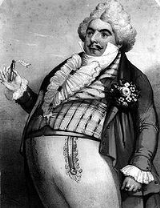
Luigi Lablache

Encyclopedia
Luigi Lablache was an Italian opera
singer of French and Irish heritage. He was most noted for his comic performances, possessing a powerful and agile bass
voice, a wide range, and adroit acting skills: Leporello in Don Giovanni
was one of his signature roles.
, the son of Nicolas Lablache, a merchant from Marseille
, France, by an Irish lady. He was educated from 1806 at the Conservatorio della Pietà de' Turchini in Naples, where Gentili taught him the elements of music, and Valesi instructed him in singing, while at the same time he studied the violin and cello. He fled the Conservatorio five times in order to pursue an acting career, but each time he was brought back in disgrace. His voice was a beautiful contralto
, and just before it broke he sang the solos in Mozart
's Requiem
on the death of Joseph Haydn
in 1809.
Before long he became possessed of a magnificent bass, which gradually increased in volume until at the age of twenty it attained a compass of two octaves from E-flat below to E-flat above the bass stave. In 1812, when only eighteen, he was engaged at the Teatro di San Carlo
, Naples, and appeared in Valentino Fioravanti
's La Molinara. From 1812 to 1817 he sang at Palermo
. In 1817, at La Scala
in Milan, he took the part of Dandini in Rossini's La Cenerentola
. The opera Elisa e Claudio
was written for him in 1821 by Saverio Mercadante
and his position was assured. His reputation spread throughout Europe.
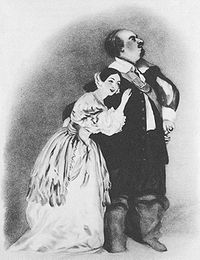 From Milan he went to Turin, returned to Milan in 1822, then appeared at Venice, and in 1824 at Vienna. Going back to Naples after an absence of twelve years, he created a great sensation as Assur in Rossini's Semiramide
. On 30 March 1830, under Ebers's management, he was first heard in London as Geronimo in Cimarosa
's Il matrimonio segreto
and thenceforth appeared there annually, also singing in many provincial festivals. In 1827 Franz Schubert
wrote three songs in Italian (Op. 83, D. 902) for Lablache, marvellous exercises in Rossinian pastiche
; they are among the last songs he ever wrote.
A physically imposing man, his voice was at all times extraordinarily powerful; but he could produce comic, humorous, tender, or sorrowful effects with equal ease and mastery. As an actor he excelled equally in comic and tragic parts. His chief rôles were Leporello
(his greatest part), Geronimo the Podestà in La gazza ladra
, Dandini in La Prova d' un' Opera Seria, Henry VIII in Anna Bolena
the Doge in Marino Faliero
, and Oroveso in Norma
. He created the title role in Donizetti's Don Pasquale
in 1843. Towards the close of his career he played two new characters of quite different types with great success, Shakespeare's
Caliban
and Gritzenko, the Kalmuck, in Scribe's
and Meyerbeer's
L'étoile du nord
.
At the funeral of Beethoven
in 1827 he was one of the thirty-two torchbearers who surrounded the coffin, and he also sang in Mozart's Requiem. He sang the same Requiem at Chopin
's funeral in 1849. He was the soloist, singing a Lacrimosa
, at Bellini
's funeral in 1835.
In 1836/37 he taught singing to Princess Victoria of the United Kingdom, the later Queen Victoria.
Luigi Lablache died at Naples on 23 January 1858, and was buried at Maisons-Laffitte
, near Paris.
He had married the singer Teresa Pinotti in 1813, and they had thirteen children; several of them, notably Frederick Lablache
, were also singers. His eldest daughter, Francesca (Cecchina), married the pianist Sigismond Thalberg
in 1843, and his younger daughter, Therese, married the opera singer Hans von Rokitansky
. The actor Stewart Granger
was his great-great-grandson.
Opera
Opera is an art form in which singers and musicians perform a dramatic work combining text and musical score, usually in a theatrical setting. Opera incorporates many of the elements of spoken theatre, such as acting, scenery, and costumes and sometimes includes dance...
singer of French and Irish heritage. He was most noted for his comic performances, possessing a powerful and agile bass
Bass (voice type)
A bass is a type of male singing voice and possesses the lowest vocal range of all voice types. According to The New Grove Dictionary of Opera, a bass is typically classified as having a range extending from around the second E below middle C to the E above middle C...
voice, a wide range, and adroit acting skills: Leporello in Don Giovanni
Don Giovanni
Don Giovanni is an opera in two acts with music by Wolfgang Amadeus Mozart and with an Italian libretto by Lorenzo Da Ponte. It was premiered by the Prague Italian opera at the Teatro di Praga on October 29, 1787...
was one of his signature roles.
Biography
Luigi Lablache was born in NaplesNaples
Naples is a city in Southern Italy, situated on the country's west coast by the Gulf of Naples. Lying between two notable volcanic regions, Mount Vesuvius and the Phlegraean Fields, it is the capital of the region of Campania and of the province of Naples...
, the son of Nicolas Lablache, a merchant from Marseille
Marseille
Marseille , known in antiquity as Massalia , is the second largest city in France, after Paris, with a population of 852,395 within its administrative limits on a land area of . The urban area of Marseille extends beyond the city limits with a population of over 1,420,000 on an area of...
, France, by an Irish lady. He was educated from 1806 at the Conservatorio della Pietà de' Turchini in Naples, where Gentili taught him the elements of music, and Valesi instructed him in singing, while at the same time he studied the violin and cello. He fled the Conservatorio five times in order to pursue an acting career, but each time he was brought back in disgrace. His voice was a beautiful contralto
Contralto
Contralto is the deepest female classical singing voice, with the lowest tessitura, falling between tenor and mezzo-soprano. It typically ranges between the F below middle C to the second G above middle C , although at the extremes some voices can reach the E below middle C or the second B above...
, and just before it broke he sang the solos in Mozart
Wolfgang Amadeus Mozart
Wolfgang Amadeus Mozart , baptismal name Johannes Chrysostomus Wolfgangus Theophilus Mozart , was a prolific and influential composer of the Classical era. He composed over 600 works, many acknowledged as pinnacles of symphonic, concertante, chamber, piano, operatic, and choral music...
's Requiem
Requiem (Mozart)
The Requiem Mass in D minor by Wolfgang Amadeus Mozart was composed in Vienna in 1791 and left unfinished at the composer's death. A completion by Franz Xaver Süssmayr was delivered to Count Franz von Walsegg, who had anonymously commissioned the piece for a requiem Mass to commemorate the...
on the death of Joseph Haydn
Joseph Haydn
Franz Joseph Haydn , known as Joseph Haydn , was an Austrian composer, one of the most prolific and prominent composers of the Classical period. He is often called the "Father of the Symphony" and "Father of the String Quartet" because of his important contributions to these forms...
in 1809.
Before long he became possessed of a magnificent bass, which gradually increased in volume until at the age of twenty it attained a compass of two octaves from E-flat below to E-flat above the bass stave. In 1812, when only eighteen, he was engaged at the Teatro di San Carlo
Teatro di San Carlo
The Real Teatro di San Carlo is an opera house in Naples, Italy. It is the oldest continuously active such venue in Europe.Founded by the Bourbon Charles VII of Naples of the Spanish branch of the dynasty, the theatre was inaugurated on 4 November 1737 — the king's name day — with a performance...
, Naples, and appeared in Valentino Fioravanti
Valentino Fioravanti
Valentino Fioravanti was a celebrated Italian composer of opera buffas.One of the best opera buffa composers between Domenico Cimarosa and Gioacchino Rossini. He was especially popular in Naples, and was the first in Italy to introduce spoken dialogue in the French manner in his works, sometimes...
's La Molinara. From 1812 to 1817 he sang at Palermo
Palermo
Palermo is a city in Southern Italy, the capital of both the autonomous region of Sicily and the Province of Palermo. The city is noted for its history, culture, architecture and gastronomy, playing an important role throughout much of its existence; it is over 2,700 years old...
. In 1817, at La Scala
La Scala
La Scala , is a world renowned opera house in Milan, Italy. The theatre was inaugurated on 3 August 1778 and was originally known as the New Royal-Ducal Theatre at La Scala...
in Milan, he took the part of Dandini in Rossini's La Cenerentola
La Cenerentola
La Cenerentola, ossia La bontà in trionfo is an operatic dramma giocoso in two acts by Gioachino Rossini. The libretto was written by Jacopo Ferretti, based on the fairy tale Cinderella...
. The opera Elisa e Claudio
Elisa e Claudio
Elisa e Claudio, ossia L'amore protetto dall'amicizia is a two-act melodramma semiseria by the 19th Century Italian composer Saverio Mercadante from a libretto by Luigi Romanelli based on the play, Rosella by Filipo Casari...
was written for him in 1821 by Saverio Mercadante
Saverio Mercadante
Giuseppe Saverio Raffaele Mercadante was an Italian composer, particularly of operas. While Mercadante may not have retained the international celebrity of Gaetano Donizetti or Gioachino Rossini beyond his own lifetime, he composed as impressive a number of works as either; and his development of...
and his position was assured. His reputation spread throughout Europe.
Semiramide
Semiramide is an opera in two acts by Gioachino Rossini.The libretto by Gaetano Rossi is based on Voltaire's tragedy Semiramis, which in turn was based on the legend of Semiramis of Babylon...
. On 30 March 1830, under Ebers's management, he was first heard in London as Geronimo in Cimarosa
Domenico Cimarosa
Domenico Cimarosa was an Italian opera composer of the Neapolitan school...
's Il matrimonio segreto
Il matrimonio segreto
Il matrimonio segreto is an opera in two acts, music by Domenico Cimarosa, on a libretto by Giovanni Bertati, based on the play The Clandestine Marriage by George Colman the Elder and David Garrick...
and thenceforth appeared there annually, also singing in many provincial festivals. In 1827 Franz Schubert
Franz Schubert
Franz Peter Schubert was an Austrian composer.Although he died at an early age, Schubert was tremendously prolific. He wrote some 600 Lieder, nine symphonies , liturgical music, operas, some incidental music, and a large body of chamber and solo piano music...
wrote three songs in Italian (Op. 83, D. 902) for Lablache, marvellous exercises in Rossinian pastiche
Pastiche
A pastiche is a literary or other artistic genre or technique that is a "hodge-podge" or imitation. The word is also a linguistic term used to describe an early stage in the development of a pidgin language.-Hodge-podge:...
; they are among the last songs he ever wrote.
A physically imposing man, his voice was at all times extraordinarily powerful; but he could produce comic, humorous, tender, or sorrowful effects with equal ease and mastery. As an actor he excelled equally in comic and tragic parts. His chief rôles were Leporello
Don Giovanni
Don Giovanni is an opera in two acts with music by Wolfgang Amadeus Mozart and with an Italian libretto by Lorenzo Da Ponte. It was premiered by the Prague Italian opera at the Teatro di Praga on October 29, 1787...
(his greatest part), Geronimo the Podestà in La gazza ladra
La gazza ladra
La gazza ladra is a melodramma or opera semiseria in two acts by Gioachino Rossini. The libretto was by Giovanni Gherardini after La pie voleuse by JMT Badouin d'Aubigny and Louis-Charles Caigniez....
, Dandini in La Prova d' un' Opera Seria, Henry VIII in Anna Bolena
Anna Bolena
Anna Bolena is a tragedia lirica, or opera, in two acts by Gaetano Donizetti. Felice Romani wrote the Italian libretto after Ippolito Pindemonte's Enrico VIII ossia Anna Bolena and Alessandro Pepoli's Anna Bolena, both telling of the life of Anne Boleyn...
the Doge in Marino Faliero
Marino Faliero (opera)
Marino Faliero is a tragedia lirica, or tragic opera, in three acts by Gaetano Donizetti. Giovanni Emanuele Bidéra wrote the Italian libretto, with revisions by Agostino Ruffini, after Casimir Delavigne's play...
, and Oroveso in Norma
Norma (opera)
Norma is a tragedia lirica or opera in two acts by Vincenzo Bellini with libretto by Felice Romani after Norma, ossia L'infanticidio by Alexandre Soumet. First produced at La Scala on December 26, 1831, it is generally regarded as an example of the supreme height of the bel canto tradition...
. He created the title role in Donizetti's Don Pasquale
Don Pasquale
Don Pasquale is an opera buffa, or comic opera, in three acts by Gaetano Donizetti. The librettist Giovanni Ruffini wrote the Italian language libretto after Angelo Anelli's libretto for Stefano Pavesi's Ser Marcantonio ....
in 1843. Towards the close of his career he played two new characters of quite different types with great success, Shakespeare's
William Shakespeare
William Shakespeare was an English poet and playwright, widely regarded as the greatest writer in the English language and the world's pre-eminent dramatist. He is often called England's national poet and the "Bard of Avon"...
Caliban
Caliban
Caliban is a character in William Shakespeare's play The Tempest.Caliban may also refer to:* Caliban , a moon of Uranus* Caliban , a metalcore band from Germany* Caliban , an acoustic Celtic folk duo...
and Gritzenko, the Kalmuck, in Scribe's
Eugène Scribe
Augustin Eugène Scribe , was a French dramatist and librettist. He is best known for the perfection of the so-called "well-made play" . This dramatic formula was a mainstay of popular theater for over 100 years.-Biography:...
and Meyerbeer's
Giacomo Meyerbeer
Giacomo Meyerbeer was a noted German opera composer, and the first great exponent of "grand opera." At his peak in the 1830s and 1840s, he was the most famous and successful composer of opera in Europe, yet he is rarely performed today.-Early years:He was born to a Jewish family in Tasdorf , near...
L'étoile du nord
L'étoile du nord
L'étoile du nord is an opéra comique in three acts by Giacomo Meyerbeer. The French-language libretto was by Eugène Scribe....
.
At the funeral of Beethoven
Ludwig van Beethoven
Ludwig van Beethoven was a German composer and pianist. A crucial figure in the transition between the Classical and Romantic eras in Western art music, he remains one of the most famous and influential composers of all time.Born in Bonn, then the capital of the Electorate of Cologne and part of...
in 1827 he was one of the thirty-two torchbearers who surrounded the coffin, and he also sang in Mozart's Requiem. He sang the same Requiem at Chopin
Frédéric Chopin
Frédéric François Chopin was a Polish composer and virtuoso pianist. He is considered one of the great masters of Romantic music and has been called "the poet of the piano"....
's funeral in 1849. He was the soloist, singing a Lacrimosa
Lacrimosa (Requiem)
The Lacrimosa is part of the Dies Irae sequence in the Requiem mass. Its text comes from the 18th and 19th stanzas of the sequence. Many composers, including Mozart, Berlioz, and Verdi have set the text as a discrete movement of the Requiem.-Latin Text:...
, at Bellini
Vincenzo Bellini
Vincenzo Salvatore Carmelo Francesco Bellini was an Italian opera composer. His greatest works are I Capuleti ed i Montecchi , La sonnambula , Norma , Beatrice di Tenda , and I puritani...
's funeral in 1835.
In 1836/37 he taught singing to Princess Victoria of the United Kingdom, the later Queen Victoria.
Luigi Lablache died at Naples on 23 January 1858, and was buried at Maisons-Laffitte
Maisons-Laffitte
Maisons-Laffitte is a commune in the Yvelines department in the Île-de-France region in north-central France. It is located in the north-western suburbs of Paris from the center....
, near Paris.
He had married the singer Teresa Pinotti in 1813, and they had thirteen children; several of them, notably Frederick Lablache
Frederick Lablache
Frederick Lablache was an English singer.Lablache, eldest son of Luigi Lablache, vocalist, was educated by his father. About 1837 he appeared at the King's Theatre, London, in Italian opera, and afterwards frequently sang at Manchester with Mario, Grisi, and Favanti...
, were also singers. His eldest daughter, Francesca (Cecchina), married the pianist Sigismond Thalberg
Sigismond Thalberg
Sigismond Thalberg was a composer and one of the most distinguished virtuoso pianists of the 19th century.- Descent and family background :...
in 1843, and his younger daughter, Therese, married the opera singer Hans von Rokitansky
Hans von Rokitansky
Baron Hans von Rokitansky was an Austrian operatic bass who sang for three decades at the Vienna Hofoper and in concerts and operas throughout Europe between 1856 and 1877.He performed a wide repertoire that encompassed French grand opera, Italian bel canto opera, the German operas of...
. The actor Stewart Granger
Stewart Granger
Stewart Granger was an English-American film actor, mainly associated with heroic and romantic leading roles. He was a popular leading man from the 1940s to the early 1960s rising to fame through his appearances in the Gainsborough melodramas.-Early life:He was born James Lablache Stewart in Old...
was his great-great-grandson.