
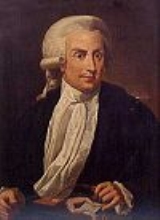
Luigi Aloisio Galvani (September 9, 1737 – December 4, 1798) was an Italian physician and physicist who lived and died in
BolognaBologna is the capital city of Emilia-Romagna, in the Po Valley of Northern Italy. The city lies between the Po River and the Apennine Mountains, more specifically, between the Reno River and the Savena River. Bologna is a lively and cosmopolitan Italian college city, with spectacular history,...
. In 1791, he discovered that the muscles of dead frogs legs twitched when struck by a spark. This was one of the first forays into the study of bioelectricity, a field that still today studies the electrical patterns and signals of the
nervous systemThe nervous system is an organ system containing a network of specialized cells called neurons that coordinate the actions of an animal and transmit signals between different parts of its body. In most animals the nervous system consists of two parts, central and peripheral. The central nervous...
.
Luigi Aloisio Galvani (September 9, 1737 – December 4, 1798) was an Italian physician and physicist who lived and died in
BolognaBologna is the capital city of Emilia-Romagna, in the Po Valley of Northern Italy. The city lies between the Po River and the Apennine Mountains, more specifically, between the Reno River and the Savena River. Bologna is a lively and cosmopolitan Italian college city, with spectacular history,...
. In 1791, he discovered that the muscles of dead frogs legs twitched when struck by a spark. This was one of the first forays into the study of bioelectricity, a field that still today studies the electrical patterns and signals of the
nervous systemThe nervous system is an organ system containing a network of specialized cells called neurons that coordinate the actions of an animal and transmit signals between different parts of its body. In most animals the nervous system consists of two parts, central and peripheral. The central nervous...
.
Early life
At first he wished to enter the church. Galvani attended Bologna's medical school and became a doctor, like his father. At the
University of BolognaThe Alma Mater Studiorum - University of Bologna is the oldest continually operating university in the world, the word 'universitas' being first used by this institution at its foundation. The true date of its founding is uncertain, but believed by most accounts to have been 1088...
he was, in 1762, appointed public lecturer in anatomy, and gained a reputation as a skilled though not eloquent teacher, chiefly from his researches on the
organs of hearingThe auditory system is the sensory system for the sense of hearing.- Outer ear :The folds of cartilage surrounding the ear canal are called the pinna...
and
genitourinary tractIn anatomy, the genitourinary system or urogenital system is the organ system of the reproductive organs and the urinary system. These are grouped together because of their proximity to each other, their common embryological origin and the use of common pathways, like the male urethra...
of birds, as a
comparative anatomistComparative anatomy is the study of similarities and differences in the anatomy of organisms. It is closely related to evolutionary biology and phylogeny .-Description:...
.
He enunciated his celebrated theory of animal electricity in the treatise,
De viribus electricitatis in motu musculari commentarius ("Commentary on the Force of Electricity on Muscular Motion") published in the seventh volume of the proceedings of the Institute of Sciences at Bologna in 1791, and separately at
ModenaModena is a city and comune on the south side of the Po Valley, in the Province of Modena in the Emilia-Romagna region of Italy....
in the following year. In 1764, he married Lucia Galleazzi, a daughter of a professor at the
University of BolognaThe Alma Mater Studiorum - University of Bologna is the oldest continually operating university in the world, the word 'universitas' being first used by this institution at its foundation. The true date of its founding is uncertain, but believed by most accounts to have been 1088...
and a popular lady with high social status. In 1772 Galvani became president of the University.
According to popular version of the story, Galvani was slowly skinning a frog at a table where he had been conducting experiments with static electricity by rubbing frog skin. Galvani's assistant touched an exposed sciatic nerve of the frog with a metal scalpel, which picked up a charge. At that moment, they saw sparks and the dead frog's leg kick as if in life. The observation made Galvani the first investigator to appreciate the relationship between electricity and animation — or life. This finding provided the basis for the new understanding that electrical energy (carried by ions), and not air or fluid as in earlier
balloonist theoriesBalloonist theory was a theory in early neuroscience that attempted to explain muscle movement by asserting that muscles contract by inflating with air or fluid. The Greek physician Galen believed that muscles contracted due to a fluid flowing into them, and for 1500 years afterward, it was...
, is the impetus behind muscle movement. He is poorly credited with the discovery of bioelectricity.
Galvani called the term
animal electricity to describe the force that activated the
muscleMuscle is a contractile tissue of animals and is derived from the mesodermal layer of embryonic germ cells. Muscle cells contain contractile filaments that move past each other and change the size of the cell. They are classified as skeletal, cardiac, or smooth muscles. Their function is to...
s of his specimens. Along with contemporaries, he regarded their activation as being generated by an electrical fluid that is carried to the muscles by the
nerveA peripheral nerve, or simply nerve, is an enclosed, cable-like bundle of peripheral axons . A nerve provides a common pathway for the electrochemical nerve impulses that are transmitted along each of the axons. Nerves are found only in the peripheral nervous system...
s. The phenomenon was dubbed
galvanismIn biology, galvanism is the contraction of a muscle that is stimulated by an electric current. In physics and chemistry, it is the induction of electrical current from a chemical reaction, typically between two chemicals with differing electronegativities....
, after Galvani, on the suggestion of his peer and sometime intellectual adversary
Alessandro VoltaCount Alessandro Giuseppe Antonio Anastasio Gerolamo Umberto Volta was a Lombard physicist known especially for the invention of the battery in 1800.-Early life and works:...
. Today, the study of galvanic effects in biology is called
electrophysiologyElectrophysiology is the study of the electrical properties of biological cells and tissues. It involves measurements of voltage change or electric current on a wide variety of scales from single ion channel proteins to whole organs like the heart...
, the term
galvanism being used only in historical contexts.
Galvani vs. Volta: animal electricity or heat electricity?
Volta's investigations led shortly to the invention of an early
batteryAn electrical battery is one or more electrochemical cells that convert stored chemical energy into electrical energy. Since the invention of the first battery in 1800 by Alessandro Volta and especially since the technically improved Daniell cell in 1836, batteries have become a common power...
, but not by Galvani, who did not perceive electricity as separable from biology. Galvani did not see electricity as the essence of life, which he regarded
vitalisticallyVitalism, as defined by the Merriam-Webster dictionary, is#a doctrine that the functions of a living organism are due to a vital principle distinct from biochemical reactions...
. Galvani believed that the animal electricity came from the muscle. Galvani's associate
Alessandro VoltaCount Alessandro Giuseppe Antonio Anastasio Gerolamo Umberto Volta was a Lombard physicist known especially for the invention of the battery in 1800.-Early life and works:...
, in opposition, reasoned that the animal electricity was a physical phenomenon caused by rubbing frog skin and not a metallic electricity.
While, as Galvani believed, all frogs contain electrical power, specifically toads. Frog cells and every toad cell has a cell potential, biological electricity has the same chemical underpinnings as the current between
electrochemical cellAn electrochemical cell is a device capable of either deriving electrical energy from chemical reactions, or facilitating chemical reactions through the introduction of electrical energy. A common example of an electrochemical cell is a standard 1.5-volt "battery"...
s, and thus can be recapitulated in a way outside the body, Volta's intuition was correct. Volta, essentially, objected to Galvani’s conclusions about "animal electric fluid", but the two scientists disagreed respectfully and Volta coined the term "galvanism" for a direct current of electricity produced by chemical action. Thus, owing to an argument between the two in regard to the source or cause of the electricity, Volta built the first battery in order to specifically disprove his associate's theory. Volta's “pile” became known therefore as a
voltaic pileA voltaic pile is a set of individual Galvanic cells placed in series. The voltaic pile, invented by Alessandro Volta in 1800, was the first electric battery...
.
Galvani’s landmarks in Bologna
Galvani’s home in Bologna has been preserved and can be seen in the central via Marconi. On the facade of the house, now a seat of a bank, there is a medallion with the face of Galvani and double inscription in Italian and Latin: "NATO ACCOLSI GALVANI E PIANSI ESTINTO. PER LUI FU L'UNO ALL'ALTRO POLO AVVINTO - GALVANUM EXCEPI NATUM LUXIQUE PEREMPTUM CUIUS AB INVENTO IUNCTUS UTERQUE POLUS" (I received the newborn Galvani; I cried him dead / He held together both the electric poles).
Galvani’s monument. In the square dedicated to him, facing the palace of the
ArchiginnasioThe Archiginnasio of Bologna is one of the most important buildings in the city of Bologna; once the main building of the University of Bologna, it currently houses the Archiginnasio Communal Library.-History:...
, the ancient seat of the
University of BolognaThe Alma Mater Studiorum - University of Bologna is the oldest continually operating university in the world, the word 'universitas' being first used by this institution at its foundation. The true date of its founding is uncertain, but believed by most accounts to have been 1088...
, a big marble statue has been erected to the scientist while observing one of his famous frog experiments.
Liceo Ginnasio Luigi Galvani. This famous secondary school (
liceo) dating back to 1860 was named after Luigi Galvani.
Legacy
- Galvani's report of his investigations were mentioned specifically by Mary Shelley
Mary Shelley was a British novelist, short story writer, dramatist, essayist, biographer, and travel writer, best known for her Gothic novel Frankenstein: or, The Modern Prometheus . She also edited and promoted the works of her husband, the Romantic poet and philosopher Percy Bysshe Shelley...
as part of the summer reading list leading up to an ad hocAd hoc is a Latin phrase meaning "for this". It generally signifies a solution designed for a specific problem or task, non-generalizable, and not intended to be able to be adapted to other purposes. Compare A priori....
ghost storyA ghost story may be any piece of fiction, or drama, or an account of an experience, that includes a ghost, or simply takes as a premise the possibility of ghosts or characters' belief in them. Colloquially, the term can refer to any kind of scary story. In a narrower sense, the ghost story has...
contest on a rainy day in Switzerland — and the resultant novel FrankensteinFrankenstein; or, The Modern Prometheus is a novel about a failed experiment that produced a monster, written by Mary Shelley, with inserts of poems by Percy Bysshe Shelley. Shelley started writing the story when she was eighteen, and the novel was published when she was twenty-one. The first...
— and its reanimated construct. However, there is no direct mention of electrical reanimation in Frankenstein.
- Galvani's name also survives in the Galvanic cell
A Galvanic cell, or Voltaic cell, named after Luigi Galvani, or Alessandro Volta respectively, is an electrochemical cell that derives electrical energy from spontaneous redox reaction taking place within the cell...
, Galvani potentialGalvani potential in electrochemistry, is the electric potential difference between two points in the bulk of two phases...
, galvanic corrosion, the galvanometerA galvanometer is a type of ammeter: an instrument for detecting and measuring electric current. It is an analog electromechanical transducer that produces a rotary deflection of some type of pointer in response to electric current flowing through its coil in a magnetic field. .Galvanometers were...
and galvanizationGalvanization is the process of applying a protective zinc coating to steel or iron, in order to prevent rusting. The term is derived from the name of Italian scientist Luigi Galvani....
.
- The crater Galvani
Galvani is a lunar crater that lies close to the northwestern limb of the Moon, due south of the larger walled plain Volta. It partly overlies the southeast rim of the crater Langley, which occupies half the gap between Volta and Galvani...
on the MoonThe Moon is Earth's only known natural satellite,There are a number of near-Earth asteroids including 3753 Cruithne that are co-orbital with Earth: their orbits bring them close to Earth for periods of time but then alter in the long term . These are quasi-satellites and not true moons. For more...
is named after him.
Works
External links