

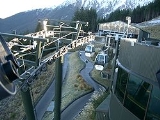
Luge

Encyclopedia
A Luge is a small one- or two-person sled
on which one sleds supine
(face up) and feet-first. Steering is done by flexing the sled's runners with the calf of each leg or exerting opposite shoulder pressure to the seat. Racing sleds weigh 21-25 kilograms (46-55 lbs.) for singles and 25-30 kilograms (55-66 lbs.) for doubles. Luge is also the
name of an Olympic sport. Of the three Olympic sliding sports, which include bobsleigh
and skeleton
, luge is the fastest and most dangerous. Lugers can reach speeds of 140 km per hour (87 mph). The Guinness World Record is held by Tony Benshoof
of the United States
who achieved a speed of 139.9 km per hour (86.93 mph). One athlete, Manuel Pfister of Austria, reached a top speed of 154 km per hour (95.69 mph) on the track in Whistler, Canada prior to the 2010 Vancouver Winter Olympics.
Street luge
is a recent innovation of the sport. Although it is considered an extreme sport, it is not yet an Olympic sport.
Lugers compete against a timer and are timed to a thousandth of a second, making luge one of the most precisely timed sports in the world. The first recorded use of the term "luge" is 1905, from the Savoy/Swiss dialect of French "luge" meaning "small coasting sled", and is possibly from a Gaulish word with the same root
as English sled.
and the bobsleigh
, originated in the health-spa town of St Moritz, Switzerland
, in the mid-to-late 19th century, through the endeavours of hotel entrepreneur Caspar Badrutt
. Badrutt successfully sold the idea of winter resorting, as well as rooms with food, drink, and activities. His more adventurous English guests began adapting delivery boys' sleds for recreation, which led to collisions with pedestrians as they sped down the lanes and alleys of the village.
The first organized meeting of the sport took place in 1883 in Switzerland
.
In 1913, the Internationale Schlittensportverband or International Sled Sports Federation was founded in Dresden
, Germany
. This body governed the sport until 1935, when it was incorporated in the Fédération Internationale de Bobsleigh et de Tobogganing
(FIBT, International Bobsleigh and Tobogganing Federation). After it had been decided that luge would replace the sport of skeleton
at the Olympic Games
, the first World Championships in the sport were held in 1955
in Oslo
(Norway
). In 1957, the Fédération Internationale de Luge de Course
(FIL, International Luge Federation) was founded. Luge events were first included in the Olympic Winter Games in 1964
.
Americans were slow to adopt the sport of luge. Although the United States competed in every Olympic luge event from 1964 through 1976, it was not until 1979 that the United States Luge Association was founded. The first artificial American track was completed in that year for use in the 1980 XIII Winter Olympic Games at Lake Placid, New York.
Since that time the United States luge program has greatly improved. A second artificial track was constructed near Park City, Utah for the 2002 XIX Winter Olympic Games at Salt Lake City.
). Tracks tend to be very smooth.
The athletes ride in a flat, aerodynamic position on the sled, keeping their heads low to minimize air resistance. They steer the sled mainly with their calves by applying pressure on the runners. It takes a precise mix of shifting body weight, applying pressure with calves and rolling the shoulders. There are also handles for minor adjustments. To be a successful luger one must be able to maintain complete concentration and relaxation on the sled while traveling at high speeds. Most lugers "visualize" the course in their minds before sliding. Fastest times are achieved by following the perfect "line" down the track. Any slight error, such as a brush of the wall, costs time. Track conditions are also important. Softer ice tends to slow speeds, while harder ice tends to lead to faster times. Lugers race at speeds averaging 120–145 km/h (75-90 mph) around high banked curves while experiencing a centrifugal pull of up to 5G. Men's Singles have their start locations near where the bobsled and skeleton competitors start at most tracks, while both the Doubles and Women's Singles competition have their starthouse located further down the track. Artificial track luge is the fastest and most agile sledding sport.

Natural tracks are adapted from existing mountain roads and paths. Artificially banked curves are not permitted. The track's surface must be horizontal. They are naturally iced. The use of artificial refrigeration is forbidden. Tracks can get rough from the braking and steering action. Athletes use a steering rein and drag their hands and use their legs in order to drive around the tight flat corners. Braking is often required in front of curves and is accomplished by the use of spikes built on the bottom of the shoes.
Most of the tracks are situated in Austria
and Italy
, with others in Germany, Poland
, Russia
, Slovenia
, Canada
, and the United States
. The Upper Peninsula Luge Club in Negaunee, MI is home to one of only five lighted natural track luge runs in the world, and the only natural track in the United States. The half-mile track features 29 curves along its 88-meter vertical drop. The hill hosts international luge events and offers luge instruction to the public during the winter months. World championships
have been held since 1979
while European championships
have been held since 1970
.
luger Nodar Kumaritashvili
who suffered a fatal crash during his final practice run for the 2010 Winter Olympics
in Whistler, British Columbia
, Canada
. Hours after the incident, the International Luge Federation concluded that the accident was caused by a steering error and not a track error. Nevertheless, changes to the track were made before the re-opening. Kumaritashvili was the fourth athlete to die while in preparation for a Winter Olympics competition, following speed skier Nicolas Bochatay
, 27, who died while preparing for the Albertville 1992 games, British
luger Kazimierz Kay-Skrzypeski
and skier Ross Milne
, 19, who both died in the run up to the Innsbruck 1964 games.
is essential to withstand the extreme G-forces of tight turns at high speeds. Since lugers have very little protection other than a visor and helmet, they must be able to endure the physical pounding administered by the track when mistakes are made. Mentally a luger must maintain total focus as they steer their sled through more than a kilometer of curves and straights at high speed. Dozens of subtle movements and weight shifts are required to find the perfect line down the track. Consistency is essential for success. Sled maintenance is also an important element for success. Serious lugers spend hours meticulously sanding their "steels," and making other important adjustments and repairs to their sleds. No luger can possibly achieve elite status without working closely with an experienced coaching staff, implementing suggestions and fine tuning technique. Other lugers will often give tips that can improve a slider's ability to find the "sweet spot" on the track. Though luge is a winter sport, it requires daily, year-round training. In the United States where luge is a relatively obscure sport, most athletes compete simply for the joy of sliding. The primary luge training facility in the United States is located in Lake Placid, New York
.
These are further broken into several age classes which include novice (ages 7-10), youth (ages 11-14), junior (ages 15-20), and general (ages 21 and older). Older competitors may enjoy the sport in masters (age 30-50), and senior masters (age 51+) classes.
In a team relay competition one man, one woman and a doubles pair form a team. A touchpad at the bottom of the run is touched by a competitor signaling a teammate at the top of the run to start.
Rules and procedures for races are very precise. Prior to a race the athlete must be weighed. This is to determine if the athlete is entitled to carry extra weight on their body while sliding. Men may use additional weight amounting to 75% of the difference between body weight and a base weight of 90 kg. Women may use additional weight amounting to 50% of the difference between body weight and a base weight of 70 kg. Doubles athletes may use additional weight amounting to 50% of the difference between body weight and a base weight of 90 kg. Additional weight is not allowed if the body weight of the front person and back person together exceeds 180 kg. If one of the partners weighs more than 90 kg, the weight exceeding the 90 kg mark is added to the lighter partner. If there should still be a difference between the partner’s weight and the 90 kg mark, the difference can be compensated according to an official weight table. A drawing is held to determine start order for the race. Athletes are assigned a number which is displayed on a bib. During major national and international events, Men's singles consists of four runs. Women's singles and doubles competitions consist of two runs. The cumulative time of all runs is used to determine finish order. In all three events, the start order after the first run is determined by the outcome of the previous run, with the last-place slider sliding first, the next-to-last place slider sliding second, and so forth, with the leader of the previous run sliding last. Between runs athletes are randomly selected for additional weight checks. Before each run the athlete and his or her sled are weighed at the start ramp. The temperature of the sled's steel blades is checked and may not be more than 5°C above that of a previously established control temperature. Once an athlete is on their sled they are audibly notified that the track is clear. At this point a tone sounds and the athlete has thirty seconds to begin their run. A run becomes official when an athlete and their sled, in contact with one another, crosses the finish line. If an athlete and sled are not within contact of one another the athlete is disqualified from further competition. Disqualifications may also take place for any violation of rules and regulations. Certain disqualifications may be appealed.
, Germany and includes 53 member nations. It is traditionally dominated by German representatives, however.
The following persons have been president of the FIL:
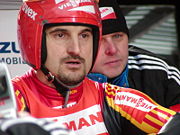
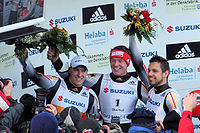
Sled
A sled, sledge, or sleigh is a land vehicle with a smooth underside or possessing a separate body supported by two or more smooth, relatively narrow, longitudinal runners that travels by sliding across a surface. Most sleds are used on surfaces with low friction, such as snow or ice. In some cases,...
on which one sleds supine
Supine position
The supine position is a position of the body: lying down with the face up, as opposed to the prone position, which is face down, sometimes with the hands behind the head or neck. When used in surgical procedures, it allows access to the peritoneal, thoracic and pericardial regions; as well as the...
(face up) and feet-first. Steering is done by flexing the sled's runners with the calf of each leg or exerting opposite shoulder pressure to the seat. Racing sleds weigh 21-25 kilograms (46-55 lbs.) for singles and 25-30 kilograms (55-66 lbs.) for doubles. Luge is also the
name of an Olympic sport. Of the three Olympic sliding sports, which include bobsleigh
Bobsleigh
Bobsleigh or bobsled is a winter sport in which teams of two or four make timed runs down narrow, twisting, banked, iced tracks in a gravity-powered sled that are combined to calculate the final score....
and skeleton
Skeleton
The skeleton is the body part that forms the supporting structure of an organism. There are two different skeletal types: the exoskeleton, which is the stable outer shell of an organism, and the endoskeleton, which forms the support structure inside the body.In a figurative sense, skeleton can...
, luge is the fastest and most dangerous. Lugers can reach speeds of 140 km per hour (87 mph). The Guinness World Record is held by Tony Benshoof
Tony Benshoof
Tony Benshoof is an American luger from White Bear Lake, Minnesota who has been competing since 1990...
of the United States
United States
The United States of America is a federal constitutional republic comprising fifty states and a federal district...
who achieved a speed of 139.9 km per hour (86.93 mph). One athlete, Manuel Pfister of Austria, reached a top speed of 154 km per hour (95.69 mph) on the track in Whistler, Canada prior to the 2010 Vancouver Winter Olympics.
Street luge
Street luge
Street luge is an extreme gravity-powered activity that involves riding a streetluge board down a paved road or course. Street luge is also known as land luge or road luge...
is a recent innovation of the sport. Although it is considered an extreme sport, it is not yet an Olympic sport.
Lugers compete against a timer and are timed to a thousandth of a second, making luge one of the most precisely timed sports in the world. The first recorded use of the term "luge" is 1905, from the Savoy/Swiss dialect of French "luge" meaning "small coasting sled", and is possibly from a Gaulish word with the same root
Root (linguistics)
The root word is the primary lexical unit of a word, and of a word family , which carries the most significant aspects of semantic content and cannot be reduced into smaller constituents....
as English sled.
History
Though the sport of luge is relatively new, sled racing is one of the oldest winter sports. The practical use of sleds is ancient and widespread. The first recorded sled races took place in Norway sometime during the 15th century. The sport of luge, like the skeletonSkeleton (sport)
Skeleton is a fast winter sliding sport in which an individual person rides a small sled down a frozen track while lying face down, during which athletes experience forces up to 5g. It originated in St. Moritz, Switzerland as a spin-off from the popular British sport of Cresta Sledding...
and the bobsleigh
Bobsleigh
Bobsleigh or bobsled is a winter sport in which teams of two or four make timed runs down narrow, twisting, banked, iced tracks in a gravity-powered sled that are combined to calculate the final score....
, originated in the health-spa town of St Moritz, Switzerland
Switzerland
Switzerland name of one of the Swiss cantons. ; ; ; or ), in its full name the Swiss Confederation , is a federal republic consisting of 26 cantons, with Bern as the seat of the federal authorities. The country is situated in Western Europe,Or Central Europe depending on the definition....
, in the mid-to-late 19th century, through the endeavours of hotel entrepreneur Caspar Badrutt
Caspar Badrutt
Swiss hotelier and tourism entrepreneur Caspar Badrutt was almost singlehandedly responsible for the origin of several modern winter sporting activities. These began when he sought to provide opportunities fun and frolic on the picturesque but cold slopes outside his first hotel in St Moritz,...
. Badrutt successfully sold the idea of winter resorting, as well as rooms with food, drink, and activities. His more adventurous English guests began adapting delivery boys' sleds for recreation, which led to collisions with pedestrians as they sped down the lanes and alleys of the village.
The first organized meeting of the sport took place in 1883 in Switzerland
Switzerland
Switzerland name of one of the Swiss cantons. ; ; ; or ), in its full name the Swiss Confederation , is a federal republic consisting of 26 cantons, with Bern as the seat of the federal authorities. The country is situated in Western Europe,Or Central Europe depending on the definition....
.
In 1913, the Internationale Schlittensportverband or International Sled Sports Federation was founded in Dresden
Dresden
Dresden is the capital city of the Free State of Saxony in Germany. It is situated in a valley on the River Elbe, near the Czech border. The Dresden conurbation is part of the Saxon Triangle metropolitan area....
, Germany
Germany
Germany , officially the Federal Republic of Germany , is a federal parliamentary republic in Europe. The country consists of 16 states while the capital and largest city is Berlin. Germany covers an area of 357,021 km2 and has a largely temperate seasonal climate...
. This body governed the sport until 1935, when it was incorporated in the Fédération Internationale de Bobsleigh et de Tobogganing
Fédération Internationale de Bobsleigh et de Tobogganing
The Fédération Internationale de Bobsleigh et de Tobogganing or International Bobsleigh and Tobogganing Federation is the main international federation for all bobsleigh and skeleton sports...
(FIBT, International Bobsleigh and Tobogganing Federation). After it had been decided that luge would replace the sport of skeleton
Skeleton (sport)
Skeleton is a fast winter sliding sport in which an individual person rides a small sled down a frozen track while lying face down, during which athletes experience forces up to 5g. It originated in St. Moritz, Switzerland as a spin-off from the popular British sport of Cresta Sledding...
at the Olympic Games
Olympic Games
The Olympic Games is a major international event featuring summer and winter sports, in which thousands of athletes participate in a variety of competitions. The Olympic Games have come to be regarded as the world’s foremost sports competition where more than 200 nations participate...
, the first World Championships in the sport were held in 1955
FIL World Luge Championships 1955
The FIL World Luge Championships 1955 took place in Oslo, Norway under the auspices of the Fédération Internationale de Bobsleigh et de Tobogganing under their "Section de Luge"...
in Oslo
Oslo
Oslo is a municipality, as well as the capital and most populous city in Norway. As a municipality , it was established on 1 January 1838. Founded around 1048 by King Harald III of Norway, the city was largely destroyed by fire in 1624. The city was moved under the reign of Denmark–Norway's King...
(Norway
Norway
Norway , officially the Kingdom of Norway, is a Nordic unitary constitutional monarchy whose territory comprises the western portion of the Scandinavian Peninsula, Jan Mayen, and the Arctic archipelago of Svalbard and Bouvet Island. Norway has a total area of and a population of about 4.9 million...
). In 1957, the Fédération Internationale de Luge de Course
Fédération Internationale de Luge de Course
The International Luge Federation is the main international federation for all luge sports...
(FIL, International Luge Federation) was founded. Luge events were first included in the Olympic Winter Games in 1964
Luge at the 1964 Winter Olympics
-Men's singles:-Men's doubles:-Women's singles:-Medal table:-References:***...
.
Americans were slow to adopt the sport of luge. Although the United States competed in every Olympic luge event from 1964 through 1976, it was not until 1979 that the United States Luge Association was founded. The first artificial American track was completed in that year for use in the 1980 XIII Winter Olympic Games at Lake Placid, New York.
Since that time the United States luge program has greatly improved. A second artificial track was constructed near Park City, Utah for the 2002 XIX Winter Olympic Games at Salt Lake City.
Artificial/Olympic tracks
Artificial luge tracks have specially designed and constructed banked curves plus walled-in straights. Most tracks are artificially refrigerated, but artificial tracks without artificial cooling also exist (for example, in St. MoritzSt. Moritz
St. Moritz is a resort town in the Engadine valley in Switzerland. It is a municipality in the district of Maloja in the Swiss canton of Graubünden...
). Tracks tend to be very smooth.
The athletes ride in a flat, aerodynamic position on the sled, keeping their heads low to minimize air resistance. They steer the sled mainly with their calves by applying pressure on the runners. It takes a precise mix of shifting body weight, applying pressure with calves and rolling the shoulders. There are also handles for minor adjustments. To be a successful luger one must be able to maintain complete concentration and relaxation on the sled while traveling at high speeds. Most lugers "visualize" the course in their minds before sliding. Fastest times are achieved by following the perfect "line" down the track. Any slight error, such as a brush of the wall, costs time. Track conditions are also important. Softer ice tends to slow speeds, while harder ice tends to lead to faster times. Lugers race at speeds averaging 120–145 km/h (75-90 mph) around high banked curves while experiencing a centrifugal pull of up to 5G. Men's Singles have their start locations near where the bobsled and skeleton competitors start at most tracks, while both the Doubles and Women's Singles competition have their starthouse located further down the track. Artificial track luge is the fastest and most agile sledding sport.
Natural track luge
Natural tracks are adapted from existing mountain roads and paths. Artificially banked curves are not permitted. The track's surface must be horizontal. They are naturally iced. The use of artificial refrigeration is forbidden. Tracks can get rough from the braking and steering action. Athletes use a steering rein and drag their hands and use their legs in order to drive around the tight flat corners. Braking is often required in front of curves and is accomplished by the use of spikes built on the bottom of the shoes.
Most of the tracks are situated in Austria
Austria
Austria , officially the Republic of Austria , is a landlocked country of roughly 8.4 million people in Central Europe. It is bordered by the Czech Republic and Germany to the north, Slovakia and Hungary to the east, Slovenia and Italy to the south, and Switzerland and Liechtenstein to the...
and Italy
Italy
Italy , officially the Italian Republic languages]] under the European Charter for Regional or Minority Languages. In each of these, Italy's official name is as follows:;;;;;;;;), is a unitary parliamentary republic in South-Central Europe. To the north it borders France, Switzerland, Austria and...
, with others in Germany, Poland
Poland
Poland , officially the Republic of Poland , is a country in Central Europe bordered by Germany to the west; the Czech Republic and Slovakia to the south; Ukraine, Belarus and Lithuania to the east; and the Baltic Sea and Kaliningrad Oblast, a Russian exclave, to the north...
, Russia
Russia
Russia or , officially known as both Russia and the Russian Federation , is a country in northern Eurasia. It is a federal semi-presidential republic, comprising 83 federal subjects...
, Slovenia
Slovenia
Slovenia , officially the Republic of Slovenia , is a country in Central and Southeastern Europe touching the Alps and bordering the Mediterranean. Slovenia borders Italy to the west, Croatia to the south and east, Hungary to the northeast, and Austria to the north, and also has a small portion of...
, Canada
Canada
Canada is a North American country consisting of ten provinces and three territories. Located in the northern part of the continent, it extends from the Atlantic Ocean in the east to the Pacific Ocean in the west, and northward into the Arctic Ocean...
, and the United States
United States
The United States of America is a federal constitutional republic comprising fifty states and a federal district...
. The Upper Peninsula Luge Club in Negaunee, MI is home to one of only five lighted natural track luge runs in the world, and the only natural track in the United States. The half-mile track features 29 curves along its 88-meter vertical drop. The hill hosts international luge events and offers luge instruction to the public during the winter months. World championships
FIL World Luge Natural Track Championships
The FIL World Luge Natural Track Championships, part of the International Luge Federation have taken place on an almost annual basis in non-Winter Olympics years since 1979. These championships are shown for natural tracks...
have been held since 1979
FIL World Luge Natural Track Championships 1979
-Men's singles:-Women's singles:-Men's doubles:-Medal table:-References:***...
while European championships
FIL European Luge Natural Track Championships
The FIL European Luge Natural Track Championships, part of the International Luge Federation , have taken place since 1970. A team event was added for the 2010 championships...
have been held since 1970
FIL European Luge Natural Track Championships 1970
The FIL European Luge Natural Track Championships 1970 took place in Kapfenberg, Austria.-Men's singles:-Women's singles:-Men's doubles:-Medal table:-References:***...
.
Risks
As with many extreme sports, luging is not without its risks. Though most injuries involve bumps, bruises, broken bones, and concussions, fatalities do occasionally occur. The most recent was GeorgianGeorgia (country)
Georgia is a sovereign state in the Caucasus region of Eurasia. Located at the crossroads of Western Asia and Eastern Europe, it is bounded to the west by the Black Sea, to the north by Russia, to the southwest by Turkey, to the south by Armenia, and to the southeast by Azerbaijan. The capital of...
luger Nodar Kumaritashvili
Nodar Kumaritashvili
Nodar David Kumaritashvili was a Georgian luger, who suffered a fatal crash during a training run for the 2010 Winter Olympics competition in Vancouver, Canada, on the day of the opening ceremony...
who suffered a fatal crash during his final practice run for the 2010 Winter Olympics
2010 Winter Olympics
The 2010 Winter Olympics, officially the XXI Olympic Winter Games or the 21st Winter Olympics, were a major international multi-sport event held from February 12–28, 2010, in Vancouver, British Columbia, Canada, with some events held in the suburbs of Richmond, West Vancouver and the University...
in Whistler, British Columbia
Whistler, British Columbia
Whistler is a Canadian resort town in the southern Pacific Ranges of the Coast Mountains in the province of British Columbia, Canada, approximately north of Vancouver...
, Canada
Canada
Canada is a North American country consisting of ten provinces and three territories. Located in the northern part of the continent, it extends from the Atlantic Ocean in the east to the Pacific Ocean in the west, and northward into the Arctic Ocean...
. Hours after the incident, the International Luge Federation concluded that the accident was caused by a steering error and not a track error. Nevertheless, changes to the track were made before the re-opening. Kumaritashvili was the fourth athlete to die while in preparation for a Winter Olympics competition, following speed skier Nicolas Bochatay
Nicolas Bochatay
Nicolas Bochatay was a Swiss speed skier who died during the 1992 Winter Olympics. Bochatay was killed when he collided with a snow grooming vehicle on the morning of the speed skiing finals. He was the nephew of Olympic skier Fernande Bochatay.-Personal life:Bochatay, a carpenter, was...
, 27, who died while preparing for the Albertville 1992 games, British
United Kingdom
The United Kingdom of Great Britain and Northern IrelandIn the United Kingdom and Dependencies, other languages have been officially recognised as legitimate autochthonous languages under the European Charter for Regional or Minority Languages...
luger Kazimierz Kay-Skrzypeski
Kazimierz Kay-Skrzypeski
Kazimierz Kay-Skrzypecki was a Polish-born British luge racer.Kay-Skrzypecki was a former pilot in the Royal Air Force. He died during one of the training runs for the first Olympic luge competition at the 1964 Winter Olympics in Innsbruck. Three days later, on 26 January 1964, Australian...
and skier Ross Milne
Ross Milne
Ross Milne was an Australian Olympic downhill skier who died when he struck a tree during a practice run three days before the 1964 Winter Olympics in Innsbruck, Austria....
, 19, who both died in the run up to the Innsbruck 1964 games.
Training
The sport of luge requires an athlete to balance mental and physical fitness. To become an elite luger a competitor must begin training at an early age and spend decades honing their skills. Physically, a luger must have strong neck, upper body, abdominal, and thigh muscles. Strength trainingStrength training
Strength training is the use of resistance to muscular contraction to build the strength, anaerobic endurance, and size of skeletal muscles. There are many different methods of strength training, the most common being the use of gravity or elastic/hydraulic forces to oppose muscle contraction...
is essential to withstand the extreme G-forces of tight turns at high speeds. Since lugers have very little protection other than a visor and helmet, they must be able to endure the physical pounding administered by the track when mistakes are made. Mentally a luger must maintain total focus as they steer their sled through more than a kilometer of curves and straights at high speed. Dozens of subtle movements and weight shifts are required to find the perfect line down the track. Consistency is essential for success. Sled maintenance is also an important element for success. Serious lugers spend hours meticulously sanding their "steels," and making other important adjustments and repairs to their sleds. No luger can possibly achieve elite status without working closely with an experienced coaching staff, implementing suggestions and fine tuning technique. Other lugers will often give tips that can improve a slider's ability to find the "sweet spot" on the track. Though luge is a winter sport, it requires daily, year-round training. In the United States where luge is a relatively obscure sport, most athletes compete simply for the joy of sliding. The primary luge training facility in the United States is located in Lake Placid, New York
Lake Placid, New York
Lake Placid is a village in the Adirondack Mountains in Essex County, New York, United States. As of the 2000 census, the village had a population of 2,638....
.
Events
There are four luge disciplines.- Men's singles
- Men's doubles
- Women's singles
- Team Relay (not an Olympic discipline)
These are further broken into several age classes which include novice (ages 7-10), youth (ages 11-14), junior (ages 15-20), and general (ages 21 and older). Older competitors may enjoy the sport in masters (age 30-50), and senior masters (age 51+) classes.
In a team relay competition one man, one woman and a doubles pair form a team. A touchpad at the bottom of the run is touched by a competitor signaling a teammate at the top of the run to start.
Rules and procedures for races are very precise. Prior to a race the athlete must be weighed. This is to determine if the athlete is entitled to carry extra weight on their body while sliding. Men may use additional weight amounting to 75% of the difference between body weight and a base weight of 90 kg. Women may use additional weight amounting to 50% of the difference between body weight and a base weight of 70 kg. Doubles athletes may use additional weight amounting to 50% of the difference between body weight and a base weight of 90 kg. Additional weight is not allowed if the body weight of the front person and back person together exceeds 180 kg. If one of the partners weighs more than 90 kg, the weight exceeding the 90 kg mark is added to the lighter partner. If there should still be a difference between the partner’s weight and the 90 kg mark, the difference can be compensated according to an official weight table. A drawing is held to determine start order for the race. Athletes are assigned a number which is displayed on a bib. During major national and international events, Men's singles consists of four runs. Women's singles and doubles competitions consist of two runs. The cumulative time of all runs is used to determine finish order. In all three events, the start order after the first run is determined by the outcome of the previous run, with the last-place slider sliding first, the next-to-last place slider sliding second, and so forth, with the leader of the previous run sliding last. Between runs athletes are randomly selected for additional weight checks. Before each run the athlete and his or her sled are weighed at the start ramp. The temperature of the sled's steel blades is checked and may not be more than 5°C above that of a previously established control temperature. Once an athlete is on their sled they are audibly notified that the track is clear. At this point a tone sounds and the athlete has thirty seconds to begin their run. A run becomes official when an athlete and their sled, in contact with one another, crosses the finish line. If an athlete and sled are not within contact of one another the athlete is disqualified from further competition. Disqualifications may also take place for any violation of rules and regulations. Certain disqualifications may be appealed.
Governing body
The sport of luge is governed by the FIL, Fédération International de Luge de Course. The FIL is located in BerchtesgadenBerchtesgaden
Berchtesgaden is a municipality in the German Bavarian Alps. It is located in the south district of Berchtesgadener Land in Bavaria, near the border with Austria, some 30 km south of Salzburg and 180 km southeast of Munich...
, Germany and includes 53 member nations. It is traditionally dominated by German representatives, however.
The following persons have been president of the FIL:
- Bert IsatitschBert IsatitschBert Isatitsch was an Austrian educator who later became the first president of the International Luge Federation , serving from its 1957 establishment until his 1994 death.-Education career:...
, AustriaAustriaAustria , officially the Republic of Austria , is a landlocked country of roughly 8.4 million people in Central Europe. It is bordered by the Czech Republic and Germany to the north, Slovakia and Hungary to the east, Slovenia and Italy to the south, and Switzerland and Liechtenstein to the...
(1957–1994) - Josef FendtJosef FendtJosef Fendt is the current president of the Fédération Internationale de Luge de Course . He was a West German-German luger who competed from the mid 1960s to the mid 1970s...
, GermanyGermanyGermany , officially the Federal Republic of Germany , is a federal parliamentary republic in Europe. The country consists of 16 states while the capital and largest city is Berlin. Germany covers an area of 357,021 km2 and has a largely temperate seasonal climate...
(1994–current)
Olympic Medal table
Men's singles
Current Olympic champion:| 1 |  Germany Germany |
9 | 7 | 6 | 22 |
| 2 |  Italy Italy |
3 | 2 | 2 | 7 |
| 3 |  Austria Austria |
1 | 2 | 2 | 5 |
| 4 |  Russia Russia |
0 | 2 | 2 | 4 |
| 5 |  Latvia Latvia |
0 | 0 | 1 | 1 |
| Total | 13 | 13 | 13 | 39 | |
|---|---|---|---|---|---|
Men's doubles
Current Olympic champion:| 1 | Germany |
9 | 4 | 6 | 19 |
| 2 | Austria |
3 | 2 | 2 | 7 |
| 3 | Italy |
2 | 2 | 3 | 7 |
| 4 |  United States United States |
0 | 2 | 2 | 4 |
| 5 | Latvia |
0 | 1 | 0 | 1 |
| 5 | Russia |
0 | 1 | 0 | 1 |
| Total | 14 | 12 | 13 | 39 | |
|---|---|---|---|---|---|
Women's singles
Current Olympic champion:| 1 | Germany |
9 | 11 | 9 | 29 |
| 2 | Italy |
2 | 0 | 0 | 2 |
| 3 | Austria |
1 | 2 | 3 | 6 |
| 4 | Russia |
1 | 0 | 1 | 2 |
| Total | 13 | 13 | 13 | 39 | |
|---|---|---|---|---|---|
Total Olympic Ranking (2010)
| 1 | Germany |
27 | 22 | 21 | 70 |
| 2 | Italy |
7 | 4 | 5 | 16 |
| 3 | Austria |
5 | 6 | 7 | 18 |
| 4 | Russia |
1 | 3 | 3 | 7 |
| 5 | United States |
0 | 2 | 2 | 4 |
| 6 | Latvia |
0 | 1 | 1 | 2 |
| Total | 40 | 38 | 39 | 117 | |
|---|---|---|---|---|---|
Fatal Accidents
| No | Competitor | Year | Track | Section | Race | Event | Vehicle |
|---|---|---|---|---|---|---|---|
| Kazimierz Kay-Skrzypeski Kazimierz Kay-Skrzypeski Kazimierz Kay-Skrzypecki was a Polish-born British luge racer.Kay-Skrzypecki was a former pilot in the Royal Air Force. He died during one of the training runs for the first Olympic luge competition at the 1964 Winter Olympics in Innsbruck. Three days later, on 26 January 1964, Australian... |
1964 | Igls |
Training run | 1964 Winter Olympics 1964 Winter Olympics The 1964 Winter Olympics, officially known as the IX Olympic Winter Games, were a winter multi-sport event which was celebrated in Innsbruck, Austria, from January 29 to February 9, 1964... |
Luge | ||
 Stanislaw Paczka Stanislaw Paczka |
1969 | Königssee Königssee bobsleigh, luge, and skeleton track The Königssee bobsleigh, luge, and skeleton track is a venue for bobsleigh, luge and skeleton located in Schönau am Königsee, Germany. It is located near Königssee... |
Luge | ||||
 Nodar Kumaritashvili Nodar KumaritashviliNodar Kumaritashvili Nodar David Kumaritashvili was a Georgian luger, who suffered a fatal crash during a training run for the 2010 Winter Olympics competition in Vancouver, Canada, on the day of the opening ceremony... |
2010 |  Whistler Whistler |
Training run | 2010 Winter Olympics 2010 Winter Olympics The 2010 Winter Olympics, officially the XXI Olympic Winter Games or the 21st Winter Olympics, were a major international multi-sport event held from February 12–28, 2010, in Vancouver, British Columbia, Canada, with some events held in the suburbs of Richmond, West Vancouver and the University... |
Luge |
See also
- World Luge Championships
- World Luge Natural Track ChampionshipsFIL World Luge Natural Track ChampionshipsThe FIL World Luge Natural Track Championships, part of the International Luge Federation have taken place on an almost annual basis in non-Winter Olympics years since 1979. These championships are shown for natural tracks...
- List of Luge World Cup champions
- European Luge Championships
- European Luge Natural Track ChampionshipsFIL European Luge Natural Track ChampionshipsThe FIL European Luge Natural Track Championships, part of the International Luge Federation , have taken place since 1970. A team event was added for the 2010 championships...
- BobsleighBobsleighBobsleigh or bobsled is a winter sport in which teams of two or four make timed runs down narrow, twisting, banked, iced tracks in a gravity-powered sled that are combined to calculate the final score....
- SkeletonSkeleton (sport)Skeleton is a fast winter sliding sport in which an individual person rides a small sled down a frozen track while lying face down, during which athletes experience forces up to 5g. It originated in St. Moritz, Switzerland as a spin-off from the popular British sport of Cresta Sledding...
- TobogganTobogganA toboggan is a simple sled which is a traditional form of transport used by the Innu and Cree of northern Canada. In modern times, it is used on snow to carry one or more people down a hill or other slope for recreation. Designs vary from simple, traditional models to modern engineered composites...
External links
- International Luge Federation
- Bob- und Schlittenverband für Deutschland/German Luge Federation
- Österreichischer Rodelverband/Austrian Luge Federation
- United States Luge Association
- Brazilian Luge Federation
- British Luge Association
- Croatian Luge Federation
- http://www.vancouver2010.com/olympic-news/n/news/afp-news/luge--benshoof-plans-to-smash-speed-world-record_271888YO.html
- POV Lake Placid Olympic track
- POV Utah Olympic track
- POV Whistler Olympic track
- POV Oberhof track
- POV Calgary Olympic track
- POV Altenberg track
- Mark Grimmette describes doubles luge