


Lucretia

Encyclopedia
Legend
A legend is a narrative of human actions that are perceived both by teller and listeners to take place within human history and to possess certain qualities that give the tale verisimilitude...
ary figure in the history of the Roman Republic
Roman Republic
The Roman Republic was the period of the ancient Roman civilization where the government operated as a republic. It began with the overthrow of the Roman monarchy, traditionally dated around 508 BC, and its replacement by a government headed by two consuls, elected annually by the citizens and...
. According to the story, told mainly by the Roman historian Livy
Livy
Titus Livius — known as Livy in English — was a Roman historian who wrote a monumental history of Rome and the Roman people. Ab Urbe Condita Libri, "Chapters from the Foundation of the City," covering the period from the earliest legends of Rome well before the traditional foundation in 753 BC...
and the Greek historian Dionysius of Halicarnassus
Dionysius of Halicarnassus
Dionysius of Halicarnassus was a Greek historian and teacher of rhetoric, who flourished during the reign of Caesar Augustus. His literary style was Attistic — imitating Classical Attic Greek in its prime.-Life:...
(who lived in Rome at the time of the Roman Emperor Caesar Augustus), her rape
Rape
Rape is a type of sexual assault usually involving sexual intercourse, which is initiated by one or more persons against another person without that person's consent. The act may be carried out by physical force, coercion, abuse of authority or with a person who is incapable of valid consent. The...
by the king's son and consequent suicide were the immediate cause of the revolution that overthrew the monarchy
Roman Kingdom
The Roman Kingdom was the period of the ancient Roman civilization characterized by a monarchical form of government of the city of Rome and its territories....
and established the Roman Republic
Roman Republic
The Roman Republic was the period of the ancient Roman civilization where the government operated as a republic. It began with the overthrow of the Roman monarchy, traditionally dated around 508 BC, and its replacement by a government headed by two consuls, elected annually by the citizens and...
. The incident kindled the flames of dissatisfaction over the tyrannical methods of the last king of Rome, Lucius Tarquinius Superbus
Lucius Tarquinius Superbus
Lucius Tarquinius Superbus was the legendary seventh and final King of Rome, reigning from 535 BC until the popular uprising in 509 BC that led to the establishment of the Roman Republic. He is more commonly known by his cognomen Tarquinius Superbus and was a member of the so-called Etruscan...
. As a result, the prominent families instituted a republic, drove the extensive Tarquin family from Rome, and successfully defended the republic against attempted Etruscan
Etruscan
-Etruscan civilization:*Etruscan alphabet*Etruscan architecture*Etruscan art*Etruscan cities*Etruscan civilization*Etruscan coins*Etruscan language*Etruscan mythology*Etruscan numerals*Etruscan society*Etruscan terracotta warriors*Etruscan warfare...
and Latin
Latins (Italic tribe)
The Latins were a people of ancient Italy who included the inhabitants of the early City of Rome. From ca. 1000 BC, the Latins inhabited the small part of the peninsula known to the Romans as Old Latium , that is, the region between the river Tiber and the promontory of Monte Circeo The Latins (or...
intervention. The rape has been a major theme in European art and literature.
The beginning of the Republic is marked by the first appearance of the two consul
Consul
Consul was the highest elected office of the Roman Republic and an appointive office under the Empire. The title was also used in other city states and also revived in modern states, notably in the First French Republic...
s elected on a yearly basis. The Romans recorded events by consular year, keeping an official list in various forms called the fasti
Fasti
In ancient Rome, the fasti were chronological or calendar-based lists, or other diachronic records or plans of official and religiously sanctioned events...
, used by Roman historians. The list and its events are authentic as far as can be known although debatable problems with many parts of it do exist. This list proves, as far as can be proved, that there was a Roman Republic, that it began at the beginning of the fasti, and that it supplanted a monarchy. One of the first two consuls is Lucius Tarquinius Collatinus
Lucius Tarquinius Collatinus
Lucius Tarquinius Collatinus was one of the four leaders of the revolution which overthrew the Roman monarchy, and became one of the first two consuls of Rome in 509 BC, together with Lucius Junius Brutus...
, husband of Lucretia. All the numerous sources on the beginning of the republic reiterate these basic events. Lucretia and the monarchy cannot therefore be total myth or an elaborate literary hoax to deceive and entertain the Roman people about an early history that can't be known. The evidence points to the historical existence of a woman named Lucretia and a historical incident playing a critical part in the real downfall of a real monarchy. Many of the specific details are debatable. Later uses of the legend, however, are typically totally mythical, being of artistic rather than historical merit.
As the events of the story move rapidly, the date of the incident is probably the same year as the first of the fasti. Dionysius of Halicarnassus, a major source, sets this year "at the beginning of the sixty-eighth Olympiad
Olympiad
An Olympiad is a period of four years, associated with the Olympic Games of Classical Greece. In the Hellenistic period, beginning with Ephorus, Olympiads were used as calendar epoch....
... Isagoras
Isagoras
Isagoras , son of Tisander, was an Athenian aristocrat in the late 6th century BC.He had remained in Athens during the tyranny of Hippias, but after Hippias was overthrown, he became involved in a struggle for power with Cleisthenes, a fellow aristocrat. In 508 BC he was elected archon eponymous,...
being the annual archon
Archon
Archon is a Greek word that means "ruler" or "lord", frequently used as the title of a specific public office. It is the masculine present participle of the verb stem ἀρχ-, meaning "to rule", derived from the same root as monarch, hierarchy, and anarchy.- Ancient Greece :In ancient Greece the...
at Athens
Athens
Athens , is the capital and largest city of Greece. Athens dominates the Attica region and is one of the world's oldest cities, as its recorded history spans around 3,400 years. Classical Athens was a powerful city-state...
;" that is, 508/507 BC (the ancient calendars split years over modern ones). Lucretia therefore died in 508 BC. The other historical sources tend to support this date, but the year is debatable within a range of about five years.
The incident
Lucius Tarquinius SuperbusLucius Tarquinius Superbus
Lucius Tarquinius Superbus was the legendary seventh and final King of Rome, reigning from 535 BC until the popular uprising in 509 BC that led to the establishment of the Roman Republic. He is more commonly known by his cognomen Tarquinius Superbus and was a member of the so-called Etruscan...
, last king of Rome, being engaged in the siege of Ardea
Ardea (RM)
Ardea is an ancient town and comune in the province of Rome, 35 km south of Rome and about 4 km from today's Mediterranean coast....
, sent his son, Sextus Tarquinius
Sextus Tarquinius
Sextus Tarquinius was a Roman prince, the third and youngest son of the last king of Rome, Lucius Tarquinius Superbus . He is primarily known for his rape of Lucretia, daughter of Spurius Lucretius Tricipitinus, wife of Collatinus....
, on a military errand to Collatia
Collatia
Collatia was an ancient town of central Italy, c. 15 km northeast of Rome by the Via Collatina.It appears in the legendary history of Rome as captured by Tarquinius Priscus. Virgil speaks of it as a Latin colony of Alba Longa...
. Sextus was received with great hospitality at the governor's mansion, home of Lucius Tarquinius Collatinus
Lucius Tarquinius Collatinus
Lucius Tarquinius Collatinus was one of the four leaders of the revolution which overthrew the Roman monarchy, and became one of the first two consuls of Rome in 509 BC, together with Lucius Junius Brutus...
, son of the king's nephew, Egerius
Egerius
Aruns Egerius Tarquinius was a member of the royal family of early Rome.His father was Aruns, son of Demaratus the Corinthian and a noblewoman Princess from Tarquinii....
Tarquinius Collatinus, former governor of Collatia and first of the Tarquinii Collatini
Tarquinius
Tarquinius is the name of an illustrious Roman family of Etruscan origin, two of whose members, according to legend, reigned as king in Rome:* Lucius Tarquinius Priscus* Lucius Tarquinius Superbus...
. Lucius' wife, Lucretia, daughter of Spurius Lucretius, prefect of Rome, "a man of distinction", made sure that the king's son was treated as became his rank, although her husband was away at the siege. In a variant of the story, Sextus and Lucius, at a wine party on furlough, were debating the virtues of wives when Lucius volunteered to settle the debate by their all riding to his home to see what Lucretia was doing. She was weaving with her maids. The party awarded her the palm of victory and Lucius invited them to visit, but for the time being they returned to camp.
At night Sextus entered her bedroom by stealth, quietly going around the slaves who were sleeping at her door. She awakened, he identified himself and offered her two choices: she could submit to his sexual advances and become his wife and future queen, or he would kill her and one of her slaves and placing the bodies together claim he had caught her having adulterous sex (in flagrante delicto
In flagrante delicto
In flagrante delicto or sometimes simply in flagrante is a legal term used to indicate that a criminal has been caught in the act of committing an offence...
). In the alternative story, he returned from camp a few days later with one companion to take Collatinus up on his invitation to visit and was lodged in a guest bedroom. He entered Lucretia's room while she lay naked in her bed and started to wash her belly with water, which woke her up.
The consequences
In the alternative version she did not go to Rome but sent to it for her father and to Ardea for her husband asking them to bring one friend each. Those selected were Publius Valerius Publicola
Publius Valerius Publicola
Publius Valerius Publicola was one of four Roman aristocrats who led the overthrow of the monarchy, and became a Roman consul, the colleague of Lucius Junius Brutus in 509 BC, traditionally considered the first year of the Roman Republic...
from Rome and Lucius Junius Brutus
Lucius Junius Brutus
Lucius Junius Brutus was the founder of the Roman Republic and traditionally one of the first consuls in 509 BC. He was claimed as an ancestor of the Roman gens Junia, including Marcus Junius Brutus, the most famous of Caesar's assassins.- Background :...
from the camp at Ardea. They found Lucretia in her room. She explained what happened and after exacting an oath of vengeance
Oath of vengeance
In Mormonism, the oath of vengeance was an oath that was made by participants in the Endowment ritual of The Church of Jesus Christ of Latter-day Saints between about 1845 and the 1920s, in which participants vowed to pray that God would avenge the blood of the prophets Joseph Smith, Jr...
: "Pledge me your solemn word that the adulterer shall not go unpunished," while they were discussing the matter drew the poignard and stabbed herself, again in the heart.
In either version Collatinus and Brutus were encountered returning to Rome unaware, were briefed and were brought to the death scene. Brutus happened to be a politically motivated participant. By kinship he was a Tarquin on his mother's side, the son of Tarquinia, daughter of Lucius Tarquinius Priscus, the third king before last. He was a candidate for the throne if anything should happen to Superbus. By law, however, as he was a Junius on his father's side, he was not a Tarquin and therefore could later propose the exile of the Tarquins without fear for himself. He acquired the cognomen
Cognomen
The cognomen nōmen "name") was the third name of a citizen of Ancient Rome, under Roman naming conventions. The cognomen started as a nickname, but lost that purpose when it became hereditary. Hereditary cognomina were used to augment the second name in order to identify a particular branch within...
Brutus, "Dullard", by playing the pleasant fool so as not to attract the king's onus. Superbus had taken his inheritance and left him a pittance, keeping him at court for the entertainment of it.
Collatinus, seeing his wife dead, became distraught. He held her, kissed her, called her name and spoke to her. Seeing the hand of Destiny in these events his friend Brutus called the grieving party to order, explained that his simplicity had been a sham, and proposed that they drive the Tarquins from Rome. Grasping the bloody dagger,he swore by Mars and all the other gods that he would do everything in his power to overthrow the dominion of the Tarquinii and that he would neither be reconciled to the tyrants himself nor tolerate any who should be reconciled to them, but would look upon every man who thought otherwise as an enemy and till his death would pursue with unrelenting hatred both the tyranny and its abettors; and if he should violate his oath, he prayed that he and his children might meet with the same end as Lucretia.
He passed the dagger around and each mourner swore the same oath by it. The two stories agree on this point: Livy's version is:
By this blood - most pure before the outrage wrought by the king's son - I swear, and you, O gods, I call to witness that I will drive hence Lucius Tarquinius Superbus, together with his cursed wife and his whole blood, with fire and sword and every means in my power, and I will not suffer them or any one else to reign in Rome.
The revolution
The newly sworn revolutionary committee paraded the bloody corpse to the Roman ForumRoman Forum
The Roman Forum is a rectangular forum surrounded by the ruins of several important ancient government buildings at the center of the city of Rome. Citizens of the ancient city referred to this space, originally a marketplace, as the Forum Magnum, or simply the Forum...
and arriving there heard grievances against the Tarquins and began to enlist an army. Brutus "urged them to act as men and Romans and take up arms against their insolent foes." The gates of Rome were blockaded by the new revolutionary soldiers and more were sent to guard Collatia. By now a crowd had gathered in the forum, The presence of the magistrates among the revolutionaries kept them in good order. Brutus happened to be Tribune of the Celeres, a minor office of some religious duties, but one which as a magistracy gave him the theoretical power to summon the curiae, an organization of patrician families used mainly to ratify the decrees of the king. Summoning them on the spot he transformed the crowd into an authoritative legislative assembly and began to harangue them in one of the more noted and effective speeches of ancient Rome.
He began by revealing that his pose as fool was a sham designed to protect him against an evil king. He leveled a number of charges against the king and his family: the outrage against Lucretia, whom everyone could see on the dais, the king's tyranny, the forced labor of the plebeians in the ditches and sewers of Rome. He pointed out that Superbus had come to rule by the murder of Servius Tullius
Servius Tullius
Servius Tullius was the legendary sixth king of ancient Rome, and the second of its Etruscan dynasty. He reigned 578-535 BC. Roman and Greek sources describe his servile origins and later marriage to a daughter of Lucius Tarquinius Priscus, Rome's first Etruscan king, who was assassinated in 579 BC...
, his wife's father, next-to-the-last king of Rome. He "solemnly invoked the gods as the avengers of murdered parents." The king's wife, Tullia
Tullia (daughter of Servius Tullius)
Tullia was the last queen of Rome. She was the younger daughter of Rome's sixth king, Servius Tullius, and she married Lucius Tarquinius. Along with her husband, she arranged the murder and overthrow of her father, securing the throne for her husband...
, was in fact in Rome and probably was a witness to the proceedings from her palace near the forum. Seeing herself the target of so much animosity she fled from the palace in fear of her life and proceeded to the camp at Ardea.
Brutus opened a debate on the form of government Rome ought to have; there were many speakers (all patricians). In summation he proposed the banishment of the Tarquins from all the territories of Rome and appointment of an interrex
Interrex
The Interrex was literally a ruler "between kings" during the Roman Kingdom and the Roman Republic. He was in effect a short-term regent....
to nominate new magistrates and conduct an election of ratification. They had decided on a republican form of government with two consuls in place of a king executing the will of a patrician senate. This was a temporary measure until they could consider the details more carefully. Brutus renounced all right to the throne. In subsequent years the powers of the king were divided among various elected magistracies.
A final vote of the curiae carried the interim constitution. Spurius Lucretius was swiftly elected interrex; he was prefect of the city anyway. He proposed Brutus and Collatinus as the first two consuls and that choice was ratified by the curiae. Needing to acquire the assent of the population as a whole they paraded Lucretia through the streets summoning the plebeians to legal assembly in the forum. Once there they heard a constitutional speech by Brutus not unlike many speeches and documents of western civilization subsequently. It began:
Inasmuch as Tarquinius neither obtained the sovereignty in accordance with our ancestral customs and laws, nor, since he obtained it — in whatever manner he got it — has he been exercising it in an honourable or kingly manner, but has surpassed in insolence and lawlessness all the tyrants the world ever saw, we patricians met together and resolved to deprive him of his power, a thing we ought to have done long ago, but are doing now when a favourable opportunity has offered. And we have called you together, plebeians, in order to declare our own decision and then ask for your assistance in achieving liberty for our country ....
A general election was held. The vote was for the republic. The monarchy was at an end, even while Lucretia was still displayed in the forum.
The constitutional consequences of this event were, formally at least, to reverberate for more than two thousand years. Rome would never again have a hereditary "king", even if later emperors
Roman Empire
The Roman Empire was the post-Republican period of the ancient Roman civilization, characterised by an autocratic form of government and large territorial holdings in Europe and around the Mediterranean....
were absolute rulers in all but name. This constitutional tradition prevented both Julius Caesar
Julius Caesar
Gaius Julius Caesar was a Roman general and statesman and a distinguished writer of Latin prose. He played a critical role in the gradual transformation of the Roman Republic into the Roman Empire....
and Octavian Augustus from accepting a crown; instead they had to devise a confluence of several republican offices
Roman Republic
The Roman Republic was the period of the ancient Roman civilization where the government operated as a republic. It began with the overthrow of the Roman monarchy, traditionally dated around 508 BC, and its replacement by a government headed by two consuls, elected annually by the citizens and...
onto their persons in order to secure absolute power. Their successors
Roman Emperor
The Roman emperor was the ruler of the Roman State during the imperial period . The Romans had no single term for the office although at any given time, a given title was associated with the emperor...
both in Rome
Western Roman Empire
The Western Roman Empire was the western half of the Roman Empire after its division by Diocletian in 285; the other half of the Roman Empire was the Eastern Roman Empire, commonly referred to today as the Byzantine Empire....
and in Constantinople adhered to this tradition in form if not in essence, and even the office of German Holy Roman Emperor
Holy Roman Emperor
The Holy Roman Emperor is a term used by historians to denote a medieval ruler who, as German King, had also received the title of "Emperor of the Romans" from the Pope...
remained typically elective rather than hereditary - up to its abolition in the Napoleonic Wars
Napoleonic Wars
The Napoleonic Wars were a series of wars declared against Napoleon's French Empire by opposing coalitions that ran from 1803 to 1815. As a continuation of the wars sparked by the French Revolution of 1789, they revolutionised European armies and played out on an unprecedented scale, mainly due to...
, 2314 years later.
Aftermath
Hearing of the doings at Rome the king, his sons and a party of retainers rode posthaste for the city, leaving Titus Herminius and Marcus Horatius in command of the troops at Ardea. The gates of Rome being barred and armed men on the wall, they returned to camp. Meanwhile letters had arrived from the revolutionary committee and were read to the troops by Herminius and Horatius. The men were assembled by unit for a vote, by which the revolution was confirmed. In one story the Tarquins escaped to Gabii. A 15-year truce was made with Ardea. The troops returned to Rome.Superbus was not long in Gabii. He had to retire with his men to Tarquinii, where he raised the standard of intervention among the Etruscans. In an alternative story he went directly to Tarquinii with two of his sons; the third, Sextus, attempted to resume control of Gabii, but was assassinated. The Romans had to face one intervention by the Etruscans (Horatius Cocles
Horatius Cocles
Publius Horatius Cocles was an officer in the army of the ancient Roman Republic who famously defended the Pons Sublicius from the invading army of Lars Porsena, king of Clusium in the late 6th century BC, during the war between Rome and Clusium.-Background:...
) and another by the Latin League
Latin league
The Latin League was a confederation of about 30 villages and tribes in the region of Latium near ancient Rome, organized for mutual defense...
(Battle of Lake Regillus
Battle of Lake Regillus
The Battle of Lake Regillus was a legendary early Roman victory, won over the Latin League led by the expelled Etruscan former king of Rome. It is usually said to have occurred in 498 BC, but other dates have been proposed, including 499 BC, 496 BC and 493 BC.The battle may be entirely legendary,...
). Sentiment ran high against the Tarquins. Collatinus was asked to resign over constitutional issues. He complied and was replaced by Publius Valerius Publicola
Publius Valerius Publicola
Publius Valerius Publicola was one of four Roman aristocrats who led the overthrow of the monarchy, and became a Roman consul, the colleague of Lucius Junius Brutus in 509 BC, traditionally considered the first year of the Roman Republic...
.
The theme in literature and music
St. AugustineAugustine of Hippo
Augustine of Hippo , also known as Augustine, St. Augustine, St. Austin, St. Augoustinos, Blessed Augustine, or St. Augustine the Blessed, was Bishop of Hippo Regius . He was a Latin-speaking philosopher and theologian who lived in the Roman Africa Province...
made use of the figure of Lucretia in The City of God to defend the honour of Christian women who had been raped in the sack of Rome and had not committed suicide.
Megadeth (band) made a song about Lucretia in which her ghost lives in lead singer/guitarist Dave Mustaine's attic.
The story of Lucretia was a popular moral tale in the later Middle Ages. The story has been recounted in Geoffrey Chaucer
Geoffrey Chaucer
Geoffrey Chaucer , known as the Father of English literature, is widely considered the greatest English poet of the Middle Ages and was the first poet to have been buried in Poet's Corner of Westminster Abbey...
's The Legend of Good Women
The Legend of Good Women
The Legend of Good Women is a poem in the form of a dream vision by Geoffrey Chaucer.The poem is the third longest of Chaucer’s works, after The Canterbury Tales and Troilus and Criseyde and is possibly the first significant work in English to use the iambic pentameter or decasyllabic couplets...
, John Gower
John Gower
John Gower was an English poet, a contemporary of William Langland and a personal friend of Geoffrey Chaucer. He is remembered primarily for three major works, the Mirroir de l'Omme, Vox Clamantis, and Confessio Amantis, three long poems written in French, Latin, and English respectively, which...
's Confessio Amantis
Confessio Amantis
Confessio Amantis is a 33,000-line Middle English poem by John Gower, which uses the confession made by an ageing lover to the chaplain of Venus as a frame story for a collection of shorter narrative poems. According to its prologue, it was composed at the request of Richard II...
(Book VII), and John Lydgate
John Lydgate
John Lydgate of Bury was a monk and poet, born in Lidgate, Suffolk, England.Lydgate is at once a greater and a lesser poet than John Gower. He is a greater poet because of his greater range and force; he has a much more powerful machine at his command. The sheer bulk of Lydgate's poetic output is...
's Fall of Princes. Lucrece is also featured in William Shakespeare's 1594 long poem The Rape of Lucretia; he also mentioned her in Titus Andronicus
Titus Andronicus
Titus Andronicus is a tragedy by William Shakespeare, and possibly George Peele, believed to have been written between 1588 and 1593. It is thought to be Shakespeare's first tragedy, and is often seen as his attempt to emulate the violent and bloody revenge plays of his contemporaries, which were...
, As You Like It
As You Like It
As You Like It is a pastoral comedy by William Shakespeare believed to have been written in 1599 or early 1600 and first published in the folio of 1623. The play's first performance is uncertain, though a performance at Wilton House in 1603 has been suggested as a possibility...
, and Twelfth Night (Malvolio authenticates his fateful letter by spotting Olivia's Lucrece seal). Niccolò Machiavelli's comedy La Mandragola
The Mandrake
The Mandrake is a satirical play by Italian Renaissance writer Niccolò Machiavelli. Its tale of the corruption of Italian society was written while Machiavelli was in exile, allegedly having plotted against the Medici...
is loosely based on Lucretia.
She is also mentioned in the poem Appius and Virginia
Appius and Virginia
Appius and Virginia is an early 17th-century stage play, a tragedy by John Webster . It is the third and least famous of his tragedies, after The White Devil and The Duchess of Malfi.-Heywood:...
by John Webster
John Webster
John Webster was an English Jacobean dramatist best known for his tragedies The White Devil and The Duchess of Malfi, which are often regarded as masterpieces of the early 17th-century English stage. He was a contemporary of William Shakespeare.- Biography :Webster's life is obscure, and the dates...
and Thomas Heywood
Thomas Heywood
Thomas Heywood was a prominent English playwright, actor, and author whose peak period of activity falls between late Elizabethan and early Jacobean theatre.-Early years:...
, which includes the following lines:
- Two ladies fair, but most unfortunate
- Have in their ruins rais'd declining Rome,
- Lucretia and VirginiaVerginiaVerginia, or Virginia, was the subject of a story of Ancient Rome, related in Livy's Ab Urbe Condita.The people of Rome were already angry with the decemviri for not calling the proper elections, taking bribes, and other abuses. It seemed that they were returning to the rule of the Kings of Rome...
, both renowned - For chastity

Thomas Heywood
Thomas Heywood was a prominent English playwright, actor, and author whose peak period of activity falls between late Elizabethan and early Jacobean theatre.-Early years:...
's play The Rape of Lucretia dates from 1607. The subject also enjoyed a revival in the mid twentieth century; André Obey
André Obey
André Obey was a prominent French playwright during the inter-war years, and into the 1950s....
's 1931 play Le Viol de Lucrèce was adapted into a 1946 opera by Benjamin Britten
Benjamin Britten
Edward Benjamin Britten, Baron Britten, OM CH was an English composer, conductor, and pianist. He showed talent from an early age, and first came to public attention with the a cappella choral work A Boy Was Born in 1934. With the premiere of his opera Peter Grimes in 1945, he leapt to...
. Ernst Krenek
Ernst Krenek
Ernst Krenek was an Austrian of Czech origin and, from 1945, American composer. He explored atonality and other modern styles and wrote a number of books, including Music Here and Now , a study of Johannes Ockeghem , and Horizons Circled: Reflections on my Music...
set Emmet Lavery's libretto
Libretto
A libretto is the text used in an extended musical work such as an opera, operetta, masque, oratorio, cantata, or musical. The term "libretto" is also sometimes used to refer to the text of major liturgical works, such as mass, requiem, and sacred cantata, or even the story line of a...
Tarquin
Tarquin (opera)
Tarquin is a chamber opera by Ernst Krenek to an English libretto by Emmet Lavery. Written in 1940, it is Krenek's only unpublished opera , though a premiere in German translation Tarquin is a chamber opera by Ernst Krenek to an English libretto by Emmet Lavery. Written in 1940, it is Krenek's only...
(1940), a version in a contemporary setting.
Lucretia appears to Dante
DANTE
Delivery of Advanced Network Technology to Europe is a not-for-profit organisation that plans, builds and operates the international networks that interconnect the various national research and education networks in Europe and surrounding regions...
in the section of Limbo reserved to the nobles of Rome and other "virtuous pagans" in Canto IV of the Inferno
Inferno (Dante)
Inferno is the first part of Dante Alighieri's 14th-century epic poem Divine Comedy. It is followed by Purgatorio and Paradiso. It is an allegory telling of the journey of Dante through what is largely the medieval concept of Hell, guided by the Roman poet Virgil. In the poem, Hell is depicted as...
. Christine de Pizan
Christine de Pizan
Christine de Pizan was a Venetian-born late medieval author who challenged misogyny and stereotypes prevalent in the male-dominated medieval culture. As a poet, she was well known and highly regarded in her own day; she completed 41 works during her 30 year career , and can be regarded as...
used Lucretia just as St. Augustine of Hippo did in her City of Ladies, defending a woman's sanctity.
In Samuel Richardson
Samuel Richardson
Samuel Richardson was an 18th-century English writer and printer. He is best known for his three epistolary novels: Pamela: Or, Virtue Rewarded , Clarissa: Or the History of a Young Lady and The History of Sir Charles Grandison...
's 1740 novel Pamela
Pamela
Pamela, or Virtue Rewarded is an epistolary novel by Samuel Richardson, first published in 1740. It tells the story of a beautiful but poor 15-year old servant-maid named Pamela Andrews whose master, Mr. B, a nobleman, makes unwanted advances towards her after the death of his mother whose maid she...
, Mr. B. cites the story of Lucretia as a reason why Pamela ought not fear for her reputation, should he rape her. Pamela quickly sets him straight with a better reading of the story. Colonial Mexican poet Sor Juana Inés de la Cruz also mentions "Lucrecia" in her poem Redondillas, a commentary on prostitution and who is to blame.
In 1932, a play was produced on Broadway starring legendary actress Katharine Cornell
Katharine Cornell
Katharine Cornell was an American stage actress, writer, theater owner and producer. She was born to American parents and raised in Buffalo, New York.Cornell is known as the greatest American stage actress of the 20th century...
in the title part. It was mostly performed in pantomime
Pantomime
Pantomime — not to be confused with a mime artist, a theatrical performer of mime—is a musical-comedy theatrical production traditionally found in the United Kingdom, Australia, New Zealand, Canada, Jamaica, South Africa, India, Ireland, Gibraltar and Malta, and is mostly performed during the...
.
The theme in the arts
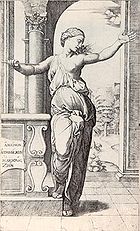
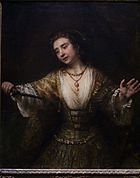
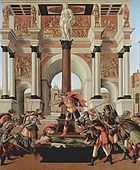
Titian
Tiziano Vecelli or Tiziano Vecellio Tiziano Vecelli or Tiziano Vecellio Tiziano Vecelli or Tiziano Vecellio (c. 1488/1490 – 27 August 1576 better known as Titian was an Italian painter, the most important member of the 16th-century Venetian school. He was born in Pieve di Cadore, near...
, Rembrandt, Dürer
Albrecht Dürer
Albrecht Dürer was a German painter, printmaker, engraver, mathematician, and theorist from Nuremberg. His prints established his reputation across Europe when he was still in his twenties, and he has been conventionally regarded as the greatest artist of the Northern Renaissance ever since...
, Raphael
Raphael
Raffaello Sanzio da Urbino , better known simply as Raphael, was an Italian painter and architect of the High Renaissance. His work is admired for its clarity of form and ease of composition and for its visual achievement of the Neoplatonic ideal of human grandeur...
, Botticelli, Jörg Breu the Elder
Jörg Breu the Elder
Jörg Breu the Elder , of Augsburg, was a painter of the German Danube school. He was the son of a weaver.He journeyed to Austria and created several multi-panel altarpieces there in 1500–02, such as the Melk Altar . He returned to Augsburg in 1502 where he became a master. He travelled to...
, Johannes Moreelse
Johannes Moreelse
Johannes Paulus Moreelse, or Johan Pauwelszon Moreelse , was a Dutch baroque painter belonging to the school of Utrecht Caravaggism during the Dutch Golden Age....
, Artemisia Gentileschi
Artemisia Gentileschi
Artemisia Gentileschi was an Italian Early Baroque painter, today considered one of the most accomplished painters in the generation influenced by Caravaggio...
, Damià Campeny, Eduardo Rosales
Eduardo Rosales
Eduardo Rosales was a Spanish realist painter. He joined the Real Academia de Bellas Artes de San Fernando in 1851, studying under Federico de Madrazo.-References:*...
, Lucas Cranach the Elder
Lucas Cranach the Elder
Lucas Cranach the Elder , was a German Renaissance painter and printmaker in woodcut and engraving...
and others.