

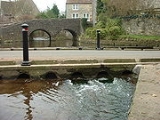
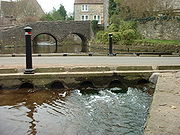
Low water crossing

Encyclopedia
Construction
The low water crossing was developed from the traditional fordFord (crossing)
A ford is a shallow place with good footing where a river or stream may be crossed by wading or in a vehicle. A ford is mostly a natural phenomenon, in contrast to a low water crossing, which is an artificial bridge that allows crossing a river or stream when water is low.The names of many towns...
. A ford permits vehicular traffic to cross a waterway with wet wheels. The term "low water crossing" implies that the crossing is usually dry, while "ford" implies that the crossing is usually wet.
A simple low-water crossing can be constructed with culvert
Culvert
A culvert is a device used to channel water. It may be used to allow water to pass underneath a road, railway, or embankment. Culverts can be made of many different materials; steel, polyvinyl chloride and concrete are the most common...
s. Culverts (often concrete pipes) are used to carry the water in a stream keeping the crossing surface dry for most of the year. High flows, e.g. spring runoff or flash floods, flow over the top of the crossing, as the culverts are not large enough to carry these flood-type runoff events.
A more elaborate low-water bridge will usually be an engineered concrete structure. There are thousands of such structures in the western United States; some of them accommodate four-lane city streets or highways. Typically, a low-water bridge that accommodates a high daily volume of vehicular traffic will be underwater only a few days per decade.
Navigation
A low-water bridge renders the waterway non-navigable. In almost all cases this is not a practical concern, since the waterway would be non-navigable except during flood conditions anyway.A low-water bridge is sometimes called a submersible bridge, but this is a misnomer. A true submersible bridge
Submersible bridge
A submersible bridge is a type of movable bridge that lowers the bridge deck below the water level to permit waterborne traffic to use the waterway. This differs from a lift bridge or table bridge, which operate by raising the roadway. Two submersible bridges exist across the Corinth Canal, one at...
is used on navigable waterways and is actively lowered into the water.
Safety
The concept behind low water crossings is that they are convenient and safe to use in normal conditions. Once the water level rises to the point where it crosses the bridge surface the bridge is generally unsafe to use, and in developed countries this will usually be indicated by warning signs. An additional hazard is that the bridge surface may become completely obscured by the water, making it relatively easy to fall off the bridge surface into the deeper and more hazardous water on either side. As a consequence the line of the submerged bridge is often marked with poles or other structures to indicate its course to unwary travelers and emergency users even when submerged.The force of the moving water may be strong enough to physically push the vehicle off the bridge (partially or totally, the higher percentage of the vehicle in the water, the more likely the water's force will take the vehicle off the bridge and send it down river with substantial damage). One additional risk for trying cross a bridge under water may include the vehicle stalling out (failing to work). Most times, when a vehicle has stalled, people will try to get out of the vehicle. When they leave the vehicle, they step into water currents that can cause them to fall or be pulled down into the water. They are exposed to a strong hydro force, which may sweep them down river and the water may jamb their body into debris in the waterway's path which may cause injury and/or death.
Despite the obvious dangers and warnings given there are still a significant number of emergencies and even deaths due to unwary use of low-water bridges during flood conditions.
One attempted solution/deterrent is the Stupid Motorist Law
Stupid Motorist Law
The "Stupid Motorist Law", which corresponds to section 28-910 of the Arizona Revised Statutes, states that any motorist who becomes stranded after driving around barricades to enter a flooded stretch of roadway may be charged for the cost of his/her rescue....
in Arizona, USA.