

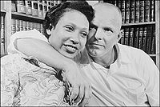
Loving v. Virginia

Encyclopedia
Loving v. Virginia, , was a landmark
civil rights
case in which the United States Supreme Court, in a unanimous decision, declared Virginia
's anti-miscegenation statute, the "Racial Integrity Act of 1924
", unconstitutional, thereby overturning Pace v. Alabama
(1883) and ending all race-based legal restrictions on marriage
in the United States
.
s, Mildred Loving (née Mildred Delores Jeter, a woman of Africa
n and Rappahannock
Native American
descent, July 22, 1939 – May 2, 2008)
and Richard Perry Loving (a white
man, October 29, 1933 – June 1975), were residents of the Commonwealth of Virginia who had been married in June 1958 in the District of Columbia, having left Virginia to evade the Racial Integrity Act, a state law banning marriages between any white person and any non-white person. Upon their return to Caroline County, Virginia
, they were charged with violation of the ban. They were found sleeping in their bed by a group of police officers who had invaded their home in the hopes of finding them in the act of sex (another crime). In their defense, Mrs. Loving had pointed to a marriage certificate on the wall in their bedroom; rather than defending them, it became the evidence the police needed for a criminal charge, because it proved they had been married in another state. Specifically, they were charged under Section 20-58 of the Virginia Code, which prohibited interracial couples from being married out of state and then returning to Virginia, and Section 20-59, which classified "miscegenation
" as a felony, punishable by a prison sentence of between one and five years. On January 6, 1959, the Lovings pled guilty and were sentenced to one year in prison, with the sentence suspended for 25 years on condition that the couple leave the state of Virginia. The trial judge in the case, Leon M. Bazile, echoing Johann Friedrich Blumenbach
's 18th-century interpretation of race, proclaimed that
The Lovings moved to the District of Columbia, and on November 6, 1963, the American Civil Liberties Union
filed a motion on their behalf in the state trial court to vacate the judgment and set aside the sentence on the grounds that the violated statutes ran counter to the Fourteenth Amendment
. This set in motion a series of lawsuits which ultimately reached the Supreme Court. On October 28, 1964, after their motion still had not been decided, the Lovings began a class action suit in the U.S District Court for the Eastern District of Virginia. On January 22, 1965, the three-judge district court decided to allow the Lovings to present their constitutional claims to the Virginia Supreme Court of Appeals. Virginia Supreme Court Justice Harry L. Carrico
(later Chief Justice of the Court) wrote an opinion for the court upholding the constitutionality of the anti-miscegenation statutes and, after modifying the sentence, affirmed the criminal convictions.
Ignoring United States Supreme Court precedent, Carrico cited as authority the Virginia Supreme Court's own decision in Naim v. Naim
(1955), also arguing that the case at hand was not a violation of the Fourteenth Amendment Equal Protection Clause because both the white and the non-white spouse were punished equally for the crime of miscegenation, an argument similar to that made by the United States Supreme Court in 1883 in Pace v. Alabama
.
In 1966, the Presbyterian Church took a stand, stating that they did not condemn or prohibit interracial marriages. The church found "no theological grounds for condemning or prohibiting marriage between consenting adults merely because of racial origin". In that same year, the Unitarian Universalist Association
declared that "laws which prohibit, inhibit or hamper marriage or cohabitation between persons because of different races, religions, or national origins should be nullified or repealed." Months before the Supreme Court ruling on Loving v. Virginia the Roman Catholic Church
joined the movement, supporting interracial couples in their struggle for recognition of their right to marriage.
(1883), the Supreme Court ruled that the conviction of an Alabama couple for interracial sex, affirmed on appeal by the Alabama Supreme Court, did not violate the Fourteenth Amendment
. Interracial marital sex was deemed a felony, whereas extramarital sex ("adultery or fornication") was only a misdemeanor. On appeal, the United States Supreme Court ruled that the criminalization of interracial sex was not a violation of the equal protection clause
because whites and non-whites were punished in equal measure for the offense of engaging in interracial sex. The court did not need to affirm the constitutionality of the ban on interracial marriage that was also part of Alabama's anti-miscegenation law, since the plaintiff, Mr. Pace, had chosen not to appeal that section of the law. After Pace v. Alabama, the constitutionality of anti-miscegenation laws
banning marriage and sex between whites and non-whites remained unchallenged until the 1920s.
In Kirby v. Kirby (1921), Mr. Kirby asked the state of Arizona for an annulment of his marriage. He charged that his marriage was invalid because his wife was of ‘negro’ descent, thus violating the state's anti-miscegenation law. The Arizona Supreme Court judged Mrs. Kirby’s race by observing her physical characteristics and determined that she was of mixed race, therefore granting Mr. Kirby’s annulment.
In the Monks case (Estate of Monks, 4. Civ. 2835, Records of California Court of Appeals, Fourth district), the Superior Court of San Diego County in 1939 decided to invalidate the marriage of Marie Antoinette and Allan Monks because she was deemed to have "one eighth negro blood". The court case involved a legal challenge over the conflicting wills that had been left by the late Allan Monks, an old one in favor of a friend named Ida Lee and a newer one in favor of his wife. Lee's lawyers charged that the marriage of the Monkses, which had taken place in Arizona, was invalid under Arizona state law because Marie Antoinette was "a Negro" and Alan had been white. Despite conflicting testimony by various expert witnesses, the judge defined Mrs. Monks' race by relying on the anatomical "expertise" of a surgeon. The judge ignored the arguments of an anthropologist and a biologist that it was impossible to tell a person's race from physical characteristics.
Monks then challenged the Arizona anti-miscegenation law itself, taking her case to the California Court of Appeals, Fourth District. Monks's lawyers pointed out that the anti-miscegenation law effectively prohibited Monks as a mixed-race person from marrying anyone: "As such, she is prohibited from marrying a negro or any descendant of a negro, a Mongolian or an Indian, a Malay or a Hindu, or any descendants of any of them. Likewise ... as a descendant of a negro she is prohibited from marrying a Caucasian or a descendant of a Caucasian...." The Arizona anti-miscegenation statute thus prohibited Monks from contracting a valid marriage in Arizona, and was therefore an unconstitutional constraint on her liberty. The court, however, dismissed this argument as inapplicable, because the case presented involved not two mixed-race spouses but a mixed-race and a white spouse: "Under the facts presented the appellant does not have the benefit of assailing the validity of the statute." Dismissing Monks' appeal in 1942, the United States Supreme Court refused to reopen the issue.
The turning point came with Perez v. Sharp
(1948), also known as Perez v. Lippold. In Perez, the Supreme Court of California
recognized that interracial bans on marriage violated the Fourteenth Amendment of the Federal Constitution.
of the Fourteenth Amendment. In its decision, the court wrote:
The Supreme Court concluded that anti-miscegenation laws were racist and had been enacted to perpetuate white supremacy
:
Despite this Supreme Court ruling, such laws remained on the books, although unenforceable, in several states until 2000, when Alabama
became the last state to repeal its law against mixed-race marriage.
Potter Stewart
filed a brief concurring opinion
where he reiterated his opinion from McLaughlin v. Florida
that "it is simply not possible for a state law to be valid under our Constitution which makes the criminality of an act depend upon the race of the actor."
after the Supreme Court ruling, but the numbers and percentages only continued to increase across the United States. However, interracial couples still had to overcome many fears of possibly losing respect from friends, family, and the community.
Some people believe that the Loving ruling will eventually aid the marriage equality
movement for same-sex partnerships, if courts allow the Equal Protection Clause to be used. F.C. Decoste states, "If the only arguments against same sex marriage are sectarian, then opposing the legalization of same sex marriage is invidious in a fashion no different from supporting anti miscegenation laws". In other words, miscegenation laws are to interracial marriage as sodomy laws are to LGBTQ rights and that sodomy laws were enacted in order to maintain traditional sex roles that have become part of American society.
On June 12, 2007, Mildred Loving issued a rare public statement, which commented on same-sex marriage, prepared for delivery on the fortieth anniversary of the Loving v. Virginia decision of the US Supreme Court. The concluding paragraphs of her statement read as follows:
Although the Majority Opinion of the New York Court of Appeals in Hernandez v. Robles (2006) (which was overridden by the New York State Legislature via enactment of the Marriage Equality Act
in 2011) 'rejected any reliance upon the Loving case as controlling upon the issue of same-sex marriage, holding that:
In the August 4, 2010 federal district court decision in Perry v. Schwarzenegger
, which overturned California's Proposition 8
(which restricted marriage to opposite-sex couples), Judge Vaughn Walker
cited Loving v. Virginia to conclude that "the right to marry protects an individual's choice of marital partner regardless of gender".
), starring Lela Rochon
, Timothy Hutton
and Ruby Dee
. The screenplay was written and directed by Richard Friedenberg. Mildred Loving disputed the accuracy of the film.
In 2007, singer-songwriter Drew Brody released a song called The Ballad of Mildred Loving (Loving in Virginia), a folk-music interpretation of the Lovings and their legal odyssey. In 2009 Nanci Griffith
released The Loving Kind written after reading a New York Times obituary about Mildred Loving. Griffith received an American Civil Liberties Union' Bill of Rights Award for this song.
Mildred Loving died of pneumonia on May 2, 2008, in Milford, Virginia. Her daughter, Peggy Fortune, told the Associated Press
: "I want (people) to remember her as being strong and brave yet humble — and believed in love."
The final sentence in Mildred Loving's obituary in The New York Times makes note of her June 2007 statement to commemorate the 40th anniversary of Loving v. Virginia. Part of the Washington Post’s obituary read: “A modest homemaker, Loving never thought she had done anything extraordinary. ‘It wasn't my doing,’ Loving told the Associated Press in a rare interview a year ago. ‘It was God's work.’"
Landmark decision
Landmark court decisions establish new precedents that establish a significant new legal principle or concept, or otherwise substantially change the interpretation of existing law...
civil rights
Civil rights
Civil and political rights are a class of rights that protect individuals' freedom from unwarranted infringement by governments and private organizations, and ensure one's ability to participate in the civil and political life of the state without discrimination or repression.Civil rights include...
case in which the United States Supreme Court, in a unanimous decision, declared Virginia
Virginia
The Commonwealth of Virginia , is a U.S. state on the Atlantic Coast of the Southern United States. Virginia is nicknamed the "Old Dominion" and sometimes the "Mother of Presidents" after the eight U.S. presidents born there...
's anti-miscegenation statute, the "Racial Integrity Act of 1924
Racial Integrity Act of 1924
On March 20, 1924 the Virginia General Assembly passed two laws that had arisen out of contemporary concerns about eugenics and race: SB 219, entitled "The Racial Integrity Act" and SB 281, "An ACT to provide for the sexual sterilization of inmates of State institutions in certain cases",...
", unconstitutional, thereby overturning Pace v. Alabama
Pace v. Alabama
Pace v. Alabama, 106 U.S. 583 , was a case in which the United States Supreme Court affirmed that Alabama's anti-miscegenation statute was constitutional. This ruling was overturned by the Supreme Court in 1964 in McLaughlin v. Florida and in 1967 in Loving v...
(1883) and ending all race-based legal restrictions on marriage
Marriage
Marriage is a social union or legal contract between people that creates kinship. It is an institution in which interpersonal relationships, usually intimate and sexual, are acknowledged in a variety of ways, depending on the culture or subculture in which it is found...
in the United States
United States
The United States of America is a federal constitutional republic comprising fifty states and a federal district...
.
Facts
The plaintiffPlaintiff
A plaintiff , also known as a claimant or complainant, is the term used in some jurisdictions for the party who initiates a lawsuit before a court...
s, Mildred Loving (née Mildred Delores Jeter, a woman of Africa
Africa
Africa is the world's second largest and second most populous continent, after Asia. At about 30.2 million km² including adjacent islands, it covers 6% of the Earth's total surface area and 20.4% of the total land area...
n and Rappahannock
Rappahannock Tribe
The Rappahannock are one of the eleven state-recognized Native American tribes in Virginia. They are made up of descendants of several small Algonquian-speaking tribes who merged in the 17th century.-17th century:...
Native American
Indigenous peoples of the Americas
The indigenous peoples of the Americas are the pre-Columbian inhabitants of North and South America, their descendants and other ethnic groups who are identified with those peoples. Indigenous peoples are known in Canada as Aboriginal peoples, and in the United States as Native Americans...
descent, July 22, 1939 – May 2, 2008)
and Richard Perry Loving (a white
White people
White people is a term which usually refers to human beings characterized, at least in part, by the light pigmentation of their skin...
man, October 29, 1933 – June 1975), were residents of the Commonwealth of Virginia who had been married in June 1958 in the District of Columbia, having left Virginia to evade the Racial Integrity Act, a state law banning marriages between any white person and any non-white person. Upon their return to Caroline County, Virginia
Caroline County, Virginia
Caroline County is a county located in the Commonwealth of Virginia. As of 2010, the population was 28,545. Its county seat is Bowling Green. Caroline County is also home to The Meadow stables, the birthplace of the renowned racehorse Secretariat, winner of the 1973 Kentucky Derby, Preakness and...
, they were charged with violation of the ban. They were found sleeping in their bed by a group of police officers who had invaded their home in the hopes of finding them in the act of sex (another crime). In their defense, Mrs. Loving had pointed to a marriage certificate on the wall in their bedroom; rather than defending them, it became the evidence the police needed for a criminal charge, because it proved they had been married in another state. Specifically, they were charged under Section 20-58 of the Virginia Code, which prohibited interracial couples from being married out of state and then returning to Virginia, and Section 20-59, which classified "miscegenation
Miscegenation
Miscegenation is the mixing of different racial groups through marriage, cohabitation, sexual relations, and procreation....
" as a felony, punishable by a prison sentence of between one and five years. On January 6, 1959, the Lovings pled guilty and were sentenced to one year in prison, with the sentence suspended for 25 years on condition that the couple leave the state of Virginia. The trial judge in the case, Leon M. Bazile, echoing Johann Friedrich Blumenbach
Johann Friedrich Blumenbach
Johann Friedrich Blumenbach was a German physician, physiologist and anthropologist, one of the first to explore the study of mankind as an aspect of natural history, whose teachings in comparative anatomy were applied to classification of what he called human races, of which he determined...
's 18th-century interpretation of race, proclaimed that
The Lovings moved to the District of Columbia, and on November 6, 1963, the American Civil Liberties Union
American Civil Liberties Union
The American Civil Liberties Union is a U.S. non-profit organization whose stated mission is "to defend and preserve the individual rights and liberties guaranteed to every person in this country by the Constitution and laws of the United States." It works through litigation, legislation, and...
filed a motion on their behalf in the state trial court to vacate the judgment and set aside the sentence on the grounds that the violated statutes ran counter to the Fourteenth Amendment
Fourteenth Amendment to the United States Constitution
The Fourteenth Amendment to the United States Constitution was adopted on July 9, 1868, as one of the Reconstruction Amendments.Its Citizenship Clause provides a broad definition of citizenship that overruled the Dred Scott v...
. This set in motion a series of lawsuits which ultimately reached the Supreme Court. On October 28, 1964, after their motion still had not been decided, the Lovings began a class action suit in the U.S District Court for the Eastern District of Virginia. On January 22, 1965, the three-judge district court decided to allow the Lovings to present their constitutional claims to the Virginia Supreme Court of Appeals. Virginia Supreme Court Justice Harry L. Carrico
Harry L. Carrico
Harry Lee Carrico is the former Chief Justice and a current Senior Justice of the Supreme Court of Virginia. His tenure as an active Justice of the Court, at more than 42 years, is the longest term of any Justice in the Court's history...
(later Chief Justice of the Court) wrote an opinion for the court upholding the constitutionality of the anti-miscegenation statutes and, after modifying the sentence, affirmed the criminal convictions.
Ignoring United States Supreme Court precedent, Carrico cited as authority the Virginia Supreme Court's own decision in Naim v. Naim
Naim v. Naim
Naim v. Naim, 197 Va 80; 87 S.E.2d 749 is a case regarding interracial marriage. The case was decided by the Supreme Court of Virginia on June 13, 1955...
(1955), also arguing that the case at hand was not a violation of the Fourteenth Amendment Equal Protection Clause because both the white and the non-white spouse were punished equally for the crime of miscegenation, an argument similar to that made by the United States Supreme Court in 1883 in Pace v. Alabama
Pace v. Alabama
Pace v. Alabama, 106 U.S. 583 , was a case in which the United States Supreme Court affirmed that Alabama's anti-miscegenation statute was constitutional. This ruling was overturned by the Supreme Court in 1964 in McLaughlin v. Florida and in 1967 in Loving v...
.
In 1966, the Presbyterian Church took a stand, stating that they did not condemn or prohibit interracial marriages. The church found "no theological grounds for condemning or prohibiting marriage between consenting adults merely because of racial origin". In that same year, the Unitarian Universalist Association
Unitarian Universalist Association
Unitarian Universalist Association , in full the Unitarian Universalist Association of Congregations in North America, is a liberal religious association of Unitarian Universalist congregations formed by the consolidation in 1961 of the American Unitarian Association and the Universalist Church of...
declared that "laws which prohibit, inhibit or hamper marriage or cohabitation between persons because of different races, religions, or national origins should be nullified or repealed." Months before the Supreme Court ruling on Loving v. Virginia the Roman Catholic Church
Roman Catholic Church
The Catholic Church, also known as the Roman Catholic Church, is the world's largest Christian church, with over a billion members. Led by the Pope, it defines its mission as spreading the gospel of Jesus Christ, administering the sacraments and exercising charity...
joined the movement, supporting interracial couples in their struggle for recognition of their right to marriage.
Key precedents
Prior to Loving v. Virginia, there were several cases on the subject of race-mixing. In Pace v. AlabamaPace v. Alabama
Pace v. Alabama, 106 U.S. 583 , was a case in which the United States Supreme Court affirmed that Alabama's anti-miscegenation statute was constitutional. This ruling was overturned by the Supreme Court in 1964 in McLaughlin v. Florida and in 1967 in Loving v...
(1883), the Supreme Court ruled that the conviction of an Alabama couple for interracial sex, affirmed on appeal by the Alabama Supreme Court, did not violate the Fourteenth Amendment
Fourteenth Amendment to the United States Constitution
The Fourteenth Amendment to the United States Constitution was adopted on July 9, 1868, as one of the Reconstruction Amendments.Its Citizenship Clause provides a broad definition of citizenship that overruled the Dred Scott v...
. Interracial marital sex was deemed a felony, whereas extramarital sex ("adultery or fornication") was only a misdemeanor. On appeal, the United States Supreme Court ruled that the criminalization of interracial sex was not a violation of the equal protection clause
Equal Protection Clause
The Equal Protection Clause, part of the Fourteenth Amendment to the United States Constitution, provides that "no state shall ... deny to any person within its jurisdiction the equal protection of the laws"...
because whites and non-whites were punished in equal measure for the offense of engaging in interracial sex. The court did not need to affirm the constitutionality of the ban on interracial marriage that was also part of Alabama's anti-miscegenation law, since the plaintiff, Mr. Pace, had chosen not to appeal that section of the law. After Pace v. Alabama, the constitutionality of anti-miscegenation laws
Anti-miscegenation laws
Anti-miscegenation laws, also known as miscegenation laws, were laws that enforced racial segregation at the level of marriage and intimate relationships by criminalizing interracial marriage and sometimes also sex between members of different races...
banning marriage and sex between whites and non-whites remained unchallenged until the 1920s.
In Kirby v. Kirby (1921), Mr. Kirby asked the state of Arizona for an annulment of his marriage. He charged that his marriage was invalid because his wife was of ‘negro’ descent, thus violating the state's anti-miscegenation law. The Arizona Supreme Court judged Mrs. Kirby’s race by observing her physical characteristics and determined that she was of mixed race, therefore granting Mr. Kirby’s annulment.
In the Monks case (Estate of Monks, 4. Civ. 2835, Records of California Court of Appeals, Fourth district), the Superior Court of San Diego County in 1939 decided to invalidate the marriage of Marie Antoinette and Allan Monks because she was deemed to have "one eighth negro blood". The court case involved a legal challenge over the conflicting wills that had been left by the late Allan Monks, an old one in favor of a friend named Ida Lee and a newer one in favor of his wife. Lee's lawyers charged that the marriage of the Monkses, which had taken place in Arizona, was invalid under Arizona state law because Marie Antoinette was "a Negro" and Alan had been white. Despite conflicting testimony by various expert witnesses, the judge defined Mrs. Monks' race by relying on the anatomical "expertise" of a surgeon. The judge ignored the arguments of an anthropologist and a biologist that it was impossible to tell a person's race from physical characteristics.
Monks then challenged the Arizona anti-miscegenation law itself, taking her case to the California Court of Appeals, Fourth District. Monks's lawyers pointed out that the anti-miscegenation law effectively prohibited Monks as a mixed-race person from marrying anyone: "As such, she is prohibited from marrying a negro or any descendant of a negro, a Mongolian or an Indian, a Malay or a Hindu, or any descendants of any of them. Likewise ... as a descendant of a negro she is prohibited from marrying a Caucasian or a descendant of a Caucasian...." The Arizona anti-miscegenation statute thus prohibited Monks from contracting a valid marriage in Arizona, and was therefore an unconstitutional constraint on her liberty. The court, however, dismissed this argument as inapplicable, because the case presented involved not two mixed-race spouses but a mixed-race and a white spouse: "Under the facts presented the appellant does not have the benefit of assailing the validity of the statute." Dismissing Monks' appeal in 1942, the United States Supreme Court refused to reopen the issue.
The turning point came with Perez v. Sharp
Perez v. Sharp
In 1948, in the case Perez v. Sharp, also known as Perez v. Lippold and Perez v. Moroney, the Supreme Court of California recognized that interracial bans on marriage violated the Fourteenth Amendment of the Federal Constitution....
(1948), also known as Perez v. Lippold. In Perez, the Supreme Court of California
Supreme Court of California
The Supreme Court of California is the highest state court in California. It is headquartered in San Francisco and regularly holds sessions in Los Angeles and Sacramento. Its decisions are binding on all other California state courts.-Composition:...
recognized that interracial bans on marriage violated the Fourteenth Amendment of the Federal Constitution.
Decision
The U.S. Supreme Court overturned the convictions in a unanimous decision (dated June 12 1967), dismissing the Commonwealth of Virginia's argument that a law forbidding both white and black persons from marrying persons of another race, and providing identical penalties to white and black violators, could not be construed as racially discriminatory. The court ruled that Virginia's anti-miscegenation statute violated both the Due Process Clause and the Equal Protection ClauseEqual Protection Clause
The Equal Protection Clause, part of the Fourteenth Amendment to the United States Constitution, provides that "no state shall ... deny to any person within its jurisdiction the equal protection of the laws"...
of the Fourteenth Amendment. In its decision, the court wrote:
The Supreme Court concluded that anti-miscegenation laws were racist and had been enacted to perpetuate white supremacy
White supremacy
White supremacy is the belief, and promotion of the belief, that white people are superior to people of other racial backgrounds. The term is sometimes used specifically to describe a political ideology that advocates the social and political dominance by whites.White supremacy, as with racial...
:
Despite this Supreme Court ruling, such laws remained on the books, although unenforceable, in several states until 2000, when Alabama
Alabama
Alabama is a state located in the southeastern region of the United States. It is bordered by Tennessee to the north, Georgia to the east, Florida and the Gulf of Mexico to the south, and Mississippi to the west. Alabama ranks 30th in total land area and ranks second in the size of its inland...
became the last state to repeal its law against mixed-race marriage.
Potter Stewart
Potter Stewart
Potter Stewart was an Associate Justice of the United States Supreme Court. During his tenure, he made, among other areas, major contributions to criminal justice reform, civil rights, access to the courts, and Fourth Amendment jurisprudence.-Education:Stewart was born in Jackson, Michigan,...
filed a brief concurring opinion
Concurring opinion
In law, a concurring opinion is a written opinion by one or more judges of a court which agrees with the decision made by the majority of the court, but states different reasons as the basis for his or her decision...
where he reiterated his opinion from McLaughlin v. Florida
McLaughlin v. Florida
McLaughlin v. Florida 379 U.S. 184 , was a case in which the United States Supreme Court ruled unanimously that a cohabitation law of Florida, part of the state's anti-miscegenation laws, was unconstitutional. The law prohibited habitual cohabitation by two unmarried people of opposite sex, if one...
that "it is simply not possible for a state law to be valid under our Constitution which makes the criminality of an act depend upon the race of the actor."
Later implications
The definition of a marriage and what constitutes a family was reconsidered by society after the decision of Loving v. Virginia. Following Loving v. Virginia, The Changing Nature of Interracial Marriage in Georgia: A Research Note states "there was a 448 per cent increase in the number of interracial marriages (from 21 in 1967 to 115 in 1970)" (Aldridge, 1973). These numbers are only from the state of GeorgiaGeorgia (U.S. state)
Georgia is a state located in the southeastern United States. It was established in 1732, the last of the original Thirteen Colonies. The state is named after King George II of Great Britain. Georgia was the fourth state to ratify the United States Constitution, on January 2, 1788...
after the Supreme Court ruling, but the numbers and percentages only continued to increase across the United States. However, interracial couples still had to overcome many fears of possibly losing respect from friends, family, and the community.
Some people believe that the Loving ruling will eventually aid the marriage equality
Marriage Equality
Marriage Equality USA is an organization working for marriage equality for all non-heterosexual couples. The group works by doing public education and outreach, media campaigns and holding visibility events. Marriage Equality, Inc...
movement for same-sex partnerships, if courts allow the Equal Protection Clause to be used. F.C. Decoste states, "If the only arguments against same sex marriage are sectarian, then opposing the legalization of same sex marriage is invidious in a fashion no different from supporting anti miscegenation laws". In other words, miscegenation laws are to interracial marriage as sodomy laws are to LGBTQ rights and that sodomy laws were enacted in order to maintain traditional sex roles that have become part of American society.
On June 12, 2007, Mildred Loving issued a rare public statement, which commented on same-sex marriage, prepared for delivery on the fortieth anniversary of the Loving v. Virginia decision of the US Supreme Court. The concluding paragraphs of her statement read as follows:
Although the Majority Opinion of the New York Court of Appeals in Hernandez v. Robles (2006) (which was overridden by the New York State Legislature via enactment of the Marriage Equality Act
Marriage Equality Act
The Marriage Equality Act is a 2011 New York State law that allows gender-neutral marriages for both same- and opposite-sex couples, while prohibiting state and local courts and governments from penalizing religious and religious-supervised institutions, their employees, or clergy for refusing to...
in 2011) 'rejected any reliance upon the Loving case as controlling upon the issue of same-sex marriage, holding that:
In the August 4, 2010 federal district court decision in Perry v. Schwarzenegger
Perry v. Schwarzenegger
Perry v. Schwarzenegger is a federal lawsuit filed in the United States District Court for the Northern District of California challenging the federal constitutionality of Proposition 8, a 2008 ballot initiative that amended the California Constitution to restrict marriage to opposite-sex couples,...
, which overturned California's Proposition 8
California Proposition 8 (2008)
Proposition 8 was a ballot proposition and constitutional amendment passed in the November 2008 state elections...
(which restricted marriage to opposite-sex couples), Judge Vaughn Walker
Vaughn R. Walker
Vaughn R. Walker served as a district judge of the United States District Court for the Northern District of California from 1989 to 2011.-Biography:Walker was born in Watseka, Illinois, in 1944...
cited Loving v. Virginia to conclude that "the right to marry protects an individual's choice of marital partner regardless of gender".
In the media
The story of the Lovings has been turned into a film, Mr. & Mrs. Loving (19961996 in film
Major releases this year included Scream, Independence Day, Fargo, Trainspotting, The English Patient, Twister, Mars Attacks!, Jerry Maguire and a version of Evita starring Madonna.-Events:...
), starring Lela Rochon
Lela Rochon
Lela Rochon is an American actress who is best known for her role as Robin Stokes in the movie Waiting to Exhale....
, Timothy Hutton
Timothy Hutton
Timothy Tarquin Hutton is an American actor. He is the youngest actor to win the Academy Award for Best Supporting Actor, which he won at the age of 20 for his performance as Conrad Jarrett in Ordinary People . He currently stars as Nathan "Nate" Ford on the TNT series Leverage.-Early life:Timothy...
and Ruby Dee
Ruby Dee
Ruby Dee is an American actress, poet, playwright, screenwriter, journalist, and activist, perhaps best known for co-starring in the film A Raisin in the Sun and the film American Gangster for which she was nominated for an Academy Award for Best Supporting Actress.-Early years:Dee was born Ruby...
. The screenplay was written and directed by Richard Friedenberg. Mildred Loving disputed the accuracy of the film.
In 2007, singer-songwriter Drew Brody released a song called The Ballad of Mildred Loving (Loving in Virginia), a folk-music interpretation of the Lovings and their legal odyssey. In 2009 Nanci Griffith
Nanci Griffith
Nanci Griffith, is an American singer, guitarist and songwriter from Austin, Texas.-Biography:...
released The Loving Kind written after reading a New York Times obituary about Mildred Loving. Griffith received an American Civil Liberties Union' Bill of Rights Award for this song.
Deaths
Richard Loving died in an automobile accident in 1975 that also seriously injured Mildred.Mildred Loving died of pneumonia on May 2, 2008, in Milford, Virginia. Her daughter, Peggy Fortune, told the Associated Press
Associated Press
The Associated Press is an American news agency. The AP is a cooperative owned by its contributing newspapers, radio and television stations in the United States, which both contribute stories to the AP and use material written by its staff journalists...
: "I want (people) to remember her as being strong and brave yet humble — and believed in love."
The final sentence in Mildred Loving's obituary in The New York Times makes note of her June 2007 statement to commemorate the 40th anniversary of Loving v. Virginia. Part of the Washington Post’s obituary read: “A modest homemaker, Loving never thought she had done anything extraordinary. ‘It wasn't my doing,’ Loving told the Associated Press in a rare interview a year ago. ‘It was God's work.’"
See also
- Civil rights movementCivil rights movementThe civil rights movement was a worldwide political movement for equality before the law occurring between approximately 1950 and 1980. In many situations it took the form of campaigns of civil resistance aimed at achieving change by nonviolent forms of resistance. In some situations it was...
- African-American Civil Rights Movement (1955–1968)
- List of United States Supreme Court cases, volume 388
- Loving DayLoving DayLoving Day is an annual celebration held on June 12, the anniversary of the 1967 United States Supreme Court decision Loving vs. Virginia which struck down all anti-miscegenation laws remaining in 16 states citing "There can be no doubt that restricting the freedom to marry solely because of racial...
- Pace v. AlabamaPace v. AlabamaPace v. Alabama, 106 U.S. 583 , was a case in which the United States Supreme Court affirmed that Alabama's anti-miscegenation statute was constitutional. This ruling was overturned by the Supreme Court in 1964 in McLaughlin v. Florida and in 1967 in Loving v...
- Perez v. SharpPerez v. SharpIn 1948, in the case Perez v. Sharp, also known as Perez v. Lippold and Perez v. Moroney, the Supreme Court of California recognized that interracial bans on marriage violated the Fourteenth Amendment of the Federal Constitution....
- McLaughlin v. FloridaMcLaughlin v. FloridaMcLaughlin v. Florida 379 U.S. 184 , was a case in which the United States Supreme Court ruled unanimously that a cohabitation law of Florida, part of the state's anti-miscegenation laws, was unconstitutional. The law prohibited habitual cohabitation by two unmarried people of opposite sex, if one...
- Kip RhinelanderKip RhinelanderLeonard Kip Rhinelander was a New York socialite. His sensational 1925 divorce trial highlighted a contemporary racial issue, i.e. the vague legal definition of that time on who was to be considered "white" or "colored". Its circumstances also led to a new development in journalistic photography,...
- Perry v. SchwarzeneggerPerry v. SchwarzeneggerPerry v. Schwarzenegger is a federal lawsuit filed in the United States District Court for the Northern District of California challenging the federal constitutionality of Proposition 8, a 2008 ballot initiative that amended the California Constitution to restrict marriage to opposite-sex couples,...
- Guess Who's Coming to DinnerGuess Who's Coming to DinnerGuess Who's Coming to Dinner is a 1967 American drama film starring Spencer Tracy, Sidney Poitier and Katharine Hepburn, and featuring Hepburn's niece Katharine Houghton...
External links
- ABC News: A Groundbreaking Interracial Marriage; Loving v. Virginia at 40. Interview with Mildred Jeter Loving & video of original 1967 broadcast. June 14, 2007.
- Resources at Oyez including complete audio of the oral arguments.
- Loving Day: June 12—commemorating legalization of interracial couples
- Loving Decision: 40 Years of Legal Interracial Unions. National Public Radio: All Things Considered, June 11, 2007.
- The Fortieth Anniversary of Loving v. Virginia: The Legal Legacy of the Case that Ended Legal Prohibitions on Interracial Marriage Findlaw commentary by Joanna Grossman.
- 40 years of interracial marriage: Mildred Loving reflects on breaking the color barrier AP article in International Herald Tribune
- New York Times article upon the death of Mildred Loving
- Encyclopedia Virginia Loving v. Virginia
- Mildred Loving's Obituary from The Economist
- Chin, Gabriel and Hrishi Karthikeyan, (2002) Asian Law Journal vol. 9 "Preserving Racial Identity: Population Patterns and the Application of Anti-Miscegenation Statutes to Asian Americans, 1910-1950"