
All Topics  
Lovebird

 
Lovebird

   Email Print
   Bookmark   Link


Lovebird


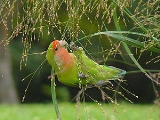
Lovebird is the commonly used name for any of the nine species of the genus
Genus

A genus is a low-level taxonomic rank used in the classification of living and fossil organisms. The taxonomic ranks are domain , kingdom , phylum, class , order , family , genus, and species....
 Agapornis (Greek
Greek language

Greek is an Indo-European languages native to the southern Balkan peninsula, the language of the Greek people. It forms an independent branch within Indo-European....
: a??p? agape 'love'; ????? ornis 'bird'). They are a social and affectionate small parrot
Parrot

File:Ara ararauna -eating -Wilhelma Zoo-8-2rc.jpgParrots, also known as psittacines , are birds of the roughly 372 species in 86 genus that make up the order Psittaciformes, found in most warm and tropical regions....
. Eight species are native to the African continent; the Grey-headed Lovebird is native to Madagascar.

The name Lovebird stems from these parrots' strong, monogamous pair bonding and the long periods of time in which paired birds will spend sat beside one another.


Discussion
Ask a question about 'Lovebird'
Start a new discussion about 'Lovebird'
Answer questions from other users
Full Discussion Forum


Recent Posts


Encyclopedia


Lovebird is the commonly used name for any of the nine species of the genus
Genus

A genus is a low-level taxonomic rank used in the classification of living and fossil organisms. The taxonomic ranks are domain , kingdom , phylum, class , order , family , genus, and species....
 Agapornis (Greek
Greek language

Greek is an Indo-European languages native to the southern Balkan peninsula, the language of the Greek people. It forms an independent branch within Indo-European....
: a??p? agape 'love'; ????? ornis 'bird'). They are a social and affectionate small parrot
Parrot

File:Ara ararauna -eating -Wilhelma Zoo-8-2rc.jpgParrots, also known as psittacines , are birds of the roughly 372 species in 86 genus that make up the order Psittaciformes, found in most warm and tropical regions....
. Eight species are native to the African continent; the Grey-headed Lovebird is native to Madagascar.

The name Lovebird stems from these parrots' strong, monogamous pair bonding and the long periods of time in which paired birds will spend sat beside one another. This is reflected by the bird's name in other languages: in German
German language

German is a West Germanic languages, thus related to and classified alongside English language and Dutch language. It is one of the world's world language and the most widely spoken mother tongue in the European Union....
, "die Unzertrennlichen", and in French
French language

French is a Romance language spoken around the world by around 80 million people as first language, by 190 million as second language, and by about another 200 million people as an acquired tongue, with significant speakers in 54 countries....
 "les inséparables", both meaning "the inseparables".

Lovebirds live in small flocks and eat mainly fruit
Fruit

The term fruit has different meanings dependent on context, and the term is not synonymous in food preparation and biology. In botany, which is the scientific study of plants, fruits are the ripened Ovary of flowering plants....
, vegetable
Vegetable

The term "vegetable" generally means the Eating parts of plants. The definition of the word is traditional rather than scientific, however, and therefore the usage of the word is somewhat arbitrary and subjective, as it is determined by individual cultural customs of food selection and food preparation....
s, some grasses and seed. Abyssinian Lovebirds also eat insect
Insect

Insects are the biggest class of arthropods and the only ones with wings. They are the most diverse group of animals on the planet. They are most diverse at the equator and their diversity declines toward the poles....
s and fig
FIG

FIG may refer to:* F?d?ration Internationale de Gymnastique* International Federation of Surveyors...
s, and the Black-collared Lovebirds have a special dietary requirement for native figs making them almost impossible to keep in captivity.

Some species of the genus are amongst the most popular parrots kept as pets, and several colour mutations have been selectively breed in aviculture. Their average lifespan is 10 to 15 years.

Description

Lovebirds vary in size from about 13 to 17 centimeters in length and from about 40 to 60 grams in weight. They are among the smallest parrots in the world, and they are characterized by a stocky build, a short blunt tail, and a relatively large beak for their overall size. Wild-type lovebirds are mostly green with a variety of colours on their upper body depending on the species. The Fischer's Lovebird, Black-cheeked Lovebird, and the Masked Lovebirds have a white ring around their eyes. The Abyssinian Lovebird, the Madagascar Lovebird, and the Red-faced Lovebird are sexually dimorphic
Sexual dimorphism

Sexual dimorphism is the systematic difference in form between individuals of different sex in the same species. Examples include color , size, and the presence or absence of parts of the body used in courtship displays or fights, such as ornamental feathers, horns, antlers or tusks....
. Many colour mutations have been produced by selective breeding in the species that are popular in aviculture.

Taxonomy

The lovebird genus comprises nine species of which five are monotypic and four are divided into subspecies. Eight of them are native in the mainland of Africa
Africa

Africa is the world's second-largest and second most-populous continent, after Asia. At about 30.2 million km? including adjacent islands, it covers 6% of the Earth's total surface area and 20.4% of the total land area....
 and the Madagascar Lovebird is native to Madagascar
Madagascar

Madagascar, or Republic of Madagascar , is an island nation in the Indian Ocean off the southeastern coast of Africa. The main island, also called Madagascar, is the List of islands by area, and is home to 5% of the world's plant and animal species, of which more than 80% are Endemism to Madagascar....
. In the wild the different species are separated geographically.

Species and subspecies:

  • Peach-faced Lovebird, Agapornis roseicollis, (Vieillot, 1818) — or Rosy-faced Lovebird
    • Agapornis roseicollis catumbella, B.P. Hall, 1952
    • Agapornis roseicollis roseicollis, (Vieillot 1818)
  • Masked Lovebird
    Masked Lovebird

    The Masked Lovebird , also called Yellow-collared Lovebird, is a monotypic species of bird of the lovebird genus in the true parrots family....
    , Agapornis personatus, Reichenow, 1887 — or Yellow-collared Lovebird
  • Fischer's Lovebird
    Fischer's Lovebird

    The Fischer's Lovebird is a small true parrots species of the Lovebird genus. They were originally discovered in the late 1800s, and were first bred in the United States in 1926....
    , Agapornis fischeri, Reichenow, 1887
  • Lilian's Lovebird
    Lilian's Lovebird

    The Lilian's Lovebird , also known as Nyasa Lovebird, is a small African parrot species of the lovebird genus. It is mainly green and has orange on its upper chest and head....
    , Agapornis lilianae, Shelley, 1894 — or Nyasa Lovebird
  • Black-cheeked Lovebird
    Black-cheeked Lovebird

    The Black-cheeked Lovebird is a small monotypic parrot species of the lovebird genus. It is mainly green and has a brown head, red beak, and white eyerings....
    , Agapornis nigrigenis, W.L. Sclater, 1906
  • Madagascar Lovebird, Agapornis canus, (Gmelin, 1788) — or Grey-headed Lovebird
    • Agapornis canus ablectaneus, Bangs, 1918
    • Agapornis canus canus, (Gmelin, 1788)
  • Abyssinian Lovebird
    Abyssinian Lovebird

    The Abyssinian Lovebird also known as Black-winged Lovebird is a mainly green bird of the parrot familiy. At about 16.5 cm long, it is the largest of the lovebird genus, a group of small parrots....
    , Agapornis taranta, (Stanley, 1814) — or Black-winged Lovebird
  • Red-faced Lovebird, Agapornis pullarius, (Linnaeus, 1758) — or Red-headed Lovebird
    • Agapornis pullarius pullarius, (Linnaeus, 1758)
    • Agapornis pullarius ugandae, Neumann, 1908
  • Black-collared Lovebird
    Black-collared Lovebird

    The Black-collared Lovebird, Agapornis swindernianus also known as Swindern's Lovebird is a small, 13.5 cm long, African parrot in the genus Agapornis....
    , Agapornis swindernianus, (Kuhl, 1820) — or Swindern's Lovebird
    • Agapornis swindernianus emini, Neumann, 1908
    • Agapornis swindernianus swindernianus, (Kuhl, 1820)
    • Agapornis swindernianus zenkeri, Reichenow, 1895


Species

Species (wild-types)
Common and binomial names PhotographDescriptionRange
Masked Lovebird
Masked Lovebird

The Masked Lovebird , also called Yellow-collared Lovebird, is a monotypic species of bird of the lovebird genus in the true parrots family....

or Yellow-collared Lovebird
(Agapornis personata)
14 cm (5.5 in) long. Mostly green, black head, yellow upper chest continuous with yellow collar, red beak, white eyeringsNortheast Tanzania
Tanzania

Tanzania , officially the United Republic of Tanzania , is a country in East Africa that is bordered by Kenya and Uganda on the north, Rwanda, Burundi and the Democratic Republic of the Congo on the west, and Zambia, Malawi and Mozambique on the south....
; introduced to Burundi
Burundi

Burundi , officially the Republic of Burundi, is a small country in the Great Lakes region of Eastern Africa bordered by Rwanda to the north, Tanzania to the south and east, and the Democratic Republic of the Congo to the west....
 and Kenya
Kenya

The Republic of Kenya is a country in East Africa. It is bordered by Ethiopia to the north, Somalia to the northeast, Tanzania to the south, Uganda to the west, and Sudan to the northwest, with the Indian Ocean running along the southeast border....
Fischer's Lovebird
Fischer's Lovebird

The Fischer's Lovebird is a small true parrots species of the Lovebird genus. They were originally discovered in the late 1800s, and were first bred in the United States in 1926....

(Agapornis fischeri)
14 cm (5.5 in) long. Mostly green, orange upper body and head, blue lower back and rump, red beak, white eyeringsSouth and southeast of Lake Victoria in northern Tanzania
Lilian's Lovebird
Lilian's Lovebird

The Lilian's Lovebird , also known as Nyasa Lovebird, is a small African parrot species of the lovebird genus. It is mainly green and has orange on its upper chest and head....

or Nyasa Lovebird
(Agapornis lilianae)
13 cm (5 in) long. Mostly green including green back and green rump, orange head, red beak, white eyeringsMalawi
Malawi

The Republic of Malawi is a landlocked country in southeast Africa that was formerly known as Nyasaland. It is bordered by Zambia to the northwest, Tanzania to the northeast and Mozambique, which surrounds it on the east, south and west....
Black-cheeked Lovebird

The Black-cheeked Lovebird is a small monotypic parrot species of the lovebird genus. It is mainly green and has a brown head, red beak, and white eyerings....

(Agapornis nigrigenis)
14 cm (5.5 in) long. Mostly green, brownish-black cheeks and throat, reddish-brown forehead and forecrown, orange upper chest, red beak, white eyeringsZambia
Zambia

The Republic of Zambia is a landlocked country in Southern Africa. The neighbouring countries are the Democratic Republic of the Congo to the north, Tanzania to the north-east, Malawi to the east, Mozambique, Zimbabwe, Botswana, and Namibia to the south, and Angola to the west....
Peach-faced Lovebird
or Rosy-faced Lovebird
(Agapornis roseicollis)
15 cm (6 in) long. Mostly green, orange face, blue lower back and rump, horn-coloured beakNamibia
Namibia

Namibia, officially the Republic of Namibia, is a country in southern Africa on the Atlantic Ocean coast. It shares borders with Angola and Zambia to the north, Botswana to the east, and South Africa to the south....
, South Africa
South Africa

The Republic of South Africa, also known by Official names of South Africa, is a country located at the southern tip of the continent of Africa....
, Angola
Angola

Angola, officially the Republic of Angola , is a country in south-central Africa bordering Namibia to the south, Democratic Republic of the Congo to the north, and Zambia to the east, and with a west coast along the Atlantic Ocean....
Abyssinian Lovebird
Abyssinian Lovebird

The Abyssinian Lovebird also known as Black-winged Lovebird is a mainly green bird of the parrot familiy. At about 16.5 cm long, it is the largest of the lovebird genus, a group of small parrots....

or Black-winged Lovebird
(Agapornis taranta)
16.5 cm (6.5 in) long. Mostly green, red beak, some black wing feathers. Sexual dimorphism: only the male has red on forehead and crown, females plumage is all greensouthern Eritrea
Eritrea

Eritrea , officially the Country of Eritrea, is a country in Northeast Africa. It is bordered by Sudan in the west, Ethiopia in the south, and Djibouti in the southeast....
 to southwestern Ethiopia
Ethiopia

Ethiopia , officially the Federal Democratic Republic of Ethiopia, is a landlocked country situated in the Horn of Africa. Ethiopia is bordered by Eritrea to the north, Sudan to the west, Kenya to the south, Somalia to the east and Djibouti to the northeast....
Red-headed Lovebird
Red-headed Lovebird

The Red-headed Lovebird also known as the Red-faced Lovebird is a member of the genus Agapornis, a group commonly known as Lovebirds....

or Red-faced Lovebird
(Agapornis pullarius)
15 cm (6 in) long. Mostly green with red on upper neck and face. Sexual dimorphism: the male has more extensive and a darker red on face and head, and the male has a darker red beak than the femaleLarge part of central Africa
Grey-headed Lovebird

The Grey-headed Lovebird or Madagascar Lovebird is a small species of parrot of the lovebird genus. It is a mainly green parrot. The species is Sexual dimorphism and only the adult male had a grey upper body....

or Madagascar Lovebird
(Agapornis canus)
13 cm (5 in) long. Mostly green with darker green on back, pale grey beak. Sexual dimorphism: male has a grey upper body, neck and head.Madagascar
Black-collared Lovebird

The Black-collared Lovebird, Agapornis swindernianus also known as Swindern's Lovebird is a small, 13.5 cm long, African parrot in the genus Agapornis....

or Swindern's Lovebird
(Agapornis swindernianus)
13.5 cm (5 in) long. Mostly green, brown collar which has a black upper margin at the back of the neck, dark grey/black beakEquatorial Africa
Equatorial Africa

Equatorial Africa is an ambiguous term that is sometimes used to refer to tropical Africa, or the region of Sub-Saharan Africa traversed by the equator....


Aviculture


Lovebirds have the potential to make great pets for those who have the patience and time required of any parrot species. Because of their inclination to bond, they can form great long-term relationships with people.

Provided with adequate space, a stimulating environment, and appropriate nutrition a lovebird can become cherished companion parrot
Companion parrot

Companion parrot is a general term used for any parrot kept as a pet that interacts abundantly with its human counterpart. Generally, almost all species of parrot can make good companions....
. They love to snuggle and often preen their favorite people.

Like with any other pet, it is essential that the person makes sure the birds they are about to buy were bred in captivity, rather than caught from the wild. Besides conservational and ethical reasons, animals caught wild are more likely to get sick and to die. Lovebirds, especially when kept individually or brought up hand-fed, make very good pets. They can be very interactive with humans, and when comfortable, will willingly perch on a finger or shoulders. Lovebirds rarely talk, but there is a chance they may learn to mimic human sounds if taught to at a young age. Lovebirds have a fairly loud call.

Housing

Lovebirds require an appropriately sized cage or aviary. Recommended space per bird is 1m×1m×1m. They require lots of toys such as willow branches, swings and other things to chew on and play with. Lack of toys and social stimulation may lead to boredom behavioral problems. Lovebirds are extremely social birds, and will enjoy several hours of interaction a day. Without this interaction, daily exercise, a roomy cage, and many toys to play with, they may resort to feather-plucking or other behavioral problems. They need a human who will dedicate lots of time with them and take the place of companion lovebirds. They love to bathe and sun themselves daily.

Diet

Lovebirds require a variety of food, such as pellets, fruits (sweetcorn, apple, pomegranate, strawberries, etc.), and vegetables (broccoli, carrot, mustard seed, watercress, squash, etc.) and seed (a mix of 14 varieties is recommended, plus wild seeding grasses, sesame seed, etc.). As a regular food, pellets are recommended, as the seed mixes generally sold in pet stores contain too much fat and are not a significant source of nutrition. Concentrated pellets specially made for birds provide a well-balanced diet. Birds should especially be exposed to a wide variety of foodstuffs when young.
Lovebirds

Potential problems


Lovebirds are very vocal birds, making loud, high-pitched noises. Some make noise all day, especially during the first morning hours.

Lovebirds are also very active, and love to chew things. When they are flying within a household, it is wise to watch them carefully and protect any furniture, electrical wiring or anything else that they could possibly chew on.Try to place fresh willow or oak branches in a favorite spot to satisfy this natural behavior.

Lovebirds of different species can mate and produce sterile hybrid offspring. It is recommended to only place birds of the same species together, or of the same sex, for the sake of the potentially faulted hybrid offspring.

Because of their dominant nature, Lovebirds should be supervised when socializing with other species/genus (whether it be cat, dog, small mammal or other bird species). Lovebirds can be aggressive to other birds, without taking into account their small size. Hand raised Lovebirds tend not to be scared and pose even more of a threat to themselves. Toe biting can occur when Lovebirds are socializing/housed with small birds (ie. Parrotlets, Budgies, and even docile Cockatiels). They should not be housed with other bird genus as they can be injured or pose a threat to the other bird.

External links