

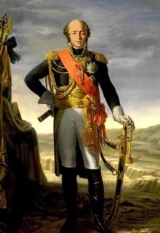
Louis Nicolas Davout

Encyclopedia
Louis-Nicolas d'Avout better known as Davout, 1st Duke of Auerstaedt
, 1st Prince of Eckmühl
, was a Marshal of France
during the Napoleonic Era
. His prodigious talent for war along with his reputation as a stern disciplinarian, earned him the title "The Iron Marshal". He is ranked along with Massena
and Lannes
as one of Napoleon's finest commanders. During his lifetime, Davout's name was commonly spelled Davoust, which is how it appears on the Arc de Triomphe
and in much of the correspondence between Napoleon and his generals (see external links below for examples).
(Yonne
), the son of Jean-François d'Avout (1739 – 1779) and wife (married in 1768) Françoise-Adélaïde Minard de Velars (1741 – 1810). He joined the French army as a sub-lieutenant in 1788. On the outbreak of the French Revolution
, he embraced its principles. He was chef de bataillon in a volunteer corps in the campaign of 1792, and distinguished himself at the Battle of Neerwinden
the following spring. He had just been promoted to general of brigade when he was removed from the active list because of his noble birth. He nevertheless served in the campaigns of 1794-1797 on the Rhine, and accompanied Desaix in the Egypt
ian expedition of Napoleon Bonaparte.
Although on his return he did not take part in the Battle of Marengo, where his friend Desaix was killed while making a decisive contribution to the victory,. Napoleon, who had great confidence in his abilities, made him a general of division soon after, and around 1801 gave him a command in the consular guard. At the accession of Napoleon as emperor, Davout was one of the generals who were created marshals of France. As commander of the III Corps
of the Grande Armée, Davout rendered his greatest services. At the Battle of Austerlitz
, after a forced march of forty-eight hours, the III Corps bore the brunt of the allies' attack. In the subsequent War of the Fourth Coalition
, Davout with a single corps fought and won the Battle of Auerstädt against the main Prussian
army, which had more than twice as many soldiers at its disposal (more than 63,000, to Davout's 28,000). Historian François-Guy Hourtoulle writes: "At Jena, Napoleon won a battle he could not lose. At Auerstädt, Davout won a battle he could not win".
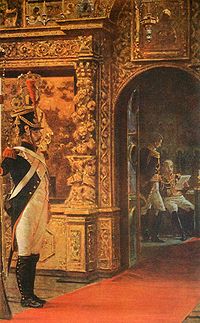 Davout added to his renown in the campaign of Eylau
and Friedland
. Napoleon left him as governor-general of the newly-created Duchy of Warsaw
following the Treaty of Tilsit of 1807, and the next year created him Duke of Auerstädt
. In the war of 1809, Davout took part in the actions which culminated in the Battle of Eckmühl
, and also distinguished himself in the Battle of Wagram
. He was created Prince of Eckmühl
following this campaign. He was entrusted by Napoleon with the task of organizing the "corps of observation of the Elbe", which was in reality the gigantic army with which Napoleon invaded Russia
in 1812. In this, Davout commanded the I Corps
, numbering over 70,000, and defeated the Russians at Mohilev before he joined the main army, with which he continued throughout the campaign and the retreat from Moscow. In 1813 he commanded the Hamburg
military district, and defended Hamburg, a poorly fortified and provisioned city, through a long siege
, only surrendering on the direct order of the new King Louis XVIII
, who had come to the throne after the fall of Napoleon in April 1814.
Davout's military character has been interpreted as cruel, and he had to defend himself against many attacks upon his conduct at Hamburg. He was a stern disciplinarian, who exacted rigid and precise obedience from his troops, and consequently his corps was more trustworthy and exact in the performance of its duty than any other. For example, Davout forbade his troops from plundering enemy villages, a policy he would enforce by the use of the death penalty. Thus, in the early days of the Grande Armée, the III corps tended to be entrusted with the most difficult work. His loyalty and obedience to Napoleon were absolute. He was regarded by his contemporaries as one of the ablest of Napoleon's marshals. On the first restoration he retired into private life, openly displaying his hostility to the Bourbon
s, and when Napoleon returned from Elba
, Davout rejoined him.
Appointed minister of war, he reorganized the French army insofar as time permitted, and he was so indispensable to the war department that Napoleon kept him in Paris
during the Waterloo
campaign. To what degree his skill and bravery would have altered the fortunes of the campaign of 1815 can only be surmised, but Napoleon has been criticized for his failure to avail himself in the field of the services of the best general he then possessed. Davout directed the gallant, but hopeless, defence of Paris after Waterloo, and was deprived of his marshalate and his titles at the second restoration. When some of his subordinate generals were proscribed, he demanded to be held responsible for their acts, as executed under his orders, and he endeavoured to prevent the condemnation of Michel Ney
. After a time the hostility of the Bourbons towards Davout faded, and he became reconciled to the monarchy. In 1817 his rank and titles were restored, and in 1819 he became a member of the Chamber of Peers.
In 1822, Davout was elected mayor of Savigny-sur-Orge
, a position he held for a year. His son Louis-Napoléon was also mayor of the city from 1843 to 1846. A main square bears their name in the city, as does a boulevard in Paris.
s, and when Napoleon returned from Elba
, Davout rejoined him.
Davout was known as a methodical person in both military and personal affairs. Within the army and among his social peers, he was often considered cold and distant; while respected, he was not well-liked. During times of peace, he preferred to spend time with his family and care for his home, rather than cultivate his high social standing.
Because of his stubborn personality and limited social skills, he developed many enemies and antagonists within the army's officer corps, notably Jean-Baptiste Bernadotte
, Joachim Murat
(with whom he clashed strongly during the 1812 campaign), Louis Alexandre Berthier
and Baron Thiébault (who would harshly criticize Davout in his memoirs).
 Perhaps his fiercest anger was directed towards Bernadotte, who failed to come to his aid at Auerstadt, though close enough to observe the smoke and hear the cannonfire. His anger was so intense that Davout requested to settle the matter with a personal duel, averted only by Napoléon's personal intervention. Bernadotte was eventually sent back to Paris in disgrace after being caught by Napoleon retreating without orders at the battle of Wagram
. Bernadotte then caught the eye of the Swedish ambassador, looking for a well-connected French officer to take on the role of heir to the Swedish throne. When Sweden threw in their lot against Napoleon in the War of the Sixth Coalition
, Davout personally asked to be placed opposite Bernadotte's contingent, in order to teach him a lesson once and for all. But with Davout assigned to defend Hamburg (which he did, up to and beyond Napoleon's abdication), they never did face each other in battle.
Of the other Marshals, Davout had the best relations with Ney, Nicolas Charles Oudinot and Laurent Gouvion Saint-Cyr. His best friend was possibly Charles-Étienne Gudin de La Sablonnière
, one of his subordinates, who was killed in battle in 1812.
Leclerc, sister of Charles Leclerc
and sister-in-law of Pauline Bonaparte
) (Pontoise
, 19 June 1782 – Paris, 17 December 1868), whom he married in 1801 and who remained with him until his death. Their marriage was loving and, most notably, the couple seem to have been faithful to each other despite very long periods of separation. They had eight children, four of whom died in childhood:
The title of Duke went to the descendants of Louis-Nicolas' brother Charles Isidor (1774–1854) by his marriage in 1824 to Claire de Cheverry (1804–1895). He also had a sister Julie (1771–1846), married in 1801 to Marc-Antoine Bonnin de La Bonninière, 1st Count de Beaumont (1763–1830)
, and another brother, Alexandre, 1st Baron d'Avout (1773–1820), married in 1808 to Alire Parisot (1786–1856); they had issue.
Duc d'Auerstaedt
The title of Duc d'Auerstaedt was created by Napoleon I, Emperor of the French, for the Marshal of France Louis Nicolas Davout in 1808 as a victory title rewarding and commemorating Davout's splendid victory at the Battle of Auerstaedt in 1806.The title became extinct in 1853 but was then given to...
, 1st Prince of Eckmühl
Eckmühl
Eckmühl is a village of Germany, in Bavaria, on the Große Laaber, 20 km S.E. of Regensburg...
, was a Marshal of France
Marshal of France
The Marshal of France is a military distinction in contemporary France, not a military rank. It is granted to generals for exceptional achievements...
during the Napoleonic Era
Napoleonic Era
The Napoleonic Era is a period in the history of France and Europe. It is generally classified as including the fourth and final stage of the French Revolution, the first being the National Assembly, the second being the Legislative Assembly, and the third being the Directory...
. His prodigious talent for war along with his reputation as a stern disciplinarian, earned him the title "The Iron Marshal". He is ranked along with Massena
André Masséna
André Masséna 1st Duc de Rivoli, 1st Prince d'Essling was a French military commander during the Revolutionary and Napoleonic Wars....
and Lannes
Jean Lannes
Jean Lannes, 1st Duc de Montebello, was a Marshal of France. He was one of Napoleon's most daring and talented generals. Napoleon once commented on Lannes: "I found him a pygmy and left him a giant"...
as one of Napoleon's finest commanders. During his lifetime, Davout's name was commonly spelled Davoust, which is how it appears on the Arc de Triomphe
Arc de Triomphe
-The design:The astylar design is by Jean Chalgrin , in the Neoclassical version of ancient Roman architecture . Major academic sculptors of France are represented in the sculpture of the Arc de Triomphe: Jean-Pierre Cortot; François Rude; Antoine Étex; James Pradier and Philippe Joseph Henri Lemaire...
and in much of the correspondence between Napoleon and his generals (see external links below for examples).
Biography
Davout was born at AnnouxAnnoux
Annoux is a commune in the Yonne department in Burgundy in north-central France....
(Yonne
Yonne
Yonne is a French department named after the Yonne River. It is one of the four constituent departments of Burgundy in eastern France and its prefecture is Auxerre. Its official number is 89....
), the son of Jean-François d'Avout (1739 – 1779) and wife (married in 1768) Françoise-Adélaïde Minard de Velars (1741 – 1810). He joined the French army as a sub-lieutenant in 1788. On the outbreak of the French Revolution
French Revolution
The French Revolution , sometimes distinguished as the 'Great French Revolution' , was a period of radical social and political upheaval in France and Europe. The absolute monarchy that had ruled France for centuries collapsed in three years...
, he embraced its principles. He was chef de bataillon in a volunteer corps in the campaign of 1792, and distinguished himself at the Battle of Neerwinden
Battle of Neerwinden (1793)
The Battle of Neerwinden took place on near the village of Neerwinden in present-day Belgium between the Austrians under Prince Josias of Coburg and the French under General Dumouriez...
the following spring. He had just been promoted to general of brigade when he was removed from the active list because of his noble birth. He nevertheless served in the campaigns of 1794-1797 on the Rhine, and accompanied Desaix in the Egypt
Egypt
Egypt , officially the Arab Republic of Egypt, Arabic: , is a country mainly in North Africa, with the Sinai Peninsula forming a land bridge in Southwest Asia. Egypt is thus a transcontinental country, and a major power in Africa, the Mediterranean Basin, the Middle East and the Muslim world...
ian expedition of Napoleon Bonaparte.
Although on his return he did not take part in the Battle of Marengo, where his friend Desaix was killed while making a decisive contribution to the victory,. Napoleon, who had great confidence in his abilities, made him a general of division soon after, and around 1801 gave him a command in the consular guard. At the accession of Napoleon as emperor, Davout was one of the generals who were created marshals of France. As commander of the III Corps
III Corps (Grande Armée)
The III Corps of the Grande Armée were few military units during the Napoleonic Wars. The III Corps came to prominence between 1805 and 1809 under the command of Marshal Louis Nicolas Davout, when it repeatedly scored impressive victories single-handedly or in conjunction with other French forces...
of the Grande Armée, Davout rendered his greatest services. At the Battle of Austerlitz
Battle of Austerlitz
The Battle of Austerlitz, also known as the Battle of the Three Emperors, was one of Napoleon's greatest victories, where the French Empire effectively crushed the Third Coalition...
, after a forced march of forty-eight hours, the III Corps bore the brunt of the allies' attack. In the subsequent War of the Fourth Coalition
War of the Fourth Coalition
The Fourth Coalition against Napoleon's French Empire was defeated in a war spanning 1806–1807. Coalition partners included Prussia, Russia, Saxony, Sweden, and the United Kingdom....
, Davout with a single corps fought and won the Battle of Auerstädt against the main Prussian
Kingdom of Prussia
The Kingdom of Prussia was a German kingdom from 1701 to 1918. Until the defeat of Germany in World War I, it comprised almost two-thirds of the area of the German Empire...
army, which had more than twice as many soldiers at its disposal (more than 63,000, to Davout's 28,000). Historian François-Guy Hourtoulle writes: "At Jena, Napoleon won a battle he could not lose. At Auerstädt, Davout won a battle he could not win".
Battle of Eylau
The Battle of Eylau or Battle of Preussisch-Eylau, 7 and 8 February 1807, was a bloody and inconclusive battle between Napoléon's Grande Armée and a Russian Empire army under Levin August, Count von Bennigsen near the town of Preußisch Eylau in East Prussia. Late in the battle, the Russians...
and Friedland
Battle of Friedland
The Battle of Friedland saw Napoleon I's French army decisively defeat Count von Bennigsen's Russian army about twenty-seven miles southeast of Königsberg...
. Napoleon left him as governor-general of the newly-created Duchy of Warsaw
Duchy of Warsaw
The Duchy of Warsaw was a Polish state established by Napoleon I in 1807 from the Polish lands ceded by the Kingdom of Prussia under the terms of the Treaties of Tilsit. The duchy was held in personal union by one of Napoleon's allies, King Frederick Augustus I of Saxony...
following the Treaty of Tilsit of 1807, and the next year created him Duke of Auerstädt
Duc d'Auerstaedt
The title of Duc d'Auerstaedt was created by Napoleon I, Emperor of the French, for the Marshal of France Louis Nicolas Davout in 1808 as a victory title rewarding and commemorating Davout's splendid victory at the Battle of Auerstaedt in 1806.The title became extinct in 1853 but was then given to...
. In the war of 1809, Davout took part in the actions which culminated in the Battle of Eckmühl
Battle of Eckmühl
The Battle of Eckmühl fought on 21 April – 22 April 1809, was the turning point of the 1809 Campaign, also known as the War of the Fifth Coalition...
, and also distinguished himself in the Battle of Wagram
Battle of Wagram
The Battle of Wagram was the decisive military engagement of the War of the Fifth Coalition. It took place on the Marchfeld plain, on the north bank of the Danube. An important site of the battle was the village of Deutsch-Wagram, 10 kilometres northeast of Vienna, which would give its name to the...
. He was created Prince of Eckmühl
Eckmühl
Eckmühl is a village of Germany, in Bavaria, on the Große Laaber, 20 km S.E. of Regensburg...
following this campaign. He was entrusted by Napoleon with the task of organizing the "corps of observation of the Elbe", which was in reality the gigantic army with which Napoleon invaded Russia
Russia
Russia or , officially known as both Russia and the Russian Federation , is a country in northern Eurasia. It is a federal semi-presidential republic, comprising 83 federal subjects...
in 1812. In this, Davout commanded the I Corps
I Corps (Grande Armée)
The I Corps of the Grande Armée was a military unit during the Napoleonic Wars. It were different troops in French service commanded by Marshal Jean-Baptiste Bernadotte in 1805 and 1806, General Claude Victor-Perrin in 1807 and Marshal Louis Nicolas Davout during the 1812 invasion of Russia.- Size...
, numbering over 70,000, and defeated the Russians at Mohilev before he joined the main army, with which he continued throughout the campaign and the retreat from Moscow. In 1813 he commanded the Hamburg
Hamburg
-History:The first historic name for the city was, according to Claudius Ptolemy's reports, Treva.But the city takes its modern name, Hamburg, from the first permanent building on the site, a castle whose construction was ordered by the Emperor Charlemagne in AD 808...
military district, and defended Hamburg, a poorly fortified and provisioned city, through a long siege
Siege of Hamburg
The city of Hamburg was one of the most powerful fortresses east of the Rhine. After being freed from Napoleonic rule by advancing Cossacks and other following allied troops it was once more occupied by Marshal Davout's French XIII Corps on 28 May 1813, at the height of the campaign for Germany in...
, only surrendering on the direct order of the new King Louis XVIII
Louis XVIII of France
Louis XVIII , known as "the Unavoidable", was King of France and of Navarre from 1814 to 1824, omitting the Hundred Days in 1815...
, who had come to the throne after the fall of Napoleon in April 1814.
Davout's military character has been interpreted as cruel, and he had to defend himself against many attacks upon his conduct at Hamburg. He was a stern disciplinarian, who exacted rigid and precise obedience from his troops, and consequently his corps was more trustworthy and exact in the performance of its duty than any other. For example, Davout forbade his troops from plundering enemy villages, a policy he would enforce by the use of the death penalty. Thus, in the early days of the Grande Armée, the III corps tended to be entrusted with the most difficult work. His loyalty and obedience to Napoleon were absolute. He was regarded by his contemporaries as one of the ablest of Napoleon's marshals. On the first restoration he retired into private life, openly displaying his hostility to the Bourbon
House of Bourbon
The House of Bourbon is a European royal house, a branch of the Capetian dynasty . Bourbon kings first ruled Navarre and France in the 16th century. By the 18th century, members of the Bourbon dynasty also held thrones in Spain, Naples, Sicily, and Parma...
s, and when Napoleon returned from Elba
Elba
Elba is a Mediterranean island in Tuscany, Italy, from the coastal town of Piombino. The largest island of the Tuscan Archipelago, Elba is also part of the National Park of the Tuscan Archipelago and the third largest island in Italy after Sicily and Sardinia...
, Davout rejoined him.
Appointed minister of war, he reorganized the French army insofar as time permitted, and he was so indispensable to the war department that Napoleon kept him in Paris
Paris
Paris is the capital and largest city in France, situated on the river Seine, in northern France, at the heart of the Île-de-France region...
during the Waterloo
Battle of Waterloo
The Battle of Waterloo was fought on Sunday 18 June 1815 near Waterloo in present-day Belgium, then part of the United Kingdom of the Netherlands...
campaign. To what degree his skill and bravery would have altered the fortunes of the campaign of 1815 can only be surmised, but Napoleon has been criticized for his failure to avail himself in the field of the services of the best general he then possessed. Davout directed the gallant, but hopeless, defence of Paris after Waterloo, and was deprived of his marshalate and his titles at the second restoration. When some of his subordinate generals were proscribed, he demanded to be held responsible for their acts, as executed under his orders, and he endeavoured to prevent the condemnation of Michel Ney
Michel Ney
Michel Ney , 1st Duc d'Elchingen, 1st Prince de la Moskowa was a French soldier and military commander during the French Revolutionary Wars and the Napoleonic Wars. He was one of the original 18 Marshals of France created by Napoleon I...
. After a time the hostility of the Bourbons towards Davout faded, and he became reconciled to the monarchy. In 1817 his rank and titles were restored, and in 1819 he became a member of the Chamber of Peers.
In 1822, Davout was elected mayor of Savigny-sur-Orge
Savigny-sur-Orge
Savigny-sur-Orge is a commune in the southern suburbs of Paris, France. It is located 19.1 km from the center of Paris in the département of Essonne.During the 2005 civil unrest in France, Savigny was the first city to implement a curfew...
, a position he held for a year. His son Louis-Napoléon was also mayor of the city from 1843 to 1846. A main square bears their name in the city, as does a boulevard in Paris.
Honours and awards
He held the following honours and awards:- Knight Grand Cross of the Order of the Legion of Honour
- Knight of the Order of the Iron CrownOrder of the Iron CrownThe Imperial Order of the Iron Crown was established June 5, 1805 by Napoleon Bonaparte . It took its name from the ancient Iron Crown of Lombardy, a medieval jewel with an iron ring, forged from what was supposed to be a nail from the True Cross as a band on the inside. This crown also gave its...
- Grand Cross and Star of the Virtuti MilitariVirtuti MilitariThe Order Wojenny Virtuti Militari is Poland's highest military decoration for heroism and courage in the face of the enemy at war...
- Knight Grand Cross of the Order of the White EagleOrder of the White EagleThe Order of the White Eagle is Poland's highest decoration awarded to both civilians and the military for their merits. It was officially instituted on November 1, 1705 by Augustus II the Strong and bestowed on eight of his supporters: four Polish magnates, three Russian field marshals , and one...
- Knight of the Order of ChristOrder of ChristOrder of Christ may refer to:* Order of Christ – former Knights Templar Order awarded initially by the kings of Portugal, now by the Portuguese state...
- Knight Grand Cross of the Military Order of St. Henry
- Knight Grand Cross of the Military Order of Max Joseph
- Knight Grand Cross of the Royal Order of St. Stephen of Hungary
- Knight of the Military Order of Maria Theresa
- Knight Grand Cross of the Order of the ElephantOrder of the ElephantThe Order of the Elephant is the highest order of Denmark. It has origins in the 15th century, but has officially existed since 1693, and since the establishment of constitutional monarchy in 1849, is now almost exclusively bestowed on royalty and heads of state.- History :A Danish religious...
Personal life
Davout's military character was on this, as on many other occasions, interpreted as cruel and rapacious, and he had to defend himself against many attacks upon his conduct at Hamburg. He was a stern disciplinarian, almost the only one of the marshals who exacted rigid and precise obedience from his troops, and consequently his corps was more trustworthy and exact in the performance of its duty than any other. Thus, in the earlier days of the Grande Armée, it was always the III corps which was entrusted with the most difficult part of the work in hand. The same criterion is to be applied to his conduct of civil affairs. His rapacity was in reality Napoleon's, for he gave the same undeviating obedience to superior orders which he enforced in his own subordinates. As for his military talents, he was admitted by his contemporaries and by later judgment to be one of the ablest, perhaps the ablest, of all Napoleon's marshals. On the first restoration he retired into private life, openly displaying his hostility to the BourbonBourbon
- Food and drink :* Bourbon whiskey, an American whiskey made using a corn-based mash* Bourbon biscuit, a chocolate sandwich biscuit* A beer produced by Brasseries de Bourbon* Bourbon coffee, a type of coffee made from a cultivar of coffea arabica...
s, and when Napoleon returned from Elba
Elba
Elba is a Mediterranean island in Tuscany, Italy, from the coastal town of Piombino. The largest island of the Tuscan Archipelago, Elba is also part of the National Park of the Tuscan Archipelago and the third largest island in Italy after Sicily and Sardinia...
, Davout rejoined him.
Davout was known as a methodical person in both military and personal affairs. Within the army and among his social peers, he was often considered cold and distant; while respected, he was not well-liked. During times of peace, he preferred to spend time with his family and care for his home, rather than cultivate his high social standing.
Because of his stubborn personality and limited social skills, he developed many enemies and antagonists within the army's officer corps, notably Jean-Baptiste Bernadotte
Charles XIV John of Sweden
Charles XIV & III John, also Carl John, Swedish and Norwegian: Karl Johan was King of Sweden and King of Norway from 1818 until his death...
, Joachim Murat
Joachim Murat
Joachim-Napoléon Murat , Marshal of France and Grand Admiral or Admiral of France, 1st Prince Murat, was Grand Duke of Berg from 1806 to 1808 and then King of Naples from 1808 to 1815...
(with whom he clashed strongly during the 1812 campaign), Louis Alexandre Berthier
Louis Alexandre Berthier
Louis Alexandre Berthier, 1st Prince de Wagram, 1st Duc de Valangin, 1st Sovereign Prince de Neuchâtel , was a Marshal of France, Vice-Constable of France beginning in 1808, and Chief of Staff under Napoleon.-Early life:Alexandre was born at Versailles to Lieutenant-Colonel Jean Baptiste Berthier ,...
and Baron Thiébault (who would harshly criticize Davout in his memoirs).
Battle of Wagram
The Battle of Wagram was the decisive military engagement of the War of the Fifth Coalition. It took place on the Marchfeld plain, on the north bank of the Danube. An important site of the battle was the village of Deutsch-Wagram, 10 kilometres northeast of Vienna, which would give its name to the...
. Bernadotte then caught the eye of the Swedish ambassador, looking for a well-connected French officer to take on the role of heir to the Swedish throne. When Sweden threw in their lot against Napoleon in the War of the Sixth Coalition
War of the Sixth Coalition
In the War of the Sixth Coalition , a coalition of Austria, Prussia, Russia, the United Kingdom, Portugal, Sweden, Spain and a number of German States finally defeated France and drove Napoleon Bonaparte into exile on Elba. After Napoleon's disastrous invasion of Russia, the continental powers...
, Davout personally asked to be placed opposite Bernadotte's contingent, in order to teach him a lesson once and for all. But with Davout assigned to defend Hamburg (which he did, up to and beyond Napoleon's abdication), they never did face each other in battle.
Of the other Marshals, Davout had the best relations with Ney, Nicolas Charles Oudinot and Laurent Gouvion Saint-Cyr. His best friend was possibly Charles-Étienne Gudin de La Sablonnière
Charles-Étienne Gudin de La Sablonnière
Charles-Étienne Gudin de La Sablonnière, count, was a French general during the French Revolutionary Wars and Napoleonic Wars.-Early career and Revolutionary Wars:...
, one of his subordinates, who was killed in battle in 1812.
Family
Davout was also noted for his loyalty to his long-time second wife Louise Aimée Julie Davout (néeNEE
NEE is a political protest group whose goal was to provide an alternative for voters who are unhappy with all political parties at hand in Belgium, where voting is compulsory.The NEE party was founded in 2005 in Antwerp...
Leclerc, sister of Charles Leclerc
Charles Leclerc
Charles Victoire Emmanuel Leclerc was a French Army general and husband to Pauline Bonaparte, sister to Napoleon Bonaparte.-To 1801:...
and sister-in-law of Pauline Bonaparte
Pauline Bonaparte
Pauline Bonaparte was the first sovereign Duchess of Guastalla, an imperial French Princess and the Princess consort of Sulmona and Rossano. She was the sixth child of Letizia Ramolino and Carlo Buonaparte, Corsica's representative to the court of King Louis XVI of France. Her elder brother,...
) (Pontoise
Pontoise
Pontoise is a commune in the northwestern suburbs of Paris, France. It is located from the centre of Paris, in the "new town" of Cergy-Pontoise.-Administration:...
, 19 June 1782 – Paris, 17 December 1868), whom he married in 1801 and who remained with him until his death. Their marriage was loving and, most notably, the couple seem to have been faithful to each other despite very long periods of separation. They had eight children, four of whom died in childhood:
- Paul (1802–1803)
- Joséphine (1804–1805)
- Antoinette Joséphine (1805-19 August 1821), married in 1820 Achille, Comte Félix-Vigier (1801–1868)
- Adèle Napoleone (June 1807-21 January 1885), married on 14 March 1827 Étienne, Comte de Cambacérès (1804-20 December 1878)
- Napoleon (1809–1810),
- Napoleon Louis, 2nd Duke of Auerstadt, 2nd and last Prince of EckmühlNapoléon Louis Davout d'Auerstaedt d'EckmühlNapoléon Louis Davout d'Auerstaedt d'Eckmühl, 2nd Duc d'Auerstaedt, 2nd and last Prince d'Eckmühl , was the son of Louis Nicolas Davout, Marshal of France. Davout inherited the title Duke of Auerstaedt upon his father's death in 1823. The title became extinct in 1853.Davout was also Mayor of...
(Paris, 6 January 1811 – 13 June 1853), who died unmarried and without issue - Jules (1812–1813)
- Adelaide-Louise (8 July 1815-6 October 1892), married on 17 August 1835 François-Edmond de Couliboeuf, Marquis de Blocqueville (1789–1861).
The title of Duke went to the descendants of Louis-Nicolas' brother Charles Isidor (1774–1854) by his marriage in 1824 to Claire de Cheverry (1804–1895). He also had a sister Julie (1771–1846), married in 1801 to Marc-Antoine Bonnin de La Bonninière, 1st Count de Beaumont (1763–1830)
Marc Antoine de Beaumont
Marc Antoine Bonnin de la Bonninière de Beaumont, born 23 September 1763 – died 4 February 1830, a French nobleman, became a page to the king and joined the army of the Old Regime. He stayed in the army during the French Revolution and narrowly escaped being executed...
, and another brother, Alexandre, 1st Baron d'Avout (1773–1820), married in 1808 to Alire Parisot (1786–1856); they had issue.
Further reading
- Potocka-Wąsowiczowa, Anna z Tyszkiewiczów. Wspomnienia naocznego świadka. Warszawa: Państwowy Instytut Wydawniczy, 1965.