


Louis McHenry Howe

Encyclopedia
Franklin D. Roosevelt
Franklin Delano Roosevelt , also known by his initials, FDR, was the 32nd President of the United States and a central figure in world events during the mid-20th century, leading the United States during a time of worldwide economic crisis and world war...
. He, along with Eleanor Roosevelt
Eleanor Roosevelt
Anna Eleanor Roosevelt was the First Lady of the United States from 1933 to 1945. She supported the New Deal policies of her husband, distant cousin Franklin Delano Roosevelt, and became an advocate for civil rights. After her husband's death in 1945, Roosevelt continued to be an international...
and Margurite "Missy" LeHand, was one of the few close associates who supported FDR throughout the most difficult stages of his personal and political recuperation after being afflicted by paralytic illness.
Personality
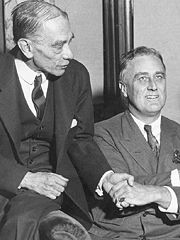
Howe is most known for his fierce, astute, and lifelong devotion to the political career of Franklin D. RooseveltFranklin D. Roosevelt
Franklin Delano Roosevelt , also known by his initials, FDR, was the 32nd President of the United States and a central figure in world events during the mid-20th century, leading the United States during a time of worldwide economic crisis and world war...
, who publicly credited him (along with James Farley
James Farley
James Aloysius Farley was the first Irish Catholic politician in American history to achieve success on a national level, serving as Chairman of the New York State Democratic Committee, Chairman of the Democratic National Committee and as Postmaster General simultaneously under the first two...
) for his initial election in 1932. Howe was also well known for his ill health and diminutive appearance which was referred to as "gnome-like" or "ghoulish". Part of this antipathy to his appearance may well have been provoked by the success of the Roosevelt campaigns he managed, doubtless a contributing factor to his sickly appearance was his loss of 32 lbs during the 1932 campaign to elect Roosevelt when he worked day and night and slept in his clothes. Howe inspired legends concerning his power over the president. Howe did not really mind the name calling and often when his phone rang, he would pick it up and say in a sepulchral voice, "This is the Medieval Gnome speaking." And, tying up many of the names which had been conferred on him, he even had cards printed with the title, "Colonel Louis Rasputin Voltaire Talleyrand Simon Legree Howe". He favored The New York Times description of him as "The President's Other I.", The New York Herald Tribune stated of him, "His loyalty is not to himself, or to an abstract ideal of government, but solely to Franklin D. Roosevelt". He was one of the most influential characters in the making of Franklin and Eleanor Roosevelt
Eleanor Roosevelt
Anna Eleanor Roosevelt was the First Lady of the United States from 1933 to 1945. She supported the New Deal policies of her husband, distant cousin Franklin Delano Roosevelt, and became an advocate for civil rights. After her husband's death in 1945, Roosevelt continued to be an international...
's political careers and perhaps most widely known under the title, "king-maker". Howe was also referred to as "The man behind Roosevelt" and Eleanor Roosevelt frankly credited him for his influence on her political development as well.
Biography
Born in IndianapolisIndianapolis
Indianapolis is the capital of the U.S. state of Indiana, and the county seat of Marion County, Indiana. As of the 2010 United States Census, the city's population is 839,489. It is by far Indiana's largest city and, as of the 2010 U.S...
to an established and very well-to-do family, he suffered a disfiguring bicycle accident as a teenager which left dark pitted scars across his face. Howe suffered as well from heart problems, severe asthma and attacks of bronchitis. Moreover, for most of his life he wore a ponderous truss to prevent hernia injury. Due to his delicate condition he was enrolled in the Temple Grove Seminary for young women in Saratoga Springs, New York
Saratoga Springs, New York
Saratoga Springs, also known as simply Saratoga, is a city in Saratoga County, New York, United States. The population was 26,586 at the 2010 census. The name reflects the presence of mineral springs in the area. While the word "Saratoga" is known to be a corruption of a Native American name, ...
.
His father, Captain Edward Porter Howe, and mother, Eliza Blake Ray, were both descendants of Indiana's first families. Yet Howe did not enjoy a privileged life for long. His father lost everything in the Panic of 1873
Panic of 1873
The Panic of 1873 triggered a severe international economic depression in both Europe and the United States that lasted until 1879, and even longer in some countries. The depression was known as the Great Depression until the 1930s, but is now known as the Long Depression...
, and the family had to share a relative's home in Saratoga Springs, New York
New York
New York is a state in the Northeastern region of the United States. It is the nation's third most populous state. New York is bordered by New Jersey and Pennsylvania to the south, and by Connecticut, Massachusetts and Vermont to the east...
. Edward Howe became a reporter for The Saratogian
The Saratogian
The Saratogian is a broadsheet-style daily newspaper published in Saratoga Springs, New York, United States. The paper has been published regularly since 1855. It covers all of Saratoga County, New York and specifically the city of Saratoga Springs....
, the local Republican newspaper, and eventually became the owner of the Saratoga Sun. Howe never attended college. At age twenty-one, Howe became the co-editor and proprietor of his father's paper. In 1898 before being sent to the Philippines to cover the Spanish-American War
Spanish-American War
The Spanish–American War was a conflict in 1898 between Spain and the United States, effectively the result of American intervention in the ongoing Cuban War of Independence...
, Howe eloped with Grace Hartley, a student at Vassar college. The couple later had three children although one would not survive infancy.
His major "scoop" came in 1901, as he interviewed then Vice-President Theodore Roosevelt
Theodore Roosevelt
Theodore "Teddy" Roosevelt was the 26th President of the United States . He is noted for his exuberant personality, range of interests and achievements, and his leadership of the Progressive Movement, as well as his "cowboy" persona and robust masculinity...
for the New York Herald
New York Herald
The New York Herald was a large distribution newspaper based in New York City that existed between May 6, 1835, and 1924.-History:The first issue of the paper was published by James Gordon Bennett, Sr., on May 6, 1835. By 1845 it was the most popular and profitable daily newspaper in the UnitedStates...
as he traveled to Buffalo
Buffalo, New York
Buffalo is the second most populous city in the state of New York, after New York City. Located in Western New York on the eastern shores of Lake Erie and at the head of the Niagara River across from Fort Erie, Ontario, Buffalo is the seat of Erie County and the principal city of the...
following the assassination
William McKinley assassination
The assassination of William McKinley occurred on September 6, 1901, inside the Temple of Music located on the grounds of the 1901 Pan-American Exposition in Buffalo, New York...
of President McKinley
William McKinley
William McKinley, Jr. was the 25th President of the United States . He is best known for winning fiercely fought elections, while supporting the gold standard and high tariffs; he succeeded in forging a Republican coalition that for the most part dominated national politics until the 1930s...
. In 1906, Howe began covering the New York State legislature in Albany
Albany, New York
Albany is the capital city of the U.S. state of New York, the seat of Albany County, and the central city of New York's Capital District. Roughly north of New York City, Albany sits on the west bank of the Hudson River, about south of its confluence with the Mohawk River...
.
Howe first met Roosevelt in 1911, while covering the latter's bold senatorial fight against Tammany Hall
Tammany Hall
Tammany Hall, also known as the Society of St. Tammany, the Sons of St. Tammany, or the Columbian Order, was a New York political organization founded in 1786 and incorporated on May 12, 1789 as the Tammany Society...
, immediately recognizing the young politician's potential and eventually joining his staff. As a young Assistant Secretary of the Navy in 1913, Roosevelt followed his Chief of Staff Howe's advice to directly and personally monitor labor conditions in the Navy Yards. This gave FDR valuable administrative experience in understanding and manoeuvring through government bureaucracy while also making connections to both labor leaders and the rank and file.
Howe accompanied Roosevelt on his 1920 campaign
United States presidential election, 1920
The United States presidential election of 1920 was dominated by the aftermath of World War I and a hostile response to certain policies of Woodrow Wilson, the Democratic president. The wartime economic boom had collapsed. Politicians were arguing over peace treaties and the question of America's...
tour as the Vice-Presidential Nominee on the Democratic ticket under Governor James Cox
James M. Cox
James Middleton Cox was the 46th and 48th Governor of Ohio, U.S. Representative from Ohio and Democratic candidate for President of the United States in the election of 1920....
, and the year after, sat at his bedside and read to him when Roosevelt was stricken with poliomyelitis
Poliomyelitis
Poliomyelitis, often called polio or infantile paralysis, is an acute viral infectious disease spread from person to person, primarily via the fecal-oral route...
. Howe's support was probably second only to Eleanor's in guiding and supporting FDR's personal and political resurrection. Howe had already become more intimately involved in the Roosevelt family situation when Eleanor had threatened to divorce her husband after discovering he had been involved in an extramarital affair with her social secretary, Lucy Mercer. With Franklin's mobility restricted, Howe played a mentorship role to Eleanor, helping her to become a more confident and effective public speaker. With this support FDR successfully attained the governorship of New York 1928, and then the presidency in 1932.
Howe's title of "Colonel
Kentucky colonel
Kentucky colonel is the highest title of honor bestowed by the Commonwealth of Kentucky. Commissions for Kentucky colonels are given by the Governor and the Secretary of State to individuals in recognition of noteworthy accomplishments and outstanding service to a community, state or the nation...
" was an honorary bestowed upon him by the Lt Governor of Kentucky
Lieutenant Governor of Kentucky
The office of lieutenant governor of Kentucky has existed under the last three of Kentucky's four constitutions, beginning in 1797. The lieutenant governor serves as governor of Kentucky under circumstances similar to the Vice President of the United States assuming the powers of the presidency...
, Happy Chandler
Happy Chandler
Albert Benjamin "Happy" Chandler, Sr. was a politician from the US state of Kentucky. He represented the state in the U.S. Senate and served as its 44th and 49th governor. Aside from his political positions, he also served as the second Commissioner of Major League Baseball from 1945 to 1951 and...
, during the 1932 campaign.
Howe's behind-the-scenes influence over Roosevelt was viewed with suspicion and sometimes outright hostility by other members of the political establishment. When Howe attempted to obtain a sinecure with the New York Parks Commission through Roosevelt the powerful head of the parks commission, Robert Moses
Robert Moses
Robert Moses was the "master builder" of mid-20th century New York City, Long Island, Rockland County, and Westchester County, New York. As the shaper of a modern city, he is sometimes compared to Baron Haussmann of Second Empire Paris, and is one of the most polarizing figures in the history of...
, humiliated him by refusing to grant the post and making his request public. When Roosevelt became governor of New York he fired Moses in retribution.
Howe was portrayed by David Paymer
David Paymer
David Paymer is an American actor and television director, seen in such films as Quiz Show, Searching for Bobby Fischer, City Slickers, Crazy People, State and Main, Payback, Get Shorty, Carpool, The American President, Ocean's Thirteen, and Drag Me to Hell...
in the 2005 movie Warm Springs
Warm Springs (film)
Warm Springs is a 2005 television film about American President Franklin D. Roosevelt's struggle with polio, his discovery of the Warm Springs, Georgia spa resort and his work to turn it into a center for the aid of polio victims, and his resumption of his political career...
, alongside Kenneth Branagh
Kenneth Branagh
Kenneth Charles Branagh is an actor and film director from Northern Ireland. He is best known for directing and starring in several film adaptations of William Shakespeare's plays including Henry V , Much Ado About Nothing , Hamlet Kenneth Charles Branagh is an actor and film director from...
as Roosevelt. Howe was also portrayed by Ed Flanders
Ed Flanders
Edward Paul Flanders was an American actor best known for his role as Dr. Donald Westphall in the television series St. Elsewhere.- Biography :...
in the 1976 TV Mini Series Eleanor and Franklin
Eleanor and Franklin
Eleanor and Franklin is a television movie released on January 11, 1976, starring Edward Herrmann as Franklin D. Roosevelt and Jane Alexander as Eleanor Roosevelt. It is the first part in a two-part biopic based on Joseph P. Lash's Pulitzer Prize-winning and best-selling biography with the same...
, and by Hume Cronyn
Hume Cronyn
Hume Blake Cronyn, OC was a Canadian actor of stage and screen, who enjoyed a long career, often appearing professionally alongside his second wife, Jessica Tandy.-Early life:...
in the 1960 movie Sunrise at Campobello
Sunrise at Campobello
Sunrise at Campobello is a 1960 American biographical film made by Dore Schary Productions and Warner Bros. It tells the story of the initial struggle by future President of the United States Franklin Delano Roosevelt and his family when he was stricken with paralysis at the age of 39 in August...
.
Roosevelt Presidency
During the administration Howe's official title was Secretary to the President, a role equivalent to the current White House Chief of StaffWhite House Chief of Staff
The White House Chief of Staff is the highest ranking member of the Executive Office of the President of the United States and a senior aide to the President.The current White House Chief of Staff is Bill Daley.-History:...
posting. Although he had a wife, son and daughter, Howe lived as much with the Roosevelts as at his own home, and after FDR's inauguration Howe took up residence at the White House Lincoln Bedroom which gave him immeasurable and unaccountable influence on the president.
His advice to Eleanor Roosevelt was also indispensable. He encouraged her to hold women-only press conferences, helped choreograph her media campaigns, and supported her efforts to find a way to address issues and shape policy. Howe especially championed the Civilian Conservation Corps
Civilian Conservation Corps
The Civilian Conservation Corps was a public work relief program that operated from 1933 to 1942 in the United States for unemployed, unmarried men from relief families, ages 18–25. A part of the New Deal of President Franklin D...
, the Subsistence Homestead programs, and the New Deal's
New Deal
The New Deal was a series of economic programs implemented in the United States between 1933 and 1936. They were passed by the U.S. Congress during the first term of President Franklin D. Roosevelt. The programs were Roosevelt's responses to the Great Depression, and focused on what historians call...
anti-crime initiative.
It is often speculated that Howe gradually lost influence on the president as the administration became more focused on governance, as the number of additional presidential advisers increased, and as his own poor health further deteriorated. Howe entered the Bethesda Naval Hospital on August 21, 1935 and remained there until his death April 18, 1936. Eleanor arranged a state funeral in the East Room of the White House for her friend, whom she would later describe as "one of the seven most important people" in her life.
Various historians argue that many of the political mistakes of the Roosevelt administration in the years after Howe's death can be attributed to the absence of his incessant criticism and accurate gauging of public opinion. After all the speculation it is evident that Howe's role was profound. Upon Howe's death in 1936, Roosevelt assigned him a final title, that of "Devoted friend, adviser and associate of the President."
Sources
- American Experience | The Presidents | Franklin D. Roosevelt | PBS at www.pbs.org
- Commemorative Chairs: Louis McHenry Howe at www.feri.org
- The American Experience | Eleanor Roosevelt | People & Events | Louis Howe at www.pbs.org