

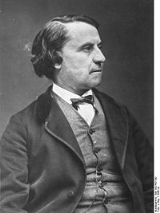
Louis Blanc

Encyclopedia
Louis Jean Joseph Charles Blanc ( 29 October 1811, Madrid
– 6 December 1882, Cannes) was a French politician
and historian
. A socialist who favored reforms, he called for the creation of cooperatives in order to guarantee employment for the urban poor.
, his father held the post of inspector-general of finance under Joseph Bonaparte
. Failing to receive aid from Pozzo di Borgo, his mother's uncle, Louis Blanc studied law in Paris, living in poverty, and became a contributor to various journals. In the Revue du progres, which he founded, he published in 1839 his study on L'Organisation du travail. The principles laid down in this famous essay form the key to Louis Blanc's whole political career. He attributes all the evils that afflict society to the pressure of competition, whereby the weaker are driven to the wall. He demanded the equalization of wages, and the merging of personal interests in the common good-- "à chacun selon ses besoins, de chacun selon ses facultés," which is often translated as "from each according to his abilities, to each according to his needs." This was to be affected by the establishment of "social workshops," a sort of combined co-operative society and trade-union, where the workmen in each trade were to unite their efforts for their common benefit. In 1841 he published his Histoire de dix ans 1830-1840, an attack upon the monarchy of July. It ran through four editions in four years.
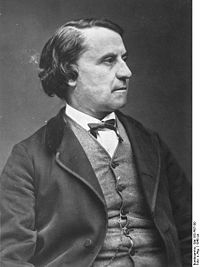 In 1847 he published the two first volumes of his Histoire de la Revolution Française. Its publication was interrupted by the Revolution of 1848, when Louis Blanc became a member of the provisional government. It was on his motion that, on 25 February, the government undertook "to guarantee the existence of the workmen by work"; and though his demand for the establishment of a ministry of labour was refused—as beyond the competence of a provisional government—he was appointed to preside over the government labour commission (Commission du Gouvernement pour les travailleurs) established at the Palace Luxembourg to inquire into and report on the labour question.
The revolution of 1848 was the real chance for Louis Blanc’s ideas to be implemented. His theory of using the established government to enact change was different from those of other socialist theorists of his time. Blanc believed that workers could control their own livelihoods, but knew that unless they were given help to get started the cooperative workshops would never work. To assist this process along Blanc lobbied for national funding of these workshops until the workers could assume control. To fund this ambitious project, Blanc saw a ready revenue source in the rail system. Under government control the railway system would provide the bulk of the funding needed for this and other projects Blanc saw in the future.
When the workshop program was ratified in the national assembly, Blanc’s chief rival Emile Thomas was put in control of the project.
The national assembly was not ready for this type of social program and treated the workshops as a method of buying time until the assembly could gather enough support to stabilize themselves against another worker rebellion. Emile Thomas’s deliberate failure in organizing the workshops into a success only seemed to anger the public more. The people had been promised a job and a working environment in which the workers were in charge, from these government funded programs. What they had received was hand outs and government funded work parties to dig ditches and hard manual labor for meager wages or paid to remain idle. When the workshops were closed the workers rebelled again but were put down by force by the national guard. The national assembly was also able to blame Blanc for the failure of the workshops. His ideas were questioned and he lost much of the respect which had given him influence with the public.
Between the "sans-culottes
", who tried to force him to place himself at their head, and the national guards, who mistreated him, he was nearly killed. Rescued with difficulty, he escaped with a false passport to Belgium, and then to London. In his absence he was condemned by a special tribunal at Bourges
, in contumaciam, to deportation. Against trial and sentence he alike protested, developing his protest in a series of articles in the Nouveau Monde, a review published in Paris under his direction. These he afterwards collected and published as Pages de l'histoire de la révolution de 1848 (Brussels, 1850).
to complete his Histoire de la Revolution Française 12 vols. (1847–1862). In 1858 he published a reply to Lord Normanby's
A Year of Revolution in Paris (1858), which he developed later into his Histoire de la révolution de 1848 (2 vols., 1870–1880). He was also active in the irregular masonic
organisation, the Conseil Supreme de l’Ordre Maconnique de Memphis. His membership in the London-based La Grand Loge des Philadelphes
is unconfirmed.
, and exerted his influence in vain on the side of moderation. In 1878 he advocated the abolition of the presidency and the Senate. In January 1879 he introduced into the chamber a proposal for the amnesty of the Communards, which was carried. This was his last important act. His declining years were darkened by ill-health and by the death, in 1876, of his wife Christina Groh, whom he had married in 1865. He died at Cannes
, and on 12 December received a state funeral in the Père Lachaise.
The 1911 Encyclopædia Britannica in turn cites, in addition to Blanc's own works,
Louis Blanc (1883) by L. Fiaux.
Madrid
Madrid is the capital and largest city of Spain. The population of the city is roughly 3.3 million and the entire population of the Madrid metropolitan area is calculated to be 6.271 million. It is the third largest city in the European Union, after London and Berlin, and its metropolitan...
– 6 December 1882, Cannes) was a French politician
Politician
A politician, political leader, or political figure is an individual who is involved in influencing public policy and decision making...
and historian
Historian
A historian is a person who studies and writes about the past and is regarded as an authority on it. Historians are concerned with the continuous, methodical narrative and research of past events as relating to the human race; as well as the study of all history in time. If the individual is...
. A socialist who favored reforms, he called for the creation of cooperatives in order to guarantee employment for the urban poor.
Early years
He was born in MadridMadrid
Madrid is the capital and largest city of Spain. The population of the city is roughly 3.3 million and the entire population of the Madrid metropolitan area is calculated to be 6.271 million. It is the third largest city in the European Union, after London and Berlin, and its metropolitan...
, his father held the post of inspector-general of finance under Joseph Bonaparte
Joseph Bonaparte
Joseph-Napoléon Bonaparte was the elder brother of Napoleon Bonaparte, who made him King of Naples and Sicily , and later King of Spain...
. Failing to receive aid from Pozzo di Borgo, his mother's uncle, Louis Blanc studied law in Paris, living in poverty, and became a contributor to various journals. In the Revue du progres, which he founded, he published in 1839 his study on L'Organisation du travail. The principles laid down in this famous essay form the key to Louis Blanc's whole political career. He attributes all the evils that afflict society to the pressure of competition, whereby the weaker are driven to the wall. He demanded the equalization of wages, and the merging of personal interests in the common good-- "à chacun selon ses besoins, de chacun selon ses facultés," which is often translated as "from each according to his abilities, to each according to his needs." This was to be affected by the establishment of "social workshops," a sort of combined co-operative society and trade-union, where the workmen in each trade were to unite their efforts for their common benefit. In 1841 he published his Histoire de dix ans 1830-1840, an attack upon the monarchy of July. It ran through four editions in four years.
The Revolution of 1848
The revolution of 1848 was the real chance for Louis Blanc’s ideas to be implemented. His theory of using the established government to enact change was different from those of other socialist theorists of his time. Blanc believed that workers could control their own livelihoods, but knew that unless they were given help to get started the cooperative workshops would never work. To assist this process along Blanc lobbied for national funding of these workshops until the workers could assume control. To fund this ambitious project, Blanc saw a ready revenue source in the rail system. Under government control the railway system would provide the bulk of the funding needed for this and other projects Blanc saw in the future.
When the workshop program was ratified in the national assembly, Blanc’s chief rival Emile Thomas was put in control of the project.
The national assembly was not ready for this type of social program and treated the workshops as a method of buying time until the assembly could gather enough support to stabilize themselves against another worker rebellion. Emile Thomas’s deliberate failure in organizing the workshops into a success only seemed to anger the public more. The people had been promised a job and a working environment in which the workers were in charge, from these government funded programs. What they had received was hand outs and government funded work parties to dig ditches and hard manual labor for meager wages or paid to remain idle. When the workshops were closed the workers rebelled again but were put down by force by the national guard. The national assembly was also able to blame Blanc for the failure of the workshops. His ideas were questioned and he lost much of the respect which had given him influence with the public.
Between the "sans-culottes
Sans-culottes
In the French Revolution, the sans-culottes were the radical militants of the lower classes, typically urban laborers. Though ill-clad and ill-equipped, they made up the bulk of the Revolutionary army during the early years of the French Revolutionary Wars...
", who tried to force him to place himself at their head, and the national guards, who mistreated him, he was nearly killed. Rescued with difficulty, he escaped with a false passport to Belgium, and then to London. In his absence he was condemned by a special tribunal at Bourges
Bourges
Bourges is a city in central France on the Yèvre river. It is the capital of the department of Cher and also was the capital of the former province of Berry.-History:...
, in contumaciam, to deportation. Against trial and sentence he alike protested, developing his protest in a series of articles in the Nouveau Monde, a review published in Paris under his direction. These he afterwards collected and published as Pages de l'histoire de la révolution de 1848 (Brussels, 1850).
Exile
During his stay in Britain he made use of the unique collection of materials for the revolutionary period preserved at the British MuseumBritish Museum
The British Museum is a museum of human history and culture in London. Its collections, which number more than seven million objects, are amongst the largest and most comprehensive in the world and originate from all continents, illustrating and documenting the story of human culture from its...
to complete his Histoire de la Revolution Française 12 vols. (1847–1862). In 1858 he published a reply to Lord Normanby's
Constantine Phipps, 1st Marquess of Normanby
Constantine Henry Phipps, 1st Marquess of Normanby KG GCB GCH, PC , styled Viscount Normanby between 1812 and 1831 and known as The Earl of Mulgrave between 1831 and 1838, was a British Whig politician and author...
A Year of Revolution in Paris (1858), which he developed later into his Histoire de la révolution de 1848 (2 vols., 1870–1880). He was also active in the irregular masonic
Freemasonry
Freemasonry is a fraternal organisation that arose from obscure origins in the late 16th to early 17th century. Freemasonry now exists in various forms all over the world, with a membership estimated at around six million, including approximately 150,000 under the jurisdictions of the Grand Lodge...
organisation, the Conseil Supreme de l’Ordre Maconnique de Memphis. His membership in the London-based La Grand Loge des Philadelphes
Rite of Memphis-Misraim
The Rite of Memphis-Misraim is a fringe Freemasonic rite which was formed by the merging of the two rites of Memphis and Misraïm under the influence of General Garibaldi in 1881.-The Rite of Misraïm:...
is unconfirmed.
Return to France
As far back as 1839 Louis Blanc had vehemently opposed the idea of a Napoleonic restoration, predicting that it would be "despotism without glory," "the Empire without the Emperor." He therefore remained in exile until the fall of the Second Empire in September 1870, after which he returned to Paris and served as a private in the national guard. On 8 February 1871 he was elected a member of the National Assembly, in which he maintained that the republic was "the necessary form of national sovereignty," and voted for the continuation of the war; yet, though a leftist, he did not sympathize with the Paris CommuneParis Commune
The Paris Commune was a government that briefly ruled Paris from March 18 to May 28, 1871. It existed before the split between anarchists and Marxists had taken place, and it is hailed by both groups as the first assumption of power by the working class during the Industrial Revolution...
, and exerted his influence in vain on the side of moderation. In 1878 he advocated the abolition of the presidency and the Senate. In January 1879 he introduced into the chamber a proposal for the amnesty of the Communards, which was carried. This was his last important act. His declining years were darkened by ill-health and by the death, in 1876, of his wife Christina Groh, whom he had married in 1865. He died at Cannes
Cannes
Cannes is one of the best-known cities of the French Riviera, a busy tourist destination and host of the annual Cannes Film Festival. It is a Commune of France in the Alpes-Maritimes department....
, and on 12 December received a state funeral in the Père Lachaise.
Political legacy
Louis Blanc possessed a picturesque and vivid style, and considerable power of research; but the fervour with which he expressed his convictions, while placing him in the first rank of orators, tended to turn his historical writings into political pamphlets. His political and social ideas have had a great influence on the development of socialism in France. His Discours politiques (1847–1881) was published in 1882. his most important works, besides those already mentioned, are Lettres sur l'Angleterre (1866–1867), Dix années de l'Histoire de l'Angleterre (1879–1881), and Questions d'aujourd'hui et de demain (1873–1884).Footnotes
Please update as needed.The 1911 Encyclopædia Britannica in turn cites, in addition to Blanc's own works,
Louis Blanc (1883) by L. Fiaux.
- G.R.S. Taylor, "Leaders of Socialism" (1968)
- G.D.H Cole, "Socialist Thought, The Forerunners 1789-1850" (1959)
- Harry W. Laidler,Ph.D, " A History of Socialist Thought" (1927)