
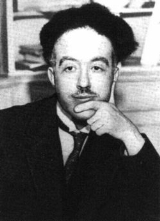
Louis-Victor-Pierre-Raymond, 7th duc de Broglie, FRS (dəˈbrɔɪ; də bʁœj;
DieppeDieppe is a commune in the Seine-Maritime department in France. In 1999, the population of the whole Dieppe urban area was 81,419.A port on the English Channel, famous for its scallops, and with a regular ferry service from the Gare Maritime to Newhaven in England, Dieppe also has a popular pebbled...
,
FranceThe French Republic , The French Republic , The French Republic , (commonly known as France , is a unitary semi-presidential republic in Western Europe with several overseas territories and islands located on other continents and in the Indian, Pacific, and Atlantic oceans. Metropolitan France...
, 15 August 1892 –
LouveciennesLouveciennes is a commune in the Yvelines department in the Île-de-France region in north-central France. It is located in the western suburbs of Paris, between Versailles and Saint-Germain-en-Laye, and adjacent to Marly-le-Roi.-Sights:...
,
FranceThe French Republic , The French Republic , The French Republic , (commonly known as France , is a unitary semi-presidential republic in Western Europe with several overseas territories and islands located on other continents and in the Indian, Pacific, and Atlantic oceans. Metropolitan France...
, 19 March 1987) was a
FrenchThe French are a nation that share a common French culture and speak the French language as a mother tongue. Historically, the French population are descended from peoples of Celtic, Latin and Germanic origin, and are today a mixture of several ethnic groups...
physicistA physicist is a scientist who studies or practices physics. Physicists study a wide range of physical phenomena in many branches of physics spanning all length scales: from sub-atomic particles of which all ordinary matter is made to the behavior of the material Universe as a whole...
and a Nobel laureate in the year 1929. He was the sixteenth member elected to occupy seat 1 of the
Académie françaiseL'Académie française , also called the French Academy, is the pre-eminent French learned body on matters pertaining to the French language. The Académie was officially established in 1635 by Cardinal Richelieu, the chief minister to King Louis XIII. Suppressed in 1793 during the French Revolution,...
in 1944, and served as Perpetual Secretary of the
Académie des sciences, FranceThe French Academy of Sciences is a learned society, founded in 1666 by Louis XIV at the suggestion of Jean-Baptiste Colbert, to encourage and protect the spirit of French scientific research...
.
Biography
Louis de Broglie was born to a noble family in Dieppe,
Seine-MaritimeSeine-Maritime is a French department in the Haute-Normandie region in northern France. It is situated on the northern coast of France, at the mouth of the Seine, and includes the cities of Rouen and Le Havre...
, younger son of
Victor, 5th duc de BroglieLouis-Alphonse-Victor, 5th duc de Broglie, called Victor de Broglie was a French aristocrat.-Biography:...
. He became the 7th duc de Broglie upon the death without heir in 1960 of his older brother,
Maurice, 6th duc de BroglieLouis-César-Victor-Maurice, 6th duc de Broglie , was a French physicist.-Early years:Maurice de Broglie was born in Paris, to Victor de Broglie, 5th duc de Broglie. In 1901, he was married to Camille Bernou de Rochetaillée in Paris. They had one daughter, Laure, born on 17 November 1904, who...
, also a physicist. He did not marry. When he died in
LouveciennesLouveciennes is a commune in the Yvelines department in the Île-de-France region in north-central France. It is located in the western suburbs of Paris, between Versailles and Saint-Germain-en-Laye, and adjacent to Marly-le-Roi.-Sights:...
, he was succeeded as
dukeA duke or duchess is a member of the nobility, historically of highest rank below the monarch, and historically controlling a duchy...
by a distant cousin,
Victor-François, 8th duc de BroglieVictor-François Marie Léon, 8th duc de Broglie , is a French aristocrat and current holder of the title duc de Broglie.The duc was born in Paris France, the eldest son of Prince Jean de Broglie . He acceded to the ducal title on the death without heir of his distant cousin, physicist and Nobel...
.
De Broglie had originally intended a career in
humanitiesThe humanities are academic disciplines that study the human condition, using methods that are primarily analytical, critical, or speculative, as distinguished from the mainly empirical approaches of the natural sciences....
, and received his first degree in
historyHistory is the discovery, collection, organization, and presentation of information about past events. History can also mean the period of time after writing was invented. Scholars who write about history are called historians...
. Afterwards, though, he turned his attention toward mathematics and physics and received a degree in physics. With the outbreak of the
First World WarWorld War I , which was predominantly called the World War or the Great War from its occurrence until 1939, and the First World War or World War I thereafter, was a major war centred in Europe that began on 28 July 1914 and lasted until 11 November 1918...
in 1914, he offered his services to the army in the development of
radioRadio is the transmission of signals through free space by modulation of electromagnetic waves with frequencies below those of visible light. Electromagnetic radiation travels by means of oscillating electromagnetic fields that pass through the air and the vacuum of space...
communications.
His 1924
Recherches sur la théorie des quanta (Research on the Theory of the Quanta), introduced his theory of electron waves. This included the wave-particle duality theory of matter, based on the work of
Max PlanckMax Karl Ernst Ludwig Planck, ForMemRS, was a German physicist who actualized the quantum physics, initiating a revolution in natural science and philosophy. He is regarded as the founder of the quantum theory, for which he received the Nobel Prize in Physics in 1918.-Life and career:Planck came...
and
Albert EinsteinAlbert Einstein was a German-born theoretical physicist who developed the theory of general relativity, effecting a revolution in physics. For this achievement, Einstein is often regarded as the father of modern physics and one of the most prolific intellects in human history...
on light. The thesis examiners, unsure of the material, passed his thesis to Einstein for evaluation who endorsed his wave-particle duality proposal wholeheartedly; de Broglie was awarded his doctorate. This research culminated in the de Broglie hypothesis stating that
any moving particle or object had an associated wave. De Broglie thus created a new field in physics, the
mécanique ondulatoire, or wave mechanics, uniting the physics of energy (wave) and matter (particle). For this he won the
Nobel Prize in PhysicsThe Nobel Prize in Physics is awarded once a year by the Royal Swedish Academy of Sciences. It is one of the five Nobel Prizes established by the will of Alfred Nobel in 1895 and awarded since 1901; the others are the Nobel Prize in Chemistry, Nobel Prize in Literature, Nobel Peace Prize, and...
in 1929.
In his later career, de Broglie worked to develop a
causalCausality is the relationship between causes and effects. It is considered to be fundamental to all natural science, especially physics. Causality is also a topic studied from the perspectives of philosophy and statistics....
explanation of wave mechanics, in opposition to the wholly probabilistic models which dominate quantum mechanical theory; it was refined by
David BohmDavid Joseph Bohm FRS was an American-born British quantum physicist who contributed to theoretical physics, philosophy, neuropsychology, and the Manhattan Project.-Youth and college:...
in the 1950s.
In addition to strictly scientific work, de Broglie thought and wrote about the
philosophy of scienceThe philosophy of science is concerned with the assumptions, foundations, methods and implications of science. It is also concerned with the use and merit of science and sometimes overlaps metaphysics and epistemology by exploring whether scientific results are actually a study of truth...
, including the value of modern scientific discoveries.
De Broglie became a member of the Académie des sciences in 1933, and was the academy's perpetual secretary from 1942. On 12 October 1944, he was elected to the
Académie françaiseL'Académie française , also called the French Academy, is the pre-eminent French learned body on matters pertaining to the French language. The Académie was officially established in 1635 by Cardinal Richelieu, the chief minister to King Louis XIII. Suppressed in 1793 during the French Revolution,...
, replacing mathematician Émile Picard. Because of the deaths and imprisonments of Académie members during the occupation and other effects of the war, the Académie was unable to meet the quorum of twenty members for his election; due to the exceptional circumstances, however, his unanimous election by the seventeen members present was accepted. In an event unique in the
historyHistory is the discovery, collection, organization, and presentation of information about past events. History can also mean the period of time after writing was invented. Scholars who write about history are called historians...
of the Académie, he was received as a member by his own brother Maurice, who had been elected in 1934.
UNESCOThe United Nations Educational, Scientific and Cultural Organization is a specialized agency of the United Nations...
awarded him the first
Kalinga PrizeThe Kalinga Prize for the Popularization of Science is an award given by UNESCO for exceptional skill in presenting scientific ideas to lay people...
in 1952 for his work in popularizing scientific knowledge, and he was elected a Foreign Member of the
Royal SocietyThe Royal Society of London for Improving Natural Knowledge, known simply as the Royal Society, is a learned society for science, and is possibly the oldest such society in existence. Founded in November 1660, it was granted a Royal Charter by King Charles II as the "Royal Society of London"...
on 23 April 1953. In 1961 he received the title of Knight of the Grand Cross in the
Légion d'honneurThe Legion of Honour, or in full the National Order of the Legion of Honour is a French order established by Napoleon Bonaparte, First Consul of the Consulat which succeeded to the First Republic, on 19 May 1802...
. De Broglie was awarded a post as counselor to the French High Commission of Atomic Energy in 1945 for his efforts to bring industry and science closer together. He established a center for applied mechanics at the Henri Poincaré Institute, where research into optics, cybernetics, and atomic energy were carried out. He inspired the formation of the
International Academy of Quantum Molecular ScienceThe International Academy of Quantum Molecular Science is an international scientific learned society covering all applications of quantum theory to chemistry and chemical physics. It was created in Menton in 1967. The founding members were Raymond Daudel, Per-Olov Löwdin, Robert G. Parr, John...
and was an early member.
Matter and wave-particle duality
"The fundamental idea of [my 1924 thesis] was the following: The fact that, following Einstein's introduction of photons in light waves, one knew that light contains particles which are concentrations of energy incorporated into the wave, suggests that all particles, like the electron, must be transported by a wave into which it is incorporated... My essential idea was to extend to all particles the coexistence of waves and particles discovered by Einstein in 1905 in the case of light and photons." "With every particle of matter with mass
m and velocity
v a real wave must be 'associated'", related to the momentum by the equation:

where

is the
wavelengthIn physics, the wavelength of a sinusoidal wave is the spatial period of the wave—the distance over which the wave's shape repeats.It is usually determined by considering the distance between consecutive corresponding points of the same phase, such as crests, troughs, or zero crossings, and is a...
,

is the
Planck constantThe Planck constant , also called Planck's constant, is a physical constant reflecting the sizes of energy quanta in quantum mechanics. It is named after Max Planck, one of the founders of quantum theory, who discovered it in 1899...
,

is the
momentumIn classical mechanics, linear momentum or translational momentum is the product of the mass and velocity of an object...
,

is the rest mass,

is the
velocityIn physics, velocity is speed in a given direction. Speed describes only how fast an object is moving, whereas velocity gives both the speed and direction of the object's motion. To have a constant velocity, an object must have a constant speed and motion in a constant direction. Constant ...
and

is the
speed of lightThe speed of light in vacuum, usually denoted by c, is a physical constant important in many areas of physics. Its value is 299,792,458 metres per second, a figure that is exact since the length of the metre is defined from this constant and the international standard for time...
in a vacuum.
This theory set the basis of wave mechanics. It was supported by Einstein, confirmed by the
electron diffraction experimentsThe Davisson–Germer experiment was a physics experiment conducted by American physicists Clinton Davisson and Lester Germer in 1927, which confirmed the de Broglie hypothesis. This hypothesis advanced by Louis de Broglie in 1924 says that particles of matter such as electrons have wave like...
of Davisson and Germer, and generalized by the work of Schrödinger.
However, this generalization was statistical and was not approved of by de Broglie, who said "that the particle must be the seat of an internal periodic movement and that it must move in a wave in order to remain in phase with it was ignored by the actual physicists [who are] wrong to consider a wave propagation without localization of the particle, which was quite contrary to my original ideas."
From a philosophical viewpoint, this theory of matter-waves has contributed greatly to the ruin of the atomism of the past. Originally, de Broglie thought that real wave (i.e., having a direct physical interpretation) was associated with particles. In fact, the wave aspect of matter was formalized by a
wavefunctionNot to be confused with the related concept of the Wave equationA wave function or wavefunction is a probability amplitude in quantum mechanics describing the quantum state of a particle and how it behaves. Typically, its values are complex numbers and, for a single particle, it is a function of...
defined by the
Schrödinger equationThe Schrödinger equation was formulated in 1926 by Austrian physicist Erwin Schrödinger. Used in physics , it is an equation that describes how the quantum state of a physical system changes in time....
, which is a pure mathematical entity having a probabilistic interpretation, without the support of real physical elements. This wavefunction gives an appearance of wave behavior to matter, without making real physical waves appear. However, until the end of his life de Broglie returned to a direct and real physical interpretation of matter-waves, following the work of
David BohmDavid Joseph Bohm FRS was an American-born British quantum physicist who contributed to theoretical physics, philosophy, neuropsychology, and the Manhattan Project.-Youth and college:...
. The de Broglie-Bohm theory is today the only interpretation giving real status to matter-waves and representing the predictions of quantum theory. But, since it has some problems and doesn't go further in its predictions than the
Copenhagen interpretationThe Copenhagen interpretation is one of the earliest and most commonly taught interpretations of quantum mechanics. It holds that quantum mechanics does not yield a description of an objective reality but deals only with probabilities of observing, or measuring, various aspects of energy quanta,...
, it is little recognized by the scientific community.
Non-nullity and variability of mass
According to de Broglie, the
neutrinoA neutrino is an electrically neutral, weakly interacting elementary subatomic particle with a half-integer spin, chirality and a disputed but small non-zero mass. It is able to pass through ordinary matter almost unaffected...
and the
photonIn physics, a photon is an elementary particle, the quantum of the electromagnetic interaction and the basic unit of light and all other forms of electromagnetic radiation. It is also the force carrier for the electromagnetic force...
have rest masses that are non-zero, though very low. That a photon is not quite massless is imposed by the coherence of his theory. Incidentally, this rejection of the hypothesis of a massless photon enabled him to doubt the hypothesis of the expansion of the universe.
In addition, he believed that the true mass of particles is not constant, but variable, and that each particle can be represented as a thermodynamic machine equivalent to a cyclic integral of action.
Generalization of the principle of least action
In the second part of his 1924 thesis, de Broglie used the equivalence of the mechanical principle of least action with
Fermat's optical principleIn optics, Fermat's principle or the principle of least time is the principle that the path taken between two points by a ray of light is the path that can be traversed in the least time. This principle is sometimes taken as the definition of a ray of light...
: "Fermat's principle applied to phase waves is identical to
Maupertuis' principleIn classical mechanics, Maupertuis' principle is an integral equation that determines the path followed by a physical system without specifying the time parameterization of that path. It is a special case of the more generally stated principle of least action...
applied to the moving body; the possible dynamic trajectories of the moving body are identical to the possible rays of the wave." This equivalence had been pointed out by
HamiltonSir William Rowan Hamilton was an Irish physicist, astronomer, and mathematician, who made important contributions to classical mechanics, optics, and algebra. His studies of mechanical and optical systems led him to discover new mathematical concepts and techniques...
a century earlier, and published by him around 1830, in an era where no experience gave proof of the fundamental principles of physics being involved in the description of atomic phenomena.
Up to his final work, he appeared to be the physicist who most sought that dimension of action which
Max PlanckMax Karl Ernst Ludwig Planck, ForMemRS, was a German physicist who actualized the quantum physics, initiating a revolution in natural science and philosophy. He is regarded as the founder of the quantum theory, for which he received the Nobel Prize in Physics in 1918.-Life and career:Planck came...
, at the beginning of the 20th century, had shown to be the only universal unity (with his dimension of entropy).
Duality of the laws of nature
Far from claiming to make "the contradiction disappear" like
Max BornMax Born was a German-born physicist and mathematician who was instrumental in the development of quantum mechanics. He also made contributions to solid-state physics and optics and supervised the work of a number of notable physicists in the 1920s and 30s...
thought could be achieved with a statistical approach, de Broglie extended wave-particle duality to all particles (and to crystals which revealed the effects of diffraction) and extended the principle of duality to the laws of nature.
His last work made a single system of laws from the two large systems of thermodynamics and of mechanics:
That idea seems to match the continuous-discontinuous duality, since its dynamics could be the limit of its thermodynamics when transitions to continuous limits are postulated. It is also close to that of Leibniz, who posited the necessity of "architectonic principles" to complete the system of mechnical laws.
However, according to him, there is less duality, in the sense of opposition, than synthesis (one is the limit of the other) and the effort of synthesis is constant according to him, like in his first formula, in which the first member pertains to mechanics and the second to optics:
-

Neutrino theory of light
This theory, which dates from 1934, introduces the idea that the photon is equivalent to the fusion of two
DiracPaul Adrien Maurice Dirac, OM, FRS was an English theoretical physicist who made fundamental contributions to the early development of both quantum mechanics and quantum electrodynamics...
neutrinos.
It shows that the movement of the center of gravity of these two particles obeys the Maxwell equations—that implies that the neutrino and the photon both have rest masses that are non-zero, though very low.
Hidden thermodynamics
De Broglie's final great idea was the hidden thermodynamics of isolated particles. It is an attempt to bring together the three furthest principles of physics: the principles of Fermat, Maupertuis, and Carnot.
In this work,
actionIn physics, action is an attribute of the dynamics of a physical system. It is a mathematical functional which takes the trajectory, also called path or history, of the system as its argument and has a real number as its result. Action has the dimension of energy × time, and its unit is...
becomes a sort of opposite to
entropyEntropy is a thermodynamic property that can be used to determine the energy available for useful work in a thermodynamic process, such as in energy conversion devices, engines, or machines. Such devices can only be driven by convertible energy, and have a theoretical maximum efficiency when...
, through an equation that relates the only two universal dimensions of the form:

As a consequence of its great impact, this theory brings back the
uncertainty principleIn quantum mechanics, the Heisenberg uncertainty principle states a fundamental limit on the accuracy with which certain pairs of physical properties of a particle, such as position and momentum, can be simultaneously known...
to distances around extrema of action, distances corresponding to
reductions in entropy.
Honors and awards
- 1929 Nobel Prize in Physics
The Nobel Prize in Physics is awarded once a year by the Royal Swedish Academy of Sciences. It is one of the five Nobel Prizes established by the will of Alfred Nobel in 1895 and awarded since 1901; the others are the Nobel Prize in Chemistry, Nobel Prize in Literature, Nobel Peace Prize, and...
- 1929 Henri Poincaré Medal
- 1932 Albert I of Monaco Prize
- 1938 Max Planck Medal
The Max Planck medal is an award for extraordinary achievements in theoretical physics. It is awarded annually by the Deutsche Physikalische Gesellschaft , the world's largest organization of physicists.-List of recipients:...
- 1938 Fellow, Royal Swedish Academy of Sciences
The Royal Swedish Academy of Sciences or Kungliga Vetenskapsakademien is one of the Royal Academies of Sweden. The Academy is an independent, non-governmental scientific organization which acts to promote the sciences, primarily the natural sciences and mathematics.The Academy was founded on 2...
- 1944 Fellow, Académie française
L'Académie française , also called the French Academy, is the pre-eminent French learned body on matters pertaining to the French language. The Académie was officially established in 1635 by Cardinal Richelieu, the chief minister to King Louis XIII. Suppressed in 1793 during the French Revolution,...
- 1952 Kalinga Prize
The Kalinga Prize for the Popularization of Science is an award given by UNESCO for exceptional skill in presenting scientific ideas to lay people...
- 1953 Fellow, Royal Society
The Royal Society of London for Improving Natural Knowledge, known simply as the Royal Society, is a learned society for science, and is possibly the oldest such society in existence. Founded in November 1660, it was granted a Royal Charter by King Charles II as the "Royal Society of London"...
Publications
- Recherches sur la théorie des quanta (Researches on the quantum theory), Thesis, Paris, 1924.
- Ondes et mouvements (Waves and Motions). Paris: Gauthier-Villars, 1926.
- Rapport au 5e Conseil de Physique Solvay. Brussels, 1927.
- La mécanique ondulatoire (Wave Mechanics). Paris: Gauthier-Villars, 1928.
- Matière et lumière (Matter and Light). Paris: Albin Michel, 1937.
- Une tentative d'interprétation causale et non linéaire de la mécanique ondulatoire: la théorie de la double solution. Paris: Gauthier-Villars, 1956.
- English translation: Non-linear Wave Mechanics: A Causal Interpretation. Amsterdam: Elsevier, 1960.
- Sur les sentiers de la science (On the Paths of Science).
- Introduction à la nouvelle théorie des particules de M. Jean-Pierre Vigier et de ses collaborateurs. Paris: Gauthier-Villars, 1961. Paris: Albin Michel, 1960.
- English translation: Introduction to the Vigier Theory of elementary particles. Amsterdam: Elsevier, 1963.
- Étude critique des bases de l'interprétation actuelle de la mécanique ondulatoire. Paris: Gauthier-Villars, 1963.
- English translation: The Current Interpretation of Wave Mechanics: A Critical Study. Amsterdam, Elsevier, 1964.
- Certitudes et incertitudes de la science (Certitudes and Incertitudes of Science). Paris: Albin Michel, 1966.
External links