

Loughton

Encyclopedia
Loughton is a town and civil parish in the Epping Forest
district of Essex
. It is located between 11 and 13 miles (21 km) north east of Charing Cross
in London
, south of the M25
and west of the M11 motorway
and has boundaries with Chingford
, Waltham Abbey
, Theydon Bois
, Chigwell
and Buckhurst Hill
. Loughton includes three conservation areas and there are 56 listed buildings in the town, together with a further 50 locally listed.
The parish of Loughton covers an area of about 3724 acres (15 km²), of which over 1300 acres (5 km²) are part of Epping Forest
. The ancient parish contained over 3900 acres (15.8 km²), but in 1996 some parts of the south of the old parish were transferred to Buckhurst Hill
parish, and other small portions to Chigwell
and Theydon Bois
. At the time of the 2001 census
Loughton had a population of 30,340. It is the most populous civil parish in the Epping Forest district, and within Essex it is the second most populous civil parish (after Canvey Island
) and the second largest in area.
, an Iron Age
earth fort in Epping Forest dating from around 500 BC. Hidden by dense undergrowth for centuries it was rediscovered in 1872.
The first references to the site of modern-day Loughton date from the Anglo-Saxon
period when it was known as Lukintune ("the farm of Luhha"). The earliest written evidence of this settlement is in the charter of Edward the Confessor
in 1062 which granted various estates, including Tippedene (Debden) and Alwartune (Alderton Hall, in Loughton), to Harold Godwinson
(later King Harold II) follwing his re-founding of Waltham Abbey
. Following the Norman conquest, the town is also mentioned in the Domesday Book
of 1086, with the name Lochintuna.
The settlement remained a small village until the early 17th century when the high road was extended north through the forest. The road quickly became the main route from London to Cambridge
and East Anglia
, and Loughton grew into an important stop with coaching inn
s. The most significant of the great houses of this period, built as country retreats for wealthy City merchants and courtiers, was Loughton Hall, owned by Mary Tudor
two months before she became Queen Mary of England in 1553, and later by the Wroth family from 1578 to 1738. Sir Robert Wroth (c. 1576 – 1614) and his wife Lady Mary Wroth
(1587 – c. 1652) entertained many of the great literary figures of the time, including Ben Jonson
, at the house.
Loughton's growth since Domesday has largely been at the expense of the forest. Expansion towards the River Roding
was arrested owing to the often flooding marshy meadows, encroachments into the forest to the north and west of the village were nevertheless possible. Loughton landlords and villagers both exploited the forest waste (open spaces and scrub of the forest), but the trickle of forest destruction threatened to turn into a flood in the 19th century after royalty had lost interest in protecting the woodland as a hunting reserve. As the forest disappeared and landowners began enclosing more of it for private use, many began to express concern at the loss of such a significant natural resource and common land. Some Loughton villagers defied landowners to practice their ancient right to lop wood—a series of court cases, including one brought by the Loughton labourer Thomas Willingale
, was needed before the City of London Corporation took legal action against the landowners' enclosures, resulting in the Epping Forest Act of 1878 which preserved the forest for use by the public.
The arrival of the railway spurred on the town's development. The railway first came to Loughton in 1856 when the Eastern Counties Railway
, (later the Great Eastern Railway
), opened a branch line via Woodford
. In 1949 the line was electrified and transferred to London Transport
to become part of the Central Line
on the London Underground
. The arrival of the railways also provided visitors from London with a convenient means of reaching Epping Forest and thus transforming it into the "East Enders' Playground". The Ragged School
Union began organising visits to the forest for parties of poor East End children in 1891 paid for by the Pearsons Fresh Air Fund. Loughton artist Octavius Dixie Deacon depicted many scenes of the town including some of its residents during the late Victorian period.
As the Great Eastern Railway
Company did not offer workmen's fares, the town's development was of a middle-class character. Much of the housing in Loughton was built in the Victorian
and Edwardian eras
, with significant expansion in the 1930s. Loughton was a fashionable place for artistic and scientific residents in Victorian and Edwardian times, and a number of prominent residents were renowned socialists, nonconformists, and social reformers. Debden
in the north-east is a post-war development being one of the London County Council's country estates. Built with the express purpose of co-locating industrial, retail and residential properties to facilitate supported re-location of London families affected by war damage within the Capital. Located within Debden's industrial estate is the former printing works of the Bank of England
; in 1993 the printing works were taken over by De La Rue
on their winning the contract to print the banknotes. The headquarters of greeting card company Clinton Cards
and construction firm Higgins Group are also located within the Debden Industrial estate. In 2008, electronics firm Amstrad
announced their intention to move the group's headquarters to Loughton from Brentwood
.
In 2002 Loughton featured in the ITV1
programme Essex Wives
, a documentary series about the lives of some of the nouveau riche
who have resided in the Essex satellite town
s of London since the 1980s. The series propelled Jodie Marsh
, one of its featured characters to fame. Journalists' use of the term "golden triangle" to describe the towns of Loughton, Buckhurst Hill and Chigwell for their propensity to attract wealthy footballers, soap-opera actors and TV celebrities as residents derives from this.
The town has been used as a backdrop in other television series, notably The Only Way is Essex
, and two shops in the High Rd are associated with members of its cast.
s, to avoid potential problems with flooding.
The highest parts of the town are the roads that border the forest's edge; from the green outside the Gardeners Arms pub
near the junction of York Hill, Pump Hill and Baldwins Hill there are views of London, south-west Essex, Kent and Surrey. From here, on a clear day, there is a panoramic view of London landmarks and the North Downs beyond. There are numerous other fine views from different parts of the town, including one roughly at the junction of Traps Hill, Borders Lane, Alderton Hill and Spareleaze Hill, and another on Spring Grove and Hillcrest Road. In the valley between these two hills flows Loughton Brook, which rises in Epping Forest near Waltham Abbey and flows through the forest and Baldwins Pond before traversing the town and emptying into the Roding.
There are several distinctive neighbourhoods in Loughton mostly identifiable by the building types incorporated during their development:
Between 1839 and 31st March 2000 policing and crime prevention was provided by the Metropolitan Police
. From 1 April 2000 responsibilities were transferred to the Essex Police
. Telephone numbers in the town have the outer London (0208) area code. This anomaly is shared with Chigwell
, Thames Ditton
, Molesey and Ewell
.
until 1974, when Epping Forest District Council
was created. Loughton Town Council was established in 1996. The Town Council consists of 22 councillors representing 7 wards, elected for a four-year term.
At district council level, Loughton is represented by two councillors from each of the 7 wards, elected for a four-year term. At county council level, Loughton is split between three divisions, Buckhurst Hill & Loughton South, Chigwell & Loughton Broadway, and Loughton Central, each returning one councillor elected for a four-year term.
Loughton has been part of the Epping Forest parliamentary constituency
since its creation in 1974.
. East 15 grew from the work of Joan Littlewood
's famed Theatre Workshop
. Joan Littlewood's Theatre Workshop was based in Stratford
, London, whose postal district is E15. The School, which became part of the University of Essex
in 2000, includes the Corbett Theatre in its campus. Regular productions are staged at the theatre, which was named after Harry H. Corbett
(1925–1982), himself a Theatre Workshop member and benefactor of East 15. The theatre building is actually a converted medieval flint barn from Ditchling
, Sussex
which was dismantled and rebuilt in Loughton.
The character actor Jack Watling
(1923–2001) lived for many years in Alderton Hall, Loughton. His son, Giles
(born 1953), also an actor, was born there. Actor and playwright Ken Campbell
(1941–2008), nicknamed 'The Elf of Epping Forest', lived in Baldwins Hill, Loughton. Comedy-drama actor Alan Davies
(born 1966) grew up in Loughton, and attended Staples Road school. Actress Jane Carr
(born 1950), best known for her role as "Louise Mercer" in the American version of the sitcom Dear John
from 1988 to 1992, was born in Loughton.
Amateur drama is performed mainly at Lopping Hall. Performances are from Loughton Amateur Dramatic Society, founded in 1924, which until 2006 alternated with those from the now-defunct West Essex Repertory Company, founded in 1945. Lopping Hall opened in 1884 and was paid for by the Corporation of London to compensate villagers for the loss of traditional rights to lop wood in Epping Forest, rights which were bought out when the management of the forest was taken over by the Corporation in 1878. Lopping Hall served as Loughton's town hall and was the venue for most of the parish's social – and especially musical - activities during the early 20th century. There are ambitious plans by the Trustees for the building's restoration by 2012. There is also a full-scale theatre, the College Theatre, on the campus of Epping Forest College.
(1887–1958) lived at 107 High Road for many years. The hymn writer Sarah Flower Adams
(1805–1848) lived with her husband William Bridges Adams
(1797–1872) at a house called 'Sunnybank', demolished in 1888 and replaced by No. 9 Woodbury Hill. Sarah's most famous hymn was "Nearer, My God, to Thee
", apparently written at Loughton in 1840, while William, a locomotive engineer, was the inventor of the fishplate
used to connect rail tracks.
Loughton is also home to the National Jazz Archive (see below), which hosts occasional jazz performances. Gladys Mills (1918–1978), a well-known music-hall pianist who performed as "Mrs Mills
", lived in Roding Road from 1934, and upon her marriage in 1947, in Barncroft Close until 1964. Loughton boasts a few rock and pop music connections; Mark Knopfler
of Dire Straits
was a lecturer at Loughton College (now Epping Forest College
), and the Genesis
song "The Battle of Epping Forest" is based on an actual event when rival East End gangs fought a turf war in the forest. The Wake Arms public house (now demolished), which was about 50 yards (45.7 m) north of the Loughton boundary in Waltham Abbey
on a roundabout, was a notable rock music venue from 1968–1973, hosting bands such as Black Sabbath
, Deep Purple
, Genesis, Pretty Things
, Status Quo, Uriah Heep
, and Van der Graaf Generator
. Ray Dorset
, the lead singer of Mungo Jerry
, had his first taste of fame when his band 'The Tramps' won the Loughton Beat Contest in 1964.
Roding Players is an amateur orchestra which rehearses at Roding Valley High School and gives three concerts a year in the Epping Forest area; composer Miles Harwood is Musical Director. Loughton Ladies Choir gives regular afternoon concerts in the Epping Forest area. Epping Forest Brass Band, founded in 1935, also has regular concerts in the Epping Forest area, and competes in national competitions and exhibitions. Loughton Cinema had a resident ladies' band during the 1930s. Music at the LMC is a series of concerts given by visiting artists in the winter months.
Loughton also has its own music academy the 'Loughton Music Academy' founded in 2001 to cope with the growing demand for music in the area. Performances are with full ochestral participation. The 'Community Music Initiative'or CMI is a charitable project led by the LMA which provides music lessons for schools in the area who do not benefit from musical facilities.
Loughton Folk Club was founded on 28 October 2010 and held its first Loughton Folk Day on 9 April 2011. The Club meets weekly at 8pm at Loughton Club, Station Road, Loughton
Epping Forest District Council's Arts Unit, Epping Forest Arts, stages occasional dance-based performance works in Loughton, with community and schools participation. Loughton School of Dancing, which meets at Lopping Hall, encourages the town's younger talent. Harlow Ballet, which stages full-scale amateur ballet productions at Harlow Playhouse, also recruits in the area.
has made Loughton a magnet for artists for many years. The sculptor and painter Sir Jacob Epstein (1880–1959) lived at 'Deerhurst' between 1933–1950, and produced some of his best known works there. Artist John Strevens
(1902–1990) lived at 8 Lower Park Road from 1963 until his death. Walter Spradbury (1889–1969), best known for his iconic interwar London Transport posters, lived nearby in Buckhurst Hill
. Octavius Deacon was a 19th century naïve artist from Loughton who painted many amusing scenes of village life. William Lakin Turner
lived and painted at Clovelly, York Hill, Loughton, in the 1890s. Juggler Mark Robertson (1963–1992) lived at 'The Avenue' and had a highly successful career appearing at the London Palladium and on many TV shows.
There is a thriving Loughton Arts Club, and there are frequent exhibitions by contemporary local artists and photographers at Loughton Library. Loughton Camera Club, a member of the East Anglian Federation of Photographic Societies, meets at Lopping Hall in Loughton, and holds regular exhibitions of members' work in Loughton Library and elsewhere.
on 9 October 1928; designed by local architect Theodore Legg, it could seat 847. This was later reduced to 700. The cinema was renamed the Century in 1953, and closed on 25 May 1963, and has since been demolished and replaced by shops. In July 2010 Loughton Town Council organised a screening of An Education
, the first film screening in Loughton since the closure of the cinema, and its success prompted the formation of the Loughton Film Society in September 2010 to redress the lack of a local cinema.
George Pearson (1875–1973), a pioneering director and film-writer in the early years of British cinematography, was headmaster of Staples Road Junior School, Loughton 1908–1913. Charles Ashton (1884 – c. 1968), film actor from the silent movie era, lived at 20 Carroll Hill, Loughton, from 1917–34. He starred in more than 20 films between 1918–29, including the first film version of The Monkey's Paw
, and Kitty
, based on Warwick Deeping
's novel of the same name.
Several films have been set in the Loughton area, including the 2001 TV movie Hot Money
, based on real events at Loughton's Bank of England
printing works.
Lady Mary Wroth
(1586–1652), niece of poet Sir Philip Sidney, lived at Loughton Hall with her husband Sir Robert Wroth, and they turned the mansion into a centre of Jacobean
literary life. Ben Jonson
was a frequent visitor, and dedicated his play The Alchemist to Mary and poetry collection The Forest to Sir Robert. Lady Mary was an author of considerable repute in her own right, and her book Urania is generally regarded as the first full-length English novel by a woman.
Anthony Trollope
(1815–1882) who lived for some time at nearby Waltham Cross
, set part of his novel Phineas Finn
(1869), which parodies corrupt electoral procedures, in a fictional Loughton. William Wymark Jacobs (1863–1943) lived at The Outlook, Upper Park Road before moving to Feltham House, Goldings Road. Best known as the author of the short story The Monkey's Paw
. Jacobs also wrote numerous sardonic short stories based in 'Claybury', which is a thinly-fictionalised Loughton. Rudyard Kipling
(1865–1936) stayed as a child at Goldings Hill Farm. Arthur Morrison
(1863–1945), best known for his grim novels about London's East End, lived in Salcombe House, Loughton High Road. Hesba Stretton
(1832–1911) was a children's author who lived in Loughton. Hesba Stretton was the pen name of Sarah Smith; her novels about the street children of Victorian London raised awareness of their plight. Horace Wykeham Can Newte lived at Alderton Hall: he was a prolific novelist. Another children's writer, Winifred Darch (1884–1960), taught at Loughton County High School for Girls 1906–1935 (now Roding Valley High School), as did the hymnodist and poet, Emily Chisholm (1910–1991), who lived in Loughton at 3 Lower Park Rd.
Ruth Rendell
, Baroness Rendell of Babergh (born 1930), who lived in Shelley Grove, Loughton, was educated at Loughton County High School for Girls and subsequently worked as a journalist in Loughton at the West Essex Gazette. Some of her fiction is set in Epping Forest, and 'Little Cornwall', the hilly area of north-west Loughton close to Epping Forest, takes its name from her description in the novel The Face of Trespass
.
Poets associated with Loughton include Sarah Flower Adams (1805–1848), and Sarah Catherine Martin (c. 1766 – 1826), author of the nursery rhyme "Old Mother Hubbard", who is buried in the churchyard of St. Nicholas Church, Loughton. William Sotheby
(1757–1833), poet and classicist, lived at Fairmead, Loughton. Alfred, Lord Tennyson
(1809–1892) lived at Beech Hill House, High Beach
1837–1840 where he wrote parts of his magnum opus "In Memoriam
". John Clare
(1793–1864) lived at a private asylum at High Beach 1837–1841. The First World War poet Edward Thomas
(1878–1917) also lived at High Beach 1915–1917. The poet George Barker
(1913–1991) was born at 116 Forest Road, Loughton. Geoffrey Ainger (born 1925), who wrote the Christmas carol
s "Born in the Night", "Mary's Child", "Do Shepherds Stand" and several other hymns, was Methodist minister of Loughton 1958–63.
T. E. Lawrence
bought land at Pole Hill
in Chingford after the First World War and constructed a hut and swimming pool there. After the Chingford Urban District council bought the land in 1930 and demolished his structures, he re-erected the hut in the grounds of The Warren in Loughton in 1931. The hut remains there, but in a state of disrepair.
Subsequent festivals have highlighted the work of the poet George Granville Barker, a native of the town; the sculptor Jacob Epstein who lived and worked in the town; Lady Mary Wroth, who lived at Loughton Hall.
Other subjects featured in the Festival's programme:
Art: three art exhibitions, including one located within Epping Forest where participants watched artists at work.
Architecture: Talks on architects who had a significant impact on the locality: Sir Frederick Gibberd and Sir Frank Baines and a six-week course concerning early 'Essex Houses and Landscapes' led by Alan Bayford.
Literature and Creative Writing: A presentation by Dr Tony Williams on 'The greatest place in the world': Dickens, Chigwell and Barnaby Rudge ; readings of Victorian writers' including Arthur Morrison, W.W. Jacobs and Hesba Stretton; and Edwardian and Victorian songs sung by baritone Carl Murray.
 Loughton is home to two important national archives:
In addition to the two museums listed above, guided tours are occasionally offered of the disused signal box
near Loughton tube station
which is owned by the London Transport Museum. Funding was pledged in 2006 to help establish a Street Museum in Loughton. There is also an Epping Forest District Museum store in the town, but this is not open to the public.
A number of Loughton buildings, including the Masonic Hall, Lopping Hall, Mortuary Chapel and several churches, were opened for Heritage Open Days in September 2007, the first time this had been done. On one of the days, a vintage bus rally was held in the town, attracting a large number of visitors.
Loughton Leisure Centre at Traps Hill, managed by a private operator on behalf of the Epping Forest District Council includes a swimming pool complex and fitness facilities. Other large commercial sports and leisure facilities are also to be found in the area.
linking Cambridge to London is accessed at Loughton's eastern boundary. The junction does not permit entry to the north-bound carriageway. The M11 was constructed in a number of phases beginning in the 1970's and finally opening in the 1980's.
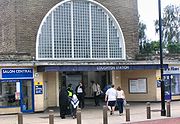 Loughton is served by both Loughton tube station
and, further north-east, Debden tube station
, both on the Central Line
of the London Underground
. The current Loughton station was opened in 1940, and Debden in 1949, but both the line and stations existed before that; the railway line dates back to 22 August 1856, when the branch from Stratford
was opened by the Eastern Counties Railway
. The railway's 150th anniversary was celebrated by an exhibition and activity day at Loughton station on 19 August 2006.
routes, commercial routes or Essex County Council contract routes.
Services operating to destinations south of Loughton are mostly frequent and are London Buses
services. Services operating to destinations north of Loughton are not London Buses
routes (meaning Oyster card
s and other forms of TfL ticketing are not accepted), and are either commercial services or services under contract to Essex County Council.
, approx. 1700 places in Key Stage 3
, approximately 1500 places in Key Stage 2
and approximately 600 places in Key Stage 1
- almost all of which were in comprehensive school
s.
Epping Forest (district)
Epping Forest is a local government district of the county of Essex, England. It is named after Epping Forest, of which the district contains a large part...
district of Essex
Essex
Essex is a ceremonial and non-metropolitan county in the East region of England, and one of the home counties. It is located to the northeast of Greater London. It borders with Cambridgeshire and Suffolk to the north, Hertfordshire to the west, Kent to the South and London to the south west...
. It is located between 11 and 13 miles (21 km) north east of Charing Cross
Charing Cross
Charing Cross denotes the junction of Strand, Whitehall and Cockspur Street, just south of Trafalgar Square in central London, England. It is named after the now demolished Eleanor cross that stood there, in what was once the hamlet of Charing. The site of the cross is now occupied by an equestrian...
in London
London
London is the capital city of :England and the :United Kingdom, the largest metropolitan area in the United Kingdom, and the largest urban zone in the European Union by most measures. Located on the River Thames, London has been a major settlement for two millennia, its history going back to its...
, south of the M25
M25 motorway
The M25 motorway, or London Orbital, is a orbital motorway that almost encircles Greater London, England, in the United Kingdom. The motorway was first mooted early in the 20th century. A few sections, based on the now abandoned London Ringways plan, were constructed in the early 1970s and it ...
and west of the M11 motorway
M11 motorway
The M11 motorway in England is a major road running approximately north from the North Circular Road in South Woodford in north-east London to the A14, north-west of Cambridge.-Route:...
and has boundaries with Chingford
Chingford
Chingford is a district of north east London, bordering on Enfield and Edmonton to the west, Woodford to the east, Walthamstow and Stratford to the south and Essex to the north. It is situated northeast of Charing Cross and forms part of the London Borough of Waltham Forest...
, Waltham Abbey
Waltham Abbey, Essex
Waltham Abbey is a market town of about 20,400 people in the south west of the county of Essex, in the East of England region. It is about 24 km north of London on the Greenwich Meridian and lies between the River Lea in the west and Epping Forest in the east. It takes its name from The Abbey...
, Theydon Bois
Theydon Bois
Theydon Bois is a large residential village and civil parish in the Epping Forest district of the County of Essex, England. It is located 1.4 miles south of Epping, 0.85 miles northeast of Loughton and 6 miles south of Harlow.Theydon Bois is within the bounds of the M25 motorway and is situated...
, Chigwell
Chigwell
Chigwell is a civil parish and town in the Epping Forest district of Essex. It is located 11.6 miles north east of Charing Cross. It is served by two London Underground stations and has a London area code.-Etymology:According to P. H...
and Buckhurst Hill
Buckhurst Hill
Buckhurst Hill is an affluent suburban town in the Epping Forest district of Essex, England. Located adjacent to the northern boundary of Greater London, it forms part of the Greater London Urban Area.- Overview :...
. Loughton includes three conservation areas and there are 56 listed buildings in the town, together with a further 50 locally listed.
The parish of Loughton covers an area of about 3724 acres (15 km²), of which over 1300 acres (5 km²) are part of Epping Forest
Epping Forest
Epping Forest is an area of ancient woodland in south-east England, straddling the border between north-east Greater London and Essex. It is a former royal forest, and is managed by the City of London Corporation....
. The ancient parish contained over 3900 acres (15.8 km²), but in 1996 some parts of the south of the old parish were transferred to Buckhurst Hill
Buckhurst Hill
Buckhurst Hill is an affluent suburban town in the Epping Forest district of Essex, England. Located adjacent to the northern boundary of Greater London, it forms part of the Greater London Urban Area.- Overview :...
parish, and other small portions to Chigwell
Chigwell
Chigwell is a civil parish and town in the Epping Forest district of Essex. It is located 11.6 miles north east of Charing Cross. It is served by two London Underground stations and has a London area code.-Etymology:According to P. H...
and Theydon Bois
Theydon Bois
Theydon Bois is a large residential village and civil parish in the Epping Forest district of the County of Essex, England. It is located 1.4 miles south of Epping, 0.85 miles northeast of Loughton and 6 miles south of Harlow.Theydon Bois is within the bounds of the M25 motorway and is situated...
. At the time of the 2001 census
United Kingdom Census 2001
A nationwide census, known as Census 2001, was conducted in the United Kingdom on Sunday, 29 April 2001. This was the 20th UK Census and recorded a resident population of 58,789,194....
Loughton had a population of 30,340. It is the most populous civil parish in the Epping Forest district, and within Essex it is the second most populous civil parish (after Canvey Island
Canvey Island
Canvey Island is a civil parish and reclaimed island in the Thames estuary in England. It is separated from the mainland of south Essex by a network of creeks...
) and the second largest in area.
History
The earliest structure in Loughton is Loughton CampLoughton Camp
Loughton Camp is an Iron Age Hill fort in Epping Forest, one mile North West of the town of Loughton.The camp's earthworks cover an area of approximately 10 acres and are visible today as a low bank and ditch encircling the main camp...
, an Iron Age
Iron Age
The Iron Age is the archaeological period generally occurring after the Bronze Age, marked by the prevalent use of iron. The early period of the age is characterized by the widespread use of iron or steel. The adoption of such material coincided with other changes in society, including differing...
earth fort in Epping Forest dating from around 500 BC. Hidden by dense undergrowth for centuries it was rediscovered in 1872.
The first references to the site of modern-day Loughton date from the Anglo-Saxon
Anglo-Saxons
Anglo-Saxon is a term used by historians to designate the Germanic tribes who invaded and settled the south and east of Great Britain beginning in the early 5th century AD, and the period from their creation of the English nation to the Norman conquest. The Anglo-Saxon Era denotes the period of...
period when it was known as Lukintune ("the farm of Luhha"). The earliest written evidence of this settlement is in the charter of Edward the Confessor
Edward the Confessor
Edward the Confessor also known as St. Edward the Confessor , son of Æthelred the Unready and Emma of Normandy, was one of the last Anglo-Saxon kings of England and is usually regarded as the last king of the House of Wessex, ruling from 1042 to 1066....
in 1062 which granted various estates, including Tippedene (Debden) and Alwartune (Alderton Hall, in Loughton), to Harold Godwinson
Harold Godwinson
Harold Godwinson was the last Anglo-Saxon King of England.It could be argued that Edgar the Atheling, who was proclaimed as king by the witan but never crowned, was really the last Anglo-Saxon king...
(later King Harold II) follwing his re-founding of Waltham Abbey
Waltham Abbey (abbey)
The Abbey Church of Waltham Abbey has been a place of worship since at least 1030, and is in the town of Waltham Abbey, Essex, England. The Prime Meridian passes through its grounds. Harold Godwinson is said to be buried just outside the present abbey...
. Following the Norman conquest, the town is also mentioned in the Domesday Book
Domesday Book
Domesday Book , now held at The National Archives, Kew, Richmond upon Thames in South West London, is the record of the great survey of much of England and parts of Wales completed in 1086...
of 1086, with the name Lochintuna.
The settlement remained a small village until the early 17th century when the high road was extended north through the forest. The road quickly became the main route from London to Cambridge
Cambridge
The city of Cambridge is a university town and the administrative centre of the county of Cambridgeshire, England. It lies in East Anglia about north of London. Cambridge is at the heart of the high-technology centre known as Silicon Fen – a play on Silicon Valley and the fens surrounding the...
and East Anglia
East Anglia
East Anglia is a traditional name for a region of eastern England, named after an ancient Anglo-Saxon kingdom, the Kingdom of the East Angles. The Angles took their name from their homeland Angeln, in northern Germany. East Anglia initially consisted of Norfolk and Suffolk, but upon the marriage of...
, and Loughton grew into an important stop with coaching inn
Coaching inn
In Europe, from approximately the mid-17th century for a period of about 200 years, the coaching inn, sometimes called a coaching house or staging inn, was a vital part of the inland transport infrastructure, as an inn serving coach travelers...
s. The most significant of the great houses of this period, built as country retreats for wealthy City merchants and courtiers, was Loughton Hall, owned by Mary Tudor
Mary I of England
Mary I was queen regnant of England and Ireland from July 1553 until her death.She was the only surviving child born of the ill-fated marriage of Henry VIII and his first wife Catherine of Aragon. Her younger half-brother, Edward VI, succeeded Henry in 1547...
two months before she became Queen Mary of England in 1553, and later by the Wroth family from 1578 to 1738. Sir Robert Wroth (c. 1576 – 1614) and his wife Lady Mary Wroth
Lady Mary Wroth
Lady Mary Wroth was an English poet of the Renaissance. A member of a distinguished literary English family, Wroth was among the first female British writers to have achieved an enduring reputation...
(1587 – c. 1652) entertained many of the great literary figures of the time, including Ben Jonson
Ben Jonson
Benjamin Jonson was an English Renaissance dramatist, poet and actor. A contemporary of William Shakespeare, he is best known for his satirical plays, particularly Volpone, The Alchemist, and Bartholomew Fair, which are considered his best, and his lyric poems...
, at the house.
Loughton's growth since Domesday has largely been at the expense of the forest. Expansion towards the River Roding
River Roding
The River Roding is a river in England that rises near Dunmow, flows through Essex and forms Barking Creek as it reaches the River Thames in London....
was arrested owing to the often flooding marshy meadows, encroachments into the forest to the north and west of the village were nevertheless possible. Loughton landlords and villagers both exploited the forest waste (open spaces and scrub of the forest), but the trickle of forest destruction threatened to turn into a flood in the 19th century after royalty had lost interest in protecting the woodland as a hunting reserve. As the forest disappeared and landowners began enclosing more of it for private use, many began to express concern at the loss of such a significant natural resource and common land. Some Loughton villagers defied landowners to practice their ancient right to lop wood—a series of court cases, including one brought by the Loughton labourer Thomas Willingale
Thomas Willingale
Thomas Willingale , lived in the village of Loughton in Essex, United Kingdom. He was instrumental in the preservation of Epping Forest and is commemorated for his actions...
, was needed before the City of London Corporation took legal action against the landowners' enclosures, resulting in the Epping Forest Act of 1878 which preserved the forest for use by the public.
The arrival of the railway spurred on the town's development. The railway first came to Loughton in 1856 when the Eastern Counties Railway
Eastern Counties Railway
The Eastern Counties Railway was an early English railway company incorporated in 1836. It was intended to link London with Ipswich via Colchester, and then on to Norwich and Yarmouth. Construction began in late March 1837 on the first nine miles, at the London end of the line.Construction was...
, (later the Great Eastern Railway
Great Eastern Railway
The Great Eastern Railway was a pre-grouping British railway company, whose main line linked London Liverpool Street to Norwich and which had other lines through East Anglia...
), opened a branch line via Woodford
Woodford
Woodford is a large suburban town in northeast London, England, occupying the north-western part of the London Borough of Redbridge. It is located approximately northeast of Charing Cross and is divided into the neighbourhoods of Woodford Green, Woodford Bridge and South Woodford...
. In 1949 the line was electrified and transferred to London Transport
London Transport Executive
The London Transport Executive was the organisation responsible for public transport in the Greater London area, UK, between 1948-1962. In common with all London transport authorities from 1933 to 2000, the public name and operational brand of the organisation was London Transport.-Creation:On 1...
to become part of the Central Line
Central Line
The Central line is a London Underground line, coloured red on the tube map. It is a deep-level "tube" line, running east-west across London, and, at , has the greatest total length of track of any line on the Underground. Of the 49 stations served, 20 are below ground...
on the London Underground
London Underground
The London Underground is a rapid transit system serving a large part of Greater London and some parts of Buckinghamshire, Hertfordshire and Essex in England...
. The arrival of the railways also provided visitors from London with a convenient means of reaching Epping Forest and thus transforming it into the "East Enders' Playground". The Ragged School
Ragged school
Ragged Schools were charitable schools dedicated to the free education of destitute children in 19th century England. The schools were developed in working class districts of the rapidly expanding industrial towns...
Union began organising visits to the forest for parties of poor East End children in 1891 paid for by the Pearsons Fresh Air Fund. Loughton artist Octavius Dixie Deacon depicted many scenes of the town including some of its residents during the late Victorian period.
As the Great Eastern Railway
Great Eastern Railway
The Great Eastern Railway was a pre-grouping British railway company, whose main line linked London Liverpool Street to Norwich and which had other lines through East Anglia...
Company did not offer workmen's fares, the town's development was of a middle-class character. Much of the housing in Loughton was built in the Victorian
Victorian era
The Victorian era of British history was the period of Queen Victoria's reign from 20 June 1837 until her death on 22 January 1901. It was a long period of peace, prosperity, refined sensibilities and national self-confidence...
and Edwardian eras
Edwardian period
The Edwardian era or Edwardian period in the United Kingdom is the period covering the reign of King Edward VII, 1901 to 1910.The death of Queen Victoria in January 1901 and the succession of her son Edward marked the end of the Victorian era...
, with significant expansion in the 1930s. Loughton was a fashionable place for artistic and scientific residents in Victorian and Edwardian times, and a number of prominent residents were renowned socialists, nonconformists, and social reformers. Debden
Debden, Epping Forest
Debden is a suburb of the town of Loughton, in the Epping Forest district of Essex, England. It takes its name from the ancient manor of Debden, which lay at its northern end. The area is predominantly residential, but is also the location of Epping Forest College, East 15 Acting School and the De...
in the north-east is a post-war development being one of the London County Council's country estates. Built with the express purpose of co-locating industrial, retail and residential properties to facilitate supported re-location of London families affected by war damage within the Capital. Located within Debden's industrial estate is the former printing works of the Bank of England
Bank of England
The Bank of England is the central bank of the United Kingdom and the model on which most modern central banks have been based. Established in 1694, it is the second oldest central bank in the world...
; in 1993 the printing works were taken over by De La Rue
De La Rue
De La Rue plc is a British security printing, papermaking and cash handling systems company headquartered in Basingstoke, Hampshire. It also has a factory on the Team Valley Trading Estate, Gateshead, and other facilities at Loughton, Essex and Bathford, Somerset...
on their winning the contract to print the banknotes. The headquarters of greeting card company Clinton Cards
Clinton Cards
Clinton Cards is a chain of stores in the UK founded in 1968 by Don Lewin. Mostly selling greeting cards, as the name suggests, the chain claims to be "the largest specialist retailer of greetings cards, plush merchandise and related products in the UK with over 700 shops." They used to be...
and construction firm Higgins Group are also located within the Debden Industrial estate. In 2008, electronics firm Amstrad
Amstrad
Amstrad is a British electronics company, now wholly owned by BSkyB. As of 2006, Amstrad's main business is manufacturing Sky Digital interactive boxes....
announced their intention to move the group's headquarters to Loughton from Brentwood
Brentwood, Essex
Brentwood is a town and the principal settlement of the Borough of Brentwood, in the county of Essex in the east of England. It is located in the London commuter belt, 20 miles east north-east of Charing Cross in London, and near the M25 motorway....
.
In 2002 Loughton featured in the ITV1
ITV1
ITV1 is a generic brand that is used by twelve franchises of the British ITV Network in the English regions, Wales, southern Scotland , the Isle of Man and the Bailiwicks of Jersey and Guernsey. The ITV1 brand was introduced by Carlton and Granada in 2001, alongside the regional identities of their...
programme Essex Wives
Essex Wives
Essex Wives is a 2002 television documentary series featuring women living in Essex, England.The ITV programme featured Jodie Marsh and led to her career and fame as a topless model. The show caused the press to use the nickname golden triangle to describe the settlements of Chigwell, Buckhurst...
, a documentary series about the lives of some of the nouveau riche
Nouveau riche
The nouveau riche , or new money, comprise those who have acquired considerable wealth within their own generation...
who have resided in the Essex satellite town
Satellite town
A satellite town or satellite city is a concept in urban planning that refers essentially to smaller metropolitan areas which are located somewhat near to, but are mostly independent of, larger metropolitan areas.-Characteristics:...
s of London since the 1980s. The series propelled Jodie Marsh
Jodie Marsh
Jodie Marsh is an English media personality, former glamour model and bodybuilder. She has appeared topless in many tabloid newspapers and has appeared in her own reality show, Totally Jodie Marsh.-Early life:...
, one of its featured characters to fame. Journalists' use of the term "golden triangle" to describe the towns of Loughton, Buckhurst Hill and Chigwell for their propensity to attract wealthy footballers, soap-opera actors and TV celebrities as residents derives from this.
The town has been used as a backdrop in other television series, notably The Only Way is Essex
The Only Way Is Essex
The Only Way Is Essex, is a British BAFTA award-winning semi-reality show based in Essex, England. It shows "real people in modified situations, saying unscripted lines but in a structured way."...
, and two shops in the High Rd are associated with members of its cast.
Geography
Loughton is bounded by Epping Forest to the west and the Roding river valley to the east. After the Epping Forest Act of 1878 prohibited any further expansion of the town into the forest, the forest and the river have formed two natural barriers constraining any expansion westwards or eastwards, and consequently most of the growth in the last 100 years has been through infilling and construction of new housing estates to the north and south of the old town centre, plus the purpose-built suburb of Debden to the north-east. The Roding valley is somewhat marshy and the river is prone to flooding, so construction close to the river is very limited and the majority of the land around it has been designated as a nature reserve or left as open space parkland. The M11 motorway that follows the course of the Roding along this section of its length is built on raised banks or flyoverOverpass
An overpass is a bridge, road, railway or similar structure that crosses over another road or railway...
s, to avoid potential problems with flooding.
The highest parts of the town are the roads that border the forest's edge; from the green outside the Gardeners Arms pub
Public house
A public house, informally known as a pub, is a drinking establishment fundamental to the culture of Britain, Ireland, Australia and New Zealand. There are approximately 53,500 public houses in the United Kingdom. This number has been declining every year, so that nearly half of the smaller...
near the junction of York Hill, Pump Hill and Baldwins Hill there are views of London, south-west Essex, Kent and Surrey. From here, on a clear day, there is a panoramic view of London landmarks and the North Downs beyond. There are numerous other fine views from different parts of the town, including one roughly at the junction of Traps Hill, Borders Lane, Alderton Hill and Spareleaze Hill, and another on Spring Grove and Hillcrest Road. In the valley between these two hills flows Loughton Brook, which rises in Epping Forest near Waltham Abbey and flows through the forest and Baldwins Pond before traversing the town and emptying into the Roding.
There are several distinctive neighbourhoods in Loughton mostly identifiable by the building types incorporated during their development:
- Old Loughton refers to the original settlement which grew up around Loughton High Road.
- Debden occupies about 650 acres/225 hectares to the north east of Loughton; London County CouncilLondon County CouncilLondon County Council was the principal local government body for the County of London, throughout its 1889–1965 existence, and the first London-wide general municipal authority to be directly elected. It covered the area today known as Inner London and was replaced by the Greater London Council...
built the woodland development between 1947 and 1952 out of county to rehouse people from London whose homes had been destroyed or damaged during the Second World WarWorld War IIWorld War II, or the Second World War , was a global conflict lasting from 1939 to 1945, involving most of the world's nations—including all of the great powers—eventually forming two opposing military alliances: the Allies and the Axis...
. - Debden Green is a hamlet set around an ancient green in the north-east corner of the parish. Debden HouseDebden HouseDebden House is a residential adult education college, conference centre and campsite located in Loughton, Essex, England. The house is owned and operated by Newham London Borough Council....
in Debden Green is an adult learning and conference centre run by the London Borough of NewhamLondon Borough of NewhamThe London Borough of Newham is a London borough formed from the towns of West Ham and East Ham, within East London.It is situated east of the City of London, and is north of the River Thames. According to 2006 estimates, Newham has one of the highest ethnic minority populations of all the...
; the grounds include a campsite. - Goldings Manor is a modern estate of mostly large detached houses built in the grounds of 'Goldings', a large mansion demolished after being hit during the Blitz. It comprises four residential streets; Broadstrood, Campions, Garden Way and Stanmore Way.
- Great Woodcote Park is a modern housing estate at the southern end of Loughton, built on the site of the former North Farm.
- Little CornwallLittle CornwallLittle Cornwall is the name given to part of Loughton, Essex, England. It is the hilly part of north-west Loughton closest to Epping Forest and characterised by steep hills, weatherboarded houses, narrow lanes and high holly hedges...
is a hilly area of north-west Loughton closest to Epping Forest characterised by steep hills, weatherboarded houses, narrow lanes and high holly hedges. - Roding Estate or South Loughton is the area south-east of the London UndergroundLondon UndergroundThe London Underground is a rapid transit system serving a large part of Greater London and some parts of Buckinghamshire, Hertfordshire and Essex in England...
Central LineCentral LineThe Central line is a London Underground line, coloured red on the tube map. It is a deep-level "tube" line, running east-west across London, and, at , has the greatest total length of track of any line on the Underground. Of the 49 stations served, 20 are below ground...
and was mostly built up between the First World War and Second World War.
Between 1839 and 31st March 2000 policing and crime prevention was provided by the Metropolitan Police
Metropolitan police
Metropolitan Police is a generic title for the municipal police force for a major metropolitan area, and it may be part of the official title of the force...
. From 1 April 2000 responsibilities were transferred to the Essex Police
Essex Police
Essex Police is a territorial police force responsible for policing the county of Essex in the east of England.It is one of the largest non-metropolitan police forces in the United Kingdom, employing approximately 3,600 police officers and operating across an area of over and with a population of...
. Telephone numbers in the town have the outer London (0208) area code. This anomaly is shared with Chigwell
Chigwell
Chigwell is a civil parish and town in the Epping Forest district of Essex. It is located 11.6 miles north east of Charing Cross. It is served by two London Underground stations and has a London area code.-Etymology:According to P. H...
, Thames Ditton
Thames Ditton
Thames Ditton is a village in Surrey, England, bordering Greater London. It is situated 12.2 miles south-west of Charing Cross between the towns of Kingston upon Thames, Surbiton, Esher and East Molesey...
, Molesey and Ewell
Ewell
Ewell is a village in the borough of Epsom and Ewell in Surrey, close to the southern boundary of Greater London. It is located 14 miles south-south-west of Charing Cross and forms part of the suburbia that surrounds Greater London. Despite its growing population it is still referred to as a...
.
Politics
Loughton was an Urban District Council from 1900–1933, when it became part of Chigwell Urban DistrictChigwell Urban District
Chigwell was a local government district in south west Essex, England. It contained the settlements of Chigwell, Loughton and Buckhurst Hill; and formed part of the Metropolitan Police District.-Formation:...
until 1974, when Epping Forest District Council
Epping Forest (district)
Epping Forest is a local government district of the county of Essex, England. It is named after Epping Forest, of which the district contains a large part...
was created. Loughton Town Council was established in 1996. The Town Council consists of 22 councillors representing 7 wards, elected for a four-year term.
At district council level, Loughton is represented by two councillors from each of the 7 wards, elected for a four-year term. At county council level, Loughton is split between three divisions, Buckhurst Hill & Loughton South, Chigwell & Loughton Broadway, and Loughton Central, each returning one councillor elected for a four-year term.
Loughton has been part of the Epping Forest parliamentary constituency
Epping Forest (UK Parliament constituency)
Epping Forest is a parliamentary constituency represented in the House of Commons of the Parliament of the United Kingdom. It elects one Member of Parliament by the first past the post system of election.- Boundaries :...
since its creation in 1974.
Drama
Loughton is home to the East 15 Acting SchoolEast 15 Acting School
East 15 is a British drama school in Debden, Loughton, Essex. At the main campus, Loughton, it occupies an 18th century mansion, Hatfields, and has its own theatre, the Corbett, which is adjacent. The Corbett Theatre is an adaptation of a 15th-century barn...
. East 15 grew from the work of Joan Littlewood
Joan Littlewood
Joan Maud Littlewood was a British theatre director, noted for her work in developing the left-wing Theatre Workshop...
's famed Theatre Workshop
Theatre Workshop
Theatre Workshop is a theatre group noted for their director, Joan Littlewood. Many actors of the 1950s and 1960s received their training and first exposure with the company...
. Joan Littlewood's Theatre Workshop was based in Stratford
Stratford, London
Stratford is a place in the London Borough of Newham, England. It is located east northeast of Charing Cross and is one of the major centres identified in the London Plan. It was historically an agrarian settlement in the ancient parish of West Ham, which transformed into an industrial suburb...
, London, whose postal district is E15. The School, which became part of the University of Essex
University of Essex
The University of Essex is a British campus university whose original and largest campus is near the town of Colchester, England. Established in 1963 and receiving its Royal Charter in 1965...
in 2000, includes the Corbett Theatre in its campus. Regular productions are staged at the theatre, which was named after Harry H. Corbett
Harry H. Corbett
Harry H. Corbett OBE was an English actor.Corbett was best known for his starring role in the popular and long-running BBC Television sitcom Steptoe and Son in the 1960s and 70s...
(1925–1982), himself a Theatre Workshop member and benefactor of East 15. The theatre building is actually a converted medieval flint barn from Ditchling
Ditchling
Ditchling is a village and civil parish in the Lewes District of East Sussex, England. The village is contained within the boundaries of the South Downs National Park; the order confirming the establishment of the park was signed in Ditchling....
, Sussex
Sussex
Sussex , from the Old English Sūþsēaxe , is an historic county in South East England corresponding roughly in area to the ancient Kingdom of Sussex. It is bounded on the north by Surrey, east by Kent, south by the English Channel, and west by Hampshire, and is divided for local government into West...
which was dismantled and rebuilt in Loughton.
The character actor Jack Watling
Jack Watling
Jack Watling was a British actor.-Early life:Watling trained at the Italia Conti Academy of Theatre Arts as a child and made his stage debut in Where the Rainbow Ends at the Holborn Empire in 1936...
(1923–2001) lived for many years in Alderton Hall, Loughton. His son, Giles
Giles Watling
Giles Watling is an English actor.Giles is the son of actor Jack Watling and actress Patricia Watling, and the brother of actresses Dilys Watling and Deborah Watling...
(born 1953), also an actor, was born there. Actor and playwright Ken Campbell
Ken Campbell (actor)
Kenneth Victor Campbell was an English writer, actor, director and comedian known for his work in experimental theatre...
(1941–2008), nicknamed 'The Elf of Epping Forest', lived in Baldwins Hill, Loughton. Comedy-drama actor Alan Davies
Alan Davies
Alan Davies is an English comedian, writer and actor best known for starring in the TV mystery series Jonathan Creek and as the permanent panellist on the TV panel show QI.- Early life :...
(born 1966) grew up in Loughton, and attended Staples Road school. Actress Jane Carr
Jane Carr
Ellen Jane Carr is an English actress. She is well known for the voice role of "Pud'n" on the animated The Grim Adventures of Billy and Mandy . She also played a character called "Pudding" in one of her earliest TV appearances, the Jilly Cooper-penned BBC sitcom It's Awfully Bad For Your Eyes,...
(born 1950), best known for her role as "Louise Mercer" in the American version of the sitcom Dear John
Dear John (US TV series)
Dear John is an American sitcom that aired on NBC from 1988 to 1992. The series was originally based on the British sitcom of the same name. Dear John was retitled Dear John USA when it was shown in the UK. During its four-season run, the series was bounced to and from various time periods on...
from 1988 to 1992, was born in Loughton.
Amateur drama is performed mainly at Lopping Hall. Performances are from Loughton Amateur Dramatic Society, founded in 1924, which until 2006 alternated with those from the now-defunct West Essex Repertory Company, founded in 1945. Lopping Hall opened in 1884 and was paid for by the Corporation of London to compensate villagers for the loss of traditional rights to lop wood in Epping Forest, rights which were bought out when the management of the forest was taken over by the Corporation in 1878. Lopping Hall served as Loughton's town hall and was the venue for most of the parish's social – and especially musical - activities during the early 20th century. There are ambitious plans by the Trustees for the building's restoration by 2012. There is also a full-scale theatre, the College Theatre, on the campus of Epping Forest College.
Music
Loughton's classical music scene dates back to the late 19th century, when there were regular concerts by the Loughton Choral Society in Lopping Hall under the redoubtable conductorship of Henry Riding. Today, performances are mainly at two venues, Loughton Methodist Church and St. John's Church. Loughton Methodist Church hosts the annual Loughton Youth Music Festival, which showcases talented pupils from local schools and colleges. St. John's festival choir undertakes extensive overseas tours, and in turn hosts well-known soloists, chamber and operatic groups. The music hall artiste José CollinsJose Collins
Jose Collins was an English actress and singer celebrated for her performances in musical comedies and early motion pictures.-Life and career:...
(1887–1958) lived at 107 High Road for many years. The hymn writer Sarah Flower Adams
Sarah Fuller Flower Adams
Sarah Fuller Flower Adams was an English poet.-Biography:Sarah Fuller Flower was born at High Street, Old Harlow, Essex, younger daughter of Benjamin Flower, editor and the sister of composer Eliza Flower....
(1805–1848) lived with her husband William Bridges Adams
William Bridges Adams
William Bridges Adams was an author, inventor and locomotive engineer.-Overview:He is best known for his patented Adams Axle — a successful radial axle design in use on railways in Britain until the end of steam traction in 1968 — and the railway fishplate...
(1797–1872) at a house called 'Sunnybank', demolished in 1888 and replaced by No. 9 Woodbury Hill. Sarah's most famous hymn was "Nearer, My God, to Thee
Nearer, My God, to Thee
"Nearer, My God, to Thee" is a 19th century Christian hymn by Sarah Flower Adams, based loosely on Genesis 28:11–19, the story of Jacob's dream. Genesis 28:11–12 can be translated as follows: "So he came to a certain place and stayed there all night, because the sun had set. And he took one of the...
", apparently written at Loughton in 1840, while William, a locomotive engineer, was the inventor of the fishplate
Fishplate
In rail terminology, a fishplate, splice bar or joint bar is a metal bar that is bolted to the ends of two rails to join them together in a track. The name is derived from fish, a wooden bar with a curved profile used to strengthen a ship's mast...
used to connect rail tracks.
Loughton is also home to the National Jazz Archive (see below), which hosts occasional jazz performances. Gladys Mills (1918–1978), a well-known music-hall pianist who performed as "Mrs Mills
Mrs Mills
Gladys Mills, née Gladys Jordan , better known as Mrs Mills, was a British popular pianist who was active in the 1960s and who released many records...
", lived in Roding Road from 1934, and upon her marriage in 1947, in Barncroft Close until 1964. Loughton boasts a few rock and pop music connections; Mark Knopfler
Mark Knopfler
Mark Freuder Knopfler, OBE is a Scottish-born British guitarist, singer, songwriter, record producer and film score composer. He is best known as the lead guitarist, vocalist, and songwriter for the British rock band Dire Straits, which he co-founded in 1977...
of Dire Straits
Dire Straits
Dire Straits were a British rock band active from 1977 to 1995, composed of Mark Knopfler , his younger brother David Knopfler , John Illsley , and Pick Withers .Dire Straits' sound drew from a variety of musical influences, including jazz, folk, blues, and came closest...
was a lecturer at Loughton College (now Epping Forest College
Epping Forest College
Epping Forest College is a sixth form and further education college in Loughton, England, offering a wide range of both AS/A2 Levels and vocational qualifications. They are the largest provider of AS and A2 Level education in the area.-External links:*...
), and the Genesis
Genesis (band)
Genesis are an English rock band that formed in 1967. The band currently comprises the longest-tenured members Tony Banks , Mike Rutherford and Phil Collins . Past members Peter Gabriel , Steve Hackett and Anthony Phillips , also played major roles in the band in its early years...
song "The Battle of Epping Forest" is based on an actual event when rival East End gangs fought a turf war in the forest. The Wake Arms public house (now demolished), which was about 50 yards (45.7 m) north of the Loughton boundary in Waltham Abbey
Waltham Abbey, Essex
Waltham Abbey is a market town of about 20,400 people in the south west of the county of Essex, in the East of England region. It is about 24 km north of London on the Greenwich Meridian and lies between the River Lea in the west and Epping Forest in the east. It takes its name from The Abbey...
on a roundabout, was a notable rock music venue from 1968–1973, hosting bands such as Black Sabbath
Black Sabbath
Black Sabbath are an English heavy metal band, formed in Aston, Birmingham in 1969 by Ozzy Osbourne , Tony Iommi , Geezer Butler , and Bill Ward . The band has since experienced multiple line-up changes, with Tony Iommi the only constant presence in the band through the years. A total of 22...
, Deep Purple
Deep Purple
Deep Purple are an English rock band formed in Hertford in 1968. Along with Led Zeppelin and Black Sabbath, they are considered to be among the pioneers of heavy metal and modern hard rock, although some band members believe that their music cannot be categorised as belonging to any one genre...
, Genesis, Pretty Things
Pretty Things
The Pretty Things are an English rock and roll band from London, who originally formed in 1963. They took their name from Bo Diddley's 1955 song "Pretty Thing" and, in their early days, were dubbed by the British press the "uglier cousins of the Rolling Stones". Their most commercially successful...
, Status Quo, Uriah Heep
Uriah Heep (band)
Uriah Heep are an English rock band formed in London in 1969 and regarded as a seminal classic hard rock act of the 1970s. Uriah Heep's progressive/art rock/heavy metal fusion's distinctive features have always been massive keyboards sound, strong vocal harmonies and David Byron's operatic vocals...
, and Van der Graaf Generator
Van der Graaf Generator
Van der Graaf Generator are an English progressive rock band, formed in 1967 in Manchester. They were the first act signed to Charisma Records. The band achieved considerable success in Italy during the 1970s...
. Ray Dorset
Ray Dorset
Ray Dorset is an English guitarist, singer, songwriter, and founder of Mungo Jerry...
, the lead singer of Mungo Jerry
Mungo Jerry
Mungo Jerry is an English rock group whose greatest success was in the early 1970s, though they have continued throughout the years with an ever-changing line-up, always fronted by Ray Dorset. They are remembered above all for their hit "In the Summertime". It remains their most successful and most...
, had his first taste of fame when his band 'The Tramps' won the Loughton Beat Contest in 1964.
Roding Players is an amateur orchestra which rehearses at Roding Valley High School and gives three concerts a year in the Epping Forest area; composer Miles Harwood is Musical Director. Loughton Ladies Choir gives regular afternoon concerts in the Epping Forest area. Epping Forest Brass Band, founded in 1935, also has regular concerts in the Epping Forest area, and competes in national competitions and exhibitions. Loughton Cinema had a resident ladies' band during the 1930s. Music at the LMC is a series of concerts given by visiting artists in the winter months.
Loughton also has its own music academy the 'Loughton Music Academy' founded in 2001 to cope with the growing demand for music in the area. Performances are with full ochestral participation. The 'Community Music Initiative'or CMI is a charitable project led by the LMA which provides music lessons for schools in the area who do not benefit from musical facilities.
Loughton Folk Club was founded on 28 October 2010 and held its first Loughton Folk Day on 9 April 2011. The Club meets weekly at 8pm at Loughton Club, Station Road, Loughton
Opera and dance
In the 1930s Loughton was home to the Pollards Operas, outdoor operatic performances in the garden of a large house. These were directed by Iris Lemare (1902–1997) and produced by Geoffrey Dunn (1903–1981), a prominent impresario, actor and cinematographer, and included several first British performances of operas. Loughton Operatic Society, founded in 1894, is one of the oldest arts organisations in Essex, and still stages regular musicals and operas at Lopping Hall.Epping Forest District Council's Arts Unit, Epping Forest Arts, stages occasional dance-based performance works in Loughton, with community and schools participation. Loughton School of Dancing, which meets at Lopping Hall, encourages the town's younger talent. Harlow Ballet, which stages full-scale amateur ballet productions at Harlow Playhouse, also recruits in the area.
Visual arts
The proximity of Epping ForestEpping Forest
Epping Forest is an area of ancient woodland in south-east England, straddling the border between north-east Greater London and Essex. It is a former royal forest, and is managed by the City of London Corporation....
has made Loughton a magnet for artists for many years. The sculptor and painter Sir Jacob Epstein (1880–1959) lived at 'Deerhurst' between 1933–1950, and produced some of his best known works there. Artist John Strevens
John Strevens
John Strevens was a London born British artist who regularly exhibited at the Royal Academy, the Royal Society of British Artists, the Royal Society of Portrait Painters and the Paris Salon.- External links :*...
(1902–1990) lived at 8 Lower Park Road from 1963 until his death. Walter Spradbury (1889–1969), best known for his iconic interwar London Transport posters, lived nearby in Buckhurst Hill
Buckhurst Hill
Buckhurst Hill is an affluent suburban town in the Epping Forest district of Essex, England. Located adjacent to the northern boundary of Greater London, it forms part of the Greater London Urban Area.- Overview :...
. Octavius Deacon was a 19th century naïve artist from Loughton who painted many amusing scenes of village life. William Lakin Turner
William Lakin Turner
William Lakin Turner was an English landscape artist.-Life and work:William Lakin Turner was born to George Turner and his wife, Eliza Turner in 1867 in Barrow upon Trent. He was educated locally before he boarded at Trent College. He was the eldest of four children and his talent for art...
lived and painted at Clovelly, York Hill, Loughton, in the 1890s. Juggler Mark Robertson (1963–1992) lived at 'The Avenue' and had a highly successful career appearing at the London Palladium and on many TV shows.
There is a thriving Loughton Arts Club, and there are frequent exhibitions by contemporary local artists and photographers at Loughton Library. Loughton Camera Club, a member of the East Anglian Federation of Photographic Societies, meets at Lopping Hall in Loughton, and holds regular exhibitions of members' work in Loughton Library and elsewhere.
Cinema
Early cinematic shows took place in the Lopping Hall. A purpose-built Loughton Cinema was opened by actress Evelyn LayeEvelyn Laye
Evelyn Laye, CBE was an English theatre and film actress.-Early years and career:Born as Elsie Evelyn Lay in Bloomsbury, London, Laye made her first stage appearance in August 1915 at the Theatre Royal, Brighton as Nang-Ping in Mr...
on 9 October 1928; designed by local architect Theodore Legg, it could seat 847. This was later reduced to 700. The cinema was renamed the Century in 1953, and closed on 25 May 1963, and has since been demolished and replaced by shops. In July 2010 Loughton Town Council organised a screening of An Education
An Education
An Education is a 2009 British coming-of-age drama film, based on an autobiographical article in Granta by British journalist Lynn Barber. The film was directed by Lone Scherfig from a screenplay by Nick Hornby, and stars Carey Mulligan as Jenny, a bright schoolgirl, and Peter Sarsgaard as David,...
, the first film screening in Loughton since the closure of the cinema, and its success prompted the formation of the Loughton Film Society in September 2010 to redress the lack of a local cinema.
George Pearson (1875–1973), a pioneering director and film-writer in the early years of British cinematography, was headmaster of Staples Road Junior School, Loughton 1908–1913. Charles Ashton (1884 – c. 1968), film actor from the silent movie era, lived at 20 Carroll Hill, Loughton, from 1917–34. He starred in more than 20 films between 1918–29, including the first film version of The Monkey's Paw
The Monkey's Paw
"The Monkey's Paw" is a horror short story by author W. W. Jacobs. It was published in England in 1902.The story is based on the famous "setup" in which three wishes are granted. In the story, the paw of a dead monkey is a talisman that grants its possessor three wishes, but the wishes come with an...
, and Kitty
Kitty (1929 film)
Kitty is a 1929 British drama film directed by Victor Saville and starring Estelle Brody and John Stuart. The film was adapted from the 1927 novel of the same name by Warwick Deeping and marked the third co-star billing of Brody and Stuart, who had previously proved a very popular screen pairing...
, based on Warwick Deeping
Warwick Deeping
Warwick Deeping was an English novelist.Warwick Deeping may also refer to:*HMT Warwick Deeping...
's novel of the same name.
Several films have been set in the Loughton area, including the 2001 TV movie Hot Money
Hot Money
-Plot:The drama tells the story of three workers at the Bank of England incinerating plant in Essex. The trio, led by Bridget , hatch a plan to steal thousands of pounds by stashing the notes in their underwear.-Cast:-Production:...
, based on real events at Loughton's Bank of England
Bank of England
The Bank of England is the central bank of the United Kingdom and the model on which most modern central banks have been based. Established in 1694, it is the second oldest central bank in the world...
printing works.
Literature
As with the visual arts, Epping Forest has long attracted and inspired writers. Shakespeare's Midsummer Night's Dream was written for the marriage of Sir Thomas Heneage Vice-Chamberlain of the Royal Household to the Countess of Southampton, who lived near Loughton at Copped Hall, where it was first performed in the long gallery in 1594.Lady Mary Wroth
Lady Mary Wroth
Lady Mary Wroth was an English poet of the Renaissance. A member of a distinguished literary English family, Wroth was among the first female British writers to have achieved an enduring reputation...
(1586–1652), niece of poet Sir Philip Sidney, lived at Loughton Hall with her husband Sir Robert Wroth, and they turned the mansion into a centre of Jacobean
Early Modern English
Early Modern English is the stage of the English language used from about the end of the Middle English period to 1650. Thus, the first edition of the King James Bible and the works of William Shakespeare both belong to the late phase of Early Modern English...
literary life. Ben Jonson
Ben Jonson
Benjamin Jonson was an English Renaissance dramatist, poet and actor. A contemporary of William Shakespeare, he is best known for his satirical plays, particularly Volpone, The Alchemist, and Bartholomew Fair, which are considered his best, and his lyric poems...
was a frequent visitor, and dedicated his play The Alchemist to Mary and poetry collection The Forest to Sir Robert. Lady Mary was an author of considerable repute in her own right, and her book Urania is generally regarded as the first full-length English novel by a woman.
Anthony Trollope
Anthony Trollope
Anthony Trollope was one of the most successful, prolific and respected English novelists of the Victorian era. Some of his best-loved works, collectively known as the Chronicles of Barsetshire, revolve around the imaginary county of Barsetshire...
(1815–1882) who lived for some time at nearby Waltham Cross
Waltham Cross
Waltham Cross is the most southeasterly town in Hertfordshire, England. It is 12 miles from the City of London and immediately north of the M25 motorway, forming part of the Greater London Urban Area and London commuter belt. Part of Waltham Cross is located within Greater London.-Geography:It is...
, set part of his novel Phineas Finn
Phineas Finn
Phineas Finn is a novel by Anthony Trollope and the name of its leading character. The novel was first published as a monthly serial from October 1867 to May 1868 in St Paul's Magazine. It is the second of the "Palliser" series of novels...
(1869), which parodies corrupt electoral procedures, in a fictional Loughton. William Wymark Jacobs (1863–1943) lived at The Outlook, Upper Park Road before moving to Feltham House, Goldings Road. Best known as the author of the short story The Monkey's Paw
The Monkey's Paw
"The Monkey's Paw" is a horror short story by author W. W. Jacobs. It was published in England in 1902.The story is based on the famous "setup" in which three wishes are granted. In the story, the paw of a dead monkey is a talisman that grants its possessor three wishes, but the wishes come with an...
. Jacobs also wrote numerous sardonic short stories based in 'Claybury', which is a thinly-fictionalised Loughton. Rudyard Kipling
Rudyard Kipling
Joseph Rudyard Kipling was an English poet, short-story writer, and novelist chiefly remembered for his celebration of British imperialism, tales and poems of British soldiers in India, and his tales for children. Kipling received the 1907 Nobel Prize for Literature...
(1865–1936) stayed as a child at Goldings Hill Farm. Arthur Morrison
Arthur Morrison
Arthur George Morrison was an English author and journalist known for his realistic novels about London's East End and for his detective stories....
(1863–1945), best known for his grim novels about London's East End, lived in Salcombe House, Loughton High Road. Hesba Stretton
Hesba Stretton
Hesba Stretton was the pen name of Sarah Smith , an English writer of children's books. She concocted the name from the initials of her five siblings and the name of a neighbouring village.-Early life:...
(1832–1911) was a children's author who lived in Loughton. Hesba Stretton was the pen name of Sarah Smith; her novels about the street children of Victorian London raised awareness of their plight. Horace Wykeham Can Newte lived at Alderton Hall: he was a prolific novelist. Another children's writer, Winifred Darch (1884–1960), taught at Loughton County High School for Girls 1906–1935 (now Roding Valley High School), as did the hymnodist and poet, Emily Chisholm (1910–1991), who lived in Loughton at 3 Lower Park Rd.
Ruth Rendell
Ruth Rendell
Ruth Barbara Rendell, Baroness Rendell of Babergh, CBE, , who also writes under the pseudonym Barbara Vine, is an English crime writer, author of psychological thrillers and murder mysteries....
, Baroness Rendell of Babergh (born 1930), who lived in Shelley Grove, Loughton, was educated at Loughton County High School for Girls and subsequently worked as a journalist in Loughton at the West Essex Gazette. Some of her fiction is set in Epping Forest, and 'Little Cornwall', the hilly area of north-west Loughton close to Epping Forest, takes its name from her description in the novel The Face of Trespass
The Face of Trespass
The Face of Trespass is a novel by British writer Ruth Rendell, first published in 1974.- Plot summary:Two years ago he was a promising young novelist. Now he barely survives, in a near-derelict cottage with only an unhooked telephone and his own obsessive thoughts for company...
.
Poets associated with Loughton include Sarah Flower Adams (1805–1848), and Sarah Catherine Martin (c. 1766 – 1826), author of the nursery rhyme "Old Mother Hubbard", who is buried in the churchyard of St. Nicholas Church, Loughton. William Sotheby
William Sotheby
William Sotheby FRS was an English poet and translator.He was born into a wealthy London family, the son of William and Elizabeth Sotheby, and was educated at Harrow School and the Military Academy, Angers, France before joining the army at 17...
(1757–1833), poet and classicist, lived at Fairmead, Loughton. Alfred, Lord Tennyson
Alfred Tennyson, 1st Baron Tennyson
Alfred Tennyson, 1st Baron Tennyson, FRS was Poet Laureate of the United Kingdom during much of Queen Victoria's reign and remains one of the most popular poets in the English language....
(1809–1892) lived at Beech Hill House, High Beach
High Beach
High Beach also known as High Beech is a hamlet located within Epping Forest. Epping is located to the north east and Central London at Charing Cross lies approximately to the south west.-Description:...
1837–1840 where he wrote parts of his magnum opus "In Memoriam
In Memoriam A.H.H.
In Memoriam A.H.H. is a poem by the English poet Alfred, Lord Tennyson, completed in 1849. It is a requiem for the poet's Cambridge friend Arthur Henry Hallam, who died suddenly of a cerebral haemorrhage in Vienna in 1833...
". John Clare
John Clare
John Clare was an English poet, born the son of a farm labourer who came to be known for his celebratory representations of the English countryside and his lamentation of its disruption. His poetry underwent a major re-evaluation in the late 20th century and he is often now considered to be among...
(1793–1864) lived at a private asylum at High Beach 1837–1841. The First World War poet Edward Thomas
Edward Thomas (poet)
Philip Edward Thomas was an Anglo-Welsh writer of prose and poetry. He is commonly considered a war poet, although few of his poems deal directly with his war experiences. Already an accomplished writer, Thomas turned to poetry only in 1914...
(1878–1917) also lived at High Beach 1915–1917. The poet George Barker
George Barker (poet)
George Granville Barker was an English poet and author.-Life and work:Barker was born in Loughton, near Epping Forest in Essex, England, elder brother of Kit Barker [painter] George Barker was raised by his Irish mother and English father in Battersea, London. He was educated at an L.C.C. school...
(1913–1991) was born at 116 Forest Road, Loughton. Geoffrey Ainger (born 1925), who wrote the Christmas carol
Christmas carol
A Christmas carol is a carol whose lyrics are on the theme of Christmas or the winter season in general and which are traditionally sung in the period before Christmas.-History:...
s "Born in the Night", "Mary's Child", "Do Shepherds Stand" and several other hymns, was Methodist minister of Loughton 1958–63.
T. E. Lawrence
T. E. Lawrence
Lieutenant Colonel Thomas Edward Lawrence, CB, DSO , known professionally as T. E. Lawrence, was a British Army officer renowned especially for his liaison role during the Arab Revolt against Ottoman Turkish rule of 1916–18...
bought land at Pole Hill
Pole Hill
Pole Hill is a geographical feature on the border between Greater London and Essex. From its summit there is an extensive view over much of East, North and West London, although in the summer the leaves of the trees in Epping Forest have a tendency to mask some of the visibility to the North and...
in Chingford after the First World War and constructed a hut and swimming pool there. After the Chingford Urban District council bought the land in 1930 and demolished his structures, he re-erected the hut in the grounds of The Warren in Loughton in 1931. The hut remains there, but in a state of disrepair.
Loughton Festival
The Loughton Festival is a celebration of the town's literary and artistic heritage which was first held between 31st March and 1st April 2007. Funds raised by the Festival have been used to contribute to local charities. The Festival has highlighted, amongst others, the lives and work of the poets Alfred Lord Tennyson, John Clare and Edward Thomas all of whom had a passing connection with the town. A festival event about the author Arthur Morrison led to the establishment of the Arthur Morrison Society.Subsequent festivals have highlighted the work of the poet George Granville Barker, a native of the town; the sculptor Jacob Epstein who lived and worked in the town; Lady Mary Wroth, who lived at Loughton Hall.
Other subjects featured in the Festival's programme:
Art: three art exhibitions, including one located within Epping Forest where participants watched artists at work.
Architecture: Talks on architects who had a significant impact on the locality: Sir Frederick Gibberd and Sir Frank Baines and a six-week course concerning early 'Essex Houses and Landscapes' led by Alan Bayford.
Literature and Creative Writing: A presentation by Dr Tony Williams on 'The greatest place in the world': Dickens, Chigwell and Barnaby Rudge ; readings of Victorian writers' including Arthur Morrison, W.W. Jacobs and Hesba Stretton; and Edwardian and Victorian songs sung by baritone Carl Murray.
Museum and archives
- The British Postal Museum Store, in Lenthall Road in Debden, houses objects ranging from the desk of Rowland HillRowland Hill (postal reformer)Sir Rowland Hill KCB, FRS was an English teacher, inventor and social reformer. He campaigned for a comprehensive reform of the postal system, based on the concept of penny postage and his solution of prepayment, facilitating the safe, speedy and cheap transfer of letters...
(founder of the Penny PostUniformA uniform is a set of standard clothing worn by members of an organization while participating in that organization's activity. Modern uniforms are worn by armed forces and paramilitary organizations such as police, emergency services, security guards, in some workplaces and schools and by inmates...
), to mobile post officeMobile post officeMobile post offices deliver mail and other postal services through specially equipped vehicles, such as trucks and trains.-United Kingdom:The United Kingdom pioneered the modern use of what it calls the Travelling Post Office , a railway service that operated for the first time in 1838...
vehicles and an astounding range of post boxPost boxA post box is a physical box into which members of the public can deposit outgoing mail intended for collection by the agents of a country's postal service...
es. The museum has public open days once a month.
- The National Jazz Archive is housed in Loughton Library; it is the national repository and research centre for printed material, photographs and memorabilia relating to jazz, with an emphasis on British jazzBritish jazzBritish jazz is a form of music derived from American jazz. It reached Britain through recordings and performers who visited the country while it was a relatively new genre, soon after the end of World War I. Jazz began to be played by British musicians from the 1930s and on a widespread basis in...
. Founded by jazz trumpeter Digby FairweatherDigby FairweatherDigby Fairweather is a British jazz cornettist and broadcaster.-Biography:Fairweather has been a professional jazz musician since 1 January 1977, but worked for seven years previously with several local jazz bands in the Essex area and recorded his first album in 1975...
in 1988, it contains an unrivalled collection of British jazz recordings, photographs, posters and memorabilia. The archive holds regular celebrity and live jazz events.
In addition to the two museums listed above, guided tours are occasionally offered of the disused signal box
Signal box
On a rail transport system, signalling control is the process by which control is exercised over train movements by way of railway signals and block systems to ensure that trains operate safely, over the correct route and to the proper timetable...
near Loughton tube station
Loughton tube station
Loughton is a London Underground station, some two miles north of the Greater London boundary, in the Epping Forest district of Essex.It is served by the Central Line and lies between Buckhurst Hill and Debden...
which is owned by the London Transport Museum. Funding was pledged in 2006 to help establish a Street Museum in Loughton. There is also an Epping Forest District Museum store in the town, but this is not open to the public.
A number of Loughton buildings, including the Masonic Hall, Lopping Hall, Mortuary Chapel and several churches, were opened for Heritage Open Days in September 2007, the first time this had been done. On one of the days, a vintage bus rally was held in the town, attracting a large number of visitors.
Sport and leisure
Although Loughton is surrounded by open countryside it contains in addition many parks and open spaces. Sports play an important part in the town's life as is reflected in the variety and range of facilities found in the town.Loughton Leisure Centre at Traps Hill, managed by a private operator on behalf of the Epping Forest District Council includes a swimming pool complex and fitness facilities. Other large commercial sports and leisure facilities are also to be found in the area.
- Athletics - Members of the Loughton Athletic Club, based at the Pavilion in Southview Road and affiliated to the Essex AAA, compete in a variety of regional track and field competitions, including the Women's Southern League and the Men's Southern League. The club was founded in 1906, making it Britain's oldest athletics club.
- BowlsBowlsBowls is a sport in which the objective is to roll slightly asymmetric balls so that they stop close to a smaller "jack" or "kitty". It is played on a pitch which may be flat or convex or uneven...
- Loughton Bowls Club has its ground at Eleven Acre Rise.
- CricketCricketCricket is a bat-and-ball game played between two teams of 11 players on an oval-shaped field, at the centre of which is a rectangular 22-yard long pitch. One team bats, trying to score as many runs as possible while the other team bowls and fields, trying to dismiss the batsmen and thus limit the...
- Loughton Cricket Club was founded in 1879, and plays in the Shepherd Neame Essex League. Its cricket ground, complete with thatched pavilionPavilion (structure)In architecture a pavilion has two main meanings.-Free-standing structure:Pavilion may refer to a free-standing structure sited a short distance from a main residence, whose architecture makes it an object of pleasure. Large or small, there is usually a connection with relaxation and pleasure in...
, and facing the war memorial, is one of the town's most important open spaces, and originated as a field named Mott's Piece. One of the earliest presidents of the Loughton Cricket Club was Julius Rohrweger, a local German extraction who owned Uplands, a large house adjacent to the cricket ground. As he was politically a Liberal, the local Conservative party created and supported for some time a rival team, the Loughton Park Cricket Club, though this no longer exists.
The South Loughton Cricket Club was founded in 1938, and plays at the Roding Road Cricket Ground. In 2007, its 1st XI became Ten-17 Herts & Essex League champions, having won the title following three consecutive promotions. The club also runs four other teams playing league and friendly cricket, and has a thriving junior section offering coaching and matchplay for children aged six upwards. The club was one of the first in the UK to gain Sport England's prestigious 'Clubmark' accreditation. It is an ECB 'Focus Club'.
- Fencing - Loughton Fencing Club meets at Debden Park High School.
- Football - At the Roding Valley Recreation Ground and Willingale Road Playing Fields a variety of local football teams play. Loughton FC, founded in 1965, dropped out of the Hertfordshire Senior County LeagueHertfordshire Senior County LeagueThe Hertfordshire Senior County League or Herts Senior County League is a football competition based in England. It was founded in 1898. It currently has two divisions for first teams along with two divisions for reserve teams and is a feeder to the Spartan South Midlands Football League...
in 2007 and now plays in the Bishops Stortford, Stansted and District League and has youth teams in the Echo Junior League and the Barking Youth League. Colebrook Royals, founded in 1997, play in the Essex Sunday Corinthian League. Ron Greenwood (1921–2006), manager of the England football team 1977-82, lived in Loughton for some years at 18 Brooklyn Avenue. The Football Academy UK opened in July 2007 on the site of the Britannia Sports Club in Langston Road.
- Golf - Loughton GolfGolfGolf is a precision club and ball sport, in which competing players use many types of clubs to hit balls into a series of holes on a golf course using the fewest number of strokes....
Club owns a 9-hole course in Clays Lane. There are many other golf courses close by, including Abridge Golf and Country Club, Chigwell Golf Club, Chingford Golf Club, Royal Epping Forest Golf Club, Theydon Bois Golf Club, West Essex Golf Club, Woodford Golf Club and Woolston Manor Golf Club.
- Horse-riding - Horse-riding is very popular in Epping Forest; riders need to be registered with the Epping Forest conservators before they are allowed to ride in the forest. Pine Lodge Riding Centre at Springfield Farm, Loughton, is an ABRS-approved stables.
- Mountain-biking - Epping Forest attracts large numbers of mountain bikersMountain bikingMountain biking is a sport which consists of riding bicycles off-road, often over rough terrain, using specially adapted mountain bikes. Mountain bikes share similarities with other bikes, but incorporate features designed to enhance durability and performance in rough terrain.Mountain biking can...
. Mountain biking is generally permitted except around Loughton Camp and Ambresbury Banks (both Iron AgeIron AgeThe Iron Age is the archaeological period generally occurring after the Bronze Age, marked by the prevalent use of iron. The early period of the age is characterized by the widespread use of iron or steel. The adoption of such material coincided with other changes in society, including differing...
forts), Loughton Brook and other ecologically or geomorphologically sensitive areas. A number of clubs organise rides, particularly on Sunday mornings. Epping Forest was considered as a venue for the mountain-biking event of the 2012 Summer Olympics, though a later (but subsequently abandoned) choice was Weald Country ParkWeald Country ParkWeald Country Park is a 700-year-old, 500 acre country park in South Weald in the borough of Brentwood in the English county of Essex. It is on the north-east fringe of Greater London....
near Brentwood, Essex.
- Orienteering and Rambling - Several long-distance footpaths pass through Loughton, including the Forest Way and the London Outer Orbital PathLondon Outer Orbital PathThe London Outer Orbital Path — more usually the "London LOOP" — is a signed walk along public footpaths, and through parks, woods and fields around the edge of Outer London, England, described as "the M25 for walkers"...
, and shorter walks are also popular, especially in Epping Forest. Chigwell & Epping Forest OrienteeringOrienteeringOrienteering is a family of sports that requires navigational skills using a map and compass to navigate from point to point in diverse and usually unfamiliar terrain, and normally moving at speed. Participants are given a topographical map, usually a specially prepared orienteering map, which they...
Club was founded in 1966, and active orienteering in Epping Forest takes place most weekends. West Essex Ramblers, founded in 1970, are the local rambling club for Loughton; the club holds four walks a week in the Loughton area, with summer excursions to more distant locations. The most important event in the ramblers calendar in the area is the traditional Epping Forest Centenary Walk, an all-day event commemorating the saving of Epping Forest as a public space, which takes place annually on the fourth Sunday in September. West Essex Ramblers have over 1,000 members.
- Speedway - High Beach near Loughton is acknowledged by most speedway historians as being the first venue for speedway racing in the UK. The first event was staged on 19 February 1928.
- Swimming - Epping Forest District SwimmingSwimming (sport)Swimming is a sport governed by the Fédération Internationale de Natation .-History: Competitive swimming in Europe began around 1800 BCE, mostly in the form of the freestyle. In 1873 Steve Bowyer introduced the trudgen to Western swimming competitions, after copying the front crawl used by Native...
Club, founded in 1977, meets at Loughton Leisure Centre.
- Tennis - The Avenue Lawn TennisTennisTennis is a sport usually played between two players or between two teams of two players each . Each player uses a racket that is strung to strike a hollow rubber ball covered with felt over a net into the opponent's court. Tennis is an Olympic sport and is played at all levels of society at all...
Club has four artificial grass courts at its ground between The Avenue and Lower Park Road. From November 2006 to March 2007, the tennisTennisTennis is a sport usually played between two players or between two teams of two players each . Each player uses a racket that is strung to strike a hollow rubber ball covered with felt over a net into the opponent's court. Tennis is an Olympic sport and is played at all levels of society at all...
courts were resurfaced with a new layer of astroturf and sand. There is a children's half-court with a basketball net. The courts surround the club house which (among other things) contains a table tennis table and a pool table. The Town Council maintains tennis courts on the Roding Valley, but those which are part of the Loughton Bowls and Lawn Tennis Club are disused.
- Taekwondo - Loughton Taekwondo meets at Debden Park High School. The club ranked top 5 at the BTCB National Taekwondo Championships in 2010 with 4 athletes becoming British Champion. The instructor Chan Sau won England's first ever Gold Medal at the 2008 Commonwealth Games in Canada .
Transport
Junction 5 (south) of the M11 motorwayM11 motorway
The M11 motorway in England is a major road running approximately north from the North Circular Road in South Woodford in north-east London to the A14, north-west of Cambridge.-Route:...
linking Cambridge to London is accessed at Loughton's eastern boundary. The junction does not permit entry to the north-bound carriageway. The M11 was constructed in a number of phases beginning in the 1970's and finally opening in the 1980's.
Railway
Loughton tube station
Loughton is a London Underground station, some two miles north of the Greater London boundary, in the Epping Forest district of Essex.It is served by the Central Line and lies between Buckhurst Hill and Debden...
and, further north-east, Debden tube station
Debden tube station
Debden is a London Underground station on the Central Line in Debden, in the Epping Forest district of Essex. The station is between Loughton and Theydon Bois...
, both on the Central Line
Central Line
The Central line is a London Underground line, coloured red on the tube map. It is a deep-level "tube" line, running east-west across London, and, at , has the greatest total length of track of any line on the Underground. Of the 49 stations served, 20 are below ground...
of the London Underground
London Underground
The London Underground is a rapid transit system serving a large part of Greater London and some parts of Buckinghamshire, Hertfordshire and Essex in England...
. The current Loughton station was opened in 1940, and Debden in 1949, but both the line and stations existed before that; the railway line dates back to 22 August 1856, when the branch from Stratford
Stratford station
Stratford station is a large multilevel railway station in Stratford, east London. The station is served by the National Rail services National Express East Anglia, London Overground and c2c, by London Underground's Central and Jubilee lines, and by the Docklands Light Railway . Stratford is in...
was opened by the Eastern Counties Railway
Eastern Counties Railway
The Eastern Counties Railway was an early English railway company incorporated in 1836. It was intended to link London with Ipswich via Colchester, and then on to Norwich and Yarmouth. Construction began in late March 1837 on the first nine miles, at the London end of the line.Construction was...
. The railway's 150th anniversary was celebrated by an exhibition and activity day at Loughton station on 19 August 2006.
Bus
There are many bus routes in Loughton, which are either London BusesLondon Buses
London Buses is the subsidiary of Transport for London that manages bus services within Greater London, UK. Buses are required to carry similar red colour schemes and conform to the same fare scheme...
routes, commercial routes or Essex County Council contract routes.
Services operating to destinations south of Loughton are mostly frequent and are London Buses
London Buses
London Buses is the subsidiary of Transport for London that manages bus services within Greater London, UK. Buses are required to carry similar red colour schemes and conform to the same fare scheme...
services. Services operating to destinations north of Loughton are not London Buses
London Buses
London Buses is the subsidiary of Transport for London that manages bus services within Greater London, UK. Buses are required to carry similar red colour schemes and conform to the same fare scheme...
routes (meaning Oyster card
Oyster card
The Oyster card is a form of electronic ticketing used on public transport services within the Greater London area of the United Kingdom. It is promoted by Transport for London and is valid on a number of different travel systems across London including London Underground, buses, the Docklands...
s and other forms of TfL ticketing are not accepted), and are either commercial services or services under contract to Essex County Council.
Education
In 2006, schools in Loughton had approximately 2330 places in post-16 education, approximately 1200 places in Key Stage 4Key Stage 4
Key Stage 4 is the legal term for the two years of school education which incorporate GCSEs, and other exams, in maintained schools in England, Wales, and Northern Ireland—normally known as Year 10 and Year 11 in England and Wales, and Year 11 and Year 12 in Northern Ireland, when pupils are...
, approx. 1700 places in Key Stage 3
Key Stage 3
Key Stage 3 is the legal term for the three years of schooling in maintained schools in England and Wales normally known as Year 7, Year 8 and Year 9, when pupils are aged between 11 and 14...
, approximately 1500 places in Key Stage 2
Key Stage 2
Key Stage 2 is the legal term for the four years of schooling in maintained schools in England and Wales normally known as Year 3, Year 4, Year 5 and Year 6, when pupils are aged between 7 and 11. The term is applied differently in Northern Ireland where it refers to pupils in Year 5, Year 6 and...
and approximately 600 places in Key Stage 1
Key Stage 1
Key Stage 1 is the legal term for the two years of schooling in maintained schools in England and Wales normally known as Year 1 and Year 2, when pupils are aged between 5 and 7. This Key Stage normally covers pupils during infant school, although in some cases this might form part of a first or...
- almost all of which were in comprehensive school
Comprehensive school
A comprehensive school is a state school that does not select its intake on the basis of academic achievement or aptitude. This is in contrast to the selective school system, where admission is restricted on the basis of a selection criteria. The term is commonly used in relation to the United...
s.
Primary schools
- Alderton Infant and Junior Schools
- Hereward Primary School
- Staples Road Infant and Junior Schools
- Thomas Willingale School
- White Bridge Infant and Junior Schools
- St John Fisher Catholic Primary School
Secondary schools
- Davenant Foundation SchoolDavenant Foundation SchoolDavenant Foundation School is a coeducational, Christian Ecumenical School, founded in 1680, currently located in Loughton, Essex, England. The school is a specialist Sports College.-Foundation in Whitechapel:...
- Debden Park High SchoolDebden Park High SchoolDebden Park High School is a mixed school situated on the Debden Estate in Loughton. The current headteacher, Christian Cavanagh, was appointed in April 2007, succeeding Michael Moore....
- Roding Valley High SchoolRoding Valley High SchoolRoding Valley High School is a comprehensive school in Loughton, Essex. The school is a performing arts specialist school. They were awarded with a 'Healthy Schools award' in 2007. The school recently changed their head teacher, when Mr Geoff Mangan retired...
Faith schools
- St. John Fisher Catholic Primary School - a voluntary aided schoolVoluntary aided schoolA voluntary aided school is a state-funded school in England and Wales in which a foundation or trust owns the school buildings, contributes to building costs and has a substantial influence in the running of the school...
, whose Board consisting of appointees from the Catholic Church controls the admission policy whilst the Essex Local Education Authority provides its funding. - Davenant Foundation SchoolDavenant Foundation SchoolDavenant Foundation School is a coeducational, Christian Ecumenical School, founded in 1680, currently located in Loughton, Essex, England. The school is a specialist Sports College.-Foundation in Whitechapel:...
- founded in WhitechapelWhitechapelWhitechapel is a built-up inner city district in the London Borough of Tower Hamlets, London, England. It is located east of Charing Cross and roughly bounded by the Bishopsgate thoroughfare on the west, Fashion Street on the north, Brady Street and Cavell Street on the east and The Highway on the...
in 1680, and moved to Loughton in 1965-66. Despite its title, it is a voluntary aided schoolVoluntary aided schoolA voluntary aided school is a state-funded school in England and Wales in which a foundation or trust owns the school buildings, contributes to building costs and has a substantial influence in the running of the school...
; the school is an ecumenical Christian school for 11-18 year olds, which operates its own admissions policy based on parental attendance at any mainstream Christian church. In deference to its origins in a part of east London with a large Jewish population, Jewish children are also eligible.
Colleges
- Debden HouseDebden HouseDebden House is a residential adult education college, conference centre and campsite located in Loughton, Essex, England. The house is owned and operated by Newham London Borough Council....
- residential adult education college - East 15 Acting SchoolEast 15 Acting SchoolEast 15 is a British drama school in Debden, Loughton, Essex. At the main campus, Loughton, it occupies an 18th century mansion, Hatfields, and has its own theatre, the Corbett, which is adjacent. The Corbett Theatre is an adaptation of a 15th-century barn...
- part of the University of EssexUniversity of EssexThe University of Essex is a British campus university whose original and largest campus is near the town of Colchester, England. Established in 1963 and receiving its Royal Charter in 1965... - Epping Forest CollegeEpping Forest CollegeEpping Forest College is a sixth form and further education college in Loughton, England, offering a wide range of both AS/A2 Levels and vocational qualifications. They are the largest provider of AS and A2 Level education in the area.-External links:*...
- further education college - LMAT - music academy
Notable residents
Notable people associated with Loughton (apart from those listed above) include:- Dick TurpinDick TurpinRichard "Dick" Turpin was an English highwayman whose exploits were romanticised following his execution in York for horse theft. Turpin may have followed his father's profession as a butcher early in life, but by the early 1730s he had joined a gang of deer thieves, and later became a poacher,...
(1705–1739), notorious highwayman, was familiar with Epping Forest (his butcher's shop was in Buckhurst HillBuckhurst HillBuckhurst Hill is an affluent suburban town in the Epping Forest district of Essex, England. Located adjacent to the northern boundary of Greater London, it forms part of the Greater London Urban Area.- Overview :...
) and carried out many documented robberies in the area during the 1730s, sometimes escaping and hiding in the forest in Turpin's CaveTurpin's CaveTurpin's Cave is an area of Epping Forest in Essex which has been attributed as a hiding place of the highwayman Dick Turpin.Dick Turpin knew Epping Forest well and organised many criminal activities from a base between the Loughton Road and Kings Oak Road, which in legend became known as 'Turpin's... - Thomas WillingaleThomas WillingaleThomas Willingale , lived in the village of Loughton in Essex, United Kingdom. He was instrumental in the preservation of Epping Forest and is commemorated for his actions...
(1799–1870), whose name is associated with the campaign that resulted in the preservation of Epping ForestEpping ForestEpping Forest is an area of ancient woodland in south-east England, straddling the border between north-east Greater London and Essex. It is a former royal forest, and is managed by the City of London Corporation....
. A plaque commemorating him is to be found in the wall of St John's Church at Church Lane. - James CubittJames CubittJames Cubitt was a Victorian church architect specialising in building non-conformist chapels. He was the son of a Baptist minister, from Norfolk who taught at Spurgeon's Pastor's College in South Norwood Hill — then on the outskirts of London.Cubitt was articled to the firm of Isaac Charles...
(1836–1912), architect, best known for his design of nonconformistNonconformismNonconformity is the refusal to "conform" to, or follow, the governance and usages of the Church of England by the Protestant Christians of England and Wales.- Origins and use:...
chapels such as the Union Chapel, IslingtonUnion Chapel, IslingtonThe Union Chapel is a Grade II* listed church and music venue in Islington, North London, England, located on Compton Terrace.An example of Victorian gothic architecture, it was designed by James Cubitt, and constructed between 1874 and 1877, with further additions 1877-90, providing an ambitious...
and the Welsh Church in Charing Cross RoadCharing Cross RoadCharing Cross Road is a street in central London running immediately north of St Martin-in-the-Fields to St Giles Circus and then becomes Tottenham Court Road...
in London, lived from c. 1880 onwards at Brook Villas and Cotsall Eaton Villas on the High Road, and spent the last years of his life at Monghyr Cottage in Traps Hill - Everard CalthropEverard CalthropEverard Richard Calthrop was a British railway engineer and inventor. Calthrop was a notable promoter and builder of narrow gauge railways, especially of gauge, and was especially prominent in India. His most notable achievement was the Barsi Light Railway; however he is best known in his home...
(1857–1927), railway engineer and parachute pioneer, lived at 'Goldings' from the early 1900s onwards - Sir Leonard Erskine HillLeonard Erskine HillSir Leonard Erskine Hill was a British physiologist. He was elected a Fellow of the Royal Society in 1900 and was knighted in 1930. One of his sons was the epidemiologist and statistician Austin Bradford Hill...
(1866–1952), physiologist - Dr Millais Culpin (1874–1953), surgeon and pioneer of psychiatry, lived at 'Slyder's Gate' and then 'The Meads', both in Church Hill, from 1913 onwards - a fictionalised version of the romance between him and his future wife Ethel, a nurse at the Royal London HospitalRoyal London HospitalThe Royal London Hospital was founded in September 1740 and was originally named The London Infirmary. The name changed to The London Hospital in 1748 and then to The Royal London Hospital on its 250th anniversary in 1990. The first patients were treated at a house in Featherstone Street,...
, WhitechapelWhitechapelWhitechapel is a built-up inner city district in the London Borough of Tower Hamlets, London, England. It is located east of Charing Cross and roughly bounded by the Bishopsgate thoroughfare on the west, Fashion Street on the north, Brady Street and Cavell Street on the east and The Highway on the...
where they both worked, was dramatised in the BBC TV series Casualty 1907 in 2008 and Casualty 1909 in 2009 - Sir Frank BainesFrank BainesSir Frank Baines, KCVO, CBE, FRIBA was at one time the architect heading Her Majesty's Office of Works.His most famous work was Thames House and its neighbour Imperial Chemical House in London, England...
(1877–1933), former Principal Architect of the government's Office of Works and chiefly known for designing Thames HouseThames HouseThames House is an office development in Millbank, London, on the north bank of the River Thames adjacent to Lambeth Bridge, designed originally as commercial head offices...
and Imperial Chemical HouseImperial Chemical HouseImperial Chemical House is a building situated on Millbank, London, United Kingdom. It was built between 1928 and 1931 by Sir Frank Baines in the neoclassical style of the inter-war years, at the same time as Thames House, also on Millbank....
in London, lived at 'Hillside' and built other large houses in Loughton - Major GreenwoodMajor GreenwoodMajor Greenwood FRS was an English epidemiologist and statistician.Major Greenwood junior was born in Shoreditch in London's East End, the only child of a doctor in general practice there...
(1880–1949), epidemiologist and statistician - Sir Leonard Hill gave him his first job after graduation as an assistant physiologist before he turned to his later career, and he later became a neighbour of the Hill family in Loughton - Sir Hugh CairnsHugh Cairns (surgeon)Sir Hugh William Bell Cairns was a British neurosurgeon.Hugh Cairns was born in Port Pirie, but came to Adelaide for his secondary education at Adelaide High School and tertiary education at the University of Adelaide...
1896-1952, neurosurgeon, promoter of the crash helmet lived at Loughton whilst at the London Hospital. - Sir Austin "Tony" Bradford HillAustin Bradford HillSir Austin Bradford Hill FRS , English epidemiologist and statistician, pioneered the randomized clinical trial and, together with Richard Doll, was the first to demonstrate the connection between cigarette smoking and lung cancer...
(1897–1991), epidemiologist and statistician, and son of Sir Leonard Erskine Hill, grew up in the family home at Osborne House - published several research collaborations with Major Greenwood, a family friend - Commander Rupert BrabnerRupert BrabnerCommander Rupert Arnold Brabner DSO, DSC, was a British Member of Parliament who served with the Royal Navy as a pilot in World War II and became an ace with 5.5 confirmed kills.-Politics:...
(1911–1945), Conservative MP for HytheHythe (UK Parliament constituency)Hythe was a constituency centred on the town of Hythe in Kent. It returned two Members of Parliament to the House of Commons until 1832, when its representation was reduced to one member...
1939–1945 and WWII pilot with the Royal NavyRoyal NavyThe Royal Navy is the naval warfare service branch of the British Armed Forces. Founded in the 16th century, it is the oldest service branch and is known as the Senior Service...
, was born in Loughton - Ron Greenwood (1921–2006), footballer and manager of West Ham UnitedWest Ham United F.C.West Ham United Football Club is an English professional football club based in Upton Park, Newham, East London. They play in The Football League Championship. The club was founded in 1895 as Thames Ironworks FC and reformed in 1900 as West Ham United. In 1904 the club relocated to their current...
and EnglandEngland national football teamThe England national football team represents England in association football and is controlled by the Football Association, the governing body for football in England. England is the joint oldest national football team in the world, alongside Scotland, whom they played in the world's first...
, lived in Brooklyn Avenue during his time as West Ham manager - Len MurrayLen MurrayLionel Murray, Baron Murray of Epping Forest, OBE PC, known as Len Murray was a British Labour politician and union leader.-Early life:...
(1922–2004), later Baron Murray of Epping Forest, leader of the Trades Union CongressTrades Union CongressThe Trades Union Congress is a national trade union centre, a federation of trade unions in the United Kingdom, representing the majority of trade unions...
1973–1984, lived for over 50 years in The Crescent and played an active role in town life - Don Robertson (born 1928), winner of the European yo-yoYo-yoThe yo-yo in its simplest form is an object consisting of an axle connected to two disks, and a length of twine looped around the axle, similar to a slender spool...
championship in 1953 - as the second championship was not held until 2010, he held this title for 57 years - Matt JohnsonMatt Johnson (singer)Matt Johnson is a musician best known as the founder and only constant member of the group The The. Johnson is known for his often deeply introspective lyrics. Musically he ranges from slow acoustic hooks to techno-pop....
(born 1961), frontman of the band The TheThe TheThe The are an English musical and multimedia group that have been active in various forms since 1979, with singer/songwriter Matt Johnson being the only constant band member.-Early years :...
, spent part of his childhood in "The Crown" pub, run by his parents Eddie and Shirley in the 1970s and 80s - Danny DyerDanny DyerDanny Dyer is an English actor, media personality, and chairman of Greenwich Borough, a non-League football team.-Biography:Daniel John Dyer was born in Custom House, an area of East London, to Antony and Christine Dyer...
(born 1977), actor, lives in Loughton with his long-time partner Joanne Mas and their children - Gary HooperGary HooperGary Hooper is an English footballer who plays as a striker for Scottish Premier League club Celtic.Hooper started his career at non-League Grays Athletic in 2003. While there he won the 2004-05 Conference South, as well as the FA Trophy twice in 2005 and 2006. After this Championship club...
(born 1988), Glasgow CelticCeltic F.C.Celtic Football Club is a Scottish football club based in the Parkhead area of Glasgow, which currently plays in the Scottish Premier League. The club was established in 1887, and played its first game in 1888. Celtic have won the Scottish League Championship on 42 occasions, most recently in the...
footballer, was born in Loughton