
Home      Discussion      Topics      Dictionary      Almanac
Signup       Login
Lotus Europa

Lotus Europa

Overview
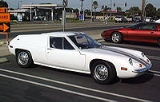
The Lotus Europa was a two door mid-engined GT
Grand tourer
A grand tourer is a high-performance luxury automobile designed for long-distance driving. The most common format is a two-door coupé with either a two-seat or a 2+2 arrangement....

 coupé
Coupé
A coupé or coupe is a closed car body style , the precise definition of which varies from manufacturer to manufacturer, and over time...

 built by Lotus Cars
Lotus Cars
Lotus Cars is a British manufacturer of sports and racing cars based at the former site of RAF Hethel, a World War II airfield in Norfolk. The company designs and builds race and production automobiles of light weight and fine handling characteristics...

 from 1966 to 1975. In 2006 Lotus began production of a totally new, Lotus Elise
Lotus Elise
The 1996 Lotus Elise weighed . Because of its relatively low weight, it was able to accelerate 0- in 5.8 seconds despite its relatively low power output of...

-derived design, a mid-engined GT coupé named Europa S
Lotus Europa S
Lotus Europa S is a GT-type two-seat sports car, designed to complement the successful Lotus Elise and its derivative, the Exige. The Europa S is the continuation of the Europa line of the 1960s and 1970s....

.
Discussion
Ask a question about 'Lotus Europa'
Start a new discussion about 'Lotus Europa'
Answer questions from other users
Full Discussion Forum
 
Recent Discussions
Encyclopedia
The Lotus Europa was a two door mid-engined GT
Grand tourer
A grand tourer is a high-performance luxury automobile designed for long-distance driving. The most common format is a two-door coupé with either a two-seat or a 2+2 arrangement....

 coupé
Coupé
A coupé or coupe is a closed car body style , the precise definition of which varies from manufacturer to manufacturer, and over time...

 built by Lotus Cars
Lotus Cars
Lotus Cars is a British manufacturer of sports and racing cars based at the former site of RAF Hethel, a World War II airfield in Norfolk. The company designs and builds race and production automobiles of light weight and fine handling characteristics...

 from 1966 to 1975. In 2006 Lotus began production of a totally new, Lotus Elise
Lotus Elise
The 1996 Lotus Elise weighed . Because of its relatively low weight, it was able to accelerate 0- in 5.8 seconds despite its relatively low power output of...

-derived design, a mid-engined GT coupé named Europa S
Lotus Europa S
Lotus Europa S is a GT-type two-seat sports car, designed to complement the successful Lotus Elise and its derivative, the Exige. The Europa S is the continuation of the Europa line of the 1960s and 1970s....

.

The original Europa used Lotus founder Colin Chapman
Colin Chapman
Anthony Colin Bruce Chapman CBE was an influential British designer, inventor, and builder in the automotive industry, and founder of Lotus Cars....

's minimalist steel backbone chassis
Backbone chassis
Backbone tube chassis is a type of an automobile construction chassis that is similar to the body-on-frame design. Instead of a two-dimensional ladder type structure, it consists of a strong tubular backbone that connects the front and rear suspension attachment areas...

 that was first used in the Lotus Elan
Lotus Elan
Lotus Elan is the name of two convertible cars and one fixed head coupé produced by Lotus Cars. The original Type 26, 26R Racing version , 36R Racing version , 36 Fixed Head Coupe, 45 Drop Head Coupe, and the "Type 50" +2 Coupe, circa 1962 to 1975, are commonly known as the '60s Elans...

, while also relying on its fibreglass moulded body for structural strength. The Europa was based on a prototype built to compete for Henry Ford II
Henry Ford II
Henry Ford II , commonly known as "HF2" and "Hank the Deuce", was the son of Edsel Ford and grandson of Henry Ford...

's contract to build a Le Mans
24 Hours of Le Mans
The 24 Hours of Le Mans is the world's oldest sports car race in endurance racing, held annually since near the town of Le Mans, France. Commonly known as the Grand Prix of Endurance and Efficiency, race teams have to balance speed against the cars' ability to run for 24 hours without sustaining...

 race car in the early 1960s.

The Europa was designed and built to be an embodiment of Chapman's oft-stated philosophy of automotive design: "Simplify, then add lightness."

The four-wheel independent suspension
Independent suspension
Independent suspension is a broad term for any automobile suspension system that allows each wheel on the same axle to move vertically independently of each other. This is contrasted with a beam axle, live axle or deDion axle system in which the wheels are linked – movement on one side affects...

 was typical of Chapman's thinking. The rear suspension was a modified Chapman strut
Chapman strut
The Chapman strut is a design of independent rear suspension used for light cars, particularly sports and racing cars. It takes its name from, and is best known for its use by, Colin Chapman of Lotus....

, as used for Chapman's earlier Formula racing
Formula racing
Formula racing is a term that refers to various forms of open wheeled single seater motorsport. Its origin lies in the nomenclature that was adopted by the FIA for all of its post-World War II single seater regulations, or formulae. The best known of these formulæ are Formula One, Formula Two, and...

 car designs. Owing to the rubber suspension bushes used to isolate engine vibration from the car body, the true Chapman strut's use of the drive shaft as the lower locating link could not be followed whilst still giving the precise track and handling desired. The forward radius arms were increased in size and rigidity, to act as a semi-wishbone. A careful compromise between engine mounting bush isolation and handling was required, culminating eventually in a sandwich bush that was flexible against shear but stiff in compression and tension. The car's handling prompted automotive writers to describe the Europa as the nearest thing to a Formula car for the road. Aside from the doors, bonnet (hood), and boot (trunk), the body was moulded as a single unit of fibreglass.

In all, Lotus built about 9,300 Europas.

History


The concept originated during 1963 with drawings by Ron Hickman
Ron Hickman
Ronald Price Hickman OBE was a South African born, Jersey based car designer and inventor who designed the original Lotus Elan, the Lotus Elan +2 and the Lotus Europa, as well as the Black & Decker Workmate....

, director of Lotus Engineering (Designer of the original Lotus Elan
Lotus Elan
Lotus Elan is the name of two convertible cars and one fixed head coupé produced by Lotus Cars. The original Type 26, 26R Racing version , 36R Racing version , 36 Fixed Head Coupe, 45 Drop Head Coupe, and the "Type 50" +2 Coupe, circa 1962 to 1975, are commonly known as the '60s Elans...

, as well as inventor of the Black and Decker Workmate), for a bid on the Ford GT40
Ford GT40
The Ford GT40 was a high performance sports car and winner of the 24 hours of Le Mans four times in a row, from 1966 to 1969...

 project. That contract went to Lola Cars as Colin Chapman wanted to call the car a Lotus and Henry Ford II insisted it would be called Ford. Chapman chose to use Hickman's aerodynamic design (with a still respectable today drag coefficient
Drag coefficient
In fluid dynamics, the drag coefficient is a dimensionless quantity that is used to quantify the drag or resistance of an object in a fluid environment such as air or water. It is used in the drag equation, where a lower drag coefficient indicates the object will have less aerodynamic or...

 of Cd 0.29) as the basis for the Europa production model; originally intended to succeed the ageless Lotus 7
Lotus Seven
The Lotus Seven is a small, simple, lightweight two-seater open-top sports car produced by Lotus Cars between 1957 and 1972....

. Because VW owned the rights to the Europa name in Germany, cars for sale in Germany were badged Europe rather than Europa.

Series 1


The Series 1 or S1 Europa (also known as Lotus Type 46) was announced for sale to Europe
Europe
Europe is, by convention, one of the world's seven continents. Comprising the westernmost peninsula of Eurasia, Europe is generally 'divided' from Asia to its east by the watershed divides of the Ural and Caucasus Mountains, the Ural River, the Caspian and Black Seas, and the waterways connecting...

an markets on December 20, 1966. The first cars were delivered in France
France
The French Republic , The French Republic , The French Republic , (commonly known as France , is a unitary semi-presidential republic in Western Europe with several overseas territories and islands located on other continents and in the Indian, Pacific, and Atlantic oceans. Metropolitan France...

 in February 1967. The S1 was fitted with a modified Renault 16
Renault 16
The Renault 16 is a hatchback produced by French automaker Renault between 1965 and 1980 in Le Havre, France. The reviewer in the May 1965 edition of the English "Motoring Illustrated" said: "The Renault Sixteen can thus be described as a large family car but one that is neither a four door saloon...

 1470 cc inline-four engine and a 4-speed gearbox. The engine was a special 82 hp (61 kW) version (as opposed to the 52 hp (39 kW) generated in standard form). Lotus associated the affordable but lightweight Renault engine and gearbox to the revolutionnary Europa longitudinal mid-engined layout, inverting the gearbox's crown wheel on its pinion gear to avoid having four reverse gears. The S1 weighed 610 kg (1512 lb), Autocar magazine achieved a top speed of 121 mi/h, and did 0–60 mph in 9.3 seconds. Of particular note, in excess of 0.9 g (8 m/s²) lateral acceleration was consistently achieved by Car magazine on road tires of that era.

Only 296 examples of the S1 were manufactured (chassis numbers from 460001 to 460296). These are the rarest on the market. These cars had extremely light and minimalist construction, with fixed side windows, fixed seats (adjustable pedals needing the use of tools), no door handles, no internal door covers, and an aluminum dashboard. The steel chassis central beam was sandwiched (incorporated) within the fibreglass bodywork, thus reinforcing stiffness, but making repair rather complicated.

Series 1A and B (around 350 built) had removable side windows, wooden dashboard, and internal door panel covers which could accommodate the windows once taken off.
Series 1B had a redesigned rear panel, with new, rectangular light clusters.

Including the S1A and S1B (which incorporated some of the later S2 changes) variations, 644 Europa S1s were manufactured. From Series 2 (Chassis Number 0645 onwards), the glassfibre bodywork was not glued to the chassis any longer but bolted and therefore could be separated for repairs.

Type 47


Although the original Europa was intended as a clubmans sports racer to replace the Lotus 7, it was realised that would be uncompetitive with the Renault engines available. A decision was therefore made for Lotus Components to manufacture a specialist race car based on the Europa to be raced by Team Lotus and sold to private entrants. Although the very first Type 47 was based on a modified Europa, all subsequent cars were produced entirely by Lotus Components rather than the main factory. Launched at the same time as the S1 Europa, the body of the 47 was thinner than the standard Europa and with larger wheel arches. Side vents into the engine bay were added after the 1st few cars after problems with engine bay temperatures. The Engine, Gearbox and rear suspension were completely different to the standard Europa and were taken in their entirety from the Lotus 23/Lotus 22 Formula Junior with a 165 hp (123 kW) 1594 cc Lotus/Ford
Ford Motor Company
Ford Motor Company is an American multinational automaker based in Dearborn, Michigan, a suburb of Detroit. The automaker was founded by Henry Ford and incorporated on June 16, 1903. In addition to the Ford and Lincoln brands, Ford also owns a small stake in Mazda in Japan and Aston Martin in the UK...

/Cosworth
Cosworth
Cosworth is a high performance engineering company founded in London in 1958, specialising in engines and electronics for automobile racing , mainstream automotive and defence industries...

 twin cam engine, which used a Cosworth-modified Kent block, and a Hewland
Hewland
Founded by Mike Hewland in 1957, Hewland is a British engineering company specialising in racing-car gearboxes. Hewland was the first company to manufacture a bespoke racing-car gearbox....

 FT 200 5-speed gearbox and suspension with reversed bottom widhbone, top link and dual radius arms. The Type 47 is fondly remembered for taking both first and second places (driven by John Miles
John Miles (auto racer)
John Miles is a British former racing driver from England. He participated in 15 Formula One World Championship Grands Prix, making his debut on July 6, 1969. He scored a total of 2 championship points...

 and Jackie Oliver
Jackie Oliver
Keith Jack Oliver, better known as Jackie Oliver, is a British former Formula One driver and team-owner from England...

, respectively) in its very first race held at the storied Brands Hatch
Brands Hatch
Brands Hatch is a motor racing circuit near West Kingsdown in Kent, England. First used as a dirt track motorcycle circuit on farmland, it hosted 12 runnings of the British Grand Prix between 1964 and 1986 and currently holds many British and international racing events...

 race course on Boxing Day
Boxing Day
Boxing Day is a bank or public holiday that occurs on 26 December, or the first or second weekday after Christmas Day, depending on national or regional laws. It is observed in Australia, Canada, New Zealand, the United Kingdom and some other Commonwealth nations. In Ireland, it is recognized as...

. Exact production numbers are unknown, the last car was 47GT-85 but it is unlikely 85 47GT's were produced, estimates vary from 55 to 68 during the years 1966-70. Although the 47GT is the best known, a few 47F's were produced, these had the detachable body similar to the S2 Europa, but retaining the large wheel arches and side vents of the 47GT. Fitted with a tuned Ford cross flow engine but with the Renault gearbox and rear suspension of the Europa. The number produced is unknown but probably no more than 6.
As a mobile test bed for the new Lotus 2 litre engine being developed for the forthcoming Elite and Eclat, the Type 62 was produced. Only 2 cars were ever made. These were space frame cars with F1 suspension to handle the 240 hp from the engine. Although deliberately made to resemble the Europa in practice the only connection to the Europa was a few of the Europa's body panels. It did win it's 1st event the 1969 BOAC 500 at Brands Hatch with John Miles and Brian Muir at the wheel. Replica 47's and 62's are bespoke-manufactured by Banks Europa Engineering, in several variations. A one-off 47, fitted with a Rover
Rover V8 engine
The Rover V8 engine is a compact V8 internal combustion engine with aluminium cylinder heads and cylinder block, originally designed by General Motors and later re-designed and produced by Rover in the United Kingdom...

 V8 engine
V8 engine
A V8 engine is a V engine with eight cylinders mounted on the crankcase in two banks of four cylinders, in most cases set at a right angle to each other but sometimes at a narrower angle, with all eight pistons driving a common crankshaft....

, was built for GKN
GKN
GKN plc is a multinational automotive and aerospace components company headquartered in Redditch, United Kingdom. The company was formerly known as Guest, Keen and Nettlefolds and can trace its origins back to 1759 and the birth of the Industrial Revolution.GKN is listed on the London Stock...

 in 1968 and registered, GKN 47 D, with 300 hp it was capable of 180 mi/h.

Series 2


The Europa S2, or Type 54, was introduced in April 1968. It used the same Renault engine as the Type 46, but offered a number of refinements, including electric windows, fully adjustable seats, a new interior, and a polished wooden fascia for the dashboard. Per request of the automotive insurance industry, Lotus switched to bolt fasteners (instead of resin bonding) to attach body to frame. A small number of Type 54s were modified to be "federalized", that is, made suitable for export to the United States
United States
The United States of America is a federal constitutional republic comprising fifty states and a federal district...

. The Federal Type 54 was slightly modified. They were actually recalled because of the headlamps being too low (a "bug eye" headlamp raiser was to be installed). The Federal 54 had the low fenders of the European 54, but larger engine of the type 65. Perhaps 200 of these were made.

In 1969-70, the Type 65 (also known as S2 Federal) was born specifically for export to the US, with additional changes to the body, chassis, suspension and the powerplant to better comply with U.S. D.O.T.
United States Department of Transportation
The United States Department of Transportation is a federal Cabinet department of the United States government concerned with transportation. It was established by an act of Congress on October 15, 1966, and began operation on April 1, 1967...

 standards. Production of the 54 continued for cars supplied to the rest of the world. Among the changes, the engine was a slightly modified emmission controlled Renault 16TL 1565 cc engine producing 80hp rather than the 1470 cc engine of the Type 54. The front suspension was changed to make the front end of the car taller along with taller front fenders to raise the headlamps. Road&Track Magazine tested the Federal S2 and recorded 0-60 mph in 9.6 seconds with a top speed of 116 mi/h.
3,615 S2s were produced.

Twin Cam and Special


In 1971, the Type 74 Europa Twin Cam was made available to the public, with a 105 bhp 1558cc [Lotus-Ford Twin Cam] engine (105 bhp US "Federal" emission standard emissions control version with Stromberg carbs, until the end of production) and a re-designed bodyshell to improve rearward visibility. Initially with the same gearbox as the earlier cars, once the supply had been exhausted in 1972 a new stronger Renault 4-speed gearbox (Type 352) was introduced. Mike Kimberley, who rose to become chief executive of Group Lotus, then a new engineer at Lotus, was appointed Chief Engineer of the Europa TC project. 1,580 cars were shipped as Europa "Twin Cam" before Lotus switched to a 126bhp "Big Valve" version of the engine The "Europa Special" version aspirated by Dell'Orto carburettors version of the same engine; in addition to offering a new Renault 5-speed (Type 365) gearbox option. It weighed 740 kg (1631 lb), Motor magaxine famously tested a UK Special to a top speed of 123 mi/h, did 0–60 mph in 6.6 seconds, and ran the 1/4 mile in 14.9 sec. This at a time when all road tests were carried out with both a driver and passenger, with only the driver on board the 0–60 mph time would have been well under 6 seconds, a phenomenal performance for the period. Introduced in September 1972 the first 200 big valve cars were badged and painted to honour the just won Team Lotus
Team Lotus
Team Lotus was the motorsport sister company of English sports car manufacturer Lotus Cars. The team ran cars in many motorsport series including Formula One, Formula Two, Formula Ford, Formula Junior, IndyCar and sports car racing...

's F1 World Championship title with John Player Special as sponsors, all with 5 speed gearbox, these were all black with gold pin stripe matching the livery of the GP cars – plus a numbered JPS dash board badge, becoming the first ever John Player Special commemorative motor vehicles. The "Special" name and colour scheme was planned to be dropped after the first 200 cars, reverting to the Twin Cam name, but such was the reaction to the new car that the name and pin stripe scheme remained until the end of Europa Production although colours other than black were made available. In the end only the numbered plaque distinguishing the first 200 JPS cars from other black Europa Specials. In total 4710 Type 74's were produced of which 3130 were "Specials".

Europa (2006–present)


In 2005, Lotus released images of a new GT type car called the Lotus Europa S
Lotus Europa S
Lotus Europa S is a GT-type two-seat sports car, designed to complement the successful Lotus Elise and its derivative, the Exige. The Europa S is the continuation of the Europa line of the 1960s and 1970s....

. It was officially introduced at the 2006 Geneva Motor Show
Salon International de l'Auto
The International Geneva Motor Show is an annual auto show held in March in the Swiss city of Geneva. The show is hosted at the Geneva Palexpo, a convention centre located next to the Geneva Cointrin International Airport...

.
Lotus Europa S production commenced in July 2006. The engine is a 2.0 L turbo delivering 200 PS at 5,400 rpm, with a maximum torque of 272 newton metre at 5,400 rpm. Delivering 0-60 mph in 5.6 seconds (0–100 km/h in 5.8 sec.) With a maximum speed of 143 mi/h. Lotus has no plans to export the Europa S to the USA before 2008. Despite this, the American manufacturer Dodge
Dodge
Dodge is a United States-based brand of automobiles, minivans, and sport utility vehicles, manufactured and marketed by Chrysler Group LLC in more than 60 different countries and territories worldwide....

 was developing an electric vehicle
Electric vehicle
An electric vehicle , also referred to as an electric drive vehicle, uses one or more electric motors or traction motors for propulsion...

 based on the Europa, known as the Dodge Circuit, which it planned to bring to the US market by 2010, however, the project was canceled according to Autocar in May 2009.

The Europa SE was unveiled at the Geneva
Geneva
Geneva In the national languages of Switzerland the city is known as Genf , Ginevra and Genevra is the second-most-populous city in Switzerland and is the most populous city of Romandie, the French-speaking part of Switzerland...

 International Motor Show
Salon International de l'Auto
The International Geneva Motor Show is an annual auto show held in March in the Swiss city of Geneva. The show is hosted at the Geneva Palexpo, a convention centre located next to the Geneva Cointrin International Airport...

on 5 March 2008. The Europa SE is an upgraded model with more comfort in mind, intended to bring in more customers. The Europa S motor was modified to bring power to 225 PS and torque to 300 newton metre.

External links