
All Topics  
Lotus Elite

 
Lotus Elite

   Email Print
   Bookmark   Link


Lotus Elite


The Lotus Elite name was used for two vehicles from Lotus Cars
Lotus Cars

File:Final assembly.jpgLotus Cars is a United Kingdom manufacturer of sports car and race car automobiles based at Hethel, Norfolk, England. The company designs and builds race and production automobiles of light weight and high Car handling characteristics....
.

1957
The first Elite
Elite

Elite is taken originally from the Latin, eligere, "to elect". In sociology as in general usage, the elite is a relatively small dominant Group within a large society, which enjoys a privileged status envied by individuals of lower social status....
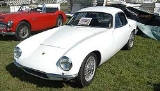
 or Lotus Type 14 was an ultra-light two-seater coupé
Coupé

A coup? or coupe is a closed car body style, the precise definition of which varies from manufacturer to manufacturer, and over time. Coup?s are often hardtopped sports cars or sporty variants of sedan body styles, with doors commonly reduced from 4 to 2, and a Close-coupled sedan interior offering either two seats or 2+2 seating ....
, produced from 1957 to 1963.

Making its debut at the 1957 London Motor Car Show, Earls Court
British International Motor Show

The British International Motor Show is an automobile show held biennially in the United Kingdom. It is recognised as an international show by the Organisation Internationale des Constructeurs d'Automobiles....
, the 14 spent a year in development, aided by "carefully selected racing customers", before going on sale.

The Elite's most distinctive feature was its highly innovative fiberglass
Fiberglass

Fiberglass, , is material made from extremely fine fibers of glass. It is used as a reinforcing agent for many polymer products; the resulting composite material, properly known as fiber-reinforced polymer or glass-reinforced plastic , is called "fiberglass" in popular usage....
 monocoque
Monocoque

Monocoque, from Greek language for single and French for shell , is a construction technique that supports structural load by using an object's external skin as opposed to using an internal frame or truss that is then covered with a non-load-bearing skin....
 construction, in which a stressed-skin unibody replaced the previously separate chassis and body components.


Discussion
Ask a question about 'Lotus Elite'
Start a new discussion about 'Lotus Elite'
Answer questions from other users
Full Discussion Forum


Encyclopedia


The Lotus Elite name was used for two vehicles from Lotus Cars
Lotus Cars

File:Final assembly.jpgLotus Cars is a United Kingdom manufacturer of sports car and race car automobiles based at Hethel, Norfolk, England. The company designs and builds race and production automobiles of light weight and high Car handling characteristics....
.

1957


The first Elite
Elite

Elite is taken originally from the Latin, eligere, "to elect". In sociology as in general usage, the elite is a relatively small dominant Group within a large society, which enjoys a privileged status envied by individuals of lower social status....
 or Lotus Type 14 was an ultra-light two-seater coupé
Coupé

A coup? or coupe is a closed car body style, the precise definition of which varies from manufacturer to manufacturer, and over time. Coup?s are often hardtopped sports cars or sporty variants of sedan body styles, with doors commonly reduced from 4 to 2, and a Close-coupled sedan interior offering either two seats or 2+2 seating ....
, produced from 1957 to 1963.

Making its debut at the 1957 London Motor Car Show, Earls Court
British International Motor Show

The British International Motor Show is an automobile show held biennially in the United Kingdom. It is recognised as an international show by the Organisation Internationale des Constructeurs d'Automobiles....
, the 14 spent a year in development, aided by "carefully selected racing customers", before going on sale.

The Elite's most distinctive feature was its highly innovative fiberglass
Fiberglass

Fiberglass, , is material made from extremely fine fibers of glass. It is used as a reinforcing agent for many polymer products; the resulting composite material, properly known as fiber-reinforced polymer or glass-reinforced plastic , is called "fiberglass" in popular usage....
 monocoque
Monocoque

Monocoque, from Greek language for single and French for shell , is a construction technique that supports structural load by using an object's external skin as opposed to using an internal frame or truss that is then covered with a non-load-bearing skin....
 construction, in which a stressed-skin unibody replaced the previously separate chassis and body components. Unlike the contemporaneous Chevrolet Corvette
Chevrolet Corvette

The Chevrolet Corvette is a sports car that has been manufactured by General Motors since 1953. The car was originally designed by Harley Earl, and named by Myron Scott after the fast corvette....
, which used fiberglass for only exterior bodywork, the Elite also used this glass-reinforced plastic material for the entire load-bearing structure of the car, though the front of the monocoque incorporated a steel subframe supporting the engine and front suspension, and there was a hoop at the windscreen
Windshield

The windshield or windscreen of an aircraft, automobile, bus, motorcycle, or tram is the front window. Modern windshields are generally made of Laminated glass, a type of treated glass, which consists of two curved sheets of glass with a plastic layer laminated between them for safety, and are Polyurethaned into the window frame....
 for mounting door hinges and jacking the car up. This body construction caused numerous early problems, until manufacture was handed over to Bristol Aeroplane Company
Bristol Aeroplane Company

The Bristol Aeroplane Company, originally British and Colonial Aeroplane Company, was a major United Kingdom aviation company. In 1956 in aviation its major operations were split into Bristol Aircraft and Bristol Aero Engines....
.

The resultant body was both lighter, stiffer, and provided better driver protection in the event of a crash. The weight savings allowed the Elite to achieve sports car
Sports car

A sports car is a term used to describe a class of automobile. The exact definition varies, but generally it is used to refer to a low to ground, light weight vehicle with a powerful engine....
 performance from a 75 hp
Horsepower

Horsepower is the name of several non-International System of Units units of power . It was originally defined to allow the output of steam engines to be measured and compared with the power output of draft horses....
 (55 kW) 1216 cc Coventry Climax
Coventry Climax

Coventry Climax was a United Kingdom Forklift, fire pump, and speciality engine manufacturer....
 all-aluminium Straight-4
Straight-4

The straight-4 or inline-4 engine is a four cylinder internal combustion engine with all four cylinder mounted in a straight line along the crankcase....
 engine. Climax-powered Elites won their class six times at the 24 hour Le Mans
Le Mans

Le Mans is a commune in France in France, located on the Sarthe River. Traditionally the capital of the province of Maine , it is now the pr?fecture of the Sarthe D?partement in France, and is furthermore the seat of the Roman Catholic diocese of Le Mans....
 race as well as two Index of Thermal Efficiency wins. The Elite was the first Lotus produced car to race in Australia and the original car to be raced in Australia is currently in boxes under re-furbishment.

The car had independent suspension all round with transverse wishbones at the front and Chapman struts at the rear. (The latter consisted of coil springs and trailing radius arms.) Girling disc brakes, without servo assistance, of diameter were used, inboard at the rear.

Advanced aerodynamics
Aerodynamics

Aerodynamics is a branch of Dynamics concerned with studying the motion of air, particularly when it interacts with a moving object. Aerodynamics is a subfield of fluid dynamics and gas dynamics, with much theory shared between them....
 also made a contribution, giving the car a very low drag coefficient
Drag coefficient

The drag coefficient is a dimensionless quantity which is used to quantify the drag or resistance of an object in a fluid environment such as air or water....
 of 0.29 — quite low even for modern cars. This accomplishment is all the more remarkable considering the engineers did not enjoy the benefits of computer-aided design
Computer-aided design

Computer-Aided Design is the use of computer technology to aid in the design and particularly the drafting of a part or product, including entire buildings....
 and wind tunnel
Wind tunnel

A wind tunnel is a research tool developed to assist with studying the effects of air moving over or around solid objects.Ways that wind-speed and flow are measured in wind tunnels:...
 testing. The original Elite drawings were by Peter Kirwan-Taylor. Frank Costin
Frank Costin

Frank Costin was an automotive engineer who pioneered monocoque chassis design and was instrumental in adapting aircraft aerodynamic knowledge for automobile use....
 (brother of Mike, one of the co-founders of Cosworth
Cosworth

Cosworth is an automotive engineering company founded in London in 1958, specialising in internal combustion engine for auto racing . It supplies a wide range of motorsport series, including the World Rally Championship, Superbike World Championship and, until the end of 2006, Formula One....
), at that time Chief Aerodynamic Engineer for the de Havilland
De Havilland

The de Havilland Aircraft Company was a United Kingdom aviation manufacturer founded in 1920 when Airco, of which Geoffrey de Havilland had been chief designer and owner, was sold to Birmingham Small Arms Company....
 Aircraft Company, contributed to the final design.

Like her siblings, the 14 was run in numerous formulae, with particular success at Le Mans and the Nürburgring
Nürburgring

The N?rburgring, simply known as "The Ring" by enthusiasts, is a motorsport race track in N?rburg, Germany. It was built in the 1920s around the village and medieval castle of N?rburg in the Eifel, which is about south of Cologne, and northwest of Frankfurt....
, and high (or higher) performance variants were produced, featuring ZF
ZF

ZF may refer to:* The Zermelo?Fraenkel set theory, a system of axioms in mathematical set theory* zettafarad, an SI unit of electric capacitance...
 gearboxes in place of the "cheap and nasty MG" standard ones, as well as a Super 95 spec, with more power.

Among its few faults was a resonant vibration at 4000 rpm (where few drivers remained, on either street or track) and poor quality control, handicapped by overly low price (thus losing money on every copy) and, "[p]erhaps the greatest mistake of all", offering it as a kit, exactly the opposite of the ideal for a quality manufacturer.

When production ended in 1963, 1030 had been built.

A road car tested by The Motor
The Motor (magazine)

The Motor - not to be confused with an Australian magazine with the same name - was a United Kingdom weekly automobile magazine founded on 28 January 1903....
 magazine in 1960 had a top speed of and could accelerate from 0- in 11.4 seconds. A fuel consumption of was recorded. The test car cost £1966 including taxes.

1974


From 1974 to 1982, Lotus produced the considerably larger Type 75 and later the Type 83 4-seat Elite II.

Lotus' first saloon car was front engined with rear wheel drive. Like all production Lotuses since the Elan, the Elite II used fiberglass for the hatchback bodyshell, mounted on a steel backbone chassis
Backbone chassis

Backbone chassis is a type of an automobile construction chassis that is similar to the body-on-frame design. Instead of a two-dimensional ladder type structure, it consists of a strong tubular backbone that connects the front and rear Suspension attachment areas....
 evolved from the Elan
Lotus Elan

Lotus Elan is the name of two convertible cars and one fixed head coup? produced by Lotus . The original Type 26, 26R Racing version, 36 Fixed Head Coupe, 45 Drop Head Coupe, and the "Type 50" +2 Coupe, circa 1962 to 1975, are commonly known as the '60s Elans....
 and Europa
Lotus Europa

The Lotus Europa or Lotus Europe was a two door mid-engined GT coup? built by Lotus from 1966 to 1975. In 2006 Lotus began production of a totally new, Lotus Elise-derived design, a mid-engined GT coup? named Lotus Europa S....
. It had 4-wheel independent suspension
Independent suspension

Independent suspension is a broad term for any automobile suspension system that allows each wheel on the same axle to move vertically independently of each other....
 using coil springs. Power steering and air conditioning were optional from 1974. The Elite II was the basis for the Eclat
Lotus Eclat

The Type 76 and Type 84 Lotus Eclat, built from 1974 to 1982, was a front engine rear drive coupe. It was based on the Lotus Elite but had a fastback body style which offered more practicality with storage in the boot ....
, and the later Excel
Lotus Excel

The Type 89 Lotus Excel, built from 1982 to 1992, is a FR layout car based on the design of the earlier Lotus Eclat, which itself was based on the earlier Lotus Elite II....
 four-seaters.

The Elite II was Lotus' first car to use the "907" aluminium-block 4-valve
Multi-valve

In automotive engineering, an engine is referred to as multi-valve when each cylinder has more than two poppet valve. Such designs have been around since at least 1912 and perhaps earlier....
, DOHC, four cylinder, 2.0 L engine. (The 907 engine had previously been used in Jensen-Healey
Jensen-Healey

The Jensen-Healey is a two-seater convertible sports car that was originally produced between 1972 and 1976 by Jensen Motors, Ltd. Roughly 10,000 were produced at West Bromwich, England....
s.) The 907 engine ultimately became the foundation for the Lotus Esprit
Lotus Esprit

The Lotus Esprit was a sports car built by Lotus in the United Kingdom from 1976 to 2004. The silver Italdesign concept that eventually became the Esprit was unveiled at the Turin Motor Show in 1972, and was a development of a stretched Lotus Europa chassis....
 powerplants, both naturally-aspirated and turbocharged. Elite IIs were available with a 5-speed gearbox standard; from January 1976 an automatic transmission was optional.

Regarding performance, the Elite and Elite II (and the related Éclat) are notable in that the stock curb weight is not much over . Once the motors reach their power band, both acceleration and handling are impressive for cars of the era.

External links