


Lorestan Province

Encyclopedia
Lorestan Province is a historic territory and province of western Iran
, amidst the Zagros Mountains
. The population of Lorestan was estimated at 1,716,527 people in 2006.
Lorestan covers an area of 28,392 km². The major cities in this province are: Khorramabad
, Borujerd
, Aligoodarz
, Dorood
, Koohdasht
, Azna
, Alashtar
, Noor Abad
, and Pol-e-Dokhtar
.
", and in the wider sense consists of that part of western Iran coinciding with the province of Ilam
and extending for about 650 km on a northwest to southeast axis from Kermanshah
to Fars, with a breadth of 150-180 km. The terrain consists chiefly of mountains, with numerous ranges, part of the Zagros chain, running northwest to southeast. The central range has many summits which almost reach the line of perpetual snow, rising to 4000 m and more, and it feeds the headwaters of Iran's most important rivers, such as the Zayandeh rud
, Jarahi, Karun
, Dix, Abi, Karkheh. Between the higher ranges lie many fertile plains and low hilly, well-watered districts.
The highest point of the province is Oshtoran Kooh peak at 4,050 m. The low-lying areas being in the southern most sector of the province, are approximately 500 m above sea level.
The climate is generally sub-humid continental with winter precipitation, a lot of which falls as snow
(Köppen
Csa). Because it lies on the westernmost slopes of the Zagros Mountains
, annual precipitation in Lorestan is among the highest anywhere in Iran south of the Alborz Mountains. At Khorramabad, the average annual precipitation totals 530 millimetres (21 inches) of rainfall equivalent, whilst up to 1270 millimetres (50 inches) may fall on the highest mountains. The months June to September are usually absolutely dry, but Khorramabad can expect 4 inches of rainfall equivalent in December and January.
Temperatures vary widely with the seasons and between day and night. At Khorramabad, summer temperatures typically range from a minimum of 12 °C (54 °F) to a hot maximum of 32 °C (90 °F). In winter, they range from a minimum of -2 °C (28 °F) to a chilly maximum of 8 °C (46 °F).
(Shahrestans): Aligudarz County
, Azna County
, Borujerd County
, Delfan County
, Dorud County
, Doureh County
, Khorramabad County
, Kuhdasht County
, Selseleh County
, and Poldokhtar County
.
, an ancient people who spoke neither an Indo-European
nor a Semitic language
, originated in Lorestān.
Lorestan was invaded and settled by the Iranian Medes
in the 2nd millennium BC The Medes absorbed the indigenous inhabitants of the region, primarily the Elamites and Kassites
, by the time the area was conquered by the Persians in the 1st millennium BC.
Lorestan was successfully integrated into the Achamenid, Parthian
and Sassanian empires. Parts of the region managed to stay independent during the Arab, Seljuk and Mongol invasions.
According to the Encyclopaedia of Islam
, the Lurs
, previously open adherents of the Ahl-e-Haqq faith, revere bread and fire like the Zoroastrians
. "Being split up into numerous tribes and sections, they migrate to their summer pastures as separate bands without overall command. In 1936, Reza Shah
's army conquered them, with much bloodshed and starvation, forcing many of the survivors to settle in villages under landlords."
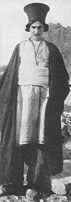
 The Lurs constitute part of the Southwestern branch of the Iranian peoples
and part of the Indo-Iranian
linguistic group, spread across the Iranian plateau
, stretching from the Hindu Kush
to central Anatolia
and from Central Asia
to the Persian Gulf
- a region that is sometimes termed Greater Iran
. Their language (called Luri or Lurish language ) is closely related to Persian
, and there are two distinct dialects of this language. "Lur-e-Bozourg" (Greater Lur), which is spoken by the Bakhtiaris, and "Lur-e-Kuchik" (Lesser Lur), spoken by the Lurs themselves. People in Borujerd speak in Borujerdi Dialect
, a local Lori Persian
dialect which is extracted from Luri. Northwest of Lorestan Province is dominated by Laki
speakers. "Luri and Bakhtiari are much more closely related to Persian, than Kurdish." The overwhelming majority of Lurs are Shia Muslims. In Khuzestan, Lur tribes are primarily concentrated in the northern part of the province, while in Ilam
they are mainly in the southern region.
Prior to the 20th century the majority of Lurs were nomadic herders, with an urban minority residing in the city of Khorramabad
. There were several attempts by the Pahlavi
governments to forcibly settle the nomadic segment of the Lur population. Under Reza Shah
, these campaigns tended to be unsuccessful. The last Shah of Iran
, Mohammad Reza Pahlavi
, used less forceful methods along with economic incentives, which met with greater, though not complete, success. By the mid-1980s the vast majority of Lurs had been settled in towns and villages throughout the province, or had migrated to the major urban centres.
A number of nomadic Lur tribes continue to exist in the province. Amongst the settled urban populace the authority of tribal elders still remains a strong influence, though not as dominant as it is amongst the nomads. As in Bakhtiari Lurs and Kurdish societies, Northern Lur women have had much greater freedoms than women
in other Iranian groups.
i territory in the west.
Lesser Lorestan maintained its independence under a succession of princes of the Khorshidi dynasty
, known as Atabeg
s, from A.D. 1155 to the beginning of the 17th century. Shah Abbas I then removed the last Atabeg, Shah Verdi Khan
, and entrusted the government of the province to Hossein Khan Shamlu
, the chief of the rival tribe of Shamlu
, with the title of Vali
in exchange for that of Atabeg. The descendants of Hossein Khan retained the title as governors of the Pushtkuh Lurs, to whom only the denomination of Feili now applies.
Atabegs from A.D. 1160 until 1424. Its capital, Idaj, survives as mounds and ruins at Malamir, sixty miles southeast of the city of Shushtar
in Khuzestan.
Iran
Iran , officially the Islamic Republic of Iran , is a country in Southern and Western Asia. The name "Iran" has been in use natively since the Sassanian era and came into use internationally in 1935, before which the country was known to the Western world as Persia...
, amidst the Zagros Mountains
Zagros Mountains
The Zagros Mountains are the largest mountain range in Iran and Iraq. With a total length of 1,500 km , from northwestern Iran, and roughly correlating with Iran's western border, the Zagros range spans the whole length of the western and southwestern Iranian plateau and ends at the Strait of...
. The population of Lorestan was estimated at 1,716,527 people in 2006.
Lorestan covers an area of 28,392 km². The major cities in this province are: Khorramabad
Khorramabad
Khorramabad is a city in and capital of Lorestan Province, Iran. At the 2006 census, its population was 328,544, in 75,945 families. Khorramabad is situated in the Zagros Mountains...
, Borujerd
Borujerd
Borujerd is a city in and capital of Borujerd County, Lorestan Province in western Iran. At the 2006 census, its population was 227,547, in 59,388 families....
, Aligoodarz
Aligoodarz
Aligudarz is a city in and capital of Aligudarz County, Lorestan Province, Iran. At the 2006 census, its population was 78,690, in 18,115 families....
, Dorood
Dorood (city)
Dorud is a city in and capital of Dorud County, Lorestan Province, Iran. At the 2006 census, its population was 100,528, in 23,596 families. The name Dorud means "where two rivers meet", where "Do" means two, and "rud" means river....
, Koohdasht
Koohdasht
Kuhdasht is a city in and capital of Kuhdasht County, Lorestan Province, Iran. At the 2006 census, its population was 85,519, in 18,087 families....
, Azna
Azna
Azna is a city in and capital of Azna County, Lorestan Province, Iran. At the 2006 census, its population was 37,645, in 9,178 families.Azna is located in the Zagros Mountains.It currently serves as a refuge camp for the Faili Kurds....
, Alashtar
Alashtar
Aleshtar is a city in and capital of Selseleh County, Lorestan Province, Iran. At the 2006 census, its population was 28,306, in 6,033 families....
, Noor Abad
Nurabad, Iran
Nurabad is a city in and capital of Delfan County, Lorestan Province, Iran. At the 2006 census, its population was 56,404, in 12,232 families.It is a mountainous city in the northwest of Lorestan province....
, and Pol-e-Dokhtar
Pol-e-Dokhtar
Pol-e Dokhtar is a city in and capital of Pol-e Dokhtar County, Lorestan Province, Iran. At the 2006 census, its population was 22,558, in 5,131 families.Pol-e-Dokhtar is approximately 100 kilometres from Khorramabad, the provincial capital...
.
Geography and climate
The name Lorestan means "land of the LursLurs
Lurs are an Iranic people living mainly in south-western Iran. Their population is estimated at above two million. They occupy Lorestan, Bakhtiari, and Kuh-Gilu-Boir Ahmed. "....
", and in the wider sense consists of that part of western Iran coinciding with the province of Ilam
Ilam Province
Ilam Province is one of the 31 provinces of Iran. It is in the south-west of the country, bordering Iraq. Its provincial center is the city of Ilam. Covering an area of 19,086 square kilometers, the cities of the province are Ilam, Mehran, Dehloran, Dareh Shahr, Sarable, Eyvan, Abdanan and Arkwaz...
and extending for about 650 km on a northwest to southeast axis from Kermanshah
Kermanshah
Kermanshah is a city in and the capital of Kermanshah Province, Iran. At the 2006 census, its population was 784,602, in 198,117 families.The overwhelming majority of Kermanshahi people are Shi'a Muslims...
to Fars, with a breadth of 150-180 km. The terrain consists chiefly of mountains, with numerous ranges, part of the Zagros chain, running northwest to southeast. The central range has many summits which almost reach the line of perpetual snow, rising to 4000 m and more, and it feeds the headwaters of Iran's most important rivers, such as the Zayandeh rud
Zayandeh Rud
Zāyandé-Rūd or Zāyanderūd , also spelled as Zayandeh-Rood or Zayanderood, is the largest river on the central plateau of Iran, Isfahan Province....
, Jarahi, Karun
Karun
The Kārun is Iran's most effluent, and the only navigable, river. It is 450 miles long. It rises in the Zard Kuh mountains of the Bakhtiari district in the Zagros Range, receiving many tributaries, such as the Dez and the Kuhrang, before passing through the capital of the Khuzestan Province of...
, Dix, Abi, Karkheh. Between the higher ranges lie many fertile plains and low hilly, well-watered districts.
The highest point of the province is Oshtoran Kooh peak at 4,050 m. The low-lying areas being in the southern most sector of the province, are approximately 500 m above sea level.
The climate is generally sub-humid continental with winter precipitation, a lot of which falls as snow
Snow
Snow is a form of precipitation within the Earth's atmosphere in the form of crystalline water ice, consisting of a multitude of snowflakes that fall from clouds. Since snow is composed of small ice particles, it is a granular material. It has an open and therefore soft structure, unless packed by...
(Köppen
Köppen climate classification
The Köppen climate classification is one of the most widely used climate classification systems. It was first published by Crimea German climatologist Wladimir Köppen in 1884, with several later modifications by Köppen himself, notably in 1918 and 1936...
Csa). Because it lies on the westernmost slopes of the Zagros Mountains
Zagros Mountains
The Zagros Mountains are the largest mountain range in Iran and Iraq. With a total length of 1,500 km , from northwestern Iran, and roughly correlating with Iran's western border, the Zagros range spans the whole length of the western and southwestern Iranian plateau and ends at the Strait of...
, annual precipitation in Lorestan is among the highest anywhere in Iran south of the Alborz Mountains. At Khorramabad, the average annual precipitation totals 530 millimetres (21 inches) of rainfall equivalent, whilst up to 1270 millimetres (50 inches) may fall on the highest mountains. The months June to September are usually absolutely dry, but Khorramabad can expect 4 inches of rainfall equivalent in December and January.
Temperatures vary widely with the seasons and between day and night. At Khorramabad, summer temperatures typically range from a minimum of 12 °C (54 °F) to a hot maximum of 32 °C (90 °F). In winter, they range from a minimum of -2 °C (28 °F) to a chilly maximum of 8 °C (46 °F).
Administrative divisions
Lorestan includes 10 countiesCounty
A county is a jurisdiction of local government in certain modern nations. Historically in mainland Europe, the original French term, comté, and its equivalents in other languages denoted a jurisdiction under the sovereignty of a count A county is a jurisdiction of local government in certain...
(Shahrestans): Aligudarz County
Aligudarz County
Aligudarz County is a county in Lorestan Province in Iran. The capital of the county is Aligudarz. At the 2006 census, the county's population was 134,802, in 28,668 families. The county is subdivided into three districts: the Central District, Zaz va Mahru District, and Besharat District. The...
, Azna County
Azna County
Azna County is a county in Lorestan Province in Iran. The capital of the county is Azna. At the 2006 census, the county's population was 70,462, in 16,663 families. The county was subdivided into two districts: the Central District and Japelaq District...
, Borujerd County
Borujerd County
Borujerd County is a county in Lorestan Province in Iran. The capital of the county is Borujerd. At the 2006 census, the county's population was 320,547, in 82,676 families. The county is subdivided into two districts: the Central District and Oshtorinan District...
, Delfan County
Delfan County
Delfan County is a county in Lorestan province, Iran. The capital of the county is Nurabad. At the 2006 census, the county's population was 137,385, in 29,257 families. The county is subdivided into two districts: the Central District and Kakavand District. The county has one city: Nurabad.It is...
, Dorud County
Dorud County
Dorud County is a county in Lorestan Province in Iran. The capital of the county is Dorud. At the 2006 census, the county's population was 159,026, in 36,687 families. The county is subdivided into two districts: the Central District and Silakhor District...
, Doureh County
Doureh County
Dowreh County is a county in Lorestan Province in Iran. The capital of the county is Sarab-e Dowreh. It was separated from Khorramabad County in 2007. At the 2006 census, the county's population was 44,146, in 9,722 families. The county is subdivided into three districts: Veysian District,...
, Khorramabad County
Khorramabad County
Khorramabad County is a county in Lorestan Province in Iran. The capital of the county is Khorramabad. At the 2006 census, the county's population was 509,251, in 113,886 families; excluding those portions, the population was 465,105, in 104,164 families...
, Kuhdasht County
Kuhdasht County
Kuhdasht County is a county in Lorestan Province in Iran. The capital of the county is Kuhdasht. At the 2006 census, the county's population was 209,821, in 43,159 families. The county is subdivided into five districts: the Central District, Rumeshkhan District, Darb-e Gonbad District, Tarhan...
, Selseleh County
Selseleh County
Selseleh County is a county in Lorestan Province in Iran. The capital of the county is Aleshtar. At the 2006 census, the county's population was 73,819, in 15,531 families. The county was subdivided into two districts: the Central District and Firuzabad District...
, and Poldokhtar County
Poldokhtar County
Pol-e Dokhtar County is a county in Lorestan Province in Iran. The capital of the county is Pol-e Dokhtar. At the 2006 census, its population was 74,537, in 16,278 families. The county is subdivided into two districts: the Central District and Mamulan District...
.
History
In the 3rd and 4th millennium BC, migrant tribes settled down in the mountainous area of the Zagros Mountains. The KassitesKassites
The Kassites were an ancient Near Eastern people who gained control of Babylonia after the fall of the Old Babylonian Empire after ca. 1531 BC to ca. 1155 BC...
, an ancient people who spoke neither an Indo-European
Indo-European languages
The Indo-European languages are a family of several hundred related languages and dialects, including most major current languages of Europe, the Iranian plateau, and South Asia and also historically predominant in Anatolia...
nor a Semitic language
Semitic languages
The Semitic languages are a group of related languages whose living representatives are spoken by more than 270 million people across much of the Middle East, North Africa and the Horn of Africa...
, originated in Lorestān.
Lorestan was invaded and settled by the Iranian Medes
Medes
The MedesThe Medes...
in the 2nd millennium BC The Medes absorbed the indigenous inhabitants of the region, primarily the Elamites and Kassites
Kassites
The Kassites were an ancient Near Eastern people who gained control of Babylonia after the fall of the Old Babylonian Empire after ca. 1531 BC to ca. 1155 BC...
, by the time the area was conquered by the Persians in the 1st millennium BC.
Lorestan was successfully integrated into the Achamenid, Parthian
Parthian Empire
The Parthian Empire , also known as the Arsacid Empire , was a major Iranian political and cultural power in ancient Persia...
and Sassanian empires. Parts of the region managed to stay independent during the Arab, Seljuk and Mongol invasions.
According to the Encyclopaedia of Islam
Encyclopaedia of Islam
The Encyclopaedia of Islam is an encyclopaedia of the academic discipline of Islamic studies. It embraces articles on distinguished Muslims of every age and land, on tribes and dynasties, on the crafts and sciences, on political and religious institutions, on the geography, ethnography, flora and...
, the Lurs
Lurs
Lurs are an Iranic people living mainly in south-western Iran. Their population is estimated at above two million. They occupy Lorestan, Bakhtiari, and Kuh-Gilu-Boir Ahmed. "....
, previously open adherents of the Ahl-e-Haqq faith, revere bread and fire like the Zoroastrians
Zoroastrianism
Zoroastrianism is a religion and philosophy based on the teachings of prophet Zoroaster and was formerly among the world's largest religions. It was probably founded some time before the 6th century BCE in Greater Iran.In Zoroastrianism, the Creator Ahura Mazda is all good, and no evil...
. "Being split up into numerous tribes and sections, they migrate to their summer pastures as separate bands without overall command. In 1936, Reza Shah
Reza Shah
Rezā Shāh, also known as Rezā Shāh Pahlavi and Rezā Shāh Kabir , , was the Shah of the Imperial State of Iran from December 15, 1925, until he was forced to abdicate by the Anglo-Soviet invasion of Iran on September 16, 1941.In 1925, Reza Shah overthrew Ahmad Shah Qajar, the last Shah of the Qajar...
's army conquered them, with much bloodshed and starvation, forcing many of the survivors to settle in villages under landlords."
People and culture
Iranian peoples
The Iranian peoples are an Indo-European ethnic-linguistic group, consisting of the speakers of Iranian languages, a major branch of the Indo-European language family, as such forming a branch of Indo-European-speaking peoples...
and part of the Indo-Iranian
Indo-Iranians
Indo-Iranian peoples are a linguistic group consisting of the Indo-Aryan, Iranian, Dardic and Nuristani peoples; that is, speakers of Indo-Iranian languages, a major branch of the Indo-European language family....
linguistic group, spread across the Iranian plateau
Iranian plateau
The Iranian plateau, or Iranic plateau, is a geological formation in Southwest Asia. It is the part of the Eurasian Plate wedged between the Arabian and Indian plates, situated between the Zagros mountains to the west, the Caspian Sea and the Kopet Dag to the north, the Hormuz Strait and Persian...
, stretching from the Hindu Kush
Hindu Kush
The Hindu Kush is an mountain range that stretches between central Afghanistan and northern Pakistan. The highest point in the Hindu Kush is Tirich Mir in the Chitral region of Khyber-Pakhtunkhwa, Pakistan.It is the westernmost extension of the Pamir Mountains, the Karakoram Range, and is a...
to central Anatolia
Anatolia
Anatolia is a geographic and historical term denoting the westernmost protrusion of Asia, comprising the majority of the Republic of Turkey...
and from Central Asia
Central Asia
Central Asia is a core region of the Asian continent from the Caspian Sea in the west, China in the east, Afghanistan in the south, and Russia in the north...
to the Persian Gulf
Persian Gulf
The Persian Gulf, in Southwest Asia, is an extension of the Indian Ocean located between Iran and the Arabian Peninsula.The Persian Gulf was the focus of the 1980–1988 Iran-Iraq War, in which each side attacked the other's oil tankers...
- a region that is sometimes termed Greater Iran
Greater Iran
Greater Iran refers to the regions that have significant Iranian cultural influence. It roughly corresponds to the territory on the Iranian plateau and its bordering plains, stretching from Iraq, the Caucasus, and Turkey in the west to the Indus River in the east...
. Their language (called Luri or Lurish language ) is closely related to Persian
Persian language
Persian is an Iranian language within the Indo-Iranian branch of the Indo-European languages. It is primarily spoken in Iran, Afghanistan, Tajikistan and countries which historically came under Persian influence...
, and there are two distinct dialects of this language. "Lur-e-Bozourg" (Greater Lur), which is spoken by the Bakhtiaris, and "Lur-e-Kuchik" (Lesser Lur), spoken by the Lurs themselves. People in Borujerd speak in Borujerdi Dialect
Borujerdi dialect
The Borujerdi dialect is a Luri dialect spoken in Borujerd city and its surrounding areas in the province of Loristan in Iran. Borujerdi is more similar to Persian than the Luri of Khurramabad, spoken in other parts of Loristan, being in some aspects is completely different.Borujerdi dialect is...
, a local Lori Persian
Persian language
Persian is an Iranian language within the Indo-Iranian branch of the Indo-European languages. It is primarily spoken in Iran, Afghanistan, Tajikistan and countries which historically came under Persian influence...
dialect which is extracted from Luri. Northwest of Lorestan Province is dominated by Laki
Laki
Łąki may refer to the following places in Poland:*Łąki, Lower Silesian Voivodeship *Łąki, West Pomeranian Voivodeship *Łąki, Lublin Voivodeship...
speakers. "Luri and Bakhtiari are much more closely related to Persian, than Kurdish." The overwhelming majority of Lurs are Shia Muslims. In Khuzestan, Lur tribes are primarily concentrated in the northern part of the province, while in Ilam
Ilam Province
Ilam Province is one of the 31 provinces of Iran. It is in the south-west of the country, bordering Iraq. Its provincial center is the city of Ilam. Covering an area of 19,086 square kilometers, the cities of the province are Ilam, Mehran, Dehloran, Dareh Shahr, Sarable, Eyvan, Abdanan and Arkwaz...
they are mainly in the southern region.
Prior to the 20th century the majority of Lurs were nomadic herders, with an urban minority residing in the city of Khorramabad
Khorramabad
Khorramabad is a city in and capital of Lorestan Province, Iran. At the 2006 census, its population was 328,544, in 75,945 families. Khorramabad is situated in the Zagros Mountains...
. There were several attempts by the Pahlavi
Pahlavi dynasty
The Pahlavi dynasty consisted of two Iranian/Persian monarchs, father and son Reza Shah Pahlavi and Mohammad Reza Shah Pahlavi The Pahlavi dynasty consisted of two Iranian/Persian monarchs, father and son Reza Shah Pahlavi (reg. 1925–1941) and Mohammad Reza Shah Pahlavi The Pahlavi dynasty ...
governments to forcibly settle the nomadic segment of the Lur population. Under Reza Shah
Reza Shah
Rezā Shāh, also known as Rezā Shāh Pahlavi and Rezā Shāh Kabir , , was the Shah of the Imperial State of Iran from December 15, 1925, until he was forced to abdicate by the Anglo-Soviet invasion of Iran on September 16, 1941.In 1925, Reza Shah overthrew Ahmad Shah Qajar, the last Shah of the Qajar...
, these campaigns tended to be unsuccessful. The last Shah of Iran
Pahlavi dynasty
The Pahlavi dynasty consisted of two Iranian/Persian monarchs, father and son Reza Shah Pahlavi and Mohammad Reza Shah Pahlavi The Pahlavi dynasty consisted of two Iranian/Persian monarchs, father and son Reza Shah Pahlavi (reg. 1925–1941) and Mohammad Reza Shah Pahlavi The Pahlavi dynasty ...
, Mohammad Reza Pahlavi
Mohammad Reza Pahlavi
Mohammad Rezā Shāh Pahlavi, Shah of Iran, Shah of Persia , ruled Iran from 16 September 1941 until his overthrow by the Iranian Revolution on 11 February 1979...
, used less forceful methods along with economic incentives, which met with greater, though not complete, success. By the mid-1980s the vast majority of Lurs had been settled in towns and villages throughout the province, or had migrated to the major urban centres.
A number of nomadic Lur tribes continue to exist in the province. Amongst the settled urban populace the authority of tribal elders still remains a strong influence, though not as dominant as it is amongst the nomads. As in Bakhtiari Lurs and Kurdish societies, Northern Lur women have had much greater freedoms than women
Iranian women
Iranian women in this article refers to women of, or from, traditional Persian or modern Iranian culture.-Depictions and appearance:...
in other Iranian groups.
Northern region
In the northern part of Lorestan, formerly known as Lesser Lorestan ("Lur-e-Kuchik"), live the Faylis, divided into the Pishkuh Lurs in the east and Pushtkuh Lurs in the adjoining IraqIraq
Iraq ; officially the Republic of Iraq is a country in Western Asia spanning most of the northwestern end of the Zagros mountain range, the eastern part of the Syrian Desert and the northern part of the Arabian Desert....
i territory in the west.
Lesser Lorestan maintained its independence under a succession of princes of the Khorshidi dynasty
Khorshidi dynasty
The Khorshidi dynasty was a dynasty that ruled Little Lorestan between 1155 - 1597 from Khorramabad. The dynasty was stemmed from the Jangardi tribe .The rulers of Khorshidi dynasty were called atabegs...
, known as Atabeg
Atabeg
Atabeg, Atabek, or Atabey is a hereditary title of nobility of Turkic origin, indicating a governor of a nation or province who was subordinate to a monarch and charged with raising the crown prince...
s, from A.D. 1155 to the beginning of the 17th century. Shah Abbas I then removed the last Atabeg, Shah Verdi Khan
Shah Verdi Khan
Shah Verdi Khan was the last atabeg of Lesser Luristan of the Khorshidi dynasty.Around the start of the 17th century Verdi Khan revolted against the tribute he was assessed by Shah Abbas I. This led to Abbas invading Luristan and removing Verdi Khan from power.-Sources:*...
, and entrusted the government of the province to Hossein Khan Shamlu
Shamlu
The Shamloo, Shamlu, shomloo Tribe was one of the 7 original and the most powerful Qizilbash Tribe of Turcoman origin in Iran.-Pre-Safavid Era:...
, the chief of the rival tribe of Shamlu
Shamlu
The Shamloo, Shamlu, shomloo Tribe was one of the 7 original and the most powerful Qizilbash Tribe of Turcoman origin in Iran.-Pre-Safavid Era:...
, with the title of Vali
Wali
Walī , is an Arabic word meaning "custodian", "protector", "sponsor", or authority as denoted by its definition "crown". "Wali" is someone who has "Walayah" over somebody else. For example, in Fiqh the father is wali of his children. In Islam, the phrase ولي الله walīyu 'llāh...
in exchange for that of Atabeg. The descendants of Hossein Khan retained the title as governors of the Pushtkuh Lurs, to whom only the denomination of Feili now applies.
Southern region
The southern part of the province, formerly known as Greater Lorestan ("Lur-e-Bozourg"), comprises the Bakhtiari region of the province of Khuzestan and the districts of the Mamasenni and Kuhgilu Lurs which are located in Fars province. At one time, Greater Lorestan formed an independent state under the FazleviehHazaraspid
The Hazaraspids , was a local Kurdish dynasty that ruled Zagros mountains region of southwestern Persia, essentially in Lorestān and the adjacent parts of Fārs which flourished in the later Saljuq, Ilkhanid, Muzaffarids, and Timurid periods...
Atabegs from A.D. 1160 until 1424. Its capital, Idaj, survives as mounds and ruins at Malamir, sixty miles southeast of the city of Shushtar
Shushtar
-External links:** Hamid-Reza Hosseini, Shush at the foot of Louvre , in Persian, Jadid Online, 10 March 2009, .Audio slideshow: .* .* * , PressTV, 13 June 2010....
in Khuzestan.
People
The Khoram Abad people were the oldest people in the Luristan region.- Grand Ayatollah Borujerdi, religious man
- Shahmirza MoradiShahmirza MoradiShahmirza Moradi was an Iranian Sorna player. He became well known for his unique technique of playing, prolonged and powerful breath , and also for his creativity in playing Sorna.-Biography:Moradi was born in Dorood, Loristan.He started learning music as a child and learned Sorna from his...
, SornaSornaThe sornā or Sarnā is an ancient Iranian woodwind instrument.-Etymology:...
player - Nasrollah Kasraian, photographer
- Abdolhossein Zarrinkoob, writer, historian, and critic
- Sayyed Jafar ShahidiJafar ShahidiJafar Shahidi was a notable scholar of Persian language and literature and a renowned historian of Islam.Shahidi was born in Boroujerd. He studied both in University and Seminary and held a PhD degree from Tehran University and Ijtihad from Seminaries in Qom and Najaf...
, writer, historian, and critic. - Parviz ShahbaziParviz Shahbazi-Biography:Shahbazi is a graduate of filmmaking from Tehran's Iran Broadcasting College. During the early 80’s he began writing short stories and directing short films...
, writer and filmmaker - Loris TjeknavorianLoris TjeknavorianLoris Tjeknavorian is a contemporary Iranian-Armenian composer and conductor...
, Armenian-Iranian composer and conductor - Mehdi KarroubiMehdi KarroubiMehdi Karroubi is an influential Iranian reformist politician, democracy activist, mojtahed, and chairman of the National Trust Party. He was Chairman of the parliament from 1989 to 1992 and 2000 to 2004, and a presidential candidate in the 2005 and 2009 presidential elections.He is a founding...
, politician.
Colleges and universities
- Lorestan University of Medical Sciences
- University of Lorestan
- Islamic Azad University of Khorram Abad
- Islamic Azad University of Aligudarz
- Islamic Azad University of Borujerd
- Islamic Azad University of Dorood
- Payam Nour University of Poldokhtar
- Payam Nour University of Alashtar
- Payam Nour University of Borujerd
- Al-ghadir Applicational Scientific Comprehensive University
- Shahid Madani school of Khoramabad
- Ma’soumeh School of Khoramabad
- Gahar Lake Place of Dorood
See also
- Chehel MinbariChehel MinbariChehel Minbari is a special tradition practiced in Iran's western Lorestān Province, in which thousands of women commemorate the martyrdom anniversary of Imam Hussein....
- Demographics of IranDemographics of IranIran's population increased dramatically during the later half of the 20th century, reaching about 75 million by 2011. In recent years, however, Iran's birth rate has dropped significantly. Studies project that Iran's rate of population growth will continue to slow until it stabilizes above 100...
- Ethnic minorities in IranEthnic minorities in IranThis article focuses on ethnic minorities in Iran and their related political issues.-Overview:Iran is an ethnically diverse country, and interethnic relations are generally amicable. Persians form the majority of the population...
- Lorestān bronze
- 2006 Borujerd earthquake
External links
Government
- Provincial Cultural Heritage Organization
- Governor's Office
- Agricultural Jihad Organization of Lorestan Province
- Lorestan Department of Education
- Lorestan Urban Utilities Company
- Lorestan Rural Utilities Company
Peoples and culture
- Information portal
- History of the Lur people
- Article about Lurs from the Encyclopedia of Islam
- Bakhtiari Tribe website
- Zagros Online, a website from Borujerd
- souri room shekan.com/ soori,online, a website from soori
Arts and culture
- A Lori folk-song sung by Shusha Guppy in 1970s: I Have Come to Ravish My Heart.