

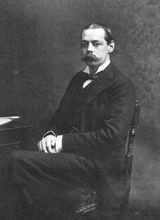
Lord Randolph Churchill

Encyclopedia
Lord Randolph Henry Spencer-Churchill MP
(13 February 1849 – 24 January 1895) was a British
statesman
. He was the third son of the 7th Duke of Marlborough and his wife Lady Frances Anne Emily Vane (1822–1899), daughter of the 3rd Marquess of Londonderry. He was the father of Winston Churchill
, the future wartime Prime Minister
, who wrote his father's first major biography.
, London
. In January 1863 he went to Eton College
, where he remained until July 1865. He did not stand out either at academic work or sport while at Eton; his contemporaries describe him as a vivacious and rather unruly boy. In October 1867 he matriculated at Merton College, Oxford
. He had a liking for sport, but was also an avid reader, and obtained a second-class degree in jurisprudence and modern history in 1870. In 1874 he was elected to Parliament
as Conservative
member for Woodstock
, Oxfordshire
defeating George Brodrick, a fellow, and afterwards warden, of Merton College. His maiden speech
, delivered in his first session, prompted compliments from Harcourt and Disraeli, who wrote to the Queen of Churchill's 'energy and natural flow'.
, of New York
in the United States
, by whom he had two sons:
Jennie Jerome's social contacts greatly helped advance Lord Randolph's early career.
In January 1875, Lord Randolph made a series of visits to his doctor, Oscar Clayton
, for "an undisclosed ailment". Frank Harris
later claimed that this was syphilis
. However, recent scholarship has exploded the hypothesis that Lord Randolph died of the disease, without providing a definitive alternative.
(afterwards 1st Baron Basing), President of the Local Government Board, was a specific target, and the minister's County Government Bill was fiercely denounced as the "crowning dishonour to Tory principles", and the "supreme violation of political honesty". Lord Randolph's attitude, and the vituperative fluency of his invective, made him a parliamentary figure of some importance before the dissolution of the 1874 parliament, though he was not yet taken quite seriously.
In the new parliament of 1880 he speedily began to play a more notable role. Along with Sir Henry Drummond-Wolff, Sir John Gorst
and occasionally Arthur Balfour, he made himself known as the audacious opponent of the Liberal
administration and the unsparing critic of the Conservative front bench. The "fourth party", as it was nicknamed, at first did little damage to the government, but awakened the opposition from its apathy; Churchill roused the Conservatives by leading resistance to Charles Bradlaugh
, the member for Northampton
, who, though an avowed atheist or agnostic, was prepared to take the parliamentary oath. Sir Stafford Northcote, the Conservative leader in the Lower House, was forced to take a strong line on this difficult question by the energy of the fourth party. The long controversy over Bradlaugh's seat, showed that Lord Randolph Churchill was a parliamentary champion who added to his audacity much tactical skill and shrewdness. He continued to play a conspicuous part throughout the parliament of 1880 to 1885, targeting William Ewart Gladstone
as well as the Conservative front bench, some of whose members, particularly Sir Richard Cross
and William Henry Smith, he singled out for attack.
From the beginning of the Egyptian
imbroglio Lord Randolph was emphatically opposed to almost every step taken by the government. He declared that the suppression of Urabi Pasha's rebellion was an error, and the restoration of the khedive
's authority a crime. He called Gladstone the "Moloch
of Midlothian", for whom torrents of blood had been shed in Africa. He was equally severe on the domestic policy of the administration, and was particularly bitter in his criticism of the Kilmainham Treaty
and the rapprochement between the Gladstonians and the Parnellites
.
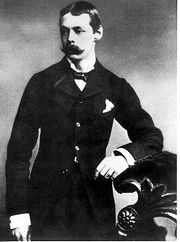 By 1885 he had formulated the policy of progressive Conservatism which was known as "Tory Democracy". He declared that the Conservatives ought to adopt, rather than oppose, popular reforms, and to challenge the claims of the Liberals to pose as champions of the masses. His views were largely accepted by the official Conservative leaders in the treatment of the Gladstonian Franchise Bill of 1884. Lord Randolph insisted that the principle of the bill should be accepted by the opposition, and that resistance should be focused on the refusal of the government to combine with it a scheme of redistribution. The prominent, and on the whole judicious and successful, part he played in the debates on these questions, still further increased his influence with the rank and file of the Conservatives in the constituencies.
At the same time he was actively spreading the gospel of democratic Toryism in a series of platform campaigns. In 1883 and 1884 he invaded the radical stronghold of Birmingham
, and in the latter year took part in a Conservative garden party at Aston Manor, at which his opponents paid him the compliment of raising a serious riot. He gave constant attention to the party organisation, which had fallen into considerable disorder after 1880, and was an active promoter of the Primrose League
.
;s budget resolutions were defeated by the Conservatives, aided by about half the Parnellites, Lord Randolph Churchill's admirers were justified in proclaiming him to have been the "organiser of victory".
His services were, at any rate, far too important to be refused recognition; and in Lord Salisbury's
cabinet of 1885 he was made Secretary of State for India
. As the price of entry he demanded that Sir Stafford Northcote be removed from the Commons, despite being the Conservative leader there. Salisbury was more than willing to concede this and Northcote went to the Lords as the Earl of Iddlesleigh. During his tenure at the India Office during the short-lived minority Conservative administration, Churchill reversed policy over Burma. He sided with commercial interests and directed the Viceroy
, Lord Dufferin
, to invade Upper Burma
in November 1885. With little discussion, Churchill then decided to annex the final remnant of the once great Burmese kingdom, adding it as a new province of the Indian Raj
as a "New Year present" for Queen Victoria on New Year's Day 1886.
In the autumn election of 1885 he contested Birmingham Central
against John Bright
, and though defeated here, was at the same time returned by a very large majority for South Paddington
. In the contest which arose over William Ewart Gladstone
's Home Rule
bill, Lord Randolph again bore a conspicuous part, and in the electioneering campaign his activity was only second to that of some of the Liberal Unionists
, Lord Hartington
, George Goschen and Joseph Chamberlain
. He was now the recognised Conservative champion in the Lower Chamber, and when the second Salisbury administration was formed after the general election of 1886 he became Chancellor of the Exchequer
and Leader of the House of Commons
.
 His management of the House was on the whole successful, and was marked by tact, discretion and temper. But he had never really reconciled himself with some of his colleagues, and there was a good deal of friction in his relations with them, which ended with his sudden resignation on 20 December 1886. Various motives influenced him in taking this surprising step; but the only ostensible cause was that put forward in his letter to Lord Salisbury
, which was read in the House of Commons
on 27 January. In this document he stated that his resignation was the result of his inability, as Chancellor of the Exchequer
, to concur in the demands made on the Treasury
by the ministers at the head of the naval and military establishments. It was commonly supposed that he expected his resignation to be followed by the unconditional surrender of the cabinet, and his restoration to office on his own terms. The sequel, however, was entirely different. The cabinet was reconstructed with Goschen as Chancellor of the Exchequer (Lord Randolph had "forgotten Goschen", as he is said to have remarked). For the next few years there was some speculation about a return to frontline politics, as often happens when a Cabinet minister resigns, but Churchill's own career as a Conservative
chief was over.
Although he continued to sit in Parliament, his health was in serious decline throughout the 1890s. He bestowed much attention on society, travel and sport. He was an ardent supporter of the turf, and, in 1889, he won the Epsom Oaks
with a mare
named the Abbesse de Jouarre. In 1891, he went to South Africa
, in search both of health and relaxation. He travelled for some months through Cape Colony
, the Transvaal
and Rhodesia
, making notes on the politics and economics of the countries, shooting lions, and recording his impressions in letters to a London newspaper, which were afterwards republished under the title of Men, Mines and Animals in South Africa. He attacked Gladstone
's Second Home Rule Bill
with energy, and gave fiery pro-Union speeches in Ireland
.
During this time he coined the phrase "Ulster will fight, and Ulster will be right". But it was soon apparent that his powers were undermined by the illness which took his life at the age of 45. As the session of 1893 wore on, his speeches lost their old effectiveness, and in 1894 he was listened to not so much with interest as with pity. His last speech in the House was delivered in the debate on Uganda
in June 1894, and was a painful failure. He was, in fact, dying. An attempted round-the-world journey failed to cure him. Lord Randolph started in the autumn of 1894, accompanied by his wife, but his illness made so much progress that he was brought back hurriedly from Cairo
. He reached England shortly before Christmas and died in London
. The gross value of his personal estate was entered in the Probate Registry at £75,971. This is the financial equivalent of over £6.45 million in 2008 terms, using the retail price index. He is buried near his wife and sons at St Martin's Church, Bladon, near Woodstock, Oxfordshire
.
His widow, Lady Randolph Churchill, married George Cornwallis-West
in 1900, when she became known as Mrs. George Cornwallis-West. After that marriage was dissolved, she resumed by deed poll
her prior married name, Lady Randolph Churchill. (Lord Randolph was her husband's courtesy title as the younger son of a duke and in English law does not qualify as a noble title.) Lord Randolph's son, Sir Winston Churchill
, died on 24 January 1965, exactly 70 years after the death of his father.
He was featured in the film Edward the King as a more natural character, sociably similar to Albert Edward, Prince of Wales
and his other friends. His downfall is represented when he confronted Alexandra, Princess of Wales
and demanded her to use her influence with the Prince to stop Lord Aylesford proceeding with a divorce from his wife, Lady Aylesford, after she had planned to elope with Lord Randolph's elder brother, the Marquess of Blandford
. He threatens to expose letters from the Prince to Lady Aylesford, so scandalous, so he says, that if they were to be exposed, "the Prince of Wales would never sit on the throne of England." Outraged, the Princess goes to see the Queen, who is equally indignant. The Prime Minister
, Benjamin Disraeli
, informs the Prince, who is so angry that he challenges Lord Randolph to a duel
in the South of France. Eventually, Lord Aylesford does not attempt to seek a divorce from his wife, and Lord Blandford does not elope with Lady Aylesford. Lord Randolph sends a note of apology to the Prince, which is merely acknowledged. Disgraced, Lord Randolph and his wife leave for America.
Other notable appearances include the film Young Winston
, in which he was portrayed by Robert Shaw
, and the miniseries, Jennie, The Life of Lady Randolph Churchill.
Sir Winston refers to his father's career in several of the last chapters of A History of the English-Speaking Peoples
.
He is the target of an assassination attempt in the J.M. Barrie novella about a secret society of killers, Better Dead.
Member of Parliament
A Member of Parliament is a representative of the voters to a :parliament. In many countries with bicameral parliaments, the term applies specifically to members of the lower house, as upper houses often have a different title, such as senate, and thus also have different titles for its members,...
(13 February 1849 – 24 January 1895) was a British
United Kingdom
The United Kingdom of Great Britain and Northern IrelandIn the United Kingdom and Dependencies, other languages have been officially recognised as legitimate autochthonous languages under the European Charter for Regional or Minority Languages...
statesman
Statesman
A statesman is usually a politician or other notable public figure who has had a long and respected career in politics or government at the national and international level. As a term of respect, it is usually left to supporters or commentators to use the term...
. He was the third son of the 7th Duke of Marlborough and his wife Lady Frances Anne Emily Vane (1822–1899), daughter of the 3rd Marquess of Londonderry. He was the father of Winston Churchill
Winston Churchill
Sir Winston Leonard Spencer-Churchill, was a predominantly Conservative British politician and statesman known for his leadership of the United Kingdom during the Second World War. He is widely regarded as one of the greatest wartime leaders of the century and served as Prime Minister twice...
, the future wartime Prime Minister
Prime Minister of the United Kingdom
The Prime Minister of the United Kingdom of Great Britain and Northern Ireland is the Head of Her Majesty's Government in the United Kingdom. The Prime Minister and Cabinet are collectively accountable for their policies and actions to the Sovereign, to Parliament, to their political party and...
, who wrote his father's first major biography.
Early life
He was born at Blenheim Palace, near Woodstock, Oxfordshire. He was at first privately educated, and later attended Tabor's Preparatory School at CheamCheam
Cheam is a large suburban village close to Sutton in the London Borough of Sutton, England, and is located close to the southern boundary between Greater London and Surrey. It is divided into two main areas: North Cheam and Cheam Village. North Cheam includes more retail shops and supermarkets,...
, London
London
London is the capital city of :England and the :United Kingdom, the largest metropolitan area in the United Kingdom, and the largest urban zone in the European Union by most measures. Located on the River Thames, London has been a major settlement for two millennia, its history going back to its...
. In January 1863 he went to Eton College
Eton College
Eton College, often referred to simply as Eton, is a British independent school for boys aged 13 to 18. It was founded in 1440 by King Henry VI as "The King's College of Our Lady of Eton besides Wyndsor"....
, where he remained until July 1865. He did not stand out either at academic work or sport while at Eton; his contemporaries describe him as a vivacious and rather unruly boy. In October 1867 he matriculated at Merton College, Oxford
Merton College, Oxford
Merton College is one of the constituent colleges of the University of Oxford in England. Its foundation can be traced back to the 1260s when Walter de Merton, chancellor to Henry III and later to Edward I, first drew up statutes for an independent academic community and established endowments to...
. He had a liking for sport, but was also an avid reader, and obtained a second-class degree in jurisprudence and modern history in 1870. In 1874 he was elected to Parliament
British House of Commons
The House of Commons is the lower house of the Parliament of the United Kingdom, which also comprises the Sovereign and the House of Lords . Both Commons and Lords meet in the Palace of Westminster. The Commons is a democratically elected body, consisting of 650 members , who are known as Members...
as Conservative
Conservative Party (UK)
The Conservative Party, formally the Conservative and Unionist Party, is a centre-right political party in the United Kingdom that adheres to the philosophies of conservatism and British unionism. It is the largest political party in the UK, and is currently the largest single party in the House...
member for Woodstock
Woodstock (UK Parliament constituency)
Woodstock, sometimes called New Woodstock, was a parliamentary constituency in the United Kingdom. It comprised the town of Woodstock in the county of Oxfordshire and the surrounding countryside and villages, and elected two Members of Parliament from its re-enfranchisement in 1553 until 1832...
, Oxfordshire
Oxfordshire
Oxfordshire is a county in the South East region of England, bordering on Warwickshire and Northamptonshire , Buckinghamshire , Berkshire , Wiltshire and Gloucestershire ....
defeating George Brodrick, a fellow, and afterwards warden, of Merton College. His maiden speech
Maiden speech
A maiden speech is the first speech given by a newly elected or appointed member of a legislature or parliament.Traditions surrounding maiden speeches vary from country to country...
, delivered in his first session, prompted compliments from Harcourt and Disraeli, who wrote to the Queen of Churchill's 'energy and natural flow'.
Influential marriage
Lord Randolph Churchill married on 15 April 1874 Jennie Jerome, daughter of Leonard JeromeLeonard Jerome
Leonard Walter Jerome was a Brooklyn, New York, financier and grandfather of Winston Churchill.- Early life :...
, of New York
New York
New York is a state in the Northeastern region of the United States. It is the nation's third most populous state. New York is bordered by New Jersey and Pennsylvania to the south, and by Connecticut, Massachusetts and Vermont to the east...
in the United States
United States
The United States of America is a federal constitutional republic comprising fifty states and a federal district...
, by whom he had two sons:
- Winston Leonard Spencer-ChurchillWinston ChurchillSir Winston Leonard Spencer-Churchill, was a predominantly Conservative British politician and statesman known for his leadership of the United Kingdom during the Second World War. He is widely regarded as one of the greatest wartime leaders of the century and served as Prime Minister twice...
(1874–1965) - John Strange Spencer-ChurchillJohn Strange Spencer-ChurchillMajor John Strange "Jack" Spencer-Churchill, DSO, TD was the younger son of Lord Randolph Churchill and Lady Randolph Churchill , and brother of World War II Prime Minster, Sir Winston Churchill....
(1880–1947).
Jennie Jerome's social contacts greatly helped advance Lord Randolph's early career.
In January 1875, Lord Randolph made a series of visits to his doctor, Oscar Clayton
Oscar Clayton
Sir Oscar Moore Passey Clayton, KCMG, CB, FRCS was a British surgeon, courtier, and socialite. He was Surgeon-in-Ordinary to Prince Alfred, Duke of Edinburgh, Extra Surgeon-in-Ordinary to the Prince of Wales, later King Edward VII, and Surgeon to the Metropolitan Police and other bodies.-Early...
, for "an undisclosed ailment". Frank Harris
Frank Harris
Frank Harris was a Irish-born, naturalized-American author, editor, journalist and publisher, who was friendly with many well-known figures of his day...
later claimed that this was syphilis
Syphilis
Syphilis is a sexually transmitted infection caused by the spirochete bacterium Treponema pallidum subspecies pallidum. The primary route of transmission is through sexual contact; however, it may also be transmitted from mother to fetus during pregnancy or at birth, resulting in congenital syphilis...
. However, recent scholarship has exploded the hypothesis that Lord Randolph died of the disease, without providing a definitive alternative.
The "Fourth Party"
It was not until 1878 that he came to public notice as the exponent of a species of independent Conservatism. He made a series of furious attacks on Sir Stafford Northcote, R. A. Cross, and other prominent members of the "old gang". George Sclater-BoothGeorge Sclater-Booth, 1st Baron Basing
George Limbrey Sclater-Booth, 1st Baron Basing PC, FRS, DL , known as George Sclater-Booth before 1887, was a British Conservative politician...
(afterwards 1st Baron Basing), President of the Local Government Board, was a specific target, and the minister's County Government Bill was fiercely denounced as the "crowning dishonour to Tory principles", and the "supreme violation of political honesty". Lord Randolph's attitude, and the vituperative fluency of his invective, made him a parliamentary figure of some importance before the dissolution of the 1874 parliament, though he was not yet taken quite seriously.
In the new parliament of 1880 he speedily began to play a more notable role. Along with Sir Henry Drummond-Wolff, Sir John Gorst
John Eldon Gorst
Sir John Eldon Gorst PC, QC, FRS was a British lawyer and politician. He served as Solicitor General for England and Wales from 1885 to 1886 and as Vice-President of the Committee on Education between 1895 and 1902....
and occasionally Arthur Balfour, he made himself known as the audacious opponent of the Liberal
Liberal Party (UK)
The Liberal Party was one of the two major political parties of the United Kingdom during the 19th and early 20th centuries. It was a third party of negligible importance throughout the latter half of the 20th Century, before merging with the Social Democratic Party in 1988 to form the present day...
administration and the unsparing critic of the Conservative front bench. The "fourth party", as it was nicknamed, at first did little damage to the government, but awakened the opposition from its apathy; Churchill roused the Conservatives by leading resistance to Charles Bradlaugh
Charles Bradlaugh
Charles Bradlaugh was a political activist and one of the most famous English atheists of the 19th century. He founded the National Secular Society in 1866.-Early life:...
, the member for Northampton
Northampton (UK Parliament constituency)
Northampton was a parliamentary constituency centred on the town of Northampton which existed until 1974.It returned two Members of Parliament to the House of Commons of the Parliament of the United Kingdom until its representation was reduced to one member for the 1918 general election...
, who, though an avowed atheist or agnostic, was prepared to take the parliamentary oath. Sir Stafford Northcote, the Conservative leader in the Lower House, was forced to take a strong line on this difficult question by the energy of the fourth party. The long controversy over Bradlaugh's seat, showed that Lord Randolph Churchill was a parliamentary champion who added to his audacity much tactical skill and shrewdness. He continued to play a conspicuous part throughout the parliament of 1880 to 1885, targeting William Ewart Gladstone
William Ewart Gladstone
William Ewart Gladstone FRS FSS was a British Liberal statesman. In a career lasting over sixty years, he served as Prime Minister four separate times , more than any other person. Gladstone was also Britain's oldest Prime Minister, 84 years old when he resigned for the last time...
as well as the Conservative front bench, some of whose members, particularly Sir Richard Cross
R. A. Cross, 1st Viscount Cross
Richard Assheton Cross, 1st Viscount Cross, GCB, GCSI, PC, FRS , known before his elevation to the peerage as R. A. Cross, was a British statesman and Conservative politician...
and William Henry Smith, he singled out for attack.
From the beginning of the Egyptian
History of Modern Egypt
The definition of modern history has varied in accordance to different definitions of Modernity. Some scholars date it as far back as 1517 with the Ottomans’ defeat of the Mamlūks in 1516–17...
imbroglio Lord Randolph was emphatically opposed to almost every step taken by the government. He declared that the suppression of Urabi Pasha's rebellion was an error, and the restoration of the khedive
Khedive
The term Khedive is a title largely equivalent to the English word viceroy. It was first used, without official recognition, by Muhammad Ali Pasha , the Wāli of Egypt and Sudan, and vassal of the Ottoman Empire...
's authority a crime. He called Gladstone the "Moloch
Moloch
Moloch — also rendered as Molech, Molekh, Molok, Molek, Molock, or Moloc — is the name of an ancient Semitic god...
of Midlothian", for whom torrents of blood had been shed in Africa. He was equally severe on the domestic policy of the administration, and was particularly bitter in his criticism of the Kilmainham Treaty
Kilmainham Treaty
The Kilmainham Treaty was an agreement reached in May 1882 between the United Kingdom Government under William Ewart Gladstone and the Irish nationalist leader Charles Stewart Parnell...
and the rapprochement between the Gladstonians and the Parnellites
Charles Stewart Parnell
Charles Stewart Parnell was an Irish landowner, nationalist political leader, land reform agitator, and the founder and leader of the Irish Parliamentary Party...
.
Tory Democracy
At the same time he was actively spreading the gospel of democratic Toryism in a series of platform campaigns. In 1883 and 1884 he invaded the radical stronghold of Birmingham
Birmingham
Birmingham is a city and metropolitan borough in the West Midlands of England. It is the most populous British city outside the capital London, with a population of 1,036,900 , and lies at the heart of the West Midlands conurbation, the second most populous urban area in the United Kingdom with a...
, and in the latter year took part in a Conservative garden party at Aston Manor, at which his opponents paid him the compliment of raising a serious riot. He gave constant attention to the party organisation, which had fallen into considerable disorder after 1880, and was an active promoter of the Primrose League
Primrose League
The Primrose League was an organisation for spreading Conservative principles in Great Britain. It was founded in 1883 and active until the mid 1990s...
.
Office
In 1884 progressive Toryism won out. At the conference of the Central Union of Conservative Associations, Lord Randolph was nominated chairman, despite the opposition of the parliamentary leaders. A split was averted by Lord Randolph's voluntary resignation; but the episode had confirmed his title to a leading place in the Tory ranks. It was strengthened by the prominent part he played in the events immediately preceding the fall of the Liberal government in 1885; and when Hugh ChildersHugh Childers
Hugh Culling Eardley Childers was a British and Australian Liberal statesman of the nineteenth century. He is perhaps best known for his reform efforts at the Admiralty and the War Office...
;s budget resolutions were defeated by the Conservatives, aided by about half the Parnellites, Lord Randolph Churchill's admirers were justified in proclaiming him to have been the "organiser of victory".
His services were, at any rate, far too important to be refused recognition; and in Lord Salisbury's
Robert Gascoyne-Cecil, 3rd Marquess of Salisbury
Robert Arthur Talbot Gascoyne-Cecil, 3rd Marquess of Salisbury, KG, GCVO, PC , styled Lord Robert Cecil before 1865 and Viscount Cranborne from June 1865 until April 1868, was a British Conservative statesman and thrice Prime Minister, serving for a total of over 13 years...
cabinet of 1885 he was made Secretary of State for India
Secretary of State for India
The Secretary of State for India, or India Secretary, was the British Cabinet minister responsible for the government of India and the political head of the India Office...
. As the price of entry he demanded that Sir Stafford Northcote be removed from the Commons, despite being the Conservative leader there. Salisbury was more than willing to concede this and Northcote went to the Lords as the Earl of Iddlesleigh. During his tenure at the India Office during the short-lived minority Conservative administration, Churchill reversed policy over Burma. He sided with commercial interests and directed the Viceroy
Viceroy
A viceroy is a royal official who runs a country, colony, or province in the name of and as representative of the monarch. The term derives from the Latin prefix vice-, meaning "in the place of" and the French word roi, meaning king. A viceroy's province or larger territory is called a viceroyalty...
, Lord Dufferin
Frederick Hamilton-Temple-Blackwood, 1st Marquess of Dufferin and Ava
Frederick Hamilton-Temple-Blackwood, 1st Marquess of Dufferin and Ava, KP, GCB, GCSI, GCMG, GCIE, PC was a British public servant and prominent member of Victorian society...
, to invade Upper Burma
Upper Burma
Upper Burma refers to a geographic region of Burma , traditionally encompassing Mandalay and its periphery , or more broadly speaking, Kachin and Shan States....
in November 1885. With little discussion, Churchill then decided to annex the final remnant of the once great Burmese kingdom, adding it as a new province of the Indian Raj
British Raj
British Raj was the British rule in the Indian subcontinent between 1858 and 1947; The term can also refer to the period of dominion...
as a "New Year present" for Queen Victoria on New Year's Day 1886.
In the autumn election of 1885 he contested Birmingham Central
Birmingham Central (UK Parliament constituency)
Birmingham Central is a former parliamentary constituency in the city of Birmingham, England. It returned one Member of Parliament to the House of Commons of the Parliament of the United Kingdom, elected by the first-past-the-post voting system....
against John Bright
John Bright
John Bright , Quaker, was a British Radical and Liberal statesman, associated with Richard Cobden in the formation of the Anti-Corn Law League. He was one of the greatest orators of his generation, and a strong critic of British foreign policy...
, and though defeated here, was at the same time returned by a very large majority for South Paddington
Paddington South (UK Parliament constituency)
Paddington South was a Parliamentary constituency in London which returned one Member of Parliament. It was a compact urban area, but predominantly wealthy, and was most famously represented by Lord Randolph Churchill during the latter part of his career....
. In the contest which arose over William Ewart Gladstone
William Ewart Gladstone
William Ewart Gladstone FRS FSS was a British Liberal statesman. In a career lasting over sixty years, he served as Prime Minister four separate times , more than any other person. Gladstone was also Britain's oldest Prime Minister, 84 years old when he resigned for the last time...
's Home Rule
Home rule
Home rule is the power of a constituent part of a state to exercise such of the state's powers of governance within its own administrative area that have been devolved to it by the central government....
bill, Lord Randolph again bore a conspicuous part, and in the electioneering campaign his activity was only second to that of some of the Liberal Unionists
Liberal Unionist Party
The Liberal Unionist Party was a British political party that was formed in 1886 by a faction that broke away from the Liberal Party. Led by Lord Hartington and Joseph Chamberlain, the party formed a political alliance with the Conservative Party in opposition to Irish Home Rule...
, Lord Hartington
Spencer Cavendish, 8th Duke of Devonshire
Spencer Compton Cavendish, 8th Duke of Devonshire KG, GCVO, PC, PC , styled Lord Cavendish of Keighley between 1834 and 1858 and Marquess of Hartington between 1858 and 1891, was a British statesman...
, George Goschen and Joseph Chamberlain
Joseph Chamberlain
Joseph Chamberlain was an influential British politician and statesman. Unlike most major politicians of the time, he was a self-made businessman and had not attended Oxford or Cambridge University....
. He was now the recognised Conservative champion in the Lower Chamber, and when the second Salisbury administration was formed after the general election of 1886 he became Chancellor of the Exchequer
Chancellor of the Exchequer
The Chancellor of the Exchequer is the title held by the British Cabinet minister who is responsible for all economic and financial matters. Often simply called the Chancellor, the office-holder controls HM Treasury and plays a role akin to the posts of Minister of Finance or Secretary of the...
and Leader of the House of Commons
Leader of the House of Commons
The Leader of the House of Commons is a member of the Cabinet of the United Kingdom who is responsible for arranging government business in the House of Commons...
.
Eclipse
Robert Gascoyne-Cecil, 3rd Marquess of Salisbury
Robert Arthur Talbot Gascoyne-Cecil, 3rd Marquess of Salisbury, KG, GCVO, PC , styled Lord Robert Cecil before 1865 and Viscount Cranborne from June 1865 until April 1868, was a British Conservative statesman and thrice Prime Minister, serving for a total of over 13 years...
, which was read in the House of Commons
British House of Commons
The House of Commons is the lower house of the Parliament of the United Kingdom, which also comprises the Sovereign and the House of Lords . Both Commons and Lords meet in the Palace of Westminster. The Commons is a democratically elected body, consisting of 650 members , who are known as Members...
on 27 January. In this document he stated that his resignation was the result of his inability, as Chancellor of the Exchequer
Chancellor of the Exchequer
The Chancellor of the Exchequer is the title held by the British Cabinet minister who is responsible for all economic and financial matters. Often simply called the Chancellor, the office-holder controls HM Treasury and plays a role akin to the posts of Minister of Finance or Secretary of the...
, to concur in the demands made on the Treasury
Treasury
A treasury is either*A government department related to finance and taxation.*A place where currency or precious items is/are kept....
by the ministers at the head of the naval and military establishments. It was commonly supposed that he expected his resignation to be followed by the unconditional surrender of the cabinet, and his restoration to office on his own terms. The sequel, however, was entirely different. The cabinet was reconstructed with Goschen as Chancellor of the Exchequer (Lord Randolph had "forgotten Goschen", as he is said to have remarked). For the next few years there was some speculation about a return to frontline politics, as often happens when a Cabinet minister resigns, but Churchill's own career as a Conservative
Conservative Party (UK)
The Conservative Party, formally the Conservative and Unionist Party, is a centre-right political party in the United Kingdom that adheres to the philosophies of conservatism and British unionism. It is the largest political party in the UK, and is currently the largest single party in the House...
chief was over.
Although he continued to sit in Parliament, his health was in serious decline throughout the 1890s. He bestowed much attention on society, travel and sport. He was an ardent supporter of the turf, and, in 1889, he won the Epsom Oaks
Epsom Oaks
The Oaks Stakes is a Group 1 flat horse race in Great Britain open to three-year-old thoroughbred fillies. It is run at Epsom Downs over a distance of 1 mile, 4 furlongs and 10 yards , and it is scheduled to take place each year in early June....
with a mare
Mare (horse)
A mare is an adult female horse or other equine.In most cases, a mare is a female horse over the age of three, and a filly is a female horse age three and younger. However, in Thoroughbred horse racing, a mare is defined as a female horse more than four years old; in harness racing a mare is a...
named the Abbesse de Jouarre. In 1891, he went to South Africa
South Africa
The Republic of South Africa is a country in southern Africa. Located at the southern tip of Africa, it is divided into nine provinces, with of coastline on the Atlantic and Indian oceans...
, in search both of health and relaxation. He travelled for some months through Cape Colony
Cape Colony
The Cape Colony, part of modern South Africa, was established by the Dutch East India Company in 1652, with the founding of Cape Town. It was subsequently occupied by the British in 1795 when the Netherlands were occupied by revolutionary France, so that the French revolutionaries could not take...
, the Transvaal
South African Republic
The South African Republic , often informally known as the Transvaal Republic, was an independent Boer-ruled country in Southern Africa during the second half of the 19th century. Not to be confused with the present-day Republic of South Africa, it occupied the area later known as the South African...
and Rhodesia
Rhodesia
Rhodesia , officially the Republic of Rhodesia from 1970, was an unrecognised state located in southern Africa that existed between 1965 and 1979 following its Unilateral Declaration of Independence from the United Kingdom on 11 November 1965...
, making notes on the politics and economics of the countries, shooting lions, and recording his impressions in letters to a London newspaper, which were afterwards republished under the title of Men, Mines and Animals in South Africa. He attacked Gladstone
William Ewart Gladstone
William Ewart Gladstone FRS FSS was a British Liberal statesman. In a career lasting over sixty years, he served as Prime Minister four separate times , more than any other person. Gladstone was also Britain's oldest Prime Minister, 84 years old when he resigned for the last time...
's Second Home Rule Bill
Home rule
Home rule is the power of a constituent part of a state to exercise such of the state's powers of governance within its own administrative area that have been devolved to it by the central government....
with energy, and gave fiery pro-Union speeches in Ireland
Ireland
Ireland is an island to the northwest of continental Europe. It is the third-largest island in Europe and the twentieth-largest island on Earth...
.
During this time he coined the phrase "Ulster will fight, and Ulster will be right". But it was soon apparent that his powers were undermined by the illness which took his life at the age of 45. As the session of 1893 wore on, his speeches lost their old effectiveness, and in 1894 he was listened to not so much with interest as with pity. His last speech in the House was delivered in the debate on Uganda
Uganda
Uganda , officially the Republic of Uganda, is a landlocked country in East Africa. Uganda is also known as the "Pearl of Africa". It is bordered on the east by Kenya, on the north by South Sudan, on the west by the Democratic Republic of the Congo, on the southwest by Rwanda, and on the south by...
in June 1894, and was a painful failure. He was, in fact, dying. An attempted round-the-world journey failed to cure him. Lord Randolph started in the autumn of 1894, accompanied by his wife, but his illness made so much progress that he was brought back hurriedly from Cairo
Cairo
Cairo , is the capital of Egypt and the largest city in the Arab world and Africa, and the 16th largest metropolitan area in the world. Nicknamed "The City of a Thousand Minarets" for its preponderance of Islamic architecture, Cairo has long been a centre of the region's political and cultural life...
. He reached England shortly before Christmas and died in London
London
London is the capital city of :England and the :United Kingdom, the largest metropolitan area in the United Kingdom, and the largest urban zone in the European Union by most measures. Located on the River Thames, London has been a major settlement for two millennia, its history going back to its...
. The gross value of his personal estate was entered in the Probate Registry at £75,971. This is the financial equivalent of over £6.45 million in 2008 terms, using the retail price index. He is buried near his wife and sons at St Martin's Church, Bladon, near Woodstock, Oxfordshire
Woodstock, Oxfordshire
Woodstock is a small town northwest of Oxford in Oxfordshire, England. It is the location of Blenheim Palace, a UNESCO World Heritage Site.Winston Churchill was born in Blenheim Palace in 1874 and is buried in the nearby village of Bladon....
.
His widow, Lady Randolph Churchill, married George Cornwallis-West
George Cornwallis-West
George Frederick Myddleton Cornwallis-West was a British officer of the Scots Guards. He was the only son of Col. William Cornwallis-West and his wife Mary, née FitzPatrick . The family moved in aristocratic circles but did not have a great deal of wealth...
in 1900, when she became known as Mrs. George Cornwallis-West. After that marriage was dissolved, she resumed by deed poll
Deed poll
A deed poll is a legal document binding only to a single person or several persons acting jointly to express an active intention...
her prior married name, Lady Randolph Churchill. (Lord Randolph was her husband's courtesy title as the younger son of a duke and in English law does not qualify as a noble title.) Lord Randolph's son, Sir Winston Churchill
Winston Churchill
Sir Winston Leonard Spencer-Churchill, was a predominantly Conservative British politician and statesman known for his leadership of the United Kingdom during the Second World War. He is widely regarded as one of the greatest wartime leaders of the century and served as Prime Minister twice...
, died on 24 January 1965, exactly 70 years after the death of his father.
Movie, television, and literary depictions
The character Randolph Churchill has appeared in numerous movies and television productions about his son Winston. He is generally portrayed as a cold and distant man, although perhaps was no worse than many other fathers of his time and class.He was featured in the film Edward the King as a more natural character, sociably similar to Albert Edward, Prince of Wales
Edward VII of the United Kingdom
Edward VII was King of the United Kingdom and the British Dominions and Emperor of India from 22 January 1901 until his death in 1910...
and his other friends. His downfall is represented when he confronted Alexandra, Princess of Wales
Alexandra of Denmark
Alexandra of Denmark was the wife of Edward VII of the United Kingdom...
and demanded her to use her influence with the Prince to stop Lord Aylesford proceeding with a divorce from his wife, Lady Aylesford, after she had planned to elope with Lord Randolph's elder brother, the Marquess of Blandford
George Spencer-Churchill, 8th Duke of Marlborough
George Charles Spencer-Churchill, 8th Duke of Marlborough DL , styled Earl of Sunderland until 1857 and Marquess of Blandford between 1857 and 1883, was a British peer.-Background and education:...
. He threatens to expose letters from the Prince to Lady Aylesford, so scandalous, so he says, that if they were to be exposed, "the Prince of Wales would never sit on the throne of England." Outraged, the Princess goes to see the Queen, who is equally indignant. The Prime Minister
Prime Minister of the United Kingdom
The Prime Minister of the United Kingdom of Great Britain and Northern Ireland is the Head of Her Majesty's Government in the United Kingdom. The Prime Minister and Cabinet are collectively accountable for their policies and actions to the Sovereign, to Parliament, to their political party and...
, Benjamin Disraeli
Benjamin Disraeli, 1st Earl of Beaconsfield
Benjamin Disraeli, 1st Earl of Beaconsfield, KG, PC, FRS, was a British Prime Minister, parliamentarian, Conservative statesman and literary figure. Starting from comparatively humble origins, he served in government for three decades, twice as Prime Minister of the United Kingdom...
, informs the Prince, who is so angry that he challenges Lord Randolph to a duel
Duel
A duel is an arranged engagement in combat between two individuals, with matched weapons in accordance with agreed-upon rules.Duels in this form were chiefly practised in Early Modern Europe, with precedents in the medieval code of chivalry, and continued into the modern period especially among...
in the South of France. Eventually, Lord Aylesford does not attempt to seek a divorce from his wife, and Lord Blandford does not elope with Lady Aylesford. Lord Randolph sends a note of apology to the Prince, which is merely acknowledged. Disgraced, Lord Randolph and his wife leave for America.
Other notable appearances include the film Young Winston
Young Winston
Young Winston is a 1972 British film based on the early years of British Prime Minister Winston Churchill.The film was based on the book My Early Life: A Roving Commission by Winston Churchill. The first part of the film covers Churchill's unhappy schooldays, up to the death of his father...
, in which he was portrayed by Robert Shaw
Robert Shaw (actor)
Robert Archibald Shaw was an English actor and novelist, remembered for his performances in The Sting , From Russia with Love , A Man for All Seasons , the original The Taking of Pelham One Two Three , Black Sunday , The Deep and Jaws , where he played the shark hunter Quint.-Early life...
, and the miniseries, Jennie, The Life of Lady Randolph Churchill.
Sir Winston refers to his father's career in several of the last chapters of A History of the English-Speaking Peoples
A History of the English-Speaking Peoples
A History of the English-Speaking Peoples is a four-volume history of Britain and its former colonies and possessions throughout the world, written by Winston Churchill, covering the period from Caesar's invasions of Britain to the beginning of the First World War...
.
He is the target of an assassination attempt in the J.M. Barrie novella about a secret society of killers, Better Dead.