
All Topics  
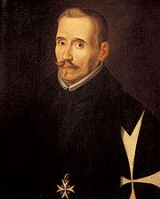
Lope de Vega

 
Lope De Vega

   Email Print
   Bookmark   Link


Lope de Vega


Lope de Vega (also Félix Lope de Vega y Carpio or Lope Félix de Vega Carpio) (25 November 1562 – 27 August 1635) was a Spanish
Spain

Spain or the Kingdom of Spain , is a country located in Southern Europe on the Iberian Peninsula.The Spanish constitution does not establish any official denomination of the country, even though Espa?a , Estado espa?ol and Naci?n espa?ola are used interchangeably....
 Baroque
Spanish Baroque literature

Spanish Baroque literature is the literature written in Spain during the Baroque.The literary Baroque took place in Spain in the middle of the so-called Spanish Golden Age of Spanish Literature....
 playwright
Playwright

A playwright, also known as a dramatist, is a person who writes dramatic literature or drama. These works may be written specifically to be performed by actors or they may be closet dramas or literary works written using dramatic forms but not meant for performance....
 and poet
Poet

A poet is a person who writes poetry....
. His reputation in the world of Spanish
Spanish language

Spanish or Castilian is a Romance languages that originated in northern Spain, and gradually spread in the Kingdom of Castile and evolved into the principal language of government and trade....
 letters is second only to that of Cervantes
Miguel de Cervantes

Miguel de Cervantes Saavedra was a Spanish novelist, poet, and playwright. His magnum opus, Don Quixote, considered the first modern novel by many, is a classic of Western literature and is regularly regarded among the best novels ever written....
, while the sheer volume of his literary output is unequalled: he is estimated to have written up to 1,500 three-act plays – of which some 425 have survived until the modern day – together with a plethora of shorter dramatic and poetic works.

de Vega was born in Madrid
Madrid

Madrid is the Capital and largest city of Spain. It is the Largest cities of the European Union by population within city limits in the European Union after Greater London and Berlin, and its Madrid metropolitan area is the Largest urban areas of the European Union in the European Union after Paris aire urbaine, Greater London Urban Area, a...
 to a family of undistinguished origins, recent arrivals in the capital from Valle de Carriedo in Cantabria
Cantabria

Cantabria is a Spain province and autonomous community with Santander, Cantabria as its capital city. It is bordered on the east by the Basque Country , on the south by Castile and Le?n , on the west by the Principality of Asturias, and on the north by the Cantabrian Sea....
, whose breadwinner, Félix de Vega, was an embroiderer.

The first indications of young Lope's genius became apparent in his earliest years.


Discussion
Ask a question about 'Lope de Vega'
Start a new discussion about 'Lope de Vega'
Answer questions from other users
Full Discussion Forum


Encyclopedia


Lope de Vega (also Félix Lope de Vega y Carpio or Lope Félix de Vega Carpio) (25 November 1562 – 27 August 1635) was a Spanish
Spain

Spain or the Kingdom of Spain , is a country located in Southern Europe on the Iberian Peninsula.The Spanish constitution does not establish any official denomination of the country, even though Espa?a , Estado espa?ol and Naci?n espa?ola are used interchangeably....
 Baroque
Spanish Baroque literature

Spanish Baroque literature is the literature written in Spain during the Baroque.The literary Baroque took place in Spain in the middle of the so-called Spanish Golden Age of Spanish Literature....
 playwright
Playwright

A playwright, also known as a dramatist, is a person who writes dramatic literature or drama. These works may be written specifically to be performed by actors or they may be closet dramas or literary works written using dramatic forms but not meant for performance....
 and poet
Poet

A poet is a person who writes poetry....
. His reputation in the world of Spanish
Spanish language

Spanish or Castilian is a Romance languages that originated in northern Spain, and gradually spread in the Kingdom of Castile and evolved into the principal language of government and trade....
 letters is second only to that of Cervantes
Miguel de Cervantes

Miguel de Cervantes Saavedra was a Spanish novelist, poet, and playwright. His magnum opus, Don Quixote, considered the first modern novel by many, is a classic of Western literature and is regularly regarded among the best novels ever written....
, while the sheer volume of his literary output is unequalled: he is estimated to have written up to 1,500 three-act plays – of which some 425 have survived until the modern day – together with a plethora of shorter dramatic and poetic works.

Life

Lope de Vega was born in Madrid
Madrid

Madrid is the Capital and largest city of Spain. It is the Largest cities of the European Union by population within city limits in the European Union after Greater London and Berlin, and its Madrid metropolitan area is the Largest urban areas of the European Union in the European Union after Paris aire urbaine, Greater London Urban Area, a...
 to a family of undistinguished origins, recent arrivals in the capital from Valle de Carriedo in Cantabria
Cantabria

Cantabria is a Spain province and autonomous community with Santander, Cantabria as its capital city. It is bordered on the east by the Basque Country , on the south by Castile and Le?n , on the west by the Principality of Asturias, and on the north by the Cantabrian Sea....
, whose breadwinner, Félix de Vega, was an embroiderer.

The first indications of young Lope's genius became apparent in his earliest years. At the age of five he was already reading Spanish and Latin, by his tenth birthday he was translating Latin verse, and he wrote his first play when he was 12.

His fourteenth year found him enrolled in the Colegio Imperial
Colegio Imperial de Madrid

Colegio Imperial de Madrid was the name of a Jesuit teaching institution in Madrid.Founded at the end of the sixteenth century and reached its peak in the seventeenth century, acquiring the title of "Imperial College" thanks to the patronage of the Empress Maria, daughter of Charles V, Holy Roman Emperor and the wife of Maximilian II, Ho...
, a Jesuit school in Madrid, from which he absconded to take part in a military expedition in Portugal
Portugal

Portugal , officially the Portuguese Republic , is a country on the Iberian Peninsula. Located in southwestern Europe, Portugal is the westernmost country of mainland Europe and is bordered by the Atlantic Ocean to the west and south and by Spain to the north and east....
. Following that escapade, he had the good fortune of being taken into the protection of the Bishop of Ávila, who recognized the lad's talent and saw him enrolled in the University of Alcalá de Henares
University of Alcalà de Henares

The Complutense University of Madrid is the most prestigious, and largest, public university in Spain and one of the oldest universities in the world....
. Following graduation Lope was planning to follow in his patron's footsteps and join the priesthood, but those plans were dashed by his falling in love and realizing that celibacy was not for him.

In 1583 Lope enlisted in the army, and he saw action with the Spanish Navy
Spanish Navy

The Spanish Armada is the maritime arm of the Military of Spain, one of the oldest active naval forces in the world. The Armada is responsible for notable achievements in world history such as the discovery of America, the first world circumnavigation, and the discovery of a maritime path from the Far East to America ....
 in the Azores
Azores

The Azores is a Portugal archipelago in the Atlantic Ocean, about 1,500 km from Lisbon and about 3,900 km from the east coast of North America....
. Following this he returned to Madrid and began his career as a playwright in earnest. He also began a love affair with Elena Osorio, an actress and the daughter of a leading theater owner. When, after some five years of this torrid affair, Elena spurned Lope in favor of another suitor, his vitriolic attacks on her and his family landed him in jail for libel and, ultimately, earned him the punishment of eight years' banishment from Castile
Castile (historical region)

A former Kingdom of Castile, Castile , gradually merged with its neighbors to become the Crown of Castile and later the Kingdom of Spain with the Crown of Aragon and the Crown of Navarre....
.

Exile
He went into exile undaunted, in the company of the 16-year-old Isabel de Urbina, the daughter of a prominent advisor at the court of Philip II
Philip II of Spain

Philip II was King of Spain from 1556 until 1598, List of monarchs of Naples from 1554 until 1598, king consort of England, as husband of Mary I of England, from 1554 to 1558, lord of the Seventeen Provinces from 1556 until 1581, holding various titles for the individual territories, such as Duke or Count; and King of Portugal as Philip I...
, whom he was subsequently forced to marry. A few weeks after their marriage, however, Lope signed up for another tour of duty with the Spanish navy: this was the summer of 1588, and the Invincible Armada
Spanish Armada

The Spanish Armada was the Habsburg Spain fleet that sailed against England under the command of the Alonso de Guzm?n El Bueno, 7th Duke of Medina Sidonia in 1588, leading to the Drake-Norris Expedition of 1589, also known as the English Armada....
 was about to sail against England
England

native_name =|conventional_long_name = England|common_name = England|image_flag = Flag of England.svg|image_coat = England COA.svg|symbol_type = Royal Coat of Arms...
.

Lope's luck again served him well, and his ship, the San Juan, was one of the few vessels to make it home to Spanish harbors in the aftermath of that failed expedition. Back in Spain, he settled in the city of Valencia
Valencia (city in Spain)

Valencia is the capital of the Spanish Valencia and its Valencia . It is the third largest city in Spain and the 21st largest in the European Union....
 to live out the remainder of exile and to recommence, as prolifically as ever, his career as a dramatist.

In 1590 he was appointed to serve as the secretary to the Duke of Alba, which required him to relocate to Toledo
Toledo, Spain

Toledo is a city and municipality located in central Spain, 70 km south of Madrid. It is the capital city of the province of Toledo and of the autonomous communities of Spain of Castile-La Mancha....
.

Return

In 1595, following Isabel's death, he left the Duke's service and – eight years having passed – returned to Madrid. There were other love affairs and other scandals: Antonia Trillo de Armenta, who earned him another lawsuit, and Micaela de Luján, who inspired a rich series of sonnet
Sonnet

The sonnet is one of the Poetry that can be found in lyric poetry from Europe.The term "sonnet" derives from the Occitan word sonet and the Italian language word sonetto, both meaning "little song"....
s and rewarded him with four children. In 1598 he married Juana de Guardo, the daughter of a wealthy butcher. Nevertheless, his trysts with others – including Micaela – continued.

The 1600s were the years when Lope's literary output reached its peak. He was also employed as a secretary, but not without various additional duties, by the Duke of Sessa. Once that decade was over, however, his personal situation took a turn for the worse. His favorite son, Carlos Félix (by Juana), died and, in 1612, Juana herself died in childbirth. Micaela also disappears from the history around this point. Deeply affected, Lope gathered his surviving children from both unions together under one roof.

His writing in the early 1610s also assumed heavier religious influences and, in 1614, he joined the priesthood. The taking of holy orders did not, however, impede his romantic dalliances, although it is somewhat unclear what role his employeer the duke, fearful of losing his secretary, played in this by supplying him with various female companions. The most notable and lasting of his relationships during this time was with Marta de Nevares, who would remain with him until her death in 1632.

Further tragedies followed in 1635 with the loss of Lope, his son by Micaela and a worthy poet in his own right, in a shipwreck off the coast of Venezuela
Venezuela

Venezuela , officially the Bolivarian Republic of Venezuela , is a country on the northern coast of South America.The country comprises a continental mainland and numerous islands located off the Venezuelan coastline in the Caribbean Sea....
, and the abduction and subsequent abandonment of his beloved youngest daughter Antonia. Lope de Vega took to his bed and died of Scarlet Fever
Scarlet fever

Scarlet fever is a disease caused by an exotoxin released by Streptococcus pyogenes. The term Scarlatina may be used interchangeably with Scarlet Fever, though it is commonly used to indicate the less acute form of Scarlet Fever that is often seen since the beginning of the twentieth century....
, in Madrid, on 27 August of that year.

Work

A rapid survey of Lope's nondramatic works can begin with those published in Spain under the title Obras Sueltas (Madrid, 21 vols., 1776-79). The more important elements of this collection include the following: La Arcadia (1598), a pastoral romance, is one of the poet's most wearisome productions; La Dragontea (1598) is a fantastic history in verse of Sir Francis Drake
Francis Drake

Sir Francis Drake, Vice Admiral , was an England sea captain, privateer, navigation, slaver, and politics of the Elizabethan era. Elizabeth I of England awarded Drake a knighthood in 1581....
's last expedition and death; El Isidro (1599) is a narrative of the life of Saint Isidore
Isidore the Laborer

Saint Isidore the Laborer, also known as Isidore the Farmer, , , was a Spanish day laborer known for his goodness toward the poor and animals....
, patron saint
Patron saint

A patron saint is a saint who is regarded as the intercessor and advocate in heaven of a nation, place, craft, activity, class, or person. Patron saints, because they have already transcended to the metaphysical, are able to intercede effectively for the needs of their special charges....
 of Madrid, composed in octosyllabic quintillas; La Hermosura de Angélica (1602), in three books, is a sort of continuation of Ariosto
Ludovico Ariosto

Ludovico Ariosto was an Italians poet. He is best known as the author of the romance Epic poetry Orlando Furioso . The poem, a continuation of Matteo Maria Boiardo's Orlando Innamorato, describes the adventures of Charlemagne, Roland, and the Franks as they battle against the Saracen with divergents into many side plots....
's Orlando Furioso. Lope de Vega is one of the greatest Spanish poets of his time, along with Luis de Góngora
Luis de Góngora

Luis de G?ngora y Argote was a Spanish Baroque literature lyric poet. G?ngora and his lifelong rival, Francisco de Quevedo, were the most prominent Spanish poets of their age....
 and Francisco de Quevedo
Francisco de Quevedo

Francisco G?mez de Quevedo y Santib??ez Villegas was a nobleman, politician and writer of the Siglo de Oro. Along with his lifelong rival, Luis de G?ngora, Quevedo was one of the most prominent Spanish poets of the age....
. In the 1580s and 1590s his poems of moorish and pastoral themes were extremely popular, in part because Lope --who appears in these poems as a moor called Zaide or a shepherd called Belardo-- portrayed elements of his own love affairs. In 1602 he published two hundred sonnets with his La Hermosura de Angélica and in 1604 he republished them with new material in his Rimas. In 1614 his religious sonnets appeared in a book entitled Rimas sacras, which was another huge bestseller. Finally, in 1634 a third book of similar name, Rimas humanas y divinas del licenciado Tomé de Burguillos, which has been considered his masterpiece as a poet and the most modern poem book of the 17th century: Lope created a heteronym, Tomé de Burguillos, a poor scholar who is in love with a maid called Juana and who observes society from a cynical and disillusional position.

Background

It curious to note that he always treated the art of comedy-writing as one of the humblest of trades and protested against the supposition that in writing for the stage his aim was glory and not money. Spanish drama, if not literally the creation of Lope, at least owes him its definitive form – the three act comedia – regardless of the precepts of the prevailing school of his contemporaries. Lope accordingly felt bound to prove that from the point of view of literary art, he attached no value to the rustic traits of his humble age: in his Arte nuevo de hacer comedias en este tiempo (1609) – his artistic manifesto and the justification of his style, breaking the neoclassical three unities (place, time, and action) – Lope begins by showing that he knows as well as anyone the established rules of poetry, and then excuses himself for his inability to follow them on the ground that the "vulgar" Spaniard cares nothing about them: "Let us then speak to him in the language of fools, since it is he who pays us."

Lope belonged in literature to what may be called the school of good sense: he boasted that he was a Spaniard pur sang, steadfastly maintained that a writer's business is to write so as to make himself understood, and took the position of a defender of the language of ordinary life. Unfortunately, the books he read, his literary connections, and his fear of Italian criticism all exercised an influence upon his naturally robust spirit and, like so many others, he caught the prevalent contagion of mannerism
Mannerism

Mannerism is a Art periods of European art which emerged from the later years of the Italian High Renaissance around 1520. It lasted until about 1580 in Italy, when a more Baroque style began to replace it, but continued into the seventeenth century throughout much of Europe....
 and of pompous phraseology.

His literary culture was chiefly Latin-Italian and, while he defends the tradition of the nation and the pure simplicity of the old Castilian, he still did not wish to be taken for an uninformed person, a writer devoid of classical training: he especially emphasizes the fact that he has passed through university, and he continually accentuates the difference between those who know Latin and ignorant laymen.

Another reason for him to speak deprecatingly of his dramatic works was the fact that the vast majority of them were written in haste and to order. Lope does not hesitate to confess that "more than a hundred of my comedies have taken only twenty-four hours to pass from the Muses to the boards of the theatre." His biographer Pérez de Montalbán, a great admirer of this kind of cleverness, tells how on certain occasion in Toledo, Lope composed fifteen acts in as many days: that is to say, five entire comedies in two weeks.

In spite of some discrepancies in the figures, Lope's own records indicate that by 1604 he had composed, in round numbers, as many as 230 three-act plays (comedias). The figure had risen to 483 by 1609, to 800 by 1618, to 1000 by 1620, and to 1500 by 1632. Montalbán, in his Fama Póstuma (1636) set down the total of Lope's dramatic productions at 1800 comedias and more than 400 shorter sacramental plays. Of these 637 plays are known to us by their titles, but only the texts of some 450 are extant. Many of these pieces were printed during Lope's lifetime, either in compilations of works by various authors or as separate issues by booksellers who surreptitiously bought manuscripts from the actors or had the unpublished comedy written down from memory by persons they sent to attend the first performance. Therefore such pieces that do not figure in the collections published under Lope's own direction – or under that of his friends – cannot be regarded as perfectly authentic, and it would be unfair to hold their author responsible for all the faults and defects they exhibit.

Themes and sources

The classification of this enormous mass of dramatic literature is a task of great difficulty. The terms traditionally employed – comedy, tragedy, and the like, do not apply to Lope's oeuvre. Another approach to categorization is needed.In the first place, Lope's work essentially belongs to the drama of intrigue: be the subject what it may, it is always the plot that determines everything else. It is from history, Spanish history in particular, that Lope borrows more than from any other source. It would in fact be difficult to say what national and patriotic subjects, from the reign of the half-fabulous King Pelayo
Pelayo of Asturias

Pelagius was the founder of the Kingdom of Asturias, ruling from 718 until his death. He is credited with beginning the Reconquista, the Christian reconquest of the Iberian peninsula from the Moors, insofar as he established an independent Christian state in opposition to Moorish hegemony, but there is no strong evidence that he either...
 down to the history of his own age, he did not put upon the stage. Nevertheless, Lope's most celebrated plays belong to the class called capa y espada or "cloak and sword", where the plots are almost always love intrigues complicated with affairs of honor, most commonly involving the petty nobility of medieval Spain.

Among the best known works of this class are El perro del hortelano ("The Dog in the Manger"), La viuda de Valencia ("The Widow from Valencia"), and El maestro de danzar. In some of these Lope strives to set forth some moral maxim and to illustrate its abuse by a living example. Thus, on the theme that poverty is no crime, we have the play entitled Las Flores de Don Juan. Here, he uses the history of two brothers to illustrate the triumph of virtuous poverty over opulent vice, while simultaneously (but indirectly) attacking the institution of primogeniture
Primogeniture

Primogeniture is the common law right of the firstborn son to inherit the entire Estate , to the exclusion of younger siblings. It is the tradition brought by the Normans to England in 1066....
, which often places in the hands of an unworthy person the honor and substance of a family when the younger members would be much better qualified for the trust. Such morality pieces are, however, rare in Lope's repertory; generally, his sole aim is to amuse and stir his public, not troubling himself about its instruction. His focus remains fixed on the plot.

Legacy

To sum up, Lope found a poorly organized drama: plays were composed sometimes in four acts, sometimes in three, and though they were written in verse, the structure of the versification was left far too much to the caprice of the individual writer. Because the Spanish public liked it, he adopted the style of drama then in vogue. Its narrow framework, however, he enlarged to an extraordinary degree, introducing everything that could possibly furnish material for dramatic situations: the Bible
Bible

The Bible is the central religious text of Judaism and Christianity. The exact Books of the Bible is dependent on the religious traditions of specific denominations....
, ancient mythology
Mythology

The word mythology refers to a body of folklore/myths/legends that a particular culture believes to be true and that often use the supernatural to interpret natural events and to explain the nature of the universe and humanity....
, the lives of the saint
Saint

A saint in Christianity is a human being who has been called to holiness. The term is used differently by various denominations, with some, such as the Anglicans, Methodists, and Lutherans distinguishing between Saints and saints....
s, ancient history, Spanish history, the legends of the Middle Ages, the writings of the Italian novelists, current events, and everyday Spanish life in the 17th century. Prior to Lope, playwrights barely sketched the conditions of persons and their characters; with fuller observation and more careful description, Lope de Vega created real types and gave to each social order the language and accoutrements appropriate to it. The old comedy was awkward and poor in its versification; Lope introduced order into all the forms of national poetry, from the old romance couplets to the rarest lyrical combinations borrowed from Italy. He was thus justified in saying that those who should come after him had only to go on along the path which he had opened.

List of works


Plays

Listed here are some of the more well-known of Lope's plays:

  • El maestro de danzar (1594) ("The Dancing Master")
  • El acero de Madrid ("The Steel of Madrid")
  • El perro del Hortelano ("The Dog in the Manger
    The Dog in the Manger

    The Dog in the Manger is a fable attributed to Aesop, concerning a dog who one afternoon lay down to sleep in the manger. On being awoken, he ferociously kept the cattle in the farm from eating the hay on which he chose to sleep, even though he was unable to eat it himself, leading an ox to mutter the moral of the fable:...
    ")
  • La viuda valenciana ("The Widow from Valencia")
  • Peribáñez y el comendador de Ocaña
  • Fuente Ovejuna
    Fuente Ovejuna

    Fuente Ovejuna is a play by the Spanish people playwright, Lope de Vega. First published in Madrid in 1619 as part of Docena Parte de las Comedias de Lope de Vega , the play is believed to have been written between 1612 and 1614....
  • El anzuelo de Fenisa
  • El cordobés valeroso Pedro Carbonero
  • El mejor alcade, el Rey ("The Best Mayor, The King")
  • El caballero de Olmedo ("The Knight of Olmedo")
  • La dama boba ("The Stupid Lady")
  • El amor enamorado
  • El castigo sin venganza ("Justice Without Revenge")
  • Las bizarrías de Belisa
  • El mayordomo de la duquesa de Amalfi ("The Duchess of Amalfi's Steward")
  • Lo Fingido Verdadero ("What you Pretend Has Become Real")


Poems

  • La Dragontea (1598) ("Drake the Pirate")
  • El Isidro (1599) ("Isidro")
  • La hermosura de Angélica (1602) ("The Beauty of Angelica")
  • Rimas (1602) ("Rhymes")
  • Arte nuevo de hacer comedias (1609)
  • Jerusalén conquistada (1609)
  • Rimas sacras (1614)
  • La Filomena (1621)
  • La Circe (1624)
  • El laurel de Apolo (1630)
  • La Gatomaquia (1634)
  • Rimas humanas y divinas del licenciado Tomé de Burguillos (1634)

Prose fiction

  • Arcadia (published 1598) ("The Arcadia") - A pastoral romance in prose, interspersed with verse
  • El peregrino en su patria (published 1604) ("The Pilgrim in his Own Country") - An adaption of byzantine novels.
  • La Dorotea (published 1632).


Sources


External links


  • at AlbaLearning