
All Topics  
Longitudinal engine


   Email Print
   Bookmark   Link


Longitudinal engine


In automotive engineering
Automotive engineering

Modern automotive engineering is a branch of vehicle engineering, incorporating elements of Mechanical engineering, Electrical engineering, Electronic engineering, Software engineering and safety engineering as applied to the design, manufacture and operation of motorcycles, automobiles, buses and trucks and their respective engineering subsy...
, a longitudinal engine, also sometimes known as a north-south engine, is an internal combustion engine
Internal combustion engine

The internal combustion engine is an engine in which the combustion of a fuel occurs in a combustion chamber inside and integral to the engine. In an internal combustion engine it is always the expansion of the high temperature and pressure gases that are produced by the combustion which apply force to the movable component of the engine, such as...
 in which the crankshaft
Crankshaft

The crankshaft, sometimes casually abbreviated to crank , is the part of an engine which translates reciprocation linear piston motion into rotation....
 is oriented along the long axis of the vehicle
Vehicle

Vehicles, derived from the Latin word, vehiculum, are non-living means of transport. Most often they are manufactured , although some other means of transport which are not made by humans also may be called vehicles; examples include icebergs and floating tree trunks....
, front to back.

Most rear wheel drive vehicles use this engine orientation, while most modern front wheel drive vehicles use a side-to-side transverse
Transverse engine

A transverse engine is an engine in which the crankshaft is oriented side-to-side relative to the length of the vehicle. This is also sometimes called an east-west engine....
 arrangement.


Discussion
Ask a question about 'Longitudinal engine'
Start a new discussion about 'Longitudinal engine'
Answer questions from other users
Full Discussion Forum


Recent Posts


Encyclopedia


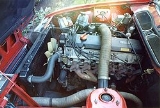
Saab 2stroke Engine
In automotive engineering
Automotive engineering

Modern automotive engineering is a branch of vehicle engineering, incorporating elements of Mechanical engineering, Electrical engineering, Electronic engineering, Software engineering and safety engineering as applied to the design, manufacture and operation of motorcycles, automobiles, buses and trucks and their respective engineering subsy...
, a longitudinal engine, also sometimes known as a north-south engine, is an internal combustion engine
Internal combustion engine

The internal combustion engine is an engine in which the combustion of a fuel occurs in a combustion chamber inside and integral to the engine. In an internal combustion engine it is always the expansion of the high temperature and pressure gases that are produced by the combustion which apply force to the movable component of the engine, such as...
 in which the crankshaft
Crankshaft

The crankshaft, sometimes casually abbreviated to crank , is the part of an engine which translates reciprocation linear piston motion into rotation....
 is oriented along the long axis of the vehicle
Vehicle

Vehicles, derived from the Latin word, vehiculum, are non-living means of transport. Most often they are manufactured , although some other means of transport which are not made by humans also may be called vehicles; examples include icebergs and floating tree trunks....
, front to back.

Most rear wheel drive vehicles use this engine orientation, while most modern front wheel drive vehicles use a side-to-side transverse
Transverse engine

A transverse engine is an engine in which the crankshaft is oriented side-to-side relative to the length of the vehicle. This is also sometimes called an east-west engine....
 arrangement. An exception is most Audi
Audi

AUDI AG, is a Germany car manufacturer which produces cars under the Audi brand, . The name Audi is based on a latin translation of the last name of the founder August "Horch", itself the German word for ?hear." Another explanation for the origin of the name is as an acronym for ?Auto Union Deutschland Ingolstadt."...
 and some Volkswagen
Volkswagen

Volkswagen Passenger Cars, also known as VW, is an automobile manufacturer based in Wolfsburg, Germany and is the original as well as the largest brand by sales volume within the Volkswagen Group....
 vehicles (those using platforms designed to accommodate the Torsen
Torsen

Torsen is a type of limited slip differential used in automobiles. It was invented by United States of America Vernon Gleasman and manufactured by the Gleason Corporation....
-based quattro four wheel drive system) which continue to use the longitudinal layout, and Saab until the Saab 9000
Saab 9000

The 9000, Saab Automobile's first executive car, was released in 1985. It was replaced by the Saab 9-5 in the fall of 1998 for the 1999 model year....
.

Position placement of longitudinal engines

Engines may be placed in three main positions within the motor car:
  • front engine
    Front-engine design

    A front-mounted engine describes the placement of an automobile internal-combustion engine in front of the vehicle passenger compartment.Historically, this designation was used regardless of whether or not the entire engine was behind the front axle line....
     - where the engine is mounted under the bonnet/hood, over the front axle (sometimes ahead of the front axle),
  • rear engine
    Rear-engine design

    In automobile design, a rear-engine design layout places the engine at the rear of the vehicle. The center of gravity of the engine itself is past the rear axle....
     - where the engine is mounted where the boot/trunk would normally be, either over, or to the rear of the rear axle,
  • mid engine
    Mid-engine design

    A mid-engine layout describes the placement of an automobile internal-combustion engine between the rear and front axles. Another term for this is mid-ship....
     - where the engine is mounted between the front and rear axles, usually where the rear seats would be sited.


Common types longitudinally placed engines

This is a list of typical examples of types of engines which can be placed in motor vehicles:
  • in-line or straight engine
    Straight engine

    Usually found in 4- and 6-cylinder configurations, the straight engine is an internal-combustion engine with all cylinders aligned in one row, with no or only minimal offset....
     - where two
    Straight-two

    A straight-two engine, parallel twin or inline twin is a two-cylinder piston engine that has its cylinders arranged in a single row....
    , three
    Straight-3

    A straight-3 or inline-3 is an internal combustion engine with three cylinder s arranged in a straight line side by side.Most straight-3 engines employ a crank angle of 120? and are thus rotationally balanced; however, since the three cylinders are offset from each other, the firing of the end cylinders induces a rocking motion from e...
    , four
    Straight-4

    The straight-4 or inline-4 engine is a four cylinder internal combustion engine with all four cylinder mounted in a straight line along the crankcase....
    , five
    Straight-5

    The straight-5 or inline-5 is an internal combustion engine with five Cylinder aligned in one row, sharing a single engine block and crankcase....
    , six
    Straight-6

    The straight-6 or inline-6 engine is a six cylinder internal combustion engine with all six cylinder mounted in a straight line along the crankcase....
    , and even eight
    Straight-8

    The straight-8 or inline-8 engine is an eight-cylinder internal combustion engine with all eight cylinder mounted in a straight line along the crankcase....
     cylinders are placed in a single plane,
  • V engine
    V engine

    A V engine is a common engine configuration for an internal combustion engine. The Cylinder_%28engine%29 and pistons are aligned, in two separate planes, so that they appear to be in a "V" when viewed along the axis of the crankshaft....
     - where two
    V-twin

    A V-twin is a two cylinder internal combustion engine where the cylinders are arranged in a V engine configuration....
    , four
    V4 engine

    File:Saab Sonett III Ford V4 engine.jpgA V4 engine is a V engine with four cylinder s....
    , six
    V6 engine

    A V6 engine is a V engine with six cylinder s mounted on the crankcase in two banks of three cylinders, usually set at either a right angle or an acute angle to each other, with all six pistons driving a common crankshaft....
    , eight
    V8 engine

    A V8 engine is a V engine with eight cylinder s mounted on the crankcase in two banks of four cylinders, in most cases set at a right angle to each other but sometimes at a narrower angle, with all eight pistons driving a common crankshaft....
    , ten
    V10 engine

    A V10 engine is a V engine with 10 cylinder s in two banks of five with a distinct exhaust note....
    , twelve
    V12 engine

    A V12 engine is a V engine with 12 cylinder s mounted on the crankcase in two banks of six cylinders, usually at a 60? angle to each other, but in some cases at a wider or narrower angle, with all 12 pistons driving a common crankshaft....
    , or even sixteen
    V16 engine

    A V16 engine is a v engine with 16 cylinder s. Engines of this number of cylinders are uncommon in automotive use.A V16 engine is perfectly balanced regardless of the V angle without requiring counter-rotating balance shaft which are necessary on large Straight-4 or counterweighted crankshaft like the 90? V8....
     cylinders are placed in two separate planes, looking like a "V" when viewed from the end of the crankshaft,
  • flat or boxer engine
    Flat engine

    A flat engine is an internal combustion engine with pistons that are all relatively horizontal. A straight engine canted 90 degrees from straight up is a flat engine, as is one in which the cylinder s are arranged in two banks on either side of a single crankshaft....
     - where two
    Flat-twin

    A flat-twin is a two cylinder internal combustion engine with the cylinders arranged on opposite sides of the crankshaft....
    , four
    Flat-4

    A flat-4 or horizontally-opposed-4 is a flat engine with four cylinders arranged horizontally in two banks of two cylinders on each side of a central crankcase....
    , six
    Flat-6

    A flat-6 or horizontally-opposed-6 is a flat engine with six cylinders arranged horizontally in two banks of three cylinders on each side of a central crankcase....
     or more cylinders are arranged in two diametrically horizontally opposed planes,
  • W engine
    W engine

    The W engine is an engine configuration in which the cylinder banks resemble the letter W in the same way a V engine resembles the letter V....
     - where two (narrow angle) vee engines are siamesed together (within 180°), where at eight
    W8 engine

    A W8 engine is an eight cylinder reciprocating engine in a W engine, or two juxtaposed 15 degree V4 engine blocks, mounted at 72 degrees to one another and coupled to one crankshaft....
    , twelve
    W12 engine

    A W12 engine is a twelve cylinder reciprocating engine in a W engine. W12 engines are manufactured in two distinct configurations. One configuration uses four banks of three cylinders , coupled to a common crankshaft ....
     or sixteen
    W16 engine

    A W16 engine is a sixteen cylinder reciprocating engine internal combustion engine in a W engine. All W16 engines consist of two banks of eight cylinders, coupled to a single crankshaft....
     cylinders are arranged in four separate planes,
  • H engine
    H engine

    An H engine is an engine configuration in which the cylinder s are aligned so that if viewed from the front, they appear to be in a vertical or horizontal letter H....
     - where two vee engines are siamesed together (greater than 180°), where at eight, twelve or sixteen cylinders are arranged in four separate planes,