


Long and short scales

Encyclopedia
The long and short scales are two of several different large-number naming systems used throughout the world for integer powers of ten
. Many countries, including most in continental Europe
, use the long scale whereas most English-speaking countries use the short scale. In all such countries, the number names are translated into the local language, but retain a name similarity due to shared etymology
. Some languages, particularly in East Asia
and South Asia
, have large number naming systems that are different from the long and short scales.
For integers less than a thousand million (< 109), the two scales are identical. At and above a thousand million (≥ 109), the two scales diverge by using the same words for different number values. These "false friend
s" can be a source of misunderstanding.
For most of the 19th and 20th centuries, the United Kingdom
uniformly used the long scale, while the United States of America
used the short scale, so that the two systems were often referred to as British and American in the English language
. In 1974, the government of the UK switched to the short scale, a change that is reflected in its mass media
and official usage. Although some residual usage of the long scale continues in the UK, the phrases British usage and American usage are no longer accurate characterisations. Usage of the two systems can be a subject of controversy. Differences in opinion as to which system should be used can evoke resentment between adherents, while national differences of any kind can acquire jingoistic
overtones.
The first recorded use of the terms échelle courte and échelle longue was by the French mathematician Geneviève Guitel
in 1975.
Each scale has a logical justification to explain the use of each such differing numerical name and value within each scale. The short scale logic is based on powers of one thousand, whereas the long scale logic is based on powers of one million. In both scales, the prefix bi- refers to "2" and tri- refers to "3", etc. However only in the long scale do the prefixes beyond one million indicate the actual power or exponent
(of 1,000,000). In the short scale, the prefixes refer to one less than the exponent (of 1,000).
The relationship between the numeric values and the corresponding names in the two scales can be described as:
The root mil in "million" does not refer to the numeral "one". Rather, it refers to the Latin word for "thousand" (milia).
The relationship between the names and the corresponding numeric values in the two scales can be described as:
The word milliard, or its translation, is found in many European languages and is used in those languages for 109. However, it is unknown in American English, which uses billion, and not used in British English, which preferred to use thousand million before the current usage of billion. The financial term yard, which derives from milliard, is used on financial markets, as it is unambiguous, unlike billion. Likewise, many long scale countries use the word billiard (or similar) for a thousand long scale billions (i.e. 1015), and the word trilliard (or similar) for a thousand long scale trillions (i.e. 1021), etc.
and Italy
use the long scale.
The pre-1974 former British English word billion, post-1961 current French word billion, post-1994 current Italian word bilione, German Billion; Dutch biljoen; Swedish biljon; Finnish biljoona; Danish billion; Spanish billón and the European Portuguese word bilião (with an alternate spelling to the Brazilian Portuguese variant) all refer to 1012, being long-scale terms. Therefore, each of these words translates to the American English or post-1974 modern British English word: trillion (1012 in the short scale), and not billion (109 in the short scale).
On the other hand, the pre-1961 former French word billion, pre-1994 former Italian word bilione, Brazilian Portuguese word bilhão and the Welsh word biliwn all refer to 109, being short scale terms. Each of these words translates to the American English or post-1974 modern British English word billion (109 in the short scale).
The terms billion and milliard both originally meant 1012 when introduced.
The word million derives from the Old French Milion from the earlier Old Italian milione, an intensification of mille, a thousand. That is, a million is a "big thousand", much as a "great gross" is a dozen gross or 1728
Timeline
}
Translation:
|-
| valign="top"|1484
|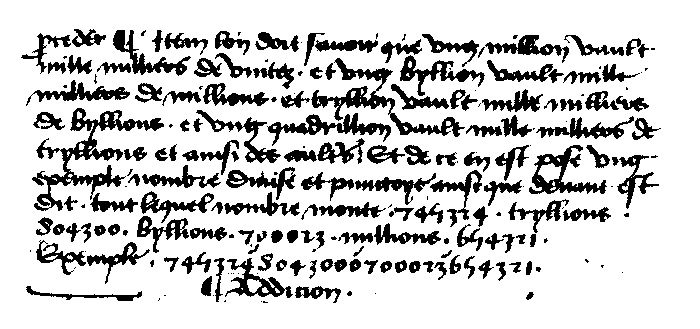 French mathematician Nicolas Chuquet
, in his article "Le Triparty en la Science des Nombres par Maistre Nicolas Chuquet Parisien", used the words byllion, tryllion, quadrillion, quyllion, sixlion, septyllion, ottyllion, and nonyllion to refer to 1012, 1018, etc. Chuquet's work was not published until the 1870s, but most of it was copied without attribution by Estienne de La Roche
and published in his 1520 book, L'arismetique.
Translation:
The extract from Chuquet's manuscript, the transcription and translation provided here all contain an original mistake: one too many zeros in the 804300 portion of the fully written out example: 745324'8043000 '700023'654321 ..."
|-
|valign="top"|1514
| French mathematician Budaeus (Guillaume Budé
), writing in Latin, used the term milliart to mean "Millions of millions" or 1012 in his book "De Asse et partibus eius Libri quinqz".
Translation:
|-
| valign="top"|1549
| The influential French mathematician Jacques Pelletier du Mans used the name milliard (or milliart), attributing this meaning to the earlier usage by Guillaume Budé
|-
| valign="top"| 1600s
| The traditional six-digit groups were split into three-digit groups. In France and Italy, some scientists then began using billion to mean 109, trillion to mean 1012, etc. This usage formed the origins of the later short scale. The majority of scientists either continued to say thousand million or changed the meaning of the Pelletier term, milliard, from "million of millions" down to "thousand million". This meaning of milliard has been occasionally used in England, but was widely adopted in France, Germany, Italy and the rest of Europe, for those keeping Chuquet's original long scale billion.
|-
| valign="top"| 1676
|The first published use of milliard as 109 occurred in 1676 in Houck's Arithmetic, published in the Netherlands.
|-
| valign="top"|Early 1700s
|The short-scale meaning of the term billion was brought to the British American colonies
|-
| valign="top"|1729
|The first American appearance of the short scale value of billion as 109 was published in the Greenwood Book of 1729, written anonymously by Prof. Isaac Greenwood
of Harvard College
|-
| valign="top"|Early 1800s
|France widely converted to the short scale, and was followed by the U.S., which began teaching it in schools. Many French encyclopedias of the 19th century either omitted the long scale system or called it "désormais obsolète", a now obsolete system. Nevertheless, by the mid 20th century France had converted back to the long scale.
|-
| valign="top"|1926
|H. W. Fowler
's A Dictionary of Modern English Usage noted:
|-
| valign="top"|1948
|The 9th General Conference on Weights and Measures
received a proposal recommending the universal use of the long scale, inviting the short-scale countries to return or convert. The proposal was considered but not adopted.
|-
| valign="top"|1960
|The 11th General Conference on Weights and Measures
adopted the International System of Units
(SI), with its own set of numeric prefixes. SI is therefore independent of the number scale being used. SI also notes the language-dependence of some larger-number names and advises against using such ambiguous terms as billion, trillion, etc.
|-
| valign="top"|1961
|The French Government
confirmed their official usage of the long scale in the Journal Officiel (the official French Government gazette).
|-
| valign="top"|1974
|British prime minister Harold Wilson
explained in a written answer to the House of Commons that UK government statistics
would from then on use the short scale. Hansard
, for the 20 December 1974, reported it:
During the last quarter of the 20th century, most other English-speaking countries (Ireland, Australia, New Zealand, South Africa, Zimbabwe, etc.) either followed this lead or independently switched to the short scale use. However, in most of these countries, some limited long scale use persists and the official status of the short scale use is not clear.
|-
| valign="top"|1975
|French mathematician Geneviève Guitel
introduced the terms échelle longue (long scale) and échelle courte (short scale) to refer to the two numbering systems.
|-
| valign="top"|1994
|The Italian Government confirmed their official usage of the long scale.
|}
Most English-language countries use the short scale with 109 = billion. For example:
Other short scale countries and regions
Other countries also use a word similar to trillion to mean 1012, etc. While a few of these countries use a word similar to billion to mean 109, most have kept a traditional long scale word similar to "milliard" for 109. Some examples of short scale use, and the words used for 109 and 1012, are:
Short scale use but with other terminology
The traditional long scale is used by most Continental Europe
an countries and by most other countries whose languages derive from Continental Europe
(with the notable exceptions of Greece, Romania, Bulgaria and Brazil). These countries use a word similar to billion to mean 1012. Some use a word similar to milliard to mean 109, while others use something equivalent to thousand millions. Some examples of long scale use, and the words used for 109 and 1012, are:
countries have their own numbering systems and use neither short nor long scales:
Presence on most continents
The long and short scales are both present on all continents, with usage dependent on the language used. Examples include:
Alternative approaches
Unambiguous ways of identifying large numbers include:
Powers of 10
In mathematics, a power of ten is any of the integer powers of the number ten; in other words, ten multiplied by itself a certain number of times. By definition, the number one is a power of ten. The first few powers of ten are:...
. Many countries, including most in continental Europe
Continental Europe
Continental Europe, also referred to as mainland Europe or simply the Continent, is the continent of Europe, explicitly excluding European islands....
, use the long scale whereas most English-speaking countries use the short scale. In all such countries, the number names are translated into the local language, but retain a name similarity due to shared etymology
Etymology
Etymology is the study of the history of words, their origins, and how their form and meaning have changed over time.For languages with a long written history, etymologists make use of texts in these languages and texts about the languages to gather knowledge about how words were used during...
. Some languages, particularly in East Asia
East Asia
East Asia or Eastern Asia is a subregion of Asia that can be defined in either geographical or cultural terms...
and South Asia
South Asia
South Asia, also known as Southern Asia, is the southern region of the Asian continent, which comprises the sub-Himalayan countries and, for some authorities , also includes the adjoining countries to the west and the east...
, have large number naming systems that are different from the long and short scales.
- Long scale is the EnglishEnglish languageEnglish is a West Germanic language that arose in the Anglo-Saxon kingdoms of England and spread into what was to become south-east Scotland under the influence of the Anglian medieval kingdom of Northumbria...
translation of the FrenchFrench languageFrench is a Romance language spoken as a first language in France, the Romandy region in Switzerland, Wallonia and Brussels in Belgium, Monaco, the regions of Quebec and Acadia in Canada, and by various communities elsewhere. Second-language speakers of French are distributed throughout many parts...
term échelle longue. It refers to a system of large-number names in which every new term greater than millionMillionOne million or one thousand thousand, is the natural number following 999,999 and preceding 1,000,001. The word is derived from the early Italian millione , from mille, "thousand", plus the augmentative suffix -one.In scientific notation, it is written as or just 106...
is 1,000,000 times the previous term: billion means a million millions (1012), trillion means a million billions (1018), and so on.
- Short scale is the English translation of the French term échelle courte. It refers to a system of large-number names in which every new term greater than million is 1,000 times the previous term: billion1000000000 (number)1,000,000,000 is the natural number following 999,999,999 and preceding 1,000,000,001.In scientific notation, it is written as 109....
means a thousand millions (109), trillion means a thousand billions (1012), and so on.
For integers less than a thousand million (< 109), the two scales are identical. At and above a thousand million (≥ 109), the two scales diverge by using the same words for different number values. These "false friend
False friend
False friends are pairs of words or phrases in two languages or dialects that look or sound similar, but differ in meaning....
s" can be a source of misunderstanding.
For most of the 19th and 20th centuries, the United Kingdom
United Kingdom
The United Kingdom of Great Britain and Northern IrelandIn the United Kingdom and Dependencies, other languages have been officially recognised as legitimate autochthonous languages under the European Charter for Regional or Minority Languages...
uniformly used the long scale, while the United States of America
United States
The United States of America is a federal constitutional republic comprising fifty states and a federal district...
used the short scale, so that the two systems were often referred to as British and American in the English language
English language
English is a West Germanic language that arose in the Anglo-Saxon kingdoms of England and spread into what was to become south-east Scotland under the influence of the Anglian medieval kingdom of Northumbria...
. In 1974, the government of the UK switched to the short scale, a change that is reflected in its mass media
Mass media
Mass media refers collectively to all media technologies which are intended to reach a large audience via mass communication. Broadcast media transmit their information electronically and comprise of television, film and radio, movies, CDs, DVDs and some other gadgets like cameras or video consoles...
and official usage. Although some residual usage of the long scale continues in the UK, the phrases British usage and American usage are no longer accurate characterisations. Usage of the two systems can be a subject of controversy. Differences in opinion as to which system should be used can evoke resentment between adherents, while national differences of any kind can acquire jingoistic
Jingoism
Jingoism is defined in the Oxford English Dictionary as extreme patriotism in the form of aggressive foreign policy. In practice, it is a country's advocation of the use of threats or actual force against other countries in order to safeguard what it perceives as its national interests...
overtones.
The first recorded use of the terms échelle courte and échelle longue was by the French mathematician Geneviève Guitel
Geneviève Guitel
Geneviève Guitel was a French mathematician. She is mostly remembered for her introduction of the terms échelle longue and échelle courte to refer to two of the main numbering systems used around the world. She was appointed as Mathematics teacher in 1920 and taught at the Lycée Molière in Paris....
in 1975.
Comparison
The same numerical value has two different names, depending on whether the value is being expressed in the long or short scale. Equivalently, the same name has two different numerical values depending on whether it is being used in the long or short scale.Each scale has a logical justification to explain the use of each such differing numerical name and value within each scale. The short scale logic is based on powers of one thousand, whereas the long scale logic is based on powers of one million. In both scales, the prefix bi- refers to "2" and tri- refers to "3", etc. However only in the long scale do the prefixes beyond one million indicate the actual power or exponent
Exponentiation
Exponentiation is a mathematical operation, written as an, involving two numbers, the base a and the exponent n...
(of 1,000,000). In the short scale, the prefixes refer to one less than the exponent (of 1,000).
The relationship between the numeric values and the corresponding names in the two scales can be described as:
| Value in Scientific notation Scientific notation Scientific notation is a way of writing numbers that are too large or too small to be conveniently written in standard decimal notation. Scientific notation has a number of useful properties and is commonly used in calculators and by scientists, mathematicians, doctors, and engineers.In scientific... |
Value in numerals |
Short Scale | Long Scale | ||
|---|---|---|---|---|---|
| Name | Logic | Name | Logic | ||
| 10 0 | 1 | one | one | ||
| 10 3 | 1,000 | thousand | thousand | ||
| 10 6 | 1,000,000 | million | million | ||
| 10 9 | 1,000,000,000 | billion or milliard | 1,0002+1 | thousand million or milliard | |
| 1012 | 1,000,000,000,000 | trillion | 1,0003+1 | billion | 1,000,0002 |
| 1015 | 1,000,000,000,000,000 | quadrillion | 1,0004+1 | thousand billion or billiard | |
| 1018 | 1,000,000,000,000,000,000 | quintillion | 1,0005+1 | trillion | 1,000,0003 |
| 1021 | 1,000,000,000,000,000,000,000 | sextillion | 1,0006+1 | thousand trillion or trilliard | |
| 1024 | 1,000,000,000,000,000,000,000,000 | septillion | 1,0007+1 | quadrillion | 1,000,0004 |
| etc. | etc. | To get from one named order of magnitude to the next: multiply by 1,000 | To get from one named order of magnitude to the next: multiply by 1,000,000 | ||
The root mil in "million" does not refer to the numeral "one". Rather, it refers to the Latin word for "thousand" (milia).
The relationship between the names and the corresponding numeric values in the two scales can be described as:
| Name | Short Scale | Long Scale | ||
|---|---|---|---|---|
| Value in Scientific notation |
Logic | Value in Scientific notation |
Logic | |
| million | 106 | 106 | ||
| billion | 109 | 1,0002+1 | 1012 | 1,000,0002 |
| trillion | 1012 | 1,0003+1 | 1018 | 1,000,0003 |
| quadrillion | 1015 | 1,0004+1 | 1024 | 1,000,0004 |
| etc. | To get from one named order of magnitude to the next: multiply by 1,000 | To get from one named order of magnitude to the next: multiply by 1,000,000 | ||
The word milliard, or its translation, is found in many European languages and is used in those languages for 109. However, it is unknown in American English, which uses billion, and not used in British English, which preferred to use thousand million before the current usage of billion. The financial term yard, which derives from milliard, is used on financial markets, as it is unambiguous, unlike billion. Likewise, many long scale countries use the word billiard (or similar) for a thousand long scale billions (i.e. 1015), and the word trilliard (or similar) for a thousand long scale trillions (i.e. 1021), etc.
History
The existence of the different scales means that care must be taken when comparing large numbers between languages or countries, or when interpreting old documents in countries where the dominant scale has changed over time. For example, British-English, French, and Italian historical documents can refer to either the short or long scale, depending on the date of the document, since each of the three countries has used both systems at various times in its history. Today, the United Kingdom officially uses the short scale, but FranceFrance
The French Republic , The French Republic , The French Republic , (commonly known as France , is a unitary semi-presidential republic in Western Europe with several overseas territories and islands located on other continents and in the Indian, Pacific, and Atlantic oceans. Metropolitan France...
and Italy
Italy
Italy , officially the Italian Republic languages]] under the European Charter for Regional or Minority Languages. In each of these, Italy's official name is as follows:;;;;;;;;), is a unitary parliamentary republic in South-Central Europe. To the north it borders France, Switzerland, Austria and...
use the long scale.
The pre-1974 former British English word billion, post-1961 current French word billion, post-1994 current Italian word bilione, German Billion; Dutch biljoen; Swedish biljon; Finnish biljoona; Danish billion; Spanish billón and the European Portuguese word bilião (with an alternate spelling to the Brazilian Portuguese variant) all refer to 1012, being long-scale terms. Therefore, each of these words translates to the American English or post-1974 modern British English word: trillion (1012 in the short scale), and not billion (109 in the short scale).
On the other hand, the pre-1961 former French word billion, pre-1994 former Italian word bilione, Brazilian Portuguese word bilhão and the Welsh word biliwn all refer to 109, being short scale terms. Each of these words translates to the American English or post-1974 modern British English word billion (109 in the short scale).
The terms billion and milliard both originally meant 1012 when introduced.
- In long scale countries, milliard was redefined down to its current value of 109, leaving billion at its original 1012 value and so on for the larger numbers. Some of these countries, but not all, introduced new words billiard, trilliard, etc. as intermediate terms.
- In some short scale countries, milliard was redefined down to 109 and billion dropped altogether, with trillion redefined down to 1012 and so on for the larger numbers.
- In many short scale countries, milliard was dropped altogether and billion was redefined down to 109, adjusting downwards the value of trillion and all the larger numbers.
The word million derives from the Old French Milion from the earlier Old Italian milione, an intensification of mille, a thousand. That is, a million is a "big thousand", much as a "great gross" is a dozen gross or 1728
1728 (number)
1728 is the natural number following 1727 and preceding 1729. 1728 is a dozen gross, one great gross .-In mathematics:...
Timeline
| Date | Event |
|---|---|
| 1200s | The word million was not used before the 13th century. Maximus Planudes Maximus Planudes Maximus Planudes, less often Maximos Planoudes , Byzantine grammarian and theologian, flourished during the reigns of Michael VIII Palaeologus and Andronicus II Palaeologus. He was born at Nicomedia in Bithynia, but the greater part of his life was spent in Constantinople, where as a monk he... (cir 1260–1305) was among the first recorded users. |
| late 1300s | The word million entered the English language. One of the earliest references is William Langland William Langland William Langland is the conjectured author of the 14th-century English dream-vision Piers Plowman.- Life :The attribution of Piers to Langland rests principally on the evidence of a manuscript held at Trinity College, Dublin... 's Piers Plowman Piers Plowman Piers Plowman or Visio Willelmi de Petro Plowman is the title of a Middle English allegorical narrative poem by William Langland. It is written in unrhymed alliterative verse divided into sections called "passus"... (written -1387), with: |
| 1475 |
Translation:
|-
| valign="top"|1484
|
Nicolas Chuquet
Nicolas Chuquet was a French mathematician whose great work, Triparty en la science des nombres , was unpublished in his lifetime...
, in his article "Le Triparty en la Science des Nombres par Maistre Nicolas Chuquet Parisien", used the words byllion, tryllion, quadrillion, quyllion, sixlion, septyllion, ottyllion, and nonyllion to refer to 1012, 1018, etc. Chuquet's work was not published until the 1870s, but most of it was copied without attribution by Estienne de La Roche
Estienne de La Roche
Estienne de La Roche was a French mathematician.Sometimes known as Estienne de Villefranche, La Roche was born in Lyon, but his family also owned property in Villefranche-sur-Saône, where he lived during his youth. He studied mathematics with Nicolas Chuquet. Having in his possession Chuquet's...
and published in his 1520 book, L'arismetique.
Translation:
The extract from Chuquet's manuscript, the transcription and translation provided here all contain an original mistake: one too many zeros in the 804300 portion of the fully written out example: 745324'8043000 '700023'654321 ..."
|-
|valign="top"|1514
| French mathematician Budaeus (Guillaume Budé
Guillaume Budé
Guillaume Budé was a French scholar.-Life:Budé was born in Paris. He went to the University of Orléans to study law, but for several years, being possessed of ample means, he led an idle and dissipated life...
), writing in Latin, used the term milliart to mean "Millions of millions" or 1012 in his book "De Asse et partibus eius Libri quinqz".
Translation:
|-
| valign="top"|1549
| The influential French mathematician Jacques Pelletier du Mans used the name milliard (or milliart), attributing this meaning to the earlier usage by Guillaume Budé
Guillaume Budé
Guillaume Budé was a French scholar.-Life:Budé was born in Paris. He went to the University of Orléans to study law, but for several years, being possessed of ample means, he led an idle and dissipated life...
|-
| valign="top"| 1600s
| The traditional six-digit groups were split into three-digit groups. In France and Italy, some scientists then began using billion to mean 109, trillion to mean 1012, etc. This usage formed the origins of the later short scale. The majority of scientists either continued to say thousand million or changed the meaning of the Pelletier term, milliard, from "million of millions" down to "thousand million". This meaning of milliard has been occasionally used in England, but was widely adopted in France, Germany, Italy and the rest of Europe, for those keeping Chuquet's original long scale billion.
|-
| valign="top"| 1676
|The first published use of milliard as 109 occurred in 1676 in Houck's Arithmetic, published in the Netherlands.
|-
| valign="top"|Early 1700s
|The short-scale meaning of the term billion was brought to the British American colonies
|-
| valign="top"|1729
|The first American appearance of the short scale value of billion as 109 was published in the Greenwood Book of 1729, written anonymously by Prof. Isaac Greenwood
Isaac Greenwood
Professor Isaac Greenwood was the first Hollisian Professor of Mathematics and Natural Philosophy at Harvard College....
of Harvard College
Harvard College
Harvard College, in Cambridge, Massachusetts, is one of two schools within Harvard University granting undergraduate degrees...
|-
| valign="top"|Early 1800s
|France widely converted to the short scale, and was followed by the U.S., which began teaching it in schools. Many French encyclopedias of the 19th century either omitted the long scale system or called it "désormais obsolète", a now obsolete system. Nevertheless, by the mid 20th century France had converted back to the long scale.
|-
| valign="top"|1926
|H. W. Fowler
Henry Watson Fowler
Henry Watson Fowler was an English schoolmaster, lexicographer and commentator on the usage of the English language...
's A Dictionary of Modern English Usage noted:
|-
| valign="top"|1948
|The 9th General Conference on Weights and Measures
General Conference on Weights and Measures
The General Conference on Weights and Measures is the English name of the Conférence générale des poids et mesures . It is one of the three organizations established to maintain the International System of Units under the terms of the Convention du Mètre of 1875...
received a proposal recommending the universal use of the long scale, inviting the short-scale countries to return or convert. The proposal was considered but not adopted.
|-
| valign="top"|1960
|The 11th General Conference on Weights and Measures
General Conference on Weights and Measures
The General Conference on Weights and Measures is the English name of the Conférence générale des poids et mesures . It is one of the three organizations established to maintain the International System of Units under the terms of the Convention du Mètre of 1875...
adopted the International System of Units
International System of Units
The International System of Units is the modern form of the metric system and is generally a system of units of measurement devised around seven base units and the convenience of the number ten. The older metric system included several groups of units...
(SI), with its own set of numeric prefixes. SI is therefore independent of the number scale being used. SI also notes the language-dependence of some larger-number names and advises against using such ambiguous terms as billion, trillion, etc.
|-
| valign="top"|1961
|The French Government
Government of France
The government of the French Republic is a semi-presidential system determined by the French Constitution of the fifth Republic. The nation declares itself to be an "indivisible, secular, democratic, and social Republic"...
confirmed their official usage of the long scale in the Journal Officiel (the official French Government gazette).
|-
| valign="top"|1974
|British prime minister Harold Wilson
Harold Wilson
James Harold Wilson, Baron Wilson of Rievaulx, KG, OBE, FRS, FSS, PC was a British Labour Member of Parliament, Leader of the Labour Party. He was twice Prime Minister of the United Kingdom during the 1960s and 1970s, winning four general elections, including a minority government after the...
explained in a written answer to the House of Commons that UK government statistics
Statistics
Statistics is the study of the collection, organization, analysis, and interpretation of data. It deals with all aspects of this, including the planning of data collection in terms of the design of surveys and experiments....
would from then on use the short scale. Hansard
Hansard
Hansard is the name of the printed transcripts of parliamentary debates in the Westminster system of government. It is named after Thomas Curson Hansard, an early printer and publisher of these transcripts.-Origins:...
, for the 20 December 1974, reported it:
During the last quarter of the 20th century, most other English-speaking countries (Ireland, Australia, New Zealand, South Africa, Zimbabwe, etc.) either followed this lead or independently switched to the short scale use. However, in most of these countries, some limited long scale use persists and the official status of the short scale use is not clear.
|-
| valign="top"|1975
|French mathematician Geneviève Guitel
Geneviève Guitel
Geneviève Guitel was a French mathematician. She is mostly remembered for her introduction of the terms échelle longue and échelle courte to refer to two of the main numbering systems used around the world. She was appointed as Mathematics teacher in 1920 and taught at the Lycée Molière in Paris....
introduced the terms échelle longue (long scale) and échelle courte (short scale) to refer to the two numbering systems.
|-
| valign="top"|1994
|The Italian Government confirmed their official usage of the long scale.
|}
Short scale countries and regions
English language-speaking countries and regions English language countries: Apart from the United States, the long scale was used for centuries in many English language countries before being superseded in recent times by short scale usage. Because of this history, some long scale use persists and the official status of the short scale in anglophone countries other than the UK and US is sometimes obscure.- 106 = one million, 109 = one billion, 1012 = one trillion, etc.
Most English-language countries use the short scale with 109 = billion. For example:
Other short scale countries and regions
- 106 = one million, 109 = one milliard / billion, 1012 = one trillion, etc.
Other countries also use a word similar to trillion to mean 1012, etc. While a few of these countries use a word similar to billion to mean 109, most have kept a traditional long scale word similar to "milliard" for 109. Some examples of short scale use, and the words used for 109 and 1012, are:
Short scale use but with other terminology
- (εκατομμύριο ekatommyrio "hundred-myriadMyriadMyriad , "numberlesscountless, infinite", is a classical Greek word for the number 10,000. In modern English, the word refers to an unspecified large quantity.-History and usage:...
" = 106; δισεκατομμύριο disekatommyrio "bi+hundred-myriad" = 109; τρισεκατομμύριο trisekatommyrio "tri+hundred-myriad" = 1012; τετράκις εκατομμύριο tetrakis ekatommyrio "quadri+hundred-myriad" = 1015, and so on.)
Long scale countries and languages
- 106 = one million, 109 = one milliard / thousand million, 1012 = one billion, 1015 = one billiard / thousand billion, 1018 = one trillion, etc.
The traditional long scale is used by most Continental Europe
Continental Europe
Continental Europe, also referred to as mainland Europe or simply the Continent, is the continent of Europe, explicitly excluding European islands....
an countries and by most other countries whose languages derive from Continental Europe
Continental Europe
Continental Europe, also referred to as mainland Europe or simply the Continent, is the continent of Europe, explicitly excluding European islands....
(with the notable exceptions of Greece, Romania, Bulgaria and Brazil). These countries use a word similar to billion to mean 1012. Some use a word similar to milliard to mean 109, while others use something equivalent to thousand millions. Some examples of long scale use, and the words used for 109 and 1012, are:
 Esperanto languageEsperantois the most widely spoken constructed international auxiliary language. Its name derives from Doktoro Esperanto , the pseudonym under which L. L. Zamenhof published the first book detailing Esperanto, the Unua Libro, in 1887...
(miliardo, duiliono)
Both long and short scale countries
Some countries use either the Short or Long scales, depending on the internal language being used or the context.- 106 = one million, 109 = EITHER one billion (Short Scale) OR one milliard / thousand million (Long Scale), 1012 = EITHER one trillion (Short Scale) OR one billion (Long Scale), etc.
| Country or Territory | Short scale usage | Long scale usage |
|---|---|---|
| Canadian English Canadian English Canadian English is the variety of English spoken in Canada. English is the first language, or "mother tongue", of approximately 24 million Canadians , and more than 28 million are fluent in the language... (billion = 109, trillion = 1012) |
Canadian French Canadian French Canadian French is an umbrella term referring to the varieties of French spoken in Canada. French is the mother tongue of nearly seven million Canadians, a figure constituting roughly 22% of the national population. At the federal level it has co-official status alongside English... (milliard = 109, billion = 1012). |
|
| economic & technical (billón = 109, trillón = 1012) | Latin American export publications (millardo or mil millones = 109, billón = 1012) | |
| South African English South African English The term South African English is applied to the first-language dialects of English spoken by South Africans, with the L1 English variety spoken by Zimbabweans, Zambians and Namibians, being recognised as offshoots.There is some social and regional variation within South African English... (billion = 109, trillion = 1012) |
Afrikaans Afrikaans Afrikaans is a West Germanic language, spoken natively in South Africa and Namibia. It is a daughter language of Dutch, originating in its 17th century dialects, collectively referred to as Cape Dutch .Afrikaans is a daughter language of Dutch; see , , , , , .Afrikaans was historically called Cape... (miljard = 109, biljoen = 1012) |
|
| For numbers > 109, the short scale is used (trilion = 1012) | For numbers ≤ 109, the long scale is used (miliard = 109) |
Neither short nor long scale countries
The following AsianAsia
Asia is the world's largest and most populous continent, located primarily in the eastern and northern hemispheres. It covers 8.7% of the Earth's total surface area and with approximately 3.879 billion people, it hosts 60% of the world's current human population...
countries have their own numbering systems and use neither short nor long scales:
| Country | Main article | Notes |
|---|---|---|
| , , , | Indian numerals Indian numbering system The South Asian numbering system, used today in the Indian subcontinent , is based on grouping by two decimal places, rather than the three decimal places commonplace in most parts of the world. This system of measurement introduces separators into numbers in places appropriate to the two-digit... |
For everyday use, but short or long scale may also be in use |
| Dzongkha numerals Dzongkha numerals Dzongkha, the national language of Bhutan, has two numeral systems, one vigesimal , and a modern decimal system. The vigesimal system remains in robust use. Ten is an auxiliary base: the teens are formed with ten and the numerals 1–9.-Vigesimal:... |
Traditional system | |
| Khmer numerals Khmer numerals Khmer numerals are characters used for writing numbers for several languages in Cambodia, most notably Cambodia's official language, Khmer. They date back to at least the oldest known epigraphical inscription of the Khmer numerals in 604 AD, found on a stele in Prasat Bayang, Cambodia, located not... |
Traditional system | |
| (People's Republic), (Republic of China) | Chinese numerals | Traditional myriad Myriad Myriad , "numberlesscountless, infinite", is a classical Greek word for the number 10,000. In modern English, the word refers to an unspecified large quantity.-History and usage:... system for the larger numbers; special words and symbols up to 1088. |
| Japanese numerals | Traditional myriad Myriad Myriad , "numberlesscountless, infinite", is a classical Greek word for the number 10,000. In modern English, the word refers to an unspecified large quantity.-History and usage:... system for the larger numbers; special words and symbols up to 1088. |
|
| , | Korean numerals Korean numerals The Korean language has two regularly used sets of numerals, a native Korean system and Sino-Korean system.-Construction:For both native and Sino- Korean numerals, the teens are represented by a combination of tens and the ones places... |
Traditional myriad Myriad Myriad , "numberlesscountless, infinite", is a classical Greek word for the number 10,000. In modern English, the word refers to an unspecified large quantity.-History and usage:... system for the larger numbers; special words and symbols up to 1088. |
| Mongolian numerals Mongolian numerals The Mongolian numerals areThey are still used on Mongolian tögrög banknotes. They are related to, and probably based on, the Tibetan numerals ༠༡༢༣༤༥༦༧༨༩.... |
Traditional system | |
| Sinhala numerals Sinhala numerals Sinhala belongs to the Indo-European language family with its roots deeply associated with Indo-Aryan sub family to which the languages such as Persian and Hindi belong [Histroy1]... Tamil numerals Tamil numerals Tamil numerals , refers to the numeral system of the Tamil language used officially in Tamil Nadu, Sri Lanka, Singapore and Mauritius, as well as by the other Tamil-speaking populations around the world including Malaysia, Réunion, and South Africa, and other emigrant communities around the world... |
Traditional systems | |
| Thai numerals Thai numerals Thai numerals constitute a numeral system of Thai number names for the Khmer numerals traditionally used in Thailand, also used for the more common Arabic numerals, and which follow the Hindu-Arabic numeral system.-Usage:... |
Traditional system based on millions | |
| Vietnamese numerals Vietnamese numerals In the Vietnamese language there are two sets of numeric systems, based on the Native Vietnamese and Sino-Vietnamese names of numbers.-Concept:Among the languages of the Sinosphere, Japanese and Korean both use two numeric systems—one native and one Chinese-based—and use the... |
Traditional system(s) based on thousands |
Presence on most continents
The long and short scales are both present on all continents, with usage dependent on the language used. Examples include:
| Continent | Short scale usage | Long scale usage |
|---|---|---|
| Africa Africa Africa is the world's second largest and second most populous continent, after Asia. At about 30.2 million km² including adjacent islands, it covers 6% of the Earth's total surface area and 20.4% of the total land area... |
South African English | Afrikaans |
| North America North America North America is a continent wholly within the Northern Hemisphere and almost wholly within the Western Hemisphere. It is also considered a northern subcontinent of the Americas... |
American English, Canadian English | American Spanish, Canadian French |
| South America South America South America is a continent situated in the Western Hemisphere, mostly in the Southern Hemisphere, with a relatively small portion in the Northern Hemisphere. The continent is also considered a subcontinent of the Americas. It is bordered on the west by the Pacific Ocean and on the north and east... |
Brazilian Portuguese, English (Guyana Guyana Guyana , officially the Co-operative Republic of Guyana, previously the colony of British Guiana, is a sovereign state on the northern coast of South America that is culturally part of the Anglophone Caribbean. Guyana was a former colony of the Dutch and of the British... ) |
American Spanish, Dutch (Suriname Suriname Suriname , officially the Republic of Suriname , is a country in northern South America. It borders French Guiana to the east, Guyana to the west, Brazil to the south, and on the north by the Atlantic Ocean. Suriname was a former colony of the British and of the Dutch, and was previously known as... ), French (French Guiana French Guiana French Guiana is an overseas region of France, consisting of a single overseas department located on the northern Atlantic coast of South America. It has borders with two nations, Brazil to the east and south, and Suriname to the west... ) |
| Antarctica | Australian English Australian English Australian English is the name given to the group of dialects spoken in Australia that form a major variety of the English language.... , British English, New Zealand English New Zealand English New Zealand English is the dialect of the English language used in New Zealand.The English language was established in New Zealand by colonists during the 19th century. It is one of "the newest native-speaker variet[ies] of the English language in existence, a variety which has developed and... |
American Spanish (Argentina, Chile), French (France), Norwegian (Norway) |
| Asia Asia Asia is the world's largest and most populous continent, located primarily in the eastern and northern hemispheres. It covers 8.7% of the Earth's total surface area and with approximately 3.879 billion people, it hosts 60% of the world's current human population... |
Burmese Burmese language The Burmese language is the official language of Burma. Although the constitution officially recognizes it as the Myanmar language, most English speakers continue to refer to the language as Burmese. Burmese is the native language of the Bamar and related sub-ethnic groups of the Bamar, as well as... (Myanmar), Hebrew (Israel), Indonesian Indonesian language Indonesian is the official language of Indonesia. Indonesian is a normative form of the Riau Islands dialect of Malay, an Austronesian language which has been used as a lingua franca in the Indonesian archipelago for centuries.... , Malaysian English Malaysian English Malaysian English , formally known as Malaysian Standard English , is a form of English used and spoken in Malaysia as a second language... , Persian Persian language Persian is an Iranian language within the Indo-Iranian branch of the Indo-European languages. It is primarily spoken in Iran, Afghanistan, Tajikistan and countries which historically came under Persian influence... (Iran), Philippine English Philippine English Philippine English is the variety of English used in the Philippines by the media and the vast majority of educated Filipinos. English is taught in schools as one of the two official languages of the country, the other being Filipino, a standardized version of Tagalog.English is used in education,... , |
Portuguese (Macau) |
| Europe Europe Europe is, by convention, one of the world's seven continents. Comprising the westernmost peninsula of Eurasia, Europe is generally 'divided' from Asia to its east by the watershed divides of the Ural and Caucasus Mountains, the Ural River, the Caspian and Black Seas, and the waterways connecting... |
British English, Hiberno-English Hiberno-English Hiberno-English is the dialect of English written and spoken in Ireland .English was first brought to Ireland during the Norman invasion of the late 12th century. Initially it was mainly spoken in an area known as the Pale around Dublin, with Irish spoken throughout the rest of the country... , Scottish English Scottish English Scottish English refers to the varieties of English spoken in Scotland. It may or may not be considered distinct from the Scots language. It is always considered distinct from Scottish Gaelic, a Celtic language.... , Welsh English Welsh English Welsh English, Anglo-Welsh, or Wenglish refers to the dialects of English spoken in Wales by Welsh people. The dialects are significantly influenced by Welsh grammar and often include words derived from Welsh... , Welsh, Bulgarian, Estonian, Greek, Latvian, Lithuanian, Turkish, Ukrainian |
Danish, Dutch, Finnish, French, German, Icelandic, Italian, Norwegian, Polish, Portuguese, Spanish, Swedish and most other languages of continental Europe |
| Oceania Oceania Oceania is a region centered on the islands of the tropical Pacific Ocean. Conceptions of what constitutes Oceania range from the coral atolls and volcanic islands of the South Pacific to the entire insular region between Asia and the Americas, including Australasia and the Malay Archipelago... |
Australian English, New Zealand English | French (French Polynesia French Polynesia French Polynesia is an overseas country of the French Republic . It is made up of several groups of Polynesian islands, the most famous island being Tahiti in the Society Islands group, which is also the most populous island and the seat of the capital of the territory... ) |
Alternative approaches
Unambiguous ways of identifying large numbers include:
- In written communications, the simplest solution for moderately large numbers is simply to write the full amount, for example 1,000,000,000,000 rather than, say, 1 trillion (short scale) or 1 billion (long scale).
- Combinations of the unambiguous word million, for example: 109 = "one thousand million"; 1012 = "one million million". This becomes rather unwieldy for numbers above 1012.
- Combination of numbers of more than 3 digits with the unambiguous word million, for example 13,600 million
- Scientific notation (also known as standard form or exponential notation, for example 1, 1, 1, 1, etc.), or its engineering notationEngineering notationEngineering notation is a version of scientific notation in which the powers of ten must be multiples of three...
variant (for example 1, 10, 100, 1, etc.), or the computing variant E notation (for example1e9,1e10,1e11,1e12, etc.) This is the most common practice among scientists and mathematicians, and is both unambiguous and convenient. - SI prefixSI prefixThe International System of Units specifies a set of unit prefixes known as SI prefixes or metric prefixes. An SI prefix is a name that precedes a basic unit of measure to indicate a decadic multiple or fraction of the unit. Each prefix has a unique symbol that is prepended to the unit symbol...
es in combination with SI units, for example, giga for 109 and tera for 1012 can give Gigawatt (=109 W) and Terawatt (=1012 W), respectively. The International System of UnitsInternational System of UnitsThe International System of Units is the modern form of the metric system and is generally a system of units of measurement devised around seven base units and the convenience of the number ten. The older metric system included several groups of units...
(SI) is independent of whichever scale is being used. Use with non-SI units (e.g. "giga-dollars", "giga-miles") is uncommon.