


London to Brighton Veteran Car Run

Encyclopedia
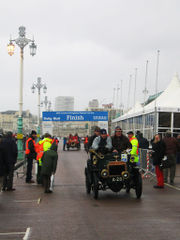
It takes place, currently, on the first Sunday in November and starts at sunrise from Hyde Park
Hyde Park, London
Hyde Park is one of the largest parks in central London, United Kingdom, and one of the Royal Parks of London, famous for its Speakers' Corner.The park is divided in two by the Serpentine...
, London
London
London is the capital city of :England and the :United Kingdom, the largest metropolitan area in the United Kingdom, and the largest urban zone in the European Union by most measures. Located on the River Thames, London has been a major settlement for two millennia, its history going back to its...
and mostly follows the A23 road
A23 road
The A23 road is a major road in the United Kingdom between London and Brighton, East Sussex. It became an arterial route following the construction of Westminster Bridge in 1750 and the consequent improvement of roads leading to the bridge south of the river by the Turnpike Trusts...
to finish at Brighton
Brighton
Brighton is the major part of the city of Brighton and Hove in East Sussex, England on the south coast of Great Britain...
– a distance of 54 miles (86.9 km). There are two official stops along the way: Crawley
Crawley
Crawley is a town and local government district with Borough status in West Sussex, England. It is south of Charing Cross, north of Brighton and Hove, and northeast of the county town of Chichester, covers an area of and had a population of 99,744 at the time of the 2001 Census.The area has...
(for coffee) and Preston Park
Preston Park, Brighton
Preston Park is a park near Preston Village in the city of Brighton and Hove, East Sussex, England. It is located in Preston Park ward to the north of the centre of Brighton, and served by the nearby Preston Park railway station....
(in a suburb of Brighton). Preston Park is the official finishing point; the cars then proceed to Madeira Drive on the seafront, also the venue for Brighton's other big motoring event, the Brighton Speed Trials
Brighton Speed Trials
The Brighton Speed Trials, in full The Brighton National Speed Trials, is commonly held to be the oldest running motor race. The first race was held July 19–22, 1905 after Sir Harry Preston persuaded Brighton town council to tarmac the surface of the road adjacent to the beach between the Palace...
.
The organisers emphasise that the event is not a race – they do not even publish the order in which cars finish, and participants are not permitted to exceed an average speed of 20 mph (8.9 m/s). Any that finish (many do not) before 16.30 are awarded a medal.
History
The first run took place on 14 November 1896, a wet Saturday. Organised by Harry J. Lawson, and named "The Emancipation Run", it was a celebration of the recently passed Locomotives on Highways Act 1896Locomotives on Highways Act 1896
The Locomotives on Highways Act 1896 removed the strict rules and UK speed limits that were included in the earlier Locomotive Acts which had greatly restricted the adoption of motorised vehicles in the United Kingdom...
, which had replaced the restrictive Locomotive Act
Locomotive Act
The Locomotive Acts were a series of Acts of Parliament in the United Kingdom to control the use of mechanically propelled vehicles on British public highways during the latter part of the 19th century...
s of 1861, 1865 and 1878 and increased the speed limit to 14 mile per hour. Since 1878 the speed limit had been 4 mph (2 m/s) in the county and 2 mph (0.89408 m/s) in the town and an escort had been required to walk 20 yards (18.3 m) ahead of the vehicle. The 1865 act had required the escort to carry a red flag at a distance of 60 yards (54.9 m).
The event started with a breakfast at the Charing Cross Hotel, which included the symbolic tearing in two by Lord Winchelsea
Murray Finch-Hatton, 12th Earl of Winchilsea
Murray Edward Gordon Finch-Hatton, 12th Earl of Winchilsea and 7th Earl of Nottingham , styled the Hon. Murray Finch-Hatton until 1887, was a British Conservative politician and agriculturalist....
of a red flag. The competitors gathered outside the Metropole Hotel, with the cars accompanied by a "flying escort" – estimated by one witness as "probably 10,000" – of pedal cyclists, recreational cycling having become popular with the English in the final decades of the 19th century. A total of 33 motorists set off from London for the coast and 17 arrived in Brighton. The first of the cars set off from London at 10.30 am and the first arrival in Brighton, by a Bollée
Léon Bollée Automobiles
Léon Bollée Automobiles was a French company founded by Léon Bollée in Le Mans to build a first vehicle called "Voiturette".The Bollée family, all car makers, created three brands:* steam vehicles, Amédée Bollée , built between 1873 and 1885....
, was timed at 2.30 pm. However, all except three of the Brighton arrivals were more than two hours after that. Two Duryea
Duryea Motor Wagon Company
The Duryea Motor Wagon Company, established in 1895, was one of the first American firms to build gasoline automobiles.Founded by Charles Duryea and his brother Frank, they built a one-cylinder "Ladies Phaeton", first demonstrated on September 21, 1893 in Springfield, Massachusetts, on Taylor...
cars participated in the run, marking the first appearance of American motor vehicles in Europe.
The run was next staged in 1927, and since then annually, with the exception of wartime years and also 1947, due to petrol rationing, making it the world's longest running motoring event. Since 1930, the event has been controlled by the Royal Automobile Club
Royal Automobile Club
The Royal Automobile Club is a private club and is not to be confused with RAC plc, a motorists' organisation, which it formerly owned.It has two club houses, one in London at 89-91 Pall Mall, and the other in the countryside at Woodcote Park, Surrey, next to the City of London Freemen's School...
.
The 1953 comedy movie Genevieve
Genevieve (film)
Genevieve is a 1953 British comedy film produced and directed by Henry Cornelius and written by William Rose. It starred John Gregson, Dinah Sheridan, Kenneth More and Kay Kendall as two couples comedically involved in a vintage automobile rally...
is set during one of these runs.
Participants
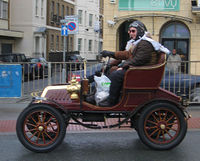
George Eyston
- References :*...
, Richard Seaman
Richard Seaman
Richard John Beattie "Dick" Seaman , was one of the greatest pre-war Grand Prix drivers from Britain....
, Kaye Don
Kaye Don
Kaye Don was a world record breaking car and speedboat racer who became a motorcycle dealer on his retirement from road racing and set up Ambassador Motorcycles.-Biography:...
, George Formby, Stirling Moss and Jochen Mass
Jochen Mass
Jochen Richard Mass is a former race car driver from Germany.He participated in 114 Formula One World Championship Grands Prix, debuting on July 14, 1973 at the British Grand Prix...
.
The 72nd anniversary run took place in 1968 and was joined by celebrity participants Prince Rainier and Princess Grace
Grace Kelly
Grace Patricia Kelly was an American actress who, in April 1956, married Rainier III, Prince of Monaco, to become Princess consort of Monaco, styled as Her Serene Highness The Princess of Monaco, and commonly referred to as Princess Grace.After embarking on an acting career in 1950, at the age of...
of Monaco
Monaco
Monaco , officially the Principality of Monaco , is a sovereign city state on the French Riviera. It is bordered on three sides by its neighbour, France, and its centre is about from Italy. Its area is with a population of 35,986 as of 2011 and is the most densely populated country in the...
, in a 1903 De Dion-Bouton
De Dion-Bouton
De Dion-Bouton was a French automobile manufacturer and railcar manufacturer operating from 1883 to 1932. The company was founded by the Marquis Jules-Albert de Dion, Georges Bouton and his brother-in-law Charles Trépardoux....
. That year Stirling Moss also participated, driving a 1903 four-cylinder Mercedes
Mercedes-Benz in motorsport
Throughout its long history, Mercedes-Benz has been involved in a range of motorsport activities, including sportscar racing and rallying, and is currently active in Formula Three, DTM and Formula One.-Early history:...
.
Some participants dress up in a late Victorian
Victorian fashion
Victorian fashion comprises the various fashions and trends in British culture that emerged and grew in province throughout the Victorian era and the reign of Queen Victoria, a period which would last from June 1837 to January 1901. Covering nearly two thirds of the 19th century, the 63 year reign...
or Edwardian
Edwardian period
The Edwardian era or Edwardian period in the United Kingdom is the period covering the reign of King Edward VII, 1901 to 1910.The death of Queen Victoria in January 1901 and the succession of her son Edward marked the end of the Victorian era...
style of clothing. In 1971 Queen Elizabeth II
Elizabeth II of the United Kingdom
Elizabeth II is the constitutional monarch of 16 sovereign states known as the Commonwealth realms: the United Kingdom, Canada, Australia, New Zealand, Jamaica, Barbados, the Bahamas, Grenada, Papua New Guinea, the Solomon Islands, Tuvalu, Saint Lucia, Saint Vincent and the Grenadines, Belize,...
was a passenger in a 1900 Daimler. A regular participant is Prince Michael of Kent
Prince Michael of Kent
Prince Michael of Kent is a grandson of King George V and Queen Mary, making him a cousin of Queen Elizabeth II. He is also the first cousin once removed of Prince Phillip. Prince Michael occasionally carries out royal duties representing the Queen at some functions in Commonwealth realms outside...
.
RAC Brighton to London Future Car Challenge
In 2010 the RAC launched the Brighton to London Future Car Challenge, following the same route as the veteran car run, but starting in Brighton and finishing at Regent Street, London – and taking place of the day prior to the veteran run. The event is intended to showcase low energy impact vehicles of various technologies – Electric, Hybrid and Low-Emission ICE (Internal Combustion Engine). Participants compete to minimise energy consumption using "road legal" vehicles in "real world" conditions.The results of the inaugural 2010 event showed that the electric vehicles used the least energy (1.68 MJ/km on average, or 141 Imperial miles per gallon petrol equivalent), compared to the hybrid vehicles (1.14 MJ/km average, 76 Imperial mpg petrol equivalent) and the largely diesel powered internal combustion engine vehicles (1.68 MJ/km average, 52 Imperial mpg petrol equivalent).
External links
- Official website
- LBVCR 2010 Information
- Veteran Car Club of Great Britain's page about LBVCR
- Cuckfield Companion's page about LBVCR
- Sponsor Renault Sport's page about LBVCR
- 1950s cine film (no sound)
- London to Brighton Veteran Car Run (LBVCR) flickr.com group
- Future Car Challenge website
- LBVCR Press Release relating to Historic Electric Vehicles