
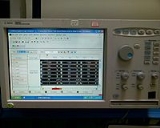
A
logic analyzer is an electronic instrument which displays signals in a
digital circuitDigital electronics represent signals by discrete bands of analog levels, rather than by a continuous range. All levels within a band represent the same signal state...
. A logic analyzer may convert the captured data into timing diagrams, protocol decodes, state machine traces,
assembly languageAn assembly language is a low-level programming language for computers, microprocessors, microcontrollers, and other programmable devices. It implements a symbolic representation of the machine codes and other constants needed to program a given CPU architecture...
, or correlate assembly with source-level software.
Presently, there are three distinct categories of logic analyzers available on the market:
- The first is mainframes, which consist of a chassis containing the display, controls, control computer, and multiple slots into which the actual data-capturing hardware is installed.
- The second category is standalone units, which integrate everything into a single package, with options installed at the factory.
- The third category is PC-based logic analyzers. The hardware connects to a computer through a USB or Ethernet
Ethernet is a family of computer networking technologies for local area networks commercially introduced in 1980. Standardized in IEEE 802.3, Ethernet has largely replaced competing wired LAN technologies....
connection, and then relays the captured signals to the software on the computer. These devices are typically much smaller and less expensive, because they do not need dedicated displays or hardware input, such as keyboards or knobs.
Mixed-signal oscilloscopes combine the functionality of a digital storage oscilloscope with a logic analyzer. The several benefits of these include the ability to view analog and digital signals together in time, and to trigger on either digital or analog signals and capture on the other.
Operation
A logic analyzer may be triggered on a complicated sequence of digital events, and then capture a large amount of digital data from the
system under testSystem under test refers to a system that is being tested for correct operation. The term is used mostly in software testing.A special case of a software system is an application which, when tested, is called an application under test....
(SUT).
When logic analyzers first came into use, it was common to attach several hundred "clips" to a digital system. Later, specialized connectors came into use. The evolution of logic analyzer probes has led to a common footprint that multiple vendors support, which provides added freedom to end users. Introduced in April, 2002, connectorless technology (identified by several vendor-specific trade names: Compression Probing; Soft Touch; D-Max) has become popular. These probes provide a durable, reliable mechanical and electrical connection between the probe and the circuit board with less than 0.5 to 0.7 pF loading per signal.
Once the probes are connected, the user programs the analyzer with the names of each signal, and can group several signals together for easier manipulation. Next, a capture mode is chosen, either "timing" mode, where the input signals are sampled at regular intervals based on an internal or external clock source, or "state" mode, where one or more of the signals are defined as "clocks", and data are taken on the rising or falling edges of these clocks, optionally using other signals to qualify these clocks.
After the mode is chosen, a
trigger condition must be set. A trigger condition can range from simple (such as triggering on a rising or falling edge of a single signal) to the very complex (such as configuring the analyzer to decode the higher levels of the TCP/IP stack and triggering on a certain HTTP packet).
At this point, the user sets the analyzer to "run" mode, either triggering once, or repeatedly triggering.
Once the data are captured, they can be displayed several ways, from the simple (showing waveforms or state listings) to the complex (showing decoded Ethernet protocol traffic). Some analyzers can also operate in a "compare" mode, where they compare each captured
data setA data set is a collection of data, usually presented in tabular form. Each column represents a particular variable. Each row corresponds to a given member of the data set in question. Its values for each of the variables, such as height and weight of an object or values of random numbers. Each...
to a previously recorded data set, and halt capture or visually notify the operator when this data set is either matched or not. This is useful for long-term empirical testing. Recent analyzers can even be set to email a copy of the test data to the engineer on a successful trigger.
Uses
Many digital designs, including those of
ICAn integrated circuit or monolithic integrated circuit is an electronic circuit manufactured by the patterned diffusion of trace elements into the surface of a thin substrate of semiconductor material...
s, are simulated to detect defects before the unit is constructed. The simulation usually provides logic analysis displays. Often, complex discrete logic is verified by simulating inputs and testing outputs using
boundary scanBoundary scan is a method for testing interconnects on printed circuit boards or sub-blocks inside an integrated circuit. Boundary scan is also widely used as a debugging method to watch integrated circuit pin states, measure voltage, or analyze sub-blocks inside an integrated circuit.The Joint...
. Logic analyzers can uncover hardware defects that are not found in simulation. These problems are typically too difficult to model in simulation, or too time consuming to simulate and often cross multiple clock domains.
Field-programmable gate arrayA field-programmable gate array is an integrated circuit designed to be configured by the customer or designer after manufacturing—hence "field-programmable"...
s have become a common measurement point for logic analyzers.