

Little People

Encyclopedia
Little People is a toy brand for preschoolers, originally produced by Fisher-Price
Fisher-Price
Fisher-Price is a company that produces toys for infants and children, headquartered in East Aurora, New York. Fisher-Price has been a wholly owned subsidiary of Mattel since 1993.-History:...
in the 1960s as the Play Family. The current product line consists of playsets, mini-sets and accessories, books, CDs, and DVDs focusing on various configurations of five characters named Eddie, Sarah Lynn, Maggie, Michael and Sonya Lee.
The "Little People" name, registered and trademarked by Fisher-Price in 1985, came from Fisher-Price
Fisher-Price
Fisher-Price is a company that produces toys for infants and children, headquartered in East Aurora, New York. Fisher-Price has been a wholly owned subsidiary of Mattel since 1993.-History:...
following the lead of consumers who referred to the early Play Family playsets as "those little people"
Original Little People
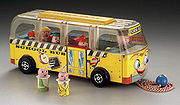
Another early Little People precursor, the "Safety School Bus", was introduced in 1959. The set included a school bus together with six independent figures made out of tall skinny pegs of cardboard tubes wrapped in lithographs simulating clothes. The toy gained instant popularity and other sets soon came out.

Little People Play Family
In 1960, Fisher-Price introduced two additional toys with removable figures; "Snorky the Fire Engine" and the "Nifty Station Wagon". The Nifty Station Wagon came with two adult figures and one child figure, thus the first "Play Family" was born. Today, the Play Family name is still used throughout Europe instead of the name "Little People". A Nifty Station Wagon in mint condition, in the box, could command up to $600 among toy collectors.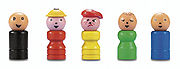
Body Style Variations
The original Little People went through six major styles of body (base) configurations, and even within each major classification there may be one or more minor style variations. By 1961, the figures were produced with wood; plastic was used for their vehicles and buildings. A few years later, the typical happy face of the traditional Little People debuted in a "straight-body" format. All of the people had a basic cylinder body with the female figures only identifiable by the addition of slanted, oval eyes and eyelashes. By 1965, the Little People consisted of a small cylindrical base and a wider cylinder shape for boys and men and a conical upper shape for the girls. Adult women had a kind of hourglass-shaped upper body.Little People Playsets
In 1968, Fisher-Price introduced the first Little People playset, the famous Play Family Barn with barn doors that made a "moo" sound when opened. Also at this time, the figures were made with plastic bodies instead of wood. Eventually, the toys encompassed a wide range of playsets, furniture packs, and accessory packs.In the middle 1970s, Fisher-Price produced the Sesame Street
Sesame Street
Sesame Street has undergone significant changes in its history. According to writer Michael Davis, by the mid-1970s the show had become "an American institution". The cast and crew expanded during this time, including the hiring of women in the crew and additional minorities in the cast. The...
town, with various Sesame Street stores, a bridge with stop lights and Sesame Street characters such as Bert, Ernie, and the only Little People toys that have been modeled after celebrities -- Loretta Long
Loretta Long
Loretta Long is an American actress best known for playing Susan Robinson on Sesame Street, having starred on the show since its debut in 1969....
(Susan), Roscoe Orman
Roscoe Orman
Roscoe Hunter Orman is an American actor who plays Gordon Robinson on the television program Sesame Street. Orman joined the show in 1973, taking over as the third actor to play Gordon on the show...
(Gordon) and Will Lee
Will Lee
Will Lee was an American actor best known for playing the store proprietor Mr. Hooper on Sesame Street, from the show's debut in 1969 until his death in 1982.-Early career:...
(Mr. Hooper
Mr. Hooper
Harold Hooper was a character on Sesame Street, played by Will Lee, who was the original proprietor of Mr. Hooper's Store, which still retains his name.-Biography:...
). Soon after, the Little People Discovery Airport, a hospital and a school would also be released. Little People characters had by then been also produced with plastic products exclusively.
Chunky Little People
In 1991, the Original Little People figures were redesigned for younger children. They were made "chunkier", were more bright and colorful, and were designed so that they could activate motion within the play sets. Most people believe that these figures were developed as a replacement for the original Little People due to the increasing concerns and pressures from parents and consumer-advocacy groups for safer toy designs. A book published in 1986 by Edward Swartz titled Toys That Kill prominently featured a trio of original Little People figures on the cover. After Fisher-Price was bought by MattelMattel
Mattel, Inc. is the world's largest toy company based on revenue. The products it produces include Fisher Price, Barbie dolls, Hot Wheels and Matchbox toys, Masters of the Universe, American Girl dolls, board games, and, in the early 1980s, video game consoles. The company's name is derived from...
in the 1990s, Little People reappeared on the markets, their figure significantly larger in size from the original Little People characters due to revised toy safety guidelines. These figures are called "chunky" by collectors.
Articulated Little People
In 1997, the figures underwent another redesign. Little People became much more detailed and smaller in overall size – in fact, closer in size to the original Little People. For the first time, the Little People figures had arms, hands, more detailed clothing, molded hair and facial features.In 1999, Little People celebrated their 40th birthday with the reintroduction of the first Little People toy ever: Little People School Bus and characters. The play sets include the school bus, circus train, construction vehicles and other play sets.
In 2000, Little People toys became even more lifelike with the introduction of electronic sounds and movement. The Little People characters were given their own distinct personalities and voices in a series of claymation video and DVD series, with Aaron Neville
Aaron Neville
Aaron Neville is an American soul and R&B singer and musician. He has had four top-20 hits in the United States along with four platinum-certified albums...
singing the theme song.
Little People A to Z Learning Zoo
In 2007, Little People produced the A to Z learning zoo. This production introduced animals to the Little People family. The A to Z learning zoo includes 26 animals that each begin with a different letter of the alphabet. This interactive play mat allows children to learn the alphabet, recognize letters, and learn facts about animals. This was a huge step for the company because now education is infused in their product.Funding
- Viewers Like You
- Corporation for Public BroadcastingCorporation for Public BroadcastingThe Corporation for Public Broadcasting is a non-profit corporation created by an act of the United States Congress, funded by the United States’ federal government to promote public broadcasting...
- Chuck E Cheese's
- The Arthur Vining Davis FoundationsThe Arthur Vining Davis FoundationsThe Arthur Vining Davis Foundations are a group of charitable foundations established by American industrialist Arthur Vining Davis, onetime Alcoa president and Florida land developer.-History:...
- McDonald'sMcDonald'sMcDonald's Corporation is the world's largest chain of hamburger fast food restaurants, serving around 64 million customers daily in 119 countries. Headquartered in the United States, the company began in 1940 as a barbecue restaurant operated by the eponymous Richard and Maurice McDonald; in 1948...
- Burger KingBurger KingBurger King, often abbreviated as BK, is a global chain of hamburger fast food restaurants headquartered in unincorporated Miami-Dade County, Florida, United States. The company began in 1953 as Insta-Burger King, a Jacksonville, Florida-based restaurant chain...
- The Carngie Company for New York
- Nickelodeon Hotel
Sources
- This Old Toy's Original "Little People History"
- Behold the Little People - The Life and Death of America's Favorite Play Family by Mark Simple, in X magazine #7, July 1991)
- History of Mattel
- Fisher-Price Little People at Retroland
External links
- Official Little People Website
- Little People TV show website on Treehouse TV
- · Little People Kid’s Clubhouse Games & Activities
- Interview with Bob Jourdian, Director of Product Development at Fisher Price about the history and evolution of the Little People.